
Economy
Women May Need to Make Extra Financial Moves
PASADENA JOURNAL — International Women’s Day will be observed on March 8.


By Arnetta Tolley, Edward Jones Financial Advisor
International Women’s Day will be observed on March 8. Around the world, special events will celebrate the cultural, social, political and economic achievements of women. However, this last area – economic progress – is one that still causes concern, and rightfully so, because women still face gender-related challenges. How can you deal with them?

Arnetta Tolley
To begin with, you need to recognize the nature of these challenges. While many factors are actually responsible for women facing more economic pressure than men, two stand out in particular:
- Gender wage gap – It’s still around, despite some progress toward equality. The U.S. Census Bureau has found that full-time, year-round working women earn about 80% of what their male counterparts earn. Other studies show a slightly smaller gap.
- Caregiving responsibilities – Women typically take more time away from the workforce than men, both to raise children and then, later in life, to take care of aging parents. These absences can result in lost wages, lower Social Security benefits and fewer contributions to 401(k) and similar retirement plans.
So, given these realities, what can you do to improve your own financial outlook? Here are a few suggestions:
- Increase your contributions to your retirement plan. Every time your salary goes up, increase the amount you contribute to your 401(k) or similar retirement plan. At a minimum, put in enough to earn your employer’s match, if one is offered. These plans offer potential tax-deferred earnings, and since your contributions are typically made with pre-tax dollars, the more you put in, the lower your taxable income.
- Invest for growth. Some studies show that men may invest more aggressively than women – though not necessarily more successfully. However, while you do need to invest wisely, you can’t ignore the need for growth. Consequently, you should consider including a reasonable percentage of growth-oriented investments in your retirement and other investment accounts, with the precise amount depending on your individual goals, risk tolerance and time horizon.
- Look for income even while serving as caregiver. Of course, you may never become the primary caregiver for your elderly parents – but even if you do, it doesn’t necessarily follow that you must forego all earned income. If it’s possible, you could seek to go part-time at your current job, or request some type of telecommuting arrangement. And as long as you have some earned income, from somewhere, you can still contribute to an IRA.
- Manage retirement plan withdrawals carefully. Once you’re retired, possibly to become a full-time caregiver, you can take penalty-free – though still taxable – withdrawals from your 401(k) as early as age 55, provided you meet certain conditions. Once you’re 59-1/2, you can take penalty-free withdrawals from a traditional IRA, though the money will be taxable. While you can withdraw contributions you made to a Roth IRA at any time, tax- and penalty-free, you’ll have to wait until 59-1/2 to take out your earnings free of taxes and penalties. And you’ll need to fi nd a sustainable withdrawal rate so you can reduce the risk of depleting these accounts too early.
As a society, we are still working toward equality for all people – including economic equality. As a woman, however, you can’t afford to wait until that day arrives, so you need to be proactive in seeking and maintaining your financial security.
[Arnetta Tolley, Financial Advisor, Edward Jones 626-744-2740 or [email protected]]
This article originally appeared in The Pasadena Journal.










Black History
Columbus’s Oldest Businesses Still Open: 10 That Have Lasted 75+ Years
COLUMBUS TIMES — Columbus, Georgia, traces its commercial roots to the early 19th century, when the Chattahoochee River and local cotton mills fueled a burgeoning regional economy. While the city has transformed into a modern hub for banking and manufacturing, a select group of businesses and institutions have managed to survive for more than 75 years.
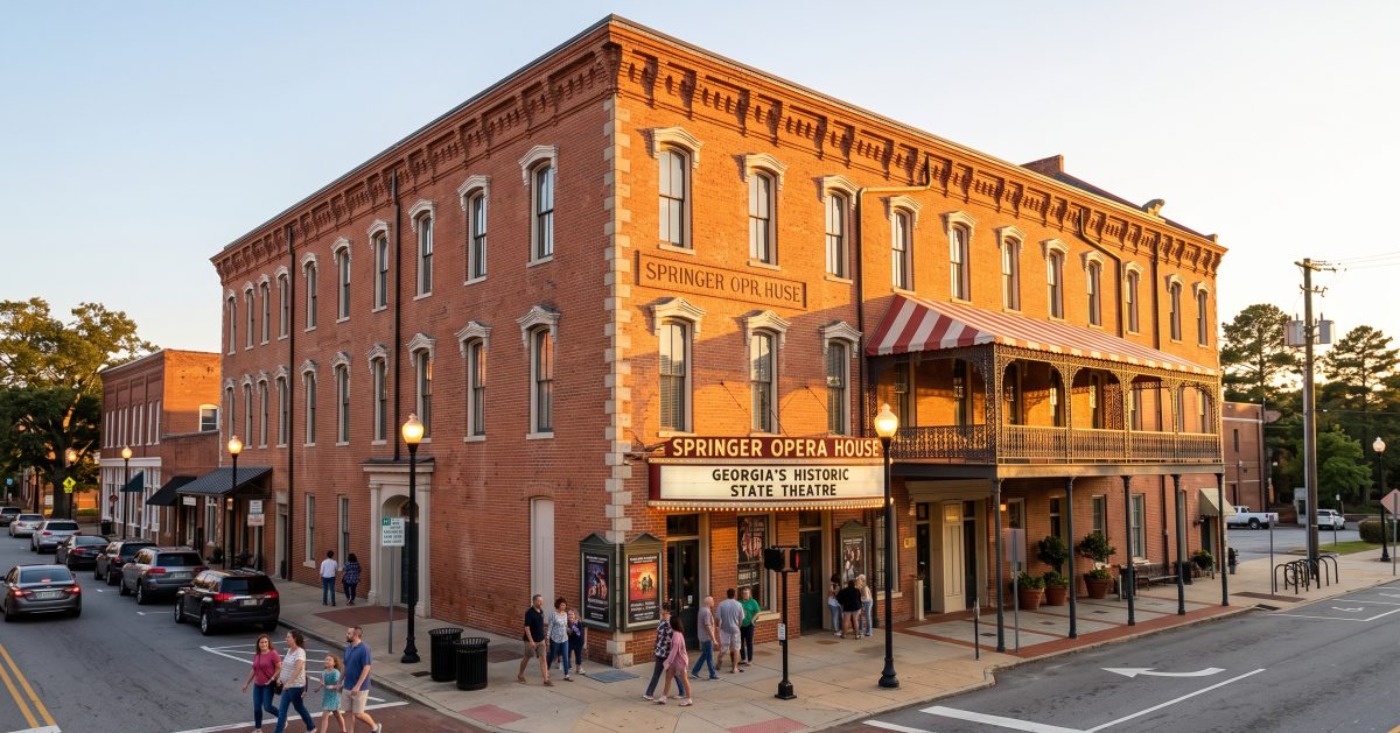
The historic Springer Opera House in downtown Columbus, Georgia, opened in 1871 and stands as one of the city’s oldest surviving cultural institutions.
Some Columbus businesses have been around longer than the automobiles, shopping centers and neighborhoods that now surround them. A handful date back to the 1800s, when cotton mills powered the local economy and the Chattahoochee River carried goods between communities. Others survived the Great Depression, two world wars, economic downturns and decades of changing consumer habits.
While hundreds of businesses have opened and closed across Columbus over the generations, these 10 have histories stretching back at least 75 years. Some remain family-owned, while others have survived mergers, ownership changes or major transformations. Together, their histories tell the story of how Columbus grew from a riverfront trading town into a regional center for banking, manufacturing, commerce and culture.
This list includes businesses, commercial institutions and their surviving successors with documented Columbus roots before 1951. It is not a definitive ranking of every surviving business, and several entries have changed ownership, names or operating models over time.
1. Columbus Ledger-Enquirer — 1828 (198 Years)
One of Columbus’s oldest surviving commercial institutions is its longtime newspaper, the Columbus Ledger-Enquirer. Its history began in 1828 with the founding of the Columbus Enquirer, the same year Columbus was established. The Columbus Ledger followed in 1886, and the two newspapers eventually became a single publication in 1988.
Over nearly two centuries, the newspaper has documented wars, elections, industrial expansion, economic downturns and major changes throughout the Chattahoochee Valley. Its ownership changed again in July 2026, when the Georgia Trust for Local News purchased the Ledger-Enquirer from McClatchy. The newspaper continues operating, although the modern publication is the product of mergers and transformations rather than an unchanged business established in 1828.
2. Willcox-Lumpkin Co. — 1848 (178 Years)
Insurance agency Willcox-Lumpkin traces its history to 1848, making it one of Columbus’s oldest documented commercial enterprises. Historical city directories identify the business as an insurance agency that protected homes, businesses and property long before automobiles became common. The company remained associated with generations of the Willcox and Lumpkin families.
Its history is supported by advertisements appearing in Columbus directories more than a century ago. Georgia Secretary of State records currently list Willcox-Lumpkin Co. as active and in compliance, with its corporate registration dating to December 1923. That distinction matters because the business’s claimed operating history is considerably older than its present corporate registration.
3. Springer Opera House — 1871 (155 Years)
The Springer Opera House opened in 1871 and became one of the city’s most important entertainment destinations. Built by businessman Francis Joseph Springer, the theater attracted nationally recognized performers and helped establish Columbus as a cultural center. Its ornate Victorian architecture remains one of downtown’s most recognizable landmarks.
The Springer nearly disappeared during the 1960s after declining attendance and years of deterioration. Preservationists rescued the building, and theatrical performances returned in 1965. Although it has not operated continuously in the same form, the Springer remains an active performing arts institution and an example of how historic properties can find new economic life.
4. Schomburg’s Jewelers — 1872 (154 Years)
Few Columbus retailers can claim a family history as long as Schomburg’s Jewelers. Carl Frederick Schomburg established the jewelry business in 1872 after working as a clockmaker, and the company gradually expanded into watches, jewelry and other luxury goods. Five generations of the family have been associated with the business.
Today, Schomburg’s operates on Rollins Way and identifies itself as Georgia’s oldest fifth-generation jeweler. Its longevity reflects a business model built around specialized craftsmanship, customer relationships and family continuity. While many traditional jewelry stores have disappeared or become part of national chains, Schomburg’s has maintained a recognizable local identity.
5. Goldens’ Foundry & Machine Co. — 1882 (144 Years)
Two brothers, Theodore and J. Poitevent Golden, established Goldens’ Foundry & Machine Co. in 1882. The company began as a small foundry and machine shop during an era when Columbus was expanding rapidly as a manufacturing center. Its products helped supply the machinery and industrial equipment needed by businesses throughout the region.
More than 140 years later, the business remains associated with descendants of its founders. Goldens’ continues manufacturing industrial castings while also developing consumer products through its Goldens’ Cast Iron brand. Its survival is especially significant because many of the textile mills and industrial operations that helped create its original market have long since closed.
6. W.C. Bradley Co. — 1885 (141 Years)
The W.C. Bradley Co. traces its origins to 1885, when William Clark Bradley entered the cotton business in Columbus. Over time, his growing enterprise expanded into groceries, fertilizer, transportation, manufacturing and financial services. The company eventually became one of the most influential business organizations in the Chattahoochee Valley.
Its business interests helped shape the development of modern Columbus, including the city’s banking and manufacturing sectors. The company also became closely associated with Char-Broil, the nationally recognized outdoor cooking brand. Today, W.C. Bradley Co. maintains its corporate headquarters near the Chattahoochee River, continuing a business legacy that began when cotton dominated the regional economy.
7. Synovus Banking Legacy — 1888 (138 Years)
The banking institution that became Synovus began in 1888 with the establishment of two Columbus banks. According to company history, the idea developed partly from the need to provide textile workers with a safe place to keep their earnings. Those early banking operations eventually evolved into Columbus Bank and Trust and later Synovus Financial Corporation.
A major change occurred in January 2026 when Synovus merged with Pinnacle Financial Partners, ending its existence as an independent corporation. The combined organization continues serving Columbus customers under the Synovus name during the transition to Pinnacle branding, which is scheduled for 2027. Pinnacle also announced plans in June to expand its downtown Columbus workspace, reinforcing the city’s continued importance to the banking operation.
8. Dinglewood Pharmacy — 1918 (108 Years)
Dinglewood Pharmacy opened on November 13, 1918, and became one of Columbus’s most recognizable neighborhood businesses. While generations of customers have visited for prescriptions and pharmacy services, the business is equally famous for its traditional lunch counter. Its signature scrambled dog has become closely associated with Columbus food culture.
The pharmacy celebrated its centennial in 2018, an achievement relatively few independent neighborhood businesses reach. Its ability to combine traditional pharmacy services with a popular local dining experience has helped preserve its reputation across generations. Dinglewood remains an especially visible example of a business whose appeal extends well beyond the original service it was established to provide.
9. Striffler-Hamby Mortuary — 1923 (103 Years)
Striffler-Hamby Mortuary traces its business history to 1923, when David Abraham Striffler opened his own funeral establishment in downtown Columbus. Striffler had entered the local funeral industry in 1908 before eventually establishing an independent operation. In 1930, he moved the business into a building constructed specifically for funeral services.
The mortuary became an established name as generations of Columbus families turned to it for funeral arrangements. Today, the business operates as part of the Dignity Memorial network, showing how a longstanding local institution can continue under different corporate ownership. Its history also offers a look at how funeral services evolved from small undertaking establishments into modern funeral homes.
10. WRCG Radio, Originally WRBL — 1928 (98 Years)
Columbus entered the broadcasting era on May 10, 1928, when WRBL began transmitting radio programs to local listeners. The station was established through the efforts of early radio pioneer Bill Lewis and became the city’s first radio broadcasting operation. Its original programming helped bring news, entertainment and live events into Columbus homes.
The station eventually changed ownership, frequencies and call letters, becoming WRCG in 1977. Historical research by Columbus State University and Historic Columbus confirms the connection between the original WRBL radio operation and its later identity. Today, WRCG represents a surviving broadcasting legacy that predates television’s arrival in Columbus by approximately 25 years.
What These Businesses Reveal About Columbus
The survival of these institutions reflects the major industries that shaped Columbus over nearly two centuries. Banking, manufacturing, retail, insurance, entertainment and communications all played important roles in the city’s economic development. Several businesses adapted to changing markets, while others survived by maintaining relationships with generations of local customers.
Their histories also demonstrate that longevity does not necessarily mean remaining unchanged. Some businesses were acquired by larger corporations, others moved into new industries, and several preserved their names despite major changes in ownership. For Columbus residents, these institutions provide a tangible connection to the city’s past while continuing to influence its economic and cultural identity.
Source: Historic Columbus Foundation; Columbus State University Archives and Special Collections; Georgia Historical Society; New Georgia Encyclopedia;
Based on reporting by Columbus Times.
Black Press
Lawyer-Turned-Contractor Hones Focus on Redeveloping Properties for Housing
BAY STATE BANNER — Donald Donnalson spent his childhood summers assisting his stepfather with contractor work, a job he initially disliked and vowed to never pursue professionally. After earning degrees from Boston College and Northeastern University Law School, Donnalson practiced law for several years before a return to contracting reignited his interest in the field. In 2011, he launched Beantown Builders, Inc.

Banner Business Sponsored by The Ujima Project
At a young age, Donald Donnalson helped his stepfather with contractor work during his summers off. He always hated it back then and vowed to never go into the profession.
After earning degrees from Boston College and Northeastern University Law School, he practiced law for a number of years. But when his stepfather asked for help with contracting as an adult, Donnalson “caught the bug.” He launched Beantown Builders, Inc. in 2011, which now focuses on housing builds including multifamily conversions, redevelopment of underutilized properties, and accessory dwelling units throughout Greater Boston and eastern Massachusetts.
“There are a lot of contractors in Massachusetts, and discovering what your niche is — for any entrepreneur, but especially in this industry — is super important,” he said, adding that their housing niche is important for its impact on the community.
“Greater Boston faces significant housing affordability and availability challenges, and we think that existing properties represent an opportunity to create additional housing without always requiring entirely new developments,” he said.
Donnalson started his company with incredible personal investment. He left his role as a finance manager for Audi Natick and liquidated his 401k to jumpstart the business.
“I basically just bet on myself. I didn’t have a project. I didn’t have anything. I was just like, I’m gonna go do this because if I don’t do it now, I’m never gonna do it,” he explained.
Today his minority-owned business is addressing the need for more housing while helping dispel broader distrust of contractors.
“Seeing a company like ours in the community that’s willing to learn more, do more, take on these experiences, and fill the gap where there seems like there’s not enough of us around is a big help,” he said, later adding that, “as an MBE [Minority Business Enterprise], we’re focused on building more than a successful construction company. We’re developing the people, systems and capabilities to take on increasingly complex projects while contributing to housing opportunities, economic development and the communities we serve.”
For Director of Marketing Alicia Zuniga, their mission helps guide the work and build trust with customers. Beantown’s clients are a mix of homeowners, families and property investors.
The team “understands construction is about much more than buildings. Behind every project are people with goals, expectations and important decisions to make,” Zuniga said.
Donnalson said one of the biggest obstacles he currently faces is attracting and keeping the best talent to help on projects, which have taken the team as far south as Fall River and North Attleboro and as far north as Lynn.
They recently supported The Guild nonprofit in constructing a community-oriented urban space, turning a hillside into public green space with paths and areas to gather. Landscape architects at Landworks Studio designed the urban forest project while Beantown supported the build, including masonry and permeable paving.
“Projects like this reflect our belief that construction can do more than improve individual properties; it can also contribute to the neighborhoods and communities around them,” Donnalson said
Based on reporting by Bay State Banner.
Black Press
Black Household Wealth Plummeted 25% in Three Years, New Data Shows
MICHIGAN CHRONICLE — A new analysis of Federal Reserve data reveals that median wealth for Black households dropped 25% between 2022 and 2025, falling from $49,100 to $36,800. This decline occurred while White, Hispanic, and Asian households experienced increases in their median net worth, further widening the national racial wealth gap.

Median wealth among Black households fell 25% between 2022 and 2025, widening the racial wealth gap even as White, Hispanic, and Asian households saw their median net worth increase, according to a new analysis of Federal Reserve data.
Center for Economic and Policy Research (CEPR) director of race and economic justice, Algernon Austin, shared in an analysis published Tuesday (October 13) that median wealth among Black households fell from $49,100 in 2022 to $36,800 in 2025, a 25% decline.
In comparison, median wealth reached $332,100 for White households, $79,600 for Hispanic households, and $677,600 for Asian households in 2025, according to CEPR.
While Black households lost wealth, these groups saw their median wealth increase between 2022 and 2025. In 2025, Black households’ median wealth was $179,100 below the national median, up from a $162,000 gap in 2022.
Austin’s analysis suggests declining home, vehicle, and retirement account values contributed to the drop. The share of Black households with nonfinancial assets also declined from 81% to 78.4%.
The findings come as broader household wealth gains slowed and financial strain increased.Reuters reported earlier this month that the Federal Reserve’s latest Survey of Consumer Finances found the share of families spending at least 40% of their income on debt payments rose from 6.5% in 2022 to 8.6% in 2025.
The latest findings add to longstanding concerns about the racial wealth gap. A 2017 report by Prosperity Now and the Institute for Policy Studies projected that median Black household wealth could reach zero by 2053 if existing trends continued, raising questions about the long-term financial security of Black families.
That figure was a projection based on trends at the time, not a confirmed outcome.
The Black Information Network is your source for Black News! Get the latest news 24/7 on The Black Information Network. Listen now on the iHeartRadio app or click HEREto tune in live.
Based on reporting by Michigan Chronicle.
Art
Kickstarter CEO Everette Taylor Shares Tips on Creating and Growing a Business
HOWARD UNIVERSITY NEWS SERVICE — Everette Taylor, the CEO of the global crowdfunding platform Kickstarter, recently visited Howard University to serve as the inaugural guest for the Cathy Hughes School of Communications’ new speaker series. Addressing students at the Founders Library, Taylor emphasized that the future of business belongs to those who are bold enough to take risks.
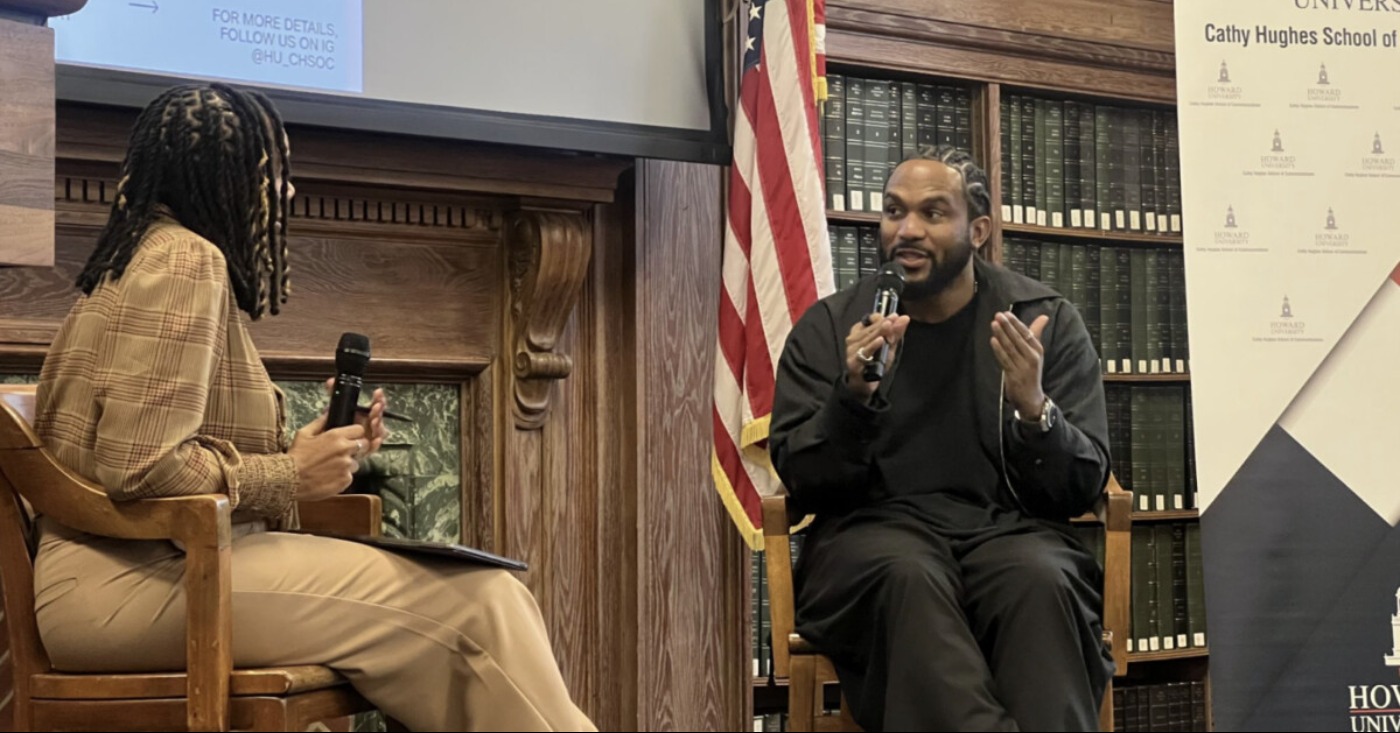
WASHINGTON (HUNS) — “The future belongs to creators who are bold,” Everette Taylor, CEO of crowdfunding platform Kickstarter, told students at Howard University during a recent visit.
As Taylor discussed his journey, he tested the boldness of students by inviting them to share their ideas during an impromptu pitch session at the Cathy Hughes School of Communications’ new speaker series in the Browsing Room of Founders Library. The inaugural speaker then shocked one group of students by pledging to invest in their thesis film, paying forward the opportunities that have lifted him as he struggled to pursue his dreams.
Taylor grew up in a low-income neighborhood in Richmond, Virginia, where he frequently encountered gang violence and drug dealing amid periods of homelessness.
Not feeling as if he conformed to conventional ideas of success, he eventually found inspiration in Jay-Z who balanced being an artist and an entrepreneur. Similarly, Taylor carved his own route, launching and growing various businesses.
He gained enough recognition to land on the 2018 Forbes’ 30 Under 30 list in marketing and advertising. In 2022, Forbes also named him as one of the top 50 most entrepreneurial CMOs when he was chief marketing officer of Artsy, an online art gallery and marketplace. That same year he took over Kickstarter, and the company reported a year-over-year revenue increase of 50% in the first quarter of 2026.
Taylor encouraged the audience through his story, but he also gave practical advice to help students who share his zeal to create and grow their business.
He explained that his mentor, Artsy CEO Mike Steib, helped him make the transition from being a CMO to becoming CEO at Kickstarter.
“These opportunities I don’t take for granted,” Taylor said, adding that Steib was “the first leader I had to take me under his wing.”
When he began his position at Kickstarter, Taylor said, “I had zero imposter syndrome, because I felt like I was ready for it, and it was because this person invested in me over the past few years.”
“A lot of my journey was me just hustling and being bold enough to ask for what I want, but I also need people to give me an opportunity.”
This idea of giving people opportunity impacts his business philosophy, as Taylor estimates that the number of African American employees grew exponentially since he’s been in leadership.
“Kickstarter was I think less than 2% Black, and at our peak I had gotten it to 20-something percent Black,” Taylor said.
Even then, Taylor also saw a need for representing other perspectives. “We still serve people globally, so we need people from different countries and cultures,” he said. “If you’re building a global company, it’s important to build a diverse base of people.”
“I always want to impact more lives, and that always leads to more results.”
Everette Taylor, CEO of Kickstarter
With the success Taylor had after becoming CEO of Kickstarter, he also found a need to prioritize his health.
“This is the first year that I’ve started the year with zero business goals,” he said. “For the first time, my goals have been centered around my health.”
He cites the illness of a friend who appeared to be healthy. Seeing his friend, who is also a successful entrepreneur, endure illness pushed him to prioritize his health.
“Business, I can do that in my sleep, but for me right now I’m so much more focused on setting goals for myself, and I know that’s going to impact the work that I do by feeling healthier and being a better version of myself.”
Samantha Housen, a sophomore public relations major and interior design minor from Harlem, attended the event to gain knowledge to grow her non-profit and for-profit businesses.
“I’m here because I want to explore more of the details of entrepreneurship from an actual professional,” Housen said, and to “see how his mindset could help me in my entrepreneurship.”
“My biggest takeaway is that I’m bold, and it’s OK to be bold,” she said. “I very much have the authority to do whatever I seek to do.”
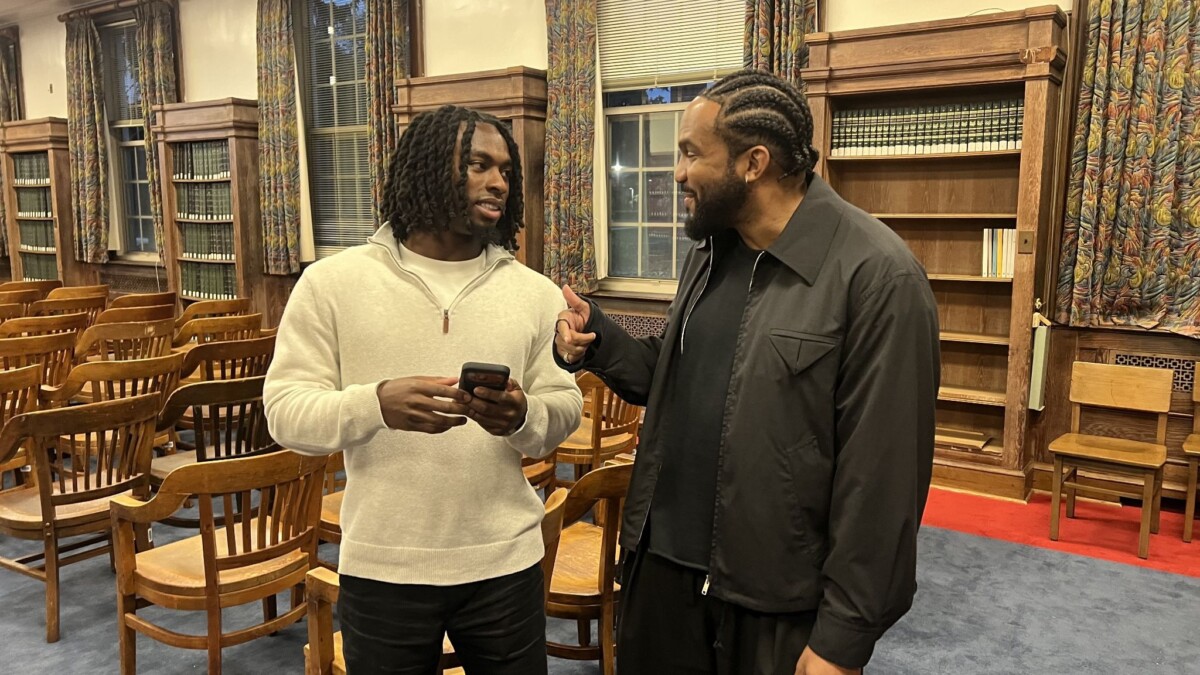
Kimberly Moffitt, Ph.D., dean of the Cathy Hughes School of Communications and host of the event, said she was excited about the speaker series.
“It’s because of students,” Moffitt said. “They felt like they weren’t hearing enough from people who are already post-graduation and successful. They wanted to hear those voices. So, this is an opportunity for me to bring folks to campus so they could reach out, talk and interact with folks that they aspire to be like or will be inspired by.”
Moffitt was excited for students to see someone who looked like them and carried themselves authentically in a position of high acclaim.
“He is showing you a different path, and letting you know that it’s OK to be who you are and show up in that space and not have to apologize,” Moffitt said of Taylor.
Moffitt also wants to encourage students to make the most of the speaker series. She gives details on upcoming speakers and the importance of hearing these people tell their stories.
“Those of you who want to be in TV and film, those jobs are different now,” she said. “You have to hustle in a different way.”
“I need our students to think about entrepreneurship in all that they do,” Moffitt added. “I want students to leave with that so that they have it in their back pocket should they need to draw on it.”
After the event. Taylor explained why boldness is essential to his success at Kickstarter.
“It’s for the grind and the ambition — not settling for status quo and mediocrity, and really going for it,” he said. “I always want to impact more lives, and that always leads to more results.”
Solomon Goins is a reporter for HUNewsService.com.
Based on reporting by Howard University News Service.
Black Press
OP-ED: She’s Not Non-Compliant, She’s Hungry: Addressing Food Justice to Improve Breast Cancer Outcomes
CHICAGO DEFENDER — Food insecurity in Chicago’s South Side and surrounding suburbs disproportionately affects Black women with breast cancer, impacting their treatment and recovery.
Here’s a transformational idea: everyone should have access to safe, healthy and affordable food.
If this idea doesn’t feel radical to you, then perhaps you haven’t spent much time in the Southside of Chicago and its adjoining suburbs.
Food insecurity is rampant in our neighborhoods. If you live in Washington Heights, you are practically guaranteed to experience lower food access than the average Chicagoan – with similar circumstances in the South Shore, West Englewood or West Pullman.
It has been clearly documented that “Food is Medicine.” In fact, according to countless scientific studies, good nutrition is critical during cancer treatment. It empowers your body to maintain muscle, rebuild damaged tissues and better withstand aggressive radiation or chemotherapy. A patient with access to nutritious food will experience fewer side effects, like fatigue and nausea, and will have less need for extra medicines. In short, good food improves a patient’s daily life.
Instead, though, a Black woman with breast cancer in our South Side neighborhoods or suburbs has the opposite experience. In fact, if “food is medicine,” then we are inarguably in a crisis, and it is disproportionately affecting Black women with breast cancer.
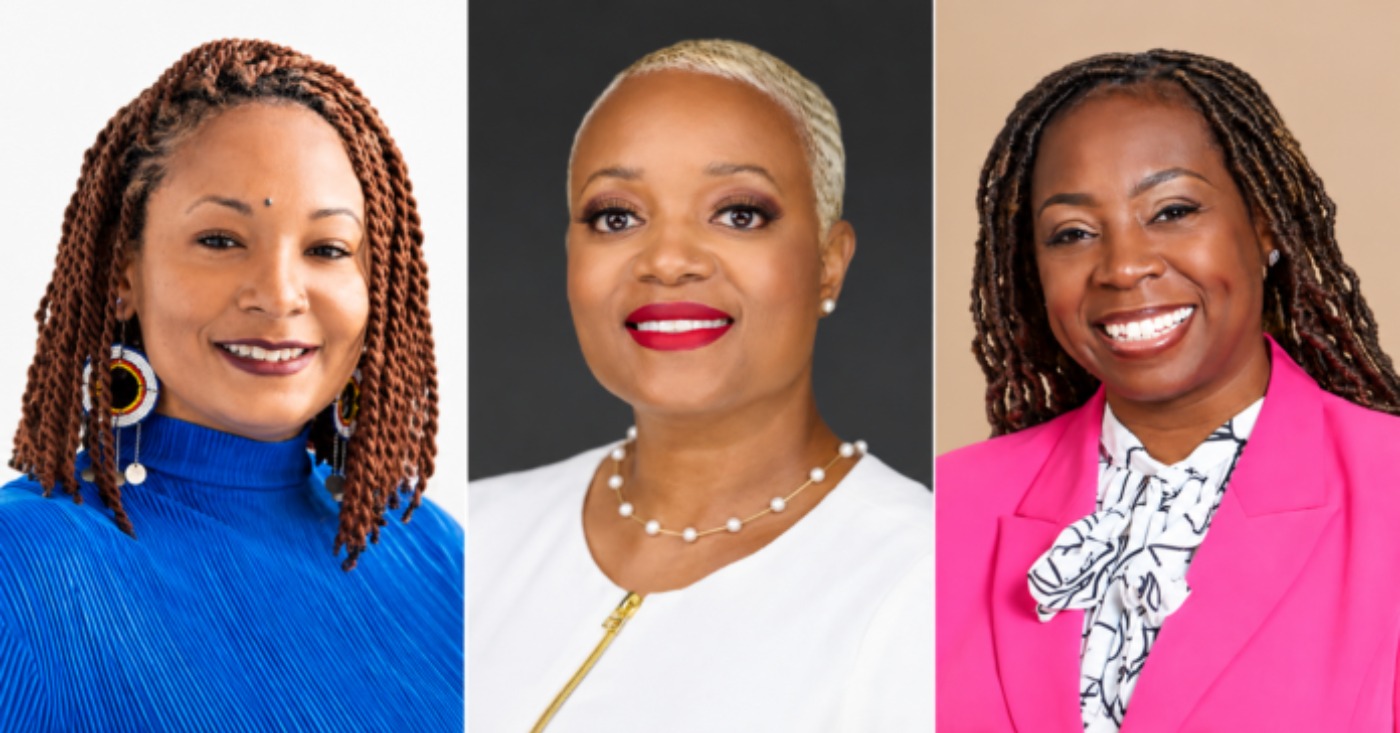
As co-authors of the Pinkprint and members of the Chicago Better Together Breast Cancer Disparities Think Tank, an initiative launched to address the disproportionate impact of breast cancer mortality on Black women in Chicago’s South Side and South Suburbs, we know that by combining data-informed strategies with community-driven advocacy and leadership, we will create equitable, sustainable outcomes for those most affected by breast cancer and the lack of access to nutritious foods in their communities.
Solutions start as local initiatives. We must pilot community-driven solutions in areas with the highest breast cancer mortality rates and limited access to nutritious food.
Existing local programs – food pantries, community fridges and even hospital-run delivery systems – are a critical piece of this local infrastructure. They are just a component, though, of the robust nutrition infrastructure the South Side lacks. In the long-term, our neighborhoods need clean, well-stocked grocery stores – and we must demand that our elected officials do everything they can to attract and retain these food corporations to invest in our communities.
This is just one item on their to-do list. Long-term solutions will include policy changes and targeted incentives at the city, state and federal levels. Just this spring, over 150,000 people in Illinois lost SNAP benefits, a devastating cut with ripple effects across families into entire neighborhoods. These cuts disproportionately affect people in the South Side of Chicago – not to mention, overwhelm food banks and other centers that serve as part of our social safety net. The Families Receiving Emergency Support for Hunger (FRESH) program in Illinois provides a one-time, automatic $400 cash payment per eligible household member to residents who lost their SNAP food benefits. This will help ease the immediate negative effects of these cuts and is much appreciated. But it is not a long-term solution.
When we started conversations in work groups about this project, we started with the idea that Black women deserve equitable access to quality breast cancer care. Any conversation about breast cancer care and goals for improved outcomes, must include a conversation about nutrition justice.
Nutrition justice is not just a transformational ideal: it is an idea that will literally transform our neighborhoods and the quality of life of every single person living in them. It will put grocery stores in empty storefronts; it will deliver food to a breast cancer patient going through chemotherapy.
Nutrition justice will help improve breast cancer outcomes for Black women on Chicago’s South Side. And Black women should not have to wait.
This op-ed is the second in a series focusing on eliminating breast cancer mortality in Black women on Chicago’s Southside. The authors are part of the Chicago Better Together Breast Cancer Disparities Think Tank, an initiative launched to address the disproportionate impact of breast cancer mortality on Black women in Chicago’s Southside and South Suburbs. Together with other community leaders, they have co-authored the Pinkprint, a strategic multistep plan and call-to-action on this critical issue.
The post She’s Not Non-compliant, She’s Hungry: Addressing Food Justice to Improve Breast Cancer Outcomes appeared first on Chicago Defender.
Based on reporting by Chicago Defender.
Black History
Cash for Moms: As Medicaid Cuts Loom, Cities Test a New Approach to Black Maternal Health
LOUISIANA WEEKLY — WORD IN BLACK — A maternal health crisis continues to disproportionately impact the Black community, with Black mothers experiencing significantly higher mortality rates during childbirth and their infants facing increased risks of prematurity and death. Data indicates Black moms die at three times the rate of white moms, and Black infants are about twice as likely to die as white infants in some states.

By now, there’s little question that a maternal health crisis is rocking the Black community. The data tells the story: Black moms are dying during childbirth at three times the rate of white moms, a disproportionately high percentage of Black children are born prematurely, and Black infants are about twice as likely to die as white infants in states like Louisiana.
But new data from a handful of pilot projects also suggests a potential solution that could significantly improve outcomes for Black mothers and their babies: cash payments, no strings attached.
Studies show the unrestricted money led to fewer preterm births, higher newborn birth weights, and fewer critical-care infant hospitalizations. It also reduced stress among new moms who would otherwise struggle to attend prenatal check-ups, pay for food and formula, or keep a roof over their heads.
“This makes so much sense to me,” says Tamara Mason, an official with the nonprofit March of Dimes who worked on an Atlanta project distributing money to low-income pregnant women. “Why isn’t everyone doing this?”
Sen. Cory Booker, a New Jersey Democrat, is among several sponsors of legislation that would provide direct financial aid to new mothers, similar to the expanded child tax credit in 2021. The credit sent monthly payments of up to $300 per child straight to most families’ bank accounts; experts credit it with lifting millions of children out of poverty.
When it expired, child poverty rose again.
“I believe that we need to, for moms, flood resources to them through things like the child tax credit,” Booker said during an August press briefing on the Black Maternal Health Momnibus Act. “We were able to cut child poverty virtually in half for our communities, and that actually does affect child outcomes.”
Those positive outcomes in part spurred the March of Dimes to launch trial programs providing universal basic income, or UBI, to pregnant women and new moms in two cities: Atlanta, which Bloomberg ranked as the most economically unequal large city in the country, and New Orleans, which March of Dimes gave an F grade.
No strings attached
In Atlanta, the Guaranteed Basic Income Program gave each participant $1,000 a month during pregnancy and her baby’s first year. Women most likely to live in poverty in that city are Black women of reproductive age; 25 pregnant women in two of the area’s highest-need ZIP codes received the cash.
March of Dimes ran the pilot through an Atlanta collective-impact partnership known as the collaborative. It is modeled on San Francisco’s Abundant Birth Project and, organizers say, rooted in an idea the Rev. Martin Luther King Jr. championed decades ago.
Funders Skeptical at First – Then All In
Mason said she spent months pitching foundations on the idea, which some considered outside her organization’s lane.
“I was honestly surprised that a couple of foundations,” Mason says. “Funders were like, ‘Why is March of Dimes in this space? You all are the birth defects people. You’re the preterm birth people.’”
The Community Foundation for Greater Atlanta signed on as the primary funder. The Liz Blake Giving Fund and the Jesse Parker Williams Foundation funded data gathering and evaluation Emory University conducted.
The nonprofit Center for Black Women’s Wellness handled recruitment, and more than 110 women applied for the 25 spots, Mason said. Applicants had to live in one of the two ZIP codes, earn no more than 200 percent of the federal poverty level, and be 12 to 28 weeks pregnant.
Cash, Diapers and a Network
Stipends were paid through a prepaid card, letting evaluators track spending without restricting it. Helping Mamas, a nonprofit focused on diaper insecurity, supplied 300 diapers and eight packs of wipes a month, plus a car seat and other essentials. The Georgia Black Doula Network encouraged, but didn’t require, participants to hire doulas.
Early results from Emory’s evaluation, as described by Mason, show a 20 percent decrease in financial stress and a 66 percent decrease in hopelessness, a figure she called striking. Prenatal outcomes trended better than average.
Mason was careful not to oversell what $1,000 a month can fix. Several participants lost housing; one or two dealt with domestic violence.
Even though GBI reduced financial stress, “it still is one piece of the puzzle,” Mason said.
New Orleans: Overcoming Crisis
March of Dimes runs a similar program in New Orleans, GBI Rx, offering pregnant patients in their first or second trimester $12,000, as a lump sum or $1,000 a month. Two partner medical clinics enroll patients for healthcare, and the payment card blocks cash withdrawals and spending on liquor and gambling.
In Louisiana, “we have a maternal and infant health crisis – specifically, a Black maternal and infant health crisis,” said Robin Gruenfeld, director of collective impact for March of Dimes in New Orleans. ”And it’s been that way for a long time.”
Black infants there died at about twice the rate of white infants from 2021 to 2023. Gruenfeld said Orleans Parish has the state’s lowest prenatal care utilization rate.
Gruenfeld said the program’s city seed money, federal pandemic relief funds, and foundation funding were “zeroed out” without notice. Most funds were later restored at a lower level, forcing organizers to scale down to 94 participants instead of the 100 planned. They also enrolled on a first-come, first-served basis.
Recipients spent lump sums on housing, cars and insurance. But spending priorities for the participants changed when the federal government stopped paying out SNAP food benefits during last fall’s federal shutdown.
“During that time, more than a quarter of the funds that we gave folks was going to groceries,” Gruenfeld said.
Several New Orleans city government officials are now weighing a program modeled on Michigan’s Rx Kids, which a study credits with nearly halving neonatal deaths in Flint, one of the poorest cities in the state.
“We are seeing policies pushed by the political will of predominantly Black women come into effect, and then also the backlash,” says Danielle Atkinson of Mothering Justice Action Fund, a nonprofit advocacy organization. “In Michigan, we have Rx Kids, which is extremely popular [and] the data on the impact is undeniable.”
But recent changes are endangering the success of such programs, particularly amid President Donald Trump’s hostility towards programs focused on diversity, equity and inclusion.
“We’re getting this pushback around identifying race and parental status as systemic areas of oppression,” Atkinson says. It remains to be seen, she says, “whether or not we are going to be able to prevail with the political power and the popular will of these issues, or the rhetoric and the history of racism in our country.”
Washington Looks Elsewhere
That includes the Republican-controlled Congress, which has shown little appetite for cash aid tied to pregnancy.
The Black Maternal Health Momnibus Act, which Booker reintroduced along with Democratic Reps. Lauren Underwood of Illinois and Alma Adams of North Carolina, bundles 14 bills on housing, nutrition, WIC and the perinatal workforce, but not direct cash.
Still, signs suggest the issue – providing cash aid to low-income mothers and their babies – may stay on the front burner as the midterm elections approach in November.
This month, former Vice President Kamala Harris and Michigan Senate nominee Abdul El-Sayed, both Democrats, hosted a Black maternal health roundtable in Detroit. Danielle Atkinson of Mothering Justice took part.
“Black mamas deserve access to quality healthcare that sees us, listens to us, and understands us at every step of the way,” Atkinson said afterward. “The responsibilities we carry do not end at pregnancy, nor do they disappear when we give birth and want to spend time with our newborn. They stay with us throughout all that we experience.”
Based on reporting by Louisiana Weekly.


Mathew Knowles Shares Breast Cancer Survival Story at Houston’s Inaugural Pearl’s Pink Promise Gala

Tre and Shawn Lemons – A Community Service Love Story

How A Busy Entrepreneur Keeps Fitness On The Agenda

Mayor Barbara Lee Holds Special State of the City Address in Deep East Oakland

Practitioners of African Traditional Spirituality Offer Ancestral Reverence Ritual Oct. 31

It’s Time to Lose Weight Before the Holidays

Trader Vic’s Returns to Its Oakland Roots

Oakland Coal Terminal Backed by Trump Would Be Bigger, Dirtier Than Promised, Says Report

Opponents Smear Effective African American Transit Director as Election Nears

COMMENTARY: BIG MAMA SAID: Don’t Throw Away the Gift Just Because It Came Wrapped Wrong

The Youngest American Killed in the Vietnam War

Passing for White, Fighting for Black America: The Courage of Walter White

OP-ED: Haiti TPS: Have We Lost Sense of Humanity?

NFL: Week Two Recap | Jalen Hurts did not fold; Caleb Williams exits game with injury

Remembering Chauncey Bailey as Student Journalists Face Threats to Truth-Telling

Peter Magubane: a Camera Against Apartheid

Mayor Lee Announces $1 Million Kaiser Permanente Grant for Pilot Program to Address Homelessness, Clean Up Public Spaces throughout Oakland

OP-ED: How Head Start Also Helps Parents

Poll: Becerra Widens His Lead Over Hilton; Californians Split on Wealth Tax

Community Action Group ‘Friends of Zakiya’ Ask Sheriff for Time
Tre and Shawn Lemons – A Community Service Love Story
How A Busy Entrepreneur Keeps Fitness On The Agenda

Luxury SUV: Heated Seats & Captain’s Chairs Review #shorts

Black-Owned Banks: Compliance to Community Business #shorts

FDIC Study: African American Banks Disappearing Rapidly #shorts

Car Buying Tip: Check Windshield Glare & Interior Space! #shorts

St. Louis Celebrates Excellence at The St. Louis American’s 39th Annual Salute to Education Gala

‘No King: Vote Early’ protest for democracy in St. Louis

Optimize Your Seating: Essential Household Setup Guide #shorts

Brake Pedal Test Drive: Smooth Stops for Your Truck! #shorts
-

 Black Press7 days ago
All Skinfolk Ain’t Kinfolk
-

 Black Press6 days ago
Oakland Awarded More than $14 Million in State Funding
-

 Black Press6 days ago
Jendayi Arrest Raises Community Concerns Regarding Sheriff’s Chain of Command
-

 African American News and Issues4 days ago
Black History: Gladys West Mathematics Helped Make GPS Possible
-

 Black Press6 days ago
Allen Temple Baptist Church Hosts Free Prostate Cancer Screenings on Oct. 17
-
 Black Press6 days ago
Democrats, Community Groups Back Measure EE to Change How Oakland Is Governed
