
Crime
OP-ED: Justin Fairfax Deserves a Fair Hearing: When African American men are accused of rape, a sordid history is evoked
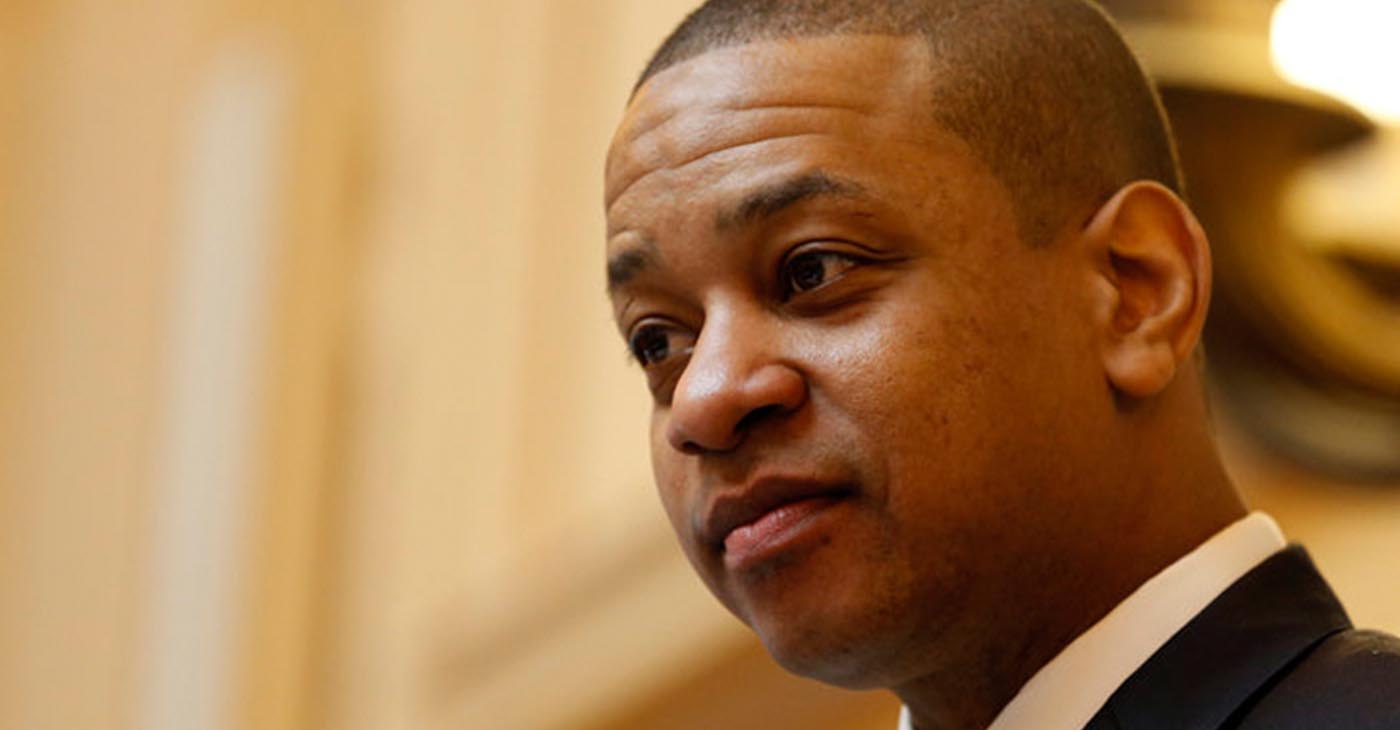
HOUSTON FORWARD TIMES — Justin Fairfax, the lieutenant governor of Virginia, has asked the FBI to investigate allegations by two women that he sexually assaulted them.

By Frederick H. Lowe
Justin Fairfax, the lieutenant governor of Virginia, has asked the FBI to investigate allegations by two women that he sexually assaulted them. The alleged assaults, which occurred years earlier, were never reported to police or to physicians but were reported to the women’s friends.
Dr. Vanessa Tyson and Meredith Watson, the two women, indicated they are willing to testify at a hearing to impeach Fairfax. Virginia delegate Patrick Hope recently said he soon would introduce articles of impeachment against Fairfax.
Tyson said that Fairfax forced her to perform oral sex on him after they kissed consensually while they were attending the 2004 Democratic National Convention in Boston. Meredith Watson says she was raped by Fairfax in 2000 while the two were students at Duke University.
Fairfax has denied the allegations of both women, but that hasn’t stopped almost everyone, including Senators Tim Kaine (D-Virginia), Mark Warner (D-Virginia), Kamala Harris (D-California) and Virginia’s Legislative Black Caucus from demanding that he resign.
The sexual assault allegations against him also have taken attention away from Virginia Gov. Ralph Northam who admitted wearing Black face at a Michael Jackson dance contest and Virginia Attorney General Mark Herring wearing Black face at parties. Both men said they will not resign from office and they may survive.
Appearing on CBS’s Face the Nation, Gayle King interviewed Northam who said it was 400 years ago when Black indentured servants were brought to the Commonwealth. That comment seemed to go right over King’s head because blacks brought to Virginia were slaves. Indentured servants paid for their passage and worked for their employer a set number of years until they paid off their debt and were free. King claims she corrected the governor, but I didn’t hear it.
Margaret Brennan, Face the Nation’s host, asked King about the allegations against Fairfax.
She said Tyson’s and Watson’s allegations were very credible. King is a Black woman, but no Black men or someone who could add a historical context to rape allegations against Black men appeared on the show.
U.S. history has plenty of tragic examples.
On June 15, 1920, a white mob in Duluth, Minnesota, lynched three Black circus workers —- Elias Clayton, Elmer Jackson, and Isaac McGhie —- after Irene Tusker, a 19-year-old White woman charged that the three men had raped her, although a physical examination by a physician established she had not been raped, according to the book “The Lynchings in Duluth.”
Recently, Rick DeSantis, Florida’s governor, pardoned four black men for the 1949 rape of a white woman that never occurred.
U.S. Rep. Rodney Davis (D., Illinois) and U.S. Sen. Tammy Duckworth (D., Illinois) said they will introduce legislation that would designate the site of the 1908 Springfield Race Riots a National Historic Monument after whites and immigrants burned down an entire black neighborhood after a White woman claimed a Black man raped her. The woman later admitted she made up the story.
Black women are not unbiased observers of the way society treats Black men. Some are sympathetic, while others know they have cachet with Whites, especially White men, because they are women and women who are expected to be especially deferential.
I have had this happen to me. I was a member of the Art Institute of Chicago. I was waiting in the gift area of the modern wing for my wife and son who were shopping nearby to join me.
A Black woman security guard, dressed in plainclothes, said to her White partner, ‘I am going to see what he’s up to.’ With an angry look, she pressed her face close to mine and said nothing. When my wife and son ran up, she told her partner, “Let’s go,” and they left.
Another abhorrent incident of this ilk took place while I was a fellow at Northwestern University. The fellows were waiting to visit Cook County Sheriff Tom Dart after twice clearing jail security. I was the only Black man among the fellows who were all younger White women except for one older Black woman and an older White man.
A Black woman deputy sheriff walked up to me and wanted to know why I was there. I explained to her that I was a fellow, which she didn’t believe. My answer angered her. She moved her watch hat with one hand in a threatening manner. Her other hand rested on the butt of her gun, leading me to fear that she was going to shoot me. I was waiting with the others to go inside the jail. I wasn’t breaking out. I wasn’t an inmate. I was an invited, registered guest.
At some point, I must have dissociated because I can’t remember what happened next. I was subsequently aware the deputy sheriff had left without explanation. None of the other fellows came to my defense to say I was with them. A few just stared at me. The Black woman fellow said something which I don’t remember.
I wonder who will come to Fairfax’s defense. People are already building gallows to lynch him over the Internet. He deserves a fair hearing.
This article originally appeared in the Houston Forward Times.












Black Press
Birmingham on Pace for Fewest Homicides in 75 Years
BAKERSFIELD NEWS OBSERVER — Birmingham, Alabama, is currently on track to record its lowest annual homicide total in approximately 75 years. According to the Birmingham Police Department’s third-quarter briefing, the city recorded 34 homicides through October 1, representing a significant decrease from the 61 reported at the same time last year and the 129 reported by October 2024.
Birmingham, Alabama, is on pace to close 2026 with its fewest homicides in roughly 75 years — a turnaround for a majority-Black city that for decades made national headlines for its murder rate.
Birmingham police counted 34 homicides through Oct. 1, down from 61 at the same point in 2025 and 129 at the same point in 2024, Police Chief Michael Pickett said at the department’s third-quarter briefing. The city’s lowest annual total on record is 44, set in 1951. Just two years ago, Birmingham recorded 152 homicides, its deadliest year.
“I did not think that we would have this much of a reduction but of course that’s always the goal,” Pickett said. He put the drop at 74% compared with 2024 and said the department has cleared 91% of this year’s cases.
“Birmingham is on track for our fewest homicides in 75 years,” Mayor Randall Woodfin wrote on Facebook this month, crediting the officers of the Birmingham Police Department, Pickett, and the city’s community violence intervention workers.
The city’s bet runs on two tracks. On the policing side, Pickett has pointed to the department’s crime reduction plan, enforcement targeting illegal firearms, and cooperation with federal agencies. On the community side, Birmingham has put about $5.4 million in American Rescue Plan money into violence intervention programs: a hospital-based partnership with UAB Hospital, the Jefferson County Department of Health, the Offender Alumni Association, and Violence Intervention and Prevention Partners that places specialists at the bedsides of people wounded by gunfire; a street outreach team run with the Urban League of Alabama; a Group Violence Reduction Strategy with the National Institute for Criminal Justice Reform; and One Hood. With the one-time federal dollars expiring, the city council extended the hospital-linked program through June 2027 with $1.15 million and put $3 million for community violence intervention — a $1.5 million increase — into the city’s fiscal 2027 budget. Whether every program is fully covered once the federal money runs out remains unclear.
The honest caveats: murders are falling across the country, too — crime analyst Jeff Asher projects the lowest U.S. murder rate ever recorded in 2026, after the FBI reported the national homicide rate hit a 75-year low in 2025 — and nobody can prove which piece of Birmingham’s approach drove the drop. One category is moving the wrong way: domestic violence offenses are up 18.3% this year, the chief said. “This is not something the police department can handle alone,” Pickett said of the domestic violence increase.
Two accounting notes readers deserve: the mayor’s latest post says homicides are down 46% from last year, while the police department’s own Oct. 1 numbers work out to about 44% — and a May fact-check by ABC 33/40 found an earlier Woodfin figure slightly overstated. Separately, Bhamwiki counts 38 homicides as of Oct. 1 because it includes police-involved and justified cases; the police count is 34. And the pace math matters: 34 homicides through Oct. 1 projects to roughly 45 for the full year — just above the 1951 record of 44. So “fewest since 1951” is within reach; a new all-time low likely isn’t.
What’s working to make your neighborhood safer? Tell us.
Drafted by News Observed Editorial AI, human reviewed and published.
Based on reporting by Bakersfield News Observer.
Black History
Federal Agents Search Ilhan Omar’s Home Just 22 Days Before Election
WASHINGTON INFORMER — Federal agents searched the D.C.-area home of Rep. Ilhan Omar (D-Minn.) on Monday, 22 days before Election Day. This extraordinary step involved executing a criminal search warrant against a sitting member of Congress.
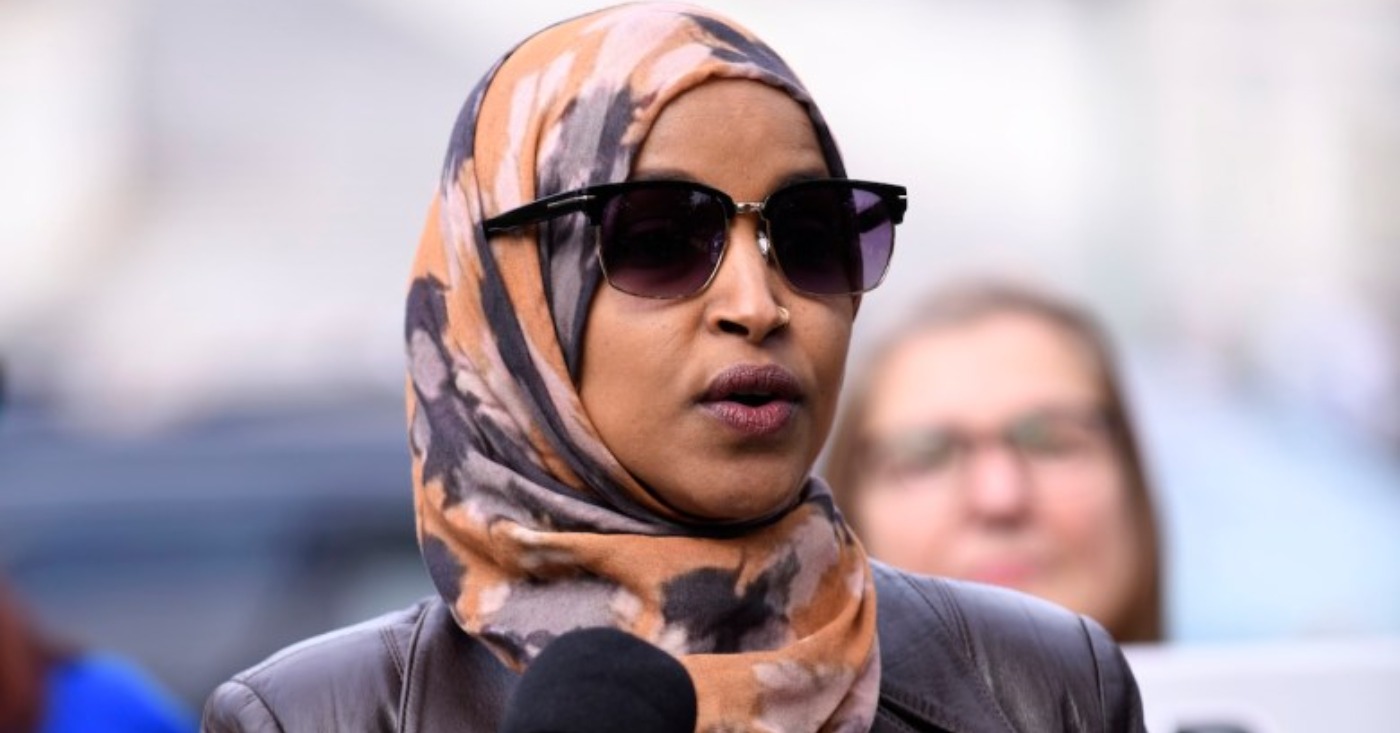
Federal agents searched the D.C.-area home of Rep. Ilhan Omar (D-Minn.) on Monday, taking the extraordinary step of executing a criminal search warrant against a sitting member of Congress just 22 days before Election Day, as the Trump administration investigates allegations involving her family’s immigration records.
The search immediately drew accusations of political intimidation from Omar’s supporters, who pointed to President Donald Trump’s repeated attacks on the Minnesota congresswoman and questioned the timing of an investigation targeting one of his most outspoken critics.
“Representative Omar is a dedicated public servant and a true ally for working families, and Donald Trump has done nothing but use racist tropes and stereotypes to attack her,” said Joel Payne, MoveOn’s chief communications officer. “Now, he’s abusing his power to physically intimidate and harass her.”
A Justice Department spokeswoman acknowledged that Homeland Security Investigations agents, part of Immigration and Customs Enforcement, searched a District residence as part of an ongoing federal criminal investigation.
The spokeswoman declined to provide additional information or publicly identify the person under investigation.
According to published reports, the warrant identified possible violations involving false statements, immigration document fraud and conspiracy. Federal investigators have also examined questions concerning Omar’s finances, campaign funds and interactions with foreign citizens.
No criminal charges against the congresswoman were identified, but Monday’s search occurred less than four weeks before voters decided whether to return Omar to Congress.
The investigation follows months of public accusations from senior Trump administration officials, including Vice President JD Vance, who previously claimed that Omar committed immigration fraud.
In an interview with conservative commentator Benny Johnson, Vance asserted, without publicly presenting evidence, that the administration believed Omar had broken immigration laws. He also said he and White House deputy chief of staff Stephen Miller had discussed how to pursue the allegations.
“What are the legal remedies now that we know that she’s committed immigration fraud?” Vance asked during the interview. “How do you go after her? How do you investigate her?”
Omar has repeatedly rejected the accusations, including claims that she married her brother to facilitate immigration fraud. Her office dismissed Vance’s allegations in March as fabricated and defamatory.
Questions about the investigation intensified in August when Immigration and Customs Enforcement refused to release records sought under the Freedom of Information Act concerning allegations surrounding Omar’s 2009 marriage to Ahmed Nur Said Elmi.
The agency cited an exemption allowing law enforcement authorities to withhold records when disclosure could interfere with enforcement proceedings. The refusal did not establish that Omar committed fraud or, at the time, confirmed that she was personally under investigation.
Omar, who came to the United States as a refugee from Somalia, was elected to Congress in 2018 and became one of the first two Muslim women to serve in the House. She represents Minnesota’s 5th Congressional District, which includes Minneapolis, and has frequently challenged Trump over immigration enforcement, civil rights, and his administration’s treatment of immigrant communities.
Her confrontations with the administration have made her a recurring target of the president’s political attacks. The criminal investigation also follows a frightening incident earlier this year in which Omar was physically attacked during a public appearance.
On Jan. 27, a man attacked Omar during a town hall meeting at the National Urban League’s Twin Cities headquarters in Minneapolis. The incident prompted condemnation from the National Coalition on Black Civic Participation and its Black Women’s Roundtable, which demanded accountability and warned against political violence.
“We are shocked and extremely disturbed by the attack on Rep. Ilhan Omar yesterday while she attempted to address the critical issues and chaos swirling around in Minneapolis,” Melanie L. Campbell, president and CEO of the coalition and national convener of the Black Women’s Roundtable, said in a Jan. 28 statement.
Campbell praised Omar for continuing to speak out despite threats against her.
“We believe that NO public official should be threatened or physically attacked, especially when they are serving in the best interests of their constituents,” Campbell said. “Political violence and intimidation have no place in our democracy.”
MoveOn, the progressive advocacy organization, accused Trump of using federal law enforcement to intimidate a political opponent and urged voters to respond at the ballot box.
“On Nov. 3rd, we get our chance to fight back and hold him and his corrupt administration accountable,” Payne said.
Based on reporting by Washington Informer.
Black Press
OP-ED: If the ‘Cornell 7’ Were Black Men at an HBCU — America Wouldn’t Be This Sympathetic
ATLANTA DAILY WORLD — This article examines how the national conversation surrounding serious allegations against fraternity members might change if the incidents occurred at an HBCU involving Black men, rather than an Ivy League institution. It references recent high-profile cases at Cornell, Penn State, Baylor, and Stanford, prompting a re-evaluation of media scrutiny and public sympathy.
Instead of it taking place at an Ivy League school in Ithaca, New York, what would it look like if a national story concerning rape allegations from fraternity members took place on an HBCU campus in Atlanta, Washington, D.C., or Nashville?
Would President Donald Trump still feel “badly” for the alleged?
Do you think the Kappas, Sigmas, and Alphas would face the same scrutiny?
Might people use more compassionate language when discussing the case’s legalities?
We already know the answers to those questions.
Sunny Hostin from “The View” recounted a call she received from actress Cynthia Erivo, who said, ‘Sis, I know you, and I know your heart and your life’s work has been about protecting women and children. But the clip that I saw doesn’t reflect who you are.” Hostin’s initial remarks about the case focused on its legal aspects, lacking compassion for the alleged victims and other survivors who might have been affected. Hostin reflected, “Instead of leading with the law, I need to lead with empathy so that people can receive the message about the law. I was accused of defending these young men and victim-shaming, which is something I would never do since I spent the majority of my career prosecuting sex crimes.”
If you’re reading this, then you are already aware of the allegations against the “Cornell 7.” The news comes just weeks after 14 people were charged in connection with the alleged trafficking of kilos of cocaine on Penn State’s campus by members of white fraternities. A decade ago, the rape scandal at Baylor University dominated the news, which was around the same time as the Brock Turner case at Stanford.
I ask again: how would the news coverage, social media chatter, and podcast conversations differ if such incidents happened on HBCU campuses and included members of Black Greek-letter organizations?
Based on reporting by Atlanta Daily World.
Black Press
Botham Jean’s Killer Granted Parole 7 Years After His Murder
MICHIGAN CHRONICLE — Former Dallas police officer Amber Guyger has been granted parole, seven years after her conviction for murdering Botham Jean inside his Dallas apartment. The Texas Board of Pardons and Paroles approved her release on October 1, seven years to the day after her murder conviction. Guyger was convicted in 2019 and sentenced to 10 years in prison for Jean’s 2018 death.
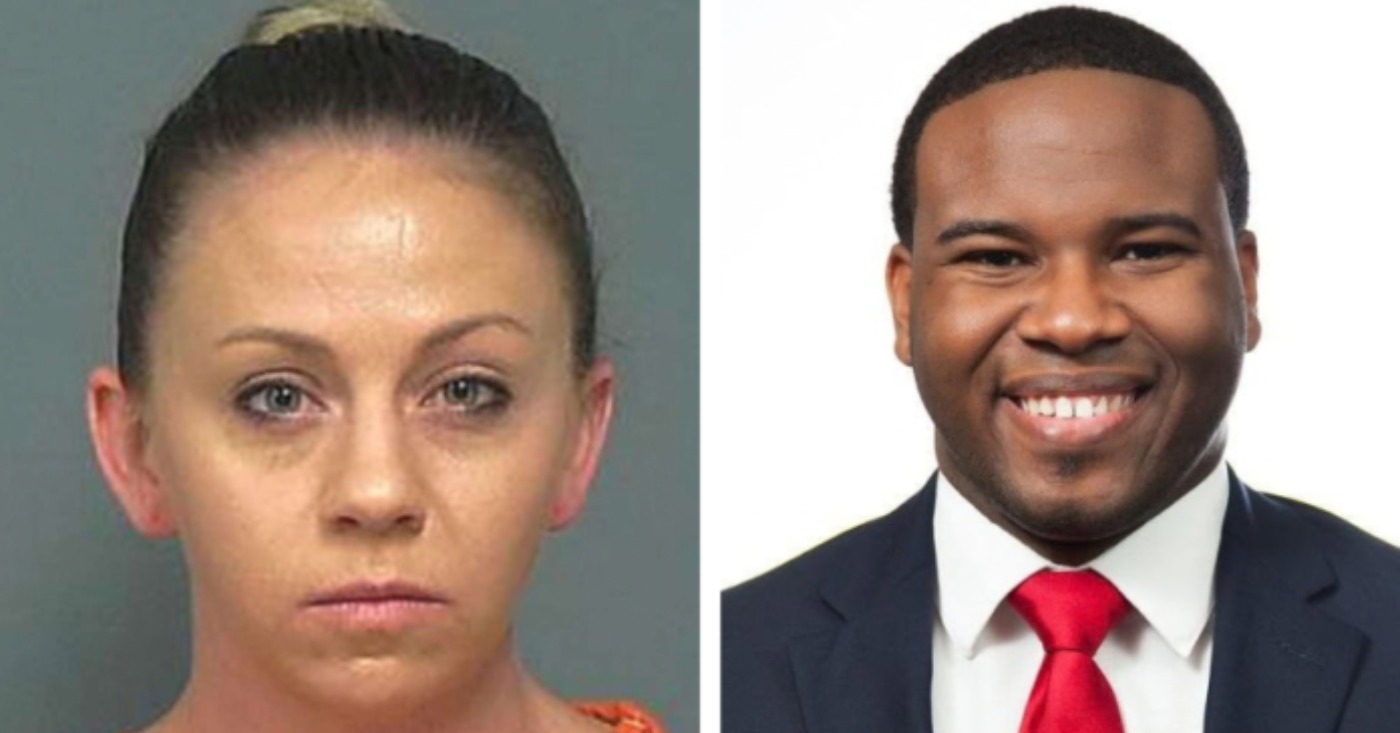
Former Dallas police officerAmber Guyger has been granted parole seven years after she was convicted of murdering her neighbor,Botham Jean, inside his Dallas apartment.
The Texas Board of Pardons and Paroles approved Guyger’s release Thursday (October 1), seven years to the day after Guyger was convicted of Jean’s murder, according to NBC News.
In 2019, a jury convicted Guyger of murder and she was sentenced to 10 years in prison for Jean’s 2018 death. Her conviction and 10-year sentence were upheld on appeal in 2022.
Geyger’s first parole request was denied in 2024, NBC Dallas-Fort Worth reported.
The Dallas Police Department fired her after the shooting. During her trial, Guyger testified that she mistakenly entered Jean’s apartment after returning home from work, believing it was her own apartment one floor below.
She said she saw Jean inside and fired her weapon because she believed he was an intruder, according to NBC News.
Jean was a 26-year-old Black man from St. Lucia who worked as an accountant. He was inside his home eating ice cream when Guyger entered and shot him, NBC DFW reported.
The parole board cited Guyger’s prison record in approving her release. According to NBC DFW, officials said she did not have a documented pattern of violent or assaultive arrests or convictions, maintained a satisfactory adjustment while incarcerated, and completed programs intended to help her obtain and maintain employment.
Jean’s family opposed the parole decision and had asked that Guyger serve her full 10-year sentence, according to NBC DFW.
Civil rights attorney Lee Merritt, who represents the family, told NBC DFW that the decision was deeply disappointing.
“They stood up again and again to ask that the full sentence be served,” Merritt said.
The Dallas Police Department told NBC DFW that the parole decision was outside its authority and that the department had no role in determining whether Guyger would be released. The department said its thoughts remained with Jean’s family and others affected by his death.
Guyger’s conviction and 10-year sentence were upheld on appeal in 2022.
A civil jury ordered Guyger to pay Jean’s family $98.6 million in damages in 2024, according to NBC DFW.
Guyger’s release date has not been announced. NBC News reported that the Texas Department of Criminal Justice will determine when she is released.
The Black Information Network is your source for Black News! Get the latest news 24/7 on The Black Information Network. Listen now on the iHeartRadio app or click HEREto tune in live.
Based on reporting by Michigan Chronicle.
Black Press
New York Prosecutors Reopen Alleged Cornell University Gang Rape Case
NEW YORK BEACON — Prosecutors in Tompkins County, New York, have reopened an alleged gang rape case from 2024 involving Cornell University. The decision follows a civil lawsuit filed by the alleged victim, Jane Doe, against several fraternity members. District Attorney Matthew Van Houten confirmed his office is examining conflicting claims and intends to present the case to a grand jury.
Cornell University is at the center of a developing matter involving an alleged gang rape case that took place in 2024. Prosecutors are reopening the matter after the alleged victim filed a civil lawsuit against a group of fraternity members at Cornell University.
ABC News reports that prosecutors in Tompkins County in Central New York State are examining the claims made by a Jane Doe, the alleged victim of the assault. According to Tompkins County District Attorney Matthew Van Houten, his office is examining whether or not to bring charges but did share that there are two conflicting claims at the heart of the matter.
“It’s our intention to present the case to the Tompkins County grand jury with Jane Doe’s cooperation,” Van Houten told the outlet. “We want to reexamine whether there’s additional evidence that we were not aware of in November of 2024, that exists now that would change our assessment of the case and would result in the grand jury finding that there was criminal conduct.”
Back in 2024, the Jane Doe and former student accused seven current and former members of the Chi Phi fraternity of assaulting her, leading to the chapter’s expulsion from Cornell University. The school conducted an investigation, and initially, Doe did not say she was drugged and forced into acts. Doe’s lawsuit is now alleging the fraternity members drugged and assaulted her.
“She never says that she was drugged without her knowledge. She admits to taking drugs and alcohol voluntarily and with knowledge. She does not allege that she was forced to engage in any acts. She does not say that she was physically helpless or unconscious or incapacitated at any point during the time at the fraternity house,” Van Houten added.
Based on reporting by New York Beacon.
Black Press
Safety Concerns at Southern University
SOUTHERN UNIVERSITY – SOUTHERNDIGEST — Students at Southern University express growing concerns about safety after dark due to poor lighting conditions across campus. Areas such as walking paths, the street near the bandroom, and streets by dorms are described as “terrifyingly pitch black” due to dying or non-existent lights.
Spending time across Southern University’s campus during the day, you feel the rich history and great energy that make the Bluff special. But once the sun goes down, that feeling shifts into a familiar sense of unease.
Returning home from a late-night study session in the library or walking back from your dorm can often feel like a game of avoiding the darkness. There are areas across campus that are terrifyingly pitch black with dying or non-existent lights posted along walking paths meant for students to walk alone. If you find yourself constantly having to squint to see while walking around campus, you can see why safety is such a big issue in students’ minds. The darkest parts of campus are the street where the bandroom is and the streets by dorms. I was driving back to my apartment on campus late one night when suddenly there was someone walking near the road. If my bright headlights weren’t on, I might not have seen them soon enough, and it could have caused an unsafe situation.
The darkness creates daily hazards that go far beyond a simple lack of visibility. Pedestrians are forced to walk directly in the street because sidewalks fade into pitch-black shadows, dodging cars while barely being able to see where they are stepping. At the same time, people are flying by on electric scooters moving through the dark, completely invisible to drivers and walkers because many of their rides lack proper headlights or reflectors. Nagging worry in the back of your mind about whether your car is even going to be in the parking lot or if it’s going to be stolen by morning, and campus life after dark feels entirely too stressful.
When looking at how Southern ranks for safety among HBCUs, Southern often lands in the lower tiers on various college safety and crime-reporting databases, frequently penalized for property concerns and lacking resources. According to PlainCampus, using the U.S. Department of Education Clery data, ranked Southern #1,287 out of 2,072 institutions based on its 2024 reported crime rate, with burglary identified as its largest reported criminal offense category.
A dark campus isn’t just an inconvenience; it’s a hazard that puts students at risk every single night. We shouldn’t have to dodge silent scooters in the middle of the road or cross our fingers every time we look toward the parking lot. It is time for the administration to step up, fix the lights, and make student safety a visible priority.
Based on reporting by Southern University – SouthernDIGEST.


NFL Round-Up: Caleb Williams strikes back, Panthers, Browns and Titans secure victories

Birmingham on Pace for Fewest Homicides in 75 Years

Ancestral Responsibility: Young Native Voters Fight Political Invisibility

Black Household Wealth Plummeted 25% in Three Years, New Data Shows

Kickstarter CEO Everette Taylor Shares Tips on Creating and Growing a Business

HBCU Football Roundup: Homecoming Wins for Howard, Tennessee State and Jackson State

Luxury SUV: Heated Seats & Captain’s Chairs Review #shorts

Black-Owned Banks: Compliance to Community Business #shorts

FDIC Study: African American Banks Disappearing Rapidly #shorts

Car Buying Tip: Check Windshield Glare & Interior Space! #shorts

The Youngest American Killed in the Vietnam War

Passing for White, Fighting for Black America: The Courage of Walter White

OP-ED: Haiti TPS: Have We Lost Sense of Humanity?
NFL: Week Two Recap | Jalen Hurts did not fold; Caleb Williams exits game with injury

Remembering Chauncey Bailey as Student Journalists Face Threats to Truth-Telling

Peter Magubane: a Camera Against Apartheid

Mayor Lee Announces $1 Million Kaiser Permanente Grant for Pilot Program to Address Homelessness, Clean Up Public Spaces throughout Oakland

OP-ED: How Head Start Also Helps Parents

Poll: Becerra Widens His Lead Over Hilton; Californians Split on Wealth Tax

Community Action Group ‘Friends of Zakiya’ Ask Sheriff for Time
Luxury SUV: Heated Seats & Captain’s Chairs Review #shorts
Black-Owned Banks: Compliance to Community Business #shorts
FDIC Study: African American Banks Disappearing Rapidly #shorts
Car Buying Tip: Check Windshield Glare & Interior Space! #shorts

St. Louis Celebrates Excellence at The St. Louis American’s 39th Annual Salute to Education Gala

‘No King: Vote Early’ protest for democracy in St. Louis

Optimize Your Seating: Essential Household Setup Guide #shorts

Brake Pedal Test Drive: Smooth Stops for Your Truck! #shorts

Life Lessons Learned Through Adversity: My Journey #shorts

From Claflin Alum to ColorBlind Artist
-

 Black Press6 days ago
All Skinfolk Ain’t Kinfolk
-
 Black Press5 days ago
Oakland Awarded More than $14 Million in State Funding
-
 Black Press5 days ago
Jendayi Arrest Raises Community Concerns Regarding Sheriff’s Chain of Command
-

 African American News and Issues4 days ago
Black History: Gladys West Mathematics Helped Make GPS Possible
-

 Black Press5 days ago
Allen Temple Baptist Church Hosts Free Prostate Cancer Screenings on Oct. 17
-
 Black Press5 days ago
Democrats, Community Groups Back Measure EE to Change How Oakland Is Governed
