
Black Press
Why Post-Launch Monitoring is Critical for Long-Term Medical Device Success
NNPA NEWSWIRE — Post-launch monitoring is a strategic function that shapes device safety, performance, and regulatory standing long after market entry. Real-world data surfaces what pre-market testing cannot catch, and manufacturers who invest in robust surveillance are better equipped to act on emerging issues, extend product longevity, and earn trust with clinicians and patients.

By Cristal Dyer
Post-launch monitoring enables medical device manufacturers to detect safety issues, track real-world performance, and maintain regulatory compliance after a product reaches the market. Pre-market trials are limited in size and scope and cannot fully account for the diversity of patients and clinical conditions encountered in everyday practice.
Continuous surveillance provides the data needed to respond quickly when problems arise and sustain device effectiveness long term.
According to the FDA, its Medical Device Reporting system logs over two million adverse event reports each year, a volume that reflects how much about a device’s real-world behavior remains unknown at launch. Those reports represent real patients and real clinicians encountering issues that no trial protocol could fully anticipate.
A device that performs flawlessly under controlled study conditions can behave very differently across varied populations, clinical settings, and years of continuous use. For manufacturers, building strong post-launch surveillance means staying ahead of those variables and having the evidence to act when it matters most.
Why Can’t Pre-Market Testing Predict Real-World Performance?
Pre-market trials are basically a starting point for understanding how a device behaves. They rely on a fairly small, carefully selected group of patients in controlled conditions, and that means there are real limits to what they can tell you about device effectiveness across diverse populations.
Clinical practice is naturally more unpredictable, with patients of varying ages, health histories, and medical complexity. Trials simply cannot replicate that variety.
Several real-world factors can actually affect how a device performs after launch:
- Patients with multiple co-existing conditions that weren’t represented in trials
- Clinicians with varying levels of training and familiarity with the device
- Differences in clinical environments, equipment, and standard procedures
- Long-term wear and tear that short-duration studies can’t capture
Post-launch analysis is what gives manufacturers a clear picture of how a device performs once it’s in the field. Real-world data can surface trends, like a higher-than-expected failure rate, for instance, or a usability problem that only appears in specific patient groups, and catching those trends early really does make a difference.
Protecting Patients and Staying Compliant
Regulatory bodies like the U.S. Food and Drug Administration expect manufacturers to keep monitoring their devices after market entry. Medical device monitoring is typically a formal requirement in most major markets, and the data collected feeds directly into safety decisions and risk management updates.
Consistent monitoring gives manufacturers the data they need to act on performance issues before they escalate.
Monitoring Strategies That Support Compliance
There are several tools manufacturers typically use to stay on top of post-market performance, and each one captures a different type of data. Each approach generates specific findings that help manufacturers spot and respond to emerging issues.
Some common monitoring strategies include:
- Complaint management systems that log issues reported by clinicians and patients
- Post-market clinical follow-up studies that track outcomes in real-world patient populations
- Device registries that collect long-term performance data across large groups of users
- Vigilance reporting systems that flag adverse events to regulators in near real-time
When manufacturers identify a problem, they can use that monitoring data to trigger corrective action: a design change, a manufacturing update, or revised instructions for use. Acting quickly on that data is what keeps devices safe and keeps manufacturers in line with their regulatory obligations.
What Does Post-Launch Monitoring Mean for Your Bottom Line?
Manufacturers that invest in strong post-market surveillance tend to see returns that go well beyond regulatory compliance. Long-term medical success depends on a device continuing to perform reliably in practice, and that only happens when manufacturers actively track performance data and act on it.
Frankly, the commercial case for monitoring is just as strong as the safety case.
Reputation and Product Longevity
A device that consistently delivers safe, effective results builds trust with clinicians and the health systems that use it. That trust translates into continued adoption, stronger referrals, and a longer commercial lifespan.
Post-market performance data can actually support the marketing of next-generation medical devices, since real-world evidence is a powerful tool in any commercial strategy.
AI-enabled devices really deserve special attention here. These devices learn from data, so their performance can shift as patient populations and clinical environments change over time. Monitoring inputs and outputs on an ongoing basis is the only way to catch that kind of drift before it affects patient outcomes.
Frequently Asked Questions
How Long Should Post-Launch Monitoring Continue After a Device Reaches Market?
Post-launch monitoring typically continues throughout the device’s commercial life. Regulatory frameworks in most markets require ongoing surveillance for as long as the device remains available to patients, and some obligations can continue even after a product is withdrawn from sale.
Who Is Responsible for Post-Market Surveillance?
The manufacturer typically carries the primary responsibility for setting up and running post-market surveillance. Regulators set the requirements and review submitted data, so in practice, it is a shared system with the manufacturer handling day-to-day operations.
How Does Post-Launch Monitoring Differ Between the FDA and EU Medical Device Regulation Frameworks?
The EU Medical Device Regulation framework, introduced in 2021, places significantly stricter demands on manufacturers than earlier EU rules, including more frequent reporting and written surveillance plans. The U.S. Food and Drug Administration’s approach is similarly comprehensive, yet uses different reporting timelines and documentation requirements. Manufacturers operating in both markets need to manage these separately.
Can Post-Launch Data Be Used to Support a New Indication or Labeling Update?
Yes, real-world evidence gathered through post-market surveillance can actually support regulatory submissions for expanded indications or updated labelling. Manufacturers often use this data to strengthen their clinical evidence base over time, and regulators in many markets actively encourage this kind of evidence generation.
The Foundation of Long-Term Device Success
Post-launch monitoring is a strategic function that shapes device safety, performance, and regulatory standing long after market entry. Real-world data surfaces what pre-market testing cannot catch, and manufacturers who invest in robust surveillance are better equipped to act on emerging issues, extend product longevity, and earn trust with clinicians and patients.
From complaint systems to post-market clinical follow-up studies, the right monitoring infrastructure defines a device’s lifespan. Visit our website to explore practical guidance and build a monitoring strategy that delivers long-term medical device success.


Black Press
Alonzo Mourning’s Affordable Senior Housing
THE POSITIVE COMMUNITY — NBA legend Alonzo Mourning has transitioned from the basketball court to community development with the opening of Astoria on 9th, a $37 million senior living complex in Florida. The project addresses the critical shortage of affordable housing for older adults living on fixed incomes.

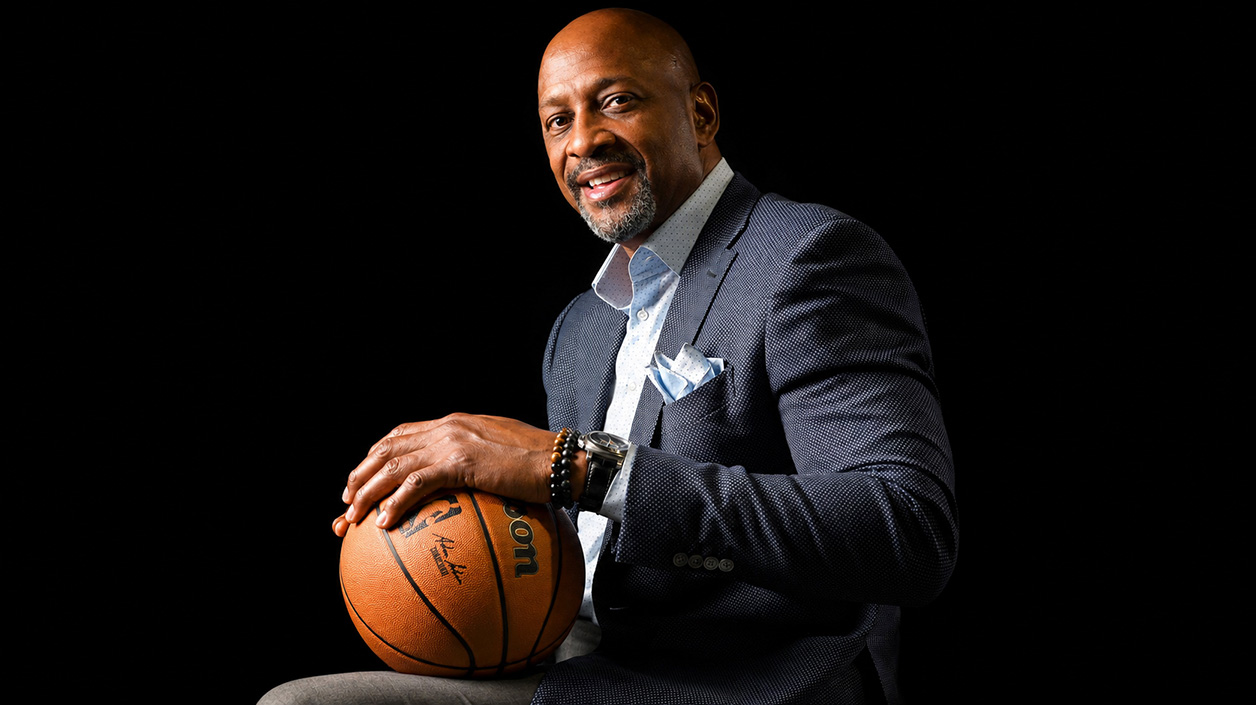
On the Astoria on 9th senior living complex
NBA legend Alonzo Mourning has added a new chapter to his story, and this one has nothing to do with basketball. He built Astoria on 9th, a senior living complex in Florida, at a cost of 37 million dollars. The project aims to give older residents a safe and affordable place to live at a time when housing costs are squeezing people on fixed incomes. It shows how a public figure can use his success and influence to address a need that affects thousands of families.
The scale of the development is significant. Astoria on 9th contains 120 apartments, which means 120 households can build a stable life under one roof. Each unit is either a one-bedroom or a two-bedroom home, giving residents some flexibility depending on their circumstances. A single person may want a quiet space of their own, while a couple or someone who wants room for a visiting family member may prefer the extra bedroom.
The apartments range from 635 to 900 square feet, which is modest but practical for older adults. Smaller homes are easier to clean, maintain, and move around in, and they also help keep costs under control. Many seniors are downsizing from larger houses, so a well-designed apartment of this size can feel comfortable rather than cramped. The goal is not luxury but dignity, safety, and a place that genuinely feels like home.
The most striking detail is the price. Residents with very low income can pay as little as 322 dollars in rent. That amount is a tiny fraction of what many people spend on housing in Florida, and it can make the difference between a secure life and a constant struggle to cover basic needs. For someone living on a small pension or limited benefits, a rent that low can free up money for food, medicine, and transportation.
Even the highest rent at the complex is only about 1,316 dollars. That is still far below what most Florida rentals demand, especially in a state where prices have climbed sharply in recent years. The gap between the lowest and highest rent, roughly fourfold, shows that the building is designed to serve a range of incomes rather than a single narrow group. Several kinds of seniors can find an option that fits their budget.
Affordable housing for older adults is an urgent issue because aging often brings rising expenses and shrinking income at the same time. Health care costs go up, savings can run low, and work becomes harder or impossible. When rent takes too large a share of a monthly check, seniors may skip medications, cut back on meals, or even risk losing their homes. Projects like Astoria on 9th act as a safety net against those pressures.
The 37 million dollar price tag also tells us something about what it takes to create this kind of housing. Dividing the cost across 120 apartments works out to roughly 308,000 dollars per home. Building affordable communities requires large investments, careful planning, and partners who are willing to accept modest returns. That makes Mourning’s commitment especially notable, because it takes patience and persistence to turn an idea into a finished building that people can actually move into.
There is also a symbolic side to the story. Athletes are often admired for what they do on the court, yet their influence can reach far beyond sports. By putting his name and resources behind a housing project, Mourning shows that celebrity can be used to support the community. His example may encourage other well-known people to look at local needs and ask how their platform and wealth could help solve problems that families face every day.
The benefits of a project like this extend beyond the residents themselves. When seniors have secure housing, their families worry less, and communities become more stable. Older neighbors can remain close to friends, places of worship, and the neighborhoods they know, which supports their emotional well-being. A well-run complex can also create a sense of community, giving residents chances to socialize, share meals, and look out for one another.
In the end, Astoria on 9th is more than a building with 120 apartments. It is a response to a real and growing need, offering homes at rents ranging from 322 to about 1,316 dollars in a state where affordability is increasingly rare. Alonzo Mourning’s work reminds us that a legacy can be measured not only in championships and records but also in the lives made easier by a safe, affordable place to call home.
Based on reporting by The Positive Community.
Black Press
Black Men Encouraged to Start Prostate Cancer Screening at 45
ATLANTA DAILY WORLD — The American Cancer Society has released updated guidelines for prostate cancer screening, emphasizing the need for earlier detection among populations at higher risk. The new recommendations follow a comprehensive modeling study conducted by clinicians, epidemiologists, and patient representatives to evaluate the benefits and harms of PSA-based screening.

Health should be a concern of the highest priority for anyone, and our Black brothers have a special obligation to take care of themselves against prostate cancer.
The American Cancer Society recently made updates to its guidelines for prostate cancer screening in efforts to detect the disease before it spreads. Among the key changes is a recommendation for annual PSA-based screening beginning at 45 years old for Black men due to a culturally recognized high risk.
RELATED:Doctors Need To Talk Through Treatment Options Better For Black Men With Prostate Cancer
Here’s What You Need To Know Now About Prostate Cancer
ACS put together a modeling study to accurately evaluate the benefits and harms of PSA-based screening strategies, made possible through the combined efforts of clinicians, epidemiologists, biostatisticians, and patient representatives.
Take a look below at the core updates made by ACS, via the official press release:
- PSA-based screening every two years for average-risk men aged 50 to 69 years.
- Men at high risk, including Black men and non-Black men with a strong family history of prostate cancer (either a first-degree relative diagnosed before age 65, or multiple first-degree relatives diagnosed at any age), should undergo annual PSA-based screening from age 45 to 69 years.
- Non-Black men with a single first-degree relative diagnosed at age 65 or older should be screened every two years from ages 45 to 69.
- Individualized decision-making on continuing screening is recommended for men aged 70 to 74 years, as the balance of benefits and harms remains uncertain.
- Men with elevated PSA levels (3.0 ng/mL or higher for men aged 45 to 69 years, and 6.5 ng/mL or higher for men aged 70 to 74 years) should undergo repeat PSA testing between two weeks and three months.
- Men with a confirmed elevated PSA should be offered testing by magnetic resonance imaging (MRI) and/or a validated biomarker to guide biopsy decisions.
- Screening is not recommended for men aged 75 years and older. Some men aged 75 to 79 who are very healthy may want to continue screening, especially if their PSA has been rising on previous tests. But this should be discussed with a healthcare provider.
- Screening is not recommended for men aged 80 and older, and for men who are not expected to live another ten years.
- Men diagnosed with prostate cancer that has a low risk of growing or spreading should be offered active surveillance as the initial management option.
The updates were made following contemporary evidence gathered so far in the fight to reduce prostate cancer deaths and diagnoses of advanced-stage disease. According to Dr. William Dahut, chief scientific officer at the American Cancer Society and one of the authors in the study, it all goes back to easing the disease burden, going on to state, “Black men experience a 67% higher incidence and nearly double the mortality rate compared with White men, an inequity that needs immediate reversal.”
Stay educated out here, fellas. Find out more information on screening for prostate cancer by clicking here.
The post Black Men Encouraged To Start Prostate Cancer Screening At 45 appeared first on Atlanta Daily World.
Based on reporting by Atlanta Daily World.
Black Press
Computational Thinking and Young Children: It’s Not What You Might Think!
BLACKPRESSUSA NEWSWIRE — Skepticism about CT in early childhood is not uncommon. Critics often argue that CT is too advanced, abstract, or inappropriate for young learners. My neighbor voiced similar concerns, questioning how concepts from a technical domain could be meaningfully adapted for children ages 3 to 5.

NAEYC recently published “Computational Thinking for Preschoolers: Nurturing Creative Thinkers and Problem Solvers,” written by Joohi Lee as part of its new suite of STEM products.
As an educator and researcher, I have spent years exploring how to integrate computational thinking (CT) into early childhood education in ways that feel natural and meaningful to young children.
One evening, I had a conversation with my neighbor—a computer scientist and father of two daughters, ages 4 and 5—about the idea of CT for preschoolers. His initial reaction was one of surprise, and he asked, “Really? Isn’t that a bit early?” This simple question kicked off an engaging hour-long exchange of perspectives.
We discussed what CT really means—things like breaking problems into steps, spotting patterns, and figuring out how to solve challenges. I described how young children learn these concepts through play, stories, and hands-on exploration, and he shared how those same ideas show up in computer science.
The longer we talked, the more we realized we were speaking the same language. By the end of our conversation, my neighbor smiled and said, “You know, I never thought of it that way, but it makes perfect sense.” That moment reminded me how universal CT skills really are—and how powerful it can be to start nurturing them in the preschool years.
When hearing the term computational thinking, many people immediately associate it with computing numbers, computer science, or programming.
Skepticism about CT in early childhood is not uncommon. Critics often argue that CT is too advanced, abstract, or inappropriate for young learners. My neighbor voiced similar concerns, questioning how concepts from a technical domain could be meaningfully adapted for children ages 3 to 5.
Some early childhood educators also share this viewpoint, perceiving CT as complex and disconnected from the developmental realities of young children. This initial hesitation is completely understandable and often stems from limited information about CT, as well as a lack of clear examples demonstrating its applicability in early learning settings.
On the other hand, some teachers are eager to integrate CT but feel somewhat intimidated by the term itself and are uncertain about where to start or how to effectively incorporate it into their teaching.
When approaching CT for young children, the first step is to understand that, while closely interconnected, CT is not the same as or interchangeable with computing, computer science, or programming. CT is a cognitive framework for problem solving. It falls under the umbrella of computing and is integral to computer science and to programming, which is a branch of computer science.
CT is also an independent skill set that leverages concepts that overlap with computer science and can be applied more broadly to problem solve in other contexts and academic disciplines. In other words, CT is not limited to any specific field or to individuals pursuing careers in computer science—it is a universal skill set for everyone.
CT equips children with the ability to think logically, analyze problems, and develop solutions systematically, making it an essential competency for navigating the complexities of our increasingly digital society.
From morning circle time to building block structures to navigating obstacle courses, the routines and play-based learning experiences that young children engage in every day inherently incorporate CT. Understanding this foundational principle can help educators get their early learning settings buzzing with curiosity, where every question, every game, and every playful moment becomes a stepping stone toward building powerful CT skills.
Example 1: Computational Thinking and Morning Interactions with Children
Mr. Miyazaki: Good morning, Angelica!
Angelica: Good morning, Mr. Miyazaki!
Mr. Miyazaki: How are you?
Angelica: Good!
Mr. Miyazaki: Tell me what is making you feel good.
The prompt Mr. Miyazaki uses (“Tell me what is making you feel good”) guides Angelica to logically think about her own feelings. Angelica may have responded “good” out of habit, but when asked to consider the cause of this feeling, she needs to contemplate what exactly is making her feel good in order to answer. This is a question that Angelica may not think of often on her own. It also requires her to engage with the important CT skills involving cause-and-effect—in other words, what (the cause) is leading to her happiness (effect). It may not be possible for educators to have exchanges like this with every child since mornings are such a busy time for greeting children and their families. However, when you find a chance to ask, this question functions as a tool to promote children’s CT. This question can also be integrated during morning whole-group time.
Example 2: Computational Thinking, Sequencing and Ordering, and Patterns in Music and Dance
Understanding that patterns are sequences helps children grasp the concept of logical progression and structure. Learning experiences that involve arranging objects or performing actions in a specific sequence reinforce this idea. For instance, teachers can invite children to follow a sequence of dance movements to the music, such as clap, stomp, jump, clap, stomp, jump, clap, stomp, jump (abc pattern). As the music plays, children perform the movements in the correct progression, helping them internalize the concept of sequencing and ordering. To support learning, the teacher may begin by demonstrating the sequence of movements slowly, ensuring the children understand each step. Once the children are familiar with the sequence, the teacher can play a lively song and encourage the children to perform the movements along with the music. To add complexity, variations in the sequence can later be introduced, such as clap, clap, stomp, jump, clap, clap, stomp, jump (aabc pattern). This not only reinforces sequencing and ordering but also engages children physically and rhythmically, making the learning process both effective and enjoyable. Through hands-on activities, children develop a stronger understanding of sequences and order, which are fundamental concepts in pattern recognition.
NAEYC recently published “Computational Thinking for Preschoolers: Nurturing Creative Thinkers and Problem Solvers,” written by Lee as part of its new suite of STEM products. She’s a professor of teacher and administrator preparation at the University of Texas at Arlington.
Black Press
Inside Chevron’s Fifth Annual “Hug a Pup” Salute to Veterans
THE COURIER ECO LATINO — Rather than limiting Veterans Day recognition to an internal email blast with a poorly prompted AI graphic, Chevron invited Veterans to HUG-A-PUP and learn about a resource that is available to them for FREE! – @TotallyRandie
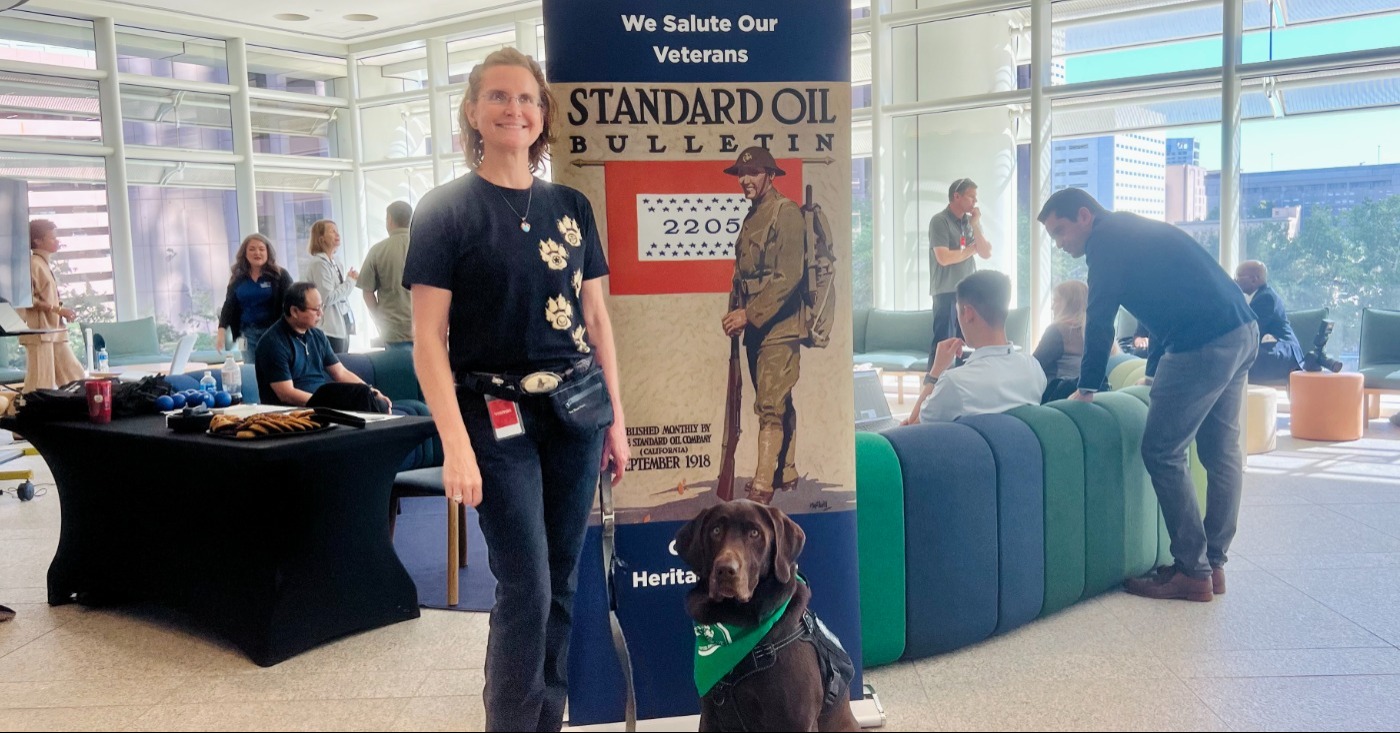
“Thank you for your service” is a phrase veterans hear so often it can start to feel like a routine greeting. Chevron decided to back that sentiment up with action. On November 12, Chevron’s employee networks hosted their fifth “Hug a Pup” event, giving downtown Houston staff five-minute breaks with four service-dogs-in-training while spotlighting the 1,200-plus U.S. veterans on the company’s roster.
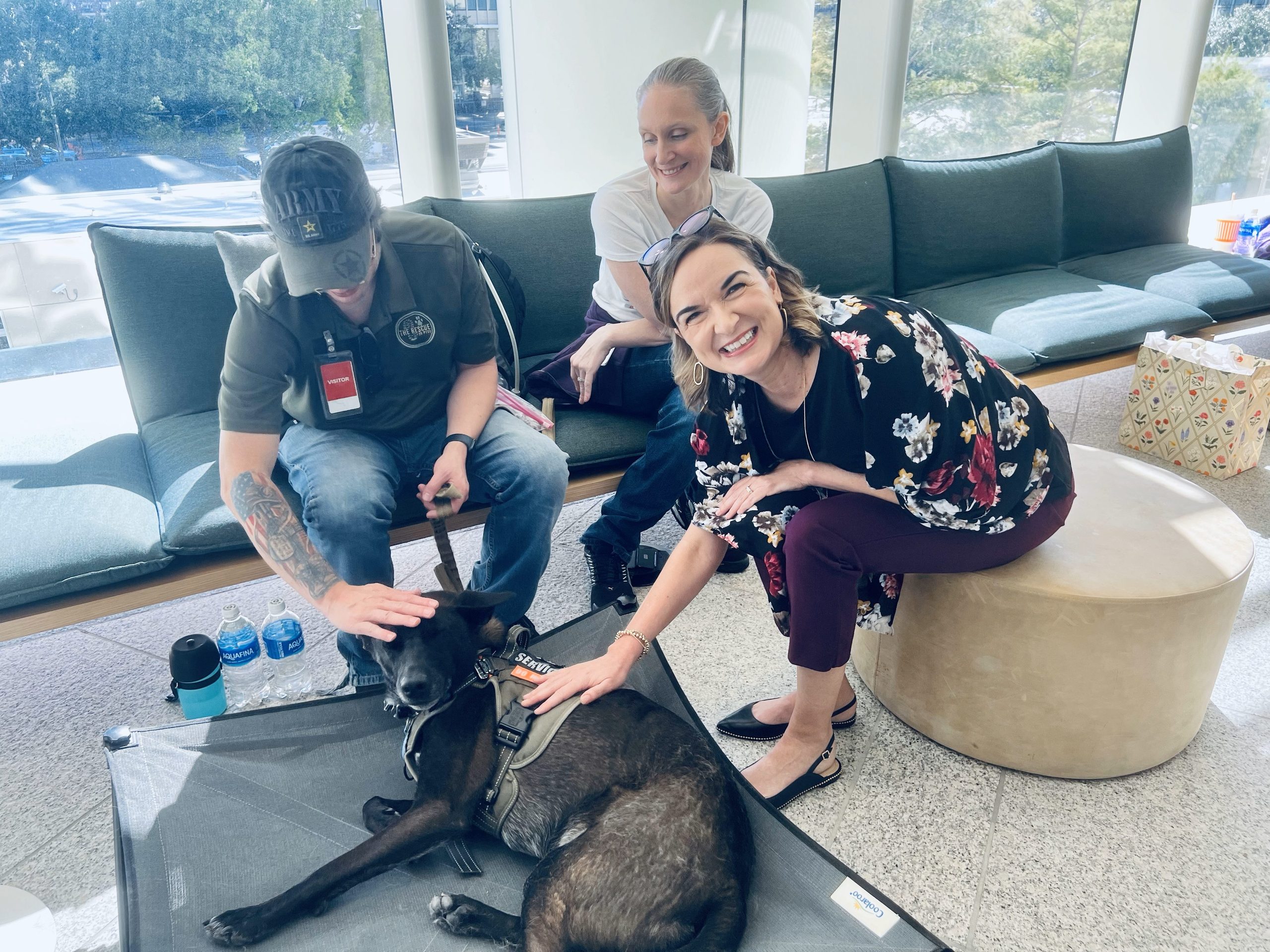
Behind the event is a partnership built inside Chevron’s own ranks. Katy Johns—Senior Asset Retirement Site Execution Lead at Chevron and Current President of the Veterans Employee Network—teamed up with Chevron retiree Laura Murray five years ago to launch the “Hug a Pup” activation. Murray, who comes from a military family and co-founded the 501(c)(3) nonprofit Rescue for PTSD with her husband, Aric, turned her lifelong background in dog training into a lifeline for returning service members. Together, Johns and Murray created the activation to give employees a midday mental health break while raising awareness around veteran PTSD; allowing staff to connect directly with trained service dogs and the military veterans who handle them.
“It’s one of our emplpoyees most favorite emplopyee engagement events that they get to participate in…It really has an impact on employee’s eventhough it’s just a 5 minute break.” – Katy Johns, President of the Veterans Employee Network
Founded in August 2017, The Rescue for PTSD has placed 19 individually trained shelter dogs with veterans and helped 38 more veterans train their own personal dogs through a dedicated group program. Bringing the organization’s total impact to 57 service dogs trained to date.
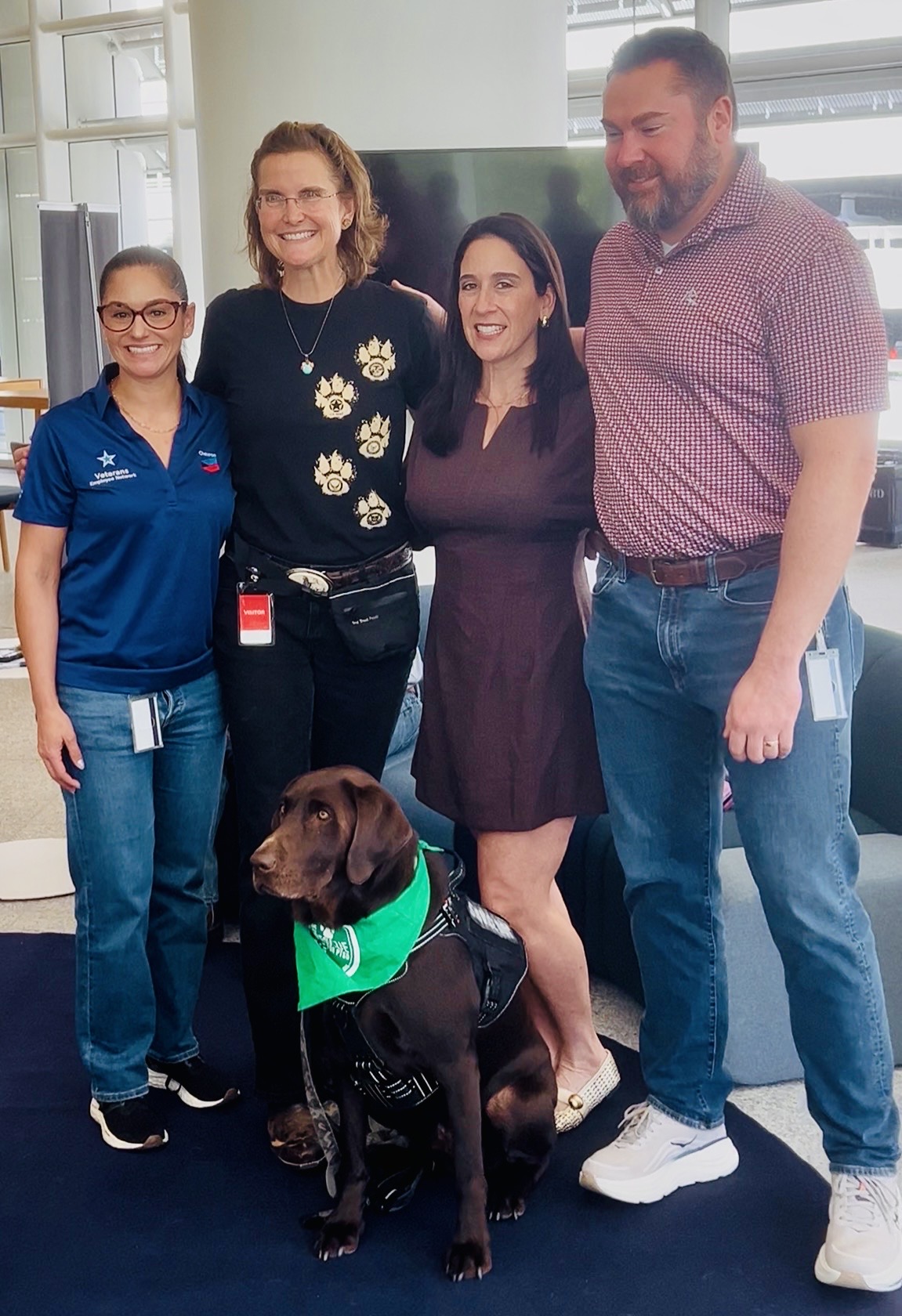
Rescue for PTSD operates on a straightforward, dual-impact model:
- Rescuing from Shelters: Rather than breeding dogs from scratch, the team adopts and rehabilitates dogs directly from local shelters and rescue groups, giving abandoned animals a second chance. “We have to deal with the PTSD of the Dogs first before we can train them to service veterans. So training can range from 6-18months” – Co-Founder Laura Murray.
- Zero Cost to Veterans: Each dog is trained specifically as a psychiatric service partner to help military veterans and first responders manage Post-Traumatic Stress Disorder—and every dog is placed completely free of charge.
- Lifelong Support: Graduates don’t just get handed a leash; veterans train alongside their partners and join ongoing monthly group classes and peer support networks to ensure the bond holds for life.
Knowing these dogs had to heal from their own trauma makes the partnership even deeper. They share real common ground with the veterans they serve, redefining what it means to be “man’s best friend.” Throughout the event, employees met four service pups: Julio, Diamond, Bear, and Smokey.
When most people picture a service dog, they imagine large breeds like Great Danes, Rottweilers, Dobermans, or Pit Bulls. Julio, however, is a Cocker Spaniel—and his owner couldn’t say enough about the difference he makes.
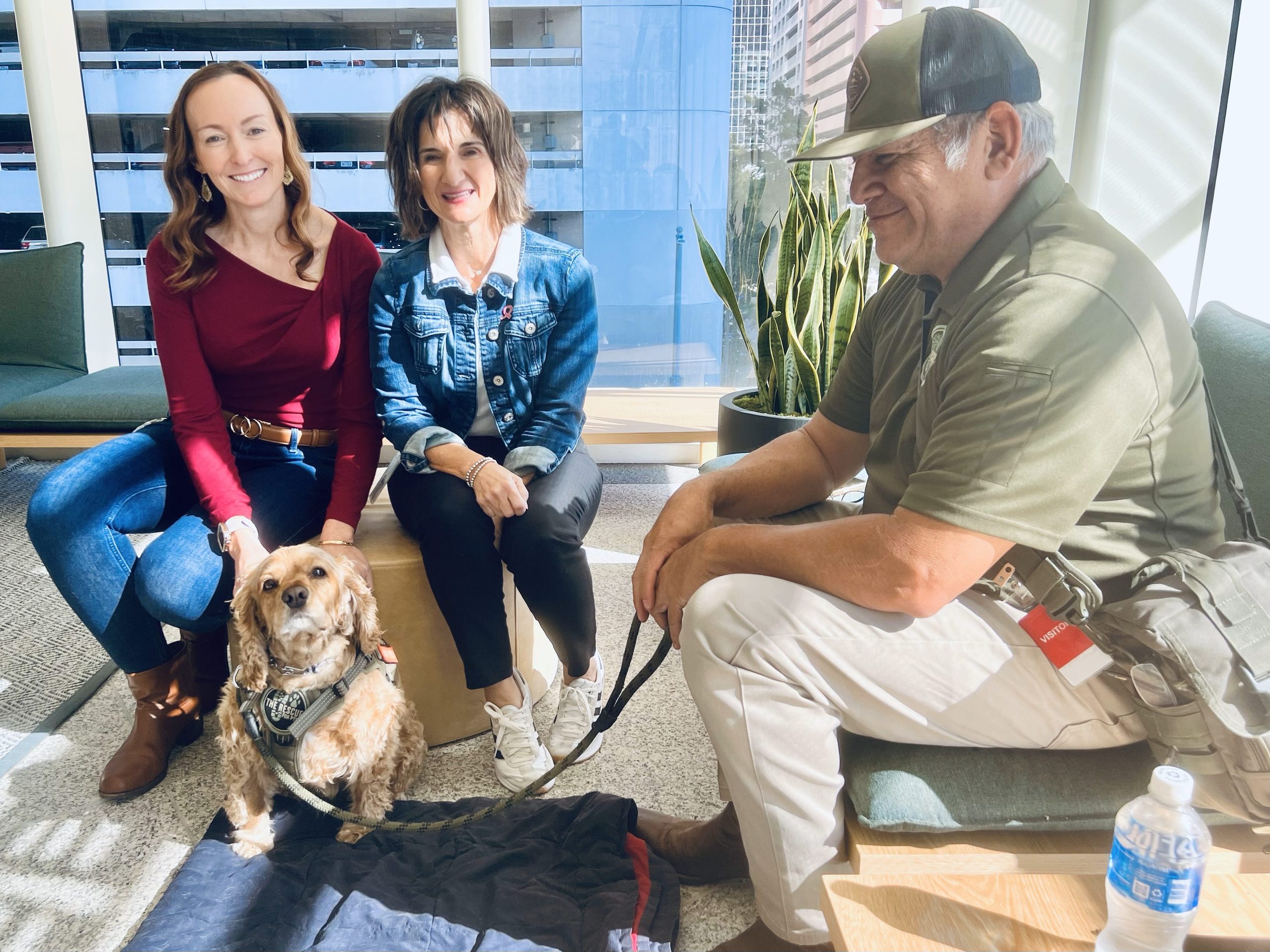
“I was in the Marines and I have a lot of anxiety. Julio helps me control my anger and anxiety.” — Mr. Davila
Everyday stressors like heavy traffic can quickly trigger anxiety or road rage for veterans managing PTSD. To interrupt those moments, The Rescue for PTSD trains its service dogs to read their handler’s cues and either rest their head in their lap or place a paw on their shoulder—a physical grounding technique that helps regulate emotions and bring calm back to the moment.
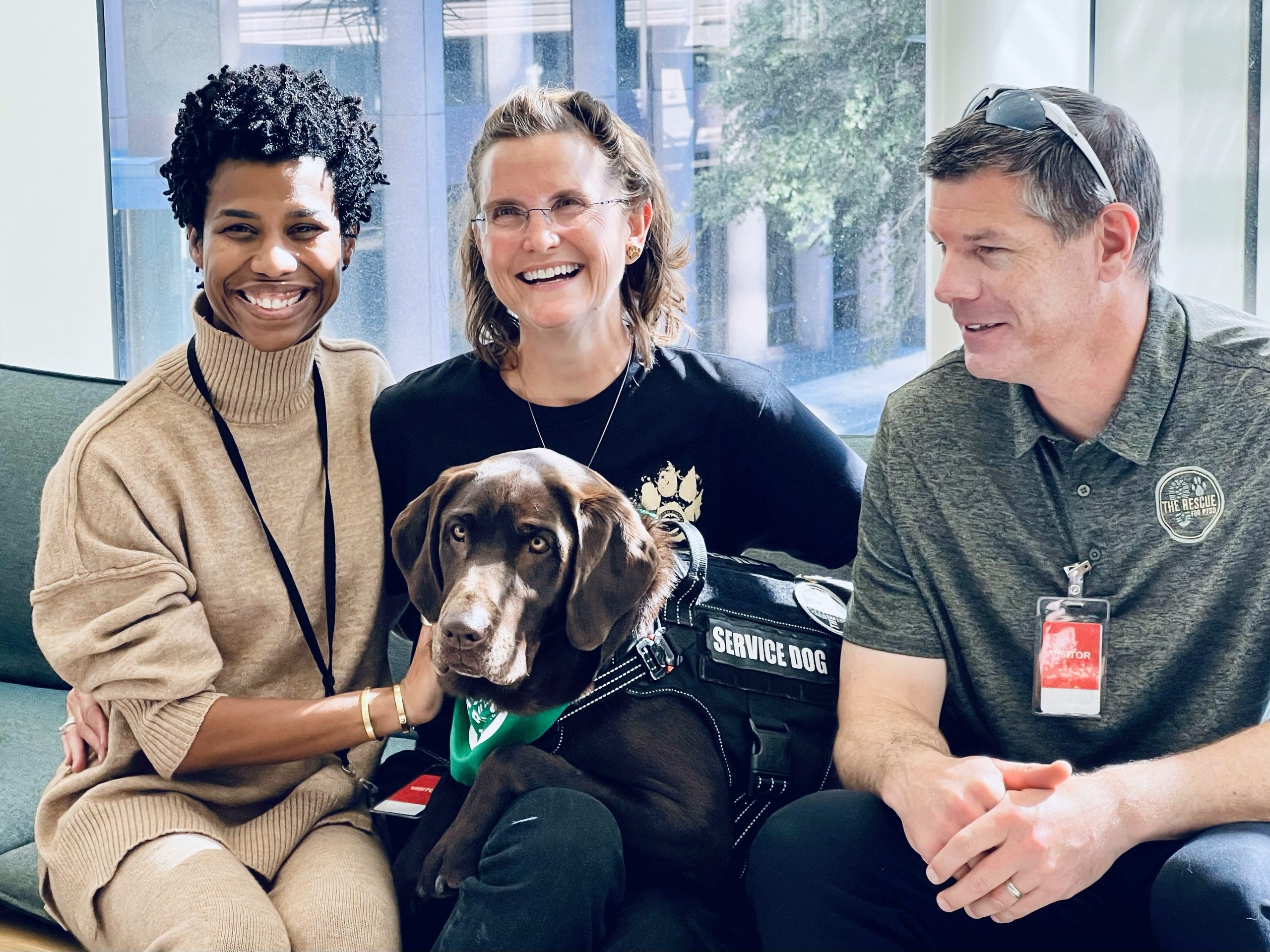
As they cycled through five-minute visits with the pups, trading conversations with veterans and seeing firsthand how these animals work in real time, employees also got a chance to HUG-A-PUP. Which helped them complete their day at work.
Rather than limiting Veterans Day recognition to an internal email blast with a poorly prompted AI graphic, Chevron brought Laura Murray, amazing service dogs, trainers, and veteran handlers onto the floor at 1500 Smith Street, putting a real face on what post-service transition actually requires. It was a brief pause in a busy downtown workday, but the takeaway was clear: service doesn’t end when the uniform comes off, and neither should community support.
To all veterans: thank you for your service. Please know you don’t have to carry the weight alone. If you are living with PTSD, reach out to The Rescue for PTSD and tap into a community built specifically with your mental health and healing in mind.
Black Press
COMMENTARY: Thank You, Trump, for Making America Great Again!
COURIER ECO LATINO — Mr. President, I never thought I would say these words, but here they are: Thank you, Donald Trump. Thank you for making America great again! You promised the American people you would do it. You traveled across this country wearing those red hats, standing before packed arenas, declaring that you alone could restore America’s greatness. And after the political earthquake of the 2026 midterm elections, I have to give you credit.

Thank You, Trump, for Making America Great Again!
Mr. President, I never thought I would say these words, but here they are: Thank you, Donald Trump. Thank you for making America great again!
You promised the American people you would do it. You traveled across this country wearing those red hats, standing before packed arenas, declaring that you alone could restore America’s greatness. And after the political earthquake of the 2026 midterm elections, I have to give you credit.
You said you would make America great again. You just never told us you were going to do it by waking up the very people you thought you could silence.
Mr. President, you may have accomplished what civil rights organizations, political strategists, voter registration campaigns and community activists have spent decades trying to achieve. You woke up Black America. You woke up young America. You woke up women across America. And perhaps most importantly, you reminded millions of Americans that democracy is not a spectator sport.
For years, we have begged our communities to understand the importance of voting. We organized marches, held rallies, registered voters, knocked on doors and pleaded with people to exercise the rights that our ancestors fought, bled and died to secure.
But then you came along.
You attacked diversity, equity and inclusion. You turned the word “woke” into a political insult. You challenged institutions that had worked to create opportunities for historically excluded communities. Your administration’s policies and rhetoric left many Americans wondering whether the progress of previous generations was being pushed backward.
And something remarkable happened.The people you underestimated decided they had heard enough. They didn’t just complain on social media. They didn’t just shake their heads at the evening news. They didn’t just talk about what needed to change. They went to the polls. And, Mr. President, they brought their receipts.
The Democratic victories in the House and Senate, along with the historic rise of Black elected leadership, represent something far greater than a political shift. They represent a powerful reminder that the American people still have the final word.
Consider Georgia. A state once synonymous with segregation, voter suppression and some of the most painful chapters of America’s racial history has witnessed a remarkable political transformation.
Keisha Lance Bottoms’ historic election as governor represents more than a victory for one candidate or one political party. As the first Black woman elected governor in American history, she represents generations of women who were told to wait their turn, stay in their place or lower their expectations.
And here in Columbus, state Rep. Carolyn Hugley stands poised to make history as the first Black woman to serve as speaker of the Georgia House of Representatives.
Think about that for a moment. Black women, whose political organizing, leadership and determination have so often been taken for granted, are now positioned to help shape the direction of government at its highest levels.
Across the country, Black candidates and other historically underrepresented leaders are demonstrating that political power does not belong exclusively to those who have traditionally held it.
And while you certainly cannot take credit for their qualifications, their sacrifices or their victories, Mr. President, you deserve recognition for helping create the political climate that motivated so many Americans to act.
You tried to make DEI a dirty word. The voters responded by making democracy a powerful one.
You said America needed to return to its greatness. But perhaps the greatest lesson of this election is that America’s greatness was never found in turning back the clock. It was never found in excluding people because of their race, gender, religion or background. It was never found in deciding whose history should be taught, whose voices should be heard or whose opportunities should be protected.
America’s greatness has always rested in its ability, however imperfectly, to move closer to the promise that all people are created equal. And sometimes, it takes a political backlash to remind us just how precious that promise is.
I am particularly proud of the role played by Black women, historically Black colleges and universities, the Black church and a new generation of voters who refused to allow frustration to become surrender.
They understood something that too many people had forgotten.You cannot change the direction of a country if you refuse to participate in determining who leads it.
But let me offer a word of caution. Winning an election is not the same as winning the future. The same energy that carried voters to the polls must now be directed toward holding elected officials accountable. Representation must translate into results. Historic firsts must produce meaningful progress.
We need affordable health care, quality education, economic opportunity, safe neighborhoods, fair housing and a justice system that treats every American with dignity.
We need elected officials who understand that making history is important, but improving people’s lives is even more important. And we must never confuse political victory with the completion of the struggle. The work continues.
Still, there is something wonderfully ironic about this moment in American history.
The man who built a political movement around the promise of making America great again may have helped inspire an entirely different movement — one determined to make America more inclusive, more representative and more accountable.
Mr. President, you told America you were going to bring about change. You did. You told America you were going to shake up Washington. You did. You told America you were going to make people pay attention to politics again. And, Lord knows, you did that too.
But perhaps your greatest political accomplishment was not what you intended to build. Perhaps it was the determination you awakened in those who refused to accept your vision of America.
You reminded us that elections have consequences. You reminded us that silence has a price. You reminded us that the power of the people is greater than the personality of any president. And you reminded Black America of something our ancestors have been telling us for generations:We do not have to beg for a seat at the table when we have the power to help determine who sits at the head of it.
So, Mr. President, from the bottom of my heart, thank you. Thank you for waking up the sleeping giant. Thank you for reminding us that our votes matter. Thank you for inspiring a generation that may have otherwise remained politically disengaged. And thank you for proving that no political movement, no administration and no individual is greater than the American people’s right to choose their own future.
You promised to make America great again. And in one of the greatest ironies of modern American politics, you may have helped do exactly that. Just not the way you planned.
Because, Mr. President, while you were busy trying to take America back, the American people were busy taking their country forward. And that, my friends, is what making America great really looks like.
Black Press
Alameda County Supervisor Miley to Propose Illegal Dumping Ordinance
POST NEWS GROUP — The proposed ordinance would add Chapter 6.121 to the County’s General Ordinance Code, establishing an administrative enforcement process that would allow the County to hold more parties accountable without relying solely on criminal prosecution.
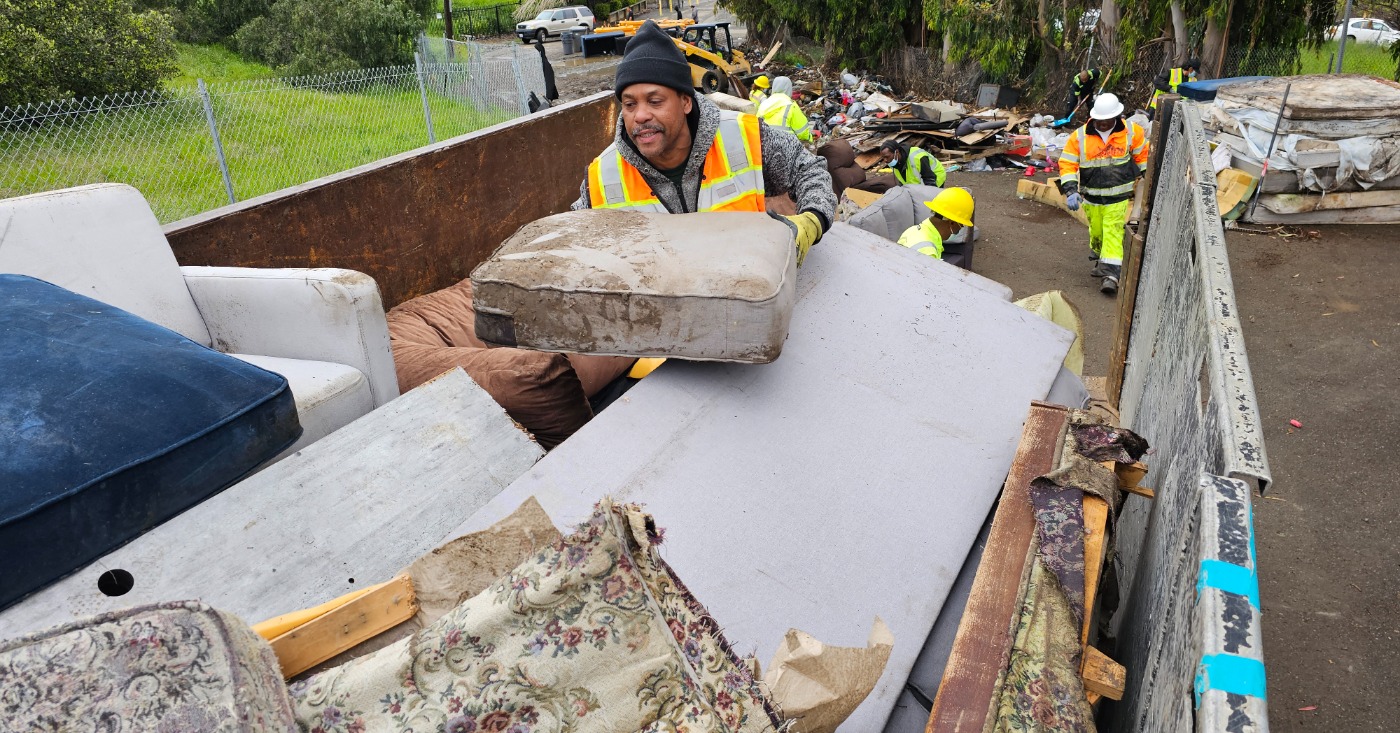
Proposal expands accountability, establishes administrative penalties, and ties fines to cleanup costs
On Tuesday, Nov. 17, the Alameda County Board of Supervisors is scheduled to consider the first reading of an ordinance proposed by Supervisor Nate Miley to strengthen enforcement against illegal dumping in unincorporated Alameda County, including Ashland, Cherryland, Castro Valley, San Lorenzo and Fairview.
Illegal dumping places a significant financial burden on residents and taxpayers. In 2024, Alameda County spent $3.8 million addressing 1,483 illegal dumping incidents, an average of approximately $2,562 per incident. Yet no illegal dumping cases from the unincorporated county were charged that year.
The proposed ordinance would add Chapter 6.121 to the County’s General Ordinance Code, establishing an administrative enforcement process that would allow the County to hold more parties accountable without relying solely on criminal prosecution.
Key provisions include:
- Expanded accountability: Penalties could apply to individuals who dump waste, those who provide waste to unlicensed haulers who illegally dispose of it, and vehicle owners who knowingly consent to their vehicles being used for illegal dumping.
- Administrative enforcement: Authorized County personnel could issue penalties and abatement orders, with opportunities for administrative hearings and judicial review.
- Penalties tied to cleanup costs: Fines would start at $2,500 for a first violation, increase to $5,000 for a second and $10,000 for a third. Enhanced penalties of up to $10,000 per violation could apply to large-scale dumping, hazardous waste, or dumping near sensitive locations such as creeks, schools and storm drains.
The ordinance includes safeguards for people acting in good faith. Residents and businesses using licensed haulers would be exempt from waste-generator liability, while vehicle owners whose vehicles were used without their consent and property owners unaware of dumping on their land would also be protected.
Cited individuals could request community service in lieu of penalties, with ability to pay among the factors considered. The proposal would also allow property owners, business improvement districts and community groups to pursue recovery of cleanup costs and authorize the Board to establish a reward fund for tips identifying illegal dumpers.
“Every mattress and every truckload of construction debris dumped in Ashland, Cherryland and Castro Valley gets paid for by the people who live there, and right now the people responsible almost never face a consequence,” Miley said. “This ordinance closes the loopholes that let people hand off their waste and walk away. It gives the County a fair and swift way to hold dumpers accountable, protects people who do the right thing, and makes the penalty match what it costs us to clean up after them.”
Modeled on Santa Cruz County’s illegal dumping ordinance, which took effect in July 2025, the proposal was recommended for approval by the Board’s Unincorporated Services Committee.
Miley is also urging cities and counties throughout the region to adopt similar standards. His office has released a Model Illegal Dumping Enforcement Ordinance developed through the Alameda County Illegal Dumping (ACID) Task Force to support coordinated regional enforcement.
If the Board conducts the first reading on Nov. 17, the ordinance will return for adoption at a subsequent meeting and take effect 30 days after adoption.
Paul Sanftner is the director of communications and special projects for the office of Alameda County Supervisor Nate Miley.


Alonzo Mourning’s Affordable Senior Housing

Black Men Encouraged to Start Prostate Cancer Screening at 45

Computational Thinking and Young Children: It’s Not What You Might Think!

Inside Chevron’s Fifth Annual “Hug a Pup” Salute to Veterans

Filmmaker Joy Adenike brings Nollywood romance to Houston

Filmmaker Joy Adenike brings Nollywood romance to Houston

2026 Best of Black Business Awards Recap: Meet the Winners

LIVE! — ASK ALMA — TUES. 11.24.26 7PM EST

Charles Cave turns community service into Houston legacy

Houston ISD board: Transition to local control can start ‘mid-January’

Practitioners of African Traditional Spirituality Offer Ancestral Reverence Ritual Oct. 31

HISTORY MADE: Keisha Lance Bottoms Becomes First Black Woman Elected Governor in American History

Tamiko Armstead | 2026 Lifetime Achiever in Education

Kickstarter CEO Everette Taylor Shares Tips on Creating and Growing a Business

BLACK MEN VOTE: Mobilizing 100,000 Black Men Ahead of the Midterms 📱

NFN live presents 🎙️ THE ROAD TO BEYOND IWDM 50: WE CANNOT STOP NOW! 8-Week Podcast

Black Household Wealth Plummeted 25% in Three Years, New Data Shows

Secretary of State Shirley Weber Pushes Back Against DOJ Demands Over California Voter Rolls

COMMENTARY: BIG MAMA SAID: Don’t Throw Away the Gift Just Because It Came Wrapped Wrong

Columbus’s Oldest Businesses Still Open: 10 That Have Lasted 75+ Years
Filmmaker Joy Adenike brings Nollywood romance to Houston
Filmmaker Joy Adenike brings Nollywood romance to Houston
2026 Best of Black Business Awards Recap: Meet the Winners
LIVE! — ASK ALMA — TUES. 11.24.26 7PM EST
Charles Cave turns community service into Houston legacy
Houston ISD board: Transition to local control can start ‘mid-January’

400 days – Fifth Ward awaits cancer cluster EPA report

The Hidden Cost of Friction in Car Buying

Truck Test Drive: Is Heavy Steering a Warning Sign? #shorts

Nationwide Flight Chaos, Democratic Leadership Battles 📱
-
 Black History1 week ago
Keisha Lance Bottoms to Govern State Where Her Great-Great-Grandfather Was Enslaved
-

 Black History1 week ago
Don’t Pass the Torch. Expand the Circle.
-

 Black Press3 days ago
OP-ED: Closing the Next Digital Divide — Communities of Color Must Have a Voice in the AI Future
-
 Black History1 week ago
Meet Scott Colom, the Mississippi Democrat Leading Tight Mississippi Senate Race
-

 Black Press1 week ago
Eight Black Women Win Georgia Statewide Offices
-

 Featured1 week ago
Democratic Leadership Under Fire, Maxine Waters Challenged & Tyler Perry’s New Political Role 📱
