
Art
Popular Crenshaw mural defaced by swastikas
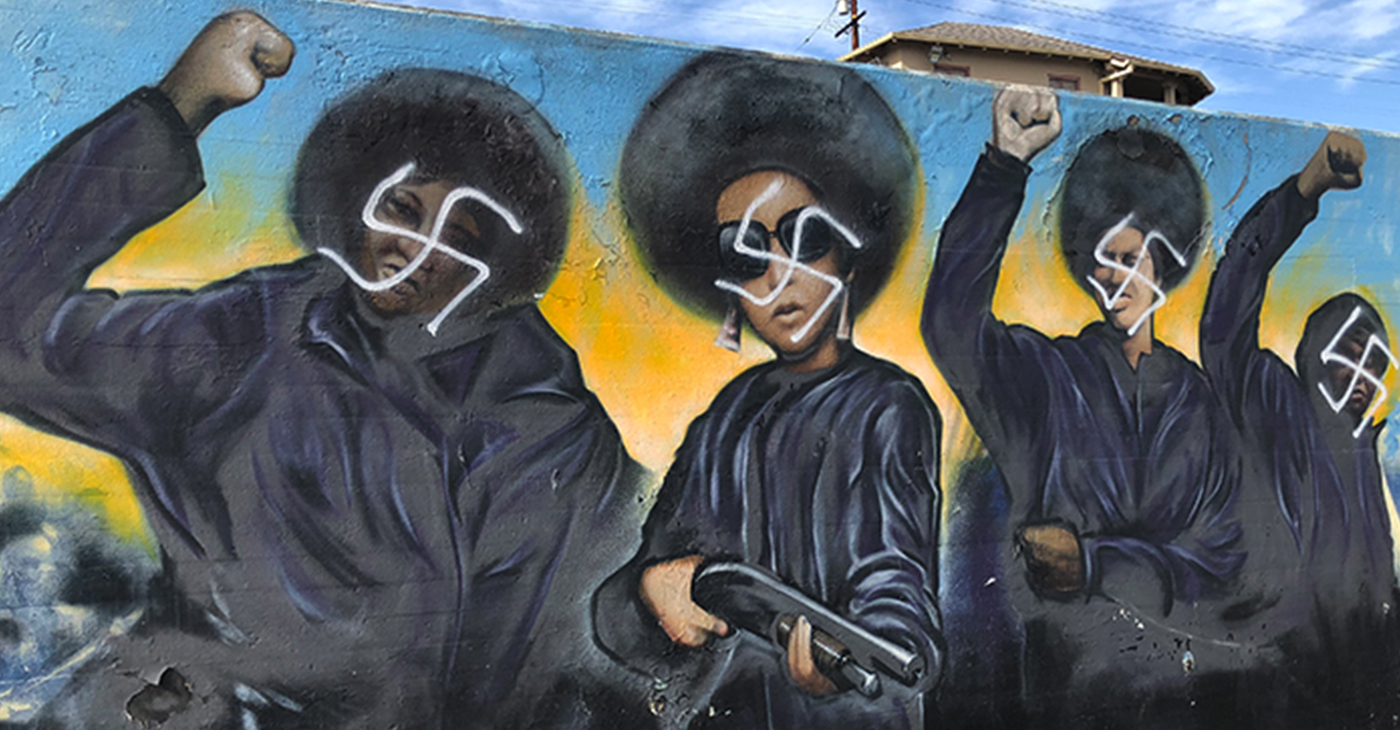
WAVE NEWSPAPERS — The mural, named “Our Mighty Contribution,” stretches for an entire city block and has been a cultural institution in the African-American community for nearly two decades

By Shirley Hawkins
CRENSHAW — The Los Angeles Police Department will conduct a community meeting concerning the vandalism of a Crenshaw Boulevard mural will be held at 6:30 p.m. Dec. 7 on the first floor of the Kaiser Permanente Baldwin Hills Community Room, 3782 W. Martin Luther King Jr. Blvd.
Speakers will include City Councilman Marqueece Harris-Dawson, Southwest LAPD Area Captain Lee Sands, Southwest LAPD Detective Commanding Officer Perry Griffith and Southwest LAPD Investigating Detective Anthony Kong.
Police are still seeking the unknown suspect who spray painted swastikas on the mural that depicts four defiant Black Panthers and other African-American heroes Nov. 29.
Police were notified of the defacement just before noon and nearly 30 law enforcement officials arrived to inspect the damage done to the mural, which is located at 50th Street and Crenshaw Boulevard.
The mural, named “Our Mighty Contribution,” stretches for an entire city block and has been a cultural institution in the African-American community for nearly two decades. It depicts African American icons such as Martin Luther King Jr. Frederick Douglass, Malcolm X and Marcus Garvey.
With hate crimes against minorities continuing to rise in Los Angeles County, the news of swastikas being painted on the faces of four Black Panther women was a cause for concern.
“My detectives canvassed the entire neighborhood for video footage,” Griffith said. “We have some investigative leads.”
Pausing, he added, “Historically, the wall is a mainstay in this community. I’ve seen that wall throughout my youth. It depicts the fabric of the community and we are taking the vandalism very seriously.”
Enkone, the artist who spearheaded the drawing of the mural over 18 years ago with 12 other artists known as Rocking the Nation, said his phone started ringing immediately after the incident.
“I received multiple phone calls from different friends,” Enkone said. “One was filmmaker and curator of the mural Gregory Everett, who is working on a Black Panther documentary titled ‘41st and Central.’ He sent a picture of the vandalism to me and to Gil Parker, a former Black Panther.”
“After I heard about the vandalism, I called a lot of people who were in the party,” said Parker, who was a member of the Black Panther Southern California Chapter from 1968 to 1970.
“Hate led to that defacement. It had to be someone who had a disrespect for our people,” Parker added. “You can’t pinpoint where it derives from, especially considering the state that the country is in at this time. There’s a lot of polarization and division. Different hate groups have come to the surface with no regard for their fellow Americans.”
Enkone said he wasted no time seeing the vandalism for himself.
“I immediately rushed to the location and witnessed the swastikas that had been spray painted over the faces of the four female Black Panthers. To tell you the truth, I was shocked,” he said.
Enkone said he and a cleanup crew worked quickly to remove the swastikas to restore the mural by using a special anti-graffiti solution. He touched up the mural with spray paint to ensure that it was restored to its original condition. “I wanted to make sure that the swastikas were removed before the students from Crenshaw High School were released from class,” he said. “I did not want the students to see that damage. That wall is love and they didn’t need to see hate.”
The mural depicts four Afro-wearing black women defiantly holding guns and hoisting their fists in solidarity during the 1960s, when the Black Panther and Black Power movements were at their height.
Enkone said he was inspired to draw the section of the mural featuring the four Black Panther women after seeing a photo of Black Panther Kathleen Cleaver holding a rifle at a rally.
“I was thumbing through this book in the library when I was in the seventh grade and came across the Cleaver photo. It was so powerful. It fascinated me,” said Enkone, who quickly posted the photo on his bedroom wall.
“I believe that the Black Panthers were misunderstood,” Enkone added. “Black people were being beaten, kicked and raped by police officers on a daily basis. They found loopholes to carry loaded guns to protect people from white supremacy because the black community was being brutalized.”
Some community residents believe that the swastikas represent an underlying sentiment that is creeping into the neighborhood. A steady stream of people have been stopping by the mural to take pictures to film the mural on their cell phones.
“The perpetrator or perpetrators need to be wiped off the face of the map,” said 54-year-old Crenshaw resident Lamar Marquez. “It could be anybody. We have nothing to go on. God Bless their soul.”
“I think that it might have been people who are against the cause of the Black Panthers,” said 14-year-old David Purdom, a student at View Park High School. “They are going to get punished by God because they defaced something beautiful.”
“I saw the vandalism of the mural on the news. It’s hard to say who did it,” said Crenshaw resident David Williams, 59, who was waiting for his order at the nearby Popeye’s Chicken. “That mural has been there for years, so why would they mess over it now? It might be some kids, but it might be some hate stuff.”
Michael Williams pulled up in his car near the mural and immediately began recording the painting of the four Black Panthers on his cell phone.
“A friend sent me an Instagram picture of the swastikas spray painted over the faces of the Black Panther women. I thought it was a joke,” Williams said. “I had to come and see for myself.
“If you allow this crap to happen in this community, then you are allowing them to take over our last standing neighborhood,” he added.
Gregory Dulan, owner of Dulan’s Soul Food that is located on the same block as the mural, said he was outraged when he heard about the incident.
‘‘That mural has been there for decades, and it made me angry when I saw it had been defaced,” Dulan said. “The fact that it was painted with swastikas is an insult to the entire community. I just hope they catch who did it.”
This article originally appeared in the Wave Newspapers.













Art
Comedy and Loss Collide in Kevonstage’s ‘Grief Sucks’ at the Pageant
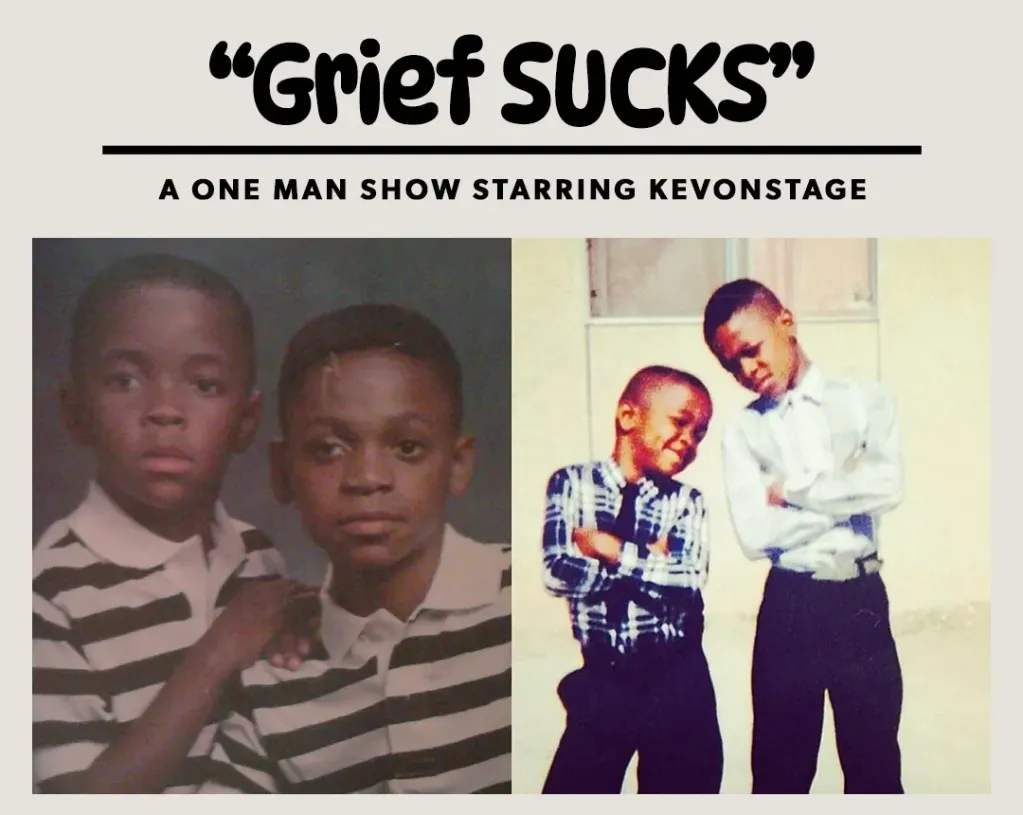
ST. LOUIS AMERICAN — Comedian KevOnStage brought his one-man show “Grief Sucks” to The Pageant, offering an experience that blended humor with the raw realities of loss. The show, rooted in his personal journey after the sudden death of his brother, manager, and business partner Jason Fredericks four years ago, gave the audience permission to laugh and cry, often at the same time.
When KevOnStage took the stage at The Pageant Sunday night, his house rules let everyone know what they were in for with his one-man show “Grief Sucks.”
“Do not judge yourself. Do not judge the jokes. Just laugh,” he said.
Even within his directions, were jokes.
He gave the audience permission to cry, but quietly – because Black people have a tendency to do things at full volume.
The hour that followed provided plenty of laughter. But underneath the humor were truths that anyone who has ever lost someone could feel deep in their chest.
The show was based on his experience of losing his brother, best friend, manager and business partner Jason Fredericks. He died suddenly of a heart attack four years ago at the age of 42.
Kev warned the audience to be mindful of their social media — both the wild posts that could end up being someone’s last and the intrusive ones people make after a loved one dies. And he gave people permission to laugh at the moments that feel too outrageous to say out loud — the ones that become inside jokes for families trying to survive the worst days of their lives.
“Grief is dark humor,” he said as he walked through the story of his brother’s death — a story he jokingly blamed on Nia Long.
He found a way to give permission to laugh at the outlandish moments that often serve as inside jokes. Those who have lived through some of the worst moments of their lives and not only found a way to talk about it, but to steal a laugh in the midst.
“Grief is dark humor,” he said as he walked through the story of his brother’s death — a story he jokingly blamed on Nia Long.
“I know that sounds crazy,” he said. “It’s not her fault — but it is her responsibility.”
It was a jarring moment, but it let the audience know exactly what kind of honesty they were in for.
He said his brother’s death was “proof that she is drop‑dead gorgeous.”
“Sometimes things are funny — and sometimes things are funny because you should not be laughing,” he said.
The show moved through a series of points about grief, each one backed by a story that made the room nod in recognition. He talked about how grief can twist ordinary moments — how it can make you jealous of people with siblings or irritated by strangers having a good day.
He explained how grief can twist even the simplest moments, how it can make you jealous of people with siblings, or irritated by strangers having a good day. He brilliantly compared grief to a rock stuck in your shoe. Sometimes it’s small and manageable. Other times its jagged and unbearable – but always there.
He also talked about the unfairness of grief — how the world doesn’t stop when your loved one dies, how people still go to Raising Cane’s, still pick up their kids, still laugh. And he talked about the heartbreak of realizing his brother never got to see things he would have loved, from TV shows to cultural moments. And that he was robbed of the opportunity to engage with him about them.
“He would have loved Sinners,” Kev said. “But he never got to see it.”
At one point, he paused to show a video of his brother telling him how proud he was. The room went quiet. It wasn’t the polite kind of silence – but the kind where you can hear someone in the back sniff. The crowd assured him that it was okay for him to take a beat. His voice shook as he pushed through. Those pauses made the audience lean in even more.
Kev made grief feel communal. He made people laugh at things they didn’t think they were allowed to laugh at. And he reminded everyone in the room that grief doesn’t make sense, doesn’t follow rules, and doesn’t care about timing. And most importantly, he drove home the point that it also doesn’t have to be carried alone.
There were moments when his emotions got the best of him. There was the video he shared of his brother telling Kev how proud he was of him that compelled him to take a beat. His voice quivered as he powered through. Those pauses made the audience connect with the show all the more. Grief Sucks wasn’t just comedy. It was catharsis. It was storytelling. It was a room full of people realizing they weren’t the only ones trying to make sense of loss.
KevOnStage gave them permission to feel all of it — and to laugh anyway.
Internet personality and standup comedian KevOnStage used the sudden and unexpected loss of his brother as the foundation for a one-man show that was funny, honest and a little dark – often at the same time.
Sunday night, he brought “Grief Sucks” to The Pageant. His barometer check
KevOnStage walked onto The Pageant stage Sunday night with a promise: that the next hour would be funny, honest and a little dark. And he delivered all three — often at the same time.
His one‑man show, Grief Sucks, was as relatable as it was funny. It was the kind of performance where the audience laughed hard, then caught themselves nodding in recognition. Because beneath every punchline was a truth that anyone who has lost someone could feel in their chest.
He opened with the kind of humor that only comes from someone who has lived through the worst days of their life and somehow found a way to talk about it. He told the crowd they had permission to cry, laugh, sit still, or just breathe — but to “cry quietly,” because, as he joked, Black folks tend to do everything at full volume.
Then he went straight into the story of losing his brother — not with soft edges, but with the kind of raw honesty that made the room go still. He explained how grief can twist even the simplest moments, how it can make you jealous of people with siblings, or irritated by strangers having a good day. He compared grief to a rock stuck in your shoe: sometimes small and manageable, sometimes jagged and unbearable, but always there.
And he didn’t shy away from the intrusive thoughts that come with loss — the ones people rarely admit out loud. He shared the moment he realized he had lived longer than his older brother ever got to, and how that fact sits heavy no matter how much time passes.
Kev’s storytelling is built on the kind of humor that comes from real life — the funeral home upcharges, the family dynamics, the dark jokes that slip out at the worst possible moments. He told a story about previewing his brother’s body with his wife and grandmother, and how one unexpected comment turned into an inside joke that has carried them through four years of grief.
He also talked about the unfairness of grief — how the world doesn’t stop when your loved one dies, how people still go to Raising Cane’s, still pick up their kids, still laugh. And he talked about the heartbreak of realizing his brother never got to see things he would have loved, from TV shows to cultural moments.
The most emotional part of the night came when he recounted the day his brother died — the phone calls, the confusion, the hope, and finally the moment his nephew said, “He’s gone,” while Kev was sitting in a middle seat on a United flight. He told it plainly, without theatrics, and the room held its breath.
But even in that story, he found a way to make people laugh — not at the pain, but at the absurdity of life continuing around you when your world has just shattered.
By the end of the show, KevOnStage had done something rare: he made grief feel communal. He made people laugh at things they didn’t think they were allowed to laugh at. And he reminded everyone in the room that grief doesn’t make sense, doesn’t follow rules, and doesn’t care about timing — but it also doesn’t have to be carried alone.
Grief Sucks wasn’t just comedy. It was catharsis. It was storytelling. It was a room full of people realizing they weren’t the only ones trying to make sense of loss.
And on a Sunday night at The Pageant, KevOnStage gave them permission to feel all of it — and to laugh anyway.
Based on reporting by St. Louis American.
Art
Inside 820 S. Michigan: New Book Captures the Lost World of Ebony and Jet
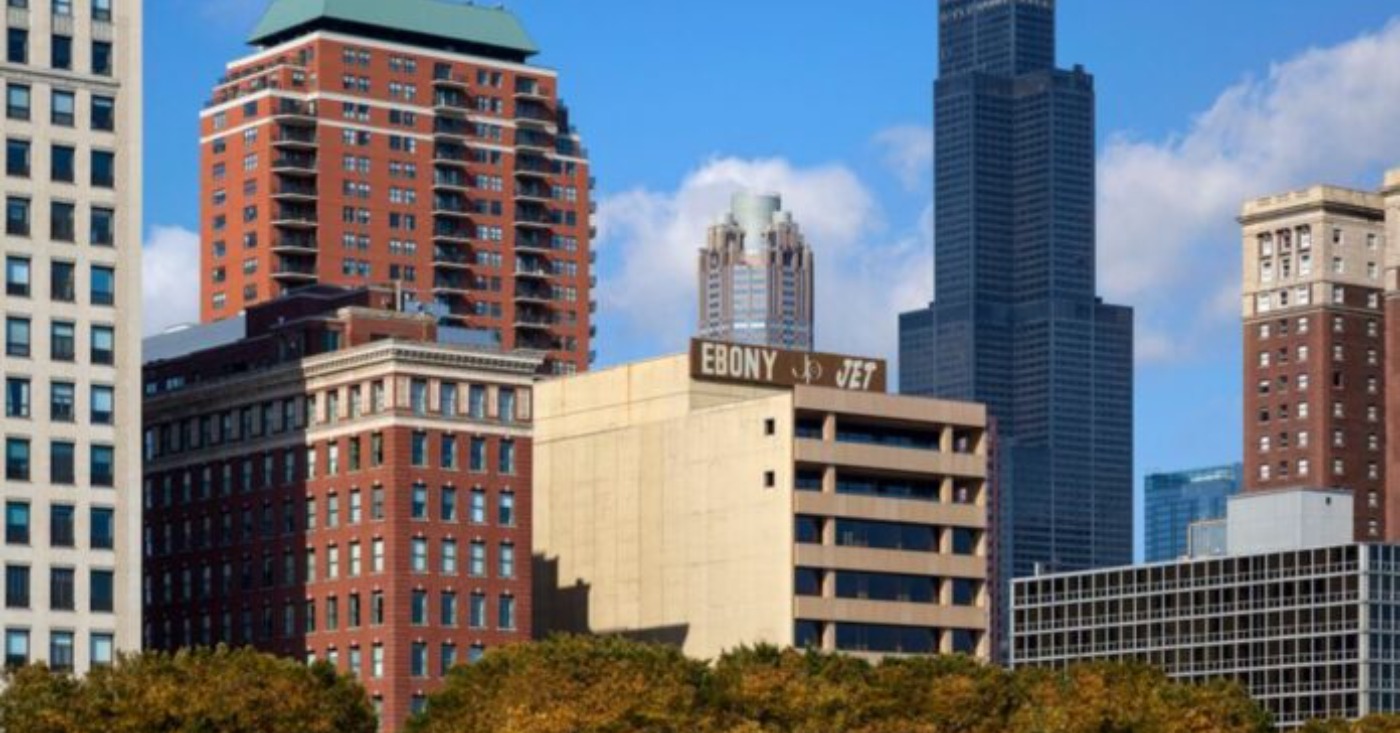
CHICAGO DEFENDER — A new photography book offers a rare look inside the former Johnson Publishing Company headquarters at 820 S. Michigan Ave., the longtime home of Ebony and Jet magazines. Titled 820 Ebony/Jet: Visions of the Johnson Publishing Company, an American Icon, the book features photographs by Barbara Karant documenting the building’s interiors.
A new photography book is giving readers a rare look inside one of the most important buildings in Black media history.
820 Ebony/Jet: Visions of the Johnson Publishing Company, an American Icon, published Tuesday by MW Editions, features photographs by Chicago photographer Barbara Karant documenting the former Johnson Publishing Company headquarters at 820 S. Michigan Ave., the longtime home of Ebony and Jet magazines. Pasted markdown
The 240-page book preserves the building’s striking interiors, many of which no longer exist in their original form, while also examining the larger cultural legacy of Johnson Publishing Company and its influence on Black media, design, photography and American culture.
Designed by architect John W. Moutoussamy and completed in 1972, the building was the first, and remains the only, high-rise in downtown Chicago designed by an African American architect. Built for publisher John H. Johnson, the headquarters became a physical expression of the ambition and influence of one of the nation’s most important Black-owned media companies.
While the building’s exterior reflected Moutoussamy’s restrained modernist style, the inside told a very different story.
Designers Arthur Elrod and William Raiser filled the headquarters with bold colors, geometric patterns, mirrored surfaces, rich textures and dramatic materials across 11 floors. The result was a workplace that looked unlike the traditional corporate offices of its era. Pasted markdown
Karant began photographing the building after Johnson Publishing sold the property in 2010 and relocated in 2012. Between 2013 and 2015, and again in 2018, she documented the largely vacant interiors after employees and much of the furniture had been removed.
What remained were the colors, patterns and architectural details that had helped define the company’s visual identity.
Her photographs capture spaces ranging from the cafeteria’s orange, purple and gold designs to Eunice Johnson’s cream-and-honey office, mirrored dressing rooms and the executive floor’s expansive views of Lake Michigan and Grant Park. Pasted markdown
Among the building’s most memorable spaces was the famed Ebony Test Kitchen.
Known for its vivid colors, psychedelic patterns and distinctive cabinetry, the kitchen became a visual reflection of Ebony magazine’s influence on food, lifestyle and Black culture. Karant photographed the kitchen as part of the larger architectural story of the headquarters. Pasted markdown
“The building was almost like a portrait of Johnson Publishing Company itself,” Karant said. “Even after the people and furnishings were gone, the colors, patterns, textures and spaces still conveyed the creativity, confidence and extraordinary cultural presence of the company.”
The photographs have taken on even greater significance because much of what Karant documented has since disappeared.
Following the building’s conversion, substantial portions of the original interiors were removed. The Ebony Test Kitchen was dismantled and preserved separately, making Karant’s images one of the most extensive visual records of how the headquarters looked during Johnson Publishing Company’s decades on Michigan Avenue. Pasted markdown
The book also includes photographs of sculptor Richard Hunt’s Expansive Construction, a work commissioned for the building’s lobby, as well as images of the company’s in-house photography studio and archival views of the original interiors.
But 820 Ebony/Jet goes beyond architecture.
The book includes a foreword by photography historian Deborah Willis, six scholarly essays and personal reflections from former Johnson Publishing Company employees. Together, the contributions explore the company’s role in Black visual representation, media, photography, art and design, while offering firsthand accounts of what it was like to work inside the building. Pasted markdown
For generations, Ebony and Jet helped shape how Black America saw itself and how the country saw Black America.
The magazines documented everything from politics and the civil rights movement to fashion, entertainment, family life and culture. Johnson Publishing Company also became an influential force in photography, beauty, design and popular culture.
That legacy extended well beyond the pages of its magazines.
The new book examines Johnson Publishing Company’s continuing influence on artists including Theaster Gates, Hank Willis Thomas, Kwame Brathwaite, Lorna Simpson, Martine Syms and David Hartt. Pasted markdown
For Chicago, the book serves as both an architectural record and a cultural archive. It preserves a place where Black entrepreneurship, media, art and design converged at a scale rarely seen before or since.
820 Ebony/Jet: Visions of the Johnson Publishing Company, an American Icon is available now from MW Editions. The hardcover volume includes 150 photographs and is priced at $65. Pasted markdown
Karant is also scheduled to present the book during Modernism Week at the Palm Springs Art Museum on Feb. 15, 2027, where she will discuss the connection between the Johnson Publishing Company headquarters and the design legacy of Arthur Elrod and William Raiser.
The post Inside 820 S. Michigan: New Book Captures the Lost World of Ebony and Jet appeared first on Chicago Defender.
Based on reporting by Chicago Defender.
Art
Houston’s ‘call Me Mother’ Exhibit Opens Today, Spotlighting Black Maternal Health
AFRICAN-AMERICAN NEWS AND ISSUES – DALLAS — The Health Museum in Houston today opens “The Call Me Mother Experience,” an exhibition spotlighting Black maternal health through art and personal storytelling. Curated by Houston’s first Black poet laureate, Deborah D.E.E.P. Mouton, the project originated from her own poem written during a miscarriage.
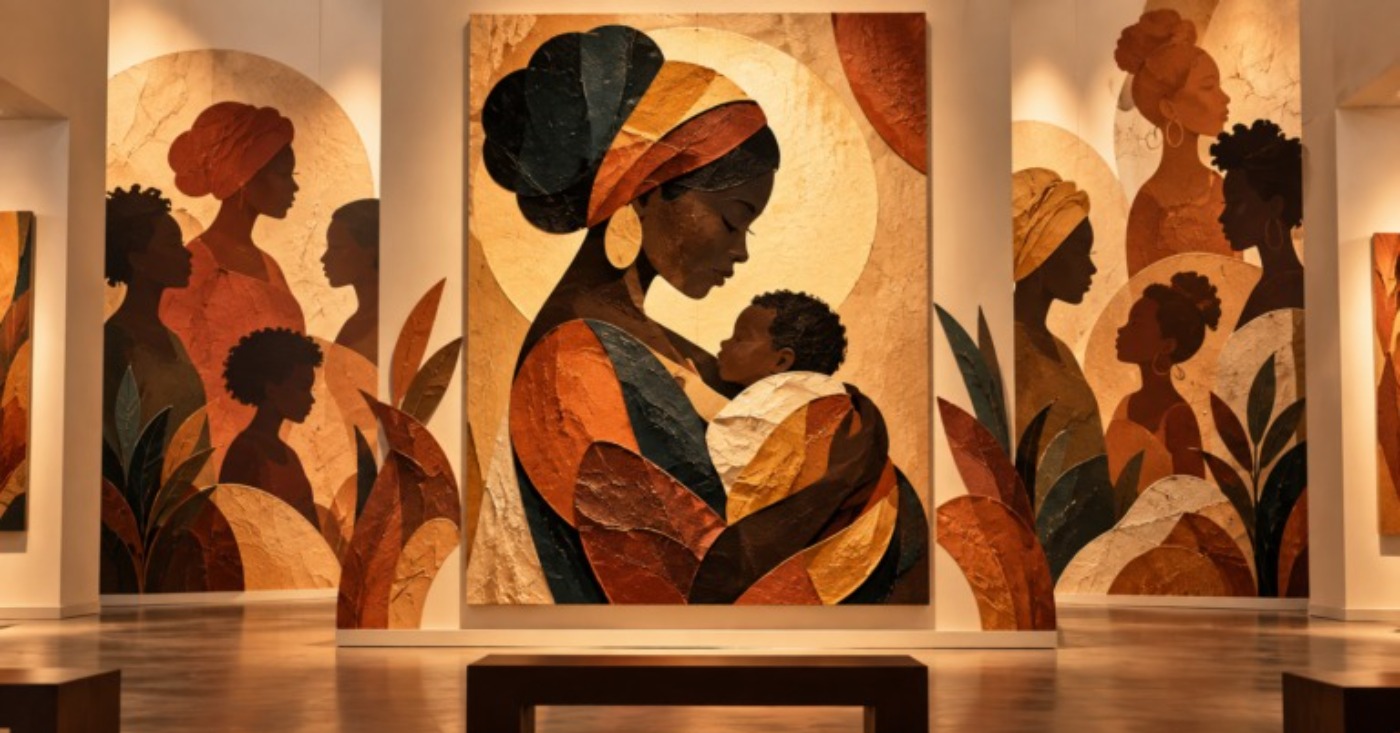
HOUSTON — A new exhibition opening Sunday, Oct. 4, at The Health Museum is bringing Black maternal health into public view through art and personal storytelling.
The Call Me Mother Experience will be on display through Feb. 28, 2027. The museum lists a preview reception today from 3 to 5 p.m. at 1515 Hermann Drive, with tickets priced at $5 for members and $15 for nonmembers.
A personal story becomes a community conversation
According to the museum, founder, curator and lead artist Deborah D.E.E.P. Mouton developed the project from a poem she wrote during a miscarriage. The installation combines films, recorded interviews, visual artwork and contributions created with community members.
Mouton, Houston’s first Black poet laureate, discussed the exhibition and her connection to its subject in an Oct. 1 appearance on KPRC’s Houston Life. The station described the project as addressing the unequal burden of pregnancy-related illness and death faced by Black women in Harris County.
An announcement distributed by the Call Me Mother Experience says the initiative will also reach community locations and faith-based organizations across Greater Houston. Those additional settings are intended to extend the conversation beyond a museum visit.
What visitors can expect
The museum says reception guests can explore the exhibit, hear the curator and meet participating artists. Reception admission includes general museum entry; refreshments are available while supplies last.
The featured image accompanying this article is an original illustrative concept, not a photograph of the exhibition or its artwork.
Sources and visitor information:The Health Museum exhibition listing; preview reception details and tickets; KPRC Houston Life; organizer announcement.
The post Houston’s ‘Call Me Mother’ Exhibit Opens Today, Spotlighting Black Maternal Health appeared first on African American News and Issues.
Based on reporting by African-American News and Issues – Dallas.
Art
Montclair Brewery: Brewing Culture, Community, History
THE POSITIVE COMMUNITY — Montclair Brewery, located in Montclair, New Jersey, has evolved beyond a craft beer destination into a community gathering place. Founded by husband-and-wife team Leo and Denise Sawadogo, the brewery connects its beers to African, Caribbean, and African American history and culture.
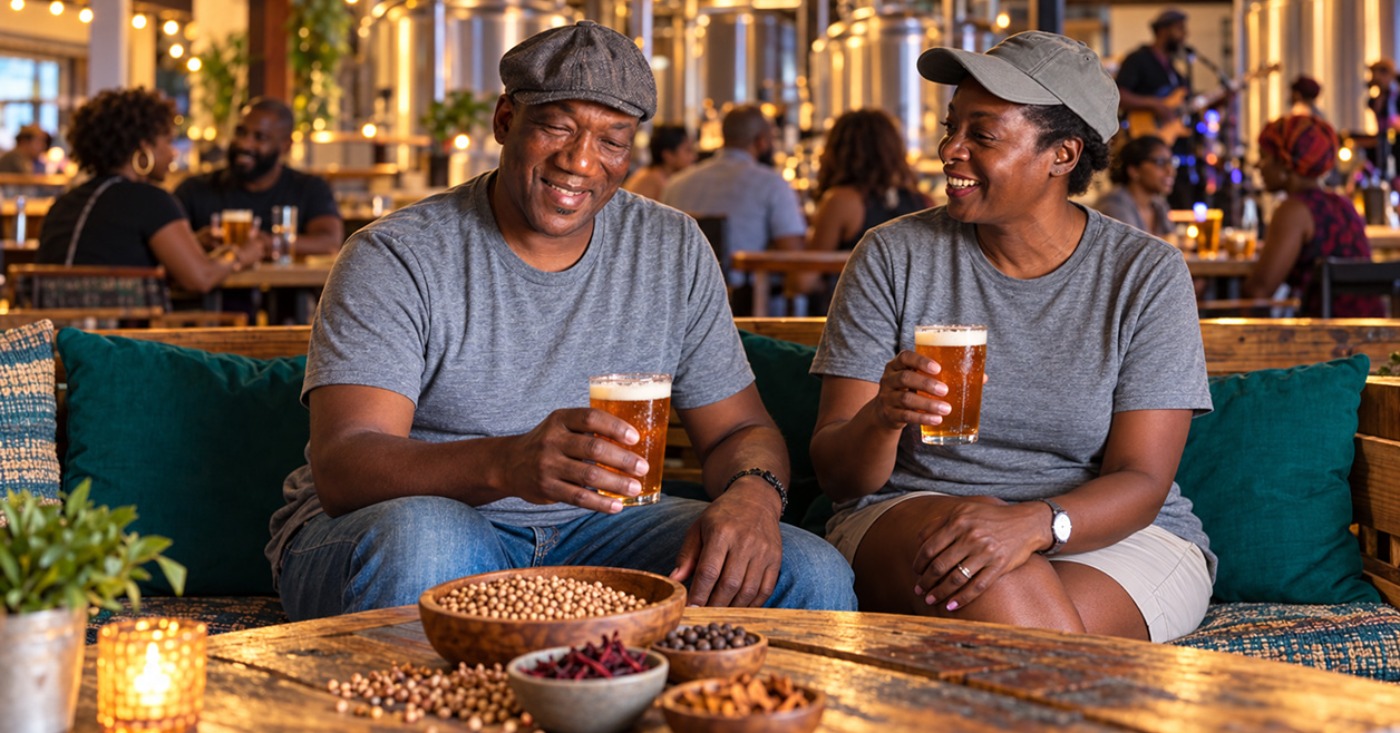
Montclair Brewery has become much more than a place to enjoy a craft beer. Located on Walnut Street in Montclair, New Jersey, the family-owned microbrewery has developed into a gathering place where beer, music, culture, history and community come together. Founded by husband-and-wife team Leo and Denise Sawadogo, the brewery has established a distinctive identity by connecting its beers to African, Caribbean and African American history and culture.
The story began with Leo Sawadogo’s passion for home brewing. Originally from Burkina Faso in West Africa, Leo grew up watching his mother brew traditional beverages using grains, herbs and spices. Brewing was part of his cultural experience long before craft beer became a major American trend. After years of making beer at home and sharing it with friends and family, Leo and Denise began imagining how they could transform that passion into a business. The company was established in 2014, and after years of planning and nearly a year of construction, Montclair Brewery opened its doors in October 2018.
The brewery represented an important milestone for Montclair because it became the town’s first microbrewery. But its significance extended beyond being a new business. Leo and Denise brought together two different cultural backgrounds: Leo’s West African heritage and Denise’s Jamaican roots. Those influences became part of the brewery’s personality and, importantly, part of the beers themselves. Instead of treating culture as something separate from the business, the couple made it an essential ingredient in their approach to brewing.
One of the brewery’s most distinctive traditions is its annual Black History Month beer series. These beers are often inspired by prominent figures, historical events and cultural traditions. Over the years, the brewery has created beers honoring people such as Harriet Tubman, Larry Doby, Maya Angelou, Chadwick Boseman and journalist Gil Noble. The brewery has also used its beers to celebrate African heritage and important moments in Black history. In 2026, for example, its series included beers inspired by Patrice Lumumba and Larry Doby.
The story behind each beer is almost as important as the beer itself. Montclair Brewery demonstrates how food and beverages can become vehicles for storytelling. A beer named for Larry Doby can introduce customers to the history of the baseball pioneer who broke the American League’s color barrier and later made Montclair his home. A beer inspired by Patrice Lumumba can encourage people to learn about African independence and the history of the Democratic Republic of Congo. In this way, the brewery turns a visit to a taproom into an opportunity for cultural discovery.
Montclair Brewery has also connected its business to local history. One example is the Howe House, one of Montclair’s historic homes associated with the town’s African American history. The brewery created a Belgian-style ale honoring James Howe and committed a portion of sales from the beer toward efforts to preserve the historic property. This illustrates a larger philosophy behind the brewery: its identity is not simply based on selling beer, but on using the business as a platform to recognize people, places and stories that deserve greater attention.
The brewery’s importance also comes from its role as a community gathering place. Its taproom offers indoor and outdoor seating and hosts a variety of events and activities. Music, entertainment, cultural programs and community gatherings have helped make the brewery part of Montclair’s social landscape. During the COVID-19 pandemic, when gathering in public spaces became difficult, the brewery adapted its business model by shifting toward bottling and outdoor operations. Its ability to adapt helped it survive a period that was devastating for many small businesses.
Another important part of Montclair Brewery’s story is representation within the craft-beer industry. Black-owned breweries remain a small portion of the American craft-brewing landscape, making the visibility of businesses like Montclair Brewery particularly significant. Denise has also become an important voice for women in the brewing industry, while Leo’s background and approach have helped challenge traditional ideas about who a brewer is supposed to be. Together, they demonstrate that the craft-beer industry can reflect a much broader range of cultures and experiences.
The brewery’s success has also allowed its reach to extend beyond Montclair. Its beers have received attention from regional and national media, and the company has participated in collaborations with other breweries and cultural organizations. One collaboration celebrated the 50th anniversary of hip-hop with the legendary DJ duo Awesome 2. Other beers have incorporated ingredients such as baobab fruit, sorghum and spices connected to African and Caribbean traditions. These collaborations and unusual ingredients help distinguish Montclair Brewery from breweries whose identities are based primarily on conventional beer styles.
Ultimately, Montclair Brewery represents an example of how a small business can become part of the cultural fabric of a community. Leo and Denise Sawadogo created a brewery from a personal passion, but they built something larger than a place to drink. Their beers tell stories about Africa, the Caribbean, Black America and Montclair itself. The brewery demonstrates that entrepreneurship can preserve history, celebrate culture and bring people together. In Montclair, every pint can become part of a larger conversation about heritage, creativity, community and the continuing evolution of Black-owned businesses in America.
Based on reporting by The Positive Community.
Art
From Ma Rainey to AI: New Technology Amplifies an Old Fight over Artist Control
HOWARD UNIVERSITY NEWS SERVICE — August Wilson’s “Ma Rainey’s Black Bottom” explores Ma Rainey’s struggle for control over her music during a 1920s recording session, highlighting conflicts over art, money, and power dynamics between musicians and business interests. Round House Theatre’s production, running through October 18 in Bethesda, Maryland, stages this historical fight, drawing parallels to contemporary issues.
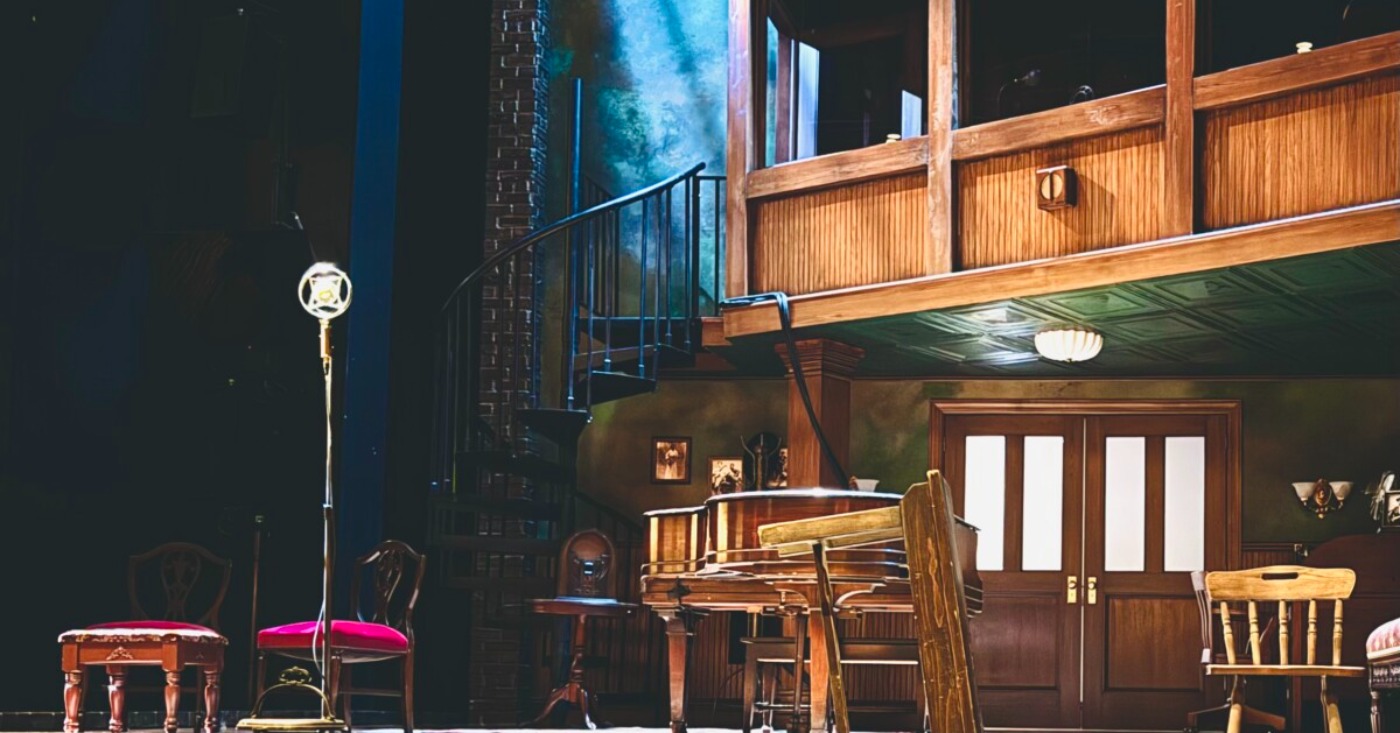
In August Wilson’s “Ma Rainey’s Black Bottom,” Ma Rainey fights to control what happens to her music once she enters the recording studio. Today, musicians are confronting a new question: What happens when artificial intelligence can profit from the identity attached to their music?
Round House Theatre’s production of “Ma Rainey’s Black Bottom,” which runs through Oct. 18 in Bethesda, Maryland, brings an older struggle over artistic control to the stage. Set during a recording session in 1920s Chicago, Wilson’s play follows Ma and her band as conflicts over art, money and control expose the imbalance between the musicians creating the work and the people conducting the business around it. That same question of who can profit from an artist’s value is now being tested in a very different setting nearly a century later.
Musicians Jason Isbell, David Lowery, Guy Forsyth and Eduardo Calle filed a class-action lawsuit on Aug. 31 against AI music company Suno. They allege that the company commercially exploits artists through an AI system capable of generating music imitating artists’ identities and styles without permission. Suno disputes the allegations.
The U.S. Copyright Office has also studied AI-generated digital replicas and recommended federal legislation to address gaps in protections against unauthorized replicas of a person’s voice or appearance. Its broader AI inquiry received more than 10,000 public comments.
For Nicole Michelle Haskins, who portrays Ma Rainey in the Round House production, the struggle over power begins with understanding Ma as more than a demanding recording star.
“She is the only advocate she has,” Haskins said. “The choices presented to her are to surrender or fight. Ma chooses to fight.”
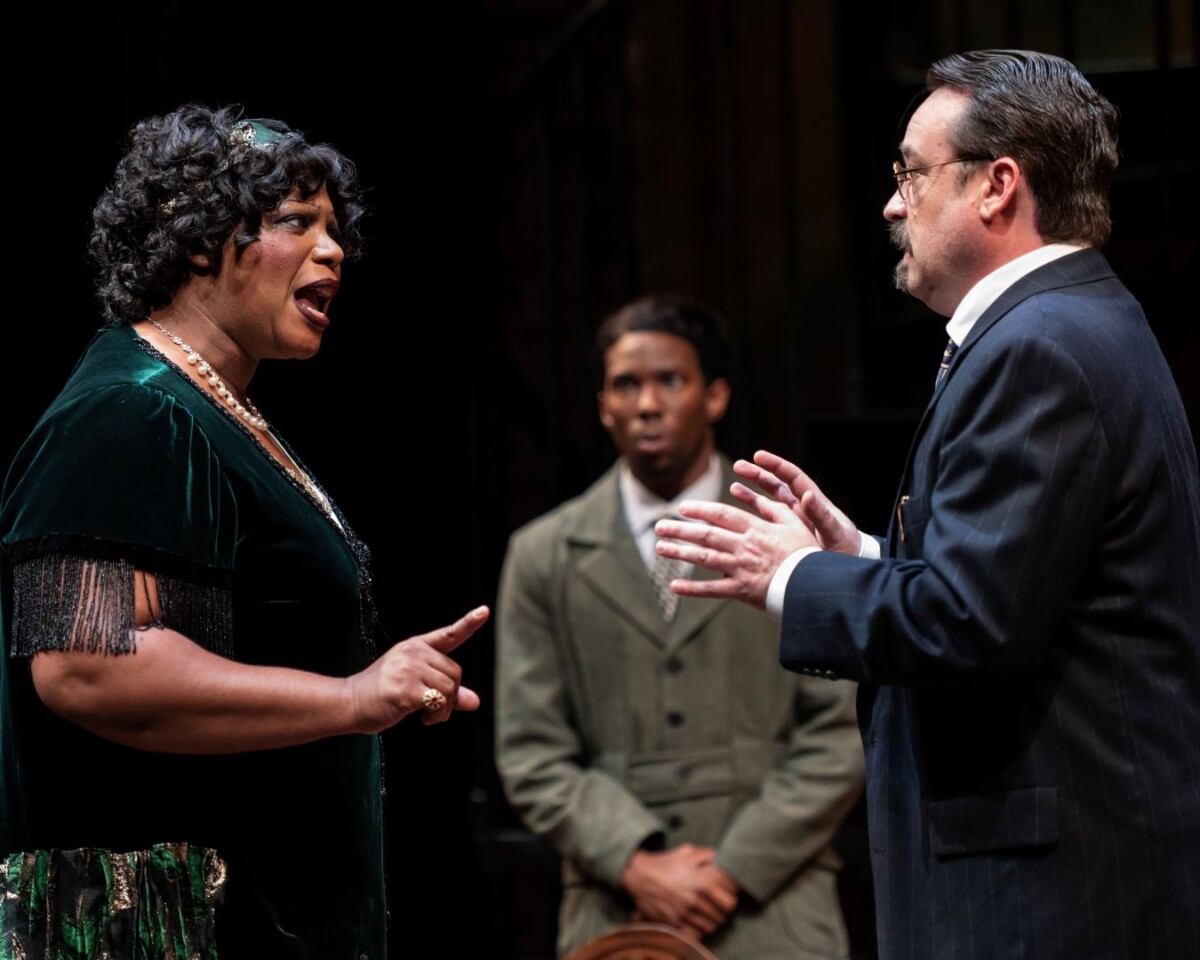
Haskins said Ma enters the recording studio knowing the value that she brings, even as the people around her repeatedly challenge her decisions. She exercises her leverage and pushes back when others attempt to dictate how the session will proceed.
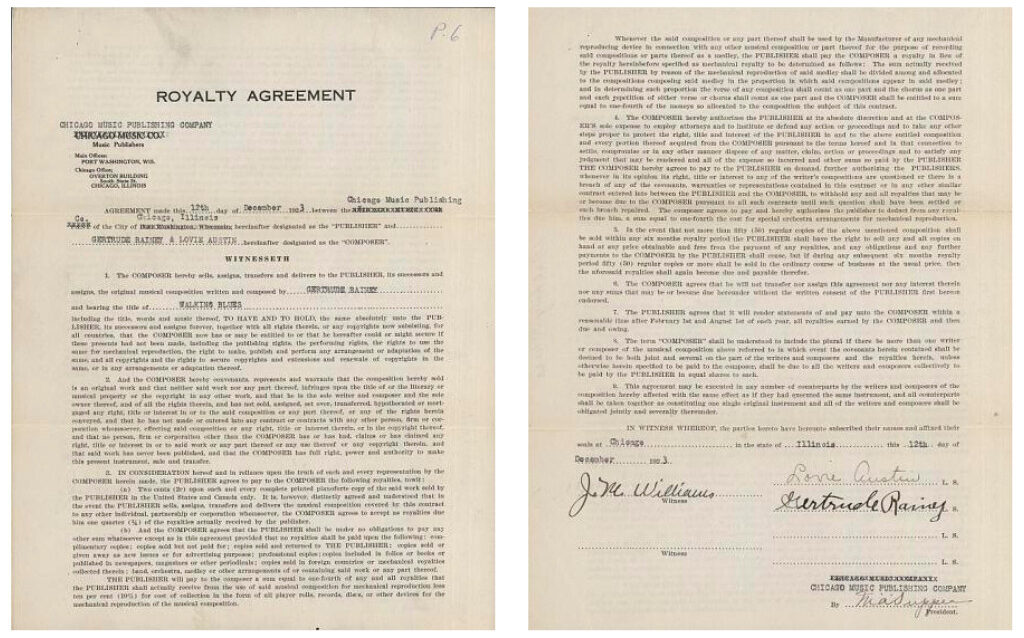
The real Gertrude “Ma” Rainey was one of the earliest Black women to record blues commercially. Between 1923 and 1928, she made more than 100 recordings for Paramount Records, according to the Smithsonian.
One surviving agreement shows how at least part of that business worked. A Dec. 12, 1923, royalty agreement for “Walking Blues,” signed by Rainey and composer Lovie Austin, provided them two cents for each printed piano copy sold in the United States and Canada. They were also entitled to one-fourth of the royalties the publisher received from mechanical reproductions, minus a 10% collection cost.
For Haskins, portraying a character negotiating those relationships does not feel entirely removed from being an artist today.
“The life that I live as an artist is not that dissimilar from the world that August Wilson has written,” Haskins said.
The technology surrounding artists, however, has changed dramatically.
The scale of AI-generated music has grown quickly. In July, streaming service Deezer said it was receiving about 90,000 fully AI-generated tracks a day, more than half of its daily uploads. Those tracks accounted for less than 3% of all streams.
The lawsuit against Suno is not primarily a traditional copyright case about whether an AI-generated song copied a particular recording. Instead, the musicians rely largely on state right-of-publicity laws, which concern the commercial use of a person’s identity.
According to the complaint, users can enter musicians’ names and use them as a retrieval key for AI-generated music drawing on characteristics associated with those artists. The plaintiffs argue that an output does not have to copy a specific song or perfectly reproduce an artist’s voice for the artist’s commercial identity to be exploited.
Suno disputes that characterization of its technology. The company has said it does not use artists’ names as training metadata and does not permit users to prompt its system for specific artists. Suno says references to artists are filtered and redirected toward descriptions of musical characteristics. Its own prompting guide, for example, encourages users to describe features such as tempo, vocals and instrumentation, using phrases like “bright pop track,” “110 BPM,” “female vocals” and a “big synth hook.”
The Suno dispute centers on more than ownership of a particular song or recording. It raises the question of whether an artist’s name, likeness and other identifying characteristics can be used commercially to generate new music without permission.
Haskins resists describing that underlying conflict as merely contemporary.
“I don’t think they feel contemporary,” Haskins said of Ma’s concerns. “I think they feel worldly.”
For Haskins, AI is one setting for a larger struggle over who has power over creative work. She said the problem of Black people being separated from control of things they created has existed far longer than the technology now raising those questions. The Library of Congress notes that early record companies sometimes used white performers to record music associated with Black artists rather than hire the Black performers themselves, while Black musicians remained rare on early commercial recordings.
“It just hasn’t stopped happening,” she said.
That interpretation shapes the way Haskins portrays Ma’s fight for control. She pointed to a brief moment in the second act when Ma’s manager attempts to steer her toward a different song. Ma refuses and proceeds with the recording she intends to make.
Haskins said the moment stands out precisely because Ma does not need a dramatic confrontation to establish who has the final say.
“She’s not demanding control. She’s not asserting control,” Haskins said. “She is simply positioning herself in correct order.”
La Tetra Metts-Owens is a reporter forHUNewsService.com. She covers Prince George’s County and theater.
Based on reporting by Howard University News Service.
Art
Mothership Sirius B: Atlanta’s Immersive Afrofuturist Art Exhibit Decodes The Past and Future for Black Americans

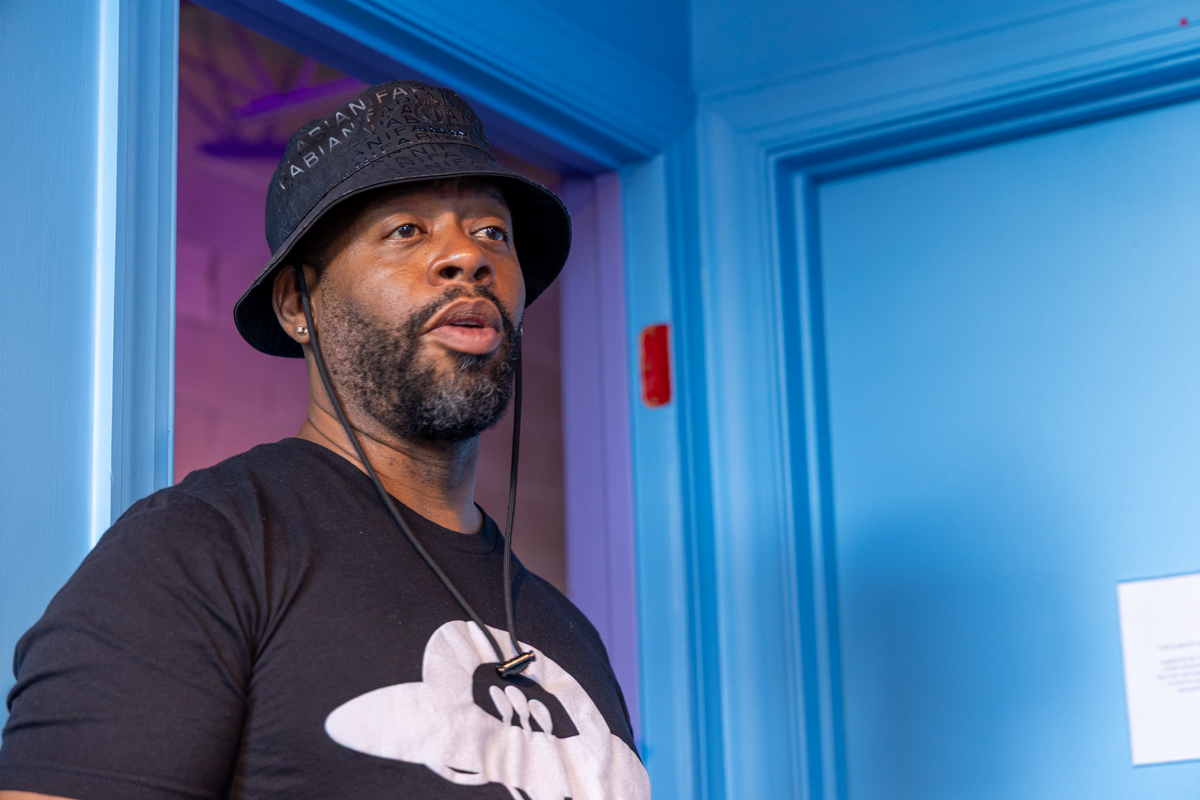
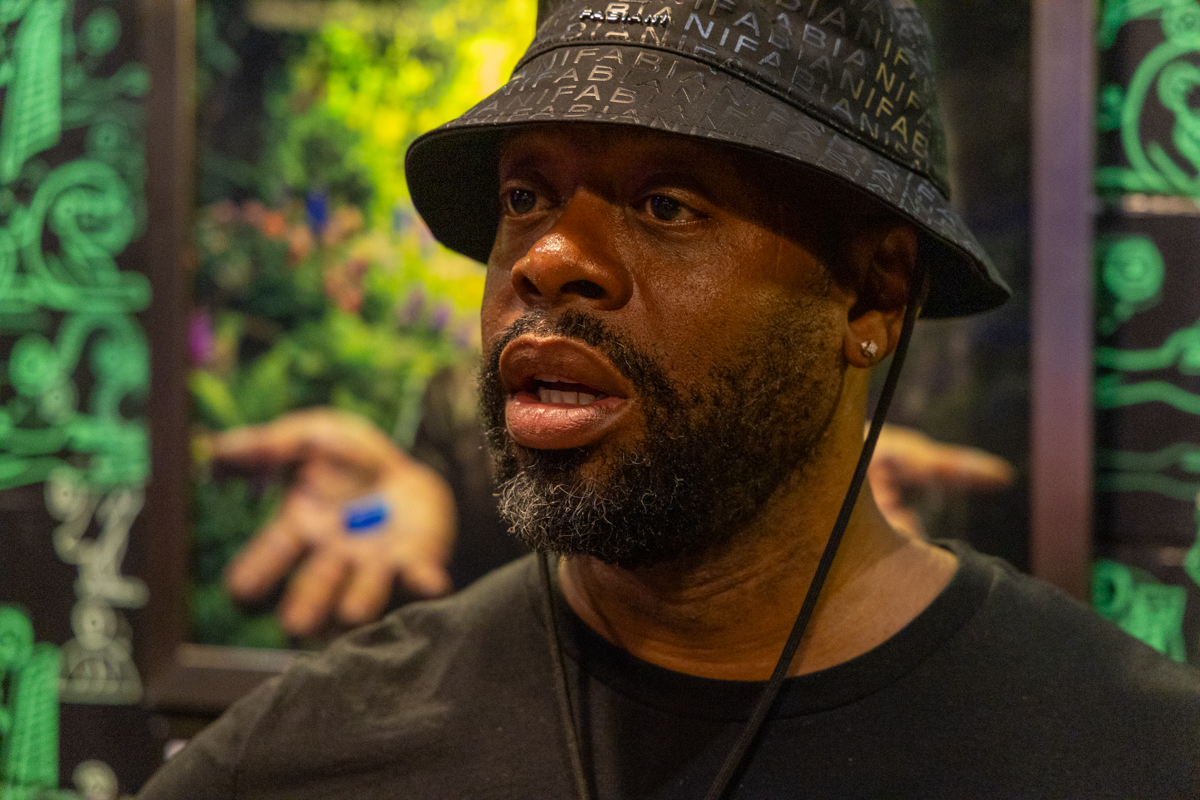
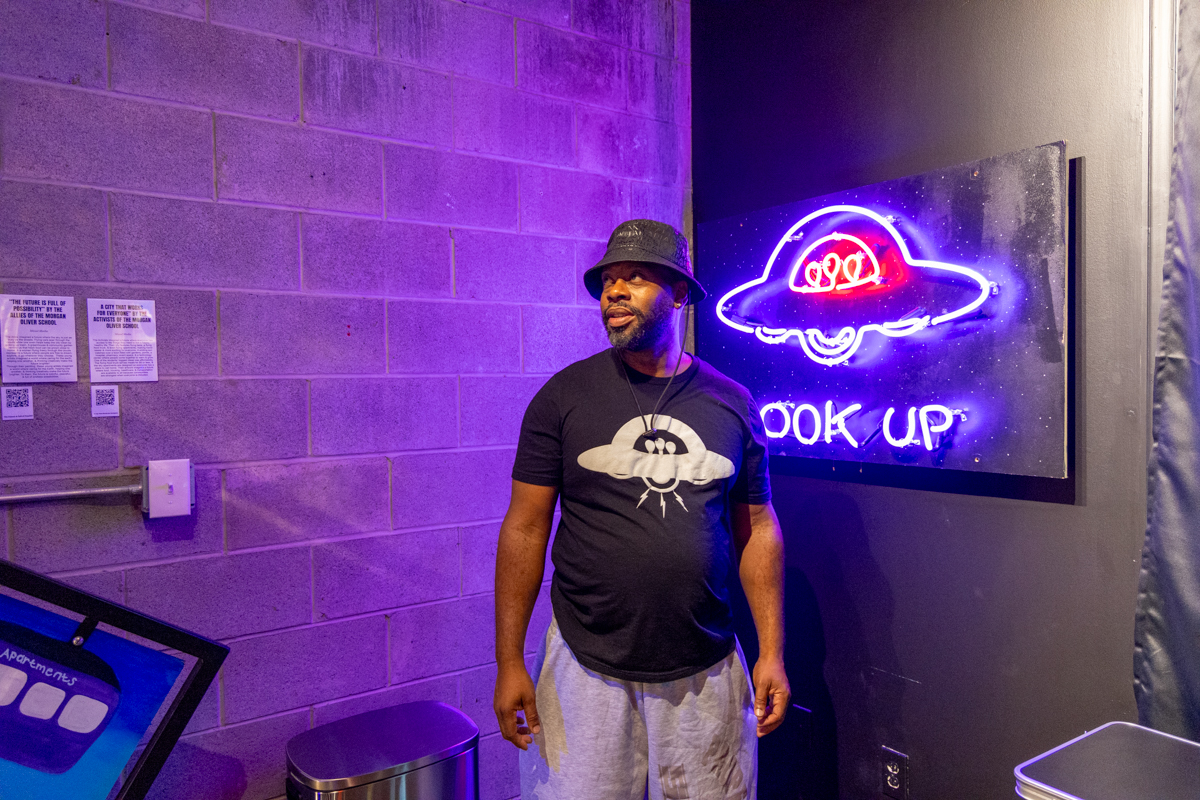
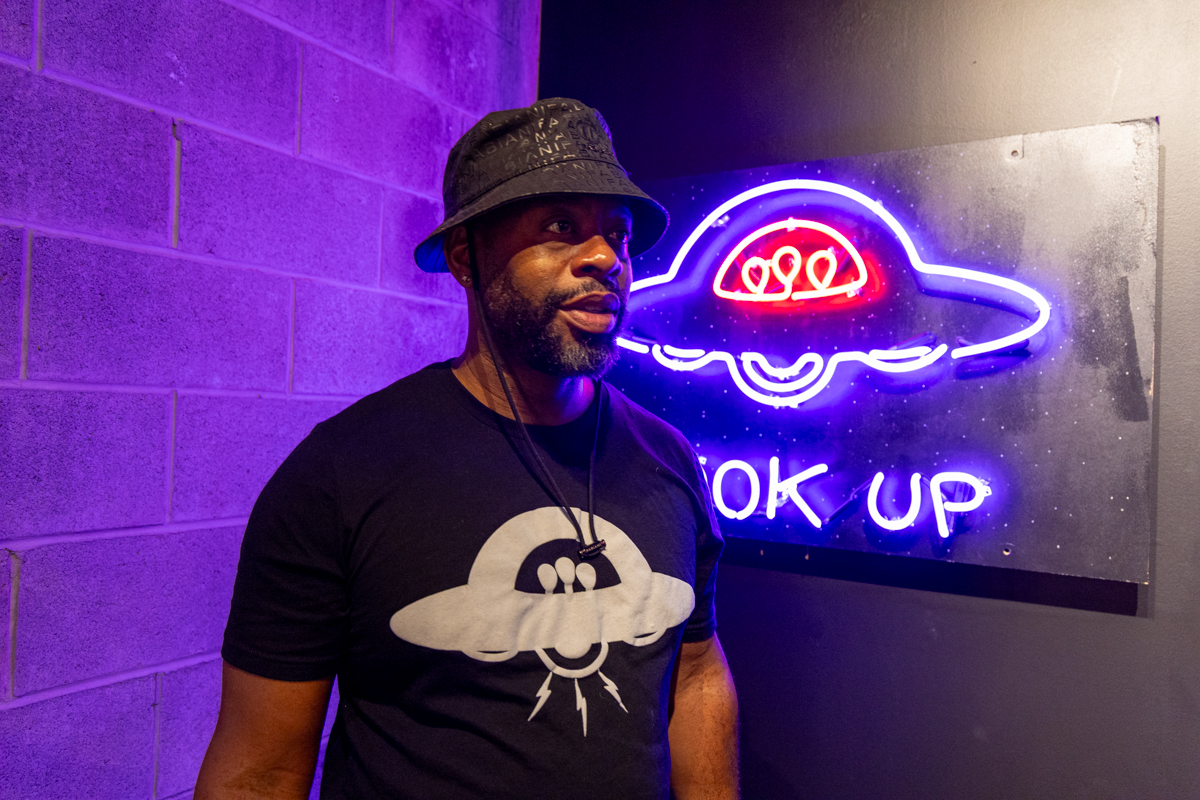
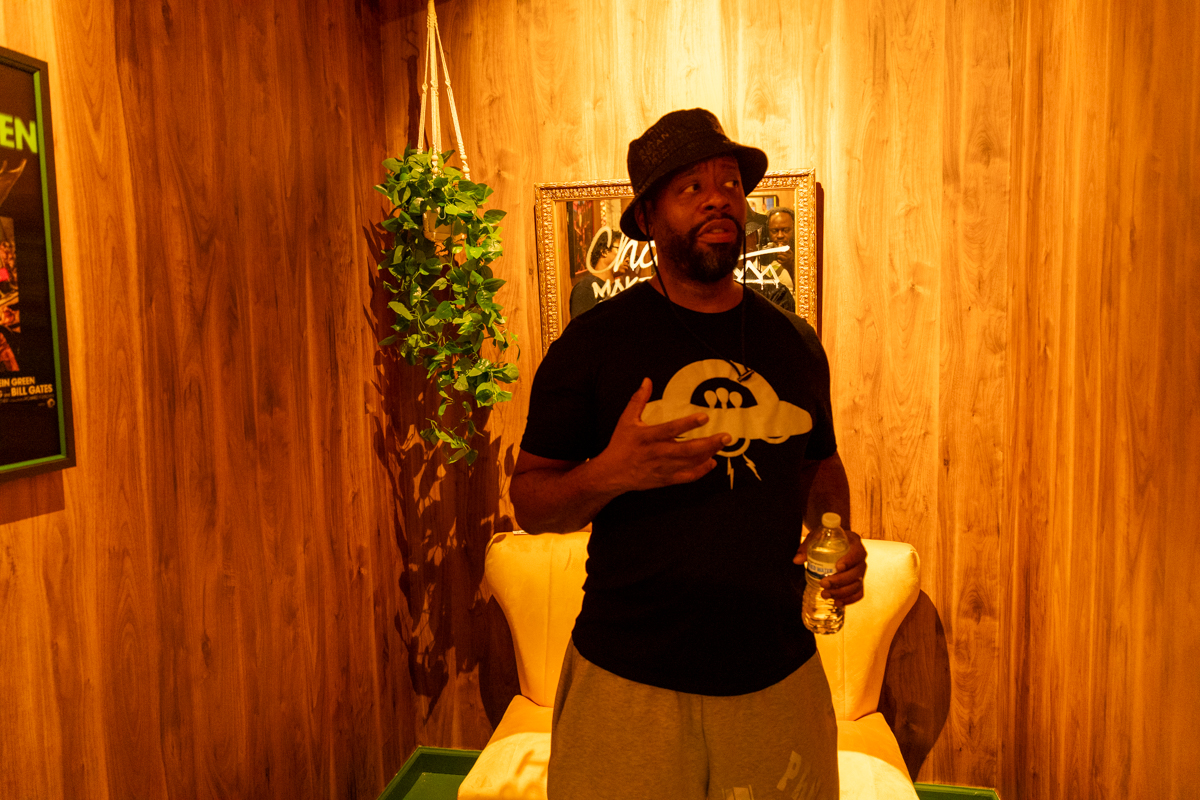
Who decides what the future looks like? For generations, science fiction and pop culture have handed us the answer. Artist Fabian Williams opened Mothership Sirius B, a three-story immersive art installation, to offer a different one.
Atlanta Students Help Shape the Exhibit
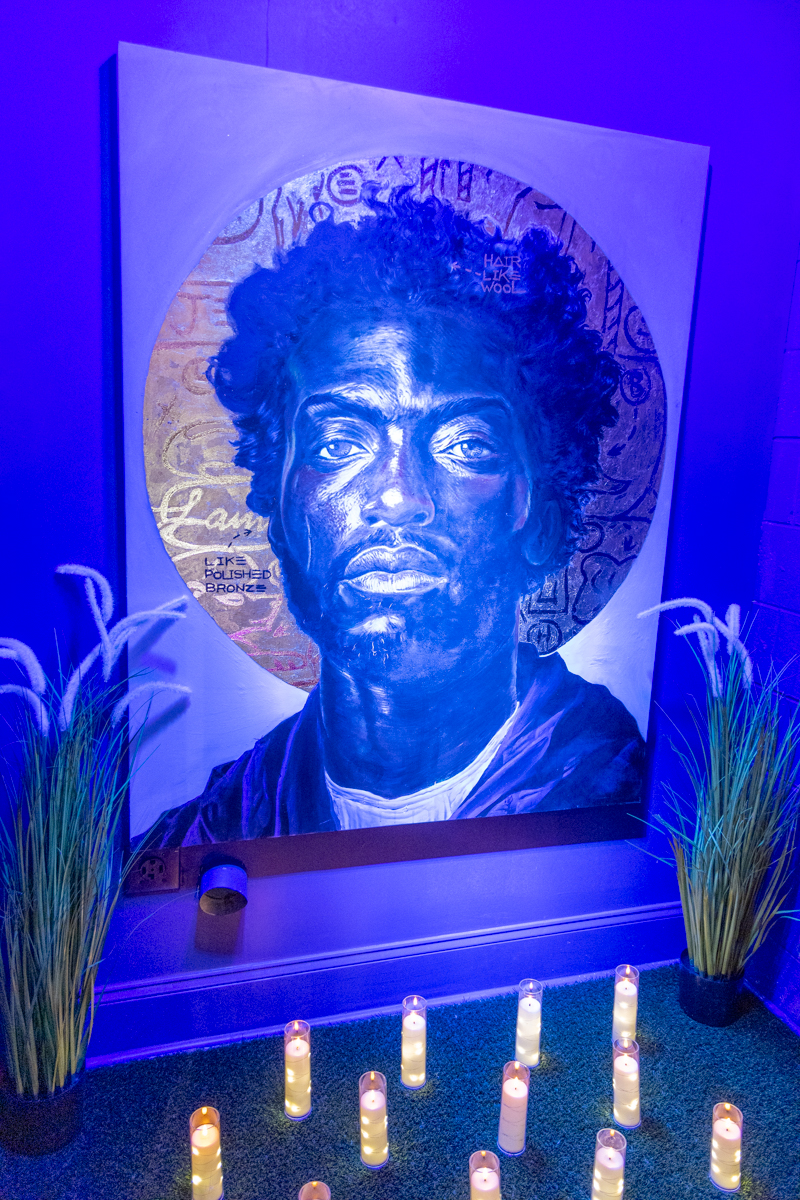
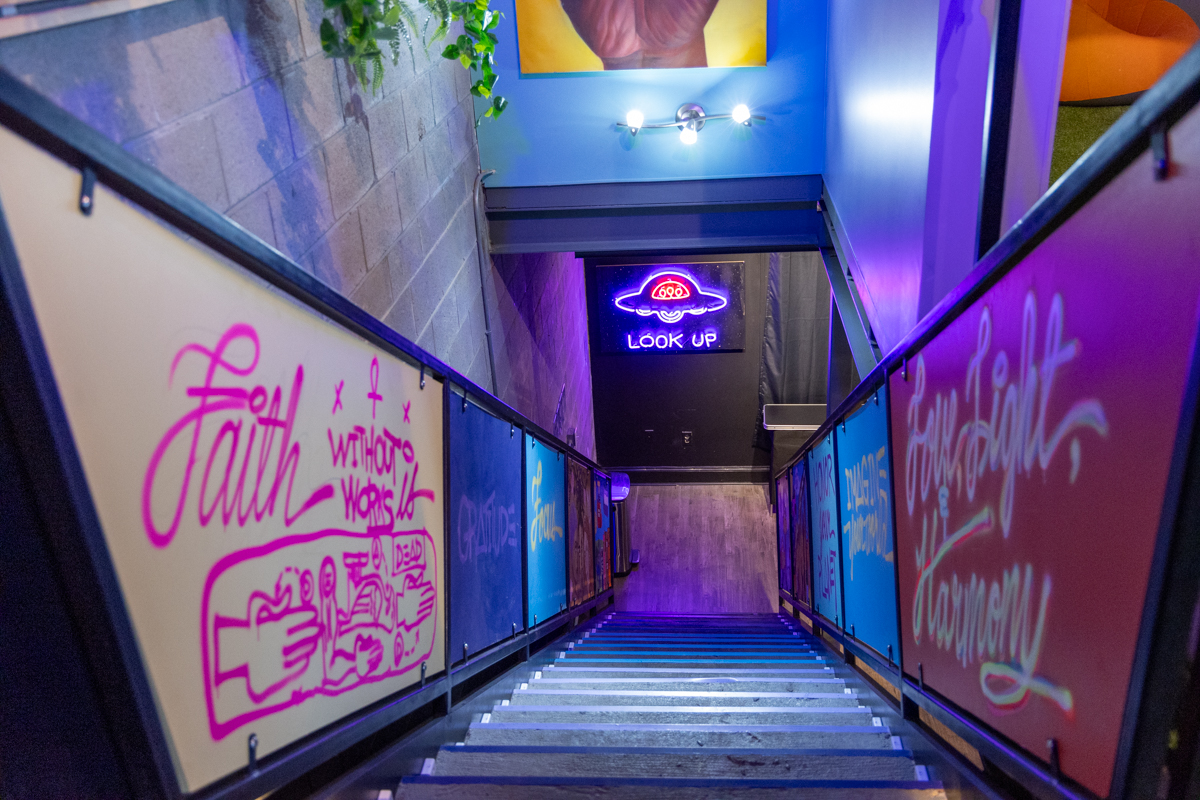
Inside the art installation at 12 Jackson St in Atlanta, the project’s community roots are what set it apart. Students from Morgan Oliver School, Maynard Jackson High School, and Georgia Tech created original artwork that runs through the whole show. It all leads to the Future Lab, a room built for conversation, creativity, and imagining what comes next together.
Williams also sat down with many of the students to ask what kind of future they want to build. Their answers give a real look at how Atlanta’s next generation pictures its city. The Mayor’s Office of Cultural Affairs, led by Adriane Jefferson, is a confirmed institutional partner.
What “Sirius B” Means
The exhibit covers six decades across its three floors, and the name carries the idea behind it. Sirius A and B form a double star system that can’t be seen with the naked eye. According to a story Afrofuturist thinkers often cite, the Dogon people of Mali knew of it centuries before Western astronomers confirmed it. For those thinkers, it shows that Black communities have always held knowledge about the future that mainstream culture was too narrow to notice. Williams puts it this way: the vessel “was always there.”
Pop Culture, Black Empowerment, and Political Commentary
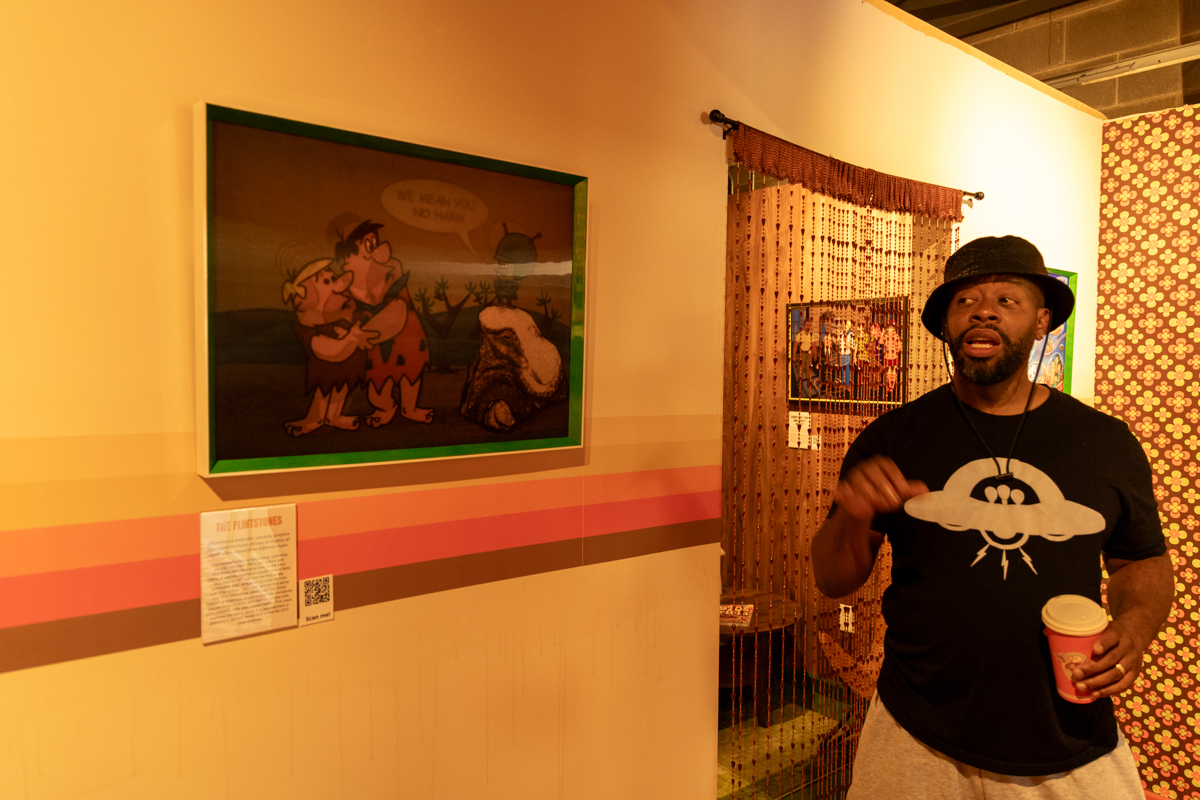
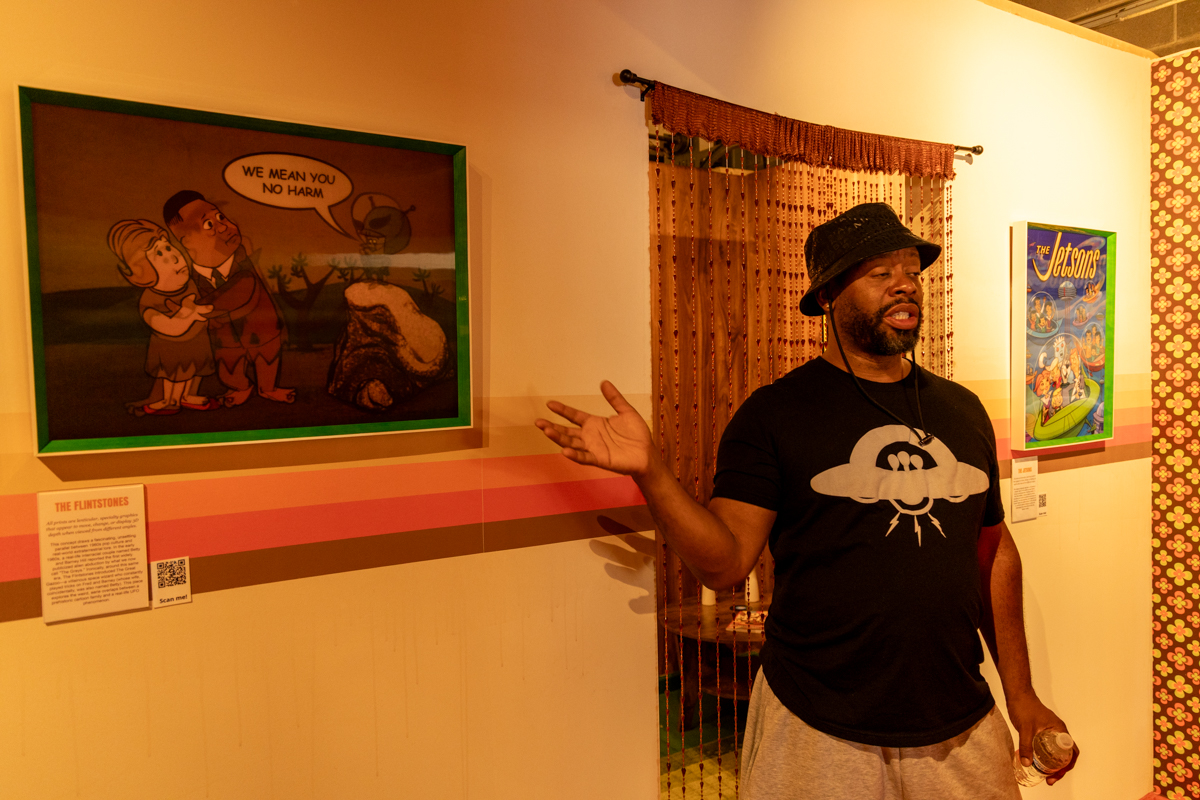
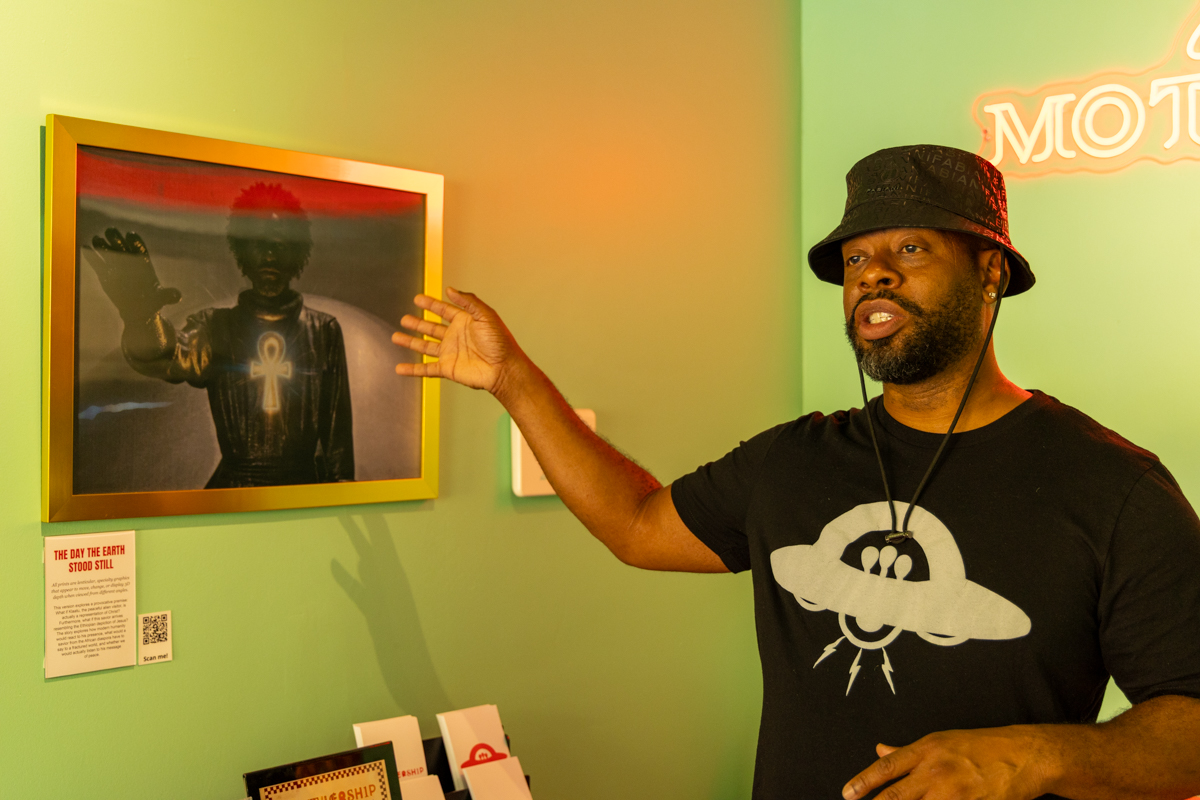
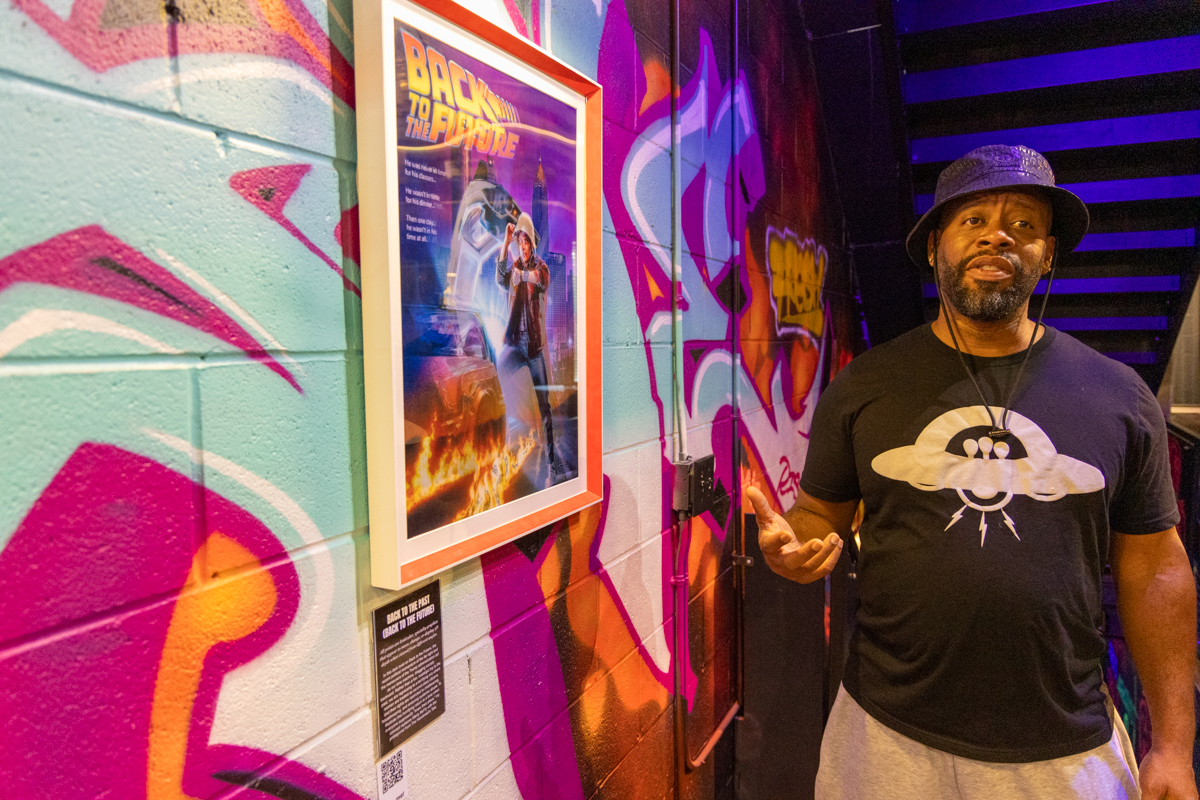
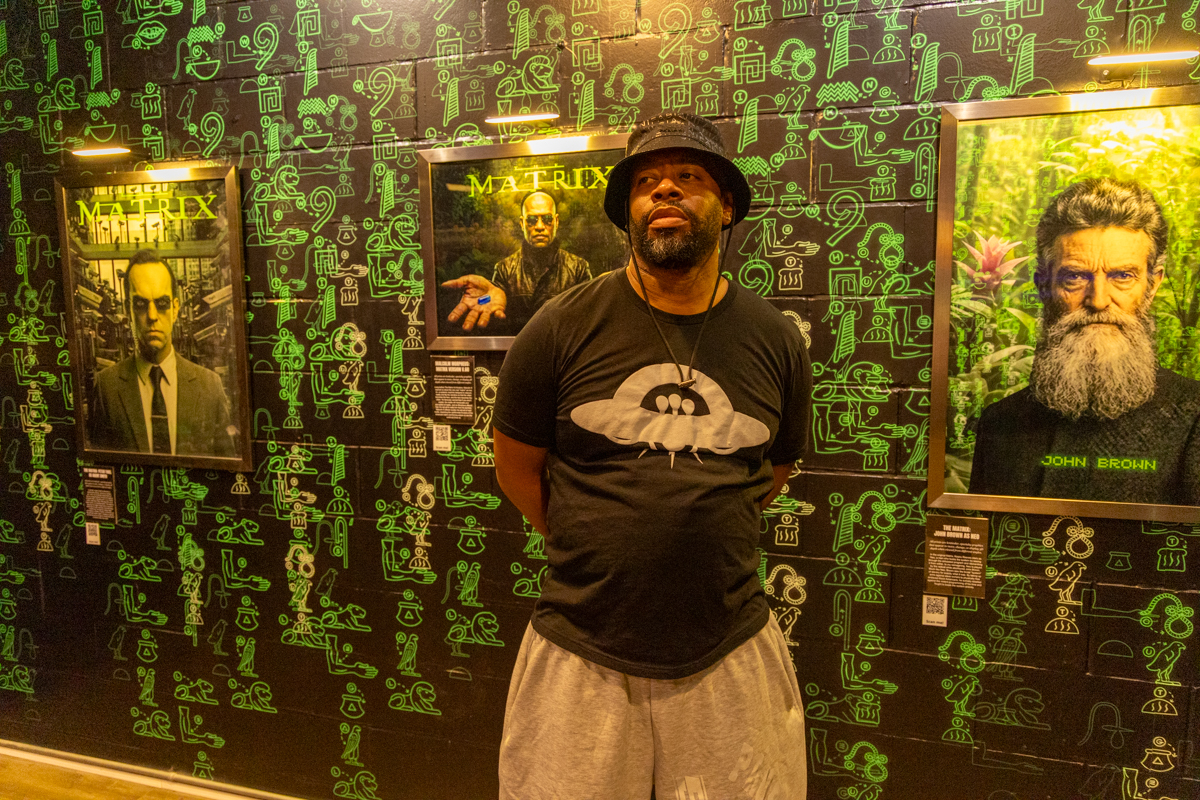
The work plays pop culture against themes of Black empowerment, and it doesn’t hide its disdain for President Donald J. Trump. Many pieces use lenticular printing, so the image changes as you move. A familiar original shifts into Williams’ own take.
Inside the Exhibit, Floor by Floor
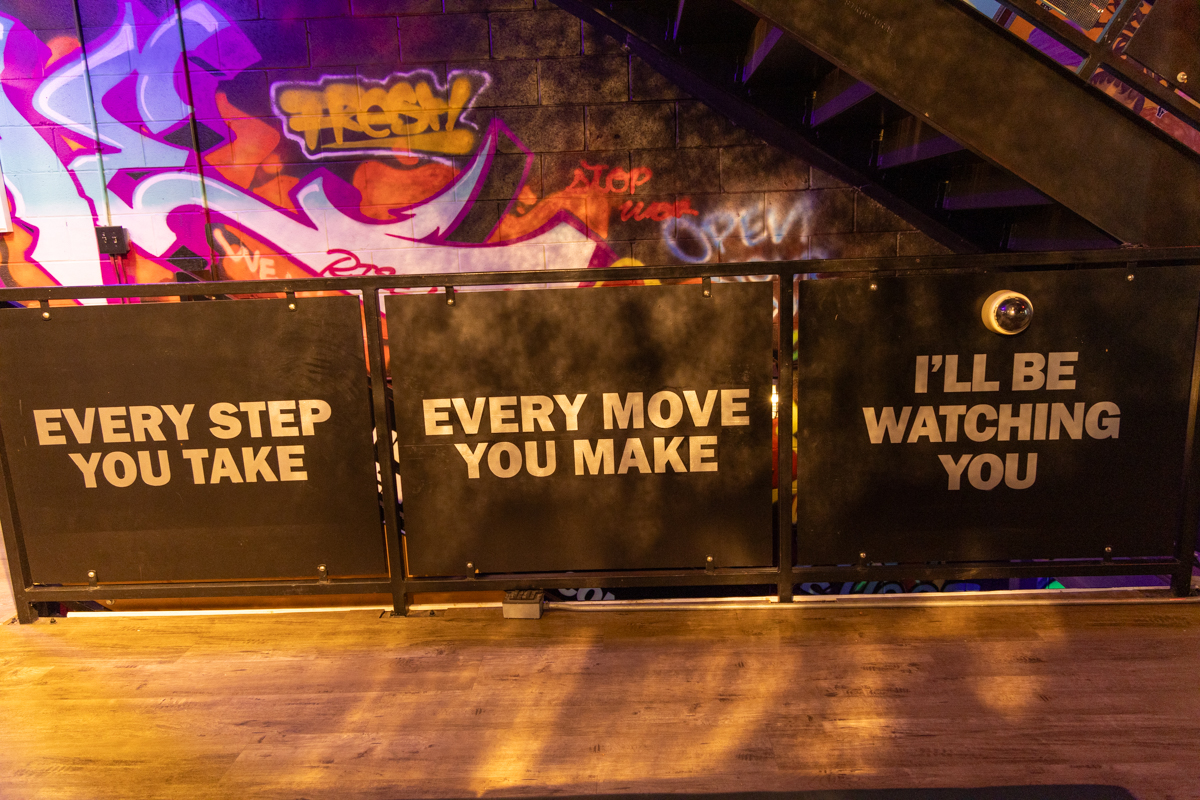
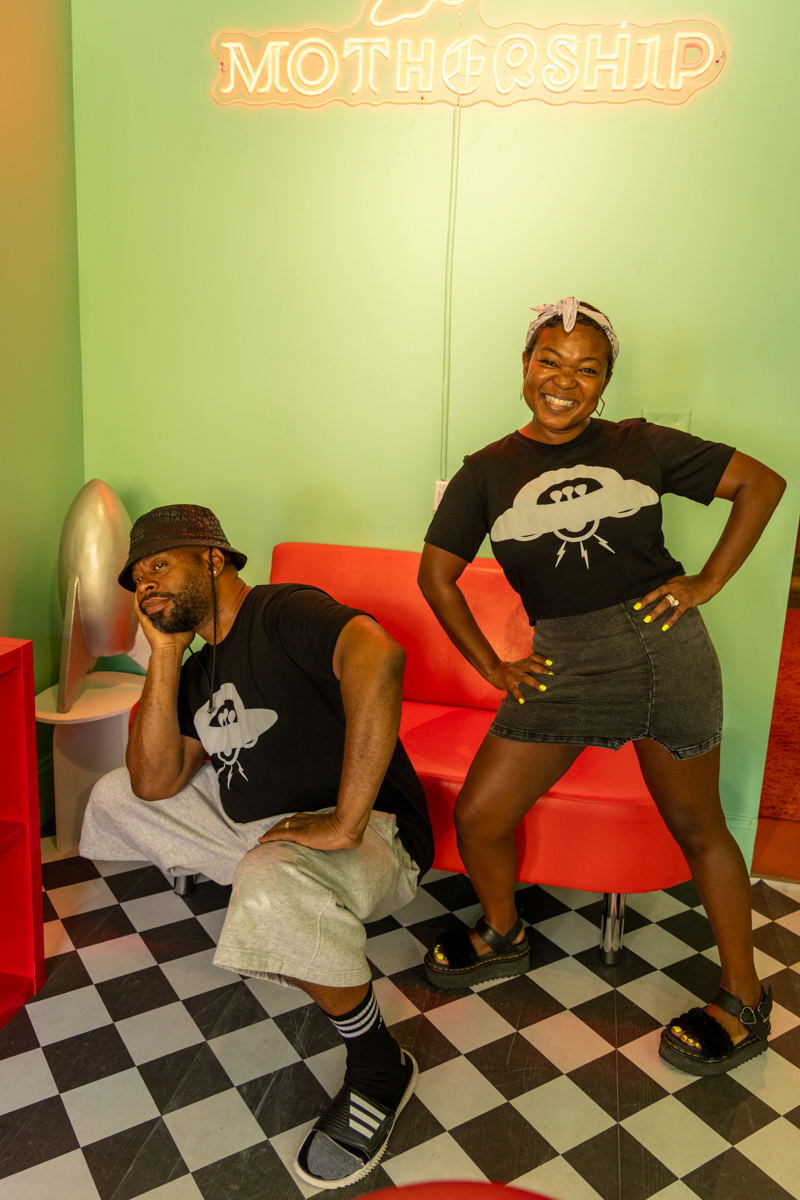
First floor: America in the 1950s. Mint green walls and checkerboard linoleum set the scene. The art draws on posters for “The Twilight Zone,” “Planet of the Apes,” and “Soylent Green,” which expose the fears and false assumptions white Americans held about Black Americans.
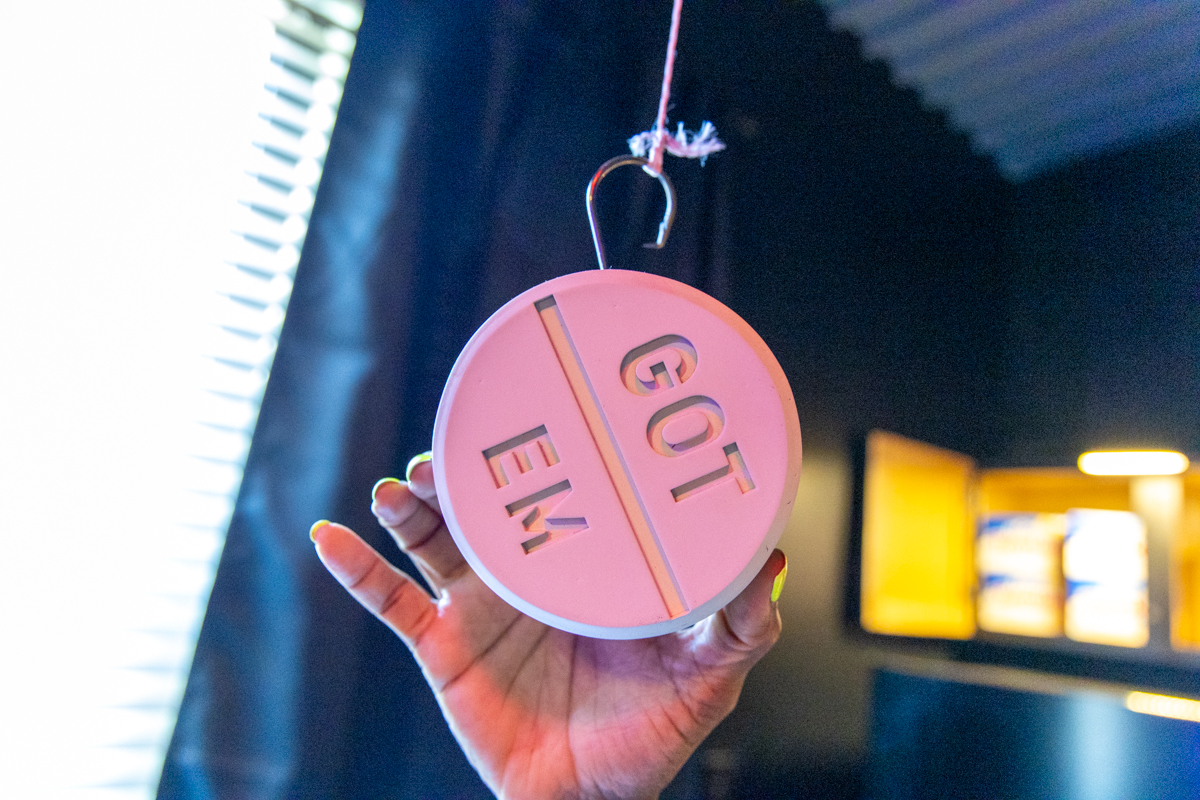
Second floor: the 1980s and 1990s. This level looks at the privatization of public life. The centerpiece of the 1990s section is “Malcolm Morpheus: Matrix Version v.68,” a lenticular print that flips between Morpheus from “The Matrix,” palms open with a red pill and a blue pill, and Malcolm X in the same pose. The wall text says Malcolm X “offered society the red pill of hard truths.”
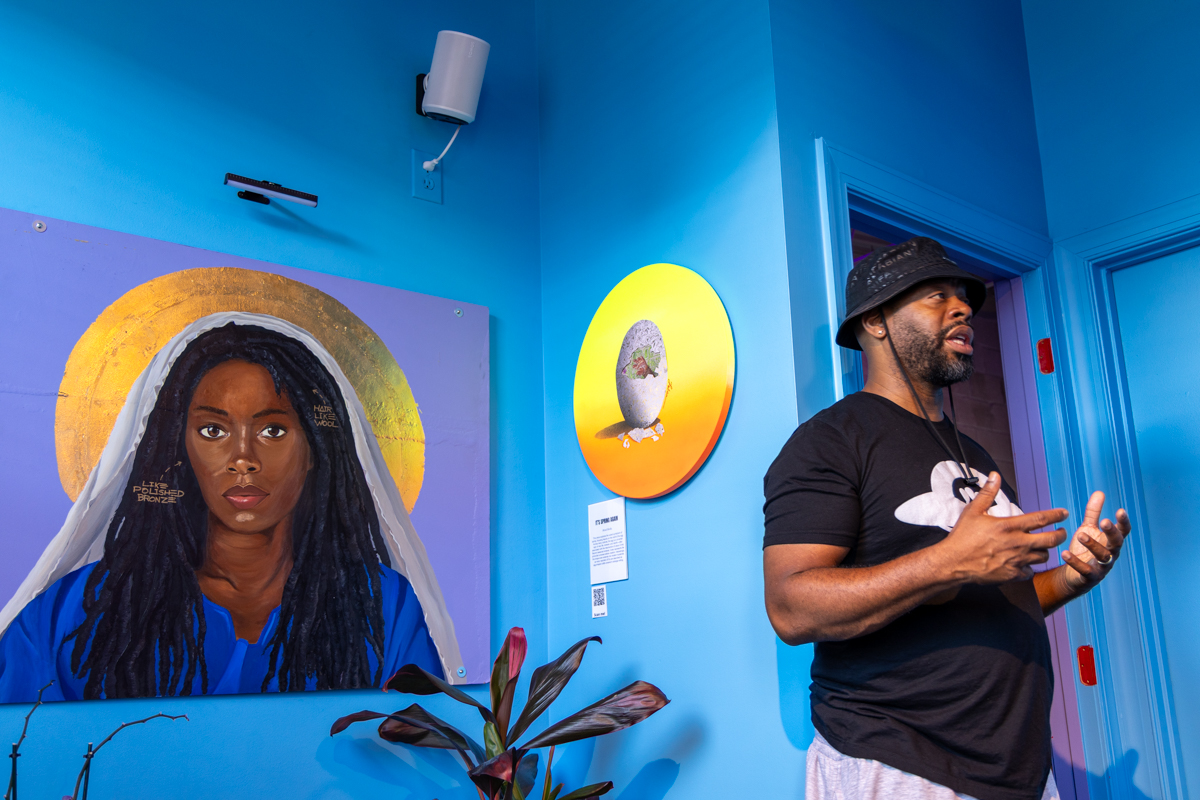
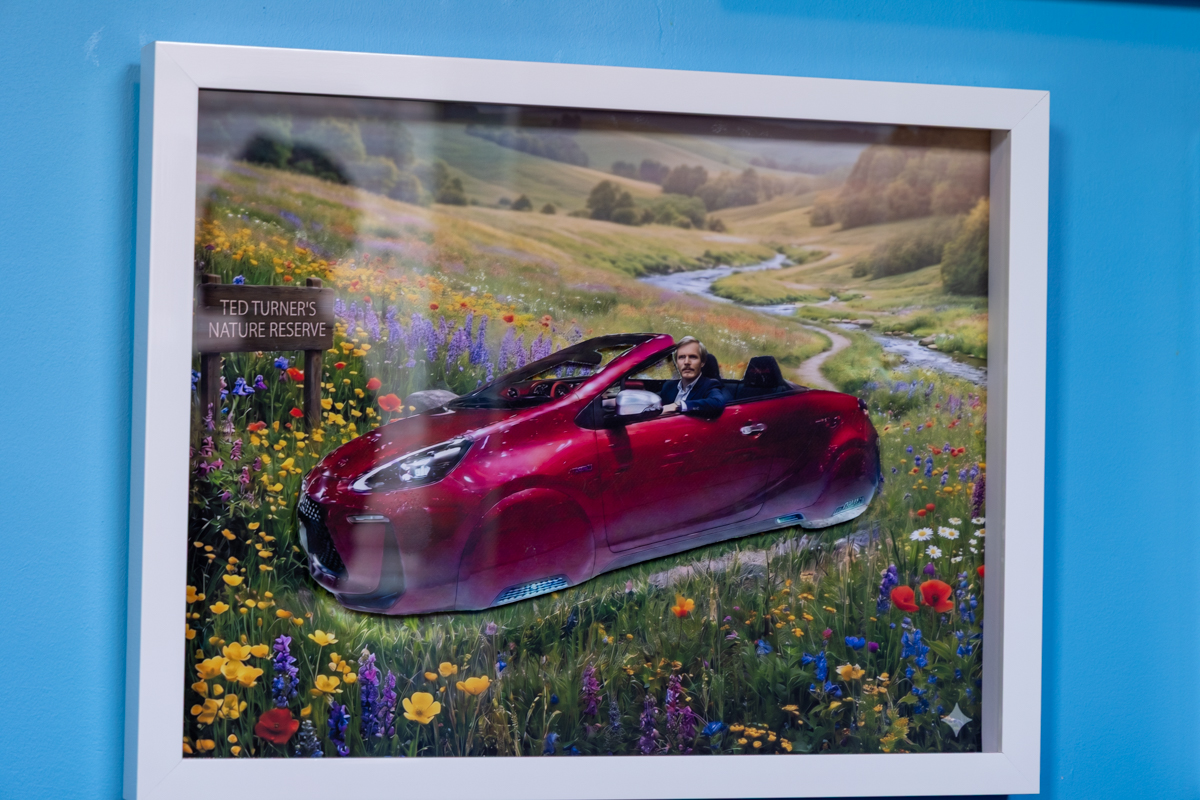
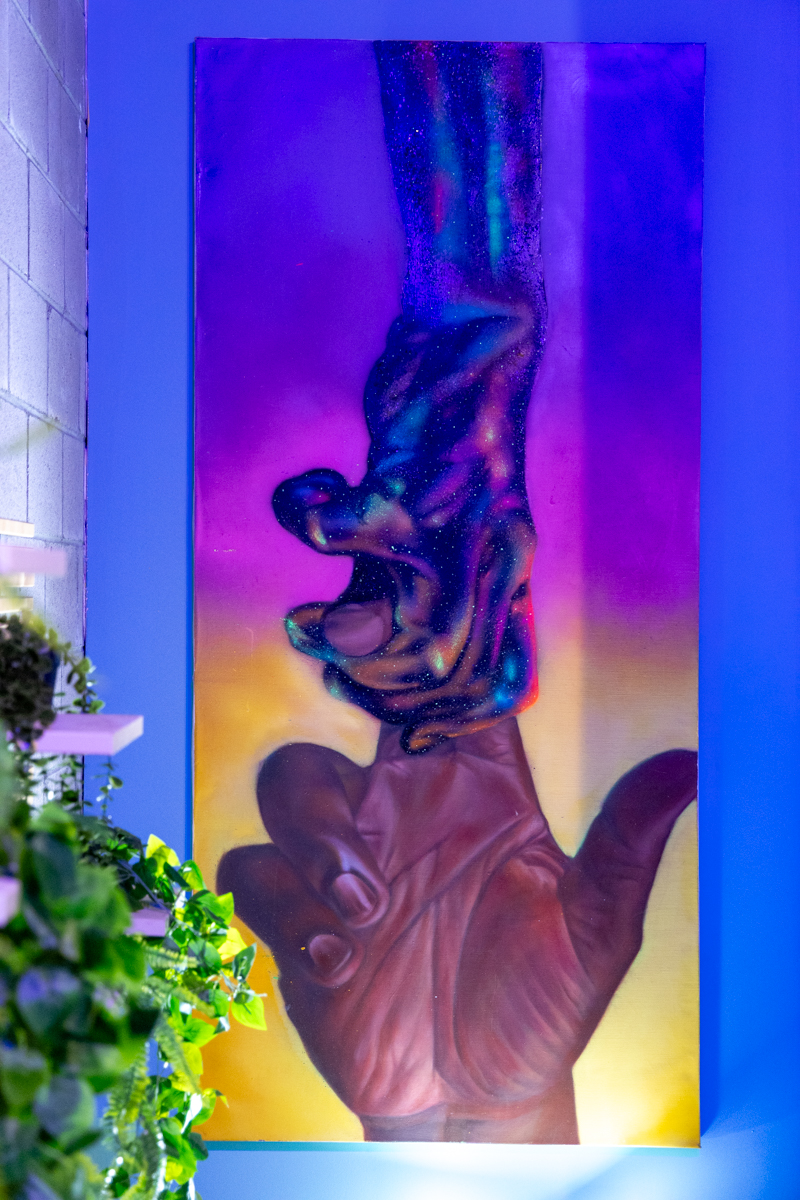
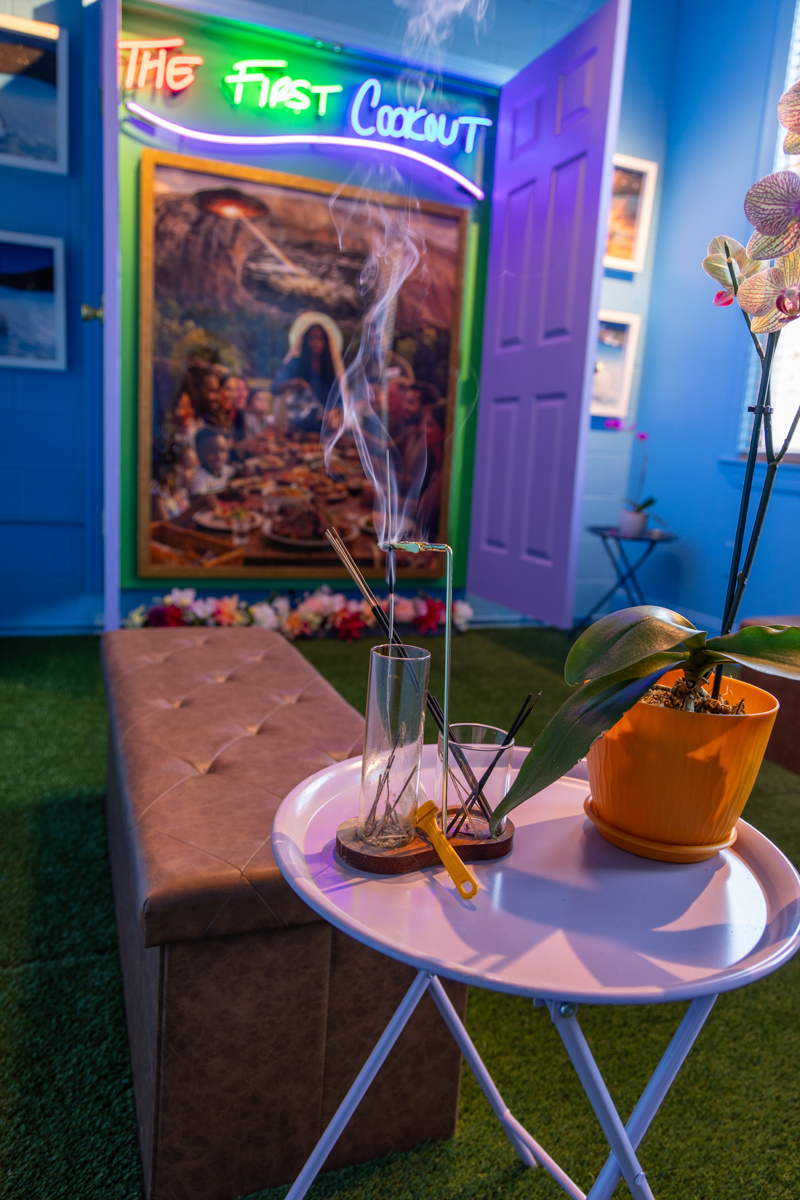
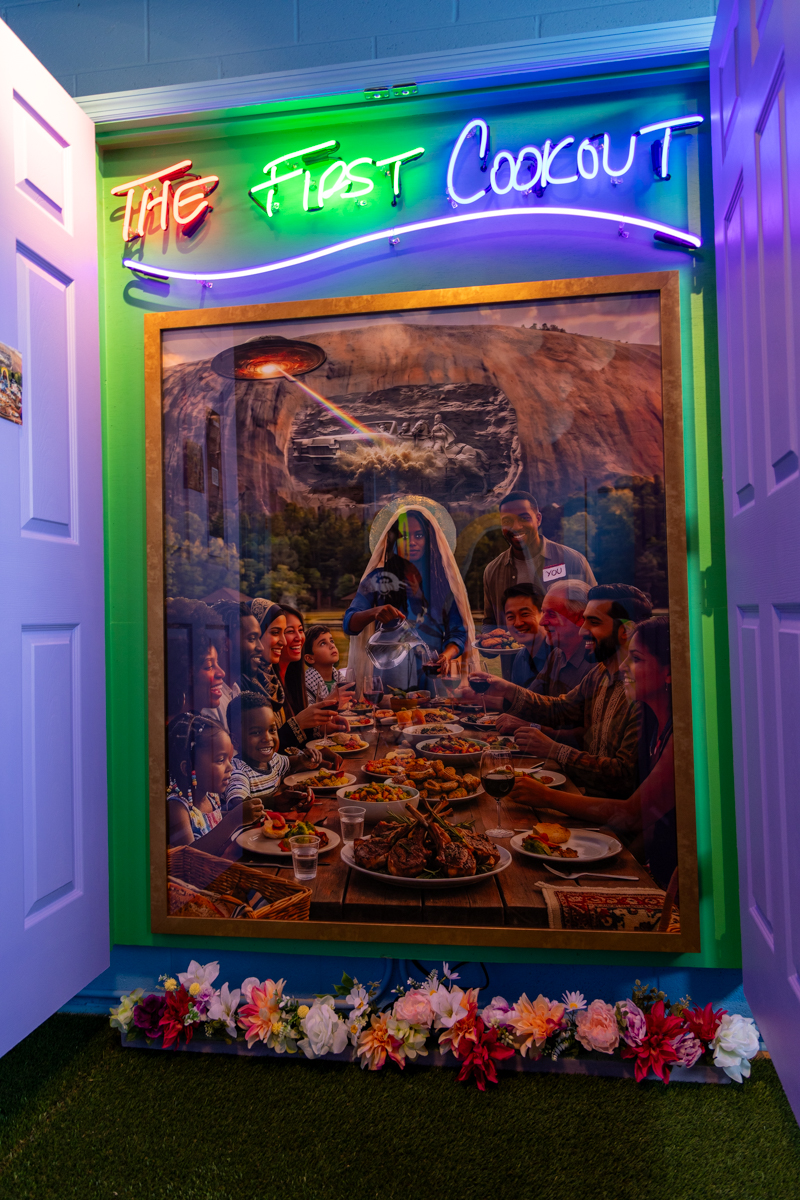
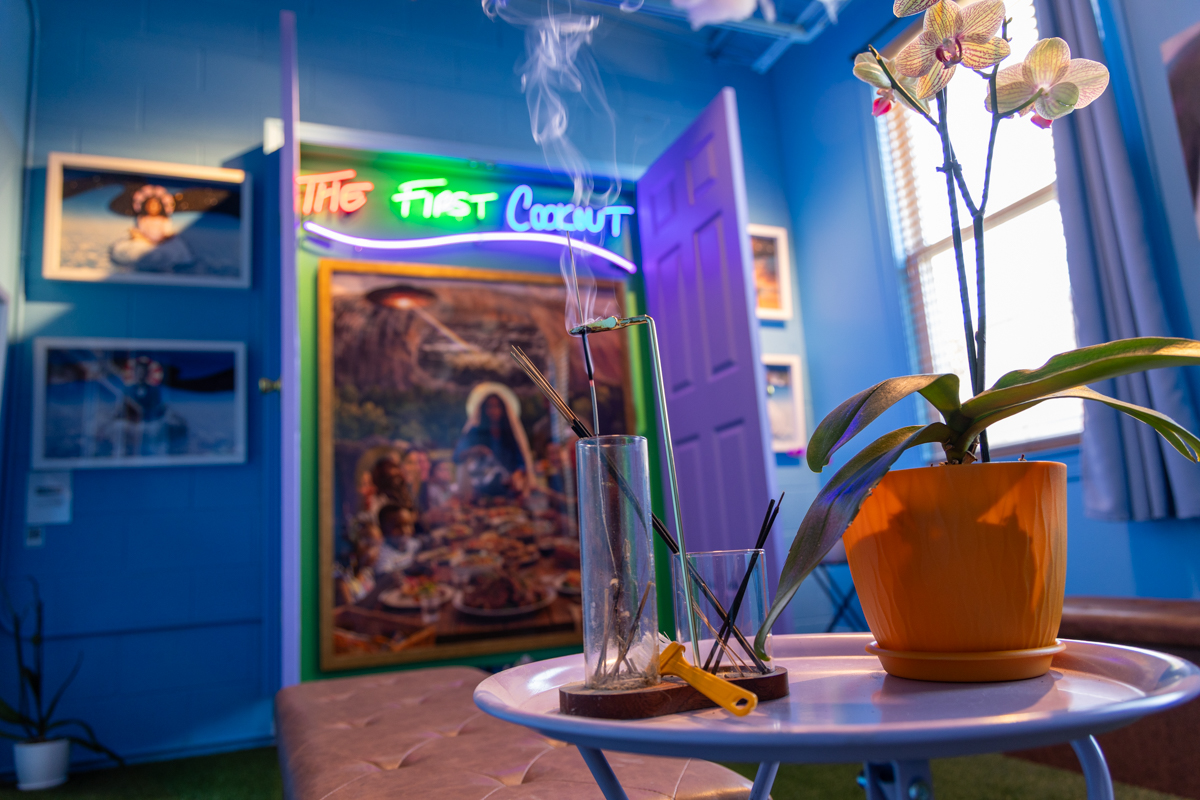
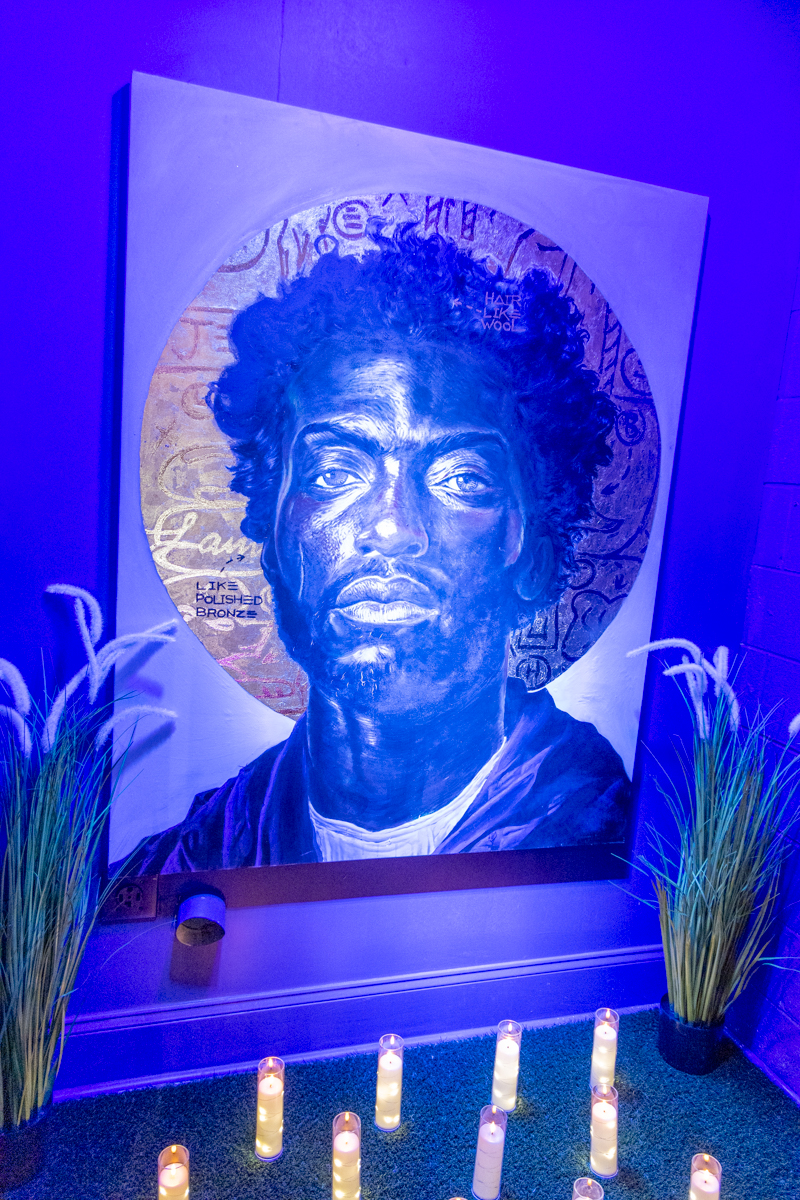
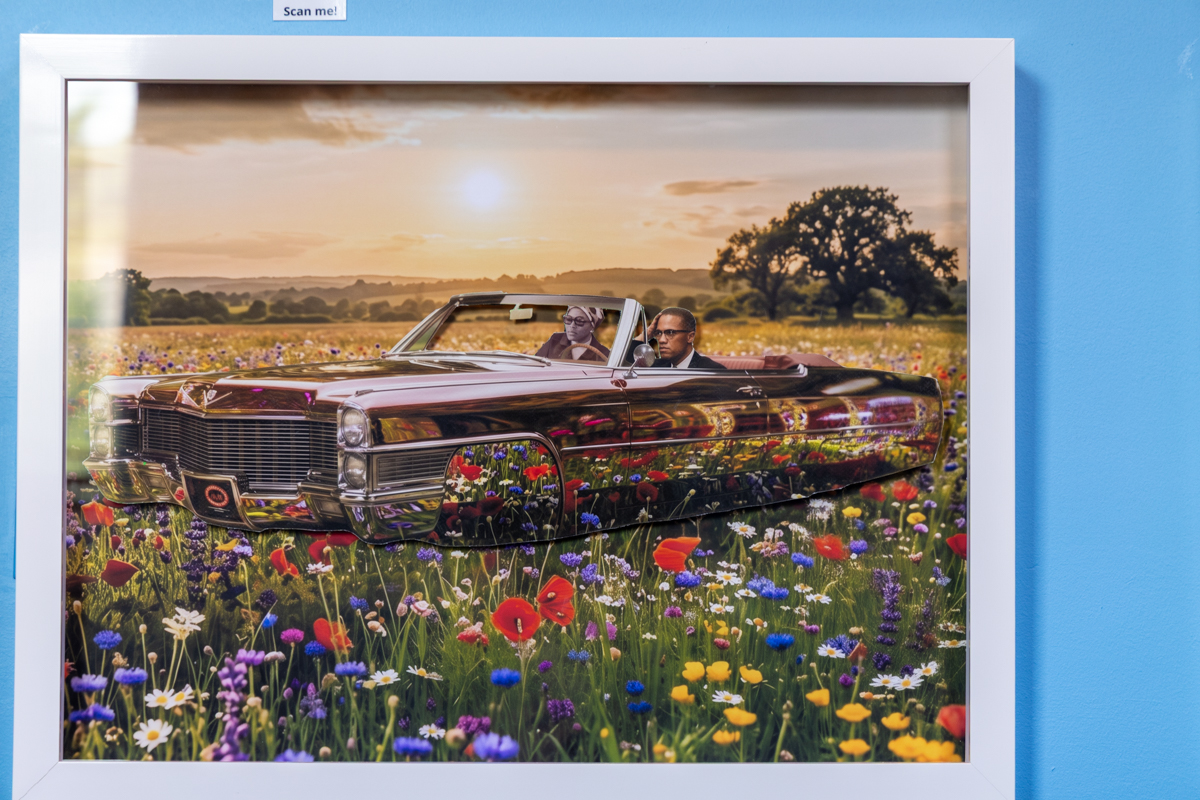
Third floor: Black Jesus and the Future Lab. A huge painting of Black Jesus greets you on arrival. The first room off the hallway, the Garden of Jza, breaks from Williams’ usual style. Its collages show civil rights figures, including Jimmy Carter, Martin Luther King Jr., and Malcolm X, alongside their spouses, drifting through peaceful landscapes in vintage cars.
The Future Lab is a lounge-style think tank with bean bag seating, curated music, and a black-lit “aether room.” Visitors are invited to write their hopes and prayers for the future on sticky notes and leave them behind.
Tickets and Admission
- General admission: $20 per person, includes one drink ticket
- RSVP without a drink: $15
- Children ages 5 to 16: $10
- Children under 5: $5
Buy tickets through Eventbrite at isawmothership.com. To support the exhibition, you can donate through Satellite Collective at secure.givelively.org/donate/satellite-collective-inc/mothership-atl.
-
- (Photo: Itoro N. Umontuen/Black Press USA)
-
- (Photo: Itoro N. Umontuen/Black Press USA)
-
- (Photo: Itoro N. Umontuen/Black Press USA)
-

- (Photo: Itoro N. Umontuen/Black Press USA)
-
- (Photo: Itoro N. Umontuen/Black Press USA)
-
- (Photo: Itoro N. Umontuen/Black Press USA)
-
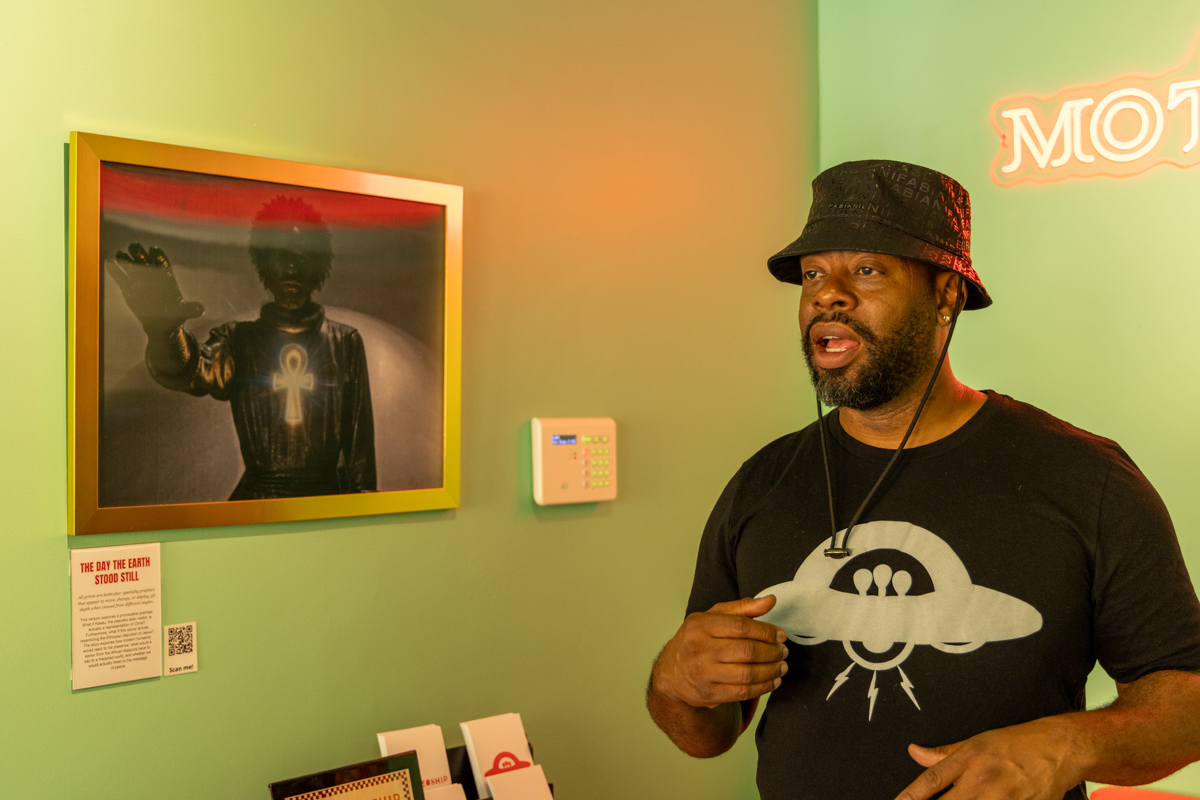
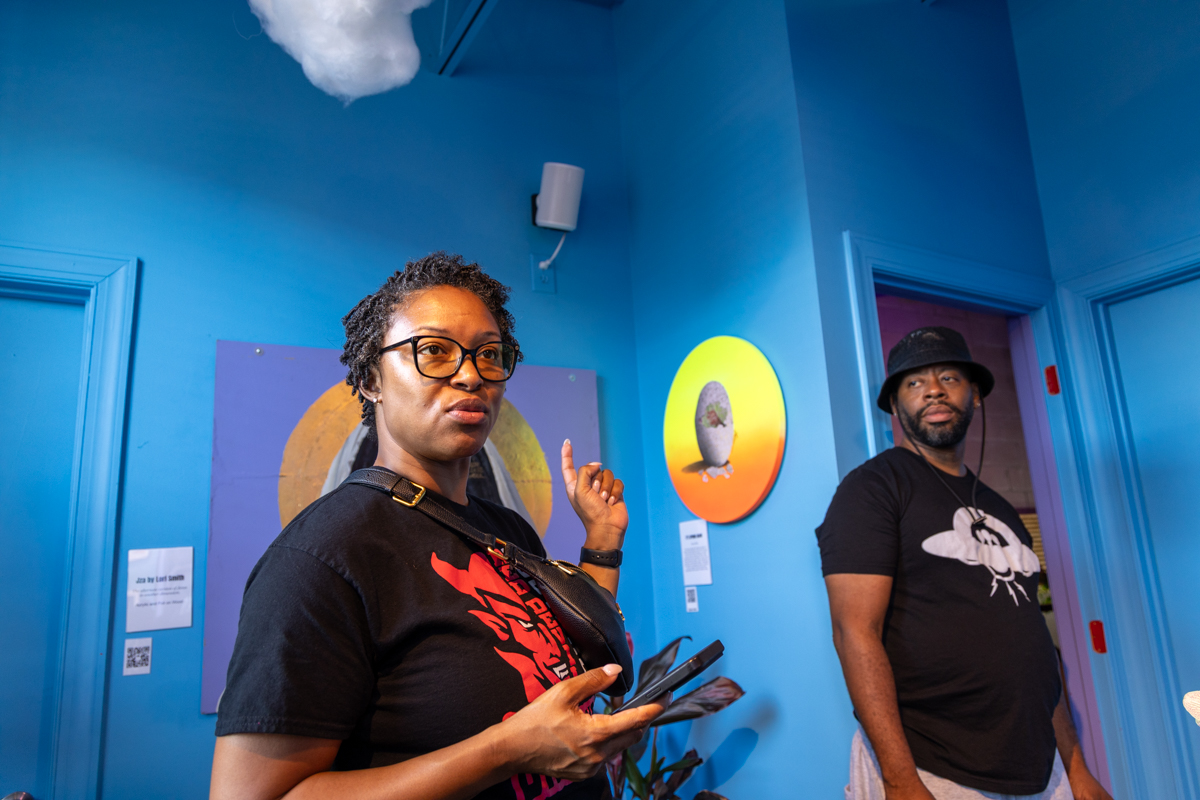
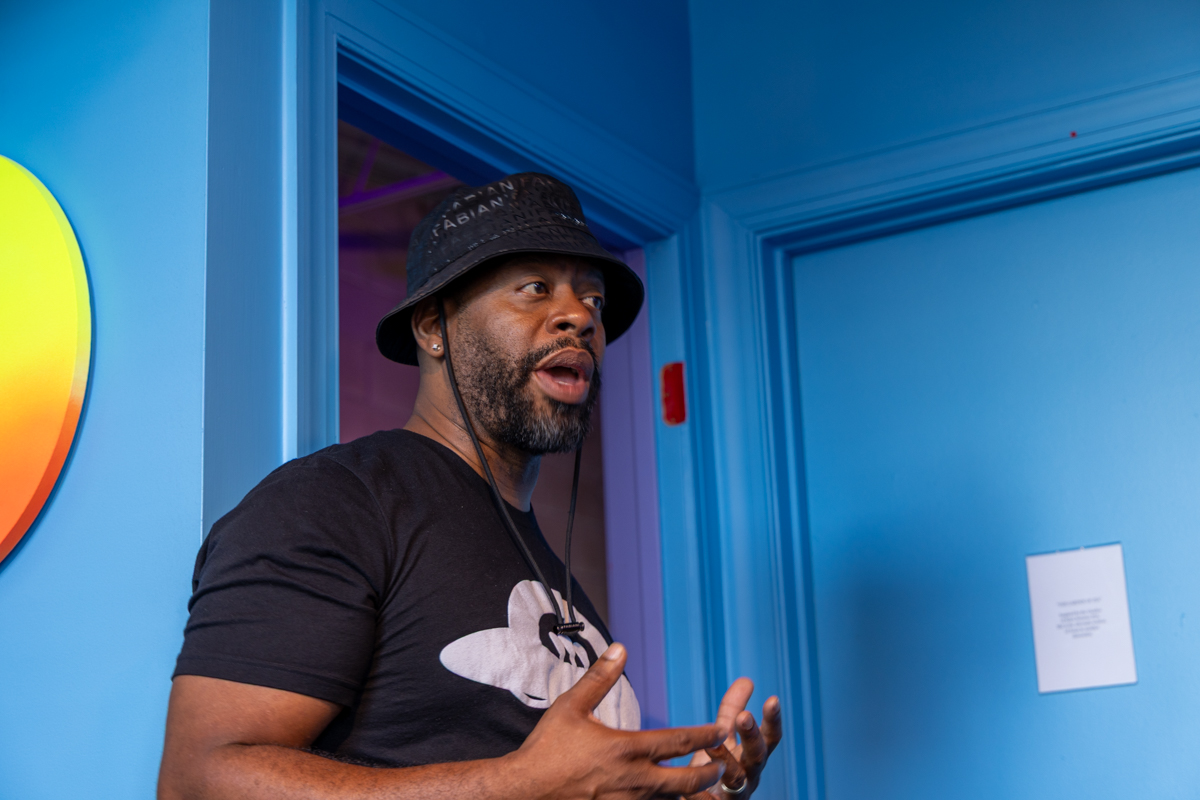
- Fabian Williams delivers a presentation inside his art installation, Mothership Sirius B in Atlanta, Georgia. (Photo: Itoro N. Umontuen/Black Press USA)
-
- (Photo: Itoro N. Umontuen/Black Press USA)
-
- (Photo: Itoro N. Umontuen/Black Press USA)
-
- (Photo: Itoro N. Umontuen/Black Press USA)
-
- (Photo: Itoro N. Umontuen/Black Press USA)
-
- (Photo: Itoro N. Umontuen/Black Press USA)
-
- (Photo: Itoro N. Umontuen/Black Press USA)
-
- (Photo: Itoro N. Umontuen/Black Press USA)
-
- (Photo: Itoro N. Umontuen/Black Press USA)
-
- (Photo: Itoro N. Umontuen/Black Press USA)
-
- (Photo: Itoro N. Umontuen/Black Press USA)
-
- (Photo: Itoro N. Umontuen/Black Press USA)
-
- (Photo: Itoro N. Umontuen/Black Press USA)
-
- (Photo: Itoro N. Umontuen/Black Press USA)
-
- (Photo: Itoro N. Umontuen/Black Press USA)
-
- (Photo: Itoro N. Umontuen/Black Press USA)
-
- (Photo: Itoro N. Umontuen/Black Press USA)
-
- (Photo: Itoro N. Umontuen/Black Press USA)
-
- (Photo: Itoro N. Umontuen/Black Press USA)
-

- (Photo: Itoro N. Umontuen/Black Press USA)
-
- (Photo: Itoro N. Umontuen/Black Press USA)
-
- (Photo: Itoro N. Umontuen/Black Press USA)


OP-ED: The Black Church Writes AI’s Next Chapter

St. Louis Celebrates Excellence at The St. Louis American’s 39th Annual Salute to Education Gala

‘No King: Vote Early’ protest for democracy in St. Louis

Optimize Your Seating: Essential Household Setup Guide #shorts

Brake Pedal Test Drive: Smooth Stops for Your Truck! #shorts

Life Lessons Learned Through Adversity: My Journey #shorts

From Claflin Alum to ColorBlind Artist

Turning Abolitionist Design Research Into Real-World Business #shorts

Black Journalists: Community, Excellence, and Lifting Up #shorts

NFN Exclusive: Muslims in AI

The Youngest American Killed in the Vietnam War

Passing for White, Fighting for Black America: The Courage of Walter White

OP-ED: Haiti TPS: Have We Lost Sense of Humanity?

NFL: Week Two Recap | Jalen Hurts did not fold; Caleb Williams exits game with injury

Remembering Chauncey Bailey as Student Journalists Face Threats to Truth-Telling

Peter Magubane: a Camera Against Apartheid

Mayor Lee Announces $1 Million Kaiser Permanente Grant for Pilot Program to Address Homelessness, Clean Up Public Spaces throughout Oakland

OP-ED: How Head Start Also Helps Parents

Poll: Becerra Widens His Lead Over Hilton; Californians Split on Wealth Tax

Community Action Group ‘Friends of Zakiya’ Ask Sheriff for Time
St. Louis Celebrates Excellence at The St. Louis American’s 39th Annual Salute to Education Gala
‘No King: Vote Early’ protest for democracy in St. Louis
Optimize Your Seating: Essential Household Setup Guide #shorts
Brake Pedal Test Drive: Smooth Stops for Your Truck! #shorts
Life Lessons Learned Through Adversity: My Journey #shorts
From Claflin Alum to ColorBlind Artist
Turning Abolitionist Design Research Into Real-World Business #shorts
Black Journalists: Community, Excellence, and Lifting Up #shorts
NFN Exclusive: Muslims in AI

NFN Live presents The State of the Westward
-

 Black Press6 days ago
All Skinfolk Ain’t Kinfolk
-

 Black Press5 days ago
Oakland Awarded More than $14 Million in State Funding
-

 Black Press5 days ago
Jendayi Arrest Raises Community Concerns Regarding Sheriff’s Chain of Command
-

 African American News and Issues3 days ago
Black History: Gladys West Mathematics Helped Make GPS Possible
-

 Black Press5 days ago
Allen Temple Baptist Church Hosts Free Prostate Cancer Screenings on Oct. 17
-

 Featured6 days ago
Uncle Luke Joins BlackPressUSA | Trump Responds to Nolan Wells Case 📱
