
World
Obama’s African Legacy Already Being Debated

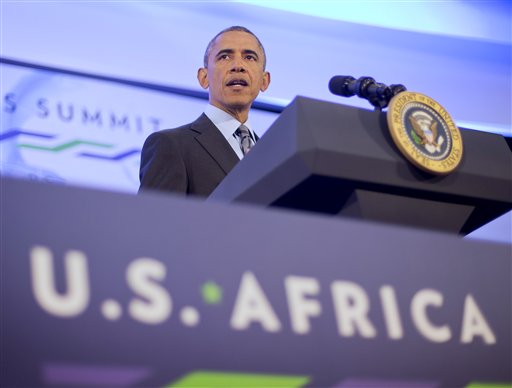
President Barack Obama listens to a question during his news conference at US African Leaders Summit, Wednesday, Aug. 6, 2014 at the State Department in Washington. (AP Photo/Pablo Martinez Monsivais)
By George E. Curry
NNPA Editor-in-Chief
SECOND OF TWO ARTICLES
WASHINGTON (NNPA) – President Obama showed a deeply personal side of him rarely seen in public as he toasted African leaders at a State Dinner at the White House at the recently-concluded U.S.-Africa Summit in Washington.
“Tonight we are making history, and it’s an honor to have all of you here,” he said on Aug. 5. “And I stand before you as the president of the United States and a proud American. I also stand before you as the son of a man from Africa. The blood of Africa runs through our family. And so for us, the bonds between our countries, our continents, are deeply personal.”
It was precisely because of those special bonds that Africans and African Americans had such high –some say unrealistic – expectations of what Obama would do for Africa when he was first elected president in 2008.
Now those expectations have faded with the passage of time.
Since his election, Obama has made only two trips to Africa, not counting his brief trip to Johannesburg in December 2013 to attend a memorial service following the death of Nelson Mandela. His first trip as president was July 10-11, 2009 to Ghana, where he met with the president, addressed the Ghanaian Parliament and toured Cape Coast Castle, where enslaved Africans were kept before being taken to the West.
He took a three-nation trip June 26-July 2, 2013, visiting Senegal, where he toured Goree Island; South Africa and Tanzania.
Obama visited Kenya, his father’s place of birth, prior to assuming office.
As Obama noted in his toast to African leaders, “Of all the incredible moments of our trips to Africa, one of the most memorable was being able to bring Michelle, and later our little girls, to my father’s hometown in Kenya, where we were embraced by so many relatives.
“We’ve walked the steps of a painful past – in Ghana, at Cape Coast Castle; in Senegal, at Gorée Island – standing with our daughters in those doors of no return through which so many Africans passed in chains. We’ll never forget bringing our daughters to Robben Island, to the cell from which Madiba showed the unconquerable strength and dignity of an African heart. We’ve been inspired by Africans – ordinary Africans doing extraordinary things…”
With slightly more than two years left in his two-term presidency, scholars and activists are already debating what will be the African legacy of the first African American elected president of the United States.
The legacies of Obama’s two immediate predecessors on the continent are clear. Although, by his own admission, Bill Clinton should have done more to end the Rwandan genocide, fight the AIDS epidemic and end famine and war in Somalia, his legacy is the passage and signing of the African Growth and Opportunity Act – AGOA – into law in 2000.
AGOA was designed to help economies in sub-Saharan Africa develop stronger economic ties with the U.S. It does that by providing trade preferences for certain goods to enter the U.S. duty free, including textiles. The law, renewed once since passage, is up for renewal again in 2015.
It is universally agreed that George W. Bush’s African legacy is what he did to curb HIV/AIDS in Africa.
A White House fact sheet noted, “President Bush has made a historic commitment to the fight against global HIV/AIDS. In his 2003 State of the Union Address, President Bush announced the President’s Emergency Plan for AIDS Relief (PEPFAR) to combat global HIV/AIDS. Later that year, President Bush signed the initial 5-year, $15 billion authorizing legislation that had been approved with strong bipartisan support. This President views this commitment as a central part of our foreign policy to help alleviate the despair that allows extremism to take hold.
“PEPFAR is the largest international health initiative in history to fight a single disease. This effort has helped bring life-saving treatment to more than 2.1 million people and care for more than 10 million people – including more than four million orphans and vulnerable children – around the world.”
What is Obama’s signature contribution to Africa?
Bill Fletcher, Jr., former president of TransAfrica, an advocacy group, summed up Obama’s African legacy in two words – “good speeches.”
He explained, “When he [Obama] was a senator, he introduced legislation in connection with the Great Lakes Region, peacekeeping and economic development. In the six years he has been in office, I’ve seen no evidence of any kind of U.S. effort to engage in peace and reconciliation.
“For example, the U.S. should be trying to resolve Moroccan occupation of the Western Sahara. But there are no special envoys working in the Great Lakes Region. The U.S. ignores the corruption of Equatorial Guinea. The response to the Nigerian Boko Haram crisis ends up being basically military and very little else. So, I don’t feel there’s anything particularly innovative in Obama’s approach toward the continent.”
Mel Foote, president of Constituency for Africa, an Africa support group, disagrees.
“His biggest legacy is going to be these young African leaders initiative,” a reference to a pre-summit gathering here hosted by Obama. “You can’t stop them. They are the powers to be in their own countries.
“He had young people from Zimbabwe here, he had young people from Cameroon here –countries that have dictators. These are the best and the brightest that have been identified by U.S. embassies, not by the governments of those countries.”
Foote and Fletcher agree that Africa’s problems extend beyond the need for additional U.S. trade.
Africa has the youngest population in the world, with nearly 200 million people between the ages of 15 and 24. In most African countries, that group makes up more than 20 percent of the total population, according to the African Development Bank. By 2045, the number of young people is expected to double.
With those growing numbers comes the challenge of providing a sufficient number of jobs.
As a Brookings report explained, “Young people find work, but not in places that pay good wages, develop skills or provide a measure of job security. With the exceptions of Botswana, Nigeria and South Africa—all of which have alarmingly high youth unemployment rates—less than one-fifth of Africa’s young workers find wage employment. Over 70 percent of youth in the Republic of the Congo, the Democratic Republic of the Congo, Ethiopia, Ghana, Malawi, Mali, Rwanda, Senegal and Uganda are either self-employed or contributing to family work.”
The Brookings study notes there is also an education crisis.
“In the midst of an increasingly knowledge-based global economy, 30 million primary school-age children in Africa – one in every four – are out of school, along with 20 million adolescents,” the report stated. “…Many of Africa’s children are denied an education because they are working as child laborers.”
The continent has other pressing issues as well, including the need for more energy.
Another Brookings study, titled, “Top Five Reasons Why Africa Should Be a Priority for the United States,” observed: “The International Energy Agency (IEA) estimates that there are 590 million people in sub-Saharan Africa, mostly in rural areas, without access to electricity, representing nearly 6 in 10 people in the region. In addition, 700 million people, or 70 percent of the population, rely on traditional, non-commercial sources of energy, such as biomass, for cooking.”
In his speech to African leaders, Obama acknowledged that even with Africa’s challenges, it is a continent on the rise.
He said, “Even as Africa continues to face enormous challenges, even as too many Africans still endure poverty and conflict, hunger and disease, even as we work together to meet those challenges, we cannot lose sight of the new Africa that’s emerging.”
###








Black Press
Cuban President Vows to Defend the Country Against US Invasion
NEW YORK CARIB NEWS — The remarks come amid heightened rhetoric from U.S. President Donald Trump, whose administration has increased pressure on the communist-led nation. Trump recently suggested that a “takeover” of Cuba, potentially unfriendly, remains a possibility, while senior officials, including Secretary of State Marco Rubio, have called for political change on the island.


New York Carib News
Cuban President Miguel Díaz-Canel has declared that the island will defend itself against any potential military action by the United States, warning of serious regional consequences if tensions escalate further.
In an interview conducted in Havana with NBC’s Kristen Welker, Díaz-Canel emphasized that there is “no justification” for U.S. aggression against Cuba, while stressing that any invasion would provoke resistance. “If that happens, there will be fighting, and there will be a struggle, and we will defend ourselves,” he said, underscoring Cuba’s readiness to protect its sovereignty.
The remarks come amid heightened rhetoric from U.S. President Donald Trump, whose administration has increased pressure on the communist-led nation. Trump recently suggested that a “takeover” of Cuba, potentially unfriendly, remains a possibility, while senior officials, including Secretary of State Marco Rubio, have called for political change on the island.
Despite the rising tensions, Díaz-Canel insisted that Cuba’s position remains defensive, not aggressive. He reiterated a willingness to engage in dialogue but rejected U.S. demands related to political reforms, including multiparty elections and the release of individuals described internationally as political prisoners. Cuban authorities, however, deny holding such prisoners and argue that these claims are part of efforts to discredit the revolution.
The decades-old U.S. embargo remains a central point of contention. First imposed in 1962 following the Cuban Revolution led by Fidel Castro, the policy continues to shape Cuba’s economic challenges, including fuel shortages, power outages, and limited access to essential goods. Díaz-Canel described the embargo as “cruel” and a major factor behind the country’s ongoing hardships.
At the same time, the Cuban leader signaled openness to economic engagement, including potential foreign investment in the island’s energy sector, an area currently restricted for U.S. companies under existing sanctions laws.
While both Washington and Havana have acknowledged preliminary talks, deep mistrust persists. Díaz-Canel pointed to past U.S. actions in other regions as a source of skepticism, warning that negotiations conducted alongside military pressure undermine confidence.
As geopolitical tensions continue to rise, Cuba’s leadership is positioning itself firmly against external intervention while leaving the door open, albeit cautiously, to diplomatic engagement.
Black Press
Cuba: No Negotiation with US on the President or Political System
NEW YORK CARIB NEWS — While Havana confirmed last week that talks with Washington are underway, Cuban President Miguel Díaz-Canel has struck an increasingly defiant tone. Addressing a group of international activists delivering humanitarian aid, he warned of potential escalation, stating, “we’re not just crossing our arms… there could be aggression against Cuba.”

New York Carib News
The government of Cuba has firmly rejected any suggestion that its political leadership or governing system could be subject to negotiation in ongoing discussions with the United States, as tensions between the two nations intensify.
Deputy Foreign Minister Carlos Fernandez de Cossio delivered the government’s position unequivocally during a press conference on Friday, stating, “I can categorically confirm that the political system of Cuba is not up for negotiation, and of course neither the president nor the position of any official in Cuba is subject to negotiation with the United States.”
His remarks follow reports that the administration of U.S. President Donald J. Trump was exploring proposals that could involve removing Cuban President Miguel Díaz-Canel as part of a broader diplomatic arrangement.
The developments come amid a deepening economic crisis in Cuba, exacerbated by U.S. restrictions on oil supplies that have triggered widespread energy shortages and hardship across the island. Despite these pressures, Cuban officials have maintained that sovereignty remains non-negotiable.
While Havana confirmed last week that talks with Washington are underway, Díaz-Canel has struck an increasingly defiant tone. Addressing a group of international activists delivering humanitarian aid, he warned of potential escalation, stating, “We’re not just crossing our arms… there could be aggression against Cuba.”
He reinforced that stance in a separate message, declaring, “Any external aggressor will face an impenetrable resistance.”
Media reports in the United States have suggested that Washington is considering a deal that could ease trade restrictions while facilitating political change in Havana. However, Cuban officials have dismissed such proposals as interference in domestic affairs.
Historically, Cuban leadership has maintained that dialogue with the United States is only acceptable under conditions of equality and mutual respect. That position has remained consistent even as economic pressures mount and international aid efforts expand to support the island’s struggling population.
De Cossio acknowledged that there are areas of mutual interest between the two countries, including trade and longstanding financial claims. However, he declined to provide specifics about the timing or structure of current discussions.
The standoff underscores a broader geopolitical tension, as both nations navigate a complex mix of diplomacy, economic pressure, and ideological differences. With Cuba facing one of its most severe crises in decades, the outcome of these talks could have far-reaching implications—not only for bilateral relations but for stability across the wider Caribbean region.
Black Press
COMMENTARY: Regime Change and The Roots Of U.S. Hostility With Iran
SAN DIEGO VOICE & VIEWPOINT — Those who are serious in their study of history are clear that the Cold War was a propaganda campaign to position communism and socialism as a “boogeyman” in order to justify Americans’ desire for geopolitical domination of the world. Additionally, Mosaddegh’s policy of nationalizing the oil wealth of the country was disruptive to Western oil companies that wanted unfettered access to Iran’s oil reserves.
By Dayvon Love | San Diego Voice and Viewpoint
Director of Public Policy, Leaders of a Beautiful Struggle
In 1953, the United States and other Western forces collaborated to overthrow the democratically elected president, Mohammad Mosaddegh, of Iran.
The stated rationale for pursuing regime change was based on the Cold War logic that Mosaddegh was aligning with an evil communist sphere of influence anchored by the former Union of Soviet Socialist Republics (USSR/Russia).
Those who are serious in their study of history are clear that the Cold War was a propaganda campaign to position communism and socialism as a “boogeyman” in order to justify Americans’ desire for geopolitical domination of the world. Additionally, Mosaddegh’s policy of nationalizing the oil wealth of the country was disruptive to Western oil companies that wanted unfettered access to Iran’s oil reserves.
After the overthrow of Mosaddegh, the United States installed the Shah of Iran to lead the country, which was a brutal, autocratic regime that lasted for a couple of decades. The 1979 revolution in Iran that resulted in the overthrow of the Shah and the taking of American hostages is often narrated as an act of anti-American aggression instead of a response to the U.S. imposition of a brutal regime on the people of Iran. In other words, the 1979 Iranian revolution and the anti-American sentiments expressed over the years by Iranian leadership is a response to U.S. imperialist aggression toward the sovereignty of the Iranian people and the larger Muslim world.
U.S. Secretary of State Marco Rubio gave a speech a few weeks ago in Munich, Germany, which provides a clear underlying logic for U.S. military strikes against Iran. He said:
“…For five centuries, before the end of the Second World War, the West had been expanding – its missionaries, its pilgrims, its soldiers, its explorers pouring out from its shores to cross oceans, settle new continents, build vast empires extending out across the globe,” Rubio said. “But in 1945, for the first time since the age of Columbus, it was contracting. Europe was in ruins. Half of it lived behind an Iron Curtain and the rest looked like it would soon follow. The great Western empires had entered into terminal decline, accelerated by godless communist revolutions and by anti-colonial uprisings that would transform the world and drape the red hammer and sickle across vast swaths of the map in the years to come … .”
The luxuries and quality of life that Western civilization enjoys are based on the colonial relationship it has with the so-called Third World, which is largely non-White and poor. People who are self-respecting will rise up to challenge the social order that causes its own degradation.
Additionally, in a November 1979 interview with journalist Mike Wallace, the Ayatollah Khomeini (leader of Iran) committed to (and delivered on this commitment) releasing Black and women hostages. His rationale for releasing Black hostages was that we are an oppressed group in America and not responsible for the aggression toward their people. This is a recognition of the global system of domination that bolsters White political and economic domination of the world.
It is also important to acknowledge the role that Israel has played in encouraging U.S. military aggression toward Iran.
Israel considers itself to be a cultural descendant of Western civilization. The state of Israel serves as a proxy for maintaining U.S. geopolitical domination of the muslim world and the Palestinian people have been casualties of U.S. maintenance and support of the settler colonial project of the state of Israel. Israel has been urging the U.S. to take a more aggressive stance toward Iran to advance its own military domination of the region.
The current administration’s capitulation to Israeli political leadership’s urging to enact regime change in Iran is a further acknowledgement of how important Israel is as an instrument of American imperialism. This current military strikes against Iran by the Trump administration is another example of the White nationalist political agenda of the Republican Party.
What must be acknowledged is that the military-industrial complex that funds both political parties must be directly confronted and ultimately dismantled. America currently invests $1 trillion a year of our tax dollars to maintain America’s role as the policeman of the world.
Democrats in the upcoming midterms need to be forced to engage in a radical change in American foreign policy that does not legitimize military aggression toward people defending their sovereignty. Democrats need to be forced to pursue a policy that divests from the $1 trillion military budget and puts those resources in the hands of the masses of people in this society who have been victimized by the global system of White supremacy.
Dayvon Love serves as director of public policy for Leaders of a Beautiful Struggle (LBS), a Baltimore-based grassroots think-tank.
Black History
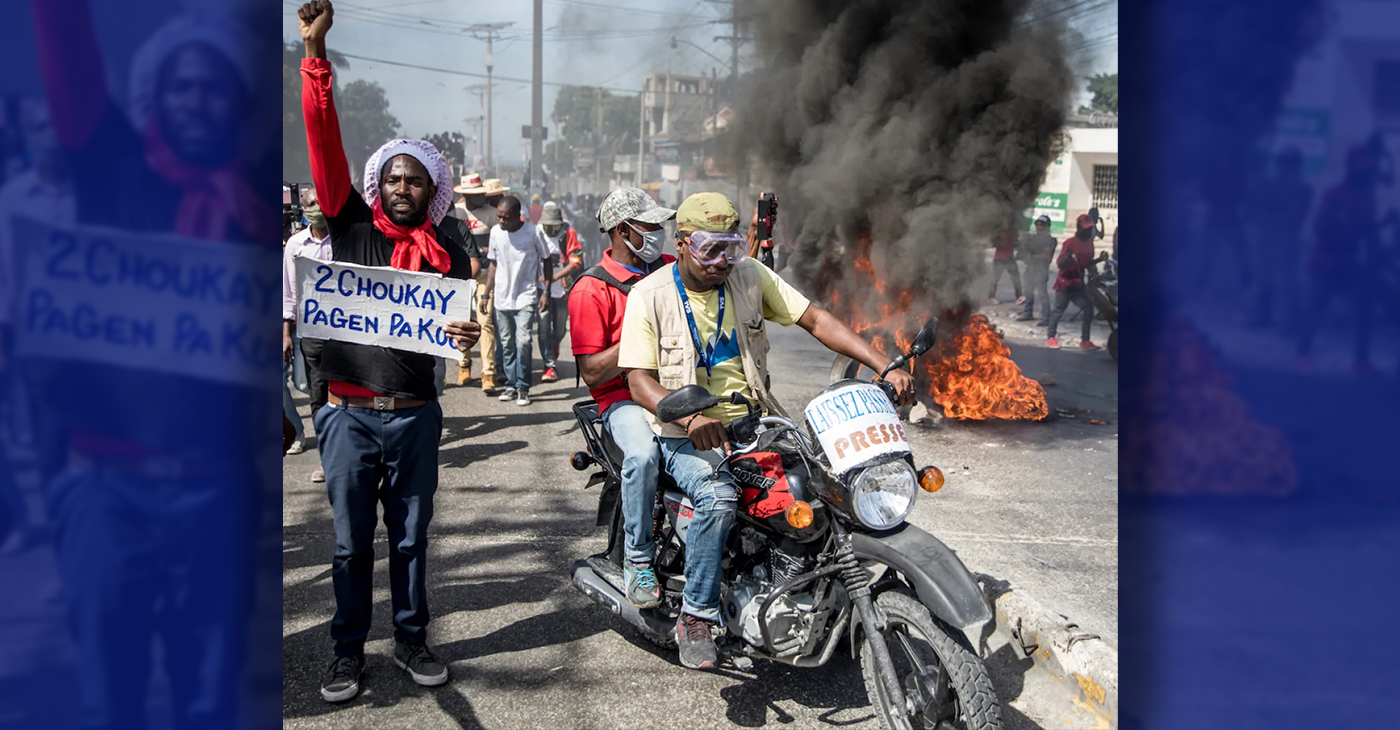
Haiti – US Warns It Will Act if Political Moves Destabilize the Country
NEW YORK CARIB NEWS — In a statement posted on X late Wednesday, the US Embassy in Haiti said Washington would view any attempt to alter the current governing arrangement as a serious threat to national stability, particularly if such moves benefit criminal gangs.
New York Carib News
The United States has issued a firm warning to Haiti’s Transitional Presidential Council, cautioning against any political actions that could further destabilize the country as international pressure mounts for long-delayed elections.
In a statement posted on X late Wednesday, the U.S. Embassy in Haiti said Washington would view any attempt to alter the current governing arrangement as a serious threat to national stability, particularly if such moves benefit criminal gangs.
“The United States would consider that any person who supports such a destabilizing initiative, which favors the gangs, would be acting against the interests of the United States, the region, and the Haitian people, and will take appropriate measures accordingly,” the embassy stated.
The U.S. warned that any such maneuver would undermine efforts to establish a minimum level of security and stability in Haiti, where gang violence continues to escalate, and economic hardship is deepening.
The statement comes amid reports of internal divisions within the Transitional Presidential Council, with some members reportedly at odds with Prime Minister Alix Didier Fils Aimé. The precise cause of the disagreement remains unclear, but the council met behind closed doors earlier on Wednesday.
A spokesperson for the prime minister’s office said he could not comment on the situation, while the council’s seven voting members did not respond to requests for comment.
Council chairman Laurent Saint Cyr later issued a statement opposing any effort to weaken government stability at this critical juncture. He emphasized that Haiti is approaching major institutional deadlines, including February 7, when the transitional council is provisionally scheduled to step down.
“As major institutional deadlines for the nation approach, any initiative likely to fuel instability, confusion, or a breakdown of trust carries serious risks for the country,” Saint Cyr said.
He warned that unilateral decisions or short sighted political calculations could jeopardize the continuity of the state and further burden an already suffering population.
“Haiti cannot afford to make unilateral decisions or engage in short sighted political calculations that would compromise the stability and continuity of the state, as well as the well being of the already sorely tested population,” he added.
Haiti remains under intense international scrutiny as calls grow for elections to be held for the first time in nearly a decade, even as persistent violence and political uncertainty continue to complicate the path toward democratic governance.
Black Press
COMMENTARY: Structural Inequality Undermines Jamaica’s Schools
THE AFRO — Many educational institutions remain under-resourced, lacking adequate infrastructure, teaching materials and technological support. This resource gap disproportionately impacts students from marginalized communities as well as schools located in marginalized areas, thus perpetuating the cycle of inequality.
By Wayne Campbell, The AFRO
Despite strong teacher appraisals, Jamaica’s education system remains crippled by deep structural failures. According to the Jamaica Teachers’ Association, 93 percent of the nation’s teachers are rated satisfactory or above in their appraisals, yet, Jamaica’s education system continues to face significant challenges.
In many societies, classroom teachers are not accorded the respect they deserve within the education system. Unfortunately, this pervasive culture of disrespect often extends to other stakeholders. Ultimately, students’ outcomes suffer as a result of an education system steeped in the legacies of colonialism, with a central axis of underperformance driven by an over-reliance on external educational practices. The problems in Jamaica’s education system are rooted in deep structural issues: under-resourced schools, unequal access, poor working conditions, ineffective oversight mechanisms such as the school boards, weak and biased school leadership, the absence of fair and balanced opportunities for teacher promotion, inadequate parental guidance, curriculum reform, low literacy and numeracy outcomes. Unfortunately, teacher appraisal continues to be used as a masking agent for the systemic challenges in the education system.
Resource inequalities
Many educational institutions remain under-resourced, lacking adequate infrastructure, teaching materials and technological support. This resource gap disproportionately impacts students from marginalized communities as well as schools located in marginalized areas, thus perpetuating the cycle of inequality. This area of concern ultimately fosters a culture of unequal access. In a recent interview, Linvern Wright, president of the Jamaica Association of Principals of Secondary Schools noted that high school administrators continue to struggle to operate on an annual allocation of approximately $17,000 per student. He pointed out that this figure has remained unchanged for nearly a decade. Undoubtedly, this one size approach regarding funding cannot adequately address the unique circumstances of each school and must be revisited.
Unequal access
The United Nations states that despite modest improvements in literacy, hundreds of millions of people remain illiterate and women are disproportionately affected. Access to education remains uneven across the region and socioeconomic groups. Disturbing regional disparities exist in early childhood development, and sub-Saharan Africa is at a particular disadvantage. Sadly, schools in rural areas tend to struggle more with teacher shortages in the STEM (science, technology, engineering and mathematics) areas. On the other hand, urban schools are often overcrowded where unequal access is still a problem.
Weak oversight mechanisms
Oversight bodies, such as school boards, frequently lack the human capacity, skills and impartiality to enforce accountability within the education system. This area of concern is both intentional and by design. As a result, ineffective governance contributes greatly to weak institutional performance and serves as a barrier to reform.
Leadership deficits
Too often we discount the role and impact of school leadership. Sadly, many of our schools suffer from a lack of transformational, instructional, ethical and compassionate leadership.
School leadership is often characterized by biased and weak management practices. This culture of leadership deficits undermines teacher morale, reduces trust in the system, negatively impacts students’ outcomes and compromises the implementation of effective educational strategies.
Parental involvement
Parental guidance and engagement remains inconsistent. Education is a partnership and without the strong support of parents and guardians students will face additional barriers to achieving mastery and proficiency in their academic pursuits. Too many parents have abandoned their roles in the hope that the school will fill the void. Global education systems must revisit how to re-engage parents so as to create a culture of stakeholder involvement which is necessary to predict a better educational outcome for all.
Curriculum implementation leadership
Carmel Roofe, professor of curriculum studies at the University of the West Indies has repeatedly called for reform regarding curriculum implementation in the education system. She stressed that those who are tasked to lead the process of curriculum implementation must demonstrate a number of key transformative curriculum skills. Among these are: knowledge of curriculum stages and models, intimate knowledge of the people, place and orality of specific context where the new curriculum is being implemented, basic research skills especially as it relates to previously implemented curricula and knowledgeable implementation leadership and practices.
Professor Roofe argues that orality is central to the lived curriculum. She added that Caribbean orality speaks to the everyday knowledge, language, actions and the Caribbean’s geopolitical context. Professor Roofe is of the view that curriculum implementation leadership underpinned by orality will encourage education stakeholders to move away from a one-size fit approach in implementing curriculum reform. It is quite evident that school leadership must be intentional and strategic in their selection regarding who is tasked to carry out the process of curriculum implementation in our schools.
Society should not be alarmed that curriculum implementation leadership is problematic across all layers of the education system. This duality concerning Jamaica’s education system is also transferred to the Curriculum Implementation Leadership. Those who are tasked with implementing curriculum leadership must be passionate to begin with. Those individuals must also be intimately familiar with the National Standards Curriculum (NSC) as well as other alternative pathways. Regrettably, in a significant number of times curriculum implementation leadership is grounded in a culture of preferential treatment. In order for curriculum implementation leadership to be successful, the stakeholders must share the collective vision and purpose.
Misuse of teacher appraisal
Teacher appraisal mechanisms are often punitive and subjective. Such mechanisms often are used as superficial solutions, masking deeper structural problems. The continuation along this pathway is problematic and does more harm to the human resources in the education system.
The way forward
Addressing Jamaica’s educational challenges requires political will as well as comprehensive reform that goes beyond teacher appraisal. Undoubtedly, there is a leadership crisis in the education system. So while society celebrates the achievements of a significant number of our students, we are mindful of the inequities within the education system. Professor Orlando Patterson, chair of the Jamaica Education Transformation Commission (JETC), characterized the Jamaican education system through a fundamental duality: a deep-seated structural divide between a high-performing elite tier and a vastly under-resourced public tier. All hands are required to truly build an inclusive education system.
Education remains a critical enabler for sustainable development. Inclusive, equitable and quality education for all speaks to the United Nations Sustainable Development Goal #4, and as such governments must put in more effort to attain this. Without a doubt, more investments in resources, stronger governance mechanisms, leadership development including curriculum implementation leadership and parental involvement are essential ingredients to improving literacy and numeracy outcomes.
The opinions expressed in this commentary are those of the writer and not necessarily those of the AFRO or the National Newspaper Publishers Association.
Black Press
Trump Says He Is Saving Nigerian Christians. History Knows This Story Well.
NNPA NEWSWIRE — From 2020 through 2025, more Muslims than Christians were killed in religiously targeted attacks. Armed groups such as Boko Haram and ISIS–West Africa primarily kill Muslims who resist them, alongside Christians and others. The deadliest Christian losses have largely occurred in Nigeria’s Middle Belt, not in the northern regions struck by U.S. bombs.

By Stacy M. Brown
NNPA Newswire Senior National Correspondent
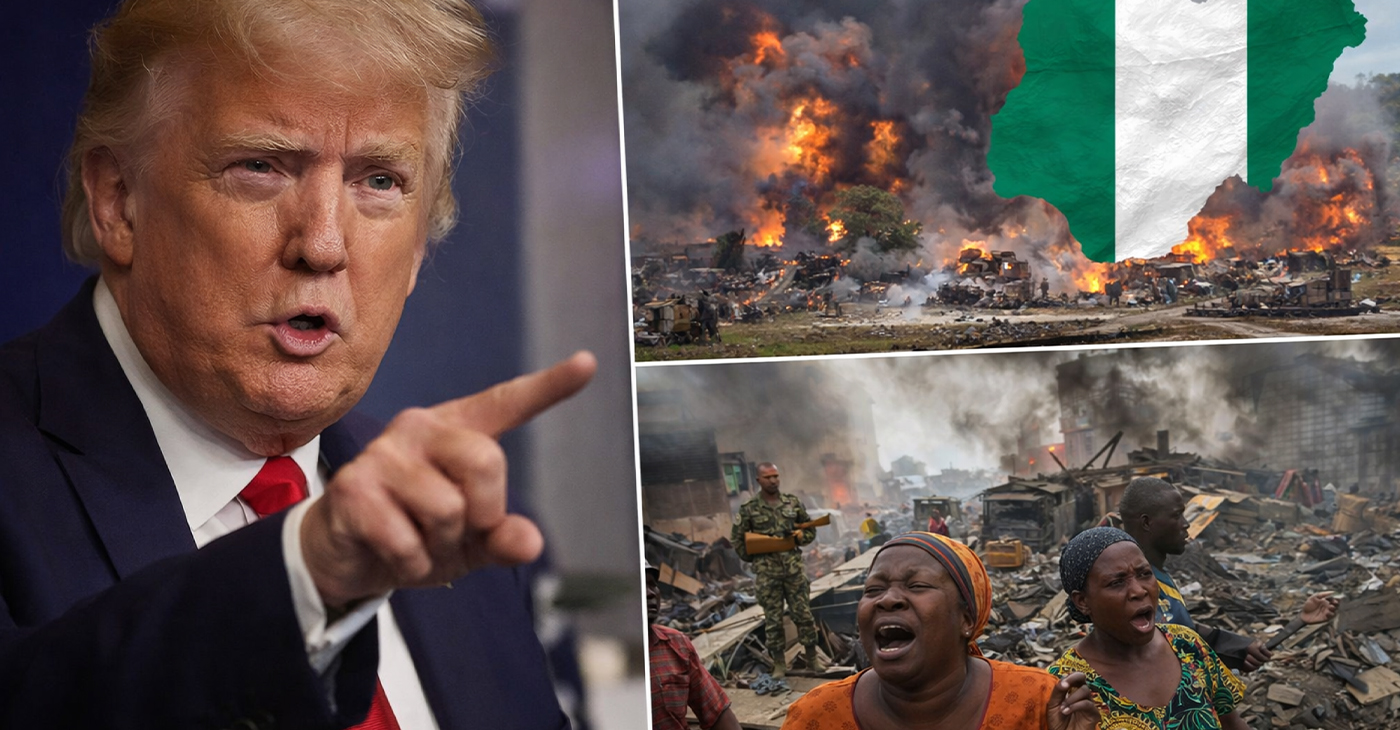
Donald Trump says U.S. bombs fell on Nigeria to protect Christians. That explanation does not survive memory, geography, or fact.
On Christmas Day, American missiles struck northern Nigeria. The administration said the targets were terrorists killing Christians. But the same administration had already stripped away humanitarian aid, dismantled U.S. Agency for International Development (USAID) programs, shut asylum doors, and blocked visas for Nigerians fleeing violence. The hand that claimed salvation had already withdrawn food, medicine, and refuge.
Nigeria is not a parable. It is a place where Muslims and Christians live side by side, where violence grows from drought, land loss, criminal networks, and borders carved by European powers to guarantee friction long after independence. The bloodshed there is not governed by scripture. It is governed by scarcity and power.
Professor Uju Anya named the contradiction without decoration. “Trump says he’s protecting Nigerian Christians,” Anya said. “Trump shuts down USAID and kills Nigerian Christians. Trump bans asylum for Nigerian Christians. Trump bans visas for Nigerian Christians. Trump bombs Nigeria, causing more misery, insecurity, and instability for Nigerian Christians.”
That misery was predictable.
When USAID was dismantled, clinics closed and food support vanished. More than a quarter-million people in Nigeria relied directly on U.S.-backed assistance. Those lives were weighed and dismissed before the first missile was launched.
Then came the strikes.
Witnesses described missiles tearing into farmland and open fields. Anti-war journalist Dave DeCamp reported that multiple U.S. missiles failed to detonate, sinking into the ground. The operation cost nearly $30 million. No evidence was released tying the bombed areas to the killings Trump cited.
At the same time, the administration also bombed Somalia. By DeCamp’s count, U.S. Africa Command has carried out at least 127 airstrikes in Somalia this year alone, more than double the previous annual record. AFRICOM has largely stopped responding to press inquiries.
The facts on Nigeria further unravel the story being told.
From 2020 through 2025, more Muslims than Christians were killed in religiously targeted attacks. Armed groups such as Boko Haram and ISIS–West Africa primarily kill Muslims who resist them, alongside Christians and others. The deadliest Christian losses have largely occurred in Nigeria’s Middle Belt, not in the northern regions struck by U.S. bombs.
If the goal were protection, the map would not look like this.
Northern Nigeria sits beneath Niger and alongside Mali and Burkina Faso, members of the Sahel alliance that expelled Western military forces and reclaimed control over gold, gas, uranium, and other strategic minerals. Niger is one of the world’s leading suppliers of uranium. Mali and Burkina Faso sit atop vast gold reserves. Nigeria remains Africa’s largest oil producer and holds significant rare earth deposits.
This pattern is not new.
In a social media post, human rights lawyer Chief Malcolm Emokiniovon Omirhobo described the strikes as part of a broader design. “The United States of America is not interested in the lives of Black Christians in Northern Nigeria,” Omirhobo said. “The real interest of the U.S. is geostrategic control.”
He said Nigeria is being positioned as a military launchpad for pressure and potential regime-change operations against Niger, Mali, and Burkina Faso. “This has nothing to do with Christianity,” Omirhobo said. “This has everything to do with resources, power, and influence.”
The selective outrage has been noticed.
Former MSNBC host Keith Olbermann questioned why Trump claimed moral urgency over Christians in Nigeria while remaining silent about Christians killed during Russia’s war in Ukraine.
Members of Congress have also raised alarms. Texas Democratic Rep. Jasmine Crockett warned against normalizing evidence-free violence. “None of this should be normalized,” Crockett said, noting that Trump has bombed Iran, Iraq, Syria, Somalia, Nigeria, Yemen, and targets in the Caribbean and Eastern Pacific this year alone.
Nigeria is left with the consequences.
President Bola Ahmed Tinubu now governs a country pulled deeper into proxy conflict, religious polarization, and regional instability. History offers no reassurance. From Libya to Iraq to Afghanistan, U.S. bombs have never stayed to rebuild what they destroyed.
“When the dust settles,” Omirhobo warned. “The U.S. will leave just as it left Afghanistan, Iraq, and Libya, and Nigeria will be left to deal with the blowback: deeper insecurity, ethnic tension, religious polarization, and a weakened sovereignty.”


Angel Reese Wins 2026 WNBA Defensive Player of the Year

What happens when purpose, leadership and resilience come together?

Car Dealer Add-Ons: What Protections Still STAND? #shorts

Defender Athlete Interview – John Rangel

Defender Athlete Interview – Elijah Eche

Inside a Century of Black Press Archives

The Defender Goes One on One with Congressman Christian Menefee

Demystifying the Retail Installment Sale Contract: Your Guide #shorts

CalAIM Helped Alfred Flores Rebuild His Life. Why Can’t More Californians Access Its Benefits?

Kia Seltos: Advanced Safety & Tech Features Explained #shorts

Latest Massacre in Haiti Reveals Cruelty U.S. Deportations

Black Americans Have Doubts About the U.S. Food System

When Praises Go Up: SUGC Nominated for Prestigious Stellar Award.

Booked and Unbound: The Legacy of Black Women’s Literary Circles

U.S. Sole Nation to Oppose U.N. Resolution Correcting Africa’s Size on World Maps

Prostate Cancer is Twice as Likely to Kill Black Men. Talking to Your Doctor Could Help Save Your Life

Outnumbered: Elbert Cox’s Equation for Greatness

COMMENTARY: Big Mama Said ‘Don’t Let Grief Break the Bank’

U.S. Open Influencers Spark Backlash over Ring Lights, Filming as Gauff and Osaka Speak Out

Passing for White, Fighting for Black America: The Courage of Walter White
What happens when purpose, leadership and resilience come together?
Car Dealer Add-Ons: What Protections Still STAND? #shorts
Defender Athlete Interview – John Rangel
Defender Athlete Interview – Elijah Eche
Inside a Century of Black Press Archives
The Defender Goes One on One with Congressman Christian Menefee
Demystifying the Retail Installment Sale Contract: Your Guide #shorts
Kia Seltos: Advanced Safety & Tech Features Explained #shorts

Carmen Meeks Turns Teachers’ Lessons Into a Legacy | 2026 Education Salute

2 Crucial Bolt EV Interior Details You MUST Inspect! #shorts
-
 Black History5 days ago
Remembering Chauncey Bailey as Student Journalists Face Threats to Truth-Telling
-
 Black Press2 days ago
OP-ED: Haiti TPS: Have We Lost Sense of Humanity?
-
 Black Press5 days ago
Poll: Becerra Widens His Lead Over Hilton; Californians Split on Wealth Tax
-
 Black History5 days ago
COMMENTARY: The Audacity of Joyce Beatty
-

 Featured1 week ago
Headlines and Hotlines 📱
-

 Black History4 days ago
Rulings Leave Questions Lingering in Nolan Wells Case