
Oakland Post
Library, Sheriff Unlock Literary Choices at Jail
OAKLAND POST — Inmates at the Marin County Jail have had access to a modest selection of books for many years. What was missing was a catalog or database to show the incarcerated patrons what else was available if it wasn’t on the shelves. A collaboration between employees of the Marin County Sheriff’s Office and the Marin County Free Library (MCFL) recently solved the situation, and it’s a page-turner of a story to tell.


Ideas and collaboration lead to expansion and new catalog
Inmates at the Marin County Jail have had access to a modest selection of books for many years. What was missing was a catalog or database to show the incarcerated patrons what else was available if it wasn’t on the shelves.
A collaboration between employees of the Marin County Sheriff’s Office and the Marin County Free Library (MCFL) recently solved the situation, and it’s a page-turner of a story to tell.
America Velasco, a program coordinator for the Sheriff’s Custody Division team who was hired in November 2018, was eager to improve the selection of materials and create a catalog for the inmates. There were about 2,000 books and a selection of educational DVDs within the jail. With a few ideas in mind, she first talked with Custody Division Reentry Sgt. Michael Dobbins. With his encouragement, Velasco walked up to the information desk at the Civic Center library branch one day in January 2019.
“There are inmates in our custody who escape their reality by reading books, and I wanted to provide them with books from various genres to choose from,” Velasco said. “It’s important for me to know what type of books we have and how many available copies we have to better assist the inmates, so a catalog was needed.”
Elmer Jan, one of the branch’s librarians, remembers the first exchange with Velasco. They both realized it was going to be a tedious and extensive project to catalog each item.
“I expressed an interest in working with America to explore what projects we could address together and so began researching how other public libraries provide service to county jails,” he said.
“I was surprised by their excitement, but I was excited to have Elmer and the rest of his peers on board,” Velasco said.
Jan’s research connected him to the San Francisco Public Library Jail and Reentry Services division staffed by library program manager Rachel Kinnon and librarian Jeanie Austin, who generously shared their resources and experiences.
In May, Jan started visiting the jail on Monday mornings to spend two hours organizing the library materials into genres. He is creating a survey to find out what type of books the inmates would like to read, and Velasco is proactively “weeding” books in poor shape from the jail archive and has initiated a subscription to the Libib cataloging website. MCFL has begun donating new books in direct response to specific inmate requests.
What’s popular? Books on World War II, astronomy, other nonfiction, historical fiction and works by author James Patterson.
“With the library taking patron requests and our response to those requests with Sara Jones’ support, I feel extremely gratified that we have begun providing library service to an underserved population,” said Jan, who is in his 19th year working for MCFL.
At the jail, Velasco normally oversees educational programs, religious services, community resources presentations, training programs and the volunteer program. She evaluates program effectiveness and creates and maintains the program scheduling in all the housing units. With that much interaction with inmates, she already knows the library upgrades are being received well.
“Once we explain to the inmates that we are creating a library catalog and expanding the selection, they are excited about having access to more books than the ones in their housing unit,” she said.
MCFL Director Sara Jones said the departmental collaboration with the Sheriff’s Office represents the County’s commitment to equity measures. “It demonstrates how we can tailor services to create access to information and provide reading materials to those who have limited options,” she said. “It’s rewarding whenever we use the skills of library staff to meet our mission for inclusion for all people in Marin.”
To learn more about supporting the jail library, call (415) 473-3203. The nonprofit Friends of the Marin County Free Library supports many other MCFL programs.













Art
Oakland Director Boots Dazzles Once Again in ‘I Love Boosters’
OAKLAND POST — Riley’s creative output is influenced by progressive ideals. His work, which includes six albums, the 2018 film “Sorry to Bother You,” and the 2023 comedy series “I’m a Virgo,” always shows that the alienation working-class people feel is inevitable under capitalism, he recently told The Guardian.

“I feel lonely,” Keke Palmer’s character Corvette says in the first few minutes “I Love Boosters,” the new comedy adventure film from Oakland-based director Boots Riley.
“I wish I could feel lonely,” Naomi Ackie’s character Sade responds. “Try having kids.”
“I Love Boosters” teems with kaleidoscopic colors, sharp playful social critique, otherworldly plot twists, and fast-paced action, but it’s grounded in its main characters’ simple and relatable motivations: They want to be less isolated, and more free to pursue their own creative endeavors.
They’d like to design clothes and run a fashion boutique, but, unfortunately, they’re mostly busy surviving. Corvette and Sade, along with Mariah, played by Taylour Page, hustle and scheme through their brilliant scrappy organized crime group, the Velvet Gang. The gang regularly boosts clothes in the Bay Area and sells them at discounted prices.
Riley portrays the gang in a positive light in “I Love Boosters,” echoing the sentiment and title of a song he recorded 20 years ago with his hip-hop band, The Coup, where he praises boosters for providing poor communities with nice clothes they can afford: like a Robin Hood of the ’hood. But while morally righteous, materially, the gang is troubled. Corvette is haunted by unpaid bills and fears getting kicked out of the building where she squats, a shuttered fast-food chicken joint.
One thing that separates Riley’s film from most others about criminal gangs is that the Velvet Gang’s members work for a living. Theirs isn’t a greedy fantasy of becoming filthy rich, or for one last hit: Boosting is a job that still doesn’t pay nearly enough.
Riley’s creative output is influenced by progressive ideals. His work, which includes six albums, the 2018 film “Sorry to Bother You,” and the 2023 comedy series “I’m a Virgo,” always shows that the alienation working-class people feel is inevitable under capitalism, he recently told The Guardian.
Visually, the film is a mix of psychedelia, afro-surrealism, noir, and perhaps a comic book.
The villain, Christie Smith, played by Demi Moore, an evil genius billionaire and fashion designer who runs the expensive clothing company the gang boosts from. She repeatedly appears on the news to put a target on the Velvet Gang members’ backs. When the gang ends up connecting with those who Christie directly exploits –workers here in the Bay Area, but also those in sweatshops overseas– the fight against Christie can commence; and uncoincidentally, Corvette starts to feel less lonely.
I don’t want to say much about that fight, but it’s delightful. Sci-Fi elements (which appear connected to Marxist theory) enter into the narrative to tie what’s become a pretty scatterbrained story together. Grounded by Palmer’s acting, “I Love Boosters” is a total joy and a refreshing break from the typical narratives we see these days. It’s totally over-the-top, but it knows it is.
Black Press
Building Bridges of Support: How AAPI Equity Alliance Is Strengthening California’s Anti-Hate Network
OAKLAND POST — In May 2022, Patricia Roque said she and her parents were attacked after a late-night stop at a fast-food drive-thru in Southern California. After hitting their car, the other driver pulled alongside them and mocked them using a racist Asian accent. Then, he threatened to kill them. The situation escalated when the man returned while the family was waiting for police and assaulted Roque’s father, fracturing his rib and choking her mother before bystanders intervened.


By Edward Henderson
When Aurelle Garner stepped out of her car one summer evening and saw a group of youths marching down her street, her stomach dropped.
What had begun as slurs hurled at her and her transgender children at a local park had escalated to violent pounding on their front door. Garner said that, before that incident, local law enforcement had repeatedly minimized her reports of harassment.
It was not until she contacted the Legal Department at The LGBTQ Center Long Beach that her family finally found help.
“I don’t know where we’d be if it weren’t for their help,” Garner, who lives in Southern California, said. “They didn’t just give legal advice. They helped us navigate a system that had otherwise dismissed us.”
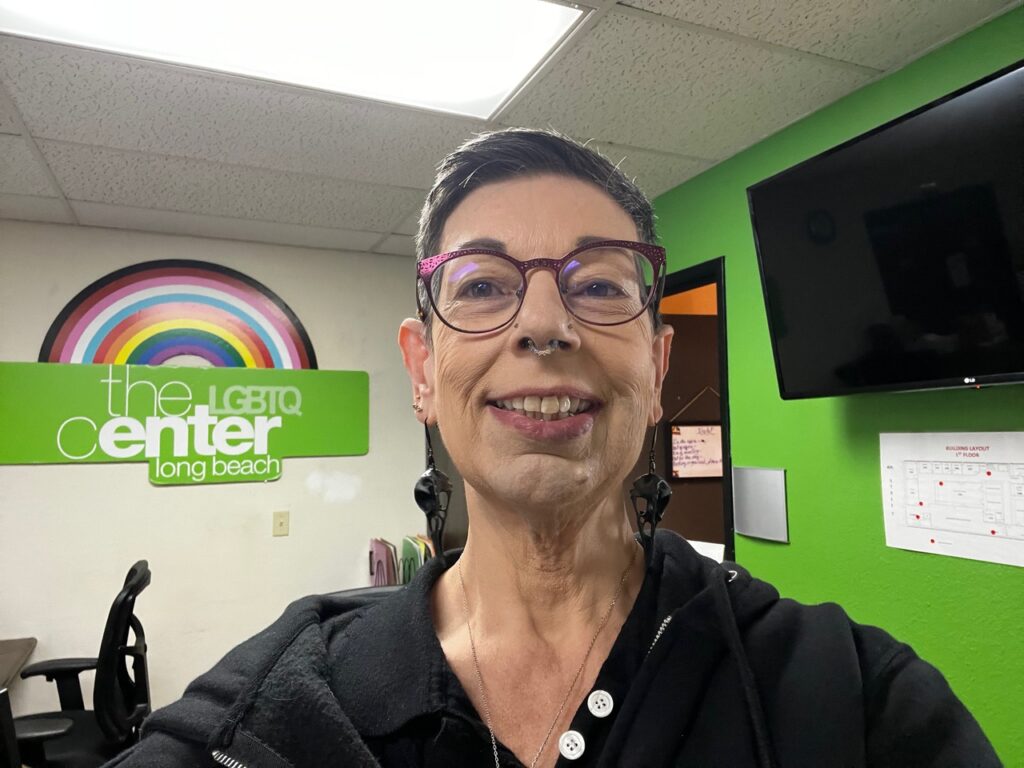
Aurelle Garner, who received services from The LGBTQ Center Long Beach (Sponsored by AAPI Equity Alliance) to aid her transgender children. (Courtesy of AAPI Equity Alliance)
That support exists because The LGBTQ Center Long Beach does not work in isolation.
The Center partners with the AAPI Equity Alliance under California’s Stop the Hate program, a statewide coalition aimed at preventing hate and supporting survivors.
As the Los Angeles County Regional Lead, AAPI Equity Alliance works with the Center and dozens of other community-based organizations to connect people to legal aid, mental health services, and support. The programs also work in tandem with CA vs Hate, the state’s anti-hate hotline and virtual reporting system that connects people across California with organizations like the LGBTQ Center Long Beach – that provide support services
Garner’s experience illustrates the kind of harm that often falls outside the narrow legal definition of a hate crime but still leaves families traumatized and unsafe. It also shows how AAPI Equity Alliance’s leadership in the Stop the Hate ecosystem translates state funding and policy into real, on-the-ground support.

Patricia Roque (Courtesy of AAPI Equity Alliance)
In May 2022, Patricia Roque said she and her parents were attacked after a late-night stop at a fast-food drive-thru in Southern California. After hitting their car, the other driver pulled alongside them and mocked them using a racist Asian accent. Then, he threatened to kill them. The situation escalated when the man returned while the family was waiting for police and assaulted Roque’s father, fracturing his rib and choking her mother before bystanders intervened.
“The police arrived long after it was over,” Roque told California Black Media (CBM). “By then, the damage was already done.”
The following day, Roque’s family was connected to the Filipino Migrant Center (FMC), a community-based organization that has received Stop the Hate funding and works within the broader AAPI Equity Alliance network. FMC provided immediate support — helping the family navigate legal options, organizing emergency financial assistance to cover medical bills and missed work, and offering emotional and community care while the criminal case unfolded.
“But the process is long and complicated. When you need help right away, that delay is a huge barrier. FMC was there immediately,”Rogue said.
The criminal case did not result in the accountability the family hoped for. But Roque said the support she received transformed her relationship to her community and to advocacy.
“Before this, I wasn’t involved in organizing at all,” she said. “Through this process, I realized my voice mattered. FMC helped turn something traumatic into a way to support others and push for change.”
Stories like Garner’s and Roque’s are part of a much larger reckoning that began at the onset of the COVID-19 pandemic, when Asian Americans and Pacific Islanders across the country experienced a surge in harassment, discrimination, and violence fueled by racist rhetoric.

Filipino Migrant Center stands in solidarity against Anti-Asian Violence (Courtesy of AAPI Equity Alliance)
In response, AAPI Equity Alliance partnered with San Francisco’s Chinese for Affirmative Action and the Asian American Studies Department at San Francisco State University to launch Stop AAPI Hate in March 2020. Since then, the project has collected more than 9,000 reports nationwide documenting incidents ranging from verbal harassment and workplace discrimination to physical assault and child bullying.
“People tend to think about hate only when it turns violent,” said Kiran Bhalla of AAPI Equity Alliance. “But there are everyday acts of discrimination that people endure constantly. Without some kind of recourse, that harm just keeps going.”
The data helped spur unprecedented action in California. In 2021, the State Legislature passed the $165.5 million Asian Pacific Islander Equity Budget, signed by Gov. Gavin Newsom. Of that total, $110 million was dedicated to victim services, education, and outreach. In August 2023, California invested an additional $40 million to expand California’s Stop the Hate program to serve a broader range of communities affected by hate and discrimination.
Today, the program supports roughly 100 nonprofit organizations statewide. As Los Angeles County Regional Lead, AAPI Equity Alliance coordinates grantees, facilitates cross-community collaboration, and helps ensure services reach those most impacted.
A recently released survey estimated that approximately 3.1 million Californians directly experienced hate, with Native Hawaiian or Pacific Islanders, Black or African Americans, and other communities of color, including Asian Americans, among those most likely to experience hate.
Black Californians, however, remain the most targeted group when it comes to reported hate crimes.
Nearly 48% of Asian American and Pacific Islander adults in California reported experiencing a hate incident in 2024, according to Stop AAPI Hate research. Most incidents were not criminal, leaving survivors with little recourse through the legal system.
That gap is precisely where AAPI Equity Alliance and its partners focus their work. The Stop the Hate framework prioritizes non-carceral responses, recognizing that policing alone often fails survivors and can further harm Black, brown, and immigrant communities.
Instead, the work centers on data and research, policy advocacy, community care, and public education. Through school-based programs, legal advocacy, emergency assistance, and survivor-centered services, the network aims to interrupt cycles of harm before they escalate.
For survivors like Garner and Roque, that support has made the difference between enduring trauma in silence and finding a path toward healing and collective power.
“When people experience hate, there’s often a profound sense of isolation,” Bhalla said. “This work helps people get back to school, back to work, back to their lives. It reminds them they’re not alone.”
Get Support After Hate:
California vs Hate is a non-emergency, multilingual hotline and online portal offering confidential support for hate crimes and incidents. Victims and witnesses can get help anonymously by calling 833-8-NO-HATE (833-866-4283), Monday to Friday, 9 a.m.–6 p.m. PT, or online at any time. Anonymous. Confidential. No Police. No ICE.This story was produced in partnership with CA vs Hate. Join them for the first-ever CA Civil Rights Summit on May 11, 2026. More information at www.cavshate.org/summit.
Black Press
Discrimination in City Contracts
OAKLAND POST — A long-awaited disparity study funded by the City of Oakland shows dramatic evidence that city government is practicing a deeply embedded pattern of systemic discrimination in the spending of public money on outside contracts that excludes minority- and woman-owned businesses, especially African Americans.

Disparity Study Exposes Oakland’s Lack of Race and Equity Inclusion
Part 1
By Ken Epstein | Oakland Post/Post News Group
A long-awaited disparity study funded by the City of Oakland shows dramatic evidence that city government is practicing a deeply embedded pattern of systemic discrimination in the spending of public money on outside contracts that excludes minority- and woman-owned businesses, especially African Americans.
Instead, a majority of public money goes to a disproportionate handful of white male-owned companies that are based outside of Oakland, according to the 369-page report produced for the city by Mason Tillman Associates, an Oakland-based firm that performs statistical, legal and economic analyses of contracting and hiring.
The report was made public by Councilmember Carroll Fife, who brought it this week to the Council’s Life Enrichment Committee, which she chairs. Councilmembers, angry at the conditions revealed, unanimously approved the informational report, which is scheduled to go to an upcoming council meeting for discussion and action.
The current study covers five years, 2016-2021, roughly overlapping the two tenures of Libby Schaaf, who served as mayor from January 2015 to January 2023.
The amount of dollars at stake in these contracts was significant in the four areas that were studied, a total of $486.7 million including $214.6 million on construction, $28.6 million on architecture, and engineering, $78.9 million on professional services, and $164.6 million on goods and services.
While the city’s policies are good, “the practices are not consistent with policy,” said Dr. Eleanor Ramsey, founder and CEO of Mason Tillman Associates.
There have been four disparity studies during the last 20 years, all showing a pattern of discrimination against women and minorities, especially African Americans, she said. “You have good procurement policy but poor enforcement.”
“Most minority- and women-owned businesses did not receive their fair share of city-funded contracts,” she continued. “Over 50% of the city’s prime contract dollars were awarded to white-owned male businesses that controlled most subcontracting awards. And nearly 65% of the city’s prime contracts were awarded to non-Oakland businesses.”
As a result, she said, “there is a direct loss of revenue to Oakland businesses and to business tax in the city… There is also an indirect loss of sales and property taxes (and) increased commercial office vacancies and empty retail space.”
Much of the discrimination occurs in the methods used by individual city departments when issuing outside contracts. Many departments have found “creative” ways to circumvent policies, including issuing “emergency” contracts for emergencies that do not exist and providing waivers to requirements to contract with women- and minority-owned businesses, Ramsey said.
Many of the smaller contracts – 59% of total contracts issued – never go to the City Council for approval.
Some people argue that the contracts go to a few big companies because small businesses either do not exist or cannot do the work. But the reality is that a majority of city contracts are small, under $100,000, and there are many Black-, woman- and minority-owned companies available in Oakland, said Ramsey.
“Until we address the disparities that we are seeing, not just in this report but with our own eyes, we will be consistently challenged to create safety, to create equity, and to create the city that we all deserve,” said Fife.
A special issue highlighted in the disparity report was the way city departments handled spending of federal money issued in grants through a state agency, Caltrans. Under federal guidelines, 17.06%. of the dollars should go to Disadvantaged Business Enterprises (DBEs).
“The fact is that only 2.16% of all the dollars awarded on contracts (went to) DBEs,” Ramsey said.
Speaking at the committee meeting, City Councilmember Ken Houston said, “It’s not fair, it’s not right. If we had implemented (city policies) 24 years ago, we wouldn’t be sitting here (now) waiving (policies).”
“What about us? We want vacations. We want to have savings for our children. We’re dying out here,” he said.
Councilmember Charlene Wang said that she noticed when reading the report that “two types of business owners that are consistently experiencing the most appalling discrimination” are African Americans and minority females.
“It’s gotten worse” over the past 20 years, she said. “It’s notable that businesses have survived despite the fact that they have not been able to do business with their own city.”
Also speaking at the meeting, Brenda Harbin-Forte, a retired Alameda County Superior Court judge, and chair of the Legal Redress Committee for the Oakland NAACP, said, “I am so glad this disparity study finally was made public. These findings … are not just troubling, they are appalling, that we have let these things go on in our city.”
“We need action, we need activity,” she said. “We need for the City Council and others to recognize that you must immediately do something to rectify the situation that has been allowed to go on. The report says that the city was an active or inactive or unintentional or whatever participant in what has been going on in the city. We need fairness.”
Cathy Adams, president of the Oakland African American Chamber of Commerce, said, “The report in my opinion was very clear. It gave directions, and I feel that we should accept the consultant Dr. Ramsey’s recommendations.
“We understand what the disparities are; it’s going to be upon the city, our councilmembers, and our department heads to just get in alignment,” she said.
Said West Oakland activist Carol Wyatt, “For a diverse city to produce these results is a disgrace. The study shows that roughly 83% of the city contracting dollars went to non-minority white male-owned firms under so-called race-neutral policies
These conditions are not “a reflection of a lack of qualified local firms,” she continued. “Oakland does not have a workforce shortage; it has a training, local hire, and capacity-building problem.”
“That failure must be examined and corrected,” she said. “The length of time the study sat without action, only further heightens the need for accountability.”
Black History
OP-ED: Like Physicians, U.S. Health Institutions Must ‘First, Do No Harm’
NNPA NEWSWIRE — Coupled with their lack of government and healthcare-related experience, we are concerned these nominees will significantly undermine public health, increase the number of uninsured people, worsen health outcomes, and exacerbate health disparities. Physicians observe Hippocrates’ maxim to “First Do No Harm,”, and we urge Trump administration officials to do the same.

By Albert L. Brooks MD | Oakland Post
Special to The Post
Presidential administrations significantly impact the health and well-being of our patients and communities.
Through the Department of Health and Human Services (HHS) and the agencies within it, such as the Centers for Medicare & Medicaid Services and the National Institutes of Health, this new administration will decide how financial resources are allocated, dictate the focus of federal research, and determine how our public health care insurance systems are managed, including the Affordable Care Act (ACA), the Children’s Health Insurance Program, the Vaccines for Children program, Medicare, and Medicaid.
The decisions made over the next four years will impact all Americans but will be felt more acutely by those most underserved and vulnerable.
As physicians, we are greatly concerned by the nominations announced by President Trump for critical healthcare-related positions. Many of their previous statements and positions are rooted in misinformation.
Coupled with their lack of government and healthcare-related experience, we are concerned these nominees will significantly undermine public health, increase the number of uninsured people, worsen health outcomes, and exacerbate health disparities. Physicians observe Hippocrates’ maxim to “First Do No Harm,”, and we urge Trump administration officials to do the same.
It is critical that the leadership of HHS and its agencies make decisions based on facts, evidence, and science. Misinformation and disinformation must not guide policymaking decisions and undermine evidence-based public health strategies. Spreading these falsehoods also erodes trust in our public institutions.
Vaccines, in particular, have been a target of disinformation by some HHS nominees. In fact, research continues to confirm that vaccines are safe and effective. Vaccines go through multiple rounds of clinical trials prior to being approved by the Food and Drug Administration (FDA) for administration to the public.
Vaccines protect against life-threatening diseases such as measles, polio, tetanus, and meningococcal disease and, when used effectively, have been shown to eliminate or substantially reduce disease prevalence and/or severity.
Because of vaccine mis- and disinformation, vaccine-preventable diseases have been resurgent such as measles and whooping cough, endangering those who are too young or unable to be vaccinated.
Several nominees have spread disinformation alleging that fluoride in public drinking water is harmful. In fact, fluoride in drinking water at the recommended level of 0.7 parts per million, like we have in our EBMUD water, is safe and keeps teeth strong. Because of public health interventions dating back to the 1960s that have resulted in 72.3% of the U.S. population now having access to fluoridated water, there has been a reduction in cavities by about 25% in both children and adults.
We also encourage the next administration to invest in our public health infrastructure. The COVID-19 pandemic highlighted the critical role of public health agencies in preventing and responding to health crises in our communities.
Health departments at the state and local levels rely on federal funding support and technical assistance to develop public health response plans, implement public health strategies, and work with on-the-ground organizations to serve hard-to-reach communities. Public health agencies are critical for protecting everyone in our communities, regardless of income level, insurance status, or housing status.
Health officials should also work to protect the significant improvements in insurance coverage that have occurred since the passage of theACAin 2010. According to HHS, uninsured Americans fell from 48 million in 2010 to 25.6 million in 2023.
California has led the way by investing in Medi-Cal and expanding enrollment eligibility. It reached its lowest uninsured rate ever in 2022 at 6.2%. Voters affirmed this commitment to developing and protecting access to care in November by passing Proposition 35, which significantly expanded funding for California’s Medi-Cal program. The administration should advance policies that strengthen the ACA, Medicaid, and Medicare and improve access to affordable health care.
Regardless of the president in power, physicians will always put the best interests of our patients and communities at the forefront. We will continue to be a resource to our patients, providing evidence-based and scientifically proven information and striving to better their lives and our community’s health. We urge the new Trump administration to do the same.
Albert L. Brooks MD is the immediate past president of the Alameda-Contra Costa Medical Association, which represents 6,000 East Bay physicians.
Black History
Former Black Panther Leader, Elaine Brown, Champions Affordable Housing with New Complex in West Oakland
OAKLAND POST — The Black Panther Apartments gets its name from developer and former Black Panther chairwoman Elaine Brown, who says she intends to honor the party throughout the building. Brown helped raise $80 million for the project, which features 79 units and includes ground floor businesses for residents and the community.

By Magaly Muñoz | Oakland Post
West Oakland is now the proud location for the new 100% affordable housing complex for low-income families.
The Black Panther Apartments gets its name from developer and former Black Panther chairwoman Elaine Brown, who says she intends to honor the party throughout the building.
Brown helped raise $80 million for the project, which features 79 units and includes ground floor businesses for residents and the community.
The complex is a brief walk from the West Oakland BART Station, making it an ideal location to access other parts of the city and region within a few minutes.
The upper levels of the complex are almost or completely parallel to a BART track, which can be a disturbing and noisy distraction with how often the trains pass by, but future residents should not worry. Every apartment has a triple-pane window that muffles the sounds of the passing train and traffic from the street below.
Brown said that she had conversations with BART to build a cover over the train track to dampen the noise, but her efforts came to no avail.
The ground-level businesses will feature a grocery store, gym, restaurant, and tech space. The restaurant will be called “Taste of Power.”
The businesses are co-owned by formerly incarcerated entrepreneurs and will allow those in the building to possibly apply for available jobs.
The complex will also feature three greenhouses that will be maintained to sell to the downstairs grocery store. Residents will have the opportunity to apply for jobs here as well.
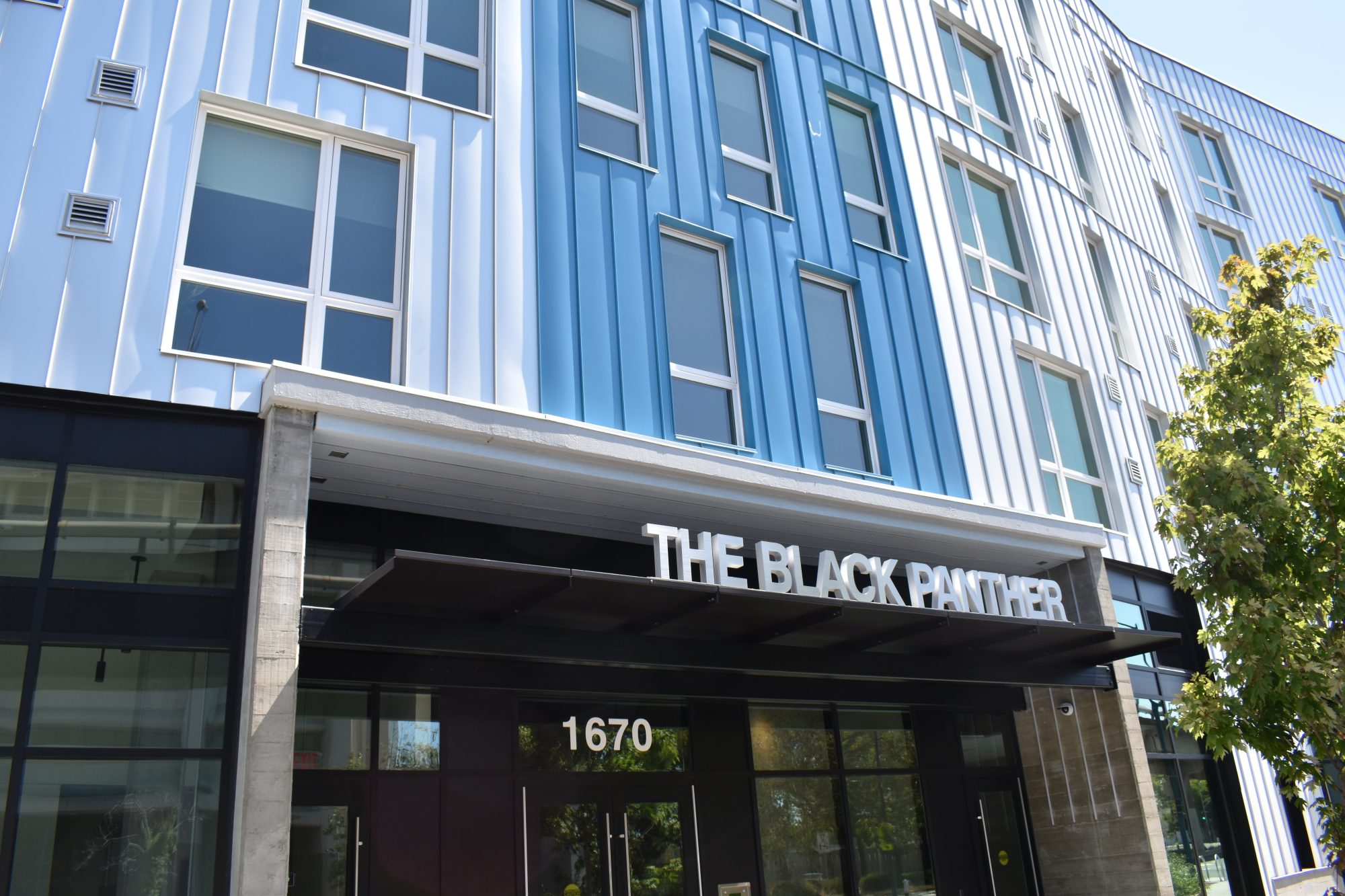
The Black Panther affordable housing complex located at 1670 Seventh St. in West Oakland. The 79-unit apartments will be ready for residents to move in starting in September. Photo by Magaly Muñoz.
But Brown emphasized that this apartment complex was not a transitional housing service or “survival program,” if people want to make their way in this capitalistic world, they have to work for it, she says.
“This is not a charity,” Brown repeated throughout the tour.
She said everyone is entitled to housing regardless of their background, but she would not be providing therapy, substance abuse programs or case work management. This is a place to give people a much-needed roof over their head.
There are studios and 1- to 2-bedroom apartments available to rent. Each apartment will come furnished with a dining table, a sofa bed in the living room, and beds for each room. Bathrooms can also be adapted for ADA accessibility.
A community room and kitchen will also be available to residents for socializing or hosting their own private events. Each residential floor also has water fountains, laundry rooms, and trash chutes.
West Oakland was once a thriving hub for Black folks, featuring restaurants, bars, music clubs and more. The area was made up of a majority of Black people and their families, but the population has slowly dwindled over the years.
It did not take long for people online to criticize the development, saying that it was a waste to build in West Oakland and the apartment complex would soon “turn into a drug den.”
Brown said she does not respond to petty comments about people who are not making any change in their community.
“What I’m hoping for is that this will inspire developers to actually develop beautiful housing for poor people who can’t afford market prices,” Brown said.
The limited amount of units available has not stopped people from applying. The complex currently has received over 7,000 applications that will be filtered through the county’s coordinated entry program.
Although they cannot house everyone, Brown and her team say that this goes to show the urgent need for more affordable housing projects in the city. They have heard of too many people and families either living on the streets and their cars or packing themselves into a tight living space with not enough room for everyone to be comfortable.
The development is one of the few affordable housing projects in the area to successfully pan out from start to finish.
Residents will begin to move into their units starting in September.
Black Press
Calif. Anti-Sex Trafficking Advocates Discuss Competing Bills, Strategies
OAKLAND POST — “It is time to send a thorough message that if you seek to buy a child for sex, you will pay the highest criminal penalties in this state,” said the Rev. Shane Harris, a San Diego-based activist, former foster youth and founder of the Peoples Association of Justice Advocates, (PAJA), a national civil rights organization and policy think tank. Harris, who was speaking at a rally at the State Capitol earlier this month, was speaking in support of Senate Bill 1414, authored by Sen. Shannon Grove (D-Bakersfield), which calls for people who buy sex from minors to be punished with a felony. The punishment includes a two-year prison sentence and a $25,000 fine.

By Bo Tefu, California Black Media | The Oakland Post
Advocates from across California are challenging state officials and community leaders to support legislation that provides resources and services for survivors and victims of human trafficking, as well as assistance as they transition back into civil society.
Some of those advocates are also calling for more effective state policy to curtail trafficking, a crime that has an outsized impact on Black children, particularly girls.
According to the FBI, a report covering a two-year period found Black children accounted for 57% of all juvenile arrests for prostitution. In addition, 40% of sex trafficking victims were Black and 60% of those victims had been enrolled in the foster care system.
“It is time to hold the perpetrators who take advantage of our children accountable,” said the Rev. Shane Harris, a San Diego-based activist, former foster youth and founder of the Peoples Association of Justice Advocates, (PAJA), a national civil rights organization and policy think tank.
“It is time to send a thorough message that if you seek to buy a child for sex, you will pay the highest criminal penalties in this state,” added Harris who was speaking at a rally at the State Capitol earlier this month. Harris was speaking in support of Senate Bill 1414, authored by Sen. Shannon Grove (D-Bakersfield), which calls for people who buy sex from minors to be punished with a felony. The punishment includes a two-year prison sentence and a $25,000 fine.
Harris said the PAJA is the only civil rights organization in the state that supports SB 1414.
Harris urged other Black-led groups who favor anti-trafficking legislation more focused on criminal justice reforms (as opposed to stiffer penalties), to “join the movement.”
Many of those civil rights groups fear that SB 1414 could lead to the incarceration of more Black youth.
Those sentiments were echoed in a panel discussion organized by Black women advocates on April 26 to examine the cause and effects of human trafficking in California’s Black communities. The virtual event was hosted by the Forgotten Children, Inc, a faith-based nonprofit that advocates for survivors and victims of human trafficking through anti-trafficking campaigns and initiatives.
Panelists shared the psychological impact of sexual exploitation on youth and children in the long term.
Author and educator Dr. Stephany Powell shared statistics and information revealing that African American women and girls are the most trafficked nationwide.
Powell, who serves as the senior advisor on law enforcement and policy at the National Center on Sexual Exploitation said that national data indicates that sex trade survivors are disproportionately women of color. She stated that male survivors often go unnoticed because boys rarely report trafficked crimes.
Powell said that decriminalizing prostitution in California could increase human trafficking. She argued that Senate Bill 357, authored by Sen. Scott Wiener (D-San Francisco), which was signed into law in 2022 and legalized loitering for prostitution, caused a surge in street-level prostitution.
Panelist and psychologist Dr. Gloria Morrow shared opposing views on decriminalizing prostitution. She said that decriminalizing prostitution could help survivors gain access to state resources and support.
Despite opposing views, Powell and Morrow agree that the Black community needs resources and educational programs to address human trafficking.

San Diego’s State Workers Demand Better Pay in Major Strike

Unscripted Sports Talk: Featuring Local Media Stars! #shorts

Par 365: Making Indoor Golf More Accessible in Minnesota #shorts

Honoring Clem Haskins: A Basketball Legend’s Legacy at UMN #shorts
NFN live presents Beyond IWDM 50 Podcast
The Hidden Cost of Insurance Loyalty

Retrospectro Talks Viral Videos, Lean Squad, Music & More | Interview

CBCF’s ALC 55 Recap | September 2026

The Washington Informer Celebrates 62 Years | Recap

Heated Seats & Sliding Window: Ultimate Truck Comfort #shorts

OP-ED: Haiti TPS: Have We Lost Sense of Humanity?

Remembering Chauncey Bailey as Student Journalists Face Threats to Truth-Telling

All Skinfolk Ain’t Kinfolk

Poll: Becerra Widens His Lead Over Hilton; Californians Split on Wealth Tax

Rulings Leave Questions Lingering in Nolan Wells Case

Latinas Deserve Equal Pay. Unions Help Make It Happen.

Zakiya Jendayi Arrested, Locked Out of Home by Sheriff’s Deputies

Why Black Artists Struggle to Sell Tours

COMMENTARY: The Audacity of Joyce Beatty

A $2.1 Trillion Wellness Industry Never Built a Daily Practice for Black Children. So This Atlanta Family Did.
San Diego’s State Workers Demand Better Pay in Major Strike
Unscripted Sports Talk: Featuring Local Media Stars! #shorts
Par 365: Making Indoor Golf More Accessible in Minnesota #shorts
Honoring Clem Haskins: A Basketball Legend’s Legacy at UMN #shorts
Retrospectro Talks Viral Videos, Lean Squad, Music & More | Interview
CBCF’s ALC 55 Recap | September 2026
The Washington Informer Celebrates 62 Years | Recap
Heated Seats & Sliding Window: Ultimate Truck Comfort #shorts

Test Subaru’s 11.6-Inch Screen in REAL Daylight #shorts

EV Range Anxiety? Your Daily Commute Needs Just One Overnight Charge #shorts
-

 Black History1 week ago
OP-ED: The Black Church Writes AI’s Next Chapter
-

 Featured7 days ago
Tamiko Armstead | 2026 Lifetime Achiever in Education
-

 Black History1 week ago
Practitioners of African Traditional Spirituality Offer Ancestral Reverence Ritual Oct. 31
-

 Art1 week ago
Kickstarter CEO Everette Taylor Shares Tips on Creating and Growing a Business
-

 Black History1 week ago
Columbus’s Oldest Businesses Still Open: 10 That Have Lasted 75+ Years
-

 Black History1 week ago
COMMENTARY: BIG MAMA SAID: Don’t Throw Away the Gift Just Because It Came Wrapped Wrong
