Black History
LABOR STRIKE: 2023

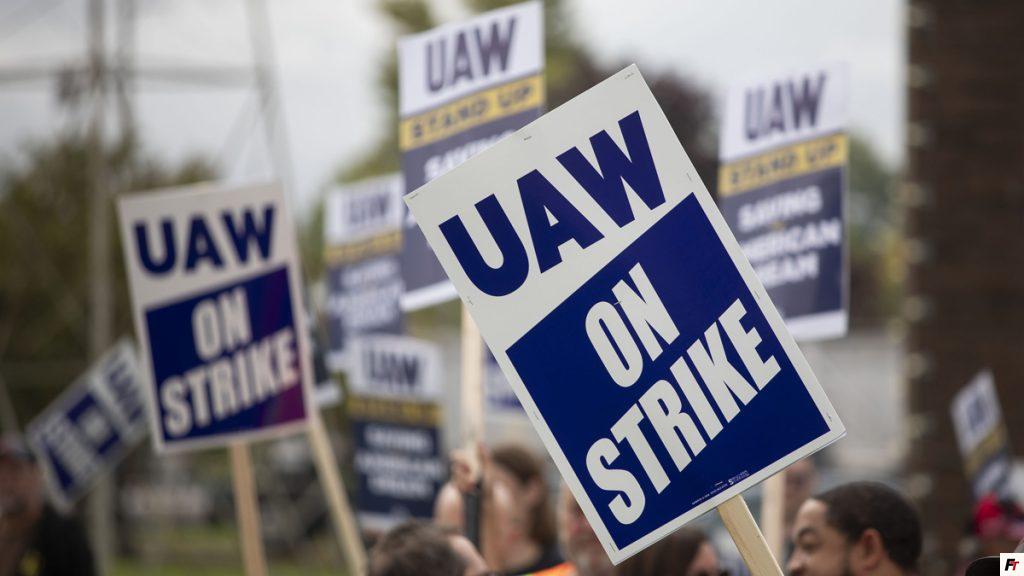
ABOVE: United Auto Workers members strike the General Motors Lansing Delta Assembly Plant on September 29, 2023 in Lansing, Michigan. Today the UAW expanded their strike against General Motors and Ford, claiming there has not been substantial progress toward a fair contract agreement. (Photo by Bill Pugliano/Getty Images)
Why “EVERYONE” in America should care about labor workers
There have been many well-documented labor strikes in this country’s history, but America finds itself amid one of the most significant labor strikes in recent memory.
The United Auto Workers (UAW) is within the third week of an ongoing strike against the Big-Three automakers, which are all headquartered in Detroit, MI—those automakers being General Motors (GM), Chrysler’s parent company Stellantis, and Ford.
When the labor strike kicked off on September 15th, UAW targeted one GM assembly plant in Wentzville, MO; a Stellantis Jeep plant in Toledo, OH; and a Ford factory in Wayne, MI.
Starting with approximately 13,000 workers, UAW began their stand-up labor strike—which is a form of striking where UAW will continue to add more workers to the picket lines as they continue to strike or until a negotiated agreement is made.
The strike has since grown from the 13,000 workers, who walked off the job, to over 25,000 and counting. The organization boasts roughly 146,000 members overall.
UAW has since added 38 GM and Stellantis plants after the first week of the labor strike but added Ford to the latest round of continued facilities as they have expanded.
According to the Anderson Economic Group, a boutique consulting firm in Michigan that specializes in public policy, business valuation, and market and industry analysis, the labor strike so far has caused a nearly $4 billion hit to the U.S. economy.
This is the first time since UAW was founded in May 1935, that the labor union has held a labor strike against all three U.S. automakers at the same time.
According to UAW leaders, they are seeking the following:
- Increased general wages
- A 32-hour work week with 40 hours of pay
- Pension increases for retirees
- End of varying tiers of wages for factory jobs, which was agreed to in order to help the Big-3 automakers avoid financial challenges that they faced when two of them had to receive a government bailout (Ford refused to receive the government bailout)
- Restoration of cost-of-living pay raises
- Restoration of traditional defined-benefit pensions for new hires who now receive only 401(k)-style retirement plans
- Other miscellaneous items
Union leaders are saying that enough is enough and that the Big-Three automakers need to do right by the laborers at their respective companies, especially as they are making gigantic and record profits, and as their CEOs are earning millions of dollars in salaries and compensation.
“I think it’s an absolute shame that the top pay for a lot of these workers is only $25 an hour, when you have CEOs who are making 100 times what some of these workers are making,” said Claude Cummings, Jr., International President of the Communication Workers of America, who recently joined UAW members on the strike line in Reno, NV. “This is about making sure we get our fair share and making sure the middle class is protected. We would not have a middle class in this country if it were not for unions, so again, this is about maintaining the middle class and getting our fair share.”
Many people quote Dr. Martin Luther King, Jr., but we rarely hear people talking about his advocacy and support for labor, and specifically the African American working class. He literally gave his life advocating for African American workers and civil rights.
Dr. King was committed to African Americans in the working class. Some of the ways Dr. King stood up for labor include:
- Speaking at UAW 25th Anniversary dinner on April 27, 1961
- Writing a letter to Amalgamated Laundry Workers, January 1962
- Speaking at UAW District 65 Convention in September 1962
- Speaking at Illinois AFL-CIO Convention in October 1965
- Speaking at Teamsters and Allied Trade Councils in New York City in May 1967
- Speaking at Local 1199 Salute to Freedom event in March 1968
As a matter of fact, the day before his assassination, Dr. King spoke in support of striking AFSCME sanitation workers at Mason Temple in Memphis, TN, on April 3, 1968.
This was his last official speech, and it is worth noting what he encouraged African Americans to do, regardless of their status in life. His words were:
We don’t have to argue with anybody. We don’t have to curse and go around acting bad with our words. We don’t need any bricks and bottles, we don’t need any Molotov cocktails, we just need to go around to these stores, and to these massive industries in our country, and say, “God sent us by here, to say to you that you’re not treating his children right. And we’ve come by here to ask you to make the first item on your agenda fair treatment, where God’s children are concerned. Now, if you are not prepared to do that, we do have an agenda that we must follow. And our agenda calls for withdrawing economic support from you.” And so, as a result of this, we are asking you tonight, to go out and tell your neighbors not to buy Coca-Cola in Memphis. Go by and tell them not to buy Sealtest milk. Tell them not to buy—what is the other bread?—Wonder Bread. And what is the other bread company, Jesse? Tell them not to buy Hart’s bread. As Jesse Jackson has said, up to now, only the garbage men have been feeling pain; now we must kind of redistribute the pain. We are choosing these companies because they haven’t been fair in their hiring policies; and we are choosing them because they can begin the process of saying, they are going to support the needs and the rights of these men who are on strike. And then they can move on downtown and tell Mayor Loeb to do what is right. But not only that, we’ve got to strengthen black institutions. I call upon you to take your money out of the banks downtown and deposit your money in Tri-State Bank—we want a “bank-in” movement in Memphis. So go by the savings and loan association. I’m not asking you something we don’t do ourselves at SCLC. Judge Hooks and others will tell you that we have an account here in the savings and loan association from the Southern Christian Leadership Conference. We’re just telling you to follow what we’re doing. Put your money there. You have six or seven black insurance companies in Memphis. Take out your insurance there. We want to have an “insurance-in.” Now these are some practical things we can do. We begin the process of building a greater economic base. And at the same time, we are putting pressure where it really hurts. I ask you to follow through here. Now, let me say as I move to my conclusion that we’ve got to give ourselves to this struggle until the end. Nothing would be more tragic than to stop at this point, in Memphis. We’ve got to see it through. And when we have our march, you need to be there. Be concerned about your brother. You may not be on strike. But either we go up together, or we go down together. Let us develop a kind of dangerous unselfishness.
Labor rights are human rights. Point blank. Period.
The correlation between progressive labor causes and African Americans has always been an important factor in the focus of ensuring African American laborers rise above the history of segregation and discrimination that have permeated every single industry for centuries.
Labor strikes are nothing new in America and labor unions have been around since 1866.
Labor unions were formed, primarily, to help address the issues that labor workers had at their respective places of employment—issues such as extremely low wages, working long and strenuous hours, working under unsafe conditions, working in unsanitary work environments, as well as other situations.
Many African Americans joined labor unions as a means of obtaining fair and equitable wages, jobs, benefits, and conditions, while also seeking to undergird their families and establish a solid financial foundation for their retirement and future generations.
The involvement and organizing of labor unions by African Americans really started taking shape after World War II and the actions of many of these union organizers significantly helped to spark the civil rights movement of the 1950s and 1960s.
Former AFL-CIO vice president, A. Philip Randolph, is considered by many to be the “father of the civil rights movement in the United States.”
Randolph helped lead a ten-year effort to organize the first predominately African American labor union called the Brotherhood of Sleeping Car Porters. The Brotherhood of Sleeping Car Porters was formed, with Randolph taking the helm as a non-employee of the Pullman Palace Car Company—who at the time, was the largest employer of African Americans in the country.
This is significant, primarily because Randolph could advocate for the employees without fear of losing his job with the company. The members of the Brotherhood of Sleeping Car Porters were formerly enslaved people of African descent, who impeccably shined shoes, made up beds, woke up the passengers, and provided other top-notch services to ensure every passenger had an enjoyable and comfortable trip. Sadly, African Americans were unable to secure higher paying and better-esteemed jobs, such as conductors and other jobs, primarily because of racism.
Randolph got involved because the Sleeping Car Porters were being forced to endure extremely poor working conditions, work long hours with little direct compensation other than earned tips, pay for their own uniforms, buy their own meals, pay for their own sleeping quarters while traveling and working, and deal with racist and disparate treatment to the highest degree.
As a result of Randolph’s advocacy, the members of the Brotherhood of Sleeping Car Porters received favorable recognition and changes such as increased wages, fewer hours in the work month, a right to a hearing before being discharged, and a reduction of the abuses of service inspectors who spied on the porters and reported discretions to the company.
Unlike today, and other documented instances in the labor movement, the Brotherhood of Sleeping Car Porters did not have the full support of organized labor at the time.
As a matter of fact, the American Federation of Labor (now the AFL-CIO) stood in the way of supporting the efforts of the Brotherhood of Sleeping Car Porters becoming an official union, even though these African American labor workers simply wanted the same things that the American Federation of Labor stated it stood for—higher wages and better working conditions.
It is important that every American see the importance of this strike.
Many of us have had working class people in our lives—whether they were our grandparents, parents, family members, friends, or even ourselves. The members of the UAW are stating that if the CEO of GM, Mary Barra, made $29 million last year, and the shareholders received $9 billion in stock buybacks, then the employees should earn a living wage and be allowed to establish themselves as a member of the middle class in America.
We will be following the outcomes of the strike, especially here in Texas.
The post LABOR STRIKE: 2023 appeared first on Forward Times.