
Arizona Informant
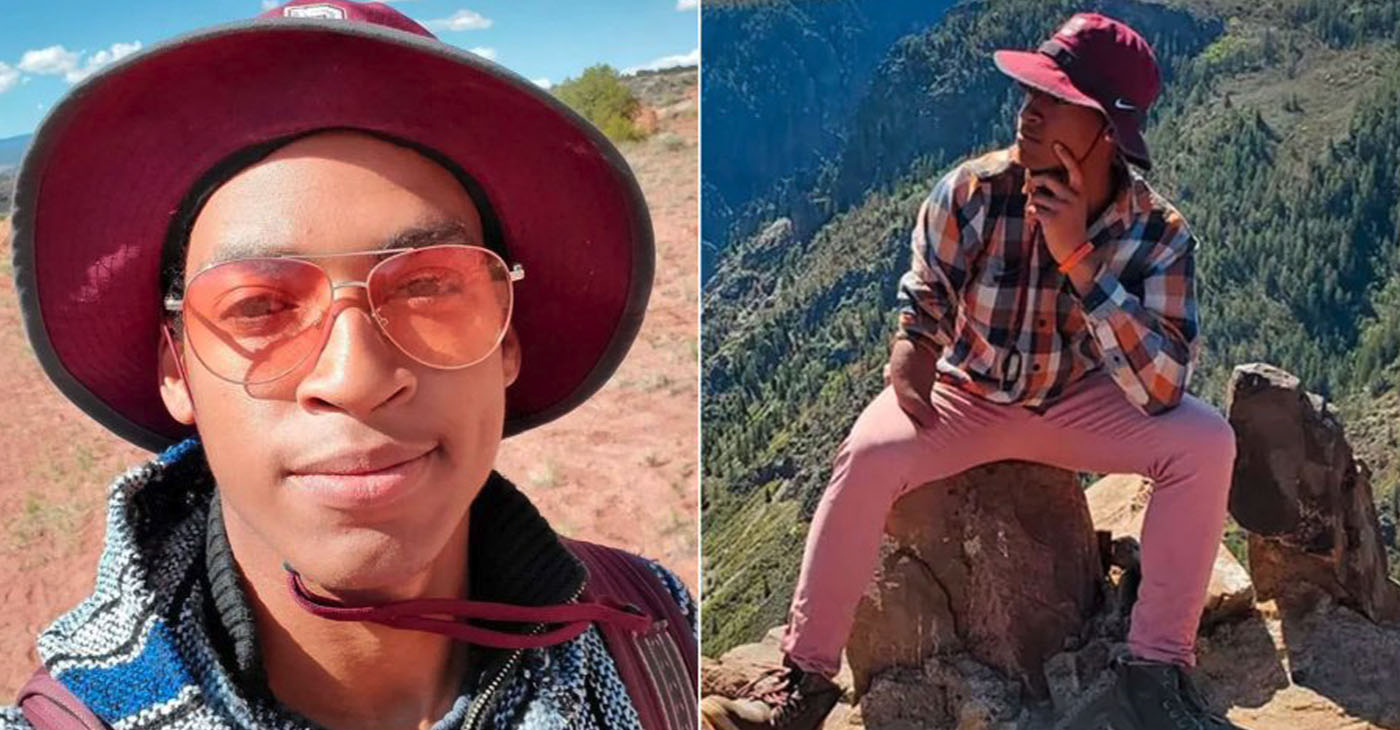
Help Find Daniel Robinson: Search continues for Missing Geologist, 24
NNPA NEWSWIRE — Unsurprised that there was no updated information from the Buckeye police about the case, the family has sought its own private investigator to proceed with exhausting all efforts and resources to search for the missing geologist. The father, David Robinson II, has taken the helms of locating his son. He recounts receiving a call from his daughter, who lives in Phoenix, on June 23, alerting him in South Carolina that Daniel was missing; she was informed by one of Daniel’s coworkers.

By Dee Ford Byas, The Arizona Informant Newspaper
A $10,000 reward is offered for any information on the whereabouts of Daniel Robinson, 24, who went missing more than two months ago from a remote Buckeye, Arizona, worksite.
The Arizona Informant received exclusive details regarding the status of search efforts to locate the young geologist who was last seen leaving his job site near Sun Valley and Cactus Road on June 23.
From having allegedly walked off the job and not showing up to having “walked off naked into the desert and joined a monastery to become a monk,” the family is steadfast in efforts to find their loved one and get the truth about what happened, causing Daniel Robinson’s prolonged disappearance.
As of September 30, there were no further updates available from the Buckeye Police Department, according to Zachary Astrup, a sergeant and patrol/bike squad member. The organization issued a second press release on July 21, after the department was notified of Daniel’s jeep discovered by a rancher on his property about four miles southwest of the job site where he was last seen.
His jeep, reportedly discovered in a ravine, had rolled, and landed on its side with its airbags deployed. Reports indicated that he was wearing a seatbelt at the time of the accident. His personal effects including clothes, cell phone, wallet, and keys were recovered at the scene, according to the report.
Detectives allegedly conducted a ground search by foot with help from the Department of Public Safety’s Ranger helicopter, the Maricopa County Sheriff’s Office and the search and rescue dogs. However, the search was said to have come up “empty.”
Detectives reportedly continue to analyze evidence from his vehicle and reevaluate further searches but as of this point, “no foul play is suspected,” the report noted.
“Once the police department received the initial report, the case was investigated as a missing person immediately. At this time, no facts or evidence have been presented that indicate any foul play. The Buckeye Police Department used all available resources to include off-road vehicles, police helicopters, searches on foot, and the civil air patrol to help search a large area,” Astrup said.
Unsurprised that there was no updated information from the Buckeye police about the case, the family has sought its own private investigator to proceed with exhausting all efforts and resources to search for the missing geologist.
The father, David Robinson II, has taken the helms of locating his son. He recounts receiving a call from his daughter, who lives in Phoenix, on June 23, alerting him in South Carolina that Daniel was missing; she was informed by one of Daniel’s coworkers.
“Naturally, Davisha was very worried, and so was I about his whereabouts. However, since Daniel usually calls his family when he decides to take a trip, I was not too alarmed until I found that it was more than six hours since anyone has heard from him,” said the father, noting how “perturbed” he became with no word from his son.
Unable to search for him from South Carolina, he called Daniel’s job for information with no success in finding him. Then, he called the Tempe Arizona Police Department to file a missing person report but was directed to the Buckeye Police Department since that would be the right precinct for the area where Daniel was last seen.
“After contacting the Buckeye Police Department, the next two days of trying to pull their teeth to go out and look for my son proved to me that I had to leave immediately from my home and search for Daniel myself. The Buckeye Police Department showed no interest in searching for my son,” he said.
“Instead, they quickly adopted a theory that my son decided to abandon his family and friends. On a couple of occasions, the Buckeye Police suggested that my son may [has] joined a monastery and became a monk. It was offensive to me, and it motivated me even more than I was; all ready to do whatever I had to do to find my son.”
He constantly contacted the Buckeye Police Department and Daniel’s job, Matrix for all the information he could get as he traveled.
“I did everything that I could to put pressure on the police department to go out and search for him. Unfortunately, it took pressure from my auntie in Philadelphia to get them to get a helicopter almost a week later. It was another sign that the Buckeye Police Department didn’t take my son’s disappearance seriously,” he said.
The father added how he was even told by Buckeye police that they “couldn’t do much because my son is a grown man,” so he took matters in his own hands, he said, interviewing the last person who saw his son.
“I needed to look that person in the eyes who said that my son got into his jeep and drove off into the desert and vanished. I had to find a way to get into that desert, find that worksite and see for myself,” said the father.
He described how he kept going to the gate with binoculars on Sun Valley Parkway in Buckeye and decided to “get in there one way or another because something, everything that was being told to me about my son’s disappearance, was not adding up.”
“The Buckeye Police Department had started searching over a week after my son went missing and said nothing was found each time. I became frustrated and tired with the police department’s lack of enthusiasm, so I created my search. Finally, I started a search with hard work and meeting the right people,” he said.
During that search, he said, about five “remains of other people in the desert” were recovered. “The remains of people were found in areas where the Buckeye Police Department told me they searched for my son but have not found these themselves. I have deep doubt that Buckeye did one thorough search for my son. If so, why didn’t they find the remains? Because of my lack of trust in the Buckeye Police Department, I decided to need my investigator on the search,” he said.
“After checking with detectives, I am aware of one set or partial human remains that has been recovered. If there were any additional remains recovered, it may not have been within the jurisdiction of the Buckeye Police Department. The remains that were discovered are pending identification by the Office of the Medical Examiner,” said Astrup when asked about the discovered remains.
An investigator came onboard and uncovered evidence the Buckeye Police Department did not, said David Robinson II, adding some evidence came from the Buckeye Police Department’s report, but “unfortunately, they either didn’t know how to read their data or didn’t care to read it correctly.”
“The Buckeye Police Department refuses to look at any possibility other than their initial theory that my son decided to abandon his family,” he said, recalling his interaction with police from viewing pictures of the scene to seeing the vehicle.”
“The detective once again suggested that my son most likely walked off naked into the desert and joined a monastery to become a monk. I was angry inside and already emotional about seeing my son’s jeep for the first time wrecked,” he stated.
The concerned father detailed how the police kept insisting that he touch the vehicle when he went to see it, but he was too emotional to do so, he said, noting that the officer “opened the back door and pointed out things that were still in it,” took a bag with his son’s items and dumped it on a seat.
“I still didn’t touch that vehicle even though they kept suggesting that I do. Finally, I told him that I was ready to leave. He then said that I needed to make arrangements to have the vehicle removed from their impound because they will have it towed away to a towing company, and I would have to pay for storage. I didn’t have a chance to breathe before I had to worry about finding some place for it. I explained that I needed time, and he agreed to give me a few more days,” said the father.
With more questions looming, he vividly recalled sitting in his hotel room, thinking about what transpired and “realized that they didn’t do any forensics work.” He requested a meeting with the Buckeye chief of police, Larry Hall and his detectives, noting the lack of forensics work at the scene where his son’s vehicle was found.
“Their explanation was they didn’t do any because there was no blood in the vehicle and no sign of foul play. I asked how they know that my son was even driving the vehicle. The detective said that ‘he was obviously driving because it’s his vehicle.’ I asked again how they knew that it was my son driving or someone else was also in the vehicle. They didn’t have a response,” he stated.
Two days later, the father said a detective called to state they were doing forensics, dusting for fingerprints, which is something he said should have been done at the scene before removing the vehicle and releasing personal effects that were all in evidence bags “but marked as safekeeping.”
“The items were never considered evidence to the Buckeye Police Department because their theory that my son walked away naked and probably became a monk was clear to them. Unfortunately, they refuse to change position until now that my investigator shared his findings with them. They so far have asked me one question; and I have not heard from them again,” he added.
“We were originally supposed to be working along with Buckeye P.D., but that fell through, and we have been gathering all of our information on our own,” said Phoenix-based vehicular crimes investigator and expert, Jeff McGrath.
Referred by an attorney friend, who the Robinson family initially contacted for assistance, McGrath was unaware of the missing Robinson saga until he got involved per the father’s request.
“When I was told that they found Daniel’s vehicle wrecked in the desert, then I started to understand why my friend was asking me to help,” he said, calling the case unique.
While he said his team is “slowly answering some of the many questions that were left unanswered,” the biggest question remains, which is the whereabouts of Daniel Robinson.
“This case started with a short investigation and final determination where Mr. Robinson was still left with confusion and a lot of questions. When we were brought onboard, a month had passed, and time was critical. As soon as we began our investigation, a month after Daniel went missing, we were able to uncover some issues with the initial investigation,” McGrath said.
“It appeared to us that the original detectives did not know there were some problems with how Daniel’s car was damaged. They had the information that they downloaded from the car’s Airbag Control Module (black box) and they did not see or understand that it did not match with the vehicle’s damage and location. It was brushed off as, Daniel crashed and walked away from his vehicle, never to be seen again and that was it. As we began to unravel those questions, we would come across more new questions,” he stated.
Since he began investigating, although the focus has narrowed, with help from many volunteers and the many hours devoted to the case, answers are slowly revealed, but “the big answer” to where Daniel is “keeps eluding us,” said McGrath.
He explained how families regularly seek outside professionals to investigate crimes against them or crimes they are accused of and many other non-criminal incidents.
“A lot of times our local, county, state, and federal law enforcement do a great job, but there are a handful of times where they get it wrong, or it’s just rushed. This is not because they don’t care, but a lot of times because they not properly or adequately trained. It’s like going to the wrong doctor for a heart condition and that doctor thinking they can treat you just fine. Well maybe they will, but if they’re wrong because they don’t know what they’re doing, the result(s) could be devastating. There are outside professionals —Private Investigators—that specialize in all types of matters and that’s where we come in,” McGrath said.
In the five years, McGrath has been involved in private investigation work, he boasts a 99% success rate, noting how he “can count on one hand how many cases we’ve lost,” but the disappearance of Daniel Robinson is presenting challenges as time passes by.
“At this point, two months have passed since Daniel went missing. I don’t want to say the chances are ‘grim,’ but we have to be realistic in that if he is out in that desert, with temps reaching as high as 115 degrees, it’s not ideal for survival,” he said, adding the next step in this process is to conduct more interviews and continue working with his team and many volunteers to “help find Daniel.”
Meanwhile, the Robinson patriarch described feelings of worry and fear as he wonders if his son is hurt, in danger.
“I am afraid to hear that something has happened to him. Not having answers to where Daniel is or what happened to him keeps me up at night; it makes me anxious. I feel like a big part of myself is missing,” said the United States Army veteran, who is an entrepreneur and businessman.
Tips and information can remain anonymous as the family awaits calls or texts to 803-200-7994.





#BuyBlack
PRESS ROOM: Civil Rights TV Launches in Selma as the World’s First 24/7 Civil Rights Television Network
ARIZONA INFORMANT — Civil Rights TV operates continuously on the Connect To Your City OTT platform powered by Connect2OTT, offering documentaries, news analysis, live discussions, educational programming, global civil rights coverage, and cultural storytelling. The channel functions as both a historical archive and a living platform addressing contemporary civil rights challenges.

Arizona Informant

SELMA, Ala. — Civil Rights TV, the world’s first 24-hour television network dedicated exclusively to civil rights history, education, and future equity, has officially launched on the Connect To Your City OTT platform powered by Connect2OTT.
The network debuts from Selma, Alabama — one of the most historically significant cities in the American civil rights movement — marking a new chapter in how civil rights stories are preserved, amplified, and carried forward for future generations.
Civil Rights TV operates continuously on the Connect To Your City OTT platform powered by Connect2OTT, offering documentaries, news analysis, live discussions, educational programming, global civil rights coverage, and cultural storytelling. The channel functions as both a historical archive and a living platform addressing contemporary civil rights challenges.
Civil Rights, Technology, and the AI Era
As technology and artificial intelligence increasingly shape access to information, media, and opportunity, Civil Rights TV launches at a moment when access to digital infrastructure itself is emerging as a civil rights issue.
Media fragmentation, misinformation, and uneven access to technology continue to reshape public discourse. While on-demand platforms have expanded individual content access, large-scale live broadcasting still faces challenges related to congestion, latency, and energy consumption.
Civil Rights TV leverages broadcast-efficient OTT architecture designed to reduce bandwidth usage and energy requirements, enabling continuous global distribution without placing added strain on network infrastructure.

Why Civil Rights TV Matters Now
Civil Rights TV is not only a media launch—it is a signal.
The network underscores the importance of preserving civil rights history using the most accurate and comprehensive sources available. For generations, the Black press has maintained some of the deepest and most reliable documentation of the civil rights movement, currents events, news and critical Black history, much of which remains underrepresented in modern digital media archives and inaccessible to artificial intelligence (AI) systems.
As a result, Civil Rights TV will rely heavily on national Black press for news, historical archives and independent voices. Prominent digital news platforms, podcasts, and broadcasters—will play an instrumental role in shaping continuous coverage, historical interpretation, and public discourse.
About Connect2OTT
Connect2OTT currently manages more than 250 live 24/7 television and radio channels streaming to audiences in more than 190 countries. Civil Rights TV joins this ecosystem as a flagship channel, designed to foster global conversation while demonstrating how media distribution, energy efficiency, and AI readiness can coexist responsibly.

About Larry Witherspoon
Larry Witherspoon is a technology entrepreneur and founder of Phoenix-based Connect2 Technologies, LLC, including Connect2OTT, Connect2AI, and Connect To Your City OTT Platform.
In 2006, Witherspoon launched FaithFone Wireless, the world’s first Christian-owned and operated mobile phone company—years ahead of today’s fintech and mobile banking platforms. As a mobile virtual network operator (MVNO), FaithFone introduced mobile banking, digital tithing, live television and radio, content downloads, and branded debit- card-based person-to-person payment functionality before mobile commerce was widely understood by major telecom and financial institutions.
That early convergence of mobile, media, and financial technology laid the foundation for Witherspoon’s current work across AI, energy efficiency, broadcasting, and infrastructure optimization.
Community Content Submissions
Civil Rights TV welcomes article submissions from trusted community voices, journalists, and verified organizations. Content may be submitted through an official upload portal or via email for editorial review.
Submissions approved for broadcast will be scheduled during the network’s community programming window from 12:00 a.m. to 5:00 a.m., with select pieces considered for prime- time airing based on their significance, accuracy, and value to the broader civil rights dialogue.
Media Contact Tina Michelle
Connect2OTT / Civil Rights TV Phone: (480) 740-7777
Email: [email protected] Website: CivilRightsTV.com
Arizona Informant
Leveling Up: How HBCUs Empower Black Students To Rise Above, Achieve
ARIZONA INFORMANT — Kenyae Stocker, a graduate in May 2024 with a stellar 3.7 GPA in mechanical engineering, embodies the unwavering spirit that thrives within HBCU walls. Hailing from Tucson, Ariz., she arrived at Southern University just as the COVID-19 pandemic hit, presenting a unique set of challenges for her freshman year. Yet, her story is a testament to the unique support system these institutions provide, empowering students to navigate challenges and embrace opportunities for growth.

Chandler – Historically Black colleges and universities (HBCUs) have long played a pivotal role in shaping the educational landscape for African-American students. They have done (and continue to do) more to educate Black students than many larger, more well-resourced historically White institutions (HWIs).
HBCU institutions transcend the realm of mere education, transforming into vibrant communities that foster academic achievement, personal growth, and a profound sense of culture and belonging. They produce more Black science and engineering majors than any HWI, and they have produced the majority of Black doctors, lawyers, judges, and academics for generations.
Their legacy is woven with stories of resilience, excellence, and individuals like Kenyae Stocker, whose journey at Southern University and A&M College, an HBCU, exemplifies the transformative power of such institutions.
Stocker, a soon-to-be graduate in May 2024 with a stellar 3.7 GPA in mechanical engineering, embodies the unwavering spirit that thrives within HBCU walls. Hailing from Tucson, Ariz., she arrived at Southern University just as the COVID-19 pandemic hit, presenting a unique set of challenges for her freshman year. Yet, her story is a testament to the unique support system these institutions provide, empowering students to navigate challenges and embrace opportunities for growth.
Her unwavering determination and proactive nature allowed her to not only adapt to online learning but also thrive academically. This is evidenced by her immediate acceptance into the prestigious Top Jags Program in fall 2020, a program reserved for students of exceptional academic achievement. Throughout her four years, Stocker has consistently remained a Top Jag, a testament to her dedication and resilience.
Furthermore, her academic excellence extends beyond the Top Jags Program. She has consistently earned a place on the Honors Roll and Dean’s List each semester, and is on track to graduate as an Honors College student. These achievements speak volumes about her character and the nurturing environment fostered by the Southern University community, which empowers students to not only overcome adversity but also excel academically.
Beyond academics, Stocker actively participated in activities such as The National Society of Black Engineers and The American Society of Mechanical Engineers. These experiences not only enriched her college experience but also helped her build a strong network within the engineering field and among her peers. Balancing these diverse commitments demonstrates her exceptional time management skills and dedication to her passions.
Southern University’s unwavering commitment to academic excellence and fostering a supportive alumnus has undeniably played a crucial role in shaping Stocker’s success.
She said, “The university’s emphasis on higher education, coupled with research programs and strong alumni engagement, provides students with valuable opportunities to learn, grow and thrive.”
Dr. Brian Warren, a professor in the Mechanical Engineering Department, exemplifies this dedication. His mentorship and guidance have been instrumental in shaping Kenyae’s academic journey, along with countless other students at Southern University.
As she prepares to embark on her career at McCarthy Building Companies, a Dallas, Texas-based company, her aspirations reflect her unwavering commitment to both her chosen field and making a positive impact in her community. Her story serves as a beacon of hope and inspiration for students everywhere, demonstrating that with perseverance, dedication, and the support offered by institutions like HBCUs, anything is possible.
Stocker’s journey is far from over, and she serves as a powerful reminder of the transformative power and relevance of HBCUs. HBCUs have much to teach us all about how to ensure educational equality for Black students specifically, and even for first-generation and low-income students, more generally, who are overrepresented at HBCUs. These institutions remain a vital resource for Black students, offering not only a path to academic success but also a nurturing environment that fosters personal growth, career success, a sense of belonging, and the unwavering confidence to level up.
As a testament to her dedication and academic excellence, Kenyae is a three-time recipient of the prestigious Southern University Alumni Federation Arizona Chapter (SUAF-AC) Excel Scholarship. This scholarship, fueled by the generous support of the Arizona community, empowers deserving students like Kenyae to reach their full potential.
Special to the Informant by Loretta H. Cheeks, Ph.D., SUAF-Arizona Chapter Member, who encourages the community to be part of the change.
Arizona Informant
First Black Racer in Porsche Carrera Cup Competes at Formula One Miami Grand Prix
NNPA NEWSWIRE — Wallace is an admirer of Formula One, but at 36 is too old to be dreaming about an F-1 seat. Instead, Wallace wants to move up to the Batmobile-like, fiendishly quick sports cars that compete in famous endurance races. “The ultimate goal is to win the Daytona 24 Hours, the 24 Hours of Le Mans and the Sebring 12 Hours, and to be the first African American to win all of those,” Wallace said. “I’ve got a ton of work ethic, a ton of desire and I think I’m showing that I’m pretty quick.”
By Blair S. Walker
MIAMI GARDENS, FLORIDA — When Jordan Wallace was a 5-year-old, his grandmother bought him a little, battery-powered Mercedes car. She may have regretted that move because Wallace immediately hopped into his miniature whip and practically drove the wheels off it.
Convinced that Upper Marlboro, Maryland, had never produced a racer with his combination of awe-inspiring speed and daring, Wallace began looking for pre-pubescent butts to kick.
“I tried to race the girl down the street in her Barbie Corvette, and she whupped me,” Wallace said, still incredulous 31 years later. “And after that, I was like – I gotta get this figured out. Ever since then, I’ve been on a charge.”
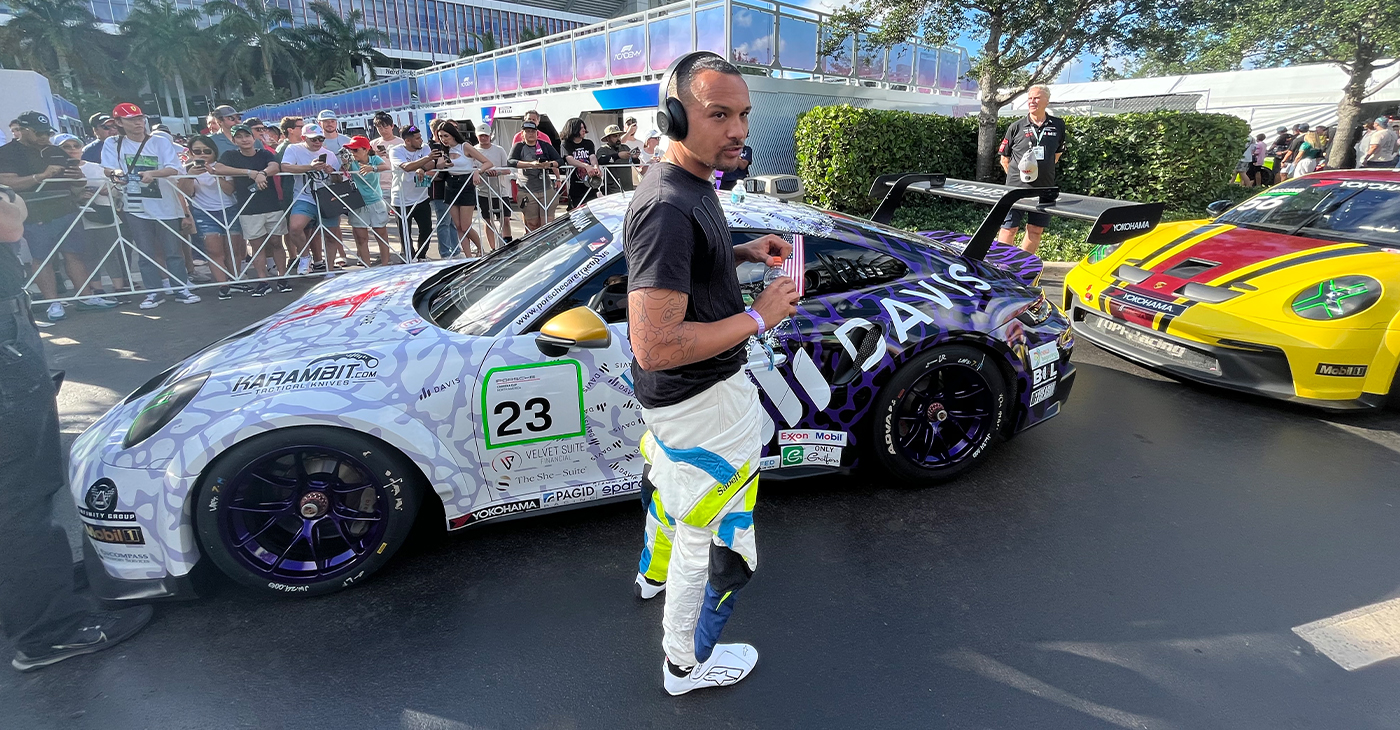
One that had Wallace swaddled in a helmet and Nomex driving suit as he blasted a 510-horsepower Porsche 911 GT3 Cup around the 3.36-mile, 19-turn Miami International Autodrome road circuit, sounding like a bellowing, deep-voiced hound from hell.
Welcome to the Porsche Carrera Cup North America racing series, Jordan Wallace’s world. He found himself onstage with the globe-trotting Formula One circus in town for the Miami Grand Prix. Formula One promoters like to have other kinds of racing cars circulating tracks while F-1 cars are being tweaked in their garages.
Wallace is an admirer of Formula One, but at 36 is too old to be dreaming about an F-1 seat. Instead, Wallace wants to move up to the Batmobile-like, fiendishly quick sports cars that compete in famous endurance races.
“The ultimate goal is to win the Daytona 24 Hours, the 24 Hours of Le Mans, and the Sebring 12 Hours and to be the first African American to win all of those,” Wallace said. I’ve got a ton of work ethic and desire, and I think I’m showing that I’m pretty quick.”
That last statement is all fact and no brag because Wallace came within one-hundredth of a second of being the fastest qualifier for his Miami International Autodrome race. To put that in perspective, it takes the average person between one-tenth to four-tenths of a second to blink their eyes.
A resident of Austin, Texas, these days, Wallace keeps a roof over his head with his racing activities and by working as a driving instructor at a nearby race track. When it comes to the Kellymoss/Vision Motorsports Racing Porsche he’s piloting in eight races this year, his sponsor is Davis Infrastructure, a Northern Virginia business that builds data centers.
“I grew up thinking race drivers were aliens because no one in my family, or in my culture, was in this sport,” Wallace said. “Now I’m part-owner in the team that I’m driving for. Not only a Black driver, but a Black owner. We’re really trying to grow that side of the sport, as well.”
About the Author:
Blair S. Walker formerly wrote for USA Today’s ‘Money’ section, has penned seven books, and was also a professional race car driver. Blair has been a guest contributor for BlackPressUSA for the past three years at the Formula One Miami Grand Prix held annually in Miami Gardens.
Arizona Informant
Liberty Captures The Open Title
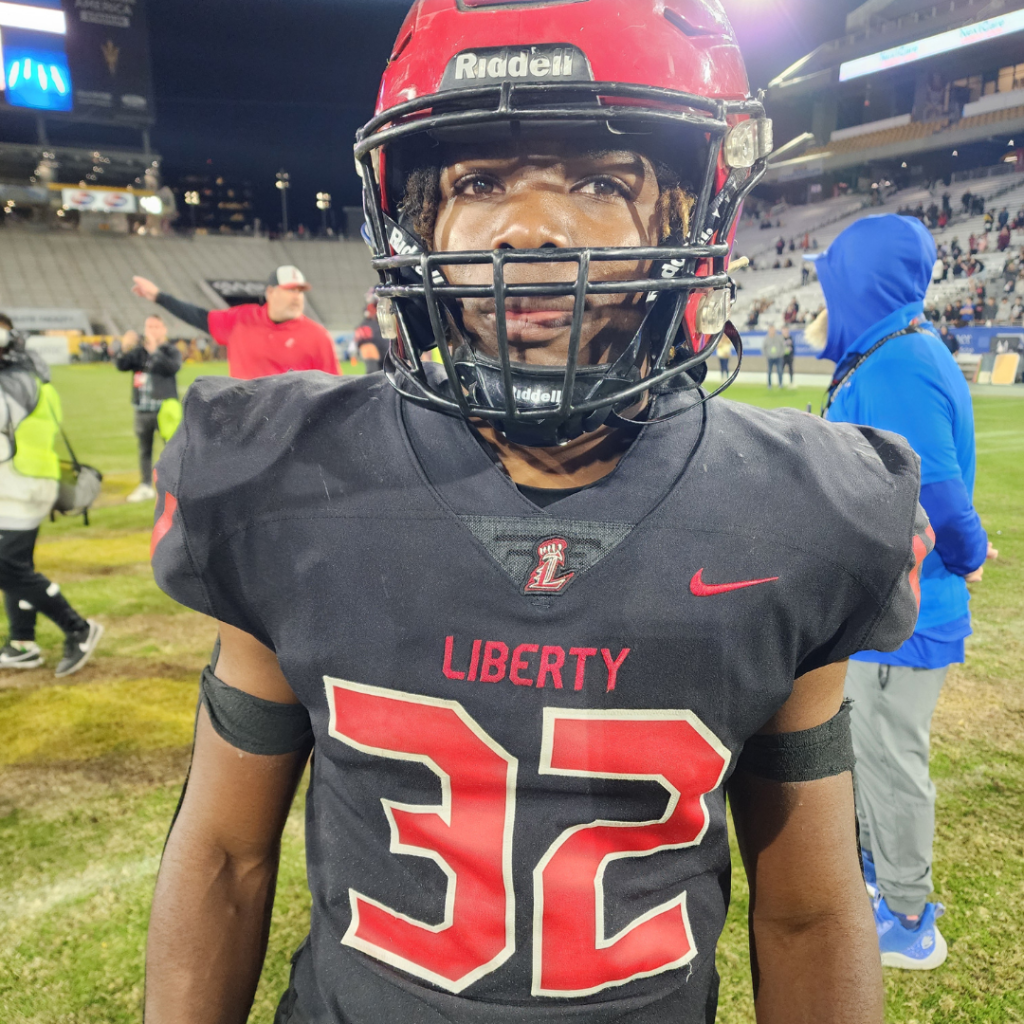
ARIZONA INFORMANT — From the beginning Liberty looked to show they were the more dominant of the two. On their first possession the Lions marched right down the field on a drive that resulted in a Navi Bruzon 20-yard touchdown pass to Ryan Jezioro with 7:20 left in the opening quarter. After the missed PAT the score was 6-0 in favor of Liberty. On the next drive Centennial was able to move the ball but the drive ended with a missed 42-yard field goal.
Arizona Informant
On December 2nd the top two teams collided once again for the second time in less than a month. This time it was for the Open Division championship of the AIA. Two nationally ranked teams, #16 Peoria Liberty and 19 Peoria Centennial, had both shown they were the premier teams in the state throughout the year.
From the beginning Liberty looked to show they were the more dominant of the two. On their first possession the Lions marched right down the field on a drive that resulted in a Navi Bruzon 20-yard touchdown pass to Ryan Jezioro with 7:20 left in the opening quarter. After the missed PAT the score was 6-0 in favor of Liberty. On the next drive Centennial was able to move the ball but the drive ended with a missed 42-yard field goal.
Centennial got the ball back again and this time they were able to capitalize. On a drive that consisted of all runs, Owen Reynosa punched it in from 1 yard out with 1:06 left in the first quarter. Centennial had grabbed the lead 7-6. Centennial had seemed to be gaining some momentum. On their next possession they hit a home run with the deep ball. This was in the form of a 44-yard pass from Kainan Manna to Kenny Worthy III that gave Centennial a 14-6 lead with 7:55 left in the 2nd quarter. Centennial continued to play solid defense on the Lions by stopping them on a 4 th down try with 6:34 remaining in the first half.
After Liberty got the ball back, they hit a home run of their own. This time it was Bruzon connecting again with Jezioro this time for a 50-yard touchdown at the 4:43 mark. After an unsuccessful 2-point conversion try the score was now 14-12 still in favor of Centennial. Liberty looking to swing the momentum in their favor blocked a Centennial punt with 3:26 left in the first half. This block gave them great field position at the Centennial 29-yard line. A Bruzon 4-yard touchdown run with 2:00 minutes left gave Liberty the lead 19-14 heading into halftime.

In the 2nd half Liberty looked to continue to build off the momentum from the end of the first half. They got the opening kickoff of the 3 rd quarter and marched down the field.
The drive was dominated by Bruzon runs and ended with a Jon Wilson 5-yard touchdown run with 7:21 left in the 3 rd quarter. The Liberty lead had now grown to 26-14. The rest of the quarter was back and forth with neither team really moving the ball much. The Centennial Defense led by defensive end Noah Carter did all they could to keep the high powered Liberty offense in check.
With the help of a pass interference call Liberty was able to sustain a drive that
goes deep into Centennial territory. Jon Wilson runs it in from 4 yards out with 7:34 left in the game to give Liberty more breathing room. The lead was now up to 33-14. A Centennial touchdown with 4:00 left in the game brought the score to 33-21. The final score was 33-21 with Liberty winning the Open Championship finishing 12-1 and Centennial being the runner-up with a record of 11-2.
The post Liberty Captures The Open Title appeared first on Arizona Informant.
This article originally appeared in The Arizona Informant.</em
Arizona Informant
Spirit Talk Ft Bishop Rick of the Message Church Tempe, AZ
ARIZONA INFORMANT — Spirit talk is a podcast that gives the spiritual leaders in the community an opportunity to speak out about situations and circumstances that are going on this this world today. You are going hear from some impactful people about their views on problems, and what they feel the church needs to be doing now. This is not a platform to beat down our fellow brothers and sisters but to encourage them to do more through stories, testimonies, and passion. Take a listen and commit what you think.
Arizona Informant
BRIEF SUMMARY OF CHECK PRESENTATION AND THE JACKIE ROBINSON FOUNDATION
ARIZONA INFORMANT — During Week 5 of the MLB World Series, Capital One presented a $250,000 check to the Jackie Robinson Foundation as the culmination of its year-long Capital One Walk-Off campaign, where they gave the Foundation $1,000 for every walk-off hit during the season (minimum guarantee of $250K).


During Week 5 of the MLB World Series, Capital One presented a $250,000 check to the Jackie Robinson Foundation as the culmination of its year-long Capital One Walk-Off campaign, where they gave the Foundation $1,000 for every walk-off hit during the season (minimum guarantee of $250K).
Judge Velva Moses-Thompson of Phoenix, Arizona is an alum of the Jackie Robinson Foundation and received the check on behalf of the Foundation. It is the second year of the program, and between the Walk-Off campaign and other grants, they have given the Foundation $850,000 to date – with a renewal for 2024 currently underway. As part of the program, Capital One cardholders receive a $3 discount off tickets to the Jackie Robinson Museum.

Founded in 1973 by Rachel Robinson, the Jackie Robinson Foundation (JRF) grants scholarships of up to $35,000 over four years to talented college students with financial need to ensure their success and develop their leadership potential. JRF provides hands-on mentoring support, access to internship and full-time jobs, and graduate-level fellowship grants. JRF has provided $117 million in financial scholarships and programmatic services over the past 50 years.
JRF website: www.jackierobinson.org
JR Museum website: www.jackierobinsonmuseum.org
Facebook.com/JRF42
Twitter & Instagram @JRFoundation
Youtube.com/JRobinsonFdtn
The post BRIEF SUMMARY OF CHECK PRESENTATION AND THE JACKIE ROBINSON FOUNDATION appeared first on Arizona Informant.


First Black Woman Manager at KARE 11: My Journey #shorts

Building a Flexible, Community-Led Space for Protest Support #shorts

Beyond the Job Search: DC Black MBA Invests in Helping Black Women Reclaim Their Next Chapter

Can Black Houston Create a Black Tech Corridor?

OPINION: Black Capitalism Re-Analyzed: June 5, 1971 – Huey Newton

Called to Do This: Overcoming Doubt and Finding Family #shorts

Black-Owned Banks: Community Lending is Our Business #shorts

LeBrent Speed on Building the B3 Project | MSR On the Radar

Towing Assistance Features on This Truck Explained #shorts

Keg House Commons: Black Ownership Brings New Life to the Historic Schmidt Keg House in St. Paul

The Youngest American Killed in the Vietnam War

Passing for White, Fighting for Black America: The Courage of Walter White

OP-ED: Haiti TPS: Have We Lost Sense of Humanity?

OP-ED: How Does Your State Rank for Pre-K?

NFL: Week Two Recap | Jalen Hurts did not fold; Caleb Williams exits game with injury

Remembering Chauncey Bailey as Student Journalists Face Threats to Truth-Telling

Headlines and Hot Topics 📱

Obama Urges Democrats to make AI a Priority 📱

Peter Magubane: a Camera Against Apartheid

Mayor Lee Announces $1 Million Kaiser Permanente Grant for Pilot Program to Address Homelessness, Clean Up Public Spaces throughout Oakland
First Black Woman Manager at KARE 11: My Journey #shorts
Building a Flexible, Community-Led Space for Protest Support #shorts
Called to Do This: Overcoming Doubt and Finding Family #shorts
Black-Owned Banks: Community Lending is Our Business #shorts
LeBrent Speed on Building the B3 Project | MSR On the Radar
Towing Assistance Features on This Truck Explained #shorts
Keg House Commons: Black Ownership Brings New Life to the Historic Schmidt Keg House in St. Paul

Reggie Wilson & Alexis Rogers on Faith, Layoffs and I Speak People | Blacklight on Sports

FTC Chair Praises Trump, NYC Calls for Target Boycott, and Jason Lee Removed as Vice Mayor 📱

FTC Chair Praises Trump, NYC Calls for Target Boycott, and Jason Lee Removed as Vice Mayor
-

 Black Press1 week ago
A $2.1 Trillion Wellness Industry Never Built a Daily Practice for Black Children. So This Atlanta Family Did.
-
 BlackPressUSA1 week ago
Latinas Deserve Equal Pay. Unions Help Make It Happen.
-

 Black Press3 days ago
All Skinfolk Ain’t Kinfolk
-

 Art1 week ago
Montclair Brewery: Brewing Culture, Community, History
-

 Black Press1 week ago
COMMENTARY: But God!
-
 Black Press1 week ago
Master P Encourages Norwood Elementary Students to Dream Big, Work Hard
