
Featured
For Many Black Washingtonians, Gentrification Threatens Housing and Health
Gentrification can have negative effects on the health outcomes of Black residents in Washington D.C. The CDC says that gentrification has many health implications that contribute to disparities among special populations.


By Barrington M. Salmon (BlackPressUSA/NNPA Newswire Contributor)
This is the first article in a series focused on the health effects associated with gentrification in Washington, D.C. This series is supported through a journalism fellowship with the Center for Health Journalism at the Annenberg School of Journalism at the University of Southern California.
By many measures, the revitalization of neighborhoods across Washington, D.C. has been a windfall for the city. Fueled by higher tax revenues and property values, the city is awash in construction cranes, new libraries, restaurants and retail, and more than 70 miles of bike lanes—all welcomed signs of gentrification in the nation’s capital.
Lost in the city’s waves of new amenities and newer, more affluent inhabitants, are the long-time Washingtonians who have been pushed out or who are fighting to stay in the city.
Shirley Williams is one of those residents, who decided to fight. For Williams, that fight came with debilitating consequences.
Williams said that she developed diabetes a year after she and fellow residents were displaced, for eight years, from their 54-unit garden-style apartment complex at 7th and Q Streets in the Shaw neighborhood. She has since returned. Now, there’s a new apartment building at 7th and Q named Jefferson Marketplace; an upscale pet store, a Thai restaurant and a French wine bar are located on the street level. Like her old neighborhood, Williams said that she’s not the same either.
Williams connects many of her health problems to the uncertainty of her housing situation, a rootlessness that has spanned nearly a decade.
“I’m on dialysis now; I can hardly get around,” said Williams, a mother of three grown children. “I wasn’t weak. I could walk down to those ONE DC meetings, but I can’t do that anymore. I’m pretty sure it affected my health; I lost my eyesight…can’t see anything anymore.”
According to the Centers for Disease Control and Prevention, the displacement associated with gentrification has many health implications that contribute to disparities among special populations, including the poor, women, children, the elderly, and members of racial/ethnic minority groups.
“These special populations are at increased risk for the negative consequences of gentrification,” the CDC said. “Studies indicate that vulnerable populations typically have shorter life expectancy; higher cancer rates; more birth defects; greater infant mortality; and higher incidence of asthma, diabetes, and cardiovascular disease.”
Dominic Moulden, a veteran activist, housing advocate and resource organizer for Organizing Neighborhood Equity (ONE DC), knows Williams well and spoke of her challenges and those faced by thousands of other residents who have been displaced by rising housing costs or who have decided to fight for their homes in court and on the streets. ONE DC is a grassroots organization that advocates on behalf of residents who are in danger of losing their homes.
Moulden said that he’s watched the city change in significant and seemingly all-encompassing ways, usually to the disadvantage of native Washingtonians.
“I’ve been here for 32 years and I organized on 14th and U Street in the ‘90s. If we talked then, I could have told you what was going to happen in every quadrant,” he said. “Our focus is on displacement—the economics of land and housing impact health and wellness, as people are moved around this chessboard.”
Moulden said that Williams’ story of declining health during a prolonged housing battle, is a familiar one.
“I’ve seen people get sick and die in the years [after they were] forced out of their homes and that includes mental health issues,” Moulden said.
In the mid-90s, according to Census data, the district had a population of 528,000 and by 2015, the population had climbed to 681,170. Washington has seen a net population gain of more than 70,000 people since the 2010 Census and more than 100,000 residents since the 2000 Census. In the mid-1990s, the city boasted a 72 percent Black population and in 2016, according to the Census, it now stands at 48 percent. To the chagrin of the city’s Black residents, “The Chocolate City,” has become a vanilla swirl, replete with dog parks, street cars, bike lanes and cobbled streets as physical evidence of the changing demographics.
Washington, D.C is one of the most expensive cities to live in anywhere in the United States. Million-dollar homes are commonplace in areas of the city like Kalorama and Congress Heights and it’s fairly certain that buyers would have to ante up hundreds of thousands for a home, apartment or townhouse. In 2015, the median household income in Washington, D.C. was $75,628, a 5.55 percent growth from the previous year.
Statistics from the U.S. Census, a combination of studies conducted and compiled by researchers at Georgetown University and an investigative series centering on gentrification by the nonprofit, independent news organization Truthout, estimates that more than 50,000 D.C. residents have fled the city, as housing costs spiraled out of reach. Washington has the second highest rents in the country and more than 50 percent of the city’s affordable housing stock has vanished since 2009.
Researchers, policymakers and physicians have only begun to scratch the surface of the effects of gentrification on residents who have lost their homes or those who refuse to leave their neighborhoods, who have chosen, instead, to do battle with wealthy landlords, real estate developers and newcomers. A number of reports and studies over the past year detail the scope and depth of the health effects caused by the dismantling of low- and middle-income neighborhoods and the displacement of residents, some of whom have lived in Washington for decades.
Maurice Jackson, a history professor at Georgetown University and the chairman of the DC Commission on African American Affairs and Christopher King, an assistant professor at the university’s School of Nursing and Health Studies (NHS), produced a report in 2016 that found that gentrification has had a major impact on the health and welfare of the city’s African American population.
Researchers reported that many of Washington’s long-time, Black residents, who remain in the city, have experienced increased stress and financial hardship, as the cost of living continues to rise.
King said that this form of “survival stress” can increase risks for or exacerbate chronic disease conditions.
“Native Washingtonians also recognize how their communities are changing, and that results in a loss of cultural identity,” King said, noting that some African Americans have been forced to leave the area even though their families have lived in the city for generations. “This dynamic can have a profound effect on mental health and the civic engagement [of city residents].”
Gentrification in Washington has produced tension and lingering resentment between Black and White residents—old and new.
Long-time residents have complained about newcomers who have lobbied to change the names of old neighborhoods, called the police to harass families sitting on their own stoops, and pushed city officials to ramp up parking enforcement, ticketing and towing churchgoers double-parked on Sundays—a custom in D.C. that has spanned generations. The stress and trauma associated with the city’s very real demographic and cultural shifts, not only affect where people live, but also how Washingtonians are living.
One area of particular concern to researchers and those in the medical community is the relationship between toxic stress and displacement. Experts like Amani Nuru-Jeter, a social epidemiologist at the University of California at Berkeley are studying the impact of stress on health disparities and outcomes. While Nuru-Jeter, Dr. Roberto Montenegro and other researchers are looking at the effects of racism and discrimination on the bodies of Blacks and Latinos, others are tying displacement to toxic stress, which many believe, is likely a precursor to a range of diseases that could afflict those who are being pushed out of the city or have already left.
Studies have connected a number of maladies to toxic stress, such as mental illness, substance abuse and behavioral problems, cancer, obesity, diabetes, auto-immune diseases, asthma, high blood pressure and heart disease, kidney disease, and gastro-intestinal problems.
Detrice Belt, a 33-year-old native Washingtonian and resident of Barry Farm, a public housing complex in Southeast, Washington, D.C. has been engaged in a six-year battle to stay in the community where she has lived for 20 years. She lives with her nine-year-old daughter, two pit bull terriers and a turtle. Belt vowed that she’s not leaving.
“Housing is a big issue in D.C. Right now, current residents are moving out,” said Belt, a licensed dental assistant who’s also the chair of the Barry Farm Tenants’ Association. “This property has [over] 400 units, but now there are about 100 residents left. People are in shelters, some are in other public housing projects, scattered.”
Belt continued: “These [apartments] are bad, but not so bad that they have to be demolished. We want redevelopment, but we want the developer to do it while [we’re] here. They told me about the noise; that my lights may be cut off and other things, but I’m not moving, whatever comes.”

[/media-credit] A once-thriving community of more than 400 residents has been reduced to less than 100 as city officials prepare to build expensive, mixed-use housing that Barry Farm residents fear will force them out of their homes. (Miriam Machado-Luces/NNPA)
Barry Farm, located east of the Anacostia River—a natural divider between the city’s visible progress and neighborhoods of concentrated poverty—has been targeted by the DC Housing Authority and developers who seek to have the 432 public housing units demolished; in its place, developers want to build a 1,400-unit, multi-phase $400 million mixed-income housing. The plan is part of the city’s New Communities Initiative, a public-private urban revitalization partnership modeled after the federal government’s Hope VI program.
According to the Washington City Paper, in 2017, a group of Barry Farm residents and housing advocacy organization, Empower D.C., filed a 65-page, class-action lawsuit against the DC Housing Authority (DCHA), which manages the property, as well as its two private developer partners, A&R Development Corp. and nonprofit Preservation of Affordable Housing Inc.
Belt said that one of her great fears is that neither the DC Housing Authority nor the developers have given the remaining residents a written guarantee that they can return when the property is redeveloped. And the past is prologue, she said, because once public housing residents are displaced, few ever return.
“They changed the language from ‘guaranteed return’ to an ‘opportunity to return.’ Despite our concerns and questions, this is a done deal,” she said. “I’ve been going to redevelopment meetings for the past six years. I’ve been trying to hear the other side. I told councilmembers that people are stressed and don’t know their rights.”
Belt said that her ordeal has left her and other Barry Farm residents stressed out, worried and fearful of what the future holds.
“They have been using scare tactics, like putting up a notice on my door about my dogs,” Belt said. “Children’s Protective Services has been called on people here, the Department of Health on others. I was born and raised here. I’m fighting back. I’m not moving.”
This article was published as a part of a journalism project for the University of Southern California Center for Health Journalism’s National Fellowship. Read the full series:
As Real Estate Developers Rush to Mine D.C.’s Affordable Housing Stock, Some Residents are Left in the Dust
How Healthy is Gentrification?
For Many Black Washingtonians, Gentrification Threatens Housing and Health
Follow Barrington on Twitter @bsalmondc.









Featured
“Money, Power, and Respect,” (SEIU) President April Verrett
SEIU President April Verrett is hitting the road to rally for “Money, Power, and Respect.” Join her and MN Lt. Governor Peggy Flanagan to demand fair treatment for workers!


Driving home workers’ demand for “Money, Power, and Respect,” Service Employees International Union (SEIU) President April Verrett will join Minnesota Lt. Governor and U.S. Senate candidate Peggy Flanagan this weekend to knock doors and speak with community members in Minneapolis about what’s at stake in this midterm election. Starting in the Twin Cities, where tens of thousands of workers took to the streets to defy a brutal surge by ICE and Border Patrol this winter, shows what workers can do when they stand together across race, background and zip code.
This weekend will kick off a cross-country tour where President Verrett will be visiting states to campaign with bold candidates that have proven they will fight for workers and who come from labor and working families. Stops will include: Wisconsin, Michigan, Florida, Texas and Pennsylvania. This summer, SEIU launched its largest-ever member-led political program, engaging 1 million members to reach 10-15 million voters across the country by the midterm elections.
Featured
Your Vote Matters…Protect Your Freedoms!
Your vote is your voice! Protect your freedoms and make sure your rights are heard. 🗳️✊🏾


🗳️✊🏾 Your vote is your voice, and your freedoms are worth protecting! Don’t sit on the sidelines when your rights and your future are at stake.
🎙️ Hear more in the full podcast episode on YouTube channel! ☝🏾
#YourVoteMatters #ProtectYourRights #FromTheDeskOfTheEditor #VoiceAndViewpoint
Featured
Defender ONE-on-ONE: U.S. Rep. Christian Menefee
Texas Congressman Christian Menefee reflects on his first 250 days in the U.S. House. Hear his insights on legislative priorities, minority party challenges, and why every vote matters.
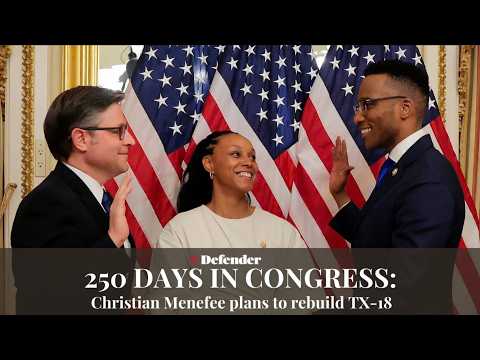
In an exclusive interview with The Defender, Texas Congressman Christian Menefee sits down to reflect on his first 250 days serving in the U.S. House of Representatives.
Congressman Menefee shares key insights into his legislative priorities, introducing new bills, and navigating the day-to-day challenges of serving in the house minority. He breaks down why every vote matters in shaping our communities and offers a preview of the urgent legislative issues he plans to tackle next.

In this video, you’ll hear about: • Reflections on his first 250 days in Congress • Key legislation introduced and priority bills • Navigating the realities and strategy of serving in the house minority • Why civic engagement and voter participation remain critical • What lies ahead on his legislative agenda

Subscribe to The Defender for more exclusive political coverage, interviews, and community insights!
Sign-up for the Top 5 newsletter
Donate/ Support Our Work
#ChristianMenefee #USCongress #TexasPolitics #TheDefender #CommunityNews #CivicEngagement #houseofrepresentativeselection2026
Chapters
0:00 Introduction and the Importance of Voting
1:12 First 250 Days and Improving Constituent Services
2:40 Oversight Committee and Environmental Justice
4:05 Rebuilding an Empty Congressional Office
6:10 The SET Act: Ending Vacancies in Representation
8:25 Life in the Minority and Playing Defense
10:45 Foreign Policy, Inflation, and Gas Prices
12:50 Economic Goals: Child Care and Housing
14:20 Redistricting and Respecting Leadership
16:15 The Rotisserie Chicken Vote and SNAP Benefits
18:20 Congressional Black Caucus Highlights
19:45 Final Call to Action for Texas Voters
Make sure to check your voter registration status and head to the polls to make your voice heard in the upcoming election. If you found this update helpful, please like this video and subscribe to stay informed on the issues that matter most to your community. 📢
#TexasPolitics #Congress #Houston #VotingRights #ChristianMenefee
Visit Our Website
Read more stories by our team
https://defendernetwork.com/category/news/opinion/
Black Enterprise
How To Manage Conflict at Work
Learn to leverage conflict, not avoid it! Unlock performance and profits with these expert tips.

Leadership consultant Dethra U. Giles, founder and CEO of ExecuPrep and author of “That’s Not What I Said: Master Conflict With Conversational Competence,” shares her framework for how to stop avoiding tough conversations at work and instead how to start leveraging conflict to unlock performance, productivity, and profits.
Black Enterprise
How To Overcome Financial Setbacks and Win
Layoffs and uncertainty hitting hard? Learn to leverage your mindset and make wealthy decisions to overcome financial setbacks. You can win!

The lives and livelihoods of millions of working professionals, especially Black women, continue to be disrupted by layoffs and economic uncertainty. The difference between surviving and thriving starts with leveraging your greatest asset—your mindset. Money expert and author Dominique Broadway, founder and CEO of Finances De*mys*ti*fied, joins the BE Wealth Accelerator podcast series with a powerful message of encouragement: You can overcome setbacks, face your financial challenges head on, and win—one wealthy decision at a time.
Black Enterprise
How To Overcome Financial Setbacks and Win
Don’t let economic uncertainty derail your dreams. Learn to leverage your mindset, face financial challenges, and win one wealthy decision at a time.

The lives and livelihoods of millions of working professionals, especially Black women, continue to be disrupted by layoffs and economic uncertainty. The difference between surviving and thriving starts with leveraging your greatest asset—your mindset. Money expert and author Dominique Broadway, founder and CEO of Finances De*mys*ti*fied, joins the BE Wealth Accelerator podcast series with a powerful message of encouragement: You can overcome setbacks, face your financial challenges head on, and win—one wealthy decision at a time.


Mastering the Used Car Market ep11

2026 Defender 130 X Is It Worth $110,110 for Your Family?

“Money, Power, and Respect,” (SEIU) President April Verrett

Car Takeoff Hesitation? Daylight Test Drive Guide #shorts

Your Vote Matters…Protect Your Freedoms!

The Black Bank That Survived the 1893 Panic #shorts

Why A Black Bank Started From A House #shorts

Defender ONE-on-ONE: U.S. Rep. Christian Menefee

How To Manage Conflict at Work

How To Overcome Financial Setbacks and Win

Latest Massacre in Haiti Reveals Cruelty U.S. Deportations

The Youngest American Killed in the Vietnam War

Booked and Unbound: The Legacy of Black Women’s Literary Circles

Passing for White, Fighting for Black America: The Courage of Walter White

OPINION: Nolan Wells’ Death One of Several Signifying Racial Terror Lives on in U.S. South

OP-ED: Haiti TPS: Have We Lost Sense of Humanity?

OP-ED: If AI Is the New Language of Power, Then NAN Wants Black Communities Fluent

OP-ED: How Does Your State Rank for Pre-K?

Henry O. Flipper: A Trailblazer at West Point and Beyond

NFL: NFC Preview | The Rams will NOT make the Super Bowl
Mastering the Used Car Market ep11
2026 Defender 130 X Is It Worth $110,110 for Your Family?
“Money, Power, and Respect,” (SEIU) President April Verrett
Car Takeoff Hesitation? Daylight Test Drive Guide #shorts
Your Vote Matters…Protect Your Freedoms!
The Black Bank That Survived the 1893 Panic #shorts
Why A Black Bank Started From A House #shorts
Defender ONE-on-ONE: U.S. Rep. Christian Menefee
How To Manage Conflict at Work
How To Overcome Financial Setbacks and Win
-
 Black Press1 week ago
OP-ED: Haiti TPS: Have We Lost Sense of Humanity?
-

 Black Press5 days ago
A $2.1 Trillion Wellness Industry Never Built a Daily Practice for Black Children. So This Atlanta Family Did.
-

 Black Press7 days ago
Zakiya Jendayi Arrested, Locked Out of Home by Sheriff’s Deputies
-

 Black History7 days ago
Listening as a Lifeline: A Doula’s Witness to Black Maternal Health
-

 Black Press5 days ago
COMMENTARY: But God!
-
 BlackPressUSA3 days ago
Latinas Deserve Equal Pay. Unions Help Make It Happen.
