
Community
Espy’s Path to the U.S. Senate Includes Black, White and ‘Purple People’ of Mississippi
Mike Espy, the first African-American elected to the U.S. House of Representatives from Mississippi since Reconstruction, a former U.S. Secretary of Agriculture, and now a practicing attorney, is running for a U.S. Senate seat against two Republican candidates in a special election. To win outright, a candidate needs 51 percent of the total vote or else the top two vote-getters will compete again in a run-off.

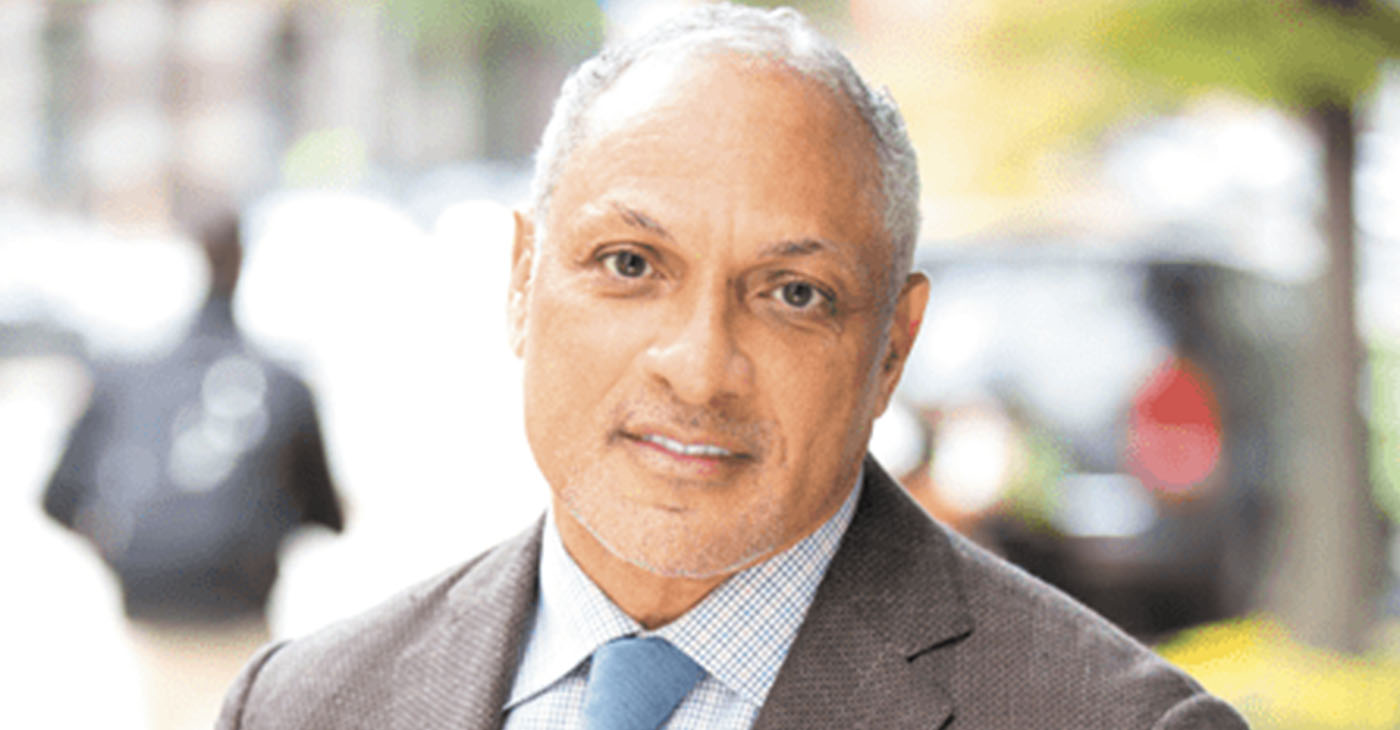

With a rock star-like following in Mississippi, Mike Espy must still fight for every vote to defeat two Republican candidates for the U. S. Senate.
By Khalil Abdullah
(TriceEdneyWire.com) – Mike Espy, the first African-American elected to the U.S. House of Representatives from Mississippi since Reconstruction, a former U.S. Secretary of Agriculture, and now a practicing attorney, is running for a U.S. Senate seat against two Republican candidates in a special election. To win outright, a candidate needs 51 percent of the total vote or else the top two vote-getters will compete again in a run-off. In a conversation with Trice Edney News Wire contributor Khalil Abdullah about his historic run, Espy reflects on his time at USDA and shares his vision of Mississippi’s future. In order to win, he says, he will need the state’s Black, White and ‘purple people’ – those who will not necessarily vote along party lines, but in sync with his plans for the disadvantaged.
KA: Does Freedom Summer, 1964, still resonate in Mississippi in your upcoming election?
Espy: Yes. In fact, this past July [2017], I was in a mule train in Marks, Mississippi, and Robert Kennedy’s grandchildren were on the platform. It marked the 50th anniversary of Robert Kennedy, Jr. coming to Marks, around the same period of the Freedom Summer. That period still resonates, not so much with Millennials, but with older people.
We revere Fannie Lou Hamer and Medgar Evers and certainly acknowledge and respect everything they did. We have to make sure Millennials understand who these individuals were and their contributions.
KA: Your take on the President’s posture on China and international trade as it affects African-American farmers?
Espy: I met with Black farmers in Leland, Mississippi, on this issue. I think the President’s tariff policy is short-sighted and misguided. When he imposed that 25 percent tariff on aluminum and steel, I believe he did it as a naked political outreach to voters in Ohio and Pennsylvania. He did it, maybe not knowing or caring, of the retaliatory impact on soybean farmers. China slapped similar tariffs on soybeans, our number three cash crop, threatening the number one market [China] for Mississippi soybeans.
All farmers benefit from open markets and free trade. We don’t need to limit our global markets. Our farmers are so good, our yields so great, that we have to find extended markets to sell to. You can’t do that by inviting retaliatory tariffs that close markets
KA: Talk election math for the Senate seat. Do you need 100 percent of the African-American vote to win? How much of the Anglo vote?
Espy: I tell it a little differently. We need African-Americans to turn out at 37 percent of the total electorate, which is just about the Black voting age population here, and was the turnout percentage for Obama. If we get 95 percent of these voters, we’re going to look pretty good. Then all we need is less than one in four White votes.

Mike Espy campaigns for the U. S. Senate.
In Mississippi, 15 percent of White voters are Democrats, so we need seven percent more, purple people, I call them. These are women who don’t necessarily like the President’s rhetoric and the chaos he’s causing. These are people who care about the closing of rural hospitals and continuing the coverage of pre-existing medical conditions. They want their children to graduate in Mississippi and not have go to Detroit or Atlanta for work. They don’t want their kids to have student debt. They know I will help them because I’ve helped them as a Congressman and Secretary of Agriculture.
We have enough purple people who will vote for me in order to win, if we get the Black vote out at strength.
KA: In Greenville years ago, elders were challenged by youth who asked, “Are you going to provide pathways for our job future and economic development other than casinos and prisons?”
ESPY: I hope to do that. I’ve heard the same thing about casinos and prisons — that we need better opportunities. Here’s what I tell them.
Number one, I want you to graduate. Don’t drop out. I’m going to do all I can to help you graduate without debt. We need to make technical schools, junior and community colleges free of charge, at least for the first two years. They’ve done it New York and in the Los Angeles area. I don’t see why we can’t do it in Mississippi.
For other schools, we can find ways to mitigate some of that student debt. That’s number two.
Number three, we want these students to stay here. That takes somebody who is pro-business and attracts companies where Millennials want to work. I brought Deval Patrick to Mississippi. Here’s a brother who was governor of Massachusetts twice in a state that has Fortune 500s and Fortune 50 companies. I wanted them to see that this has been done before.
Massachusetts is not Mississippi. I know that. But there ought to be some collaboration and appreciation for best practices we can employ in Mississippi to bring jobs here, as long as we have the educated workforce. Of those reasons, none include prisons or casinos.
KA: Your take on technology, the demands for a changing labor force, and agriculture?
Espy: Those 30 Black farmers were already “there.” Some owned 6,000 acres, some owned two or three farms. They were telling me, they may be third generation farmers, but they’re often first generation to have graduated college. They spoke about new technologies they have employed that make farming easier. One said, when I was with my dad, I had to get in this tractor in the hot sun, but now, I get into a combine that’s air conditioned, and with hip-hop music. I plug in the coordinates, push a button, and that tractor drives itself. It picks the cotton, de-seeds the cotton, bales the cotton, all in one action. I can go from sunup until sundown, give it to my brother at nighttime because it’s using global positioning. We don’t need any sunlight to operate. All I have to do is afford it. It costs $250,000, and a lot of banks won’t lend because we don’t have the credit a lot of other farmers have established[K1] over generations.
We agreed we would focus on something called Catch-up, meaning for all the cost-share USDA imposes, they would get some benefit more than others, for a certain farm size, and if you were minority or disadvantaged. Agriculture has a great future, with technologies a lot of students don’t know about.
KA: Of the Department of Agriculture, it was said racism was so entrenched, it wouldn’t have mattered — you or any African-American who brought a sensibility for fairness and equity would have been fighting uphill.
Espy: They called it the last plantation. I guess that was a plantation master’s view, but I felt that. When I came in, I tried to change the culture to make it more consumer and patron friendly. I reduced the size of it, but also reinforced a different mission. I elevated the food and nutrition mission, the conservation mission, and what they used to call food stamps I made friendlier for consumers.
More than anything, I elevated the rural development mission, to make sure every town in America with fewer than 50,000 people had access to water and sewer, and telephone and broadband, and everything the USDA offers them. I reformed the farmers’ side to make sure there was diversity and class satisfaction, regardless of race, and also highlighted things like rural development.
KA: Is it a valid criticism that you weren’t aggressive enough in uprooting that culture of racism?
Espy: Before I got to USDA, there were no Black farmers on any local county committee anywhere in America. There’s something like 4,200 counties in America and each county had a USDA presence. There were no Black farmers on these committees because members were elected by their peers. Those White farmers had never elected a Black guy nowhere in America prior to 1993. Nowhere.
Knowing that — because I had studied it as a member of Congress — I tried to eke reform into existence, but it didn’t work. The committee formula is created by the Farm Bill, a legislative device. Congress voted down the law I proposed, that there be an African-American farm representative that could vote in each of those counties where the African-American farm population constituted more than 20 percent.
I said, okay, let the Secretary of Agriculture choose a Black farmer to monitor these committees, because that’s where the farmers receive the loan approval, at these county committees. Congress voted that down.
Meanwhile, I found out there were no USDA civil rights agencies in existence because President Ronald Reagan had terminated them all. I made sure President Clinton understood that those civil rights offices should be reauthorized and he did that. That’s how the Pigford settlement for Black farmers came into being.
I created diversity panels at all of the agencies under USDA, whether they were forestry or nutrition, for example, to make sure those panels had people on them that looked like the consumers they served. So, I don’t know what those critics are talking about. That’s one of the reasons antagonists wanted me to leave, because I was reforming and doing too much.
KA: In the mid-1990s, a German associate said, “Our labor costs are too high and U.S. import tariffs make our vehicles less competitive. We’re going to make America our Third World. You have cheap land in the South and no labor unions.”
In years since, BMW, Nissan, Toyota have built plants in the South. Nissan just celebrated 15 years for one of its Mississippi plants. Your response to this foreign presence? And is there a labor movement emerging in Mississippi?
Espy: I certainly invite the next generation of global auto manufacturers to consider locating in Mississippi. Those are jobs we need; jobs for people we need trained. We need more of them – BMW plants and all that. We have a Mercedes’ plants right here in Mississippi. Those are jobs for our people and that’s what I would promote as Senator.
Where labor is concerned, I’m pro-business and also pro-labor. I don’t think there’s a contradiction. I’ve come out for a $15 minimum wage; that just ought to be the bottom line. I’m for collective bargaining. Workers ought to have the right to decide for themselves whether that plant should be unionized. So, I’m certainly for collective bargaining and against arbitration. Some plants in Mississippi are union and some aren’t. As long as the vote is taken, and if it’s an honest and fair vote – without manipulation by the companies – I’m willing to live with the results.
These plants are hi-tech, bringing opportunities for employees to be trained in jobs of the future. I’m all for them coming, as long as labor has an opportunity to organize without frustration or penalty.
KA: For those outside of Mississippi, what do you want them to know about your candidacy and state?
Espy: That we have more Black voters in Mississippi than anywhere else in the nation. We’re approaching a 40 percent African-American population and 35 percent of them are voters. I want the Black community outside of Mississippi to understand the dynamics in play here. If Black voters turn out, at strength, then all we need are White Democrats and purple people, who believe in the same thing as I do, that we need to lift the state by lifting those who are the most disadvantaged.
For those who want a slice of the American dream, irrespective of race, we want to make sure that opportunity exists. As Senator, I’ll provide that for them. If you focus on that American dream for those in that socio-economic class I’m targeting, that’s going to lift most African-Americans in Mississippi. That’s why everyone needs to focus on this race; make sure that we’re serious; make sure we can win. I’m going to lift everybody and I’m going to lift the Black community.
KA: If elected to the U.S. Senate, would you consider a 2020 run for President?
ESPY: No, and I promise you that. We’re focused on Mississippi.













Black Press
WCCUSD Joins Statewide Organic School Food Purchasing Cooperative
Other districts involved include: Alameda USD, Albany USD, Berkeley USD, Capistrano USD, Cupertino Union SD, Hayward USD, Laguna Beach USD, Lagunitas Elementary SD, Mt. Diablo USD, North Monterey County USD, Pajaro Valley USD, San Leandro USD, San Ramon Valley USD, Santa Clara USD, Sausalito Marin City SD, Tahoe-Truckee USD and West Contra Costa USD.

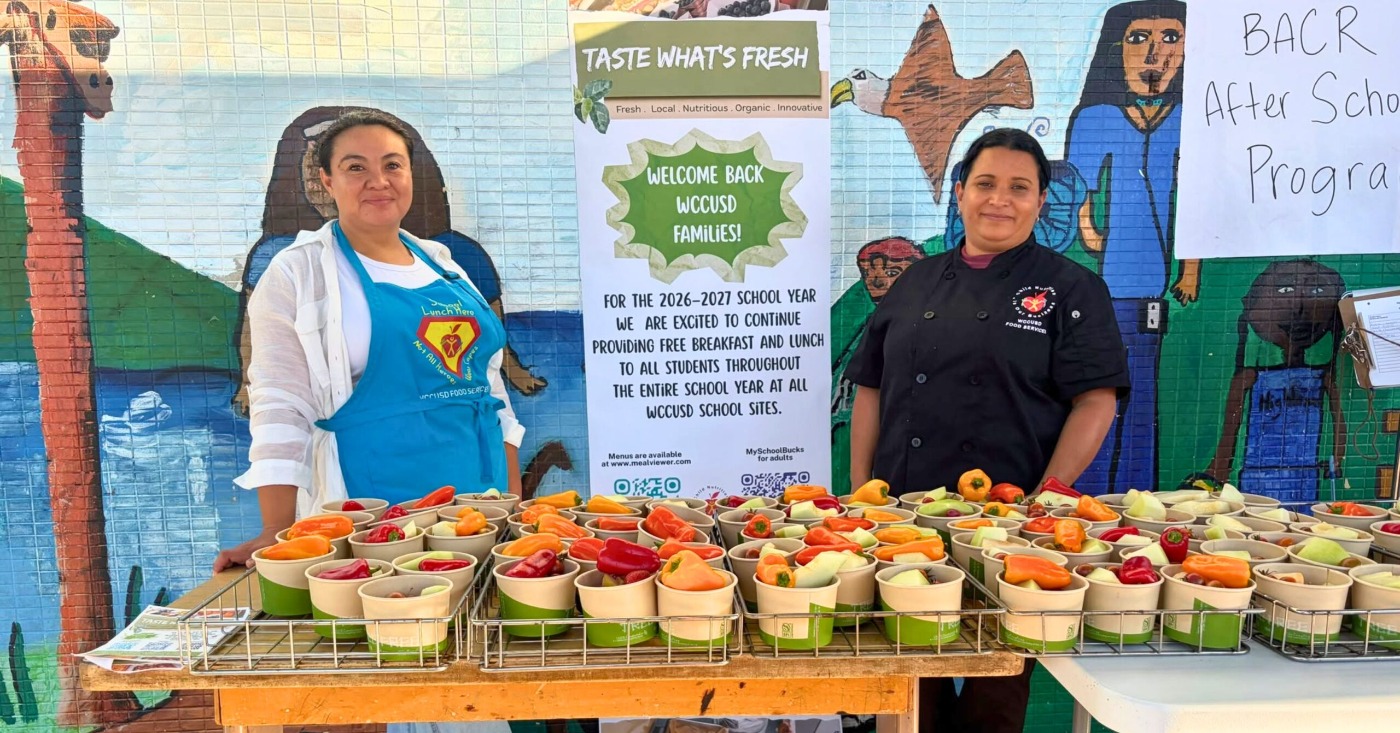
Seventeen California public school districts, including West Contra Costa Unified (WCCUSD), have joined a purchasing cooperative to pool their buying power and expand access to organic food in school meals.
The nonprofit Conscious Kitchen recently announced the launch of the Conscious Organic School Food Purchasing Cooperative. Its founding districts serve more than 300,000 students combined.
The cooperative partnered with food distributors UNFI and Sysco to expand the organic products available to participating districts. Combining schools’ purchasing demand helps distributors plan with suppliers while creating more dependable markets for organic farmers and food makers, according to Conscious Kitchen.
Other eligible California school districts can access the cooperative’s products and pricing through its existing contracts without conducting their own bids. Mt. Diablo Unified School District serves as the lead district for the cooperative’s grocery bid.
Other districts involved include: Alameda USD, Albany USD, Berkeley USD, Capistrano USD, Cupertino Union SD, Hayward USD, Laguna Beach USD, Lagunitas Elementary SD, Mt. Diablo USD, North Monterey County USD, Pajaro Valley USD, San Leandro USD, San Ramon Valley USD, Santa Clara USD, Sausalito Marin City SD, Tahoe-Truckee USD and West Contra Costa USD.
Barbara Jellison, WCCUSD’s executive director of food services, said the cooperative builds on years of work bringing fresh, organic food into school kitchens.
“The next challenge has always been how to make that possible for more districts,” Jellison said. “The Co-op gives schools a way to take what we have learned and move it to a completely different scale.”
Black Press
Democrats, Community Groups Back Measure EE to Change How Oakland Is Governed
Along with clearer executive responsibility, the Charter reform would also create new checks and balances, including an independent Budget and Legislative Analyst office, City Council confirmation of key appointments, expanded council hearing and subpoena authority, and give the council the ability to override a mayoral veto with six votes.
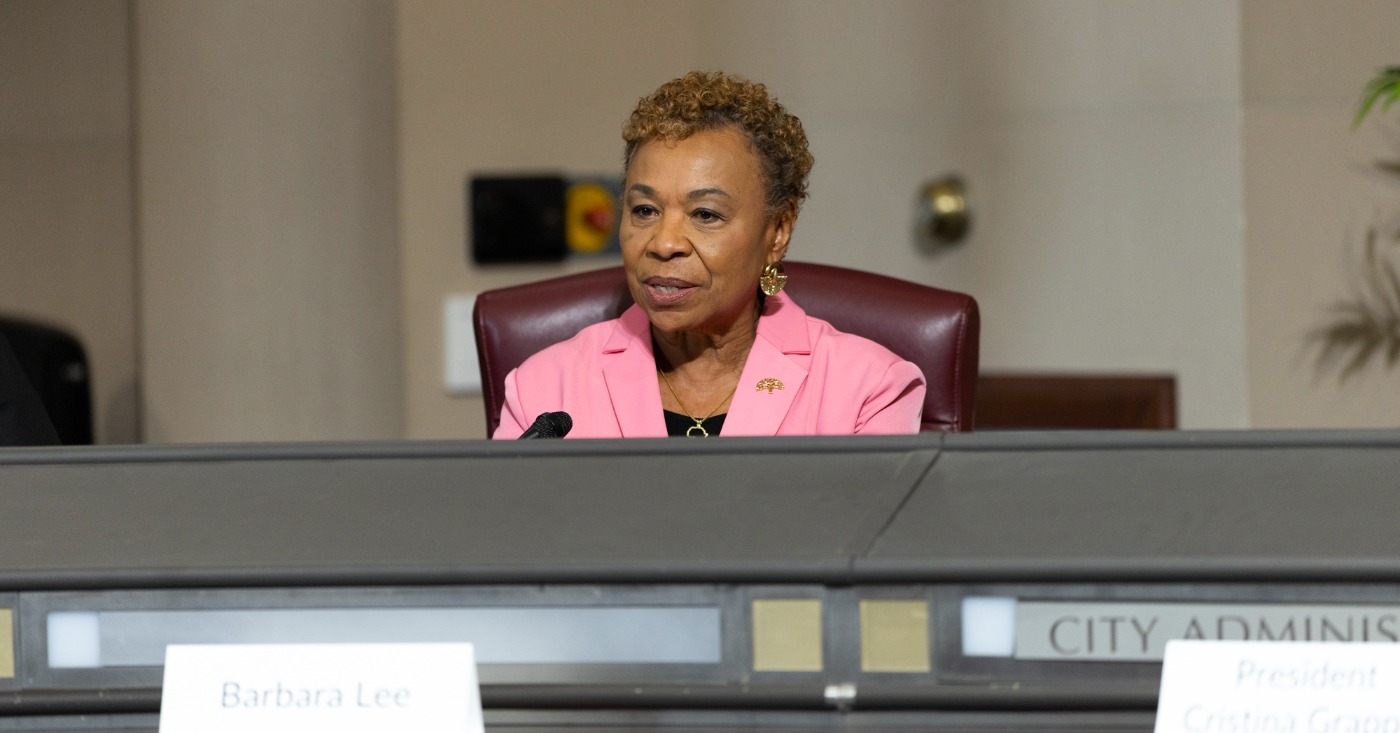
The Alameda County Democratic Party has voted to endorse Measure EE, the Oakland Charter reform measure on the November 2026 ballot. The party’s endorsement is announced alongside a broad coalition of organizations spanning labor, business, faith, and community advocacy, including Oakland Rising Action that are also supporting the measure.
Those supporters include:
- League of Women Voters of Oakland
- AFSCME Council 57
- SPUR
- Bay Area Council
- Black Women Organized for Political Action
- Faith in Action East Bay
- Oakland Chamber of Commerce
- Oakland Rising Action
- Revitalize East Bay
- Empower Oakland
Measure EE would reform Oakland’s hybrid governance system by establishing a strong-mayor structure, making the mayor the city’s chief executive, responsible for delivering effective, efficient services.
The measure would also reform and expand responsibilities of City Councilmembers.
Measure EE would create clearer lines of responsibility for the performance of city government, allowing voters to evaluate the mayor based on how effectively the city delivers services and produces results.
Along with clearer executive responsibility, the Charter reform would also create new checks and balances, including an independent Budget and Legislative Analyst office, City Council confirmation of key appointments, expanded council hearing and subpoena authority, and give the council the ability to override a mayoral veto with six votes.
“Oakland voters deserve a City Hall where they know exactly who’s responsible when something goes wrong and exactly who to credit when it gets fixed. Measure EE puts that responsibility squarely with the mayor, backed by real checks and balances, so Oakland can finally move as fast as its problems demand. That’s why the Alameda County Democratic Party is proud to stand behind it,” said Igor Tregub, chair of the Alameda County Democratic Party.
Oakland Rising Action, a collaboration of racial, economic, and environmental justice organizations, has also issued a press statement explaining its support for Measure EE.
Measure EE “represents a critical opportunity for residents to clarify the governance role of the Oakland Mayor and City Council, so we, as residents, know who to hold accountable for the execution of voter-approved and budgeted services within city departments,” the statement said.
Measure EE would reform Oakland’s Charter, which is the city’s Constitution, strengthening “the role of the mayor as the CEO of Oakland, with the city administrator being hired and managed by the mayor explicitly.”
The measure would also strengthen oversight of city departments by mandating reporting directly to the City Council and provide the mayor with veto power in approving policies and the budget.
Measure EE was placed on the ballot by the Oakland City Council in June 2026. For more than half a year, the mayor’s working group on Charter reform engaged residents and elected officials on the options for governance of Oakland, which led to Measure EE.
“Oaklanders need clarity about who is responsible for the management of our city departments, our tax dollars, and our voter-approved ballot measures,” said Pecolia Manigo, executive director of Oakland Rising.
“The average resident believes that we already have a strong mayor system,” she continued. “However, this is simply not the truth in our City Charter. It is time for us to stop talking about the Charter changes Oakland needs. This is the first of many Charter reforms that are needed to improve conditions in Oakland, especially the flatlands. It’s time all voters start paying attention to who is making decisions for Oakland. This election allows us to say how we believe Oakland should be governed.”
Black Press
Veterans Housing Project Proposed for South Richmond
According to the development team’s presentation, the project has an estimated total cost of nearly $158 million. The presentation outlines five phases encompassing entitlement and construction documents, community outreach, soil remediation and utility work, podium and building construction, solar technology integration, and interior buildouts.

A proposed mixed-use development at 338 Carlson Blvd. could bring hundreds of homes and support services for military veterans to South Richmond.
Led by the Richmond-based Veterans Resource Program in partnership with Eagle Environmental Construction & Development, the proposal covers an approximately 2.3-acre property the nonprofit acquired in 2018.
The proposal features a multi-building residential development with various apartment sizes, though city documents and developer materials cite conflicting totals ranging from 226 to 268 units.
The proposal also includes approximately 40,000 square feet of commercial and retail space, about 200 parking spaces, and an entrepreneurial training and job-development component intended to connect veterans with economic and workforce opportunities.
According to the development team’s presentation, the project has an estimated total cost of nearly $158 million. The presentation outlines five phases encompassing entitlement and construction documents, community outreach, soil remediation and utility work, podium and building construction, solar technology integration, and interior buildouts.
Founded in 2011, the Veterans Resource Program provides housing assistance and other services to veterans, including those experiencing homelessness or transitioning from incarceration.
The proposal aims to advance Richmond’s affordable housing goals while connecting veterans with housing and supportive services. Details of affordability and veteran eligibility remain to be clarified.
The Richmond City Council was scheduled to receive an informational presentation on the project at its Oct. 6 meeting, following a continuance from Sept. 22. The item does not seek project approval or city funding. Any future request for city financial assistance or other public resources would require separate consideration and approval.
Black Press
Jendayi Arrest Raises Community Concerns Regarding Sheriff’s Chain of Command
Judge Sandra K. Bean ordered a legally inherited home to be taken from beneficiary Jendayi, citing “undue influence,” and gave it to Court Administrator Phillip Campbell, who Jendayi believes will quickly sell the house and pay himself more than $600,000 in court fees. The disinherited sisters will get the remainder of the proceeds of the sale.
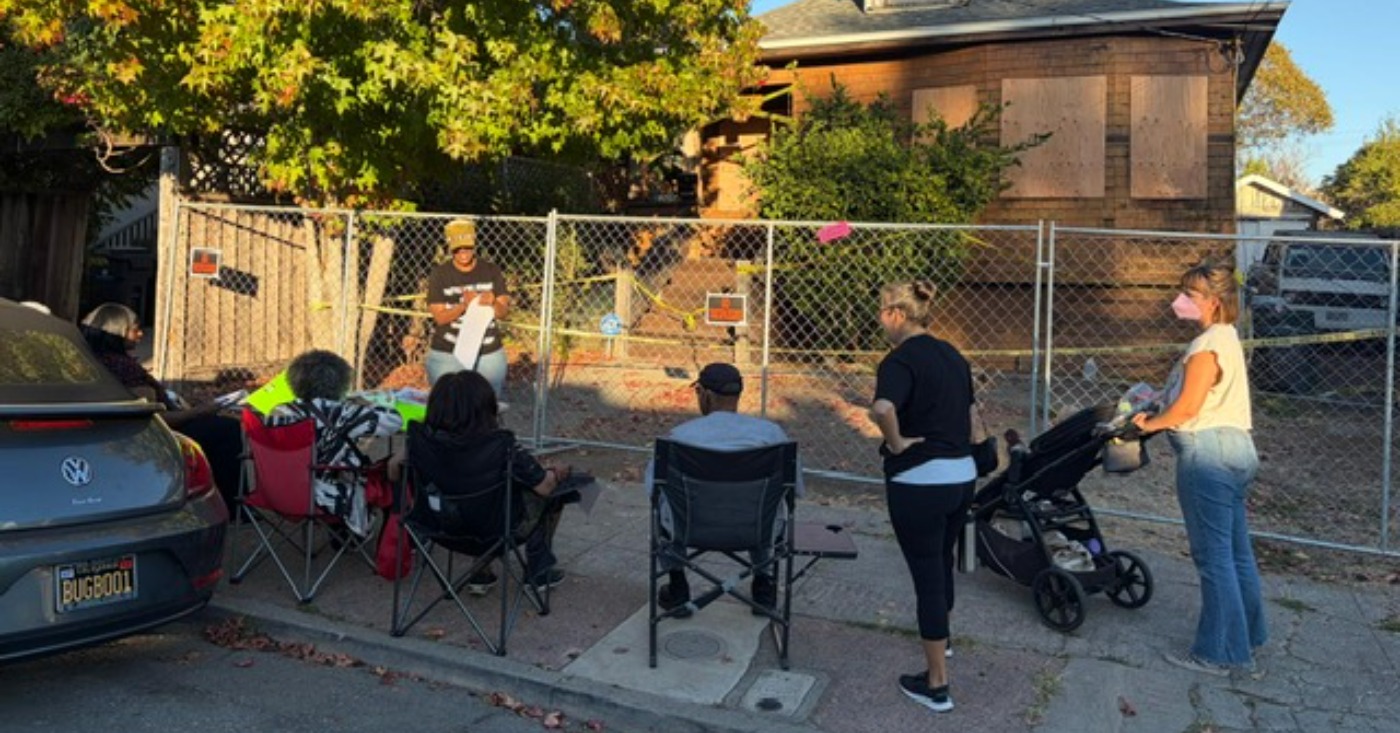
Last Thursday, Zakiya Jendayi parked on the side of the René C. Davidson Courthouse in Oakland to file an emergency stay request in what Jendayi asserts was the “legal” theft of her home of 13 years by a court administrator in her ongoing battle for her rightful inheritance in a probate battle.
But before she could fully emerge from the car at 12th and Oak streets, she was arrested by Alameda County Sheriffs for disobeying a court order and obstruction.
According to observers who have read the transcripts, the Hamlin v. Jendayi case, now in its sixth year, has resulted in what they describe as a gross miscarriage of justice.
Judge Sandra K. Bean ordered a legally inherited home to be taken from beneficiary Jendayi, citing “undue influence,” and gave it to Court Administrator Phillip Campbell, who Jendayi believes will quickly sell the house and pay himself more than $600,000 in court fees. The disinherited sisters will get the remainder of the proceeds of the sale.
Dr. Laura Dean Head named Jendayi as the beneficiary and executor over her estate after Jendayi took care of her during the last months of her life. Head’s disinherited sisters, Della Hamlin and Helaine Head, challenged the validity of Head’s will and trust, despite not being able to recognize Head in a photo during the trial, and Della stating she hadn’t spoken to her sister since 1997 or 1998 and would not have taken care of her during her hospice.
The appellate court upheld Bean’s ruling, which Jendayi asserts was based on a failure to fully consider the transcripts. “They never read the transcripts because if they had, they would have seen the truth,” Jendayi said.
Accompanied by Alameda Couty Sheriff’s Department deputies, Campbell arrived unannounced at Jendayi’s home on Oct. 1 – at the same time Jendayi was being arrested – to change the locks, board up the windows, and place a fence around the property.
Neither Jendayi, nor her supporters who had been in touch with Alameda County leadership and the Sheriff’s Department and been given the impression that nothing would happen without warning had been told Campbell was coming.
“I went to the courthouse to file an emergency stay document, and while getting out of the car, a sheriff immediately approached me and put handcuffs on me before I could stand up,” Jendayi said in recounting the events of Oct. 1. “I asked him if he had a warrant. He said ‘yes,’ and seven other officers immediately approached and surrounded me, with an additional three sheriffs standing back observing.
“I asked why it was necessary to have 10 officers to arrest me. They would not answer. I asked if the sergeant was there and asked if I could speak to him, but the sergeant refused to approach while another officer started taunting me over and over, stating, ‘I was at your house. I was at your house when you refused to surrender. We got you now.’
“The officer put the handcuffs on tight. I asked him to please loosen them. He refused and said they weren’t too tight. Then a Black, female deputy named Lewis, came over and asked him to loosen the handcuffs. Three times the white male officers were overly aggressive with me, and each time Deputy Lewis would step up and they would fall back. They said I was under arrest for refusing to surrender the house on Aug. 25.
“I asked them if I could file my paperwork, and they said, ‘No.’ Several officers asked me if I was on drugs. I felt like my life was in danger. I asked to speak to Deputy Lewis, and she came. I said, ‘Please tell my mother and Joyce Gordon that I would never kill myself.’ I did not want to end up like Sandra Bland, who was murdered by police officers in a Texas jail.”
Zendayi said they then took her to a section in the basement of the courthouse, placed her in a holding cell, and confiscated her belongings around 3 p.m. “They went through everything, took both cell phones, and asked if they could turn off my phones. I said ‘no,’ so they placed them in airplane mode.”
Then she was taken in a van to Santa Rita Jail in Dublin, which, because of traffic took almost two hours. “They asked me if I was on drugs and asked me to give a urine sample. I refused. They took a mug shot, and I was told it would be Monday before I could go to court. They put me in a cell with feces on the wall.
An hour after being detained, a deputy asked Jendayi if she knew someone who worked for the county and then asked if knew someone from the Sheriff’s Office and answered ‘no’ to both questions. He said, “You must know someone because we received orders to release you immediately. You’ll be out of here in about 40 minutes.”
“Rev. Raymond Langford of the Oakland Private Industry Council has been helping me to negotiate for more time to stay in my home,” Jendayi said. “I have an appeal with the Northern District Court of Appeals, where I’ve been promised they will review my case based on its merits. I was hoping to stay (in my home) until they reached a determination.
Rev. Langford reached out to Alameda County Supervisor Nikki Fortunata Bas and Chief Administrator David Brown, and they’ve been in contact with Sheriff Yesenia Sanchez.
“They weren’t going to give me the time I requested, but they did say that I would have time to move my belongings and would also be notified when they were coming,” Jendayi said. “None of that occurred.”
Langford said he spoke to Brown, Fortunato Bas and Sanchez right after the first attempt to evict Jendayi on Aug. 25 as well as the Alameda County Counsel and others to negotiate a time for Jendayi to move her belongings.
“There is no truth to the statement that there was no contact [with court and law enforcement officials.] There was an obvious miscommunication between Sanchez and her officers. They don’t have to inform the public of their actions, I understand that, but Zakiya and the community were concerned after they confiscated her guns.”
(Jendayi relinquished her weapons on Aug. 25 when sheriff’s deputies came to forcibly evict her while her petition for bankruptcy was still pending and should have interrupted the eviction process.)
“The Sheriffs have their own trust issues, and they need to work on that. They are not following the chain of command. David Brown, Fortunato Bas’s chief of staff, was puzzled also. He was told they would be informed when they would be returning. He was also blindsided like all of us.”
“(The Sheriffs’ Department) can come to the supervisors and get millions of dollars, but they can’t exhibit the courtesy to inform a citizen when she needs to move.”
“We, our group, ‘Friends of Zakiya,’ took a letter to Sanchez’s office citing Zakiya’s health issues, asking for more time just last week. Sanchez was a person who ran on the platform that she would not run the Sheriff’s Department on a military strategy, which they did on an African American senior in a comfortable, safe community.
“We understand they have to do their job, but we don’t want them targeting and profiling seniors. There has to be some accountability to the community,” Lankford said.
Supervisor Nikki Bas, deeply concerned with what has occurred, is joining with Supervisor Nate Miley to request a meeting with Attorney General Rob Bonta to request an independent investigation.
Black Press
Marin County Supes Expand Small Business Options with Home Kitchen Pilot Program
“This will deliver immediate financial relief to entrepreneurs in areas like Marin City, West Marin and the Canal neighborhood, removing barriers right where economic opportunity is needed the most,” said Shannon Bell, consumer protection supervisor with Marin County Environmental Health Services, at the meeting.

The Marin County Board of Supervisors adopted a three-year pilot program that will allow cooks and food entrepreneurs to prepare and sell meals from their homes on Sept. 29
The Microenterprise Home Kitchen Operation program, or MEHKO, will establish a permitting process for small-scale home food businesses. California state law allows licenses if local governments opt in.
“This will deliver immediate financial relief to entrepreneurs in areas like Marin City, West Marin and the Canal neighborhood, removing barriers right where economic opportunity is needed the most,” said Shannon Bell, consumer protection supervisor with Marin County Environmental Health Services, at the meeting.
MEHKO licenses fill the gap between cottage food permits, which only apply to non-potentially hazardous foods like baked goods and jams, and full commercial kitchens.
Microenterprises can serve as commissaries for up to two mobile food operations; they require food to be prepared and served the same day. They are exempt from commercial facility requirements, such as industrial grease traps and commercial stove hoods.
The program allows takeout or on-site dining with strict limits of 30 meals per day, or 90 meals per week, and an annual sales cap of $100,000.
The pilot would begin March 1, 2027, and permits would be capped at 100 per year. Application fees are $725 with an annual renewal fee of $414, but fee waivers for a third of the permits are reserved for low-income communities.
After two years, supervisors will consider making the program permanent.
“By eliminating the need for commercial leases and expensive equipment, entrepreneurs can safely test their businesses and ideas with minimal financial risk,” Bell said. According to statewide data from the Cook Alliance, 85% of MEHKO operators are women, immigrants, and people of color, and over 70% rely on this income to support their families, she said.
Bell also said unpermitted sales are already happening in areas like the Canal.
Local Vendors Seek a Legal Path
Marina Palma advocates for San Rafael’s Canal neighborhood, which is home to a vulnerable community of over 13,000 low-income residents. About 84% are Latino and roughly half of all households spend more than 50% of their income on housing.
Palma told the board that the pandemic caused many Canal residents to lose their jobs, and that’s why the neighborhood has so many vendors selling food in public. Because they have no license, enforcement actions can be harsh.
“They have really high tickets of $600, and their food has been thrown away,” said Palma.
She said MEHKO would help vendors get an official license, but she questions whether vendors will need a Social Security number and be legally in the country.
According to the home-chef’s national nonprofit Cook Alliance, MEHKO applicants need no proof of citizenship nor a Social Security number to obtain a permit.
“I’m from Mexico, and I’m one of the mobile vendors,” said Elsie Vega through a Spanish translator. “I have two jobs. Everything is pricey — house, food, everything. I am here to work hard, to pay taxes. I don’t make enough money to pay the community kitchens.”
MEHKO license holders must pass inspection under the oversight of the Marin County Department of Environmental Health Services and comply with local zoning, parking and noise ordinances.
California authorized MEHKO programs in 2019. Seventeen counties have since adopted them, including Sonoma, San Mateo, Solano, Contra Costa, Alameda and Santa Clara counties.
Other commenters who spoke in favor of the program represented a range of food system and small business organizations. They included the Agricultural Institute of Marin, which operates nine Bay Area farmers markets, the University of California Cooperative Extension, the Cook Alliance, the West Marin Food Systems Group, which coordinates farm-to-school food access, and the Marin Small Business Development Center.
Black Press
Allen Temple Baptist Church Hosts Free Prostate Cancer Screenings on Oct. 17
The summit’s mission is to reduce the impact of prostate cancer through education, early detection, research, and support. It is presented in partnership with The Oakland Institute of Health, Inc., SCAN, Brotherhood of Elders Network, UCSF Helen Diller Family Comprehensive Cancer Center, Alameda County Public Health Department, Stanford Medicine Cancer Center, Impact Oakland Now, Bay Area Umoja Health, Bay Area Black Nurses Association, Inc., and 100 Black Men of the Bay Area, Inc.

The Prostate Cancer 2500™ Care Summit brings together health systems, community organizations, and survivors to put early detection within reach
Black men in America are diagnosed with prostate cancer more often than other men and are about twice as likely to die from it. Early detection changes that outcome.
On Saturday, Oct. 17 from 10 a.m. to 2 p.m., Allen Temple Baptist Church will host the Prostate Cancer 2500™ Care Summit (#PC2500), a free event open to the entire community.
. Attendees can receive prostate cancer screenings and health consultations on site, learn about prevention and nutrition, ask medical experts questions in an interactive Q&A, and hear from survivors who will share their stories and offer support.
Screening is recommended beginning at age 45, and at age 40 for Black men with a family history of prostate cancer. All men are welcome, and families are encouraged to attend.
The summit’s mission is to reduce the impact of prostate cancer through education, early detection, research, and support. It is presented in partnership with The Oakland Institute of Health, Inc., SCAN, Brotherhood of Elders Network, UCSF Helen Diller Family Comprehensive Cancer Center, Alameda County Public Health Department, Stanford Medicine Cancer Center, Impact Oakland Now, Bay Area Umoja Health, Bay Area Black Nurses Association, Inc., and 100 Black Men of the Bay Area, Inc.
For more information prior to the event, reach out to Rev. Charlotte Y. Williams at (510) 604-5242 | [email protected]
For more information on the day of the event, reach out to Deacon Dwight Williams (510) 501-1650 [email protected]. The church is located at 8501 International Blvd., Oakland, CA 94621 The service is free and free parking and refreshments will be provided. The site is accessible to persons with disabilities. To pre-register, go to Allen-Temple.org
Allen Temple Baptist Church was organized in 1919 in Oakland. For 107 years, ATBC has served as a bright beacon of faith, hope, and love beyond its’ four walls. Allen Temple is committed to sharing the love of God and the message of Good News throughout the world. We welcome people of all ages and cultural backgrounds as we joyfully celebrate worship and fellowship, and carry out ministries of evangelism, discipleship, education, community outreach, and global missions. Allen Temple’s holistic, prophetic and social justice ministries address the needs of the whole person as well as the whole community. Dr. Jacqueline A. Thompson.
Rev. Charlotte Y. Williams is the minister and director of Communications at Allen Temple Baptist Church.


HBCU Homecoming: A never-miss annual tradition

News Observer Weekly — October 14, 2026 | Top 5 Stories of the Week

Coach Tremaine Jackson Urgent Mindset- ‘Fourth and One’

Michael Jackson Returns to the Super Bowl Spotlight, Druski Heads to SNL, and Gas Drops Below $1!

Michael Jackson Returns to the Super Bowl Spotlight, Druski Heads to SNL, and Gas Drops Below $1! 📱

Secure growth by funding business expansion without taking on bad debt

Save money on storm damage repairs by addressing your property hurricane risk early in the season

Sunset Loft – The Crystal

HISD takeover “diminished, degraded, destroyed” schools – Citizen commission report

Everything You Need to know before you Vote

The Youngest American Killed in the Vietnam War

Passing for White, Fighting for Black America: The Courage of Walter White

OP-ED: Haiti TPS: Have We Lost Sense of Humanity?

OP-ED: How Does Your State Rank for Pre-K?

NFL: Week Two Recap | Jalen Hurts did not fold; Caleb Williams exits game with injury

Remembering Chauncey Bailey as Student Journalists Face Threats to Truth-Telling

Headlines and Hot Topics 📱

NEWSOM, KAMALA & 2028: THE POLITICAL CALCULUS BEGINS 📱

Peter Magubane: a Camera Against Apartheid

Obama Urges Democrats to make AI a Priority 📱
HBCU Homecoming: A never-miss annual tradition
News Observer Weekly — October 14, 2026 | Top 5 Stories of the Week
Coach Tremaine Jackson Urgent Mindset- ‘Fourth and One’
Michael Jackson Returns to the Super Bowl Spotlight, Druski Heads to SNL, and Gas Drops Below $1!
Michael Jackson Returns to the Super Bowl Spotlight, Druski Heads to SNL, and Gas Drops Below $1! 📱
Sunset Loft – The Crystal
HISD takeover “diminished, degraded, destroyed” schools – Citizen commission report
Everything You Need to know before you Vote

From Doubts to Calling: My Wife Saved My Career #shorts

HBCU Homecoming: A never-miss annual tradition
-

 Black Press1 week ago
A $2.1 Trillion Wellness Industry Never Built a Daily Practice for Black Children. So This Atlanta Family Did.
-

 Art1 week ago
Montclair Brewery: Brewing Culture, Community, History
-
 BlackPressUSA6 days ago
Latinas Deserve Equal Pay. Unions Help Make It Happen.
-

 Black History1 week ago
Listening as a Lifeline: A Doula’s Witness to Black Maternal Health
-

 Black Press2 days ago
All Skinfolk Ain’t Kinfolk
-

 Black Press1 week ago
COMMENTARY: But God!
