
Featured
Digger
(**1/2) What the ….? It’s likely moviegoers will be perplexed by the opening scenes of this bombastic, cautionary satire. The initial, deceptively idyllic visuals throw you off track: A picture window frames a placid scene. Heavenly light pours from a chandelier fit for Versailles. A palatial, 18th-century-looking bedroom reeks of elegance—a boudoir only a billionaire […]

(**1/2)
What the ….?
It’s likely moviegoers will be perplexed by the opening scenes of this bombastic, cautionary satire. The initial, deceptively idyllic visuals throw you off track: A picture window frames a placid scene. Heavenly light pours from a chandelier fit for Versailles. A palatial, 18th-century-looking bedroom reeks of elegance—a boudoir only a billionaire could afford.
Digger Rockwell (Tom Cruise), an eccentric Texas oil baron, is worried about his sickly, scrawny white cat. But he has bigger issues on his plate than the ailing feline. Underlings warn him that a disaster involving a Greenland glacier could destroy his company and endanger vast numbers of people, especially those living in coastal areas.
That’s the bare-bones premise of the overwrought, excessively talky screenplay by writer-director Alejandro G. Iñárritu, Alexander Dinelaris, Nicolás Giacobone and Sabina Berman, based on a story by Berman, Iñárritu and Jez Butterworth. The apparent goal is to warn the world about the catastrophic consequences of environmental negligence—disasters that can start locally and spread globally. That’s the gist. But before viewers reach that conclusion, they have to endure two hours of screaming, arguing and chaos.
Why the hell would anyone sit through this attack on the senses by a chorus of blustery men? In addition, the central character, a narcissistic rich guy, is so damn repulsive. Overconfident like Musk. Insensitive like Bezos. Self-absorbed and self-promotional. He’s surrounded by sycophants unable to stand up to him: “You profit off my company like parasites.” And of course, he thinks he’s smarter than the rest: “Oil is mother nature’s milk.” In his mind, he’ll be the hero who saves the day. But he’s saving the world from a problem he caused.
Though nominated for three acting Oscars, Cruise has never won a competitive one. His performances in Rain Man and The Color of Money shared the screen with Oscar-winning portrayals by Dustin Hoffman and Paul Newman, respectively. Cuba Gooding Jr. won Supporting Actor for Jerry Maguire, another Cruise-led film. For his co-stars, he seems to have the Midas touch. For him, he’s always the best man and never the groom.
It’s easy to imagine Iñárritu pitching this project to Cruise. Easy to imagine Cruise seeing the opportunity to work with the director of Birdman and The Revenant on a challenging character while sizing up the awards-season possibilities.
The 64-year-old veteran actor is in most scenes. This production lives or dies on his interpretation of an unlikable, abrasive character. And in typical Cruise fashion, he’s all in. His portrayal is consistent in tone and deliberately obnoxious: a bully with a savior complex. On paper, the character should be repulsive. On screen, the Oscar-starved actor plays to the rafters and gets away with it. He’s fun to watch, even when the film isn’t. And the film isn’t—most of the time.
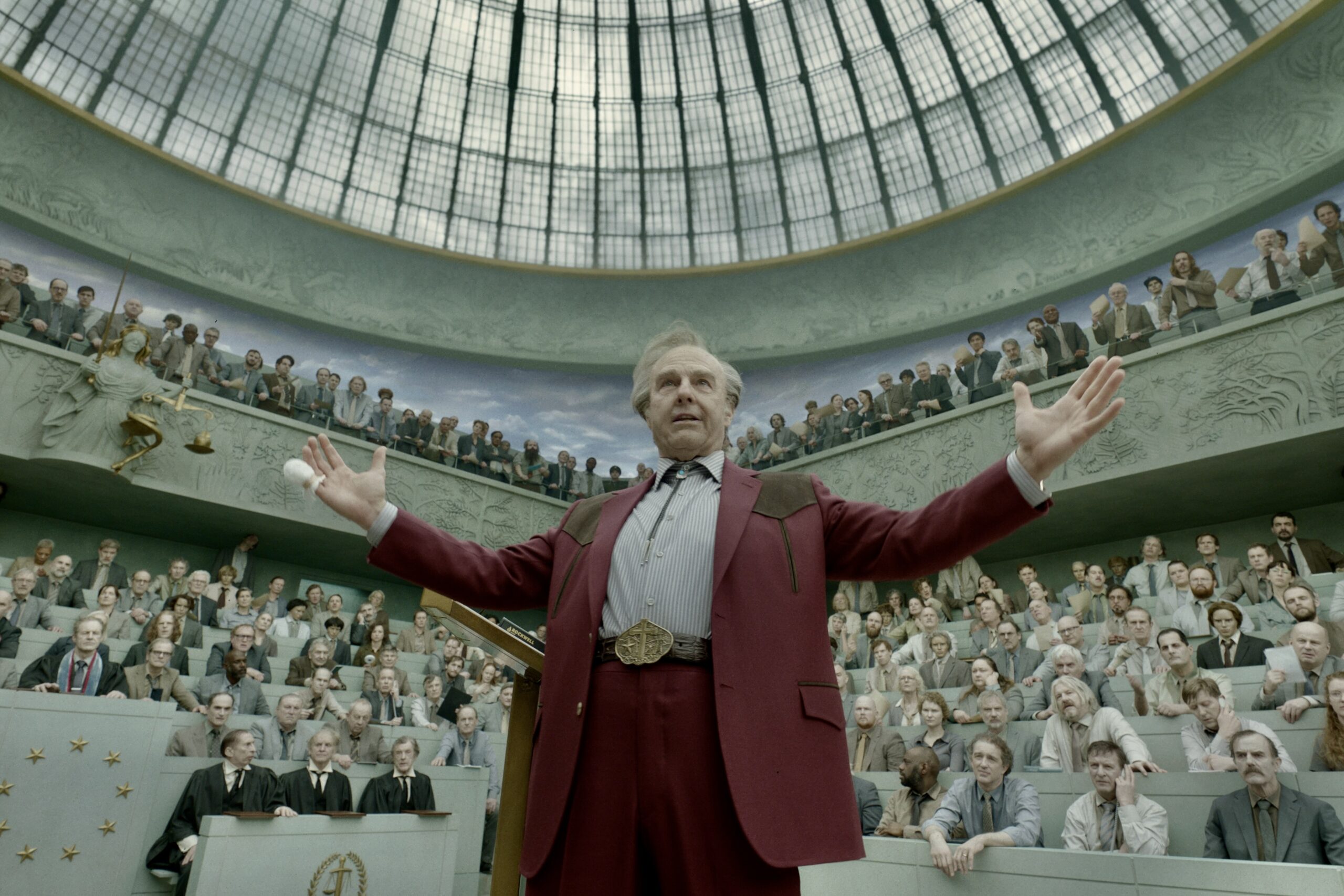
The technical craftsmanship is meticulous and often striking. In one crucial town-hall scene, costume designer Jacqueline West dresses the cast in neutral colors, giving the scene a detached feel. Makeup and hair designer Alessandro Bertolazzi gives Cruise a pasty, washed-out, corpse-like complexion that’s hauntingly weird. From that bafflingly beautiful opening scene, production designers Dennis Gassner and Richard Johnson create a world that feels suspiciously theatrical rather than cinematic, reinforcing the film’s artificiality.
Nothing looks real. It’s almost like you’re looking at a coffee-table picture book, an artificial mirage co-created by cinematographer Emmanuel Lubezki. Did prosthetic makeup designer Kazu Hiro give Cruise that grandad belly, or did he eat his way into it? Either way, his floating tummy should get second billing. Composer Cosmo Sheldrake’s score is overbearing for much of the film, then varies nicely to accommodate what’s on screen.
Two-thirds of the way through, the shifting music becomes especially helpful as the frenetic footage subsides. There’s a tonal shift. Realities change. The messaging becomes clear. It’s abrupt, but not a bad transition. What came before—a stagy, artificial, increasingly abrasive hybrid of satire and farce—suddenly makes more sense. It’s like looking at a picture within a picture, with editors Stephen Mirrione and Conor O’Neill providing an obvious but seamless transition. It’s almost like you now understand why you had to sit through the worst to get to the good part. The end. That’s when real clarity emerges.
Hard to believe that the same director who created the intimacy of Amores Perros, gritty themes of 21 Grams, international intrigue of Babel, innovation of Birdman and earthy danger of The Revenant did this. His gift for assembling a stellar behind-the-camera team is still intact. His ability to coordinate, stage and choreograph challenging films is still strong. However, questions remain: Is it worth it? Was this the right strategy? It’s like he’s telling an inside joke that’s bombing and not letting the audience in on it. Until it’s way too late.
Cruise chews up the scenery like it’s his last meal. His Digger character is manic, but not in an intriguing way. That forces the actor to work overtime to put scenes across. John Goodman, as the buffoonish U.S. president prone to napping at the wrong times, is unhinged but not in a humorous way. Sandra Hüller, as Rockwell’s sister, seems wasted. She deserved more screen time, as did Sophie Wilde. In fact, the testosterone-heavy atmosphere becomes increasingly toxic. Riz Ahmed, as Ganesh, Digger’s chief advisor and an environmental scientist, is adequate but largely reactive. It’s a role that needed an in-your-face actor like Samuel L. Jackson—someone who could set the screen on fire and make you chuckle.
Expect divided reactions. That’s what happens when a movie feels distant and rarely compelling. Easy to revere the theme. Easier to dislike the rest. It’s like getting a vaccination shot. You know that in the end it’s good for you. But that doesn’t make the needle any less painful—especially if the doctor keeps missing the vein.
Trailer: https://www.youtube.com/watch?v=job8V254NAE
Visit Film Critic Dwight Brown at DwightBrownInk.com.









(**½)
Like Robin Hood and his band of Merry Men, these thieves steal from the rich to give to the poor.
But for how long? That depends on screenwriter Mark Bianculli’s crime-thriller script and whether the storyline can sustain its carefree robbery approach without tiring its target Gen Z audience. Frustrated teens and those grievance-heavy twentysomethings who feel locked out of the American Dream might take a break from social media binging long enough to go on this crime spree. They may stick with this eclectic band of thieves, led by a bleached blonde, bad-attitude prince who’s got an ax to grind against banks and how they treat the less fortunate. Or they may just do a drive by and move on.
The very contemporary premise gets a big boost from wacky pop-up graphics, overlays, digital avatars and QR codes. The kind that hypnotize viewers on TikTok and YouTube, sending them down rabbit holes where algorithms keep them entrapped. Costume designer Jocelyn Pierce starts the cast of robbers off in odd clothes from construction worker garb to security guard uniforms and animal outfits. Art director Marika Stephens and supervising art director Jeremy Woolsey pick bright, animated colors as images of the real-life characters metamorphose into cartoonish figures.
Production designer David Scheunemann pulls viewers into this altered universe, whether the characters are in loft spaces, tenement apartments or big banks. Makeup artists apply exaggerated shadows around eyes and top off looks with quirky platinum-blonde wigs. In a crucial bridge scene, the oversaturated hues of yellow and blue heighten the pop-art sensibility captured by cinematographer Jonathan Sela (Bullet Train). It’s a good thing that the visuals are alluring and that composer Dominic Lewis (The Fall Guy) provides a soundtrack with verve. All that almost makes up for the times when the film loses momentum.
The Wolf, aka Ryan (Nicholas Hoult, The Great and The Favourite), has a deep-seated grudge. That’s what drives him to lead a group of misfits as they rob banks and share their exploits live on social media video rants. Not just to show off, but to show others how it’s done. He wants his followers to walk in his footsteps. He isn’t alone. His girlfriend Emi (Anna Sawai, Shōgun) supports his criminal endeavors and is becoming a top-notch getaway driver who can spin a car with the best of them. Vince (Pete Davidson), a military vet with health issues who struggles to support his family, teaches her the finer points of speeding off and evading after a bank robbery. The tight-knit crew is augmented by Hugo (Rhenzy Feliz, The Penguin), a Latino tech whiz and supreme hacker who captures Ryan’s rages against the machine and broadcasts them to the world.
Bank heist movies are as common as rain. Setting a crime film apart from the legions of others in the genre isn’t easy. Tarantino did it with Reservoir Dogs, using extreme graphic violence and an unconventional narrative structure. Set It Off featured an all-Black female cast. Dog Day Afternoon combined a bank robbery intended to finance the robber’s partner’s gender-affirming surgery with Al Pacino’s bravura performance. Director David Leitch (Bullet Train, The Fall Guy) and the film’s producers try to distinguish their project through pop-culture visuals and the desire for revenge among those hurt by insensitive banks. Their approach has more potential than the film ultimately realizes. There’s a social commentary about rebelling against today’s injustices, but it’s thin. Even thinner than the commentary in One Battle After Another.
Leitch is a pro at creating and shooting over-the-top action scenes. Anyone who witnessed Bad Bunny, Brian Tyree Henry and Brad Pitt aboard that speeding locomotive in Bullet Train, with its elaborate, eye-catching action sequences, may wonder why Leitch didn’t unleash that kind of spectacle here. There are plenty of opportunities for outrageously choreographed heists and escapes, but those that make it onscreen are neither spectacular or indelible. The pop visuals are striking in a smirky way, but still not enough to redefine the genre.
The young crooks don’t go unnoticed. Stuck-in-the-past FBI Agent West (John C. Reilly) is on the case. Which is something like assigning Sherlock Holmes to investigate a cryptocurrency crime spree. For this older gent, analog is his game; digital is not. He needs someone to bring him into the 21st century world of gadgets and tech, which is why he tracks down Reagan (Zoë Kravitz, Blink Twice). She’s a professional software developer with expertise in digital tracking—and she’s easy to find. Why? She’s on lockdown. The two meet, and like Holmes and Watson, they follow the clues in hopes of tracking down the crooks.
Much of what unfolds consists of short, fast-paced scenes, adroitly assembled by editor ElísabetRonaldsdóttir. However, the loss of momentum becomes noticeable during conversations between West and Reagan. These are moments when audience attention may waver, although the performances occasionally perk up the lackluster exchanges. Reilly’s version of the doddering sleuth gives his character a fish-out-of-water awkwardness that’s fun. Kravitz is cooler than ice as Reagan, the sardonic tech genius. She has an odd secondary characteristic: she’s endlessly munching on snack foods. As she noshes her way through the movie, it’s almost like watching a French actress smoke cigarettes incessantly as a character trait or acting crutch.
Feliz’s take on Hugo is very blasé and informed. Easy to like him, his family and neighbors. Davidson’s interpretation of Vince may be his most accomplished performance yet. He’s sarcastic at times, but never outlandish. Instead, he seems to be hiding emotions beneath a veneer of humor. His line delivery is fluid, his emotions run deep and it’s easy to believe in and care about his predicament. Sawai’s delight as Emi learns to perform spins in what look like a 1970s Oldsmobile is charming.
The weight of the movie rests on Hoult’s shoulders. He must convince audiences that Ryan is so deeply wounded he’s compelled to retaliate against the institutions who have robbed him of something important. His despair is so profound that it carries him from heist to heist, searching for the chance to stick it to the man: “When justice isn’t given, we take it!” For the most part, his blend of boldness and vulnerability is effective and convincing—a feat the film as a whole cannot claim.
The pop-culture sensibility and real-time social media commentary make this crime story different, but never extraordinary. That could hurt its box-office prospects during a theatrical run. On the other hand, once the film lands on Amazon Prime and viewers plop themselves on their couches with a bag of chips in one hand and a joint or beer in the other, this little story about those who steal from the rich to give to the poor may find its real home. Bank on it.
Trailer: https://www.youtube.com/watch?v=ORxw68y3lyw
Visit Film Critic Dwight Brown at DwightBrownInk.com.
Featured
Healthcare Legend Dr. L. Natalie Carroll Continues to Shine
Pioneering Houston physician Dr. L. Natalie Carroll reflects on a groundbreaking five-decade career in medicine and the history that shaped her journey.


In an interview with The Defender’s Aswad Walker, pioneering Houston physician Dr. L. Natalie Carroll reflects on more than five decades in medicine, the barriers she broke and the history that shaped her.
Read the full story at defendernetwork.com.
Subscribe to The Defender for more exclusive interviews, local news, and community coverage.
Sign up for the Top 5 newsletter
Donate / Support Our Work
#DrNatalieCarroll #Houston #BlackDoctors #WomenInMedicine #BlackHistory #HoustonMedicalForum #TheDefender
———————————————
SQUARE SHORT (no chapters needed)
Pioneering Houston physician Dr. L. Natalie Carroll knew she’d be a doctor at age eight, and she didn’t let anyone decide her path for her. #DrNatalieCarroll #Houston #BlackDoctors #WomenInMedicine #TheDefender
Visit Our Website
Read more stories by our team
https://defendernetwork.com/category/news/opinion/
Sign-up for the Top 5 newsletter
Donate/ Support Our Work
Featured
The African Cultural Film Festival Returns to Houston
The African Cultural Film Festival returned to Houston for its 4th edition, uniting filmmakers and fans to celebrate the global impact of African cinema.

The African Cultural Film Festival (AFFRICUFF) returned to Houston for its 4th edition, and The Defender was there as filmmakers, actors and film lovers gathered to celebrate African cinema.
Founder Emem Isong talks about African film resonating with audiences worldwide and building a Nollywood community in the diaspora. Filmmakers, volunteers and attendees share why the festival matters, from bringing Black American and Nollywood audiences together to keeping African culture alive in Houston, home to one of the largest Nigerian communities in the country.
In this video, you’ll hear about:
• AFFRICUFF’s 4th edition and its theme, “New Voices, New Vision”
• Building a Nollywood community in the diaspora
• Why Black American and Nollywood audiences belong together
• Keeping African culture and the arts alive in Houston
Chapters
0:00 AFFRICUFF returns to Houston
0:30 New Voices, New Vision
0:53 Voices from the festival
1:15 Black America meets Nollywood
1:37 Keeping culture alive
Read “African cinema takes root across Texas, Houston” at defendernetwork.com.
Subscribe to The Defender for more exclusive interviews, local news, and community coverage.
Sign up for the Top 5 newsletter
Donate / Support Our Work
#AFFRICUFF #Nollywood #Houston #AfricanCinema #AfricanDiaspora #NABJ #TheDefender
Featured
Athlete of the Week – Gabe Sampson
Meet Gabe Sampson, our latest Athlete of the Week, as we highlight his impressive performance and dedication on the field.

Visit Our Website
Read more stories by our team
https://defendernetwork.com/category/news/opinion/
Sign-up for the Top 5 newsletter
Donate/ Support Our Work
Featured
NSA Hacked; A Wake Up Call About Intelligence Security
How secure is America’s most sensitive intelligence? Dr. John E. Warren explores the fallout of the recent NSA hack and what it means for national security.

🔐 How secure is America’s most sensitive intelligence? Dr. John E. Warren raises that question on From the Desk of the Editor. ▶️ Watch the full episode now!
#CyberSecurity #NationalSecurity #FromTheDeskOfTheEditor #VoiceAndViewpoint
Featured
Derrick “Delite” Stevens on 40 Years in Radio, MC Skat Kat & Twin Cities Hip-Hop
Radio legend Derrick “Delite” Stevens reflects on his 40-year career, from building the Twin Cities hip-hop scene to voicing the iconic MC Skat Kat.

Before there was a Twin Cities hip-hop scene, Derrick “Delite” Stevens was helping build one.
On this episode of Blacklight on Sports, hosts Charles Hallman and Dr. Mitchell Palmer McDonald sit down with Derrick “Delite” Stevens, a radio veteran who started at 14 through the KBEM program at North High School and got his first DJ job from Pete Rhodes in 1984. Today he is a producer at The Current, where he has worked since the station’s first months on air.
Stevens tells the story of how a KMOJ shift led Paula Abdul’s producer to call him out of the blue, leading to his role as MC Skat Kat on the No. 1 remix of “Opposites Attract,” recorded at Prince’s Paisley Park. He also shares growing up in Queens as hip-hop was born, moving to Minnesota in 1979 and winning a Kurtis Blow rap contest at 14 before performing at First Avenue in the early 1980s.
In this episode, you’ll hear about:
Starting in radio at 14 and multitracking before multitracking existed
Joining The Current after being told he sounded too Black for commercial radio
Becoming MC Skat Kat and still signing autographs decades later
Meeting Quincy Jones, Stevie Wonder and Barry White
Bringing hip-hop from Queens to the Twin Cities
Conscious rap, AI music and the state of hip-hop in 2026
Why artists should honor the musicians they sample
Subscribe for more episodes of Blacklight on Sports, where Charles Hallman and Dr. Mitchell Palmer McDonald bring you the stories, voices and history of Black sports and culture in Minnesota and beyond.



Georgia Clinches 6th Straight SEC Championship Game Berth; 3 Teams Chase Final Spot

How to Rob a Bank

Healthcare Legend Dr. L. Natalie Carroll Continues to Shine

The African Cultural Film Festival Returns to Houston

Athlete of the Week – Gabe Sampson

NSA Hacked; A Wake Up Call About Intelligence Security

Derrick “Delite” Stevens on 40 Years in Radio, MC Skat Kat & Twin Cities Hip-Hop

Car Buying Checklist: 6 Steps to Shop Smarter #shorts

Chevy Tahoe Entry Test: Is the Driver’s Grab Handle Awkward? #shorts

Las Vegas GP: Ferrari Struggles During Qualifying; Verstappen Captures Pole

HISTORY MADE: Keisha Lance Bottoms Becomes First Black Woman Elected Governor in American History

Secretary of State Shirley Weber Pushes Back Against DOJ Demands Over California Voter Rolls

Retirement Triggers Doctor to Pen Book for Young Audience

Capturing Black Life’s Beauty

Multi-Faith Leaders Representing 10 Million People Launch National Anti-Authoritarian Initiative

Christianity’s Racial History

Hundreds of Black Christian Leaders Arriving in Israel for Martin Luther King-Inspired Mission

Oakland Honors 60 Years of the Black Panther Party at the All Power to the People Gala

Message from the Associate Editor: Blindness, Hurts, Cops

Michael Shiner: The Enslaved Man Who Wrote His Way into American History
Healthcare Legend Dr. L. Natalie Carroll Continues to Shine
The African Cultural Film Festival Returns to Houston
Athlete of the Week – Gabe Sampson
NSA Hacked; A Wake Up Call About Intelligence Security
Derrick “Delite” Stevens on 40 Years in Radio, MC Skat Kat & Twin Cities Hip-Hop
Car Buying Checklist: 6 Steps to Shop Smarter #shorts
Chevy Tahoe Entry Test: Is the Driver’s Grab Handle Awkward? #shorts

How Sick Must America Get Before Saying Enough to RFK

Tahoe 6.2L EcoTec3 V8: Surprising Acceleration in a Full-Size SUV #shorts

From The Desk of The Editor 11/18/26
-

 Black Press1 week ago
OP-ED: Closing the Next Digital Divide — Communities of Color Must Have a Voice in the AI Future
-

 Black History1 week ago
New NAACP Report Warns AI Could Deepen Health Disparities in Black Communities
-

 Black Press6 days ago
COMMENTARY: Thank You, Trump, for Making America Great Again!
-

 Black History1 week ago
“Blue Tsunami” Sweeps Georgia, Bottoms Makes History
-

 Black Press1 week ago
OP-ED: And Then What?
-

 Black Press5 days ago
Black Men Encouraged to Start Prostate Cancer Screening at 45
