
Featured
Darnell Earley Tells His Side

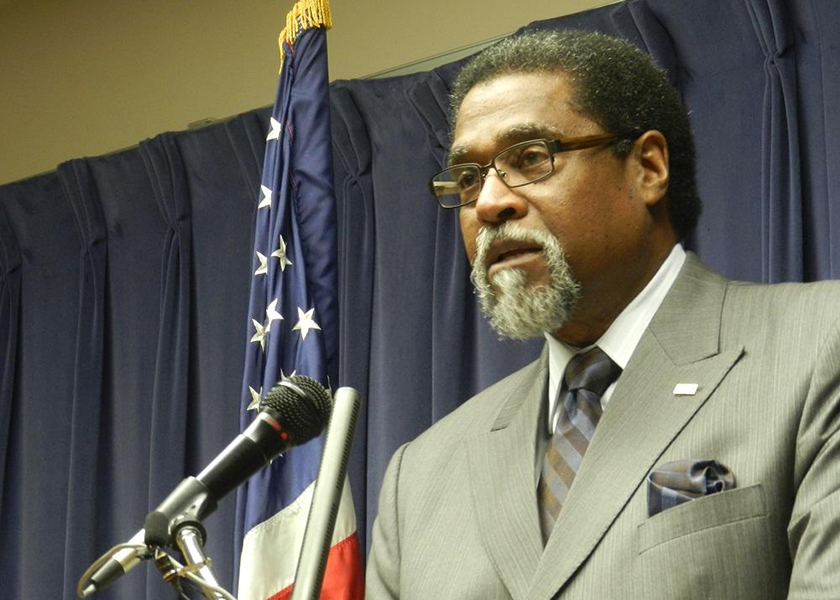
[PHOTO] Former Flint, Mich., Emergency Manager Darnell Earley recently spoke to the Black Press about the Flint water crisis. (Steve Carmody/Michigan Public Radio)
By Keith A. Owens, Michigan Chronicle Senior Editor
Retiring DPS Emergency Manager Darnell Earley has been caught in the crosshairs of withering criticism for more than six months now, targeted by the media as well as a number of community activists and some politicians as well, for the damning role they all claim he played in the Flint water crisis when he served as emergency manager there. The Flint water crisis has developed into a nationwide story and even a potent campaign issue in the Democratic presidential primary. And as if that wasn’t enough, Earley has also simultaneously fended off equally harsh criticism that he, as Emergency Manager #4, is also guilty for being in charge of a Detroit school system that critics claim is anti-democratic during a time when the most glaring shortcomings of that deteriorating system – buckling floors, dead rodents in classrooms, and classrooms that are either freezing or overheated – have been put on wide display.
Throughout this ordeal, Earley has steadfastly proclaimed his innocence, insisting that the choice to switch over to Flint water was the decision of the former Emergency Manager Ed Kurtz and the Flint City Council and that he only followed their lead when he signed off on the decision. But until now, the man who has been at the center of two of the worst disasters in Michigan’s recent history has not agreed to go on the record and give his full account of what happened. What follows is the unedited transcript of a series of written questions posed to Earley, each of which he answered in written detail after those questions were first reviewed and approved by his attorney.
Q: What would you consider your primary accomplishments during your tenure as Flint emergency manager? What remains to be done?
Darnell Earley: My primary accomplishment during my tenure as Flint Emergency Manager was eliminating the city’s structural budget deficit through cost cutting and containment measures. This allowed the city to return to local control under the auspices of a Receivership Transition Advisory Board. In addition, I facilitated the implementation of the city’s new Master Plan, which had previously been developed by a cross section of civic, business, and community leaders. Together, these initiatives brought about increased revenue and a more efficient and effective use of financial and human resources to deliver services. Emergency Managers are brought into a city or school district when financial conditions are such that the unit is virtually insolvent. Once in place, Emergency Managers aim to restore fiscal stability and keep the unit from falling into bankruptcy. We were able to accomplish just that in Flint. Meanwhile, the strategic plan, drafted and adopted by the mayor and the city council, still remains to be implemented. It offers a blueprint for sustaining the city’s financial integrity by addressing legacy costs, organizational dysfunction, better financial management, and reconsideration of its long-term governance structure.
Q: You have said that it was the Flint City Council that approved the switch to Flint water, and that you were simply following the wishes of that elected council when you signed off on the agreement initiated by your predecessor Ed Kurtz. Since then there have been a number of reports that seem to show the Flint City Council did not approve the switch to Flint water, but instead only voted to end the relationship with DWSD (Detroit Water and Sewer). Do you still stand by your version of events? And if so, do you wish to make any clarification that might shed light on what the media has missed or misinterpreted in regards to your version of what actually happened?
DE: While much has been made about the actual vote that the city council took, the plan presented to and discussed with me upon entering office in October 2013 by former Emergency Manager Michael Brown, Public Works Director Howard Croft, and Mayor Dayne Walling, was that the city would leave the Detroit Water and Sewerage Department (“DWSD”) once its 50-year contract with DWSD expired. The city would then join the Karegnondi Water Authority (“KWA”), and would use the Flint River, in the interim, for the two years during which the new system was being constructed. Edward Kurtz signed two orders effectuating these actions. Specifically, on June 21, 2013, he signed an Order “[a]uthorizing Approval to Enter into a Professional Engineering Services Contract for the Implementation of Placing the Flint Water Plant into Operation…using the Flint River as a primary drinking water source at a cost of $171,000…” It was also discussed with me at that time that, because the Flint River had served as a capable back-up water system during the life of the DWSD contract, was used as the primary water source for the city prior to the implementation of the DWSD contract, and because Flint did not have the financial capability to sustain the costs for remaining with DWSD during the interim period of construction, the river was the only legitimate and viable interim option for the city. I am convinced that the council voted to go with KWA knowing that the Flint River would serve as the water source irrespective of an actual council vote on that specific part of the plan. I also dispute the accounts that I made any kind of dictatorial edict to force the city into using the Flint River despite pleas to the contrary. The record demonstrates local consensus to use the river, and such use was discussed by the Council and the Mayor. In fact, the lone no-vote from the city council objected to the KWA plan, arguing for using the Flint River as the permanent alternative source to DWSD rather than an interim source. Further, one of the first issues presented to me by the water department staff for action when I arrived was to sell a portion of the water main that carried water from DWSD to the city of Flint to the Genesee County Drain Commissioner, since they were going to be using the Flint River and no longer needed that section of pipeline.
The City Council vote was symbolic, and inherent in that vote was the use of the Flint River – this wasn’t a secret, and is germane to ending the relationship with DWSD given the circumstances. They could not vote to go to KWA without the understanding that they would use the river in the interim – otherwise, they would have no water at all for two years, as there were no other realistic options. EPA and MDEQ additionally approved this river use in the interim. The Council vote was really about upgrading the local treatment plant and acquiring EPA and MDEQ approval. This was openly discussed on a regular basis, without opposition at any time and at any level. It is disingenuous for my would-be critics, such as Mayor Walling, to suggest or believe otherwise. When it’s all said and done, what we really need to do is figure out a way solve the present issues involving not only the water treatment situation but just as important, the aged and ill-repaired condition of the city-wide distribution system of pipes and control mechanisms, in order to prevent similar situations in the future.
Q: As emergency manager, is there anything you believe you could have done to prevent what is now being referred to as the Flint water crisis? Is there anything you did that has not been reported or that has been misrepresented?
DE: As Emergency Manager you are given an 18-month timeline to manage a daunting list of organizational and financial challenges. When a distressed community is declared to be in financial emergency as described in Public Act 436 of 2012, there are usually a number of long-term, systemic issues that need to be addressed immediately and alongside day-to-day management of operations of the city or school district. I relied on the professionals and experts to manage their day-to-day responsibilities while I addressed the long-term issues for turning around the city’s financial condition and returning it to local control. To be sure, I sign Order 15 on June 20, 2014, increasing daily responsibilities to include the operations of the Department of Planning and Development and the Department of Public Works, including the Flint Water Treatment Plant. Reflective of this Order and Mayor Walling’s increased responsibilities, his annual compensation rate was substantially increased, as well.
In hindsight, there is probably more that everyone could have done, from the federal level on down to the street maintenance employees who repaired the unusually high number of water main breaks in a distribution system nearing 100 years old. However, without the benefit of hindsight, one is left to follow the guidelines of the regulatory agencies, MDEQ and EPA that monitor and implement the laws governing water systems. I am confident that we did that. Only after the fact have we all now learned that the regulations, and the guideline protocols that the city were told to administer were inaccurate – by the admissions of both EPA and MDEQ. Their standards for whatever reason were false, misguided, and misleading.
What isn’t being reported is that when every option the staff attempted failed to eliminate the contaminants behind the boil water advisories (contamination from TTHM, total coliform, etc.), I sought the assistance of a professional water engineering firm, Veolia North America, to come in and help diagnose the problems. I was not getting the answers needed to correct the problem. While my tenure ended before the report was released, Veolia commended the significant efforts I and my team had taken to address the issues. However, the report did not speak to the issue of lead contamination, which we now know to be the main issue in the water crisis.
Saying that I, as Emergency Manager, unilaterally made the switch is untrue, and saying that I turned down the DWSD offer to return to their water source in order to save, “a few dollars” is not only untrue but a disingenuous fabrication that ignores the complexity of those decisions which were made in consultation with many others.
First, the city of Flint had already invested millions in the KWA. Second, Flint simply had no money to pay for the costs of continuing to receive water from DWSD once they notified the city that the contract was going to terminate. Third, what Flint really needed as an alternative to consider was a short-term contract, but DWSD would not offer anything less than a new long-term agreement with DWSD over 30 years. The option of a short term contract was not on the table, nor did the state provide additional funding to support such an arrangement, until well into 2015. Those resources were not available to Flint during my tenure. And note, as a backdrop, the Flint residents were paying such exorbitant rates as it was, that they filed suit to challenge those rates. It is inappropriate for one to compound our rationale into a media soundbite concerning our decision to implement a water transfer plan that was already in place. These were not easy decisions, nor was the Flint water crisis foreseeable at any level in April 2014. Anyone who thinks otherwise is engaging in revisionist history by creating a nonfactual narrative.
I am at once sad, angry, and extremely disappointed about what is happening and being reported on what is happening in Flint. I have a special affinity for Flint. I know the community, the people, I have relatives living in the city, and was a part of the community from 2001 until 2004 working as the city administrator, and briefly as the acting mayor to help resolve the first financial emergency. I have worshiped with the people in the community. I relied upon people at all levels of government specifically the MDEQ, the EPA, and the Flint water Treatment staff to advise me and to examine the issues that we faced switching from DWSD to the Flint River. As a part of that group, despite lacking the necessary water treatment expertise, I now wish that I had been more probative in my approach in delving deeper into the explanations I was receiving about what was being done, what needed to be done and when it would be done. As a leader and as a public administrator with nearly forty years of experience managing in public sector organizations in Michigan, and as a public servant, it is my sincere belief that the people of Flint deserve not only an apology, but consistently better and deeper engagement from their government at all levels, and in all governing situations.
Q: In recent weeks a large number of emails have been released that seem to show there was much more concern among some in Gov. Snyder’s administration about the decision to switch to Flint water than had previously been indicated. Gov. Snyder has said that he was not adequately served by some in his administration and was not made aware of these concerns and problems about the potential dangers of Flint water until too late. Were you at any time aware of any of these concerns prior to them recently being made public?
DE: No. My knowledge of the issues contained in the releases from the Governor’s office came at the same time as the general public’s. While we were trying to manage the switch from DWSD to the interim use of the Flint River, both the Governor’s office and the Treasurer’s office were kept apprised of our efforts through regular telephone conferences. At no time were there concerns expressed to me that the project was unmanageable or that the unintended consequences that are now obvious were ever a possibility. And, at no time did any water treatment staff member, Michael Glasgow included, directly alert me to any doubts he or the staff might have had concerning the plant’s readiness or our schedule. Lead contamination was never an issue during my tenure as Emergency Manager.
Q: When you first accepted the appointment to become emergency manager for Flint, what did you believe would be the challenges that would come with the job? What – if anything – were you told would be the most significant challenges for getting Flint back on track? Was there any one aspect that you were told – or that you yourself identified – as being the one key issue that needed to be addressed? If so, what was that issue, and how did you handle it?
DE: The role of Emergency Manager in any city or school district is a very contentious issue. Local units of government as well as school districts are entities of the state, created by the laws of the state. They are not sovereign in and of themselves. This means that the state is obligated to address the emergency financial nature of their operations, in order to make them solvent and to retain that solvency, as it is in the state’s best interest to do so. That is the premise of Public Act 436 of 2012. Make no mistake, this is extremely difficult work—but it must be done. Being an agent of change and a leader is always a very volatile and confrontational issue – Flint was no different. In addition to financial insolvency, Flint, as a distressed community, had a number of high-stress factors that threatened its quality of life. These ranged from public safety, community and economic development, to huge levels of unemployment. The largest challenge, the very reason why Emergency Managers were brought in, was stabilizing the financial condition of the city given its loss of revenue, tax base, population, etc. The goal in Flint was to make the necessary decisions to restore financial health, set the city on a course for sustainability, and restructure the city’s organization so that the resources that it had could be used most efficiently and effectively.
I have always adopted the philosophy that anyone who wants to be a part of the solution is welcome to be a part of my team. Together with staff, we developed a (seven-point) management plan, and involved the Mayor and City Council to the extent they wished to be included. To be sure, under my tenure, the structural budget deficit was eliminated, organizational changes were made, and the city was positioned for return to local control. I am proud of those accomplishments. In the end, that is what I, as an Emergency Manager, worked to accomplish. Making the tough decisions is a requisite ingredient to improve the quality of life in the long-term. When obstacles come up, such as those we have observed with the water contamination issue, I worked diligently to solve that problem, to take the necessary corrective actions, and to move the city towards sustainability. For example, I held weekly meetings with the director, and as needed, other members of Flint’s public works staff, organized and held conference calls with MDEQ experts when boil water advisories were issued, sought and obtained independent analysis from Veolia North America, issued boil water advisories, repaired water main breaks and valves, and flushed the system. Unfortunately, these steps were not enough to overcome the false information fed to us from MDEQ and EPA.
Q: Although it was actually Flint Emergency Manager Ed Kurtz who made the actual decision to switch to Flint water, you seem to be the one who has taken the most heat even though at worst you signed off on what Kurtz approved. Why do you feel Kurtz has not undergone the same level of scrutiny? Are you being hung out to dry?
DE: I think it is important to note that the plan to leave DWSD and go with KWA was a plan long in the making. When I was City Administrator in Flint from 2001 until 2004, the County Drain Commissioner, the city, and outlying communities were already discussing its feasibility. While serving as City Manager of Saginaw, I read of the successful vote of the City Council to join KWA and leave DWSD. I also read of the complexities of the decision-making that would be necessary to implement that plan. Although the contract with DWSD expired on my watch, the plan to switch to KWA and to use the Flint River in the interim was already being implemented when I arrived in October 2013. Prior to my arrival there had been two other Emergency Managers appointed, beginning with Michael Brown (November 28, 2011 – August 8, 2012), and Edward J. Kurtz (August 8, 2012 – July 4, 2013). Michael Brown was reappointed July 4, 2013, until I arrived on October 8, 2013. Gerald W. Ambrose succeeded me from January 13, 2015, until April 29, 2015. If the goal of the investigations surrounding this crisis is to uncover the truth based soley upon the facts about what happened during the course of this project up to the eventual return to DWSD as a water supply source, one would think that the other emergency managers would be subjected to the same level of scrutiny, interrogation, misguided accusations, and false allegations that I have had dumped upon me since this crisis began and throughout its course.
It is no secret that I, as the only African American Emergency Manager to serve Flint, have taken more than of my fair share of criticism than the others. I feel I have been unjustly persecuted, vilified, and smeared both professionally and personally–all because I accepted the very difficult challenge to bring positive change to the City of Flint and the Detroit Public Schools. The decision to make the switch, as I have repeatedly maintained, was made long before I arrived and at different points involved the other three appointees and culminated into a done deal that fell to me to make sure it was implemented. (This would include Emergency Manager Gerald Ambrose, who served as financial director and advisor to all three emergency managers since 2011 before being appointed emergency manager himself.).
There was no information relayed to me at any point that would suggest that the implementation of this plan would cause the amount of suffering that we have witnessed unfold in Flint. Mayor Walling often is quoted that myself and others knew the water was no good. I specifically deny that irresponsible allegation, given that neither the MDEQ nor the EPA ever declared it as such. I’m not sure how I would know that since I don’t claim to know more about these matters than the experts in place to advise every municipality and its water departments in the state of Michigan and in the United States of America on that kind of analysis and conclusion. Moreover, the record is replete with documents showing Walling was an advocate for the switch, but that he continued to advocate and assure residents of water safety despite their complaints. While I heard the complaints, I demanded answers from the Flint water treatment staff, MDEQ, and EPA, and was simply given information that I, Mayor Walling, and others, came to rely upon.








Black Press
WCCUSD Joins Statewide Organic School Food Purchasing Cooperative
Other districts involved include: Alameda USD, Albany USD, Berkeley USD, Capistrano USD, Cupertino Union SD, Hayward USD, Laguna Beach USD, Lagunitas Elementary SD, Mt. Diablo USD, North Monterey County USD, Pajaro Valley USD, San Leandro USD, San Ramon Valley USD, Santa Clara USD, Sausalito Marin City SD, Tahoe-Truckee USD and West Contra Costa USD.

Seventeen California public school districts, including West Contra Costa Unified (WCCUSD), have joined a purchasing cooperative to pool their buying power and expand access to organic food in school meals.
The nonprofit Conscious Kitchen recently announced the launch of the Conscious Organic School Food Purchasing Cooperative. Its founding districts serve more than 300,000 students combined.
The cooperative partnered with food distributors UNFI and Sysco to expand the organic products available to participating districts. Combining schools’ purchasing demand helps distributors plan with suppliers while creating more dependable markets for organic farmers and food makers, according to Conscious Kitchen.
Other eligible California school districts can access the cooperative’s products and pricing through its existing contracts without conducting their own bids. Mt. Diablo Unified School District serves as the lead district for the cooperative’s grocery bid.
Other districts involved include: Alameda USD, Albany USD, Berkeley USD, Capistrano USD, Cupertino Union SD, Hayward USD, Laguna Beach USD, Lagunitas Elementary SD, Mt. Diablo USD, North Monterey County USD, Pajaro Valley USD, San Leandro USD, San Ramon Valley USD, Santa Clara USD, Sausalito Marin City SD, Tahoe-Truckee USD and West Contra Costa USD.
Barbara Jellison, WCCUSD’s executive director of food services, said the cooperative builds on years of work bringing fresh, organic food into school kitchens.
“The next challenge has always been how to make that possible for more districts,” Jellison said. “The Co-op gives schools a way to take what we have learned and move it to a completely different scale.”
Black Press
Democrats, Community Groups Back Measure EE to Change How Oakland Is Governed
Along with clearer executive responsibility, the Charter reform would also create new checks and balances, including an independent Budget and Legislative Analyst office, City Council confirmation of key appointments, expanded council hearing and subpoena authority, and give the council the ability to override a mayoral veto with six votes.

The Alameda County Democratic Party has voted to endorse Measure EE, the Oakland Charter reform measure on the November 2026 ballot. The party’s endorsement is announced alongside a broad coalition of organizations spanning labor, business, faith, and community advocacy, including Oakland Rising Action that are also supporting the measure.
Those supporters include:
- League of Women Voters of Oakland
- AFSCME Council 57
- SPUR
- Bay Area Council
- Black Women Organized for Political Action
- Faith in Action East Bay
- Oakland Chamber of Commerce
- Oakland Rising Action
- Revitalize East Bay
- Empower Oakland
Measure EE would reform Oakland’s hybrid governance system by establishing a strong-mayor structure, making the mayor the city’s chief executive, responsible for delivering effective, efficient services.
The measure would also reform and expand responsibilities of City Councilmembers.
Measure EE would create clearer lines of responsibility for the performance of city government, allowing voters to evaluate the mayor based on how effectively the city delivers services and produces results.
Along with clearer executive responsibility, the Charter reform would also create new checks and balances, including an independent Budget and Legislative Analyst office, City Council confirmation of key appointments, expanded council hearing and subpoena authority, and give the council the ability to override a mayoral veto with six votes.
“Oakland voters deserve a City Hall where they know exactly who’s responsible when something goes wrong and exactly who to credit when it gets fixed. Measure EE puts that responsibility squarely with the mayor, backed by real checks and balances, so Oakland can finally move as fast as its problems demand. That’s why the Alameda County Democratic Party is proud to stand behind it,” said Igor Tregub, chair of the Alameda County Democratic Party.
Oakland Rising Action, a collaboration of racial, economic, and environmental justice organizations, has also issued a press statement explaining its support for Measure EE.
Measure EE “represents a critical opportunity for residents to clarify the governance role of the Oakland Mayor and City Council, so we, as residents, know who to hold accountable for the execution of voter-approved and budgeted services within city departments,” the statement said.
Measure EE would reform Oakland’s Charter, which is the city’s Constitution, strengthening “the role of the mayor as the CEO of Oakland, with the city administrator being hired and managed by the mayor explicitly.”
The measure would also strengthen oversight of city departments by mandating reporting directly to the City Council and provide the mayor with veto power in approving policies and the budget.
Measure EE was placed on the ballot by the Oakland City Council in June 2026. For more than half a year, the mayor’s working group on Charter reform engaged residents and elected officials on the options for governance of Oakland, which led to Measure EE.
“Oaklanders need clarity about who is responsible for the management of our city departments, our tax dollars, and our voter-approved ballot measures,” said Pecolia Manigo, executive director of Oakland Rising.
“The average resident believes that we already have a strong mayor system,” she continued. “However, this is simply not the truth in our City Charter. It is time for us to stop talking about the Charter changes Oakland needs. This is the first of many Charter reforms that are needed to improve conditions in Oakland, especially the flatlands. It’s time all voters start paying attention to who is making decisions for Oakland. This election allows us to say how we believe Oakland should be governed.”
Black Press
Four Tips to Help You Plan a Holiday “Staycation”
“A great staycation starts when you treat your hometown like a destination – book one ‘anchor’ experience, stay somewhere that changes your scenery, and leave room for a little spontaneity,” said Steve Orens, President of FROSCH by Chase Travel, a leading travel agency. “My favorite staycation tip is to make it easy on yourself: choose a walkable area, plan one highlight each day, and let the hotel do the heavy lifting – warm beds, quick breaks, and fewer logistics.”

Holiday travel can be exciting, but between costs, crowded airports and packed schedules, sometimes the idea of staying home can be much more appealing.
If you still want to get away without the hassle of an actual getaway, consider a holiday staycation.
By remaining close to home, you can experience your city from a fresh perspective without the stress of a long trip. Whether you book a night at a local hotel, check out a new neighborhood or just finally get around to seeing that landmark attraction that’s been on your to-do list, you can make staying at home feel like a real getaway.
Here are four tips you can use to create an amazing holiday at home this season:
1. Treat your hometown like a destination
One common theme surrounding area attractions is that they’re more likely to be packed with tourists than locals. If that popular museum, tour or other institution is always “there,” it can be easy to avoid it and say you’ll get there eventually.
A staycation provides a great opportunity to approach those kinds of places like a tourist. Start by making a short list of places or experiences you’ve always wanted to try but never seem to prioritize. You might include a museum, holiday market, historic site, restaurant or neighborhood, or you might attend a holiday-related performance that’s an annual late fall or winter tradition in your area.
“A great staycation starts when you treat your hometown like a destination – book one ‘anchor’ experience, stay somewhere that changes your scenery, and leave room for a little spontaneity,” said Steve Orens, President of FROSCH by Chase Travel, a leading travel agency. “My favorite staycation tip is to make it easy on yourself: choose a walkable area, plan one highlight each day, and let the hotel do the heavy lifting – warm beds, quick breaks, and fewer logistics.”
2. Spend the night away
A hotel stay can provide a change of scenery that makes you feel like you’re enjoying a getaway.
Consider a traditional hotel, bed and breakfast or rental property where you can walk to restaurants, shopping, entertainment or holiday activities. An upscale hotel can also be the centerpiece of your staycation, allowing you to enjoy fine dining, a fitness center, spa services or other on-site experiences.
If you want a quieter, more relaxed experience, find a hotel “off the beaten path,” but still close to home, to enjoy the rhythms and sounds of nature.
3. Be flexible
If your schedule allows, plan your staycation for a weekday or less crowded period — like the days between Christmas and New Year’s Eve — rather than a peak weekend. Hotel rates in the middle of the week tend to be cheaper, and it might be easier to grab a restaurant reservation or performance tickets. Locations might be less crowded as well during the week, making it easier to get around.
Book some experiences in advance to save money but stay open to spontaneous opportunities once you arrive. You might find some great last-minute deals.
4. Try something new
Even if you think you’ve seen everything your hometown has to offer, there’s always something new to explore or discover.
Check out a neighborhood you usually drive through and visit the local shops and other businesses. You can also try a new cuisine at a neighborhood restaurant or kitchen.
Sometimes what’s old can be new again during the holiday season, so if you want to go back to your favorite restaurants and other popular spots, do so with fresh eyes. Order from the eatery’s holiday menu or take a walk when lights, decorations and seasonal programming transform many communities.
Other helpful tips
Although staying at home can eliminate major travel costs, expenses can still add up quickly. Make a staycation budget and then consider ways to help keep costs down.
“A ‘smart’ staycation is one you can pay for comfortably: choose dates with better rates, book flexible options, and keep a small buffer for surprises,” added Orens. “The goal of a staycation is a real reset. Even if you’re close to home, give yourself permission to unplug and find moments to treat yourself – say yes to room service, a spa hour, or a new restaurant you’ve been saving for ‘someday.’”
If you have rewards points from credit cards or loyalty programs, put them toward your hotel to get a free or cheaper night’s stay. Local museums, cultural institutions and attractions often have resident discounts, reduced-price admission days or seasonal offers. Community calendars can provide information about free or low-cost events like holiday concerts, light displays, markets, park activities and other events. If a performance doesn’t normally sell out, wait until the day before or day of to buy tickets, as prices are often reduced and you can find great seats.
With a little creativity, you might find everything you’d want in a holiday vacation. You can enjoy good food, new experiences and an escape from your daily routine – all right at home.
For more financial health tips, visit https://www.chase.com/travel/guide.
For informational/educational purposes only: Views and strategies described in this article or provided via links may not be appropriate for everyone and are not intended as specific advice/recommendation for any business. Information has been obtained from sources believed to be reliable, but JPMorgan Chase & Co. or its affiliates and/or subsidiaries do not warrant its completeness or accuracy. The material is not intended to provide legal, tax, or financial advice or to indicate the availability or suitability of any JPMorgan Chase Bank, N.A. product or service. You should carefully consider your needs and objectives before making any decisions and consult the appropriate professional(s). Outlooks and past performance are not guarantees of future results. JPMorgan Chase & Co. and its affiliates are not responsible for, and do not provide or endorse third party products, services, or other content.
Deposit products provided by JPMorgan Chase Bank, N.A. Member FDIC. Equal Opportunity Lender.
© 2026 JPMorgan Chase & Co.
Black Press
Veterans Housing Project Proposed for South Richmond
According to the development team’s presentation, the project has an estimated total cost of nearly $158 million. The presentation outlines five phases encompassing entitlement and construction documents, community outreach, soil remediation and utility work, podium and building construction, solar technology integration, and interior buildouts.

A proposed mixed-use development at 338 Carlson Blvd. could bring hundreds of homes and support services for military veterans to South Richmond.
Led by the Richmond-based Veterans Resource Program in partnership with Eagle Environmental Construction & Development, the proposal covers an approximately 2.3-acre property the nonprofit acquired in 2018.
The proposal features a multi-building residential development with various apartment sizes, though city documents and developer materials cite conflicting totals ranging from 226 to 268 units.
The proposal also includes approximately 40,000 square feet of commercial and retail space, about 200 parking spaces, and an entrepreneurial training and job-development component intended to connect veterans with economic and workforce opportunities.
According to the development team’s presentation, the project has an estimated total cost of nearly $158 million. The presentation outlines five phases encompassing entitlement and construction documents, community outreach, soil remediation and utility work, podium and building construction, solar technology integration, and interior buildouts.
Founded in 2011, the Veterans Resource Program provides housing assistance and other services to veterans, including those experiencing homelessness or transitioning from incarceration.
The proposal aims to advance Richmond’s affordable housing goals while connecting veterans with housing and supportive services. Details of affordability and veteran eligibility remain to be clarified.
The Richmond City Council was scheduled to receive an informational presentation on the project at its Oct. 6 meeting, following a continuance from Sept. 22. The item does not seek project approval or city funding. Any future request for city financial assistance or other public resources would require separate consideration and approval.
Black Press
Mayor Lee Delivers 2026 State of the City Address: ‘Oakland Continues to Be on the Move’
To create a police force that better serves and protects Oakland, the city is working toward the goal of reaching 700 sworn police officers, she said. These steps include recruiting from Oakland, holding academies, reinstituting a cadet program, and increasing foot patrols.
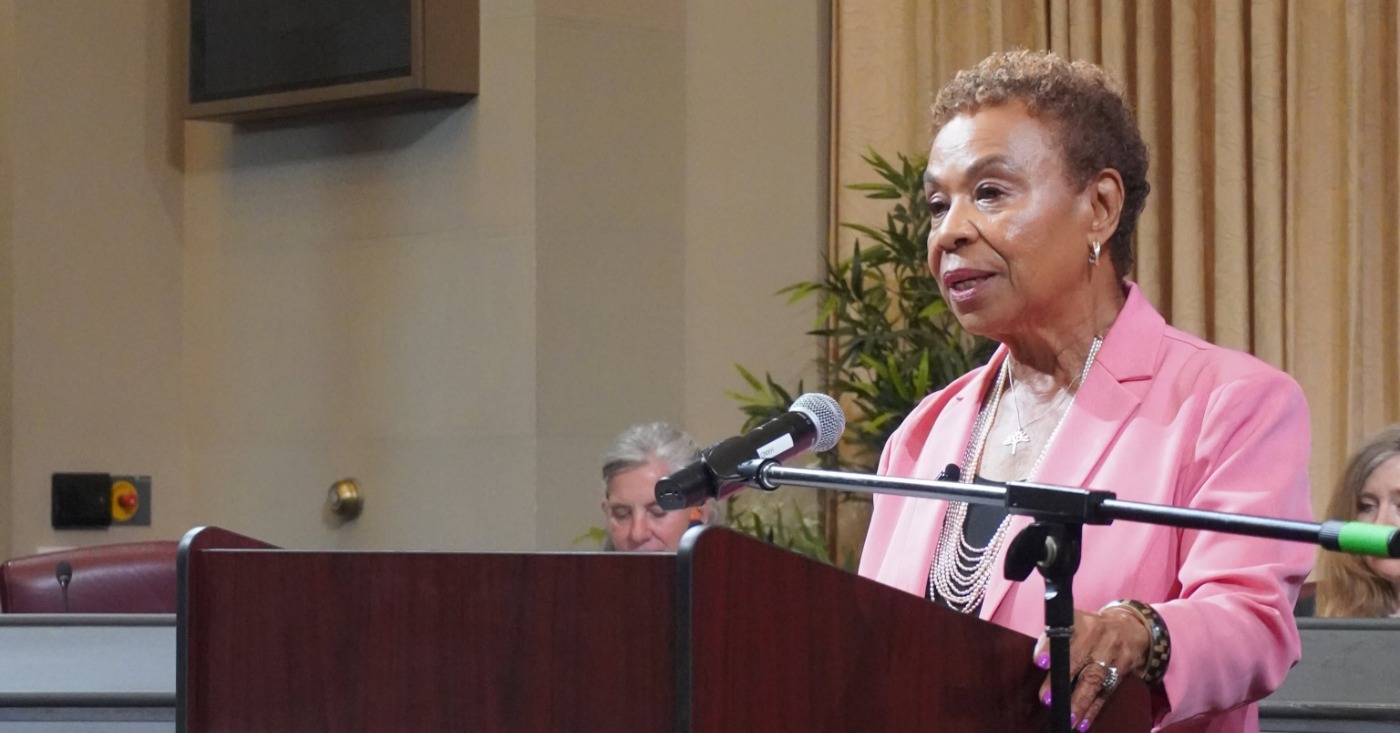
Mayor Barbara Lee, speaking this week to Oakland residents and elected leaders in City Council chambers, delivered the annual mayoral State of the City Address, highlighting the city’s accomplishments as well as the challenges Oakland is facing going forward.
Lee began her remarks praising city workers, who picketed outside City Hall before the meeting, and are currently negotiating with the city for a wage increase and ending understaffing that leaves many departments shorthanded.
“We are working very hard (not) just to get a contract, but to get a fair contract,” she said. “I know that our City Council and myself are working constantly toward that end.”
The mayor also praised Councilmember Carroll Fife for her legislation for a 45-day moratorium on data center construction, which passed unanimously at the council meeting Tuesday following Lee’s presentation.
Speaking bluntly, she said, “Oakland continues to be a city on the move, (but) I want to tell you the truth about the state of our city.”
“We have made real progress, and we still face real challenges.”
She said the city has balanced its budget but has a structural deficit, which is decreasing, and must operate within the context of federal funding cuts.
“Too many Oaklanders are unhoused, too many families are struggling with the cost of living, and too many neighborhoods still need basic services that they deserve, and too many people are living in fear,” Mayor Lee said.
“We’re not sweeping these realities under the rug,” she continued. “We are being intentional and transparent about how we must face these challenges, but we will not ignore our progress.”
Substantial progress includes:
• Bringing crime down;
• Building affordable and deeply affordable housing;
• Cleaning the streets and fixing the roads;
• Helping small businesses.
“We are bringing new investment to Oakland,” she said. “We’re making City Hall work better. There’s more to do, but make no mistake, Oakland is on the move.”
Speaking broadly about the city’s public safety initiatives, she said that crime continues to decline. Burglaries fell by 26%, and violent crime fell by 17%.
In recent years, homicides and shootings have fallen by double digits, and gun violence has dropped by more than 50% in the last 33 months.
“These aren’t just statistics: these are lives. These are families. These are people who never made it home,” Mayor Lee said.
She talked about what to expect now that federal court oversight of the Oakland Police Department ended last week after 23 years. “Ending federal oversight does not mean ending accountability; quite the opposite,” she said. “Accountability and civilian oversight must remain our standard. Community trust must be our standard.”
Mayor Lee also emphasized that Oakland remains a city of refuge.
“We do not work with ICE; we do not cooperate with ICE; our police do not cooperate with ICE; we will not be militarized,” she said.
The mayor also emphasized that investing in youth is a top priority of her administration and should be considered a public safety strategy.
“We advocated for almost $2 million to restore the mayor’s youth summer employment program,” she said. “We connected youth with Oakland businesses to develop skills that will support them for years to come, and that’s a big deal.”
To create a police force that better serves and protects Oakland, the city is working toward the goal of reaching 700 sworn police officers, she said. These steps include recruiting from Oakland, holding academies, reinstituting a cadet program, and increasing foot patrols.
The city also is strengthening other programs, including the Department of Violence Prevention and Ceasefire, she said. “We must have this comprehensive public safety strategy, because we must also prevent violence before it happens.”
Continuing, Lee said public safety is connected to unsanitary conditions in city neighborhoods.
“Illegal dumping is unacceptable, and it’s a moral disgrace,” she said. “No child should have to walk past piles of garbage on their way to school; no senior should have to live next to it; no small business should have to clean it up outside its door.”
She said the city is changing the way it fights illegal dumping, securing a $9.2 million investment to develop a new strategy. “We’re not just cleaning it up; we’re working to stop it before it starts. We have the three E’s – Eradication, enforcement, and education,” she said.
Focusing on the continuing crisis of Oakland’s unhoused residents, she said, “We consider housing a basic human right, and homelessness remains one of Okland’s greatest challenges.”
“There are two things we must do: keep people from becoming unsheltered and help people who are unsheltered get back into housing with services that they need,” Lee said.
Since 2024, homelessness in Oakland has fallen by 20%, she said. In the past year prevention programs helped keep 1,000 families in their homes, and over 1,300 affordable homes opened over the past two years.
Addressing community tensions over encampments, she said, “We should never have to choose between compassion for people experiencing homelessness and the health and safety of our neighborhoods.”
“A strong city has to deliver both,” she said. “That’s the work we’re advancing through Oakland’s new homelessness strategic action plan.”
Black Press
Oakland Awarded More than $14 Million in State Funding
Direct state investments in city programs can revitalize Oakland’s commercial corridors and foster economic growth, strengthen community violence prevention strategies, and expand transitional housing, while supporting cherished community spaces, according to a city media statement.

Money will support small businesses, public safety, transitional housing, and community partners
Mayor Barbara Lee recently announced that the City of Oakland and local community partners will receive more than $14 million in direct investments from California’s new 2026-27 state budget.
Securing $4.25 million for city programs and $10 million for local community organizations, these state funds were backed by state Senator Jesse Arreguin and Assemblymembers Mia Bonta and Buffy Wicks, with support from Governor Gavin Newsom.
The goal of securing state and federal funding and bringing in outside resources to address the city’s most pressing needs continues to be a top priority for Lee.
Direct state investments in city programs can revitalize Oakland’s commercial corridors and foster economic growth, strengthen community violence prevention strategies, and expand transitional housing, while supporting cherished community spaces, according to a city media statement.
“Thank you so much to Senator Jesse Arreguin, Assemblymember Mia Bonta, Assemblymember Buffy Wicks, and Gov. Gavin Newsom for investing in Oakland,” Lee said.
“We are fortunate to have strong, dedicated leaders representing Oakland in Sacramento who consistently deliver for our residents and businesses,” she said. “This critical funding directly addresses some of our most pressing challenges, including supporting our small businesses, building vibrant neighborhood corridors, advancing violence intervention, and housing our unsheltered neighbors.”
How the $4.25 million will be spent for city projects:
- $2.5 million will be used for the Facade and Tenant Improvement Grant Program to support small businesses;
- $1 million for the Department of Violence Prevention to enhance staffing and program capacity; and
- $750,000 for the Holland transitional housing facility, providing resources to help unhoused residents.
• How the $10 million for Oakland community groups will be spent:
- $5 million for Children’s Fairyland for essential infrastructure, accessibility, and facility upgrades.;
- $3 million for the Juntos Fruitvale Cultural Arts Center to create a multi-use space for performances, exhibitions, workshops, neighborhood meetings in the Fruitvale neighborhood; and
- $2 million for Samuel Merritt University to grow its nationally recognized Human Trafficking Prevention and Response Initiative.
“State investments in Oakland’s nonprofit and educational organizations highlight their deep value not just to our city, but their importance to the entire state,” said Lee. “Oakland has long served as a hub for inclusive arts and culture and as a community that protects its most vulnerable members.”
Said Arreguin, “This investment is a commitment to Oakland’s health, safety, and future. In partnership with my state colleagues, Mayor Lee, and our community partners, we are strengthening our response to human trafficking and gun violence, to create safer neighborhoods, and improve the quality of life of all Oakland residents.”
“Investing in Oakland means investing in California’s future. I’m proud to be a voice for the beautiful people of Oakland in the State Capitol and to deliver real funding wins that ensure our shared safety, expand housing opportunities, and preserve the artistic and cultural legacy of Oakland,” said Bonta.


WCCUSD Joins Statewide Organic School Food Purchasing Cooperative

Democrats, Community Groups Back Measure EE to Change How Oakland Is Governed

Four Tips to Help You Plan a Holiday “Staycation”

Veterans Housing Project Proposed for South Richmond

Mayor Lee Delivers 2026 State of the City Address: ‘Oakland Continues to Be on the Move’

Oakland Awarded More than $14 Million in State Funding

Jendayi Arrest Raises Community Concerns Regarding Sheriff’s Chain of Command

Marin County Supes Expand Small Business Options with Home Kitchen Pilot Program

Allen Temple Baptist Church Hosts Free Prostate Cancer Screenings on Oct. 17

AC Transit Labor Unions Back Director Joel Young

The Youngest American Killed in the Vietnam War

Latest Massacre in Haiti Reveals Cruelty U.S. Deportations

OPINION: Nolan Wells’ Death One of Several Signifying Racial Terror Lives on in U.S. South

Passing for White, Fighting for Black America: The Courage of Walter White

OP-ED: If AI Is the New Language of Power, Then NAN Wants Black Communities Fluent

OP-ED: Haiti TPS: Have We Lost Sense of Humanity?

OP-ED: How Does Your State Rank for Pre-K?

Henry O. Flipper: A Trailblazer at West Point and Beyond

Asm. Smallwood-Cuevas’s Bill Repealing ‘Racist’ CalWORKs ‘Man-in-the-House’ Rule Clears Legislature

NBA All-Star Damian Lillard Returns Home for 15th Annual Backpack Giveaway

Sherrell Dorsey on Tech, Black Innovation, and Impactful Businesses

Community-Centered Business: Adapting to Support a City in Need #shorts

The Conversation with Al McFarlane

Serve First: The Secret to Life and Business Success #shorts

Denise Upshaw – Founder, Black Houston Creative Network

Houston advocates breakdown Black voter fatigue

Digital Rearview Mirror Test: Blind Spots & Camera Views #shorts

HE SAID, HE SAID, HE SAID, Separating Fact, Fear, & Freedom w/ Allen Orr, FRI. 2.22.26 7PM EST

Hot Girl Walk at Sabathani Community Center | Ernestine Belton Playground | MSR

NEW INVESTIGATION INTO FEDERAL RESERVE GOVERNOR
-

 Black Press1 week ago
Zakiya Jendayi Arrested, Locked Out of Home by Sheriff’s Deputies
-

 Black Press1 week ago
A $2.1 Trillion Wellness Industry Never Built a Daily Practice for Black Children. So This Atlanta Family Did.
-

 BlackPressUSA6 days ago
Latinas Deserve Equal Pay. Unions Help Make It Happen.
-

 Art1 week ago
Montclair Brewery: Brewing Culture, Community, History
-

 Black History1 week ago
Listening as a Lifeline: A Doula’s Witness to Black Maternal Health
-

 Black Press1 week ago
COMMENTARY: But God!
