
Indianapolis Recorder
Children’s Museum demolition hits a brick wall
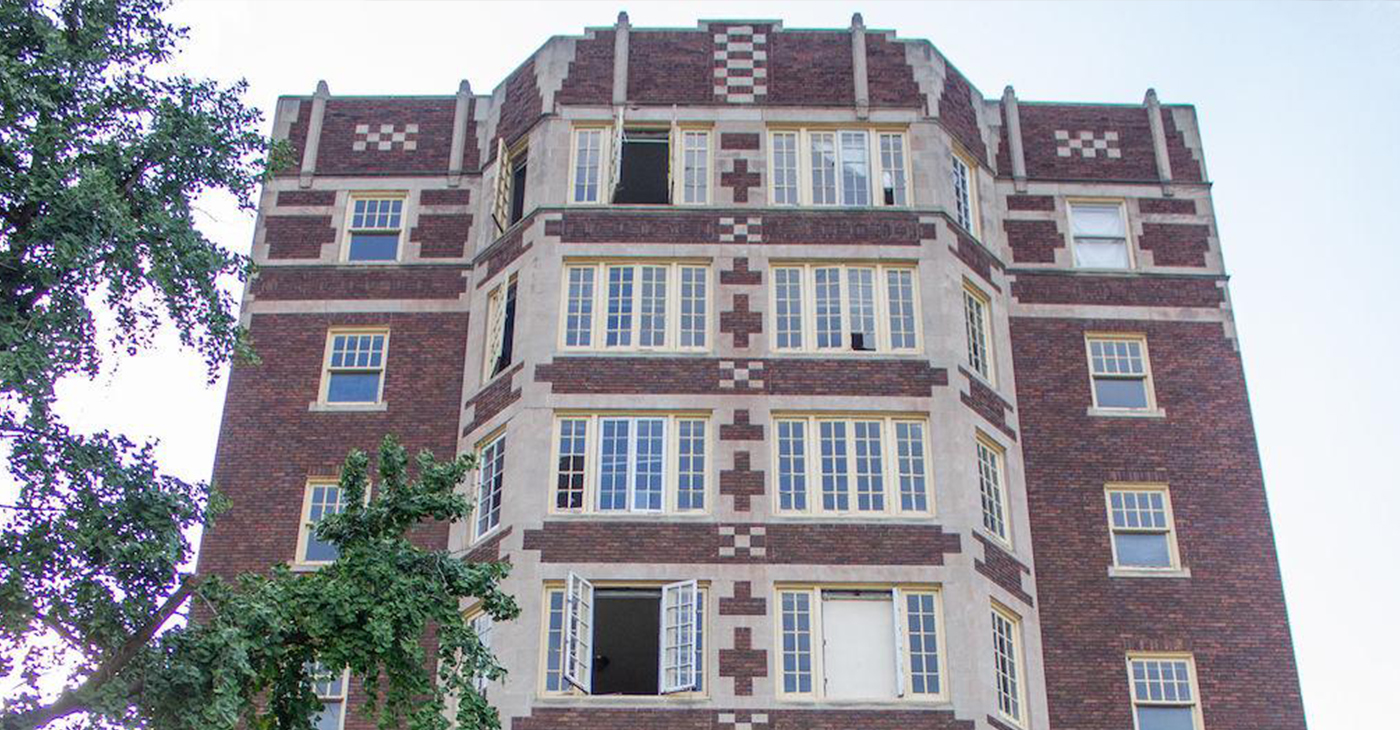
INDIANAPOLIS RECORDER — The Indianapolis Historic Preservation Commission voted in early September to declare the vacant Drake Apartments building on the near north side as historically significant, a move that, if ratified, will protect what used to be a luxury apartment complex. The Children’s Museum of Indianapolis, which owns the building, kickstarted this process when it announced plans to demolish the building and temporarily turn the property into a surface parking lot before deciding what to do in the long term.

By Tyler Fenwick
The Indianapolis Historic Preservation Commission voted in early September to declare the vacant Drake Apartments building on the near north side as historically significant, a move that, if ratified, will protect what used to be a luxury apartment complex.
The Children’s Museum of Indianapolis, which owns the building, kickstarted this process when it announced plans to demolish the building and temporarily turn the property into a surface parking lot before deciding what to do in the long term.
Eight of the nine members on the commission voted to add emergency protection to the building, which has been vacant for nearly three years. One member abstained from the vote.
Bill Browne, president of the commission, did not respond to requests for comment.
Brian Statz, vice president of operations at the museum, said the commission’s vote to protect the building was “not unexpected.” Before making plans to demolish, museum leadership worked with Indiana Landmarks, a nonprofit that helps save and revitalize historic places, to find something to do with the building.
The children’s museum didn’t want to take on the cost — estimated in the millions — to make the necessary renovations to the building. Between that building and another vacant building next to it that used to be a Salvation Army — which the museum could still demolish — the museum pays about $200,000 a year in taxes, utilities, insurance and maintenance.
The museum instead sent out a request for proposals to hotel operators. One company made a proposal, Statz said, but the company didn’t answer follow-up questions and the museum had doubts about its finances.
The request process was confidential, and Statz declined to provide details about the request or offer.
Even if it’s just temporary, the museum would have to grapple with the optics of making a surface level parking lot right next to the newly opened Red Line. Looking ahead, Statz said one possibility for permanent use of the land with the old Salvation Army on it is expanding the outdoor Sports Legends Experience.
The Metropolitan Development Commission will have to ratify the vote to give protection to the Drake Apartments building. That’s expected to happen within the next couple of months. There will also be a public hearing.
Marsh Davis, president of Indiana Landmarks, said he was “disappointed” to learn of the museum’s plans to demolish the building.
“But we also feel there are some stones left unturned in looking for a solution or alternative to demolition,” he said. “I don’t believe all options are exhausted.”
One of those options includes the city stepping in to provide economic incentives — tax abatement, for example — to a developer willing to take on the project of restoring the building.
Andrea Watts, a spokesperson for the Department of Metropolitan Development, confirmed the city could offer economic incentives to a developer and said the department has met with the museum.
The museum could also simply sell the property, and the protection would carry over to the next owner.
“The city is within its rights to do what it’s done,” Statz said. “We’re hoping to work out an arrangement that’s a win-win for the city and the community.”
Contact staff writer Tyler Fenwick at 317-762-7853. Follow him on Twitter @Ty_Fenwick.
This article originally appeared in The Indianapolis Recorder.












BlackPressUSA
Free Career Training
INDIANAPOLIS RECORDER — Those who don’t have a high school diploma may take the high school equivalency test for free. Adult basic education classes to help prepare for the test are free as well.

Marion County adults affected by COVID-19 can receive free training for high-demand industries through Washington Township Adult Education. Courses are offered online and in person, depending on the industry and include dental assisting, certified clinical medial assistant, pharmacy tech, construction, appliance repair, electrical wiring, IT security specialist, IT network tech, welding and commercial driver’s license. For a full list of classes visit IndyAdultEd.com.
Those who don’t have a high school diploma may take the high school equivalency test for free. Adult basic education classes to help prepare for the test are free as well.
Interested individuals should enroll by Nov. 15.

BlackPressUSA
Comfort Food Consumption On the Rise
INDIANAPOLIS RECORDER — In addition to the comforting flavor, this trend provides valuable nutritional benefits. As a part of many healthy eating plans, bread and pasta are nutritionist approved and provide nutrients needed for healthy aging such as B vitamins, magnesium, selenium, iron, folate and fiber.

(Family Features) As families spend more time at home, Americans are finding comfort in a surprising source: bread. In fact, a 20-year trend of declining grain food consumption has been reversed.
A national study by the Grain Food Foundation suggests that the turnaround is more than a one-time sales blip due to pantry loading. In reality, consumers count bread among their top comfort foods. The study revealed one-third of Americans named pasta and bread as foods that are comforting during a stressful time.
In addition to the comforting flavor, this trend provides valuable nutritional benefits. As a part of many healthy eating plans, bread and pasta are nutritionist approved and provide nutrients needed for healthy aging such as B vitamins, magnesium, selenium, iron, folate and fiber.
“For years, we’ve been telling consumers that grain foods are the foods we love that love us back,” said Christine Cochran, executive director of the Grain Foods Foundation. “The stress has given us permission to enjoy bread and pasta again, but unlike most comfort foods, consumers recognize that grains have nutritional value.”
The highest-ranking comfort foods were ice cream; baked goods like cakes, cookies and pastries; salty snacks; candy; and fast food. However, when asked to identify comfort foods with nutritional advantages, consumers identified bread and pasta as the top two.
“We can all rest assured that there is enough supply of grain food products in this country,” Cochran said. “Shoppers may be experiencing some sporadic unavailability of certain high-demand items. However, manufacturers are working closely with retailers to make sure that out-of-stocks are short lived. Consumers will be able to buy their favorite grain-food products and eat them, too.”
To learn more about the role of grain foods in a healthful diet, visit GrainFoodsFoundation.org.
Rotini with Sausage and Mushrooms
Recipe courtesy of Sylvia Melendez-Klinger, MS, RD, on behalf of the Grain Foods Foundation
Prep time: 18 minutes
Servings: 8
- 1 box (13 1/4 ounces) whole-grain rotini
- 1 tablespoon olive or vegetable oil
- 1 pound chicken sausage, sliced
- 1 cup leeks, thinly sliced
- 1 cup green onions, thinly sliced
- 2 cups mushrooms, sliced
- 1 cup chicken stock
- 1/4 cup parsley chopped
- 6 leaves from tarragon sprigs, chopped
- 1 cup Romano cheese grated
- Parmesan-Romano cheese (optional)
- Prepare rotini according to package directions. Drain and transfer to large bowl.
- In large skillet, heat oil over medium heat. Cook sausage 2-3 minutes, or until well browned. Add leeks, onions and mushrooms; cook until tender. Add chicken stock and simmer 3-5 minutes, or until hot. Fold sausage mixture into warm pasta. Add parsley, tarragon and Romano cheese; toss again. Top with Parmesan-Romano cheese, if desired.

Cheesy Black Bean Toast with Pico de Gallo
Recipe courtesy of Sylvia Melendez-Klinger, MS, RD, on behalf of the Grain Foods Foundation
Prep time: 15 minutes
Servings: 4
- 6 Roma tomatoes, diced
- 1⁄2 medium onion, finely chopped
- 1 clove garlic, finely minced
- 2 serrano or jalapeno peppers, finely chopped
- 3 tablespoons fresh cilantro, chopped
- 1 lime, juice only
- 1⁄8 teaspoon oregano, finely crushed
- 1⁄8 teaspoon salt (optional)
- 1⁄8 teaspoon pepper
- 1⁄2 Hass avocado, diced
- 4 bolillos (6 inches) or large Kaiser rolls, sliced in half lengthwise
- 1 can (16 ounces) seasoned low-fat refried black beans
- 2 cups shredded Chihuahua or mozzarella cheese
- Heat oven to 350 F.
- In medium mixing bowl, combine tomatoes; onion; garlic; peppers; cilantro; lime juice; oregano; salt, if desired; pepper; and avocado; set aside.
- On medium platter, split rolls. With medium spatula, spread refried beans onto each bread half; sprinkle cheese among bread.
- Bake 5-8 minutes, or until cheese is melted and hot.
This article originally appeared in The Indianapolis Recorder.
Black History
COMMENTARY: “I’m Just Sayin'” — Sharing results from the Black Agenda
INDIANAPOLIS RECORDER — My takeaway is while the Black community is overwhelmingly forward looking, there is a strong sense that there must be a redress of past policies that have hurt our community. A Black agenda must do both. There was also a strong consensus amongst the respondents that both development and implementation of a Black agenda should be a collaborative effort — a partnership with the Black community, elected officials and Black community leaders.


Marshawn Wolley is a lecturer, commentator, business owner and civic entrepreneur.
I don’t know if there has ever been a community wide survey of just Black people about a Black agenda— and while I recognize there is always room for improvement — I think this needs to be something we do moving forward.
While just over 1,700 respondents completed the survey, ultimately this report is only going to focus on the 1,117 Black people who live in Indianapolis — or the respondents for the sake of this article.
So, what did we learn?
Over 95% of survey respondents said that they believe Black Indianapolis should have a Black agenda.
While this might seem like an obvious response there were enough powerful and influential Black people who told me directly that they didn’t think we needed a Black agenda — I dismissed those comments to concerns about electoral politics at the time.
The truth has always been our community wanted a plan — the better question was what should it look like?
The vast majority of respondents (87%) felt like an agenda needed to have S.M.A.R.T. goals or specific, measurable, attainable, realistic and timely goals. Among the many learnings in the current process is that any agenda has to be communicated in multiple ways.
Notably, 60% of respondents supported “a checklist of demands of elected leaders addressing policies that harmed Black people.”
My takeaway is while the Black community is overwhelmingly forward looking, there is a strong sense that there must be a redress of past policies that have hurt our community.
A Black agenda must do both.
There was also a strong consensus amongst the respondents that both development and implementation of a Black agenda should be a collaborative effort — a partnership with the Black community, elected officials and Black community leaders.
Nearly 62% of respondents felt like the development of a Black agenda should involve a partnership between the Black community, Black leaders and elected officials.
“When responding to who should be responsible for implementing a Black agenda” only a very small percentage of respondents (6%) felt like the Black community should do it all by itself.
An even smaller percentage (4%) felt like Black leaders and Black elected officials should be left with the implementation of a Black agenda.
There is a desire — even expectation for collaboration and practical realization that white politicians and even white leaders aren’t going anywhere anytime soon and at a minimum can’t shirk responsibility for redressing the harms of the past to the Black community.
The Black community called for focused action specifically aimed at the Black community — equity demands it as well.
The aforementioned responses were all statistically significant at the .05 level within a margin of error of +/- 3 percent.
This basically means that if we implemented this effort 100 times, 95% of the time we would have gotten similar results. We might also expect changes in some answers of around 3% either direction if redone.
Unfortunately, the number of people who provided answers to the next set of questions didn’t meet the statistically significant threshold, nevertheless the responses are informative.
When looking at both the current AACI agenda and feedback from the community about community issues, we found that 1,000 respondents — again Black people who live in Indianapolis — ranked education and mental health as the top two issues of concern.
The survey asked about police reform and 1,000 respondents stated that implementation of body cameras and the reduction of excessive use of force by 25% in three years were the top two ranked concerns respectively.
When asked about community violence, 1,000 respondents ranked the stated goals of reducing homicides by 10% over three years by partnering with the Office of Public Health and Safety and other community organizations as the slight majority (50.1%).
The same number of respondents ranked decreasing shootings by 10% over three years by partnering with the Office of Public Health and Safety and other community organizations as the second goal (42.1%).
When asked about Black economic inclusion and Black business development 993 respondents ranked developing a Black business development plan (26%) as the top priority, with the development of a Black Community Development Financial Institution second, and increasing Black youth entrepreneurship a close third.
In conclusion, many lessons were learned in the development and implementation of this effort which was also impacted by COVID-19.
For example, going into the process we knew survey completion for groups facing socio–economic challenges is harder and there is a healthy distrust of surveys in the Black community. While plans were made to address these concerns, some efforts to overcome these challenges were impacted.
We do appreciate the partners who helped with distribution which included social media influencers, community centers, churches and civic organizations.
An additional reality that was outside of our control was a pandemic, dramatic rise in violence and financial crisis that occurred during the eight-week period the survey was out between May 9 and July 9.
Black Onyx Management Inc., a management consultancy specializing in diversity, equity and inclusion developed and managed the survey process.
What I am hearing …
Looks like there was an effort to move the Northwest district police station. Pike Township residents have expressed some frustration with the process and made their voices heard.
See you next week …
Marshawn Wolley is a lecturer, commentator, business owner and civic entrepreneur. Contact him at [email protected].
This article originally appeared in The Indianapolis Recorder.
BlackPressUSA
A Creamy Complement for Summer Steaks
INDIANAPOLIS RECORDER — This Horseradish and Chive Sauce is the ideal complement for juicy steak; try making a day in advance to allow the flavors to meld together overnight.

Black History
OP-ED: African American Coalition of Indianapolis Statement on the Fatal Police Action Shooting of Dreasjon Reed
INDIANAPOLIS RECORDER — While we await the next steps of the criminal and administrative investigation of this shooting, we would encourage only peaceful responses to this tragedy. We also appreciate the desire to gather to voice frustration at what has occurred, but we also want to discourage large gatherings due to COVID-19 and its disproportionate impact on our community. We urge IMPD to be transparent about its actions to establish the truth of what happened before and at 62nd and Michigan Road. We will continue to monitor this case as well as advocate for the unfinished work of police reform, such as civilian presence on use of force review panels.

The African American Coalition of Indianapolis joins the family of Dreasjon Reed and the community in mourning his tragic loss. Police action shootings, especially when the facts about the incident are unclear and disputed, strain positive police and community relations and create further fear and distrust within our community. While we recognize the work IMPD has done to reduce such incidents through its implicit bias training, transparency in posting its general orders, and even reviewing its use of force policies, we believe an IMPD investigation of this case is insufficient. We believe an independent and external investigation is required to determine what happened in this police action shooting, especially whether the civil rights of Dreasjon Reed were violated. There must be justice and accountability for IMPD to retain its credibility in our community.
While we await the next steps of the criminal and administrative investigation of this shooting, we would encourage only peaceful responses to this tragedy. We also appreciate the desire to gather to voice frustration at what has occurred, but we also want to discourage large gatherings due to COVID-19 and its disproportionate impact on our community. We urge IMPD to be transparent about its actions to establish the truth of what happened before and at 62nd and Michigan Road. We will continue to monitor this case as well as advocate for the unfinished work of police reform, such as civilian presence on use of force review panels.
Indianapolis Urban League
Indiana Black Expo
Indianapolis Recorder
Purpose 4 My Pain
Indy Black Chamber of Commerce
Exchange at the Indianapolis Urban League
Interdenominational Ministerial Alliance
This article originally appeared in The Indianapolis Recorder.
Environment
PRESS ROOM: Celebrate ENERGY STAR Day-Every Day
INDIANAPOLIS RECORDER — Every October, the U.S. Environmental Protection Agency (EPA) celebrates ENERGY STAR Day to raise awareness about the benefits of saving energy today, tomorrow, and for good. The typical household spends about $2,000 a year on energy bills. American consumers interested in saving money on their utility bills can look for the blue ENERGY STAR label to identify products—in categories such as electronics, appliances, smart thermostats, and lighting-that have been independently certified to use less energy. According to the EPA, outfitting your home with these products could save you 30 percent—or about $575—on your household energy bills, while avoiding more than 5,500 pounds of greenhouse gas emissions that contribute to climate change.

By Indianapolis Recorder
(NAPSI)—Every October, the U.S. Environmental Protection Agency (EPA) celebrates ENERGY STAR Day to raise awareness about the benefits of saving energy today, tomorrow, and for good.
The typical household spends about $2,000 a year on energy bills. American consumers interested in saving money on their utility bills can look for the blue ENERGY STAR label to identify products—in categories such as electronics, appliances, smart thermostats, and lighting-that have been independently certified to use less energy. According to the EPA, outfitting your home with these products could save you 30 percent—or about $575—on your household energy bills, while avoiding more than 5,500 pounds of greenhouse gas emissions that contribute to climate change.
Utilities, product manufacturers, and retailers around the country join the celebration and offer special deals that help make energy efficiency accessible and affordable for everyone. In some communities, manufacturers of ENERGY STAR certified light bulbs work with electric utilities to provide low-cost LED bulbs at major discount and DIY retailers. For more information visit www.energystar.gov/SaveForGood.
Since 1992, ENERGY STAR and its partners have helped American families and businesses save nearly 4 trillion kilowatt-hours of electricity and achieve over 3 billion metric tons of greenhouse gas reductions.
This article originally appeared in The Indianapolis Recorder.


Attend a Green Line Bus Rapid Transit Open House

VIN Check: Avoid Truck Recalls Before Buying! #shorts

Defender Parking Camera & Screen Features Explained #shorts

Find Black-Owned Banks & Credit Unions Easily #shorts

HBCU Homecoming: A never-miss annual tradition

News Observer Weekly — October 14, 2026 | Top 5 Stories of the Week

Coach Tremaine Jackson Urgent Mindset- ‘Fourth and One’

Michael Jackson Returns to the Super Bowl Spotlight, Druski Heads to SNL, and Gas Drops Below $1!

Michael Jackson Returns to the Super Bowl Spotlight, Druski Heads to SNL, and Gas Drops Below $1! 📱

Secure growth by funding business expansion without taking on bad debt

The Youngest American Killed in the Vietnam War

Passing for White, Fighting for Black America: The Courage of Walter White

OP-ED: Haiti TPS: Have We Lost Sense of Humanity?

OP-ED: How Does Your State Rank for Pre-K?

NFL: Week Two Recap | Jalen Hurts did not fold; Caleb Williams exits game with injury

Remembering Chauncey Bailey as Student Journalists Face Threats to Truth-Telling

Headlines and Hot Topics 📱

NEWSOM, KAMALA & 2028: THE POLITICAL CALCULUS BEGINS 📱

Obama Urges Democrats to make AI a Priority 📱

Peter Magubane: a Camera Against Apartheid
Attend a Green Line Bus Rapid Transit Open House
VIN Check: Avoid Truck Recalls Before Buying! #shorts
Defender Parking Camera & Screen Features Explained #shorts
Find Black-Owned Banks & Credit Unions Easily #shorts
HBCU Homecoming: A never-miss annual tradition
News Observer Weekly — October 14, 2026 | Top 5 Stories of the Week
Coach Tremaine Jackson Urgent Mindset- ‘Fourth and One’
Michael Jackson Returns to the Super Bowl Spotlight, Druski Heads to SNL, and Gas Drops Below $1!
Michael Jackson Returns to the Super Bowl Spotlight, Druski Heads to SNL, and Gas Drops Below $1! 📱

Sunset Loft – The Crystal
-

 Black Press1 week ago
A $2.1 Trillion Wellness Industry Never Built a Daily Practice for Black Children. So This Atlanta Family Did.
-
 BlackPressUSA7 days ago
Latinas Deserve Equal Pay. Unions Help Make It Happen.
-

 Art1 week ago
Montclair Brewery: Brewing Culture, Community, History
-

 Black Press2 days ago
All Skinfolk Ain’t Kinfolk
-

 Black Press1 week ago
COMMENTARY: But God!
-

 Black Press1 week ago
Safety Concerns at Southern University
