
National
Black Sororities, Fraternities Differ on Protests


In this photo taken on Dec. 5, 2014, a protestor is restrained and taken into custody as she marched with others against police brutality near the American Airlines Arena in downtown Dallas. The protest was in response to a New York City grand jury not prosecuting a police officer in the death of Eric Garner. Delta Sigma Theta and Alpha Kappa Alpha sororities recently advised members that if they join in the protests, they should not wear any identifying clothing. AKA would later reverse course on its directive. (AP Photo/The Dallas Morning News, Vernon Bryant)
TOM FOREMAN Jr., Associated Press
CHARLOTTE, N.C. (AP) — Recent protests against the police killings of Eric Garner and Michael Brown have created a conundrum for the nation’s black fraternities and sororities: to remain relevant in the black community they need to be involved, but protect their reputations if demonstrations go awry.
The competing pressures were exemplified last weekend when black Greek members and alumni participated in lay down protests across the country and two sororities asked their members not to wear their letters during the demonstrations so as not to embarrass them.
Many of the nine historically Black Greek organizations — known collectively as “The Divine Nine” — were born out of the nation’s racial conflict. Founded on college campuses in the early 1900s when black students faced racial prejudice and exclusion that barred them from already existing fraternities and sororities, a century later they are wrestling with their role in the most recent protests.
There was a time when the black Greek organizations were in the forefront of the civil rights struggles, but those days have faded into memory, said Gregory Parks, an assistant professor at the Wake Forest University School of Law and a member of Alpha Phi Alpha fraternity.
“These organizations, whether you’re talking about the fraternities or sororities, do indeed have a direct or indirect impact on African-Americans’ quest for social equality throughout the 20th century,” Parks said. But recently “these organizations’ voices have been absent in assertive fashion around racial justice and social equality.”
The sororities’ recent directive followed a picture on the front of the Dallas Morning News showing a woman wearing a Delta Sigma Theta top during one of the protests following grand jury decisions not to indict police officers in the killings of Brown and Garner. Standing behind the woman is an officer preparing to take her into custody.
“Feel free to wear our sorority colors, but REFRAIN from wearing Delta Sigma Theta Sorority Inc. letters and/or symbols as our policy outlines,” the sorority said after the photo was published.
Alpha Kappa Alpha sorority also told its members they could wear the sorority’s colors but nothing identifying them as members.
The picture and directives sparked fiery commentary on social media. Many said black Greek organizations should be front and center during the protests and not worry about image. Some called for abject defiance with the call.
“I’ve always been extremely proud that Delta Sigma Theta Sorority, Inc. was born in protest and stood on not only the front lines of the Women’s Suffrage Parade in 1913, but the March on Washington in 1963,” said Tamura Lomax, a visiting assistant professor at Virginia Commonwealth University and a member of the sorority, in an email sent to TheRoot.com. “While some sorors have decided to toe the party line and not wear paraphernalia while protesting, many others have decided to fall in line with and honor the ancestors by doing the opposite.”
On Thursday, Alpha Kappa Alpha, reversed course.
“It appears the request to refrain from wearing the sorority’s letters has become a distraction and a distortion of the sorority’s position on these issues that is diverting attention and effort away from the broader fight to secure social justice and reform,” said a letter from the sorority.
Alpha Kappa Alpha declined further comment, and Delta Sigma Theta didn’t respond to telephone calls seeking additional information.
Black fraternities like Omega Psi Phi, Alpha Phi Alpha and Phi Beta Sigma and sororities Zeta Phi Beta and Sigma Gamma Rho called on members to join the police protests and issued no directives about wearing their Greek letters.
Joyce Ladner, an author, former sociology professor and an interim president of Howard University in Washington, said leaders of her Delta Sigma Theta sorority demonstrated a conservatism at odds with the days when the group was in the vanguard of protests and helping to get their sisters out of jail.
“The leadership needs to get with it because these issues are going to be here for a while,” Ladner said. “If white medical students can stage (die-ins) and law students can do the same, I just find it quite, quite regrettable that our sorority has chosen not to.”
Vicki Moore, a Delta member from Charlotte, said she supports the movement, but would abide by the official sorority line if she joins a protest.
“It would be great for us to be seen out there unified, showing our symbols, saying that we’re out there supporting these causes,” she said. “But if that is a directive coming from national headquarters, I’m not going to be the one to buck that.”
Copyright 2014 The Associated Press. All rights reserved. This material may not be published, broadcast, rewritten or redistributed.









Black Press
WCCUSD Joins Statewide Organic School Food Purchasing Cooperative
Other districts involved include: Alameda USD, Albany USD, Berkeley USD, Capistrano USD, Cupertino Union SD, Hayward USD, Laguna Beach USD, Lagunitas Elementary SD, Mt. Diablo USD, North Monterey County USD, Pajaro Valley USD, San Leandro USD, San Ramon Valley USD, Santa Clara USD, Sausalito Marin City SD, Tahoe-Truckee USD and West Contra Costa USD.

Seventeen California public school districts, including West Contra Costa Unified (WCCUSD), have joined a purchasing cooperative to pool their buying power and expand access to organic food in school meals.
The nonprofit Conscious Kitchen recently announced the launch of the Conscious Organic School Food Purchasing Cooperative. Its founding districts serve more than 300,000 students combined.
The cooperative partnered with food distributors UNFI and Sysco to expand the organic products available to participating districts. Combining schools’ purchasing demand helps distributors plan with suppliers while creating more dependable markets for organic farmers and food makers, according to Conscious Kitchen.
Other eligible California school districts can access the cooperative’s products and pricing through its existing contracts without conducting their own bids. Mt. Diablo Unified School District serves as the lead district for the cooperative’s grocery bid.
Other districts involved include: Alameda USD, Albany USD, Berkeley USD, Capistrano USD, Cupertino Union SD, Hayward USD, Laguna Beach USD, Lagunitas Elementary SD, Mt. Diablo USD, North Monterey County USD, Pajaro Valley USD, San Leandro USD, San Ramon Valley USD, Santa Clara USD, Sausalito Marin City SD, Tahoe-Truckee USD and West Contra Costa USD.
Barbara Jellison, WCCUSD’s executive director of food services, said the cooperative builds on years of work bringing fresh, organic food into school kitchens.
“The next challenge has always been how to make that possible for more districts,” Jellison said. “The Co-op gives schools a way to take what we have learned and move it to a completely different scale.”
Black Press
Democrats, Community Groups Back Measure EE to Change How Oakland Is Governed
Along with clearer executive responsibility, the Charter reform would also create new checks and balances, including an independent Budget and Legislative Analyst office, City Council confirmation of key appointments, expanded council hearing and subpoena authority, and give the council the ability to override a mayoral veto with six votes.

The Alameda County Democratic Party has voted to endorse Measure EE, the Oakland Charter reform measure on the November 2026 ballot. The party’s endorsement is announced alongside a broad coalition of organizations spanning labor, business, faith, and community advocacy, including Oakland Rising Action that are also supporting the measure.
Those supporters include:
- League of Women Voters of Oakland
- AFSCME Council 57
- SPUR
- Bay Area Council
- Black Women Organized for Political Action
- Faith in Action East Bay
- Oakland Chamber of Commerce
- Oakland Rising Action
- Revitalize East Bay
- Empower Oakland
Measure EE would reform Oakland’s hybrid governance system by establishing a strong-mayor structure, making the mayor the city’s chief executive, responsible for delivering effective, efficient services.
The measure would also reform and expand responsibilities of City Councilmembers.
Measure EE would create clearer lines of responsibility for the performance of city government, allowing voters to evaluate the mayor based on how effectively the city delivers services and produces results.
Along with clearer executive responsibility, the Charter reform would also create new checks and balances, including an independent Budget and Legislative Analyst office, City Council confirmation of key appointments, expanded council hearing and subpoena authority, and give the council the ability to override a mayoral veto with six votes.
“Oakland voters deserve a City Hall where they know exactly who’s responsible when something goes wrong and exactly who to credit when it gets fixed. Measure EE puts that responsibility squarely with the mayor, backed by real checks and balances, so Oakland can finally move as fast as its problems demand. That’s why the Alameda County Democratic Party is proud to stand behind it,” said Igor Tregub, chair of the Alameda County Democratic Party.
Oakland Rising Action, a collaboration of racial, economic, and environmental justice organizations, has also issued a press statement explaining its support for Measure EE.
Measure EE “represents a critical opportunity for residents to clarify the governance role of the Oakland Mayor and City Council, so we, as residents, know who to hold accountable for the execution of voter-approved and budgeted services within city departments,” the statement said.
Measure EE would reform Oakland’s Charter, which is the city’s Constitution, strengthening “the role of the mayor as the CEO of Oakland, with the city administrator being hired and managed by the mayor explicitly.”
The measure would also strengthen oversight of city departments by mandating reporting directly to the City Council and provide the mayor with veto power in approving policies and the budget.
Measure EE was placed on the ballot by the Oakland City Council in June 2026. For more than half a year, the mayor’s working group on Charter reform engaged residents and elected officials on the options for governance of Oakland, which led to Measure EE.
“Oaklanders need clarity about who is responsible for the management of our city departments, our tax dollars, and our voter-approved ballot measures,” said Pecolia Manigo, executive director of Oakland Rising.
“The average resident believes that we already have a strong mayor system,” she continued. “However, this is simply not the truth in our City Charter. It is time for us to stop talking about the Charter changes Oakland needs. This is the first of many Charter reforms that are needed to improve conditions in Oakland, especially the flatlands. It’s time all voters start paying attention to who is making decisions for Oakland. This election allows us to say how we believe Oakland should be governed.”
Black Press
Four Tips to Help You Plan a Holiday “Staycation”
“A great staycation starts when you treat your hometown like a destination – book one ‘anchor’ experience, stay somewhere that changes your scenery, and leave room for a little spontaneity,” said Steve Orens, President of FROSCH by Chase Travel, a leading travel agency. “My favorite staycation tip is to make it easy on yourself: choose a walkable area, plan one highlight each day, and let the hotel do the heavy lifting – warm beds, quick breaks, and fewer logistics.”

Holiday travel can be exciting, but between costs, crowded airports and packed schedules, sometimes the idea of staying home can be much more appealing.
If you still want to get away without the hassle of an actual getaway, consider a holiday staycation.
By remaining close to home, you can experience your city from a fresh perspective without the stress of a long trip. Whether you book a night at a local hotel, check out a new neighborhood or just finally get around to seeing that landmark attraction that’s been on your to-do list, you can make staying at home feel like a real getaway.
Here are four tips you can use to create an amazing holiday at home this season:
1. Treat your hometown like a destination
One common theme surrounding area attractions is that they’re more likely to be packed with tourists than locals. If that popular museum, tour or other institution is always “there,” it can be easy to avoid it and say you’ll get there eventually.
A staycation provides a great opportunity to approach those kinds of places like a tourist. Start by making a short list of places or experiences you’ve always wanted to try but never seem to prioritize. You might include a museum, holiday market, historic site, restaurant or neighborhood, or you might attend a holiday-related performance that’s an annual late fall or winter tradition in your area.
“A great staycation starts when you treat your hometown like a destination – book one ‘anchor’ experience, stay somewhere that changes your scenery, and leave room for a little spontaneity,” said Steve Orens, President of FROSCH by Chase Travel, a leading travel agency. “My favorite staycation tip is to make it easy on yourself: choose a walkable area, plan one highlight each day, and let the hotel do the heavy lifting – warm beds, quick breaks, and fewer logistics.”
2. Spend the night away
A hotel stay can provide a change of scenery that makes you feel like you’re enjoying a getaway.
Consider a traditional hotel, bed and breakfast or rental property where you can walk to restaurants, shopping, entertainment or holiday activities. An upscale hotel can also be the centerpiece of your staycation, allowing you to enjoy fine dining, a fitness center, spa services or other on-site experiences.
If you want a quieter, more relaxed experience, find a hotel “off the beaten path,” but still close to home, to enjoy the rhythms and sounds of nature.
3. Be flexible
If your schedule allows, plan your staycation for a weekday or less crowded period — like the days between Christmas and New Year’s Eve — rather than a peak weekend. Hotel rates in the middle of the week tend to be cheaper, and it might be easier to grab a restaurant reservation or performance tickets. Locations might be less crowded as well during the week, making it easier to get around.
Book some experiences in advance to save money but stay open to spontaneous opportunities once you arrive. You might find some great last-minute deals.
4. Try something new
Even if you think you’ve seen everything your hometown has to offer, there’s always something new to explore or discover.
Check out a neighborhood you usually drive through and visit the local shops and other businesses. You can also try a new cuisine at a neighborhood restaurant or kitchen.
Sometimes what’s old can be new again during the holiday season, so if you want to go back to your favorite restaurants and other popular spots, do so with fresh eyes. Order from the eatery’s holiday menu or take a walk when lights, decorations and seasonal programming transform many communities.
Other helpful tips
Although staying at home can eliminate major travel costs, expenses can still add up quickly. Make a staycation budget and then consider ways to help keep costs down.
“A ‘smart’ staycation is one you can pay for comfortably: choose dates with better rates, book flexible options, and keep a small buffer for surprises,” added Orens. “The goal of a staycation is a real reset. Even if you’re close to home, give yourself permission to unplug and find moments to treat yourself – say yes to room service, a spa hour, or a new restaurant you’ve been saving for ‘someday.’”
If you have rewards points from credit cards or loyalty programs, put them toward your hotel to get a free or cheaper night’s stay. Local museums, cultural institutions and attractions often have resident discounts, reduced-price admission days or seasonal offers. Community calendars can provide information about free or low-cost events like holiday concerts, light displays, markets, park activities and other events. If a performance doesn’t normally sell out, wait until the day before or day of to buy tickets, as prices are often reduced and you can find great seats.
With a little creativity, you might find everything you’d want in a holiday vacation. You can enjoy good food, new experiences and an escape from your daily routine – all right at home.
For more financial health tips, visit https://www.chase.com/travel/guide.
For informational/educational purposes only: Views and strategies described in this article or provided via links may not be appropriate for everyone and are not intended as specific advice/recommendation for any business. Information has been obtained from sources believed to be reliable, but JPMorgan Chase & Co. or its affiliates and/or subsidiaries do not warrant its completeness or accuracy. The material is not intended to provide legal, tax, or financial advice or to indicate the availability or suitability of any JPMorgan Chase Bank, N.A. product or service. You should carefully consider your needs and objectives before making any decisions and consult the appropriate professional(s). Outlooks and past performance are not guarantees of future results. JPMorgan Chase & Co. and its affiliates are not responsible for, and do not provide or endorse third party products, services, or other content.
Deposit products provided by JPMorgan Chase Bank, N.A. Member FDIC. Equal Opportunity Lender.
© 2026 JPMorgan Chase & Co.
Black Press
Veterans Housing Project Proposed for South Richmond
According to the development team’s presentation, the project has an estimated total cost of nearly $158 million. The presentation outlines five phases encompassing entitlement and construction documents, community outreach, soil remediation and utility work, podium and building construction, solar technology integration, and interior buildouts.

A proposed mixed-use development at 338 Carlson Blvd. could bring hundreds of homes and support services for military veterans to South Richmond.
Led by the Richmond-based Veterans Resource Program in partnership with Eagle Environmental Construction & Development, the proposal covers an approximately 2.3-acre property the nonprofit acquired in 2018.
The proposal features a multi-building residential development with various apartment sizes, though city documents and developer materials cite conflicting totals ranging from 226 to 268 units.
The proposal also includes approximately 40,000 square feet of commercial and retail space, about 200 parking spaces, and an entrepreneurial training and job-development component intended to connect veterans with economic and workforce opportunities.
According to the development team’s presentation, the project has an estimated total cost of nearly $158 million. The presentation outlines five phases encompassing entitlement and construction documents, community outreach, soil remediation and utility work, podium and building construction, solar technology integration, and interior buildouts.
Founded in 2011, the Veterans Resource Program provides housing assistance and other services to veterans, including those experiencing homelessness or transitioning from incarceration.
The proposal aims to advance Richmond’s affordable housing goals while connecting veterans with housing and supportive services. Details of affordability and veteran eligibility remain to be clarified.
The Richmond City Council was scheduled to receive an informational presentation on the project at its Oct. 6 meeting, following a continuance from Sept. 22. The item does not seek project approval or city funding. Any future request for city financial assistance or other public resources would require separate consideration and approval.
Black Press
Mayor Lee Delivers 2026 State of the City Address: ‘Oakland Continues to Be on the Move’
To create a police force that better serves and protects Oakland, the city is working toward the goal of reaching 700 sworn police officers, she said. These steps include recruiting from Oakland, holding academies, reinstituting a cadet program, and increasing foot patrols.
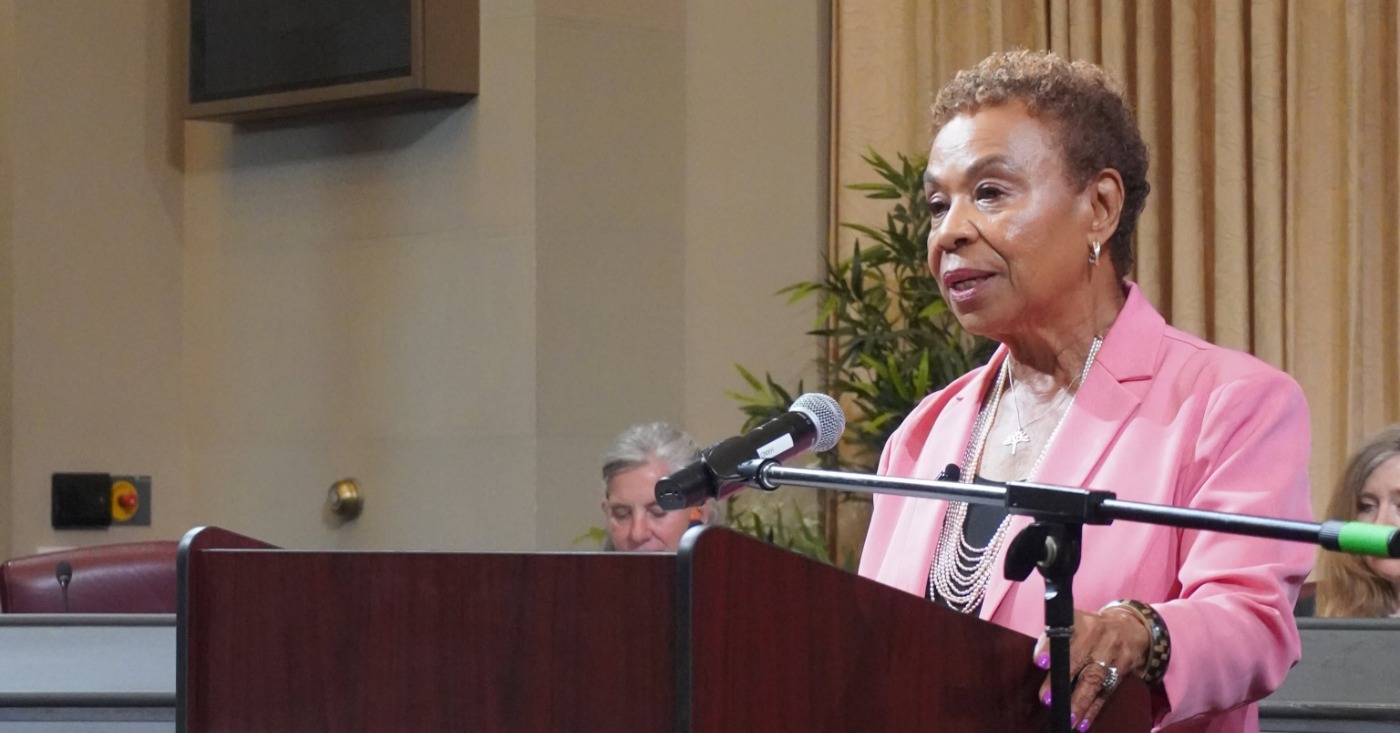
Mayor Barbara Lee, speaking this week to Oakland residents and elected leaders in City Council chambers, delivered the annual mayoral State of the City Address, highlighting the city’s accomplishments as well as the challenges Oakland is facing going forward.
Lee began her remarks praising city workers, who picketed outside City Hall before the meeting, and are currently negotiating with the city for a wage increase and ending understaffing that leaves many departments shorthanded.
“We are working very hard (not) just to get a contract, but to get a fair contract,” she said. “I know that our City Council and myself are working constantly toward that end.”
The mayor also praised Councilmember Carroll Fife for her legislation for a 45-day moratorium on data center construction, which passed unanimously at the council meeting Tuesday following Lee’s presentation.
Speaking bluntly, she said, “Oakland continues to be a city on the move, (but) I want to tell you the truth about the state of our city.”
“We have made real progress, and we still face real challenges.”
She said the city has balanced its budget but has a structural deficit, which is decreasing, and must operate within the context of federal funding cuts.
“Too many Oaklanders are unhoused, too many families are struggling with the cost of living, and too many neighborhoods still need basic services that they deserve, and too many people are living in fear,” Mayor Lee said.
“We’re not sweeping these realities under the rug,” she continued. “We are being intentional and transparent about how we must face these challenges, but we will not ignore our progress.”
Substantial progress includes:
• Bringing crime down;
• Building affordable and deeply affordable housing;
• Cleaning the streets and fixing the roads;
• Helping small businesses.
“We are bringing new investment to Oakland,” she said. “We’re making City Hall work better. There’s more to do, but make no mistake, Oakland is on the move.”
Speaking broadly about the city’s public safety initiatives, she said that crime continues to decline. Burglaries fell by 26%, and violent crime fell by 17%.
In recent years, homicides and shootings have fallen by double digits, and gun violence has dropped by more than 50% in the last 33 months.
“These aren’t just statistics: these are lives. These are families. These are people who never made it home,” Mayor Lee said.
She talked about what to expect now that federal court oversight of the Oakland Police Department ended last week after 23 years. “Ending federal oversight does not mean ending accountability; quite the opposite,” she said. “Accountability and civilian oversight must remain our standard. Community trust must be our standard.”
Mayor Lee also emphasized that Oakland remains a city of refuge.
“We do not work with ICE; we do not cooperate with ICE; our police do not cooperate with ICE; we will not be militarized,” she said.
The mayor also emphasized that investing in youth is a top priority of her administration and should be considered a public safety strategy.
“We advocated for almost $2 million to restore the mayor’s youth summer employment program,” she said. “We connected youth with Oakland businesses to develop skills that will support them for years to come, and that’s a big deal.”
To create a police force that better serves and protects Oakland, the city is working toward the goal of reaching 700 sworn police officers, she said. These steps include recruiting from Oakland, holding academies, reinstituting a cadet program, and increasing foot patrols.
The city also is strengthening other programs, including the Department of Violence Prevention and Ceasefire, she said. “We must have this comprehensive public safety strategy, because we must also prevent violence before it happens.”
Continuing, Lee said public safety is connected to unsanitary conditions in city neighborhoods.
“Illegal dumping is unacceptable, and it’s a moral disgrace,” she said. “No child should have to walk past piles of garbage on their way to school; no senior should have to live next to it; no small business should have to clean it up outside its door.”
She said the city is changing the way it fights illegal dumping, securing a $9.2 million investment to develop a new strategy. “We’re not just cleaning it up; we’re working to stop it before it starts. We have the three E’s – Eradication, enforcement, and education,” she said.
Focusing on the continuing crisis of Oakland’s unhoused residents, she said, “We consider housing a basic human right, and homelessness remains one of Okland’s greatest challenges.”
“There are two things we must do: keep people from becoming unsheltered and help people who are unsheltered get back into housing with services that they need,” Lee said.
Since 2024, homelessness in Oakland has fallen by 20%, she said. In the past year prevention programs helped keep 1,000 families in their homes, and over 1,300 affordable homes opened over the past two years.
Addressing community tensions over encampments, she said, “We should never have to choose between compassion for people experiencing homelessness and the health and safety of our neighborhoods.”
“A strong city has to deliver both,” she said. “That’s the work we’re advancing through Oakland’s new homelessness strategic action plan.”
Black Press
Oakland Awarded More than $14 Million in State Funding
Direct state investments in city programs can revitalize Oakland’s commercial corridors and foster economic growth, strengthen community violence prevention strategies, and expand transitional housing, while supporting cherished community spaces, according to a city media statement.

Money will support small businesses, public safety, transitional housing, and community partners
Mayor Barbara Lee recently announced that the City of Oakland and local community partners will receive more than $14 million in direct investments from California’s new 2026-27 state budget.
Securing $4.25 million for city programs and $10 million for local community organizations, these state funds were backed by state Senator Jesse Arreguin and Assemblymembers Mia Bonta and Buffy Wicks, with support from Governor Gavin Newsom.
The goal of securing state and federal funding and bringing in outside resources to address the city’s most pressing needs continues to be a top priority for Lee.
Direct state investments in city programs can revitalize Oakland’s commercial corridors and foster economic growth, strengthen community violence prevention strategies, and expand transitional housing, while supporting cherished community spaces, according to a city media statement.
“Thank you so much to Senator Jesse Arreguin, Assemblymember Mia Bonta, Assemblymember Buffy Wicks, and Gov. Gavin Newsom for investing in Oakland,” Lee said.
“We are fortunate to have strong, dedicated leaders representing Oakland in Sacramento who consistently deliver for our residents and businesses,” she said. “This critical funding directly addresses some of our most pressing challenges, including supporting our small businesses, building vibrant neighborhood corridors, advancing violence intervention, and housing our unsheltered neighbors.”
How the $4.25 million will be spent for city projects:
- $2.5 million will be used for the Facade and Tenant Improvement Grant Program to support small businesses;
- $1 million for the Department of Violence Prevention to enhance staffing and program capacity; and
- $750,000 for the Holland transitional housing facility, providing resources to help unhoused residents.
• How the $10 million for Oakland community groups will be spent:
- $5 million for Children’s Fairyland for essential infrastructure, accessibility, and facility upgrades.;
- $3 million for the Juntos Fruitvale Cultural Arts Center to create a multi-use space for performances, exhibitions, workshops, neighborhood meetings in the Fruitvale neighborhood; and
- $2 million for Samuel Merritt University to grow its nationally recognized Human Trafficking Prevention and Response Initiative.
“State investments in Oakland’s nonprofit and educational organizations highlight their deep value not just to our city, but their importance to the entire state,” said Lee. “Oakland has long served as a hub for inclusive arts and culture and as a community that protects its most vulnerable members.”
Said Arreguin, “This investment is a commitment to Oakland’s health, safety, and future. In partnership with my state colleagues, Mayor Lee, and our community partners, we are strengthening our response to human trafficking and gun violence, to create safer neighborhoods, and improve the quality of life of all Oakland residents.”
“Investing in Oakland means investing in California’s future. I’m proud to be a voice for the beautiful people of Oakland in the State Capitol and to deliver real funding wins that ensure our shared safety, expand housing opportunities, and preserve the artistic and cultural legacy of Oakland,” said Bonta.


FTC Chair Praises Trump, NYC Calls for Target Boycott, and Jason Lee Removed as Vice Mayor 📱

FTC Chair Praises Trump, NYC Calls for Target Boycott, and Jason Lee Removed as Vice Mayor

Black History: Gladys West Mathematics Helped Make GPS Possible

Richmond’s Secret Bank: The True Reformers Story #shorts

7 USB-C Ports + Wireless Charging: Power Up Your Family #shorts

Urban League, AT&T Expand Digital Skills and Laptop Access in St. Louis

Attend a Green Line Bus Rapid Transit Open House

VIN Check: Avoid Truck Recalls Before Buying! #shorts

Defender Parking Camera & Screen Features Explained #shorts

Find Black-Owned Banks & Credit Unions Easily #shorts

The Youngest American Killed in the Vietnam War

Passing for White, Fighting for Black America: The Courage of Walter White

OP-ED: Haiti TPS: Have We Lost Sense of Humanity?

OP-ED: How Does Your State Rank for Pre-K?

NFL: Week Two Recap | Jalen Hurts did not fold; Caleb Williams exits game with injury

Remembering Chauncey Bailey as Student Journalists Face Threats to Truth-Telling

Headlines and Hot Topics 📱

Peter Magubane: a Camera Against Apartheid

Obama Urges Democrats to make AI a Priority 📱

The Conversation with Al McFarlane 📱
FTC Chair Praises Trump, NYC Calls for Target Boycott, and Jason Lee Removed as Vice Mayor 📱
FTC Chair Praises Trump, NYC Calls for Target Boycott, and Jason Lee Removed as Vice Mayor
Black History: Gladys West Mathematics Helped Make GPS Possible
Richmond’s Secret Bank: The True Reformers Story #shorts
7 USB-C Ports + Wireless Charging: Power Up Your Family #shorts
Urban League, AT&T Expand Digital Skills and Laptop Access in St. Louis
Attend a Green Line Bus Rapid Transit Open House
VIN Check: Avoid Truck Recalls Before Buying! #shorts
Defender Parking Camera & Screen Features Explained #shorts
Find Black-Owned Banks & Credit Unions Easily #shorts
-

 Black Press1 week ago
A $2.1 Trillion Wellness Industry Never Built a Daily Practice for Black Children. So This Atlanta Family Did.
-
 BlackPressUSA1 week ago
Latinas Deserve Equal Pay. Unions Help Make It Happen.
-

 Art1 week ago
Montclair Brewery: Brewing Culture, Community, History
-

 Black Press3 days ago
All Skinfolk Ain’t Kinfolk
-

 Black Press1 week ago
COMMENTARY: But God!
-

 Black Press1 week ago
Safety Concerns at Southern University
