
Film
A reflection on ‘The Last Black Man in San Francisco’
ROLLINGOUT — Amazing and awestruck are the feelings that came through as my eyes took in the latest indie flick, The Last Black Man in San Francisco.
Jimmy Fails works masterfully to expose the constant thoughts of the gentrifier and their continued foot on the neck of the Black community occupying the city of San Francisco. The circumstances that he faces, along with the city’s other Black and poor residents in general, is made poignant through his gaze and experiences. It is here that the character Jimmie and his best friend navigate the beautiful Alice in Wonderland maze of oppressors while consciousness keeps the dreamy truth about growing into manhood and brotherhood frightening, dangerous, and segregated.


By Munson Steed
Amazing and awestruck are the feelings that came through as my eyes took in the latest indie flick, The Last Black Man in San Francisco.
Jimmy Fails works masterfully to expose the constant thoughts of the gentrifier and their continued foot on the neck of the Black community occupying the city of San Francisco. The circumstances that he faces, along with the city’s other Black and poor residents in general, is made poignant through his gaze and experiences. It is here that the character Jimmie and his best friend navigate the beautiful Alice in Wonderland maze of oppressors while consciousness keeps the dreamy truth about growing into manhood and brotherhood frightening, dangerous, and segregated.
It is clear from the start that the circumstances of Jimmie’s ancestral family home that doesn’t belong to the family anymore, yet his strong ties to hold onto the warm memories and his only true family tie might breed contempt for the transformation of cultural identity for the Black community and ownership in San Francisco.
The external attacks on brothers of both unemployment, environmental dumps, and drugs illuminate the lack of possibility of any sense of normalcy and development by African-American communities families and their legacy.
As James Baldwin said in his seminal work “I am not your Negro,” Jimmie highlights why the principal feeling of being alienated from society systemically clouds and brutalizes the future faith of young Black men.
For those who will never wear the skin that Jimmie does in the film, each White character seeks to really minimize the impact of a system of gentrification and application of responsibilities by liberals and politicians who its constituencies are not the individuals that bear their skin or their vote at the box.
In one scene, Jimmie showcases the rationale that all societal pressures, and those who have privilege in this country, explain their bloody sinful behavior for economic gain based on “If it wasn’t me, it would’ve been somebody else.” The starkest example being the while real estate agent who after learning about the perilous house’s status decides to list it himself to get the commission while Jimmie is trying his best to reclaim the property with no resources.
The film also showcases the feeling of Jimmie’s friend who is writing Jimmie’s memoir while he is living in the same world, but metaphorically being a Langston Hughes-like character who explains the pain that is omitted from the 5 o’clock news but sometimes highlighted in a very liberal voice by NPR without resolution.
Brotherhood could be felt on so many layers that this might be a movie to use as a healing tool to bring gangland murders to a minimum. We see the brotherhood that has often started within young black men beginning in their unfortunate circumstances like group homes and lonely nights on the corner gaining poor examples of masculine maturity as a death results from the corner training of gang-like confrontation principal rights of passage.
Black male toughness constitution leads to the death of Jimmie’s group home friend. Each man suffers from getting the shackle of their oppressed history and memories to remove the fog of lies and hope from their approach to a new day.
There is a poetic use of blindness in the film where our favorite actor and black community benefactor Danny Glover plays the blind grandfather of Jimmie’s best friend, Montgomery Allen. He sees everything on another realm but can change why and what his grandson chooses to be. He does appear to know life has given Jimmie a depressed mind, which does not let black men forget their oppressed station.
Glover’s grandfather character is an elder who is praying for his grandson and his community and urges the two men to stick together against the dangers of the world both seen and unseen.
Emotional tears and anger showcase the need for psychological and mental therapy for many black men. Their fathers have failed to create a legacy of emotional intelligence. Instead of lies breed lies and pain rains on all emotional levels.
Heartbreak, dissatisfaction, and disappointment are served by all of San Francisco, which seems to benefit from all tragic losses of the black community and especially black men.
Jimmie Fails writes the life in the land of Flint, Michigan’s black cousin of San Francisco.
The honest depiction of new age colonizers in this movie might have gotten Jimmie’s project left on an editor’s desk. Demonstrating how a liberal and tolerant white society still benefits from black oppression as white actors always explain away part of the constant injustice San Francisco offers as a gift.
Lastly, Jimmie asks Black fathers why don’t we see the cycle of abuse they administer like free cheese. “You didn’t die from so it was not so bad” philosophy that begs for a pass is a lie that expired decades ago.
Brothers cry, scream and accept that their bond as black men must be protected with honesty; but the pain is going to be part of process and practice.
Jimmie Fails work appears to free black men from the lie that the colonizer has defined you and demand a Black redefinition of their future outside the boxed circumstances of their birth.
Jimmie Fails is not your negro either with the masterpiece The Last Black Man in San Francisco.
This article originally appeared in Rollingout.com.













Entertainment
Marvel Has No Problem Finding Room for Spider-Man. So, Why Wasn’t There Room for Blade?
BLACKPRESSUSA—After seven years of delays, Mahershala Ali confirms Blade is dead in the water — even as Marvel fast-tracks another Spider-Man movie, expands the X-Men, and announces a new Black Panther film. This piece asks the question Marvel would rather avoid: what does it mean when a studio finds room for everything except one of its most significant Black superhero franchises?


By Kendall Gayle Washington
There is something increasingly difficult to ignore about Marvel Studios’ treatment of its Black characters: the company always seems to have room for another Spider-Man movie, another Avengers project, another X-Men announcement, or another expansion of the Marvel Cinematic Universe, but somehow, there was never enough room to get Mahershala Ali’s Blade made. After seven years of waiting, the two-time Oscar winner has finally said what Marvel fans have been reluctant to hear: the movie is no longer happening with him. In a recent interview, Ali was blunt about the situation, saying, “If they wanted to do it, we would’ve done it.”
That statement should not be dismissed as an actor simply being frustrated with a failed production. Ali was announced as Blade in 2019, and for years, Marvel continued to keep the project alive publicly while the film cycled through writers, directors, and production delays. Bassam Tariq departed as director in 2022, Yann Demange later left the project, and the movie never reached the finish line. Marvel Studios president Kevin Feige has since admitted that he feels like a “gigantic loser and failure” because the studio never got the film off the ground with Ali.
The problem is that Marvel’s explanation starts to feel less convincing when you look at what the studio continues to make room for. Spider-Man is already moving into another chapter of his MCU story. Spider-Man: Brand New Day, the fourth MCU Spider-Man film starring Tom Holland was released in 2026, and there has already been discussion of continuing Holland’s Spider-Man beyond that movie. Marvel and Sony have repeatedly demonstrated that when they believe a character is valuable, they are willing to keep finding ways to continue the story.
And Spider-Man is not the only example. Marvel continues to announce and develop major projects. At D23, the studio unveiled its new X-Men cast, including Maya Boyd as Storm, while Avengers: Doomsday, Avengers: Secret Wars, and other major projects remain part of the company’s future. Marvel has also confirmed another Black Panther movie, demonstrating that the studio is still investing in Black stories when it believes those franchises fit into its larger plans.
That is why Blade feels different. Blade is not an untested character. Wesley Snipes already proved that the character could headline a successful franchise decades before the Marvel Cinematic Universe existed. Marvel then had the opportunity to take one of its most recognizable Black superheroes and put one of the most acclaimed Black actors of his generation behind the sword. Instead, the studio spent seven years trying to figure out what it wanted the movie to be.
There is nothing wrong with taking time to make a good movie. In fact, Marvel was right not to rush Blade into theaters simply because it had announced it. But there is a difference between taking your time and repeatedly demonstrating that a project is not a priority. When a studio can announce new projects while an existing Black-led film remains trapped in development, audiences are justified in questioning what gets considered urgent and what gets considered optional.
The comparison becomes even more complicated when we look at Jonathan Majors. His situation is fundamentally different from Ali’s, and it would be unfair to pretend otherwise. Marvel dropped Majors as Kang in December 2023 after he was convicted in his assault trial. He had been positioned as one of the central figures of the MCU’s next saga and was expected to appear in Avengers: The Kang Dynasty and Avengers: Secret Wars. Marvel subsequently reworked The Kang Dynasty into Avengers: Doomsday, replacing Kang as the primary antagonist with Robert Downey Jr.’s Doctor Doom.
But Majors’ departure still illustrates how quickly Marvel can make a decision when the studio believes it has to. The company did not spend seven years trying to figure out whether Kang would eventually work. Once the circumstances surrounding Majors made continuing with him untenable, Marvel changed course. The studio moved forward with another plan. That is what makes Ali’s comments so frustrating. His problem was not misconduct or a legal issue. His problem was that Marvel could never seem to get his movie together.
And that distinction matters.
Black actors should not have to wait years for Hollywood to decide whether their characters are worth prioritizing. Black audiences should not have to interpret every cancellation as a referendum on whether stories about Black people are commercially viable. The burden should not constantly be placed on the audience to prove that these characters deserve franchises.
Mahershala Ali is moving on. His new film with former Blade director Bassam Tariq exists in part because the Blade project fell apart, giving them an opportunity to create something outside the Marvel machine. That may ultimately be a blessing for Ali. But Marvel should still have to reckon with the fact that one of its most promising Black superhero projects became a seven-year lesson in indecision.
Marvel does not owe audiences every superhero movie they want. But it does owe audiences honesty about its priorities. If there is always money, time, and creative energy for another Spider-Man movie, another Avengers storyline, or another massive franchise announcement, then it is fair to ask why a Black superhero as significant as Blade could not receive the same level of commitment.
The issue is not that Marvel canceled one movie. The issue is what that cancellation says when placed next to everything Marvel continues to announce.
Representation is not proven when a Black actor is announced at Comic-Con. It is proven when the studio is willing to follow through.
Art
Oakland Director Boots Dazzles Once Again in ‘I Love Boosters’
OAKLAND POST — Riley’s creative output is influenced by progressive ideals. His work, which includes six albums, the 2018 film “Sorry to Bother You,” and the 2023 comedy series “I’m a Virgo,” always shows that the alienation working-class people feel is inevitable under capitalism, he recently told The Guardian.

“I feel lonely,” Keke Palmer’s character Corvette says in the first few minutes “I Love Boosters,” the new comedy adventure film from Oakland-based director Boots Riley.
“I wish I could feel lonely,” Naomi Ackie’s character Sade responds. “Try having kids.”
“I Love Boosters” teems with kaleidoscopic colors, sharp playful social critique, otherworldly plot twists, and fast-paced action, but it’s grounded in its main characters’ simple and relatable motivations: They want to be less isolated, and more free to pursue their own creative endeavors.
They’d like to design clothes and run a fashion boutique, but, unfortunately, they’re mostly busy surviving. Corvette and Sade, along with Mariah, played by Taylour Page, hustle and scheme through their brilliant scrappy organized crime group, the Velvet Gang. The gang regularly boosts clothes in the Bay Area and sells them at discounted prices.
Riley portrays the gang in a positive light in “I Love Boosters,” echoing the sentiment and title of a song he recorded 20 years ago with his hip-hop band, The Coup, where he praises boosters for providing poor communities with nice clothes they can afford: like a Robin Hood of the ’hood. But while morally righteous, materially, the gang is troubled. Corvette is haunted by unpaid bills and fears getting kicked out of the building where she squats, a shuttered fast-food chicken joint.
One thing that separates Riley’s film from most others about criminal gangs is that the Velvet Gang’s members work for a living. Theirs isn’t a greedy fantasy of becoming filthy rich, or for one last hit: Boosting is a job that still doesn’t pay nearly enough.
Riley’s creative output is influenced by progressive ideals. His work, which includes six albums, the 2018 film “Sorry to Bother You,” and the 2023 comedy series “I’m a Virgo,” always shows that the alienation working-class people feel is inevitable under capitalism, he recently told The Guardian.
Visually, the film is a mix of psychedelia, afro-surrealism, noir, and perhaps a comic book.
The villain, Christie Smith, played by Demi Moore, an evil genius billionaire and fashion designer who runs the expensive clothing company the gang boosts from. She repeatedly appears on the news to put a target on the Velvet Gang members’ backs. When the gang ends up connecting with those who Christie directly exploits –workers here in the Bay Area, but also those in sweatshops overseas– the fight against Christie can commence; and uncoincidentally, Corvette starts to feel less lonely.
I don’t want to say much about that fight, but it’s delightful. Sci-Fi elements (which appear connected to Marxist theory) enter into the narrative to tie what’s become a pretty scatterbrained story together. Grounded by Palmer’s acting, “I Love Boosters” is a total joy and a refreshing break from the typical narratives we see these days. It’s totally over-the-top, but it knows it is.
#BuyBlack
A Conversation with Machel Montano on Carrying the Culture
NEW YORK CARIB NEWS — Witness the premiere of ‘Like Ah Boss: Journey of a Soca King,’ an intimate documentary on Machel Montano’s four-decade-long career, launching globally on Amazon on May 29.


By Mell P | New York Carib News
On a Friday evening in Brooklyn, the air carried something unmistakably Caribbean. Inside the Brooklyn Public Library, a select gathering witnessed something rare, a first look at Like Ah Boss: Journey of a Soca King, the intimate new documentary tracing Machel Montano’s extraordinary life in Soca music, captured since 2015 and set for its global launch on Amazon on May 29.
It was an evening that felt bigger than a premiere. It felt like a reckoning, with legacy, with culture, with the quiet sacrifices behind four decades of dominance on the world stage.
We sat down with the man they call the ‘Michael Jackson of the Caribbean’ to talk about what it truly means to carry a culture on your shoulders, and why, after all this time, he’s still running like a boss.
Watch:
Black History
Black Celebrity Health Scares That Had Fans Seriously Concerned
NNPA NEWSWIRE — Some of us view celebrities as superheroes. Their health scares often remind us that they are human. It’s shocking to hear news of a hospital admission when you’ve just been watching a movie or podcast featuring a celebrity.

By Rob McManus
People start panicking when a celebrity shares pics or does an interview about health struggles. Jamie Foxx, Tamar Braxton, and Dwayne Johnson are a few of the Black celebrities who have dealt with health scares recently. You can learn what to watch out for when you read about their journeys.
According to the Pew Research Center, 40% of US adults learn about health and wellness from podcasts and social media influencers. You may even have picked up some wellness tips from a black celebrity.
Seeing them discuss their current health issues is encouraging more people to get checkups or start living a healthier lifestyle.
What Is a Health Scare?
A health scare is an incident that makes you realize your health is in danger. Waking up feeling fine, then dealing with any of these issues later in the day, counts as a health scare:
- Trouble breathing
- Emotional burnout
- Collapsing
Health scares sometimes result in many people needing urgent care in Washington. You shouldn’t ignore minor signs since they may lead to an emergency surgery or damage your organs.
After dealing with a health scare, you remember how precious life is. Adopt healthier habits and take a deeper look at your lifestyle to pull through.
When you address small warning signs like your jaw popping and clicking, you might be able to avoid significant health scares.
How to Deal With a Health Scare
Avoid spending a lot of time on internet searches, and see a professional. Dealing with a health scare causes panic, and you may find yourself having racing thoughts. It’s tempting to Google your symptoms or watch videos about similar experiences.
Two people may have symptoms that are quite similar, even if they have different health conditions. Going for a checkup is better than guessing and trying to self-medicate. Your doctor will be able to spot warning signs before your health worsens.
The confusion caused by an unexpected diagnosis often makes it hard to focus during an appointment. Bring someone with you so they can take notes on your behalf. Getting support from your loved ones or religious groups helps you deal with the mental health effects of a scare.
Always follow your doctor’s advice and contact them if you notice any new odd development. Some people ignore the instructions after they find videos online of people claiming to have used alternative methods.
Even if you try other ways of dealing with the health issues, talk to your doctor first.
Black Celebrity Health Scares Fans Couldn’t Ignore
Some of us view celebrities as superheroes. Their health scares often remind us that they are human. It’s shocking to hear news of a hospital admission when you’ve just been watching a movie or podcast featuring a celebrity.
Jamie Foxx and the Mystery Medical Complication
The news about Jamie Foxx’s hospitalization in 2023 caused a lot of panic and speculation online. His family asked for privacy and didn’t go into much detail about what he was battling.
You might have seen people posting videos trying to debunk when he started ailing. Some wondered whether he would ever be the same after recovery.
Seeing a celebrity you grew up watching in movies or comedy shows lying in a hospital bed can be terrifying. The updates Jamie gave later suggested their recovery took time and patience.
Talking about going to ‘hell and back’ during this period resonates with many of his fans.
Dwayne Johnson Opening up About His Past
When Dwayne Johnson talked about the severe injuries and depression he had dealt with when he was younger, many fans felt surprised. He is one of the celebrities a lot of us know for his strength and discipline.
Opening up about how his mental health suffered due to his football dreams ending is encouraging more Black men to be open about their struggles. He recently talked about the gut issues he has been dealing with in the company of his doctor.
More male celebrities are open to being vulnerable. Hearing about their stories shows the importance of not giving up when trying to solve persistent health issues.
Tamar Braxton’s Health Scares
A lot of fans felt very concerned after paramedics rushed Tamar Braxton to the hospital. She was dealing with a severe case of the flu, which she described as worse than COVID.
Recently, there has been news about a friend finding her in a pool of blood. These are some of the issues Tamar has openly talked about:
- Emotional exhaustion
- Depression
- Pressure
No one should focus on their job more and ignore their health in the process. It’s a powerful lesson we need to learn from Tamar Braxton’s health scares.
Workplaces are starting to encourage people to take breaks and care for their mental health. When celebrities like Tamar share their stories, we learn to take our wellness more seriously.
Frequently Asked Questions
Can Lifestyle Changes Prevent Future Health Problems?
Absolutely. The choices you make every day eventually affect how your body works or deals with health issues. You should:
- Get enough sleep every night
- Move your body
- Eat a balanced diet
- Always stay hydrated
Stress worsens health issues when you don’t deal with it. Take a walk or use breathing exercises to keep your cortisol levels low.
What Should I Do Immediately After a Medical Crisis?
Get enough rest. Scheduling a follow-up with our doctor allows you to figure out if you’re improving. Your body will use a lot of energy to fix the damage caused by a health scare.
Avoid just getting back to work without giving yourself enough time to recover.
Why Do Celebrity Health Stories Spread So Fast?
People feel emotionally connected to celebrities. You’ve probably seen your friends reposting news of a celebrity being sick.
Some people even make videos that go viral. Spending years watching celebrities perform or appear on your favorite TV shows makes you feel like you know them well.
Learning From Black Celebrity Health Scares
No one is really immune to health scares, and it helps to have a good wellness routine. Seeing your favorite celebrity being rushed to the hospital or talking about their struggles can be heartbreaking.
We should learn from their experiences. Surround yourself with supportive people during a crisis to protect your mental health. Read more updates about the black community and celebrity culture on our page.
#BuyBlack
Snoop Dogg Celebrates 10 Til’ Midnight at the Compound
LOS ANGELES SENTINEL — The album is paired with a film that stars Snoop Dogg, Hitta J3, G Perico, and Ray Vaughn, and one of the strongest elements of the whole project is that the production stayed rooted right here in Los Angeles.
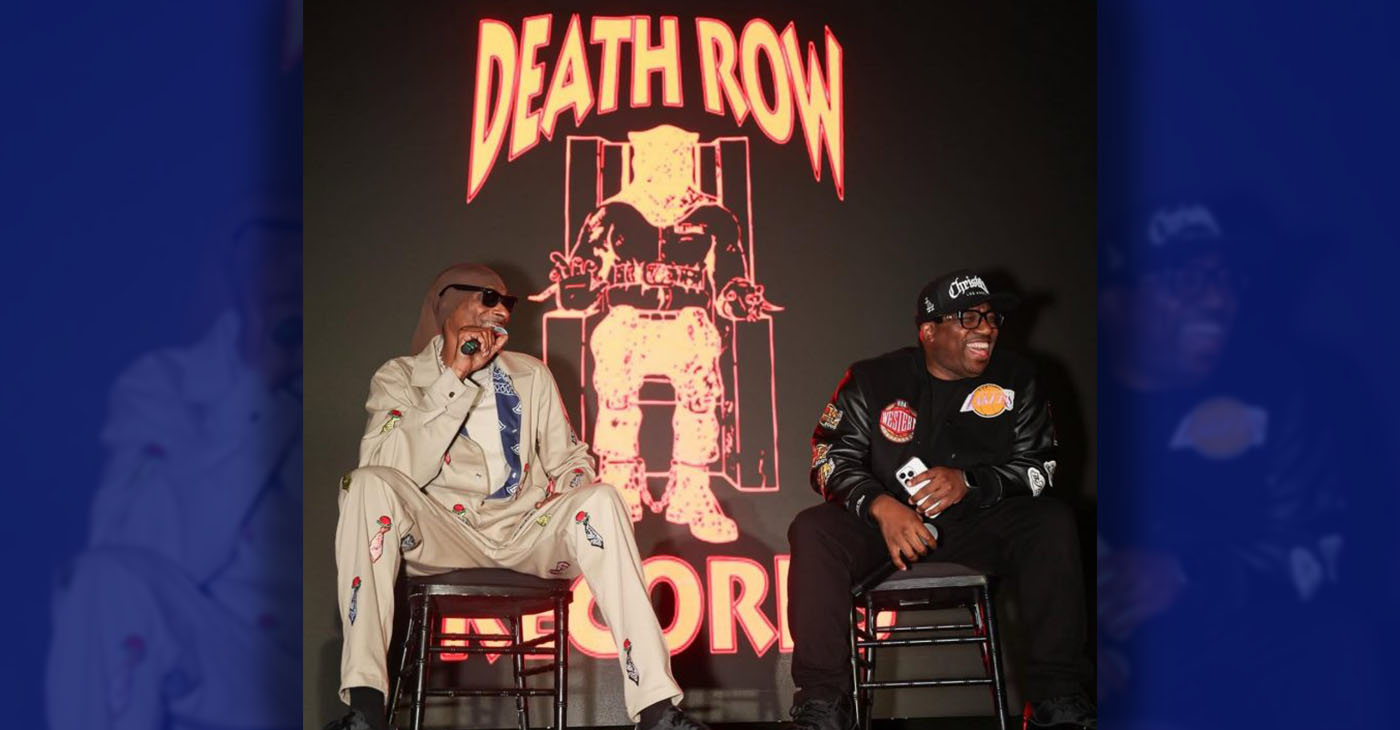
Snoop Dogg celebrated the premiere of 10 Til’ Midnight at his Inglewood recording studio & multipurpose facility, The Compound, but the night felt like much more than an album release. It felt like Los Angeles. It felt like legacy. And it felt like another major move from one of the city’s greatest cultural architects as he continues to prove that he is not just dropping music — he is building moments, shaping narratives, and pushing the culture forward in real time.
What made the event so powerful was the clarity behind the vision. During a panel conversation with DJ Hed, Snoop opened up about the heart behind 10 Til’ Midnight, explaining that the project was created to help bridge older and younger generations while also speaking to the long-standing divisions between Bloods and Crips in a unique way through film. That alone gave the project a different kind of weight. This was not just about songs. This was about using creativity as a tool for connection. This was about taking a story rooted in Los Angeles and telling it in a way that could bring people together.
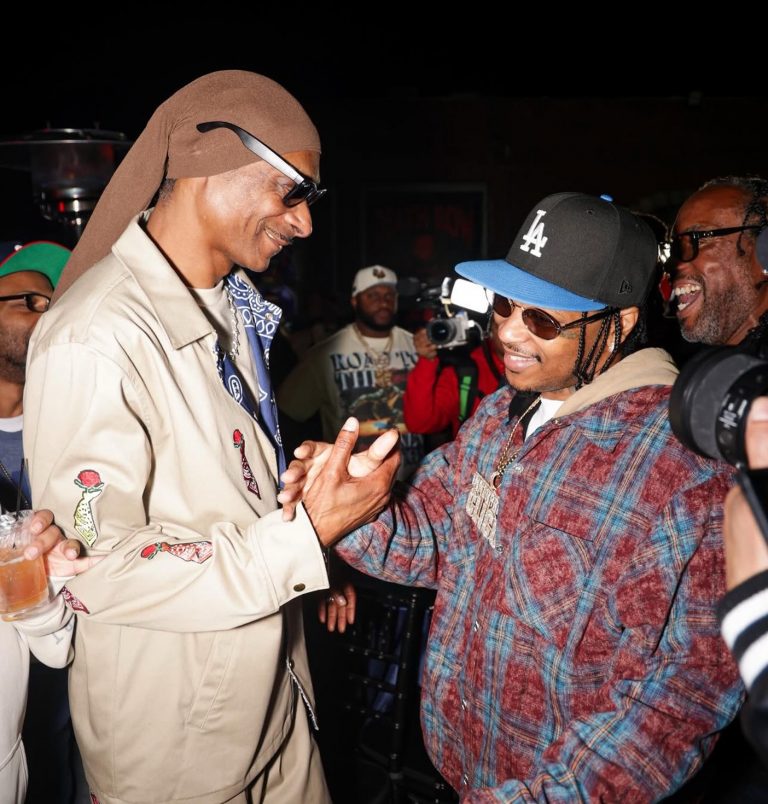
Snoop Congratulated By Rapper & Fellow 10 Til Midnight Cast Member G Perico (CreativeLB/KreativeKapturez)
The album is paired with a film that stars Snoop Dogg, Hitta J3, G Perico, and Ray Vaughn, and one of the strongest elements of the whole project is that the production stayed rooted right here in Los Angeles. The film was shot in the city, including at WePlay Studios in Inglewood, which gave the entire project an even deeper hometown feel. It was not just a West Coast story in content — it was a Los Angeles-made production from the ground up.
That matters because, in a city like this, authenticity still carries weight. Snoop understands how to make sure that what he creates does not just represent Los Angeles on the surface, but actually comes from it.
What also makes 10 Til’ Midnight significant is that it represents another major step in Snoop’s evolution as both an artist and executive. Public reporting around the project identifies it as his 22nd studio album, but the bigger story is what it represents in this season of his life. This is one of several consecutive moves he has made in his 50s that show he is still building, still expanding, and still finding new ways to reinvent what the next chapter looks like.
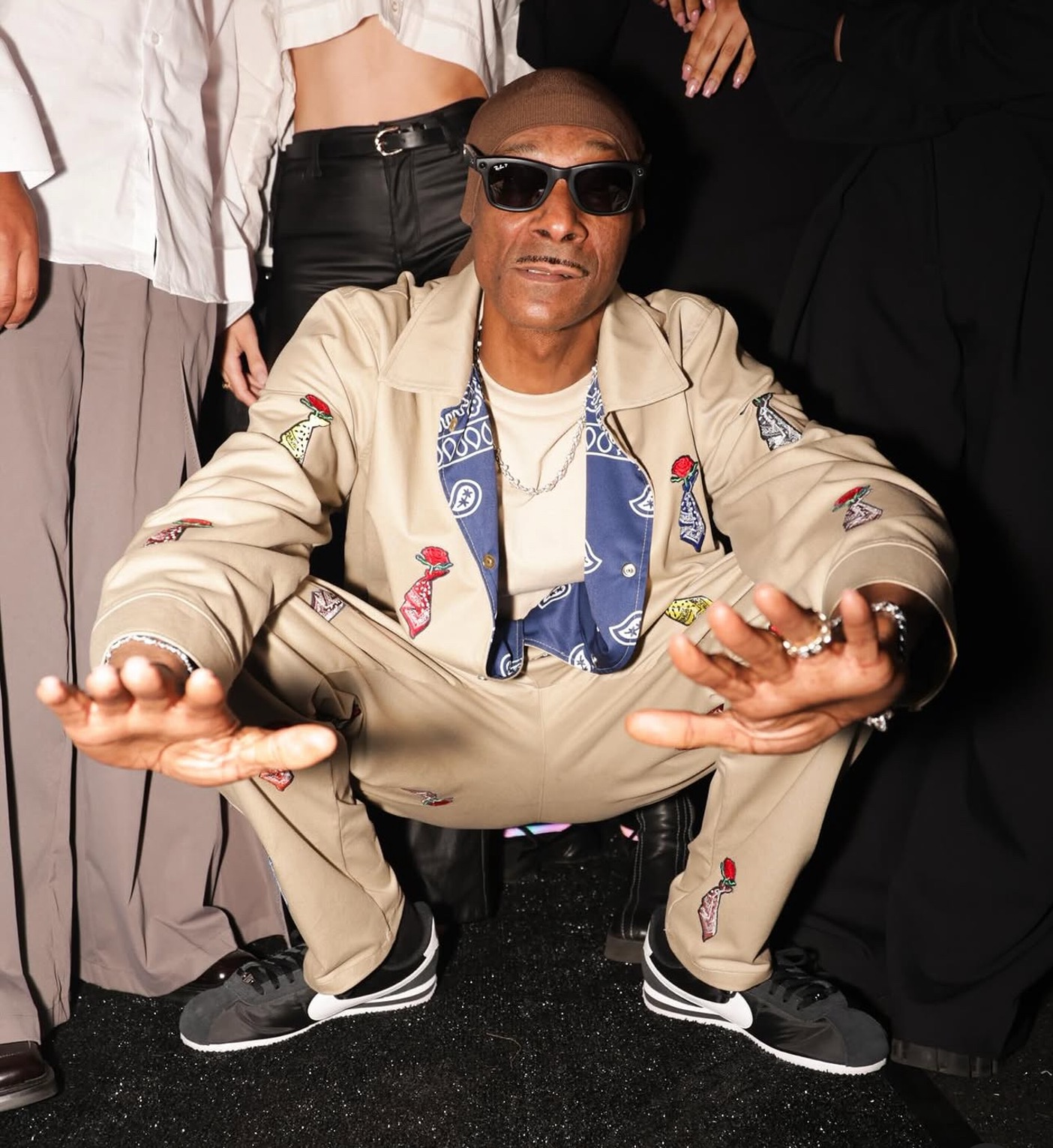
Snoop Dogg at the Premiere of 10 Til Midnight (CreativeLB/KreativeKapturez)
Now, as the head of Death Row Records and the newly aligned leader of Death Row Pictures, he is taking the brand into a new dimension. That is what made this moment feel bigger than music. Snoop is not just protecting the legacy of Death Row — he is stretching it. He is expanding it beyond records and into film, visual storytelling, and larger creative worlds that can continue carrying the label’s impact forward. Public reporting has noted that this project arrives as part of that broader cinematic push.
That is a major Los Angeles move because the city has always been built on the intersection of music, film, neighborhood identity, and cultural storytelling. With 10 Til’ Midnight, Snoop is leaning all the way into that intersection.
The room at The Compound reflected that. It felt like a private premiere, but it also felt like a statement — a reminder that Snoop Dogg’s staying power has never been based only on nostalgia. It comes from his ability to remain connected, remain visionary, and remain in tune with how to move the culture without losing the essence of who he is.
That is why this premiere mattered. It was not just about celebrating another album. It was about witnessing a Los Angeles legend continue to evolve, continue to unify, and continue to use art to tell stories that hit deeper than entertainment alone.
In that sense, 10 Til’ Midnight became more than a project launch. It became another example of how Snoop Dogg is still taking Los Angeles to the next level — using music, film, and legacy together to build something bigger than a moment.
Art
COMMENTARY: In 2025 Black Culture Claimed Ownership Not Permission
NNPA NEWSWIRE — Across platforms, Black pop culture in 2025 resisted dilution. Virality lost its grip. Ownership replaced access. Community replaced clicks. The work did not ask to be understood. It stood where it was.

By Stacy M. Brown
NNPA Newswire Senior National Correspondent
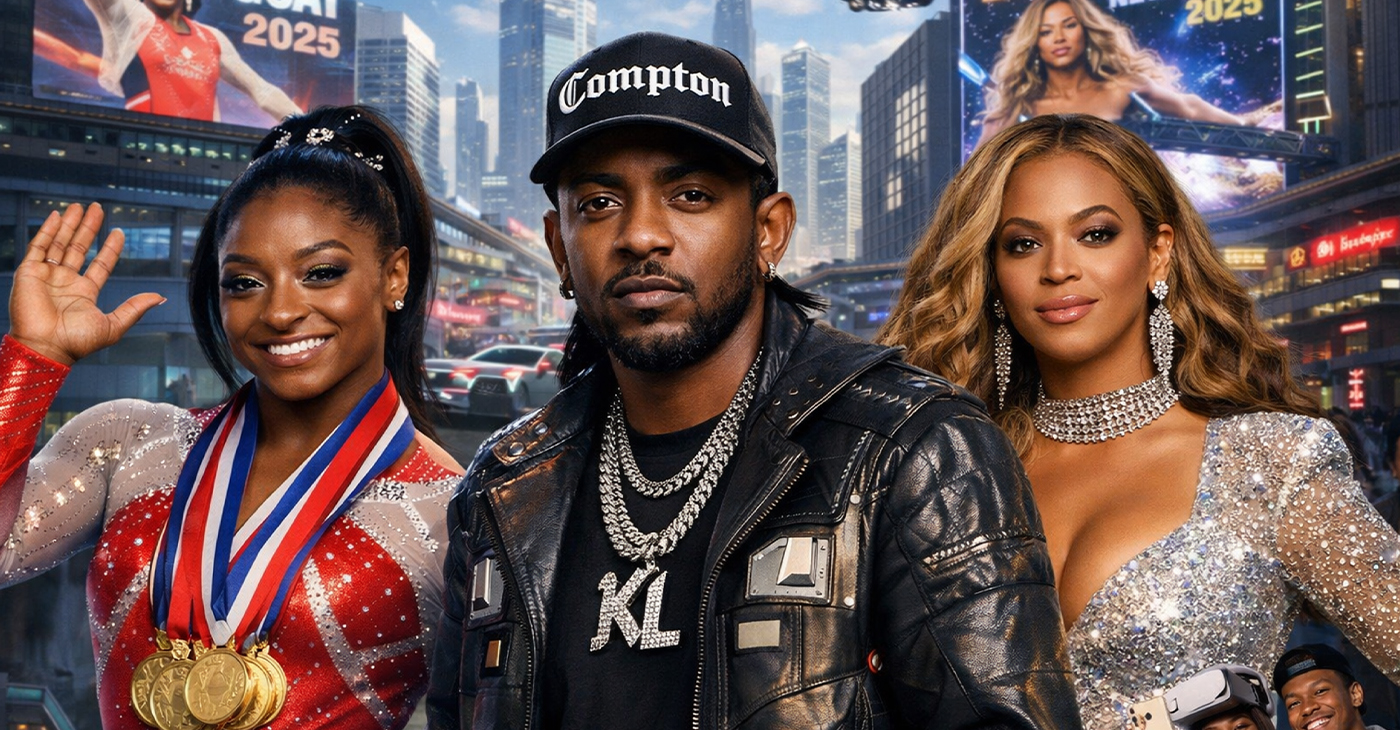
Black pop culture in 2025 did not chase attention. It set terms. Across music, television, film, fashion, and sports, Black creators tightened control over narrative, ownership, and meaning at a moment when the country itself felt unmoored.
Hip hop provided the year’s clearest line of separation. “Not Like Us” by Kendrick Lamar did more than dominate playlists. It reset cultural boundaries. “They not like us” became shorthand for lineage, authorship, and accountability, repeated in crowds, locker rooms, and online spaces as a declaration rather than a slogan. The record carried the weight of history and the sharpness of confrontation, reinforcing hip hop’s original purpose as documentation and refusal.
Kendrick’s presence in 2025 was not constant, but it was decisive. The work rejected false humility and cultural trespassing with lines that landed like verdicts. “I can’t fake humble just ’cause your ass is insecure” circulated as both lyric and posture, mirroring a broader mood across Black creative spaces. Hip hop did not soften itself for comfort. It drew lines.
Southern rap reinforced that authority without explanation. Future continued to shape the emotional architecture of the genre, his influence evident in pacing, tone, and restraint across new releases. The music carried detachment, survival, and repetition as reality rather than affectation. Killer Mike anchored Atlanta’s legacy in organizing and consequence, his words from earlier years still circulating with urgency: “I don’t believe in hope. I believe in action.”
Megan Thee Stallion stood as one of 2025’s clearest examples of ownership without apology. Independent and visible, she rejected respectability politics while controlling her work outright. “I’m really just being myself, and that’s what people connect to” echoed across interviews and social media as both explanation and refusal.
R&B moved with intention rather than excess. SZA remained central to the genre’s emotional vocabulary, her work continuing to soundtrack contradiction, longing, and self-examination. Lyrics about uncertainty and self-worth circulated heavily, reflecting a collective fatigue that did not seek resolution on demand. Summer Walker leaned further into intimacy and boundary-setting, her work resisting polish in favor of truth. R&B in 2025 did not present healing as a finish line. It acknowledged the work was ongoing.
Television reflected a similar confidence. Abbott Elementary continued to thrive by trusting Black specificity rather than flattening it. Its humor landed because it mirrored lived experience, not because it softened it. Lines about underfunded schools, burnout, and joy in the margins resonated widely without translation. Black audiences were not treated as a niche. They were treated as the center.
Film followed that lead. Black directors increasingly controlled projects from development through release, telling stories rooted in history, class, migration, and survival without requiring trauma as an entry fee. Black cinema in 2025 assumed its audience was informed, present, and deserving of complexity.
Fashion delivered one of the year’s most visible cultural statements. The 2025 Met Gala, themed “Superfine: Tailoring Black Style,” centered Black dandyism, craftsmanship, and lineage. Co-chaired by Pharrell Williams, Lewis Hamilton, Colman Domingo, and A$AP Rocky, the night functioned as correction rather than costume. Tailoring, elegance, and experimentation were framed as inheritance, not exception. “Style is about intention,” a phrase long associated with Black designers, moved from subtext to thesis.
Sports culture continued to blur the line between competition and cultural leadership. Angel Reese expanded her influence beyond the court, turning scrutiny into leverage and visibility into ownership. Her posture reflected a generational shift among Black women athletes who refused to shrink. Simone Biles remained one of the most influential figures in global sports, her insistence on self-preservation continuing to resonate. “I don’t owe anyone anything” circulated as both boundary and blueprint.
Across platforms, Black pop culture in 2025 resisted dilution. Virality lost its grip. Ownership replaced access. Community replaced clicks. The work did not ask to be understood. It stood where it was.
And through the year’s noise, pressure, and persistence, one refrain continued to carry weight, memory, and resolve: “We gon’ be alright.”


2026 Defender 130 X Is It Worth $110,110 for Your Family?

“Money, Power, and Respect,” (SEIU) President April Verrett

Car Takeoff Hesitation? Daylight Test Drive Guide #shorts

Your Vote Matters…Protect Your Freedoms!

The Black Bank That Survived the 1893 Panic #shorts

Why A Black Bank Started From A House #shorts

Defender ONE-on-ONE: U.S. Rep. Christian Menefee

How To Manage Conflict at Work

How To Overcome Financial Setbacks and Win

How To Overcome Financial Setbacks and Win

Latest Massacre in Haiti Reveals Cruelty U.S. Deportations

The Youngest American Killed in the Vietnam War

Booked and Unbound: The Legacy of Black Women’s Literary Circles

Passing for White, Fighting for Black America: The Courage of Walter White

OPINION: Nolan Wells’ Death One of Several Signifying Racial Terror Lives on in U.S. South

OP-ED: Haiti TPS: Have We Lost Sense of Humanity?

OP-ED: If AI Is the New Language of Power, Then NAN Wants Black Communities Fluent

OP-ED: How Does Your State Rank for Pre-K?

Henry O. Flipper: A Trailblazer at West Point and Beyond

NFL: NFC Preview | The Rams will NOT make the Super Bowl
2026 Defender 130 X Is It Worth $110,110 for Your Family?
“Money, Power, and Respect,” (SEIU) President April Verrett
Car Takeoff Hesitation? Daylight Test Drive Guide #shorts
Your Vote Matters…Protect Your Freedoms!
The Black Bank That Survived the 1893 Panic #shorts
Why A Black Bank Started From A House #shorts
Defender ONE-on-ONE: U.S. Rep. Christian Menefee
How To Manage Conflict at Work
How To Overcome Financial Setbacks and Win
How To Overcome Financial Setbacks and Win
-
 Black Press1 week ago
OP-ED: Haiti TPS: Have We Lost Sense of Humanity?
-

 Black Press6 days ago
Zakiya Jendayi Arrested, Locked Out of Home by Sheriff’s Deputies
-
 Black Press4 days ago
A $2.1 Trillion Wellness Industry Never Built a Daily Practice for Black Children. So This Atlanta Family Did.
-
 Black History6 days ago
Listening as a Lifeline: A Doula’s Witness to Black Maternal Health
-
 BlackPressUSA2 days ago
Latinas Deserve Equal Pay. Unions Help Make It Happen.
-

 Black Press4 days ago
COMMENTARY: But God!
