
Commentary
Community Protests Moving Processing Plant for Grease, Petroleum Polluted Water & Ooze From Landfills
TENNESSEE TRIBUNE — At landfills, newly covered garbage increases the weight on previously covered garbage and that growing pressure squeezes liquids from garbage. That leaching process produces leachate, a liquid waste that legally can’t be drained into sanitary sewers without pretreatment.


NASHVILLE, TN — A waste management service’s plan to move from Baptist World Center Drive to Whites Creek Pike is the reason for one of many Metro Council votes set Tuesday night in Davidson County’s courthouse.
Haynes-Trinity Neighborhood Coalition members protest the move within District 2, with leaders insisting the business owner, Harvey Combs, could find another location away from their homes. They’ve complained about offensive odors for more than a decade.
It is “environmental racism,” opponents say.
Combs’ engineer, Roy Dale, counters the allegation saying, “Leaving that existing facility where it is — that’s environmental racism.”
Dale compares Onsite Environmental’s current operation to an outhouse and the new facility to indoor plumbing. Furthermore, the new site is across the street from a quarry, and Dale says the new processing plant would be on the back side of land suitable for a strip-mall and stores.

[/media-credit] Roy Dale
Combs “is buying it [the new site] with the idea that it could be retail,” Dale says, adding Combs does not want to speak publicly. “Theoretically, it [the retail area] could be offices,” and a 600-foot-wide wooded area would be a buffer zone between the plant and the closest homes.
Moving the facility — from 1421 Baptist World Center Drive to a nearby site at 2832 Whites Creek Pike — Dale says, is: convenient for established business traffic patterns; closer to other industrial operations; an opportunity to sell the current site for development residents want, such as restaurants and stores; and the move is going to force the business to meet current regulations, which the current plant doesn’t face because of common law grandfather rights.
Onsite Environmental, previously known as Combs Industrial Service, receives tank truck loads of liquids from landfills, car washes and restaurant grease traps. At landfills, newly covered garbage increases the weight on previously covered garbage and that growing pressure squeezes liquids from garbage. That leaching process produces leachate, a liquid waste that legally can’t be drained into sanitary sewers without pretreatment. Same thing for petroleum products and soap that pollute water from car washes, as well as restaurant grease trapped before it can flow into, and clog, sewers. Petroleum products and leachate kill micro-organisms in the biological process used by sewage treatment plants.
Dale says Combs looked for alternate sites. They were at Clarksville, Goodlettsville, and other places.
Suitable alternative sites aren’t that far away, according to Haynes-Trinity Neighborhood Coalition spokeswoman Winnie Forrester, president of the Haynes Heights Neighborhood Association. Forrester reports her friends in the real estate business say there are other suitable sites for Comb’s business, and they’re not going to adversely affect nearby residents. In an email to friends and neighbors, Forrester provides an Internet link to Real Tracks to display alternative sites. They’re on: Haynie Avenue with 1.38 acres priced at $305,000; Locust Street where 2.5 acres are priced at $2.8 million; and three sites elsewhere on Brick Church Pike including 10.7 acres for $1,922,000, some 16.6 acres for $3 million, and 5.91 acres near a sweeping interstate interchange for $1,061,041.
Haynes-Trinity Neighborhood Coalition members have lobbied members of metro’s city council, asking them to vote against the proposed ordinance that’s up for its third and final vote Tuesday night, Sept. 4. The date is important because two days later, Thursday, Sept. 6, is the end of a 30-day period that started Aug. 7 when the council conducted a public hearing in conjunction with the state’s Jackson Law. That statute, when adopted by a city and/or a county, authorizes the local government to stop what’s judged to be an environmental threat to the health, welfare, lifestyle, economic value of nearby real estate and several other criteria listed in the law.
The law was used by elected officials in nearby Marshall and Rutherford counties when corporations that own landfills sought state permits to expand the areas used to bury garbage at, respectively, Cedar Ridge and Middle Point Sanitary landfills.
If the council denies Onsite Environmental’s request — such denials have come with explanations on why circumstances justify denial based on the criteria — then the company can appeal to chancery court. The chancellor in such a case must conduct independent hearings with newly presented evidence so that a ruling can be made without using the record considered by council members.
Onsite Environmental “can sue and will win,” 1st District Councilman DeCosta Hastings told his constituents during a District 1 meeting on Aug. 28. “I will do all I can to protect you.”
Later, Dale said that an ad hoc community group might be created to monitor the new site.
Haynes-Trinity area residents remain skeptical
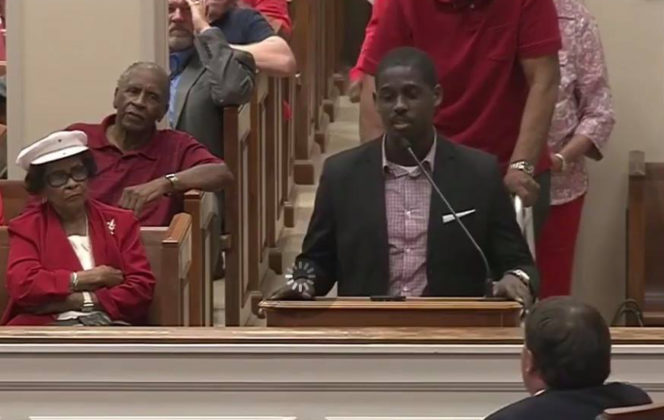
[/media-credit] Greg Fontus speaks to metro council about a waste processing plant. Among many affected residents is Terri Short, front left.
“We have heard council members say it’s futile to vote against the bill because Onsite says they will move anyway and just process grease, since the Jackson Law can only prevent the processing of landfill leachate and oil wastewater,” Forrester reports. “This is not a justifiable argument. According to the Tennessee Department of [Environment and] Conservation [TDEC, the agency that issues permits for landfills and treatment plants], the grease is only 60 percent of their business and it’s likely [that] preventing 40 percent of their revenue stream will … make it unprofitable for them to move…”
Some of Forrester’s neighbors made the same argument in the North Police Precinct after attending Hastings’ meeting Aug. 28.
Early on Wednesday, Aug. 29, while discussing the Jackson Law and its applicability to Onsite’s move, Dale addressed the profitability of the new site with only part of the treatment process removed from the old site.
“The Jackson Law has eight tests,” or criteria against which a proposed landfill, or treatment facility must be judged, Dale said. Since Onsite Environmental treats liquids — and much of its operation is recycling waste into fertilizer — there’s a question about whether the Jackson Law applies to any of the proposed processes for liquid wastes, especially since it is recognized as a law governing landfills for solid waste.
“Metro legal said, ‘Why take the chance?’” Dale said. “It’s a problem.”
If processing grease into fertilizer isn’t subject to the Jackson Law, will the other liquid waste’s processing be subject to the Jackson Law?
“I think not,” Dale said.
So, that unanswered question might become the subject for a Chancery Court lawsuit.
Much of the legal challenge to overturn a council denial of Onsite’s request might well rest on how the council justifies denial. In Marshall County, justification was specified by county commissioners moments before they cast their votes. Expansion of the landfill near Lewisburg was permitted eventually, but that was after Phil Bredesen’s term as governor ended and Bill Haslam began his first term as governor with a new commissioner of the Department of Environment and Conservation.
“Over 45 people … showed up” for a rally in the north precinct’s lobby to publicly explain their objections to Onsite Environmental, Forrester reports. “Later, the crowd grew to 120 people for the councilman’s meeting,” also attended by advocates of Habitat for Humanity homes, and another development, as well as Dale, and Combs’ lawyer, Tom White, and advocates for various other interests. White previously opined that the Jackson Law does not apply to Onsite’s processing, but Aug. 28, he made a distinction.
During the councilman’s district meeting, Danavan Hylton, CEO of B2B & B2C Consulting, distributed papers to coalition members so they could write questions to be answered by Onsite Environmental. Hylton was asked by The Tennessee Tribune about providing a link to his website, or one where answers might be posted. The idea was well-received. Hylton was contacted hours after the meeting about adding such a link to this website.
Accepting written questions from residents, Forrester says, is “quite a novel way of handling a crowd…
“We didn’t see any minds changed” during the presentation by Hylton or answers from White and Dale, Forrester states.
Nevertheless, area resident Kenyatte Tidwell spoke to an Onsite Environmental representative after the meeting.
“If you move, will you will you keep the same employees?” Tidwell asked, adding that the processing plant creates a bad odor. However, she complimented the manager as “awesome” and said she believes he works Monday through Friday. During weekend, she says, it seems that “the workers are not following protocol and procedures.”
If the processing plant is moved, it must meet environmental regulations that are more stringent than those enforced at the current site, which is grandfathered.
“Onsite is a good fit for the community” at the proposed location, which is near other industrial operations, Hylton said. Onsite Environmental, previously Combs Industrial Service, has been in business at the current site since 1988.
Hylton and Hastings also explained that the proposed site is appropriately zoned for Onsite Environmental’s new operation. That’s an important point because of the Jackson Law. Hastings emphasized that the land was rezoned when one of his predecessors was in office. Documents made available during the meeting substantiated the point, and include then-Mayor Karl Dean’s signature after an ordinance was passed by the council.
“We can’t rezone the property anymore,” Hastings said.
The grease plant shouldn’t stay the way it is today, Hastings said. If it’s moved, the processing must be inside a building.
White told the coalition members, “We’re here tonight because of … [Nick] Leonardo,” the former 2nd District councilman who sponsored, advocated and shepherded an ordinance that led to the city’s adoption of the Jackson Law; the statute that may well give the council authority to block state issuance of a permit for Onsite Environmental’s new site.
Dale contends that it’s better for the old grease plant to be closed and be replaced by a new facility. The immediate plan is to move it to a place that’s still in District 2.
“The old facility is old and it smells and creates the problem,” Dale said. There’s an image problem; that being: the plant will just be moved and will still smell bad.
Dale concedes that there is a lack of trust and that it’s an emotional issue. Long-time residents refuse to change their position that the grease plant near their homes must be shut down and reopened far away.
“It’s something that sticks in their craw and they can’t get over it,” Dale said.
During the public hearing Aug. 7 at the city council meeting, one of the area residents conceded that a more modern facility would be an improvement, and as long as it works and is operated properly, then there’s no problem. However, that’s not always the case and mistakes are made, he said.
This post originally appeared in the Tennessee Tribune.











Black Press
OP-ED: Washington Has a Chance to Save Veterans’ Lives
BLACKPRESSUSA NEWSWIRE — I became paralyzed watching young Marines go outside the base, thinking about their families and whether they would see them again. I began hallucinating that wounded Marines I cared for were walking toward me in the war zone. I now recognize that, alongside my own PTSD, I was carrying secondary PTSD from caring for wounded Marines.

I graduated from Marine Corps boot camp a couple weeks before September 11, 2001. I had no idea how profoundly 9/11 would change the trajectory of my life.
I went on to deploy to Iraq and Afghanistan. Between deployments, I worked at the Wounded Warrior Battalion in San Diego, supporting Marines as they rebuilt their lives. What I did not understand was how deeply I was absorbing their grief and losses.
That became clearer when I later deployed to Afghanistan during one of the deadliest periods of the war for Marines. I purposefully stopped counting the flag-draped coffins as they were loaded onto planes to return home, swallowing my grief so I could return to the mission.
I became paralyzed watching young Marines go outside the base, thinking about their families and whether they would see them again. I began hallucinating that wounded Marines I cared for were walking toward me in the war zone. I now recognize that, alongside my own PTSD, I was carrying secondary PTSD from caring for wounded Marines.
With every loss, I swallowed what I felt just to keep functioning. I kept moving forward, until everything I buried became impossible to ignore.
I did not recognize what was happening until five years after returning home. I sought help. Therapy helped me feel less alone, but my symptoms continued to affect my life and relationships.
My experience is not unique. 870,000 veterans receiving VA health care were diagnosed with PTSD in 2024. Since 9/11, nearly 150,000 veterans have died by suicide. Many continue searching for relief after available treatments have failed.
That is why veterans are cautiously hopeful about psychedelic treatments.
Studies of psilocybin for treatment-resistant depression show significant reductions in depressive symptoms, with up to one-third of patients achieving remission in some trials. Research involving veterans with PTSD found that 75% were in remission one month after psilocybin treatment.
I followed the research before pursuing psilocybin treatment myself. During that experience, I was finally able to access the grief I spent decades burying. It did not erase what happened or the memories of the Marines I lost. It changed my relationship with those memories. They no longer controlled my life.
I reconnected to the self I had lost and was able to feel joy and love again.
Psychedelic medicines are not a cure-all. But veterans pursuing them are not looking for shortcuts. Many have spent years doing everything the medical system asked while continuing to search for relief.
Our government is beginning to recognize the potential of new approaches.
This year, President Trump signed an executive order to accelerate research and reduce barriers to psychedelic treatments for serious mental illness. VA is conducting clinical trials of MDMA for PTSD and psilocybin for depression. In July, FDA finalized guidance for clinical trials involving psychedelic drugs.
If these treatments receive FDA approval, the healthcare system must be ready to deliver them responsibly — through DEA action, clear safeguards, and VA facilities prepared to provide care.
Our country asks a great deal of those who serve. If evidence demonstrates that these treatments are safe and effective, veterans should not wait years longer because Washington failed to prepare for success.
Juliana Mercer is a Marine Corps veteran and executive director of Healing Breakthrough. A version of this column was published in Stars and Stripes.
Black Press
OP-ED: Haiti TPS: Have We Lost Sense of Humanity?
BLACKPRESSUSA NEWSWIRE — The treatment of more than 300,000 Haitians living and working in the United States under Temporary Protected Status (TPS) presents such a moment. The Senate should pass S.4814, legislation that would extend TPS for Haitians for three years. The Senate’s Republican members hold a critical key to whether Congress will act before the midterm elections.

There are moments when a nation must decide, not simply what it has the legal power to do, but what its sense of humanity requires it to do.
The treatment of more than 300,000 Haitians living and working in the United States under Temporary Protected Status (TPS) presents such a moment. The Senate should pass S.4814, legislation that would extend TPS for Haitians for three years. The Senate’s Republican members hold a critical key to whether Congress will act before the midterm elections.
There are several reasons that the Haitian TPS question is a genuine crisis. First and foremost, Haiti is dangerously unsafe, and the justification for TPS could hardly be clearer.
Haiti continues to experience extraordinary violence and instability. United Nations and human-rights organizations report killings, kidnappings, sexual violence, displacement and widespread abuses by armed gangs. Millions of Haitians face acute humanitarian needs.[1]
Most tellingly, the U.S. Department of State warns Americans: “Do Not Travel” to Haiti, citing kidnapping, crime, terrorism, civil unrest and limited health care.[2]
That warning raises an unavoidable question: If Haiti is too dangerous for Americans to travel there, how can it be considered safe to compel more than 300,000 Haitians to return?
Congress created TPS precisely for circumstances in which armed conflict or extraordinary conditions make safe return impossible or inappropriate.[3] The documented conditions in Haiti meet that humanitarian standard many times over.
Let’s also clear up another misimpression. The Supreme Court in its June 25, 2026 decision in Mullen v. Doe did not order TPS to end and it did not order Haitians to be deported.
Rather, the Court ruled that the Department of Homeland Security (DHS) had the primary responsibility to decide when to grant TPS and that its decisions were not, in most instances, judicially reviewable.[4]
The decision therefore permitted the Administration’s termination of Haitian TPS to proceed, but the humanitarian question of whether it should proceed remains with the political branches. In other words, Congress retains its legislative authority to act. S.4814 is Congress exercising that authority.
For Haitians living under the threat of deportation, this is not an abstract legal dispute. The human cost is becoming painfully real.
Consider Pierre Damas Bel, a 20-year-old Haitian college student with a promising future, who lived in Springfield, Ohio. After losing his immigration protection, he was placed on an ICE ankle monitor. His family has described the profound psychological distress he experienced.
Bel subsequently died after stopping his car and walking into traffic on a crowded Ohio highway. His family believes it was suicide Authorities are investigating, and it would be irresponsible to claim that immigration policy alone caused his death. But his tragic story illustrates the human consequences of creating fear and uncertainty for people who have lived, studied and worked lawfully in this country and have no immediate expectation of returning home safely.[5]
There also is another compelling reason for Congress to act: Haitian TPS holders are caring for Americans.
Approximately 21,000 Haitian TPS holders work as caregivers and nursing assistants, serving an estimated 77,000 patients nationwide.[6] They care for seniors in nursing homes, assist people with disabilities and provide home care that allows vulnerable Americans to remain in their communities.
When experienced Haitian caregivers lose their legal ability to work, families must scramble to find replacements, nursing facilities face staffing shortages, and vulnerable people can lose caregivers they have trusted for years.
At a time when America already faces a serious shortage of direct-care workers, deporting thousands of experienced Haitian caregivers is not merely inhumane, it’s self-defeating and contrary to our nation’s own healthcare needs.[7]
The mass deportation of Haitians also presents a troubling humanitarian double standard that Congress should confront.
The Trump Administration has made a special effort to admit White South African Afrikaners as refugees, citing racial persecution and violence — a dubious claim at best. At the same time, it is stripping protection from Haitians whose country is experiencing catastrophic violence, death and insecurity.
The State Department currently rates South Africa for travel recommendations at Level 2—“Exercise Increased Caution.” Haiti is at Level 4—“Do Not Travel.”[8]
Every person facing genuine persecution deserves humanitarian consideration and protection, but humanitarian standards should be applied consistently. If America can recognize humanitarian danger facing White South Africans, surely it can recognize the documented and extraordinary danger confronting Black Haitians.
The disparity deserves congressional scrutiny—not because one group should receive less protection, but because humanitarian protection should not depend upon race or political convenience.
Finally, the Haitian TPS question should not be reduced to a partisan argument.
Republican Ohio Governor Mike DeWine has criticized the Administration’s approach to Haitian immigrants and warned of the consequences of ending TPS. Democratic Maryland Governor Wes Moore has likewise expressed opposition to returning Haitians to dangerous conditions.[9]
These governors understand that immigrants are not merely immigration cases. They are workers, taxpayers, caregivers, parents, students, neighbors and members of their communities.
The House of Representatives has already taken action and passed a bill to restore Haitian TPS.
The Senate’s Haitian TPS bill (S.4814) offers a measured response: three additional years of protection while Haiti confronts its extraordinary crisis. It is not amnesty! It does not grant citizenship or permanent residence. It does not repeal America’s immigration laws. It does, however, provide important and humane temporary protection while conditions make return to Haiti unsafe.
Our history tells us what happens when government treats human beings with hostility and indifference, and regards humanitarian appeals as inconveniences to be overcome.
America can and must do better.
The Senate now has an opportunity to demonstrate that America’s humanitarian principles apply consistently—to Black immigrants as well as everyone else. Republican senators hold a critical key to bipartisan action. Before the midterm elections, they should join Democrats in responding to this humanitarian imperative.
Our nation’s sense of humanity demands it.
Wade Henderson, Esq. is a civil and human rights attorney in Washington, DC. He serves as a Senior Advisor to the Haitian Bridge Alliance.
Endnotes
- United Nations Integrated Office in Haiti (BINUH), Human Rights Reports; Human Rights Watch, World Report 2026: Haiti.
- U.S. Department of State, Haiti Travel Advisory, Level 4—“Do Not Travel.”
- 8 U.S.C. §1254a(b)(1).
- Mullin v. Doe / Trump v. Miot, U.S. Supreme Court, June 25, 2026.
- Washington Post, “College student steps into traffic, is killed after losing immigration status,” Sept. 1, 2026; ABC News, Sept. 1, 2026. Authorities continue to investigate Bel’s death.
- Reuters, “US families, healthcare providers under strain after Trump crackdown on Haitian immigrants,” Aug. 19, 2026.
- Id.; see also reporting by LeadingAge concerning the impact of ending Haitian TPS on senior and disability care.
- U.S. Department of State, Haiti Travel Advisory; South Africa Travel Advisory.
- Reporting on statements by Ohio Gov. Mike DeWine and Maryland Gov. Wes Moore concerning Haitian TPS.
Black History
COMMENTARY: Battling Black Voter Distrust
HOUSTON DEFENDER — Black voters have long been a reliable base for the Democratic Party, but political strategists and voters indicate that years of inconsistent engagement and unfulfilled expectations have created a trust gap.

Black voters have been among the Democratic Party’s most dependable supporters for generations. But loyalty and trust are not the same thing.
With less than a month to go before the midterm elections, Black voters and political strategists say years of inconsistent engagement and unmet expectations have left some voters questioning whether the party has earned their continued support. The challenge now is bigger than winning votes. It’s convincing distrustful voters that staying politically engaged is worth it.

Communications strategist Ashley Etienne argues that Democrats have spent years taking one of their most reliable voting blocs for granted, creating a widening trust gap that threatens the party’s long-term prospects in Texas and nationally.
“Trust is the currency of persuasion,” she said. “We’re seeing distrust at an all-time high, especially with Black voters … distrust of the media, institutions, the Democratic Party, self-agreement. Campaigns don’t lose because they fail to talk to voters. They lose because they fail to listen.”
Etienne, who served as a senior adviser to Presidents Barack Obama and Joe Biden and communications director for Vice President Kamala Harris, said repairing that relationship requires something considerably more difficult than another campaign advertisement. It requires listening.
Black support remains strong, but not absolute
Recent polling suggests Democrats continue to hold a substantial advantage among Black voters heading into November, but that support isn’t universal.
A July 2026 Pew Research Center survey found 68% of Black registered voters said they would support the Democratic candidate for U.S. House in their district, compared with 8% who favored the Republican. Another 25% said they were either unsure or would support another candidate.

That uncertainty follows some erosion in Democratic support among Black voters in the 2024 presidential election. A Pew analysis of validated voters found 83% of Black voters supported Kamala Harris in 2024, compared with 92% who supported Joe Biden in 2020.
Pew found that shift was driven less by individual voters switching from one party to another than by differences in who turned out to vote.
The findings don’t suggest Black voters have abandoned Democrats. They do raise questions about whether longstanding party loyalty is enough to guarantee participation.
“We’ve been making that same argument decade after decade,” Etienne said. “Those are becoming less persuasive arguments.”
Why is trust disappearing?
The distrust isn’t necessarily about one candidate or one election. For some Black voters, frustration comes from feeling heavily courted during election season without seeing enough progress afterward on the issues affecting their daily lives.
Housing costs remain a concern. So do education, economic opportunity, neighborhood investment, and the cost of everyday necessities.
That creates a difficult dynamic for campaigns: Asking voters to participate in a political system that some believe has not delivered enough for them.
It also raises a separate question. What happens when frustration with political parties becomes disengagement from the political process altogether?
What happens when voters stay home?
The answer can become particularly consequential in local elections, where races can be decided by hundreds of votes rather than thousands.
Harris County Democratic Party Chair Traci Gibson has pointed to several 2024 judicial races decided by narrow margins. District judge candidate Elaine Palmer lost by 304 votes, while Jeralynn Manor lost by 647 votes.
Gibson also warned about voters who begin Harris County’s lengthy ballot but don’t finish it.
“If you go into these polls and you vote for the first five people and then you leave, that’s how we get Elaine Palmer losing by about 300 votes,” Gibson said.
The larger issue extends beyond any candidate or political party. Judges are elected. School boards make decisions affecting students and families. City and county officials determine how public dollars are spent. State lawmakers decide which bills become state law.
Those decisions are made regardless of how many eligible voters participate.
“We have to have strategies, we have to have plans, we have to have a mechanism in place for people to feel they are heard.”
Karla West
For voters distrustful of political parties or government institutions, political participation also doesn’t have to mean unquestioning loyalty to either party.
Voters can research candidates individually, compare their positions, attend or watch candidate forums and examine an incumbent’s record against previous campaign promises. They can also learn what the often-overlooked offices farther down the ballot actually control.
In that sense, distrust can become a reason for greater scrutiny rather than disengagement.
Candidates have work to do, too
Responsibility for rebuilding participation doesn’t fall solely on voters.
At a recent Third Ward town hall hosted by state Rep. Jolanda “Jo” Jones, Harris County Precinct 7 Constable James “Smokie” Phillips and Houston Black American Democrats, voters and political strategists called for more sustained campaign engagement.
“Investment drives outcomes. If you don’t invest in it, it doesn’t work,” Etienne said.
She argued that campaigns spend heavily on polling, consultants and advertising while directing too little money toward Black-led political infrastructure and organizations with established relationships in Black communities.
Shamier Bouie, chair of Houston Black American Democrats, said organizing cannot begin a few months before Election Day.
“It’s all about year-round organizing, and increased investment in Black voter outreach … more funding for Black-led organizations that have relationships, infrastructure, and experience in effectively engaging Black communities,” Bouie said.
The question of investment also surfaced in July when Democratic U.S. Senate candidate James Talarico pledged $25 million toward Black voter outreach. Some voters wanted specifics about where and how that money would be spent.
“We still need our kids, we still need our schools equitably funded,” said Augie Cahee, vice president of marketing web delivery at JPMorgan Chase & Co. “So, we want to know what you’re going to do with the money. Don’t stand up and tell me $25 million and you don’t have a plan.”
The exchange illustrated the larger trust problem: Voters aren’t simply asking candidates to talk to them. They want to know what happens after the conversation.
From distrust to accountability
Karla West, a precinct chair for downtown’s Precinct 16, said responsibility ultimately belongs on both sides.
“We fell asleep at the wheel,” West said of voter turnout.
But she also challenged political leaders.
“The Democratic Party did not say what they would do for you,” West said. “We haven’t heard a plan for years. I’m sick of it. We have to have strategies, we have to have plans, we have to have a mechanism in place for people to feel they are heard.”
Defender Reporter Tannistha Sinha contributed to this report.
Based on reporting by Houston Defender.
Black Press
COMMENTARY: Property Is Power! What Is a Gift of Equity and What Could It Mean for Black America?
MICHIGAN CHRONICLE — For many Black families, a significant hurdle to homeownership is not the monthly mortgage payment, but rather the initial costs such as down payments, closing costs, and other cash requirements. This can delay homeownership for years, even for individuals with stable careers, good income, and reasonable credit.
For generations, the conversation about Black wealth has focused on what we do not have: not enough savings, not enough access to capital, not enough homeownership and not enough inherited wealth. Those realities matter, and the disparities behind them are real but there is another question worth asking: What are we doing with the wealth we already have?
That question deserves more attention because one of the greatest barriers to homeownership is often not the ability to make a monthly mortgage payment. It is the ability to get through the front door the down payment, closing costs and cash required to purchase a property in the first place. For many Black families, that initial hurdle can delay homeownership for years, even when someone has a stable career, good income, reasonable credit and the financial capacity to sustain a mortgage.
Yet in some families, part of the solution may already be sitting within the family itself.
Across Black America, there are parents, grandparents, sisters, brother, aunt and uncles who may not consider themselves wealthy but who own something extraordinarily valuable equity. They purchased homes decades ago, made mortgage payments month after month, raised families in those homes, maintained them through recessions and difficult economic periods and, over time, watched those properties appreciate. A house purchased for $50,000 or $75,000 may today be worth $250,000, $300,000 or considerably more.
That difference represents more than appreciation on a financial statement. It represents years of work and sacrifice converted into an asset and therein lies a tremendous opportunity.
A gift of equity allows a homeowner, typically in a transaction involving family, to sell a property for less than its appraised market value and transfer some of the difference to the buyer as equity. Subject to the requirements of the mortgage program, that equity can potentially be used toward the buyer’s down payment and, in some circumstances, closing costs.
Example. Suppose a mother owns a home that appraises for $300,000. She wants to sell it to her daughter for $240,000. The $60,000 difference between the appraised value and the sales price can potentially become a gift of equity. The mother does not have to withdraw $60,000 from a bank account and hand it to her daughter. The wealth is already there it has been accumulating inside the property.
That is what makes this strategy so important to understand. We frequently talk about the difficulty of saving a down payment without asking whether a family may already possess an asset capable of helping overcome that barrier. A son or daughter could spend another five or ten years attempting to save enough money to purchase a home while a parent or grandparent is sitting on substantial equity accumulated over several decades.
The family has wealth it simply may not be liquid.
A gift of equity can create a bridge between those two realities. The previous generation may have spent 30 years building equity so that the next generation does not have to begin at zero. That is one of the deeper meanings of generational wealth. It is not simply about leaving something behind after we die. It is about understanding whether the assets one generation has built can improve the economic starting position of the generation that follows.
For Black families, that distinction is especially important we have spent generations fighting for access to property and the opportunity to own it. As more Black families acquire homes and build equity, the conversation must eventually expand beyond the question of how we create more first-generation homeowners. We must also ask how the ownership already achieved by one generation can help create ownership in the next.
This requires us to think differently about inheritance. We often imagine inheritance as an event that occurs at the end of someone’s life, when assets pass through a will, trust or estate. But property gives families another possibility. Under the right circumstances, real estate can be used to transfer economic opportunities while parents and grandparents are still alive to participate in the process and see what the asset they spent decades building can do for the next generation.
A parent may not have $100,000 sitting in a savings account that does not mean the parent has nothing substantial to give. The family home may be the largest asset that person owns, and this points to a distinction that is essential to any serious conversation about wealth income is what we earn; wealth is what we own.
A family can have relatively modest income and still possess meaningful wealth because a home purchased decades earlier has appreciated while its mortgage has steadily been paid down. This matters for Black America because the racial wealth gap cannot be understood solely as a question of wages and income. It is also a question of ownership, assets and whether those assets successfully move from one generation to another.
Return to the mother with the $300,000 home. She could sell the property on the open market, receive the proceeds and allow the house to leave the family. There is nothing inherently wrong with that decision. She earned that equity, and her own financial security must matter. But suppose her circumstances allow another choice. She sells the property to her daughter for $240,000 and provides $60,000 through a gift of equity.
Her daughter may now be able to purchase a home she otherwise could not have acquired because she lacked sufficient cash. More importantly, she does not necessarily begin her ownership journey at zero. She enters it with equity. If she manages the property responsibly, makes the mortgage payments, maintains the home and allows time and amortization to work, the economic value accumulated by one generation has the potential to continue growing in another.
The mother has therefore transferred more than a house she has transferred a financial head start.
That is when property becomes more than shelter it becomes capital.
None of this means that a gift of equity eliminates financial responsibility or the normal requirements of obtaining a mortgage. The buyer still has to qualify. A lender will evaluate credit, income, debt and the ability to repay the loan. The property generally must be appraised, title requirements must be satisfied and the transaction must comply with the rules of the mortgage program.
There is documentation as well. A lender will generally require a gift-of-equity letter identifying the parties, their relationship, the amount of the gift and confirmation that repayment is not expected. That final requirement matters because a gift cannot secretly be another loan. If a parent provides $50,000 in equity but expects the child to repay the $50,000 later, it is not a true gift for mortgage purposes.
The larger issue, however, is not the paperwork. It is what happens to Black-owned property over time. For much of American history, Black families faced enormous barriers to acquiring property in the first place. Redlining, restrictive covenants, discriminatory lending and unequal access to mortgage credit limited where Black Americans could purchase homes and whether they could obtain the financing necessary to do so. Against that history, when a Black family has managed to acquire property, pay for it, preserve it and accumulate substantial equity over decades, we should understand what has been created.
It is not simply a house it is an asset, and assets require strategy.
Before a family property is simply listed for sale, there should be a deeper conversation around the kitchen table. What is the property actually worth? How much equity has accumulated? Is there someone in the next generation who wants the home and is financially capable of maintaining it? Could that person qualify for financing? Could a gift of equity help make the transaction possible? And perhaps most importantly, what do we want this asset to accomplish for our family?
Generational wealth rarely happens by accident. Someone has to think beyond today’s transaction and understand that the equity accumulated over 20, 30 or 40 years represents stored economic power.
A gift of equity will not be appropriate for every family, and it is certainly not a solution by itself to the racial wealth gap. But it illustrates a much larger principle. We should not spend all of our time discussing the wealth Black America has yet to build while overlooking the wealth that millions of Black families have already spent generations creating.
That is what it means to turn ownership into legacy.
Property is Power. And when property passes from one generation to the next with knowledge, planning and purpose, that power can outlive us.
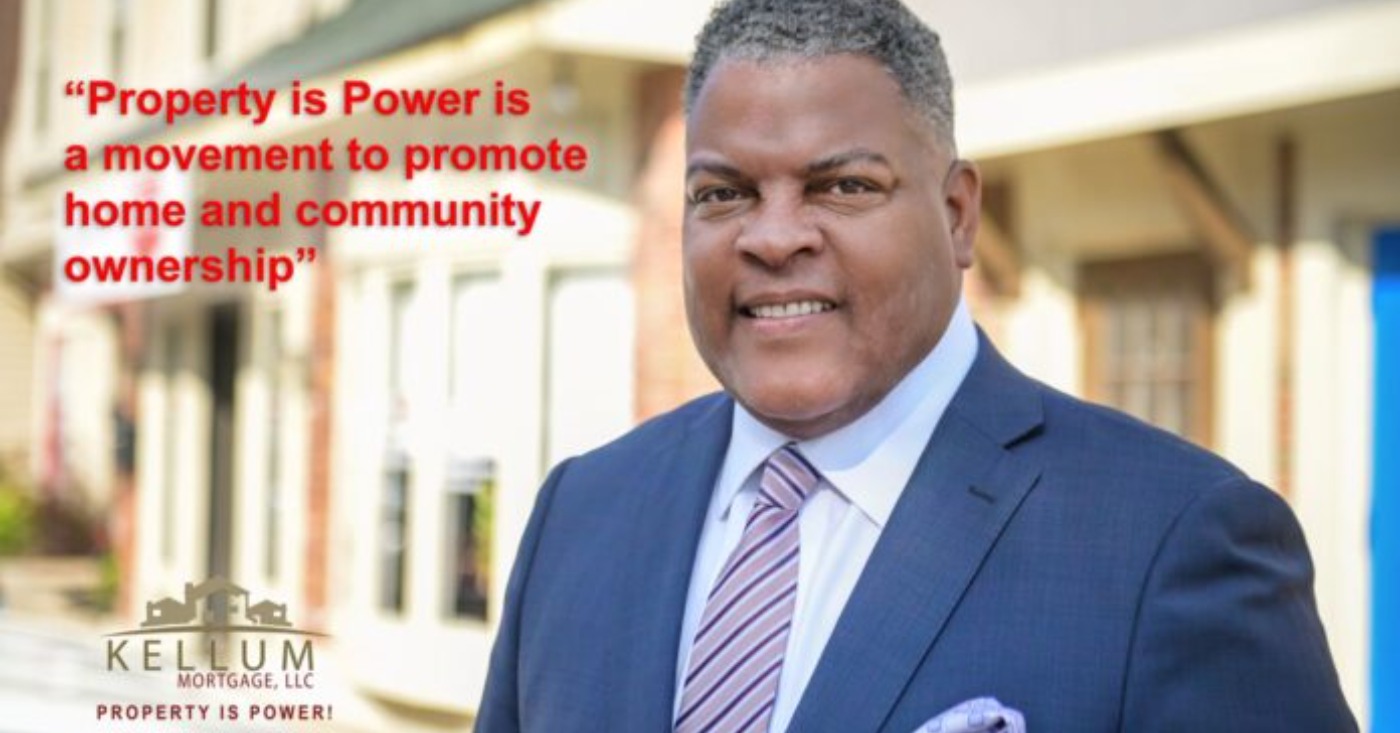
Property is Power! is a movement to promote home and community ownership. Studies indicate homeownership leads to higher graduation rates, family wealth, and community involvement.
Based on reporting by Michigan Chronicle.
Art
From Ma Rainey to AI: New Technology Amplifies an Old Fight over Artist Control
HOWARD UNIVERSITY NEWS SERVICE — August Wilson’s “Ma Rainey’s Black Bottom” explores Ma Rainey’s struggle for control over her music during a 1920s recording session, highlighting conflicts over art, money, and power dynamics between musicians and business interests. Round House Theatre’s production, running through October 18 in Bethesda, Maryland, stages this historical fight, drawing parallels to contemporary issues.

In August Wilson’s “Ma Rainey’s Black Bottom,” Ma Rainey fights to control what happens to her music once she enters the recording studio. Today, musicians are confronting a new question: What happens when artificial intelligence can profit from the identity attached to their music?
Round House Theatre’s production of “Ma Rainey’s Black Bottom,” which runs through Oct. 18 in Bethesda, Maryland, brings an older struggle over artistic control to the stage. Set during a recording session in 1920s Chicago, Wilson’s play follows Ma and her band as conflicts over art, money and control expose the imbalance between the musicians creating the work and the people conducting the business around it. That same question of who can profit from an artist’s value is now being tested in a very different setting nearly a century later.

Musicians Jason Isbell, David Lowery, Guy Forsyth and Eduardo Calle filed a class-action lawsuit on Aug. 31 against AI music company Suno. They allege that the company commercially exploits artists through an AI system capable of generating music imitating artists’ identities and styles without permission. Suno disputes the allegations.
The U.S. Copyright Office has also studied AI-generated digital replicas and recommended federal legislation to address gaps in protections against unauthorized replicas of a person’s voice or appearance. Its broader AI inquiry received more than 10,000 public comments.
For Nicole Michelle Haskins, who portrays Ma Rainey in the Round House production, the struggle over power begins with understanding Ma as more than a demanding recording star.
“She is the only advocate she has,” Haskins said. “The choices presented to her are to surrender or fight. Ma chooses to fight.”

Haskins said Ma enters the recording studio knowing the value that she brings, even as the people around her repeatedly challenge her decisions. She exercises her leverage and pushes back when others attempt to dictate how the session will proceed.
The real Gertrude “Ma” Rainey was one of the earliest Black women to record blues commercially. Between 1923 and 1928, she made more than 100 recordings for Paramount Records, according to the Smithsonian.
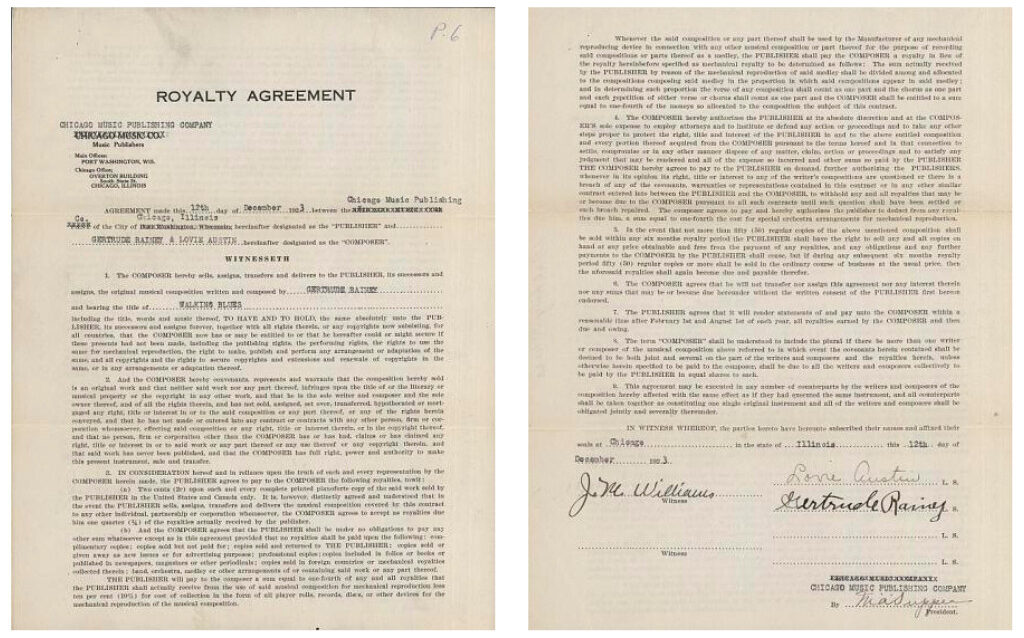
One surviving agreement shows how at least part of that business worked. A Dec. 12, 1923, royalty agreement for “Walking Blues,” signed by Rainey and composer Lovie Austin, provided them two cents for each printed piano copy sold in the United States and Canada. They were also entitled to one-fourth of the royalties the publisher received from mechanical reproductions, minus a 10% collection cost.
For Haskins, portraying a character negotiating those relationships does not feel entirely removed from being an artist today.
“The life that I live as an artist is not that dissimilar from the world that August Wilson has written,” Haskins said.
The technology surrounding artists, however, has changed dramatically.
The scale of AI-generated music has grown quickly. In July, streaming service Deezer said it was receiving about 90,000 fully AI-generated tracks a day, more than half of its daily uploads. Those tracks accounted for less than 3% of all streams.
The lawsuit against Suno is not primarily a traditional copyright case about whether an AI-generated song copied a particular recording. Instead, the musicians rely largely on state right-of-publicity laws, which concern the commercial use of a person’s identity.
According to the complaint, users can enter musicians’ names and use them as a retrieval key for AI-generated music drawing on characteristics associated with those artists. The plaintiffs argue that an output does not have to copy a specific song or perfectly reproduce an artist’s voice for the artist’s commercial identity to be exploited.
Suno disputes that characterization of its technology. The company has said it does not use artists’ names as training metadata and does not permit users to prompt its system for specific artists. Suno says references to artists are filtered and redirected toward descriptions of musical characteristics. Its own prompting guide, for example, encourages users to describe features such as tempo, vocals and instrumentation, using phrases like “bright pop track,” “110 BPM,” “female vocals” and a “big synth hook.”
The Suno dispute centers on more than ownership of a particular song or recording. It raises the question of whether an artist’s name, likeness and other identifying characteristics can be used commercially to generate new music without permission.
Haskins resists describing that underlying conflict as merely contemporary.
“I don’t think they feel contemporary,” Haskins said of Ma’s concerns. “I think they feel worldly.”
For Haskins, AI is one setting for a larger struggle over who has power over creative work. She said the problem of Black people being separated from control of things they created has existed far longer than the technology now raising those questions. The Library of Congress notes that early record companies sometimes used white performers to record music associated with Black artists rather than hire the Black performers themselves, while Black musicians remained rare on early commercial recordings.
“It just hasn’t stopped happening,” she said.
That interpretation shapes the way Haskins portrays Ma’s fight for control. She pointed to a brief moment in the second act when Ma’s manager attempts to steer her toward a different song. Ma refuses and proceeds with the recording she intends to make.
Haskins said the moment stands out precisely because Ma does not need a dramatic confrontation to establish who has the final say.
“She’s not demanding control. She’s not asserting control,” Haskins said. “She is simply positioning herself in correct order.”
La Tetra Metts-Owens is a reporter forHUNewsService.com. She covers Prince George’s County and theater.
Based on reporting by Howard University News Service.
Black Press
TILGHMAN: Why Parents of Children with IEPs Should Know Their School Bus Driver
WASHINGTON INFORMER — Parents of children with Individualized Education Programs (IEPs) often face unique considerations regarding their child’s school transportation. Ensuring consistency and understanding their child’s needs on the bus can be a significant concern.

As the father of a young daughter with autism, I have learned that getting your child to school is not always as simple as putting them on the bus and waiting for them to come home.
When your child has an Individualized Education Program, you pay attention to things other parents may never have to think about.
Who is working with my child today? Does this person understand her needs? What happens if her routine suddenly changes? If something goes wrong and she cannot fully explain it to me, who will be able to tell me what happened?
Those questions do not stop at the schoolhouse door. They follow our children onto the school bus.
That is why one of the simplest pieces of advice I can give another parent of a child with an IEP is this: Get to know your child’s bus driver and attendant.
Learn their names. Introduce yourself. Say good morning. Ask how your child is doing on the ride.
Those few minutes can matter more than we realize.
For some children with disabilities, consistency is incredibly important. The same bus, the same driver, the same seat and the same routine can provide a sense of comfort before the school day even begins.
Then one morning, something changes.
The bus is late. There is a substitute driver. The route changes. The bus does not arrive when expected.
For many families, that is an inconvenience. For some of our children, it can change the entire morning.
As parents, we also know that our children may not always come home and tell us exactly what happened during the ride. That makes the adults who interact with them even more important.
A bus driver may notice that your child suddenly does not want to get on the bus. An attendant may notice that your child seems upset at the same point along the route every day.
They may notice a change in behavior, a problem with another student, or simply that something seems different.
That information can be valuable to a parent.
But relationships work both ways.
Parents can also help transportation staff understand our children. You do not have to share every detail of your child’s disability or educational record. But appropriate information about communication, behavior, safety or transitions can help the adults responsible for transporting your child better understand how to support them.
And when a transportation problem occurs, you are no longer starting the conversation with a complete stranger.
That does not mean parents should be responsible for fixing school transportation. We shouldn’t.
School systems remain responsible for providing required transportation services, including services identified in a student’s IEP. When buses are repeatedly late, accommodations are not being followed or transportation problems interfere with a child’s education, parents should document those concerns and raise them with the appropriate school and transportation officials.
Building a relationship with a driver should complement accountability, not replace it.
That distinction is important.
As a father navigating special education, I have learned that advocacy is not only about what happens during an IEP meeting.
Advocacy happens in the hallway. It happens at pickup. It happens through an email to a teacher. And sometimes it happens at the bus stop at 7 o’clock in the morning.
Our children’s educational experience begins before they enter the classroom and continues after they leave it.
Think about the person behind the wheel.
For some children, their bus driver is the first school employee they see every morning and the last one they see every afternoon.
That person is part of your child’s school experience.
So tomorrow morning, if you haven’t already, introduce yourself.
Learn the driver’s name.
Let them learn your child’s name — and, when appropriate, a little about what helps your child succeed.
It won’t prevent every late bus, substitute driver or transportation problem.
But if there is one thing I continue to learn as both a father and an advocate, it is that relationships matter.
And for children with IEPs, one more adult who knows, understands, and cares about your child can make a difference.
Based on reporting by Washington Informer.


Here is what you need to know about finding unique white elephant gift ideas that everyone wants to steal

Check out these proven ways to increase property value for commercial business locations

Lutheran North Celebrates Homecoming With 40 to 19 Win Over Westminster Christian

Luxury Car Features: Harman Kardon & More! #shorts

Tuskegee Airmen Field Reopens in The Ville, Giving St. Louis Youth a Place to Grow

2027 Chevy Bolt: Worth $29,990? Hidden Flaws Revealed! #shorts

Kia Seltos Luxury Car Tech: Prestige Package Features Explained! #shorts

Serena Williams: The Beast Narrative & Black Womanhood #shorts

Black Men Shattering Stereotypes: Intelligence Beyond Assumptions #shorts

Vegetarian Switch: My Brother’s Fasting Journey Inspired Me #shorts

Latest Massacre in Haiti Reveals Cruelty U.S. Deportations

Black Americans Have Doubts About the U.S. Food System

When Praises Go Up: SUGC Nominated for Prestigious Stellar Award.

Booked and Unbound: The Legacy of Black Women’s Literary Circles

U.S. Sole Nation to Oppose U.N. Resolution Correcting Africa’s Size on World Maps

COMMENTARY: Big Mama Said ‘Don’t Let Grief Break the Bank’

Prostate Cancer is Twice as Likely to Kill Black Men. Talking to Your Doctor Could Help Save Your Life

Outnumbered: Elbert Cox’s Equation for Greatness

The Youngest American Killed in the Vietnam War

U.S. Open Influencers Spark Backlash over Ring Lights, Filming as Gauff and Osaka Speak Out
Lutheran North Celebrates Homecoming With 40 to 19 Win Over Westminster Christian
Luxury Car Features: Harman Kardon & More! #shorts
Tuskegee Airmen Field Reopens in The Ville, Giving St. Louis Youth a Place to Grow
2027 Chevy Bolt: Worth $29,990? Hidden Flaws Revealed! #shorts
Kia Seltos Luxury Car Tech: Prestige Package Features Explained! #shorts
Serena Williams: The Beast Narrative & Black Womanhood #shorts
Black Men Shattering Stereotypes: Intelligence Beyond Assumptions #shorts
Vegetarian Switch: My Brother’s Fasting Journey Inspired Me #shorts

Serena Williams: The Beast Narrative & Black Women’s Burden #shorts

Giving Back: 100 Book Bags for Twin Cities Youth #shorts
-
 Black History6 days ago
Remembering Chauncey Bailey as Student Journalists Face Threats to Truth-Telling
-

 Black Press3 days ago
OP-ED: Haiti TPS: Have We Lost Sense of Humanity?
-

 Black Press6 days ago
Poll: Becerra Widens His Lead Over Hilton; Californians Split on Wealth Tax
-

 Black History6 days ago
COMMENTARY: The Audacity of Joyce Beatty
-

 Black History5 days ago
Rulings Leave Questions Lingering in Nolan Wells Case
-

 Black History5 days ago
Baptist Minister Says Black Church Champions for Civil Rights to Reign but Hesitates to Let Black Women Lead
