
Featured
OP-ED: Why Is the Black Vote Still Being Treated Like a Political Piñata?
Jeffrey Boney says that, on the surface, African Americans are marketed to as if their sacred votes means so much, but historically that often changes once their votes are cast.


By Jeffrey L. Boney (NNPA Newswire Political Analyst)
When it comes to politics in this country, there is one thing that seems to be a constant—the Black vote is important and always tends to make a difference.
Although Blacks make up roughly 13 percent of the overall population in the United States, Black voters remain a powerful voting bloc that can change the trajectory of any election.
Now, it is no secret that Black people overwhelmingly vote for Democratic candidates in nearly every national election, with identical results being shown in local and state elections.
Even in elections where a race is considered to be nonpartisan, such as for a Mayor or City Council seat, Black people have historically voted for the candidates that have self-identified or campaigned as a Democrat.
While this has been the norm for decades, Black people have been on the receiving end of neglect and disparate treatment by candidates who win with the overwhelming support of the Black vote.
It is an interesting phenomenon to watch, as Black people are strategically sought after and courted for their vote, with the hope of securing their collective support for specific candidates or certain issues. Black people are typically courted with the same archaic methods to get them registered and to the polls, while providing limited resources for voter outreach and education.
On the surface, African Americans are marketed to as if their sacred vote means so much, but historically that often changes once their vote is cast.
The way African American voters are treated, it is as if they have become a political piñata.
You know what a “piñata is right?
According to the Merriam-Webster dictionary, a “piñata” is “a decorated container filled with candies, fruits, and gifts that is hung up at parties or celebrations and hit with a stick by blindfolded persons until it is broken and the things inside it fall out.”
As it relates to voting, African Americans are often treated like the treats on the inside of a piñata. They don’t care how they get Black votes, they just want that vote no matter how Blacks are treated or handled. Blacks are consistently pounded and beat over the head with political messages during campaign season until they give up their precious and valuable vote. Then once that piñata is finally opened, or in this case when the Black votes are finally cast, Black voters are either forgotten or vilified depending on the outcome of the race.
The routine is simple. When the results don’t go the way those who courted the Black vote wanted it to go, they blame the Blacks for the results. However, when the outcome is favorable to those who courted the Black vote, they celebrate the results, reap the benefits and then essentially ignore those same loyal, African American voters after the election is over.
Because Black voters overwhelmingly vote for Democratic candidates, it would make sense for the Democratic Party to avoid treating Blacks like piñatas and taking them for granted.
At a recent plenary session at the National Association of Black Journalists (NABJ) Annual Convention in Detroit, Democratic National Committee Chair Tom Perez emphatically stated that the Democratic Party had become notorious for taking African Americans for granted.
“Shame on us for taking African Americans for granted,” said Perez. “We can’t allow that to happen again and we won’t allow that to happen again under my watch. We can’t criticize Black voters for not showing up, because it’s not on them. It’s on the Democratic Party to show up and put our money where our mouth is to better organize in the African American community.”
History shows us that beginning with the Civil War era and through the early part of the 20th century, Blacks voted heavily Republican. One key factor for that was the decision for Republican President Abraham Lincoln to push for and pass the Emancipation Proclamation.
After the passage of the Emancipation Proclamation, the Ku Klux Klan began to terrorize Blacks with threats of violence to discourage them from voting, while strongly putting a fear in Blacks to avoid supporting Republican candidates, unless they wanted to be lynched. The Democratic Party, at that time, did not solicit Blacks to be a part of their party, primarily because the majority of the members of their party were White, segregationist politicians who governed Southern states.
Many Blacks who lived in the South were prevented from participating in the political process. It wasn’t until 1924 that Blacks were even permitted to attend Democratic conventions in any official capacity.
That changed in 1948, when Harry Truman received roughly 77 percent of the Black vote. It was at the point that many Blacks began to self-identify as Democrats. However, not all Black people were ready to switch so fast. It took a few more years for Blacks to shift to the Democratic Party in the way they have today.
In 1956, Republican Dwight D. Eisenhower got 39 percent of the Black vote and four years later Republican Richard Nixon got 32 percent of the Black vote in 1960. However, once President Lyndon B. Johnson championed the landmark Civil Rights Act of 1964, while his Republican opponent Senator Barry Goldwater openly opposed it, the almost full migration to the Democratic Party by African Americans had begun. Johnson received 94 percent of the Black vote that year.
The following year President Johnson signed the Voting Rights Act of 1965 into law and ever since, no Republican presidential candidate has gotten more than 15 percent of the Black vote.
African Americans are more than just a vote. Blacks have sacrificed and contributed mightily to the betterment of our nation, and to our state and local governments. No political party should ever treat the Black community and Black voters like political piñatas. Black people need to receive the same type of support and political respect as all other groups of people in this country. If African Americans aren’t respected and are continuously treated like political piñatas, then they might just become galvanized to the point where they either switch political parties or create their own—whatever it takes to avoid becoming a proverbial political piñata.
This upcoming midterm election in November, along with the events leading up to it, will be telling and will show how much effort the Democratic Party has done to engage their loyal voting bloc – Black voters.
The National Newspaper Publishers Association (NNPA), which represents over 200 Black-owned media companies across the U.S., has been focused on encouraging 5 million Blacks to register to vote and go to the polls before the midterm elections in 2018. The NNPA is calling on the Democratic Party, the Republican Party and all of their affiliates to invest in voter outreach utilizing Black newspapers across the country and to join the NNPA’s efforts to get Blacks registered and to the polls in November.
Jeffrey Boney is a political analyst for the NNPA Newswire and BlackPressUSA.com and the associate editor for the Houston Forward Times newspaper. Jeffrey is an award-winning journalist, dynamic, international speaker, experienced entrepreneur, business development strategist and founder and CEO of the Texas Business Alliance Follow Jeffrey on Twitter @realtalkjunkies.









Featured
Defender ONE-on-ONE: U.S. Rep. Christian Menefee
Texas Congressman Christian Menefee reflects on his first 250 days in the U.S. House. Hear his insights on legislative priorities, minority party challenges, and why every vote matters.

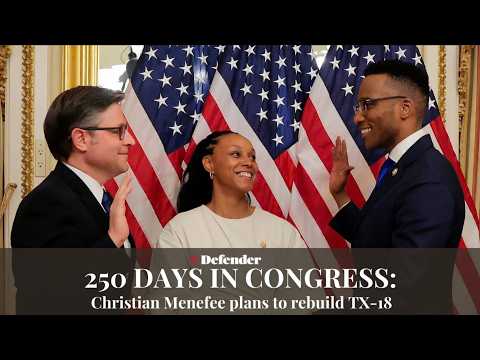
In an exclusive interview with The Defender, Texas Congressman Christian Menefee sits down to reflect on his first 250 days serving in the U.S. House of Representatives.
Congressman Menefee shares key insights into his legislative priorities, introducing new bills, and navigating the day-to-day challenges of serving in the house minority. He breaks down why every vote matters in shaping our communities and offers a preview of the urgent legislative issues he plans to tackle next.

In this video, you’ll hear about: • Reflections on his first 250 days in Congress • Key legislation introduced and priority bills • Navigating the realities and strategy of serving in the house minority • Why civic engagement and voter participation remain critical • What lies ahead on his legislative agenda

Subscribe to The Defender for more exclusive political coverage, interviews, and community insights!
Sign-up for the Top 5 newsletter
Donate/ Support Our Work
#ChristianMenefee #USCongress #TexasPolitics #TheDefender #CommunityNews #CivicEngagement #houseofrepresentativeselection2026
Chapters
0:00 Introduction and the Importance of Voting
1:12 First 250 Days and Improving Constituent Services
2:40 Oversight Committee and Environmental Justice
4:05 Rebuilding an Empty Congressional Office
6:10 The SET Act: Ending Vacancies in Representation
8:25 Life in the Minority and Playing Defense
10:45 Foreign Policy, Inflation, and Gas Prices
12:50 Economic Goals: Child Care and Housing
14:20 Redistricting and Respecting Leadership
16:15 The Rotisserie Chicken Vote and SNAP Benefits
18:20 Congressional Black Caucus Highlights
19:45 Final Call to Action for Texas Voters
Make sure to check your voter registration status and head to the polls to make your voice heard in the upcoming election. If you found this update helpful, please like this video and subscribe to stay informed on the issues that matter most to your community. 📢
#TexasPolitics #Congress #Houston #VotingRights #ChristianMenefee
Visit Our Website
Read more stories by our team
https://defendernetwork.com/category/news/opinion/
Black Enterprise
How To Manage Conflict at Work
Learn to leverage conflict, not avoid it! Unlock performance and profits with these expert tips.

Leadership consultant Dethra U. Giles, founder and CEO of ExecuPrep and author of “That’s Not What I Said: Master Conflict With Conversational Competence,” shares her framework for how to stop avoiding tough conversations at work and instead how to start leveraging conflict to unlock performance, productivity, and profits.
Black Enterprise
How To Overcome Financial Setbacks and Win
Layoffs and uncertainty hitting hard? Learn to leverage your mindset and make wealthy decisions to overcome financial setbacks. You can win!

The lives and livelihoods of millions of working professionals, especially Black women, continue to be disrupted by layoffs and economic uncertainty. The difference between surviving and thriving starts with leveraging your greatest asset—your mindset. Money expert and author Dominique Broadway, founder and CEO of Finances De*mys*ti*fied, joins the BE Wealth Accelerator podcast series with a powerful message of encouragement: You can overcome setbacks, face your financial challenges head on, and win—one wealthy decision at a time.
Black Enterprise
How To Overcome Financial Setbacks and Win
Don’t let economic uncertainty derail your dreams. Learn to leverage your mindset, face financial challenges, and win one wealthy decision at a time.

The lives and livelihoods of millions of working professionals, especially Black women, continue to be disrupted by layoffs and economic uncertainty. The difference between surviving and thriving starts with leveraging your greatest asset—your mindset. Money expert and author Dominique Broadway, founder and CEO of Finances De*mys*ti*fied, joins the BE Wealth Accelerator podcast series with a powerful message of encouragement: You can overcome setbacks, face your financial challenges head on, and win—one wealthy decision at a time.
Featured
Sports Talk: Texans vs Cowboys
Sports Talk: Texans vs. Cowboys – Get the latest analysis and opinions on the big game. Visit Defender Network for more!
Visit Our Website
Read more stories by our team
https://defendernetwork.com/category/news/opinion/
Sign-up for the Top 5 newsletter
Donate/ Support Our Work
Black Enterprise
Social Media Success through Songs
Teach music appreciation with catchy tunes! See how Brandon A. Booth turns popular songs into viral lessons.

From Michael Jackson and Beyonce, to the “Pink Panther” and “Law & Order” theme songs, you’ve probably seen lots of viral videos with hundreds of thousands of views of music students learning popular songs, while using the solfège system of “do re me fa so la ti do.” The beloved music instructor introducing music appreciation to a new generation —in the classroom and on social media — is Brandon A. Booth, Arts Department Chair & Director of Vocal Music at ConneXions: A Community Based Arts School in Baltimore. The Hampton University alum discusses his journey as a Grammy-nominated music educator turned social media sensation, while sharing his love for music with students.


Why A Black Bank Started From A House #shorts

Defender ONE-on-ONE: U.S. Rep. Christian Menefee

How To Manage Conflict at Work

How To Overcome Financial Setbacks and Win

How To Overcome Financial Setbacks and Win

Sports Talk: Texans vs Cowboys

Car Warranty Explained: Battery, Maintenance & Roadside #shorts

Social Media Success through Songs

2026 Voting Guide: Every Candidate and Proposition Explained!

From The Desk of The Editor 10/07/26

Latest Massacre in Haiti Reveals Cruelty U.S. Deportations

The Youngest American Killed in the Vietnam War

Booked and Unbound: The Legacy of Black Women’s Literary Circles

Passing for White, Fighting for Black America: The Courage of Walter White

OPINION: Nolan Wells’ Death One of Several Signifying Racial Terror Lives on in U.S. South

Prostate Cancer is Twice as Likely to Kill Black Men. Talking to Your Doctor Could Help Save Your Life

OP-ED: Haiti TPS: Have We Lost Sense of Humanity?

OP-ED: If AI Is the New Language of Power, Then NAN Wants Black Communities Fluent

OP-ED: How Does Your State Rank for Pre-K?

Henry O. Flipper: A Trailblazer at West Point and Beyond
Why A Black Bank Started From A House #shorts
Defender ONE-on-ONE: U.S. Rep. Christian Menefee
How To Manage Conflict at Work
How To Overcome Financial Setbacks and Win
How To Overcome Financial Setbacks and Win
Sports Talk: Texans vs Cowboys
Car Warranty Explained: Battery, Maintenance & Roadside #shorts
Social Media Success through Songs
2026 Voting Guide: Every Candidate and Proposition Explained!
From The Desk of The Editor 10/07/26
-
 Black Press1 week ago
OP-ED: Haiti TPS: Have We Lost Sense of Humanity?
-

 Black History1 week ago
Why Black Artists Struggle to Sell Tours
-

 Auto1 week ago
Consumers and States Awarded $694 Million After Predatory Auto Lender Settles Lawsuit
-

 Black Press1 week ago
TILGHMAN: Why Parents of Children with IEPs Should Know Their School Bus Driver
-

 Art1 week ago
From Ma Rainey to AI: New Technology Amplifies an Old Fight over Artist Control
-

 Black Press1 week ago
COMMENTARY: Property Is Power! What Is a Gift of Equity and What Could It Mean for Black America?
