
Black History
369th Experience Band Ties HBCU Musicians to WWI Black History
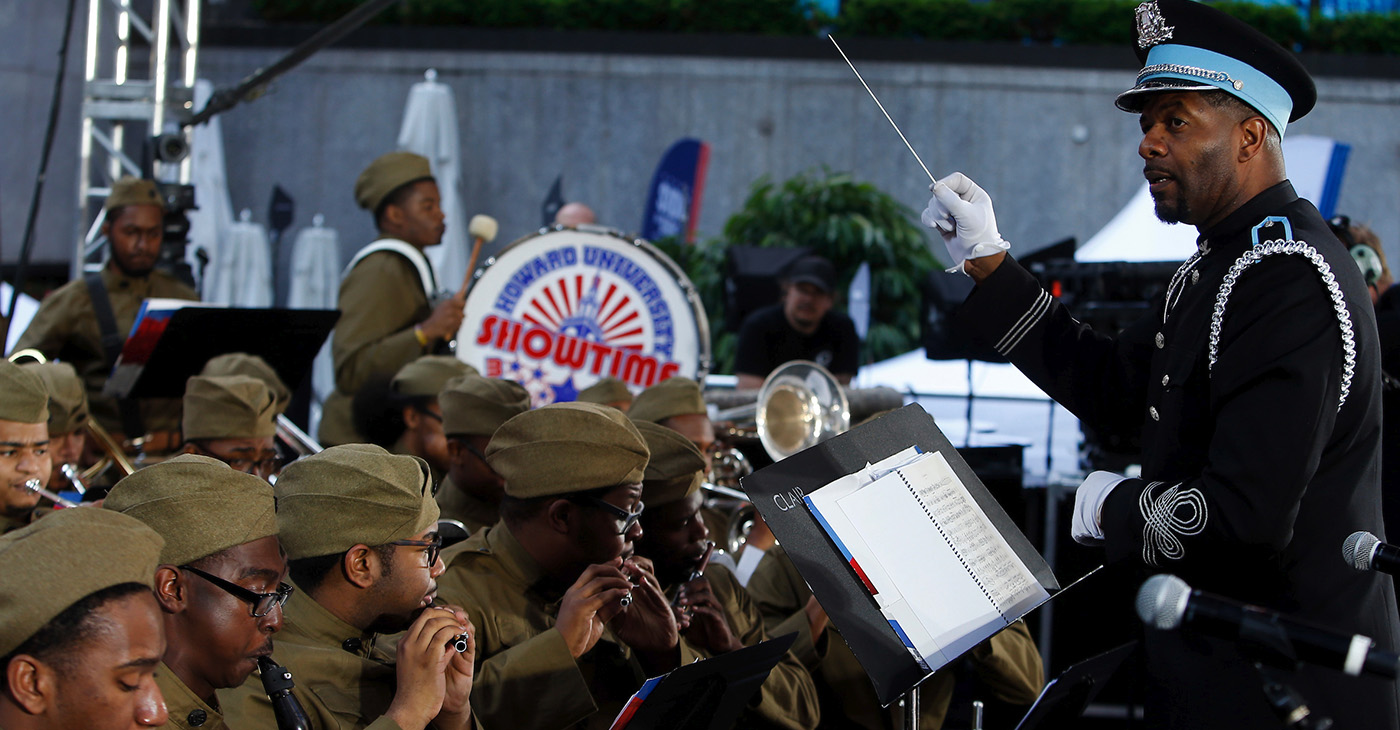
NNPA NEWSWIRE — Thanks to the United States World War I Centennial Commission, Coca Cola and the network of Historically Black Colleges and Universities (HBCUs), a band of 42 accomplished musicians from HBCUs are traveling around the country playing the sounds of the 369th Infantry Regimental Band that made its mark in history during WWI and WWII.

By Leonard E. Colvin, Chief Reporter, New Journal and Guide
In 1919 when the Treaty of Versailles ended WWI, two years after the U.S. entered the fight with France and Great Britain against Germany, 44 Black colleges existed.
Today, 100 years later, there are 101 public and private HBCUs, and they and their students are playing an important part in reclaiming the role African American soldiers and artists played in that conflict.
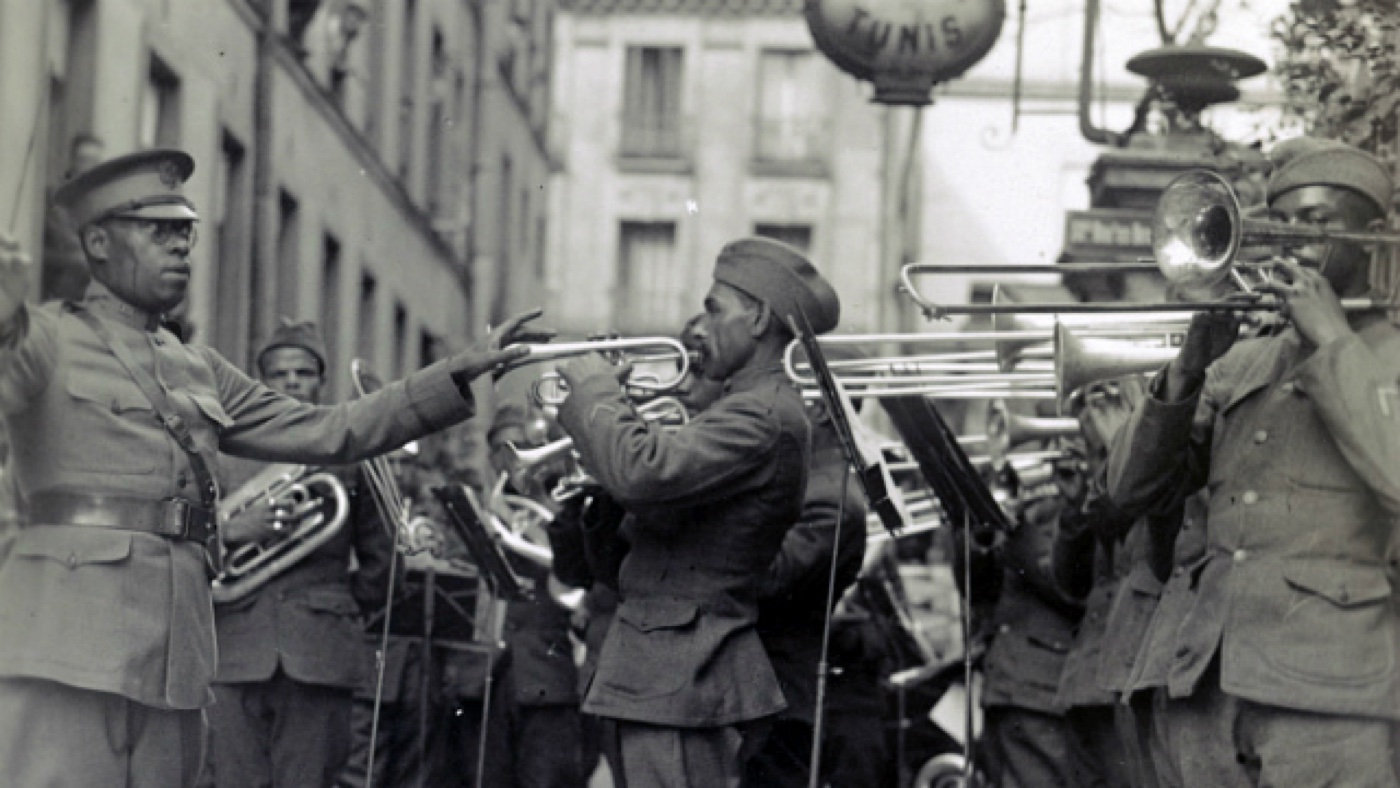
WWI 369 Infantry Regimental Band (Photo: Courtesy)
Thanks to the United States World War I Centennial Commission, Coca Cola and the network of Historically Black Colleges and Universities (HBCUs), a band of 42 accomplished musicians from HBCUs are traveling around the country playing the sounds of the 369th Infantry Regimental Band that made its mark in history during WWI and WWII.
The old wartime regimental band was reincarnated four years ago in the form of the 369th Experience. Most of the new band’s 42 members are current students or pending graduates of the HBCUs.
Its namesake, the 369th Infantry Regimental Band of WWI and WWII, used musical instruments and its artists with a flair for Jazz, originated by African Americans, to establish its legacy, and introduce the art form to the Europeans.
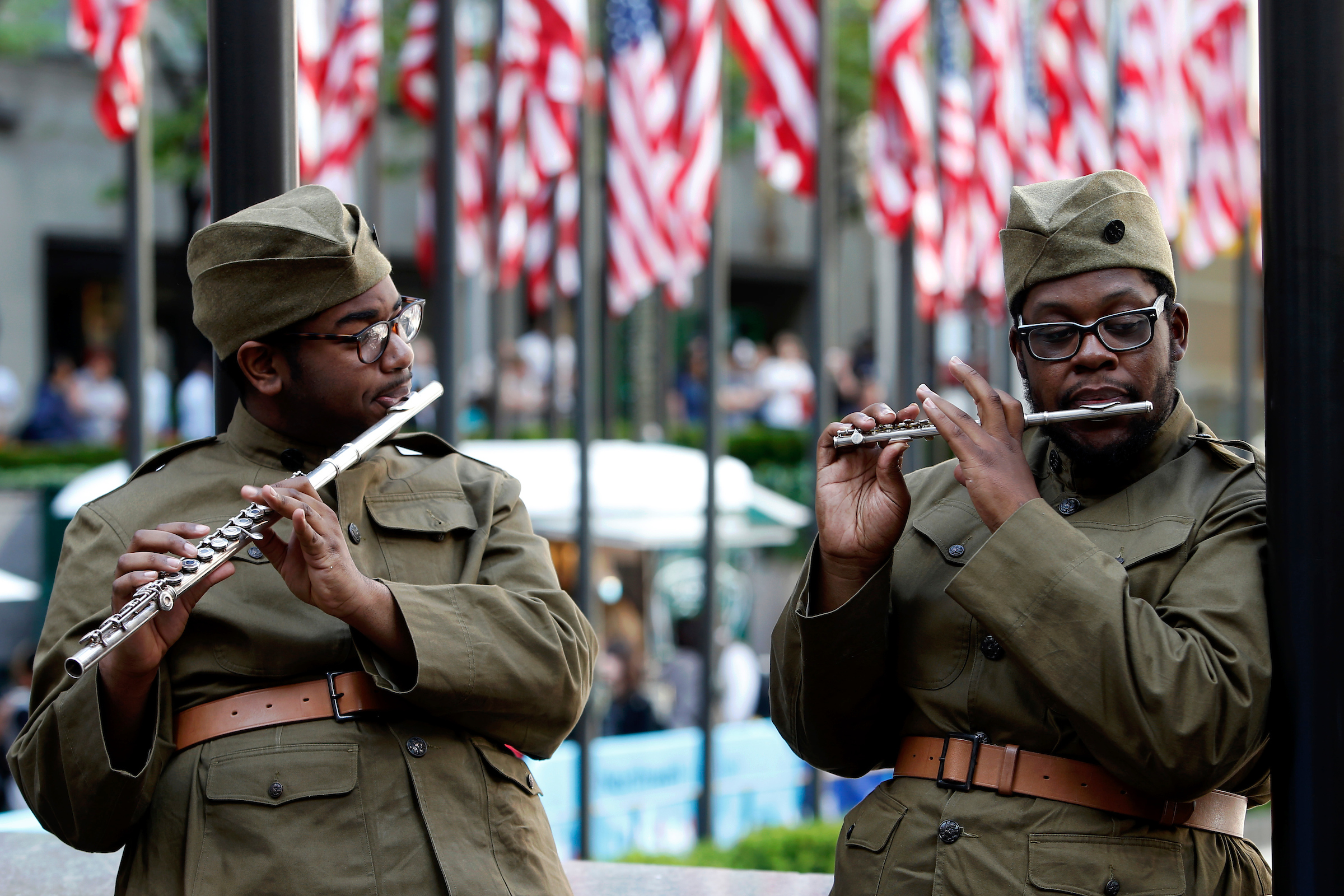
The 369th Experience, a WWI tribute band sponsored by the U.S WWI Centennial Commission, performs in Rockefeller Center during Fleet Week New York, which this year is commemorating WWI, Saturday, May 25, 2019, in New York. The band, which is made up of music students from Historically Black Colleges and Universities across the U.S., play the musical repertoire of New York’s legendary 369th Regiment “Harlem Hellfighters” Regimental Jazz Band. (Jason DeCrow/AP Images for U.S. WWI Centennial Commission)
The WWI band was formed to accompany the 369th Infantry Regiment, a group of Black fighting troops. Its assignment was to boost the morale of the Black troops comprising the 369th Infantry Regiment, formerly known as the 15th New York National Guard Regiment and commonly referred to as the Harlem Hellfighters.
The Black soldiers in the field fought valiantly with their grit and guns to help the allies win WWI and show that Black men could fight for freedom.
The accompanying band was led by and composed of established musical professionals. In the process of performing their assignment, they also exported Jazz music, crafted by African Americans to the allied nations.
One of the band’s leaders, James Reese Europe was a respected artist in Harlem music circles before he was assigned to the military band. He went on to direct the regimental band to great acclaim.
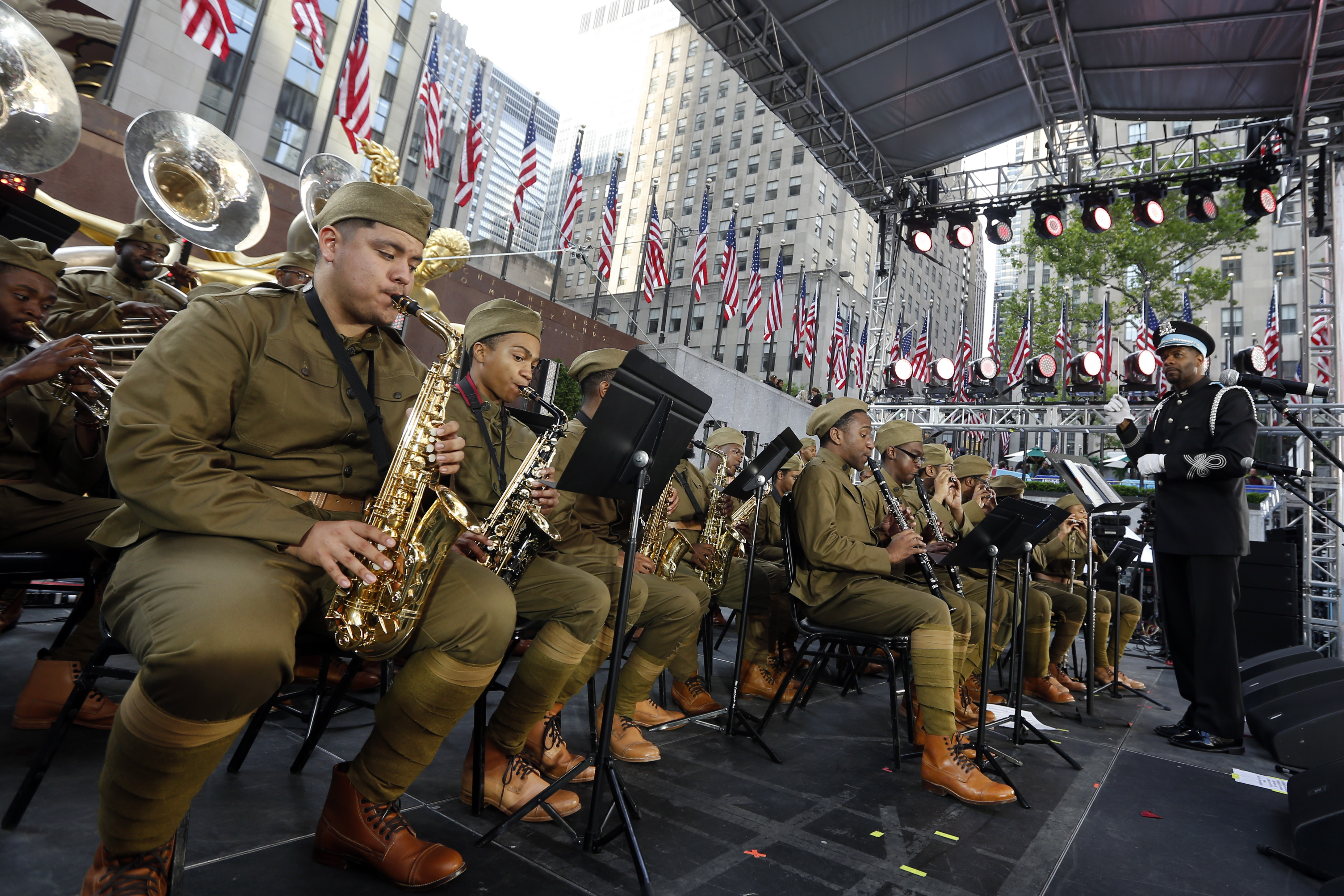
The 369th Experience, a WWI tribute band sponsored by the U.S WWI Centennial Commission, performs in Rockefeller Center during Fleet Week New York, which this year is commemorating WWI, Saturday, May 25, 2019, in New York. The band, which is made up of music students from Historically Black Colleges and Universities across the U.S., play the musical repertoire of New York’s legendary 369th Regiment “Harlem Hellfighters” Regimental Jazz Band. (Jason DeCrow/AP Images for U.S. WWI Centennial Commission)
In February and March 1918, James Reese Europe and his military band traveled over 2,000 miles in France, performing for British, French and American military audiences as well as French civilians. Europe’s “Hellfighters” also made their first recordings in France for the Pathé brothers.
According to the key organizers of the current project involving HBCU students, The 369th Experience is designed to introduce people of all cultures, especially the band members, to the band’s legacy and the role it and the fighting soldiers of the 369th played in WWI.
Also, a goal is to use the band to display the Jazz music art form to audiences domestically and abroad.
It is taking place at a time when HIP-HOP and Neo-soul are overshadowing Jazz as an art form among Black people, despite efforts since the 1970s, to repackage Jazz as a popular and “profitable” genre of music to the masses.
“We chose HBCU band students because we knew we would get the best students in terms of music and marching formation!” said Stephany B. O’Neal, publicity director for the outfit. “We had to use HBCUs to even come close to representing the Harlem Hellfighters and James Reese Europe.
“This is a totally historic event,” she continued. “Bringing the Harlem Hellfighters full circle. They won all kinds of awards from the French and totally changed the music industry in Europe.
“Like the Black soldiers who fought on the battlefield, after the war, the band suffered many slights, despite the respect the French soldiers and later the governments bestowed upon them,” O’Neal said.
She said after the war, in Paris, France, the band was not allowed to join in the victory parade with the Americans when they marched down the Champs Elysees.
To right that wrong, plans are in the works for the 369th Experience Band to travel to Versailles, France at the upcoming International observance of the Centennial of the signing of the Treaty which ended WWI.
During the 2019 Memorial Day Weekend, in conjunction with New York’s annual Fleet Week Observance, the band performed at Rockefeller Center, Marcus Garvey Park, the Liberty Park, and in New Jersey at Harlem One Stop, a historical site.
The effort to recreate the 369th Infantry Regimental Band was launched in 2013.
After the plea was made before the House Appropriation Committee, it took several years before funding for the project was first submitted.
The U.S. Army School of Music, and their PR Personnel, Noble Sissle, Jr., son of one of the original band members, and O’Neal, even before the funding was secured, hammered together the framework and foundation of the band’s operation.
They developed the audition criteria, auditioned the students online, hired a band leader who worked at Ohio State and once all the students were selected, began rehearsing.
“We could not get all the students in one place to rehearse and engage them,” said O’Neal, “so we did it online and in sections and we had some problems. But Coke funded a better online conferencing system, so we managed to do a lot of work even before the band members and directors met each other in person.”
Although there were 65 members of the original 365th Infantry Regimental Band, currently there are 42 members from HBCUs and 1 historically white school.
Prairie View, Florida A&M and Southern University, all southern HBCUs, have the most representatives on the band.
Eventually, the band’s membership will be expanded to 65, O’Neal said. She said that recruiting for future membership is ongoing. She said HBCU veteran band members alert and recruit band members from their respective schools to apply to be a member.
People who are interested should go to the 369th website to apply for an audition, O’Neal said.




Black History
Together Building Back Better
AFRICAN-AMERICAN NEWS AND ISSUES – DALLAS — For more than 57 years, the SHAPE Community Center has served as a cornerstone of Houston’s Third Ward, providing essential programs based on principles of unity and collective responsibility. Known as “The United Nations of The ‘Hood,” the center recently faced its most difficult challenge following a devastating electrical fire at the Nia Becnel Family Center.

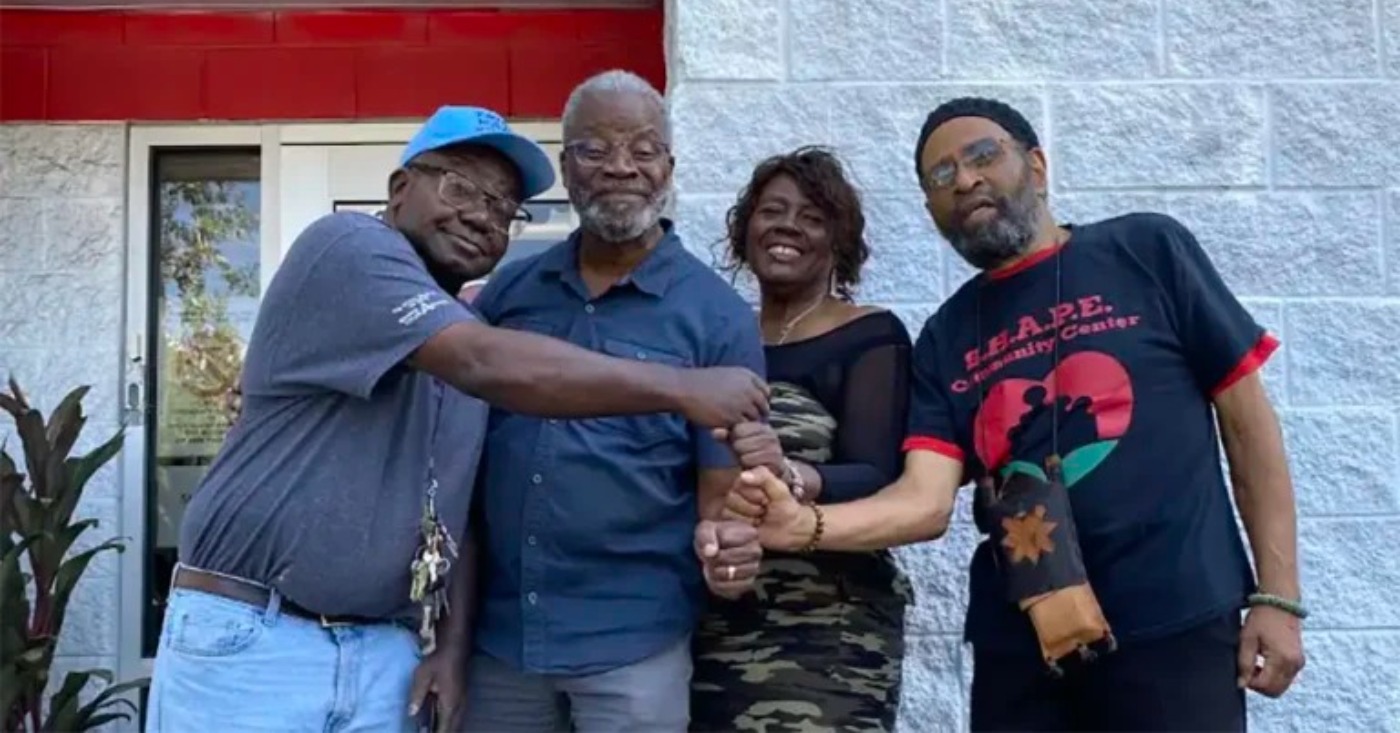
I’m going through the most challenging experience of my life with SHAPE,” said Deloyd Parker. He has served as the executive director of the historic SHAPE Community Center for over 57 years and is still energetic and driven by the love of serving the people. Known as “The United Nations of The ‘Hood,” SHAPE is a precious cornerstone of Houston’s Third Ward, serving generations of families through programs and activities, with emphasis on Unity, Self-Determination, Collective Work & Responsibility, Cooperative Economics, Purpose, Creativity, and Faith.
January 2027 will mark two years since a devastating electrical fire took place at SHAPE’s Nia Becnel Family Center, located at 3815 Live Oak. The building and priceless historical items were significantly damaged and lost. That included the “Wall of Fame” photo collection that adorned the interior walls. Nedzra Ward, President of the Board of Directors, shared how the fi rst few days aft er the fire were very trying for everyone who loved SHAPE and those who visited the sacred grounds were in shock and silence. “We knew we had to start working to get things back up,” said Ms. Ward who has been apart of SHAPE’s staff and board for decades. In the aftermath, Ms. Ward called the insurance company and then reached out to Charles Cave to be the lead project manager. They also reached out to engineers Brian Smith, Barbara Smith and Frank Brown, and other experts to formulate the group known as Together Building Back Better (TBBB).
The team met weekly at the Harambee Admin Building located at 3903 Almeda Rd. And to continue serving the people, Mr. Parker and team worked to get that building certified and operational, especially for the children. “Deloyd never stopped. He was the driving force for everything. He made sure that someone was taking care of licenses and that this place was being refigured. His whole goal was to have these kids back and in a safe environment,” said Ms. Ward. “We have served the people for 57 years and as a result of serving the people, the people are coming through,” said Mr. Parker. “It’s going to take more than a fi re to put us out.
Volunteers from the community stepped up to help at Harambee Admin Building. Many programs, events and activities have resumed including the weekly Elders Institute of Wisdom and enrollment is now open for the 2026-2027 After School Enrichment Program. Soft opening scheduled for November The desire was to reopen the gutted Live Oak location within a year but Ms. Ward and Mr. Cave described the many challenges SHAPE has faced in this rebuilding effort. The insurance did not cover everything that’s needed and tariffs
The post TOGETHER BUILDING BACK BETTER appeared first on African American News and Issues.
Based on reporting by African-American News and Issues – Dallas.
Black History
COMMENTARY: Bring on the Positive Calvary
SEATTLE MEDIUM — Dr. E. Faye Williams addresses the exhaustion many Americans feel following two years of political hostility, corruption, and systemic bigotry.
(Trice Edney Wire)—Like Amy Acton, candidate for Governor in Ohio and Dr. Abdul El-sayed for U.S. Senate in Michigan, the Positive Calvary really is coming soon! Aren’t we all tired of the negative past two years we’ve experienced in the U.S.? Aren’t we tired of the atrocious accusations being thrown around, the filthy language, lies, unending corruption, hatred, racism, sexism, Islamophobia, and bigotry of all kinds. This election season has been worse than ever! I’m sick and tired of women’s names being dragged through the mud—as mine, and others have been out of hate and jealousy. I’m tired of so many people being reluctant to support women. Let’s be the ones to stop this
I’m ready to hear in detail what candidates are ready to do to win the upcoming elections and give help to the people in need—and there are a lot of things from which to choose!
My prayer is that candidates will stop bickering and just tell us what they’re planning to do to help to bring us out of this abysmal situation we’re in now. Instead of spending so much time being shocked by what the highest elected man in the land is saying and doing, let’s concentrate on how to put up guard rails for him when we vote We already know more than enough about what he has said and done. Let’s pledge to elect leaders who’ve shown they care about the people they campaign to represent. There are a lot of good candidates out there who are being overshadowed by the bickering
Let’s not leave everything to elected leaders. As community activists, Get Out the Vote workers, religious leaders and all the good people around us. Show the way to a better nation to all around us. Let’s concentrate on what we are going to do to help people in need. Let’s work on plans to make their lives better. Let’s pledge to get along with our neighbors at home, and our neighbors in Canada, our friends in Ukraine and stop being led by someone who hangs out with those set on disrupting our system of democracy. Ignore the wrecking balls who are more interested in tearing down monuments and praising themselves, supporting evil with lies and unbelievable positions on good people, those who are destroying our military and using government and our taxes on evil things.
Let’s call out corruption, but don’t participate in it. Let us ignore lies about good candidates at all levels. Let’s support the left out. Jamie Davis, a Black man in Louisiana, is a leading candidate for the U.S. Senate. We don’t have to live in Louisiana or be a Democrat or a farmer to support him when you see how much trouble the person running against him is dealing with something people don’t want.
We can vote across party lines when that candidate has expressed the good things she/he will work for when elected. Never mind that in this case she has an R after her name. I know Monique Appeaning in Louisiana who worked in my campaign for Congress when she was a very young woman. I missed winning by a few votes to become the first Black woman to represent my home state in Congress. Forty years later, there has still been no Black woman in the Louisiana delegation. Monique has chosen to pick up the challenge and give my hope life so that other young Black women can have hope in refusing to allow any good thing to be beyond their reach
You know right from wrong, so don’t be afraid to vote for what’s right in a few days. Always promote good. Dr. Abdul El-Sayed and Amy Acton deserve your vote if you are in Ohio or Michigan. Yes, you know right from wrong, so do what’s right wherever you are.
Based on reporting by Seattle Medium.
Black History
Retirement Triggers Doctor to Pen Book for Young Audience
THE CHAMPION NEWSPAPER — After more than 35 years as a pediatric surgeon, Dr. Deborah Burton has transitioned from the operating room to the world of young adult literature. Writing under the pen name MD Burton, the retired Marietta physician recently released her debut sci-fi fantasy mystery novel, Invisible Cages: The Alynthia Quest.

After more than 35 years as a pediatric surgeon, Deborah Burton retired but didn’t give up one of the most rewarding aspects of her career—connecting with young people.
Burton used writing and her imagination to create a young adult sci-fi fantasy mystery novel, Invisible Cages: The Alynthia Quest, under the pen name MD Burton. Her debut novel launched in early October, and Burton said she’s been delighted with the responses so far.
The novel follows Jade Babington who leads a team of resourceful friends as they join an elite organization to crack a spy network and embark on a high-tech adventure to find answers. Her quest is complicated by powers that surge through her body, and to be successful, she needs to understand her family roots, embrace her emerging talents, and step into her legacy, according to a press release.
Through the book, readers are introduced to a range of characters who work in STEM and healthcare careers which Burton hopes will inspire readers to consider pursuing careers in some of those areas.
Burton moved to Dunwoody in 1995 and ran a successful pediatric ear, nose, and throat practice in Marietta. She retired in 2021 but missed the educational moments she shared with her young patients.
“I talk to kids all the time,” said Burton, adding that she likes to share insight into the many career paths in healthcare. “I love to educate and empower.”
She said she worked on the book for five years, researching coding, microchips, and satellites.
“It was a learning journey,” she remarked.
The book explores themes of self-acceptance, girl empowerment through strong female characters, the importance of family, and STEM exposure, states the press release. Set on a fictional health complex, the novel introduces readers to healthcare careers, as well as engineering and computer science.
The author also had to delve into unique aspects of her main character.
“Jade has powers and sees auras,” she explained. “So I spent a good amount of time learning about auras, telepathy and magical realism.”
In addition, to providing insight to STEM and healthcare careers, Burton hopes the books help her teen female readers dealing with insecurities to better understand and appreciate what makes them unique and the power they possess. She also hopes it will build self-confidence.
“You have to accept who you are,” she said. “Whatever your differences are, everybody’s got them, embrace them.”
Burton said she originally planned the book to be a seven-part series but on the advice of her edit changed it to four parts.
“I know what my end goal is,” said Burton noting that she’s included Easter eggs in the first book to entice readers throughout the reading process and has a completed outline for the other books in the series. After completing an audiobook of Invisible Cages: The Alynthia Quest by the end of the year, Burton plans to start writing the next book in 2027.
On Nov. 15, a book signing is scheduled at the Politan Row food hall in Dunwoody.
The self-published book is available in eBook, paperback, and hardback formats, on Amazon, Barnes & Noble, and other online retailers.
3 total views
Based on reporting by The Champion Newspaper.
Black History
Metro Detroit Faith Leaders Call out Islamophobia in Michigan Senate Race
MICHIGAN CHRONICLE — Faith leaders from diverse religious backgrounds gathered Thursday at the downtown Detroit United Methodist Church to denounce the rise of Islamophobic rhetoric in Michigan’s U.S. Senate race. Clergy members, including representatives from Christian, Jewish, and Muslim traditions, expressed concern over religious identity being used as a weapon in the final weeks before the general election.
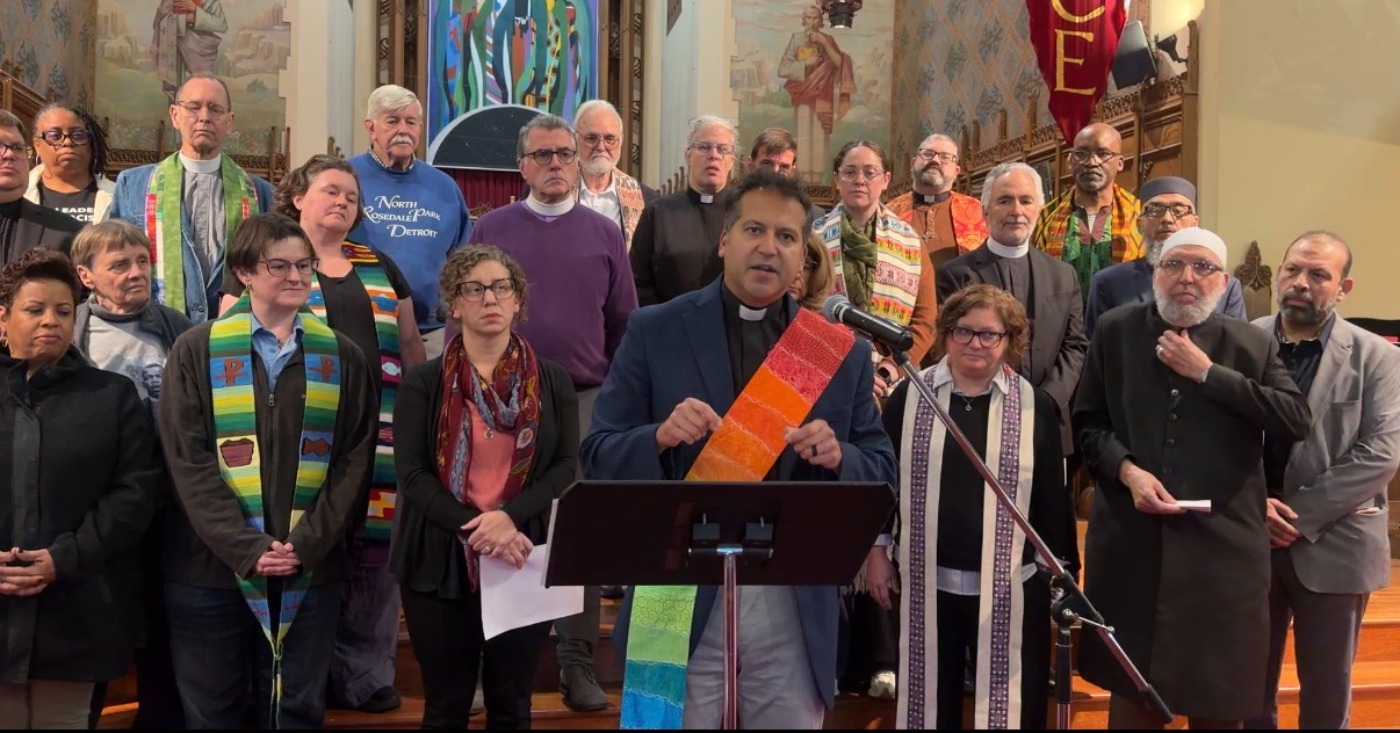
Faith leaders of different religions came together Thursday afternoon inside the downtown Detroit United Methodist Church to oppose Islamophobic rhetoric that’s ramped up ahead of the Nov. 3 general election.
“In the final weeks of Michigan’s U.S. Senate race, we have watched religious identity used as a weapon,” said Rev. Paul Perez, who leads the downtown Detroit church.
Perez and other faith leaders said at the press conference they weren’t endorsing a candidate, but compassion and understanding as Michigan voters decide who to send to the U.S. Senate.
Democratic nominee Abdul El-Sayed would be the first Muslim ever elected to the U.S. Senate. His identity is being used by supporters of Rogers’ campaign to cast doubt on his loyalty to the U.S. Constitution.
Earlier this month, El-Sayed’s Republican opponent, former U.S. Rep. Mike Rogers agreed with a social media post calling El-Sayed a terrorist.
“The charge of dual loyalty has been thrown at Jews for generations,” says Rabbi Alana Alpert, of Ferndale’s Congregation T’chiyah. “When we hear it aimed at our Muslim neighbors we recognize it. And we will not let it be used against anyone.”
At an El-Sayed event Thursday at the Wayne State Fieldhouse, an ant-Muslim activist Cam Higby interrupted his rally as El-Sayed began his remarks.
“Why do you take money from members of the Muslim Brotherhood?” Higby shouted before being escorted out of the gymnasium.
TV and digital ads echo the charge against El-Sayed that he is connected to designated terrorist organizations, which he has denied. He has disavowed and condemned Hamas, the military group controlling Gaza, and the Muslim Brotherhood, a decentralized movement with a long history in Egypt.
While tweets from his half-sister suggest she and her mother had sympathetic attitudes toward the organization, no evidence has been produced that points to El-Sayed being affiliated with the Muslim Brotherhood.
In an interview with Michigan Chronicle, Higby said he doesn’t believe Muslims belong in America. That sentiment is often found in online replies and comments from accounts run by conservative Christians.
sd Democratic voters have also expressed skepticism about El-Sayed’s faith.
Ahead of the primary election, Farmington Hills School Board member Angie Smith caused an uproar online after she told Michigan Chronicle she wasn’t sure whether El-Sayed could represent everybody.
“Don’t come out speaking only Arabic; don’t come out with your Arabic music on; represent everyone,” Smith said.
She later apologized for the comments.
At Thursday’s press conference, Imam Steve Mustapha Elturk of Warren’s Islamic Organization of North America, shared a story about how he eventually earned the trust of new neighbors who feared his congregation was bringing Sharia law when they arrived.
“When a person’s faith is treated as evidence for disloyalty, every Muslim family hears that message. Our children hear it. They come home from school and ask, ‘Are we really American?,’” Elturk said. I want to answer them today from this pulpit surrounded by our Christian and Jewish brothers and sisters, yes, we are Americans. Yes, we are Americans. Our faith is protected by the same Constitution that protects every other faith.”
Pastor Louis Forsythe II of Detroit’s Pleasant Grove Baptist Church, said that liberation of Christians, Jewish and Muslims are tied together.
“The Black church knows what it means to have our loyalty questioned,” Forsythe said. “We know what it means to be told we are less than full citizens. We are called un-American for demanding the rights of the Constitution promised us.
“Our faith carried us through that, and it was the faith of others standing beside us that helped bend this nation toward justice. Dr. Martin Luther King Jr. wrote from a Birmingham jail that injustice anywhere is a threat to justice everywhere.”
Based on reporting by Michigan Chronicle.
Art
Brooklyn Roots and Artistic Genius
THE POSITIVE COMMUNITY — Jean-Michel Basquiat emerged from Brooklyn to become one of the most influential artists of the late twentieth century. Born in 1960 to a Haitian father and a mother of Puerto Rican descent, his upbringing was defined by a rich blend of Caribbean cultural traditions and the linguistic diversity of New York City.
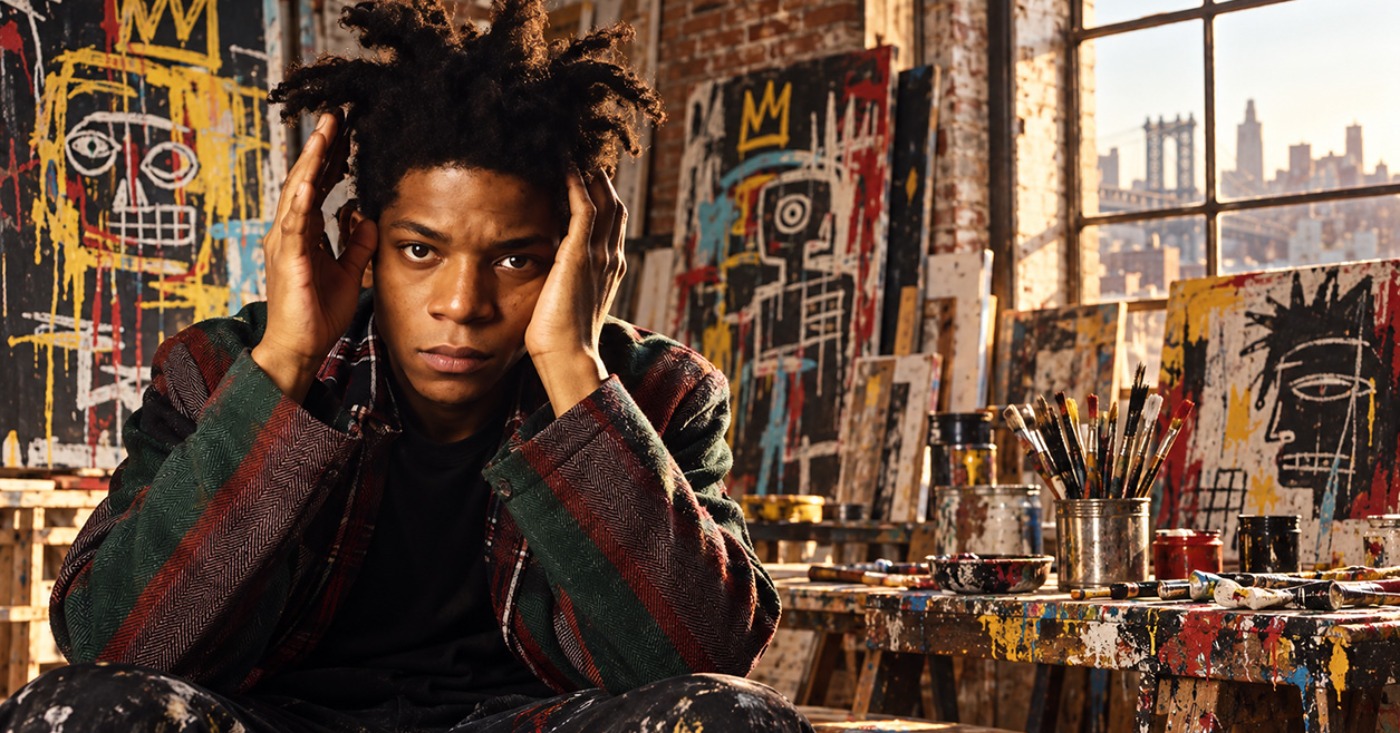
Jean-Michel Basquiat was one of the most influential artists to emerge from New York City during the late twentieth century. Born on December 22, 1960, in Brooklyn, New York, he transformed his experiences growing up in the city into a distinctive artistic language that combined painting, poetry, history, music, and social commentary. His work explored Black identity, racism, power, and the experiences of people whose stories had often been overlooked by mainstream institutions. Although his career lasted only a few years, Basquiat left a lasting mark on contemporary art.
Basquiat grew up in a family that exposed him to several cultural influences. His father, Gérard Basquiat, was born in Haiti, while his mother, Matilde Andrades, was born in New York to Puerto Rican parents. Through his parents, Jean-Michel was connected to Haitian, Puerto Rican, and broader Caribbean cultural traditions. Growing up in Brooklyn, he experienced the diversity of New York City, where different languages, communities, musical styles, and artistic expressions existed side by side. These influences would later become visible in his paintings, which frequently incorporated historical references, handwritten words, and symbols.
His mother played an important role in encouraging his early interest in art. Matilde recognized her son’s artistic ability and introduced him to museums, books, and cultural experiences. One important childhood event occurred when Basquiat was seven years old and was struck by a car while playing in the street. During his recovery, his mother gave him a copy of Gray’s Anatomy, a medical reference book that illustrated the human body in considerable detail. Its anatomical drawings influenced his lifelong interest in skeletons, skulls, and the internal structures of the human body. These images later became recurring features in his artwork.
Basquiat was one of four children born to Gérard and Matilde, although the family had experienced the loss of an older son before his birth. He had two younger sisters, Lisane and Jeanine, with whom he shared his early family life. His parents eventually separated, and his mother experienced periods of serious personal difficulties that affected the family. These circumstances formed part of a complicated childhood that included both encouragement and hardship. Although his family relationships were not always easy, his mother’s early support for his artistic interests remained an important influence on his development.
Basquiat’s upbringing was also shaped by language and cultural diversity. He grew up speaking English, French, and Spanish, reflecting the backgrounds of his parents and the environment in which he was raised. In 1974, his family moved to Puerto Rico for a period before returning to Brooklyn in 1976. These experiences exposed him to different cultural perspectives and helped establish the broad historical and cultural interests that later appeared in his work. His paintings often included words and references drawn from different languages, histories, and communities, creating a visual expression of his multicultural identity.
As a teenager, Basquiat became increasingly connected to Manhattan’s downtown art and music scenes. He eventually left home and supported himself through various activities, including selling handmade postcards and painted T-shirts. Along with his friend Al Diaz, he began creating cryptic graffiti under the name SAMO, short for “Same Old.” Their messages appeared on walls around Lower Manhattan and attracted attention for their wit, unusual phrasing, and criticism of established social and cultural conventions. This early work helped Basquiat develop a reputation as an original voice in New York’s underground creative community.
By the early 1980s, Basquiat had moved from street-based expression into the world of professional painting. His work attracted attention through exhibitions that introduced his distinctive style to collectors, critics, and fellow artists. His paintings combined bold colors, rough lines, repeated symbols, handwritten phrases, and images of human figures. Rather than following traditional expectations of polished painting, he created works that appeared energetic, fragmented, and emotionally direct. His artistic approach reflected the rhythms of New York City, where street culture, hip-hop’s emerging influence, punk music, and experimental art intersected.
A central theme in Basquiat’s work was the experience of Black people in a society shaped by racial inequality. He frequently portrayed historical figures, athletes, musicians, and other individuals whose achievements deserved recognition. Crowns appeared throughout his paintings as symbols that could suggest dignity, authority, and the importance of people who had been marginalized. His work also challenged colonialism, racism, and the unequal distribution of power. Rather than presenting history as a distant collection of events, Basquiat brought it into the present, encouraging viewers to consider whose stories were celebrated and whose were neglected.
Music was another important element of Basquiat’s creative life. He played in a band that eventually became known as Gray, exploring experimental sounds alongside his visual art. He was influenced by jazz and the broader musical culture of New York, and his paintings often possess a rhythm that resembles improvisation. Words, marks, and images seem to compete for attention while creating an overall composition. His artistic process shared something with jazz musicians who build a performance through experimentation, repetition, and unexpected changes. This connection between music and painting helped distinguish Basquiat from many of his contemporaries.
Basquiat also developed a significant relationship with Andy Warhol, one of the most recognizable artists of the twentieth century. The two artists collaborated on paintings during the 1980s, combining different approaches to imagery, color, and popular culture. Their relationship brought Basquiat into contact with an influential figure in the established art world, although it also highlighted the tensions between artistic creativity, celebrity, and commercial success. As his reputation grew, Basquiat had to navigate an industry that increasingly treated his identity and personal story as part of the appeal of his work. Nevertheless, he continued to produce paintings that expressed his individual perspective and challenged conventional ideas about art.
Despite his extraordinary success, Basquiat’s life was tragically short. He died in New York City on August 12, 1988, at just 27 years old, from an accidental drug overdose. His death ended a remarkably productive period in which he had moved from an underground artist in Brooklyn and Manhattan to an internationally recognized painter. His final years have also encouraged broader discussions about the pressures faced by young artists, the demands of celebrity, and the difficulties of maintaining personal well-being while working in a highly competitive industry. His death remains a painful reminder of the distance between public recognition and the private struggles a person may experience.
Today, Jean-Michel Basquiat’s legacy extends far beyond the galleries in which his paintings are displayed. His work is held by major museums, studied by scholars, and admired by artists across generations. His Brooklyn upbringing, Haitian and Puerto Rican heritage, family experiences, and encounters with New York’s streets all contributed to the development of an artistic vision that was unmistakably his own. Basquiat demonstrated that an artist did not need to follow traditional academic pathways to create work of lasting significance. His paintings continue to speak about identity, inequality, history, and the power of creative expression. From the streets of New York to the world’s leading museums, Basquiat remains a symbol of artistic independence and the enduring influence of Black creativity.
Based on reporting by The Positive Community.
Art
Capturing Black Life’s Beauty
THE POSITIVE COMMUNITY — Deana Lawson is an acclaimed American photographer and visual artist whose work explores Black identity, family, and spirituality through powerful portraiture. Born in Rochester, New York, in 1979, Lawson developed a distinctive aesthetic that blends carefully arranged compositions with emotionally compelling subjects.
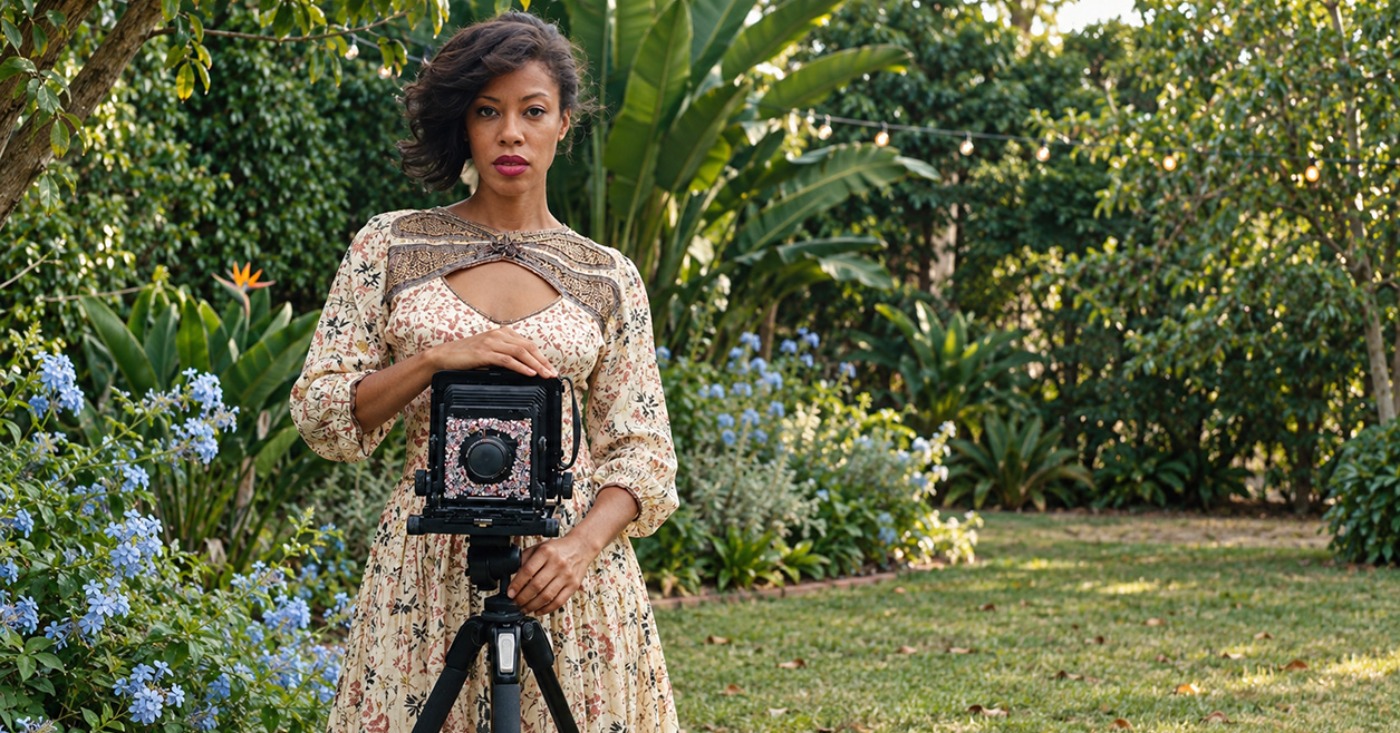
Deana Lawson is an acclaimed American photographer and visual artist whose powerful portraits explore Black identity, family, spirituality, intimacy, and the complexities of everyday life. Born in 1979 in Rochester, New York, Lawson has developed a distinctive approach to photography that combines carefully arranged compositions with emotionally compelling subjects. Her images often resemble scenes from family photo albums, yet they possess a theatrical quality that encourages viewers to look beyond the surface. Through her work, Lawson challenges conventional representations of Black people and presents images that celebrate their humanity, individuality, beauty, and cultural richness.
Lawson’s interest in photography developed partly through her family’s relationship with the medium. Her father was an enthusiastic family photographer, and the photographs he collected helped shape her understanding of how images preserve memories and communicate identity. Growing up surrounded by family pictures gave her an appreciation for the significance of documenting everyday experiences. She recognized that family photographs do more than record appearances; they capture relationships, traditions, aspirations, and moments that become part of a family’s history. These early influences would eventually become central to her artistic practice, inspiring her to examine how photographs shape our understanding of ourselves and the people around us.
Her formal education provided the foundation for a successful career in the visual arts. Lawson earned a Bachelor of Fine Arts degree in photography from Pennsylvania State University in 2001 before completing a Master of Fine Arts degree at the Rhode Island School of Design in 2004. During her studies, she developed the technical and conceptual skills necessary to create photographs that communicate complex ideas. Rather than concentrating exclusively on conventional documentary photography, Lawson explored the possibilities of staging, portraiture, lighting, and composition. Her work demonstrates that photography can occupy a space between reality and imagination, documenting actual people while constructing carefully considered scenes that communicate broader emotional and cultural truths.
One of the most recognizable characteristics of Lawson’s photography is her attention to detail. She carefully considers the positioning of her subjects, the arrangement of furniture, the colors within a room, and the relationship between people and their surroundings. Bedrooms, living rooms, and other domestic spaces frequently become important settings in her photographs. Everyday objects, including mirrors, religious items, toys, clothing, and household decorations, help establish a sense of personal history. These details give viewers the impression that they are entering an intimate environment, while the deliberate composition encourages them to consider what the image communicates about family, identity, and belonging.
Lawson frequently photographs Black individuals, couples, and families in poses that communicate dignity, confidence, vulnerability, and emotional complexity. Her subjects often look directly into the camera, establishing a powerful connection with the viewer. Their expressions may appear serious, mysterious, or quietly contemplative. This direct gaze gives the people in her photographs a strong visual presence, making it difficult to treat them as passive subjects. Instead, they appear self-possessed and fully aware of their place within the image. Lawson’s approach challenges stereotypes that have historically influenced the representation of Black people in photography and popular culture, replacing simplistic narratives with images that emphasize individuality and humanity.
Her photographs also explore spirituality, a theme that adds another dimension to her artistic vision. Religious imagery, symbolic objects, unusual gestures, and carefully controlled lighting sometimes give her compositions an almost sacred atmosphere. Lawson’s images may resemble familiar domestic scenes while simultaneously suggesting something mysterious or otherworldly. This combination encourages viewers to consider the spiritual dimensions of ordinary life and the ways people seek meaning through relationships, traditions, and personal beliefs. Her photographs do not always offer clear explanations, allowing ambiguity to become part of their emotional power. The viewer is invited to interpret the scene and consider how visible appearances may conceal deeper experiences.
Although Lawson is deeply interested in African American life, her artistic vision extends throughout the African diaspora. A Guggenheim Fellowship in 2013 supported travel that included destinations such as Haiti, Jamaica, Ethiopia, and the Democratic Republic of the Congo. These experiences expanded her perspective on the relationships connecting Black communities across different countries and cultural traditions. Her photographs explore similarities and differences in how people express identity, beauty, family, spirituality, and social belonging. Rather than suggesting that Black experiences are identical everywhere, Lawson’s work acknowledges the richness and diversity of Black life. Her international perspective places individual portraits within a broader conversation about history, migration, ancestry, and cultural connection.
Among her notable works is Roxie and Raquel, New Orleans, Louisiana (2010), a portrait featuring twin sisters positioned together on a bed. The carefully arranged composition emphasizes both their resemblance and their individuality, while the surrounding furnishings and colors contribute to the photograph’s visual balance. Another important work, Nation (2018), demonstrates Lawson’s interest in constructing images that carry symbolic and cultural significance. Her photographs often invite extended examination because their meaning emerges through the relationship between the subjects, their gestures, and the surrounding environment. These images illustrate her ability to transform seemingly ordinary moments into compositions that feel monumental, mysterious, and emotionally resonant.
Lawson’s achievements have brought her work to some of the most respected institutions in the art world. In 2020, she became the first photographer to receive the prestigious Hugo Boss Prize, an award recognizing significant contemporary artistic achievement. The recognition led to Centropy, an exhibition at the Solomon R. Guggenheim Museum in New York in 2021. Her work has also been presented at the Museum of Modern Art, MoMA PS1, the Institute of Contemporary Art in Boston, and the High Museum of Art in Atlanta. In 2022, she received the Deutsche Börse Photography Foundation Prize. Beyond her exhibitions, Lawson has contributed to art education through her work at Princeton University, where she serves as the inaugural Dorothy Krauklis ’78 Professor of Visual Arts.
Ultimately, Deana Lawson’s significance lies in her ability to make photography a powerful vehicle for cultural affirmation and artistic exploration. Her portraits challenge viewers to reconsider familiar assumptions about Black identity while celebrating the beauty, complexity, and emotional depth of Black communities. By combining elements of documentary photography, family albums, staged portraiture, and symbolic imagery, she has created a visual language that is unmistakably her own. Her work reminds audiences that photographs are never simply records of what appears before a camera; they can also express dreams, histories, relationships, and aspirations. Through her remarkable vision, Lawson continues to expand the possibilities of contemporary photography and ensure that the lives and experiences of Black people occupy a central place in the visual record of our time.
Based on reporting by The Positive Community.


Together Building Back Better

Homecoming Ends in Gunfire Outside FAMU: 12 Hurt, Six of Them Children
COMMENTARY: Bring on the Positive Calvary

Retirement Triggers Doctor to Pen Book for Young Audience

Fatigue, Bloating, and Inflammation: Spotting the Subtle Signs of MASLD

Metro Detroit Faith Leaders Call out Islamophobia in Michigan Senate Race

Dallas Trinity FC Signs Kaiya Brewer to Academy Contract

Dallas Mavericks Unite Players, Legends and the Oak Cliff Community at 2026 Community Tip-Off

Brooklyn Roots and Artistic Genius

NCCU Snap Three – Game Losing Streak with Win over Delaware State University

OP-ED: Haiti TPS: Have We Lost Sense of Humanity?

Remembering Chauncey Bailey as Student Journalists Face Threats to Truth-Telling

All Skinfolk Ain’t Kinfolk

Poll: Becerra Widens His Lead Over Hilton; Californians Split on Wealth Tax

Rulings Leave Questions Lingering in Nolan Wells Case

Latinas Deserve Equal Pay. Unions Help Make It Happen.

Why Black Artists Struggle to Sell Tours

COMMENTARY: The Audacity of Joyce Beatty

Zakiya Jendayi Arrested, Locked Out of Home by Sheriff’s Deputies

A $2.1 Trillion Wellness Industry Never Built a Daily Practice for Black Children. So This Atlanta Family Did.

East Side Shoutout! Sports Talk & Guest Invite! #shorts

Black Girl Walk in the Rain at George Floyd Square | Protect Your Peace | MSR

Stop Overpaying for Car Insurance: Compare 3–5 Quotes #shorts

A $50K SUV Becomes $66K—Are the Options Worth It? #shorts

Dr. Charles Drew – Blood Banking and Preservation

15 Years Together: The Surprising Joy of Discovering Your Partner #shorts

Wala Blegay on the Future of Energy Grid Stability and Data Center Concerns

Gopher Football: Can They Rekindle 2019 Magic Or Are They Just Average? #shorts

The Conversation with Al McFarlane (10/27)

Citizen Savings Bank: Oldest Black-Owned Bank in US #shorts
-

 Featured1 week ago
Tamiko Armstead | 2026 Lifetime Achiever in Education
-

 Black History1 week ago
OP-ED: The Black Church Writes AI’s Next Chapter
-
 Black History1 week ago
Practitioners of African Traditional Spirituality Offer Ancestral Reverence Ritual Oct. 31
-
 Art1 week ago
Kickstarter CEO Everette Taylor Shares Tips on Creating and Growing a Business
-
 Black History1 week ago
Columbus’s Oldest Businesses Still Open: 10 That Have Lasted 75+ Years
-
 Black History1 week ago
COMMENTARY: BIG MAMA SAID: Don’t Throw Away the Gift Just Because It Came Wrapped Wrong
