
Commentary
They’re going to Walt Disney World! 100 Teens Selected for 2025 Disney Dreamers Academy
NNPA NEWSWIRE — Selected students from around the country to be part of a once-in-a-lifetime mentoring program at Walt Disney World Resort in March; Dreamers to interact with celebrities, business leaders, educators and more during four-day all-expenses-paid event

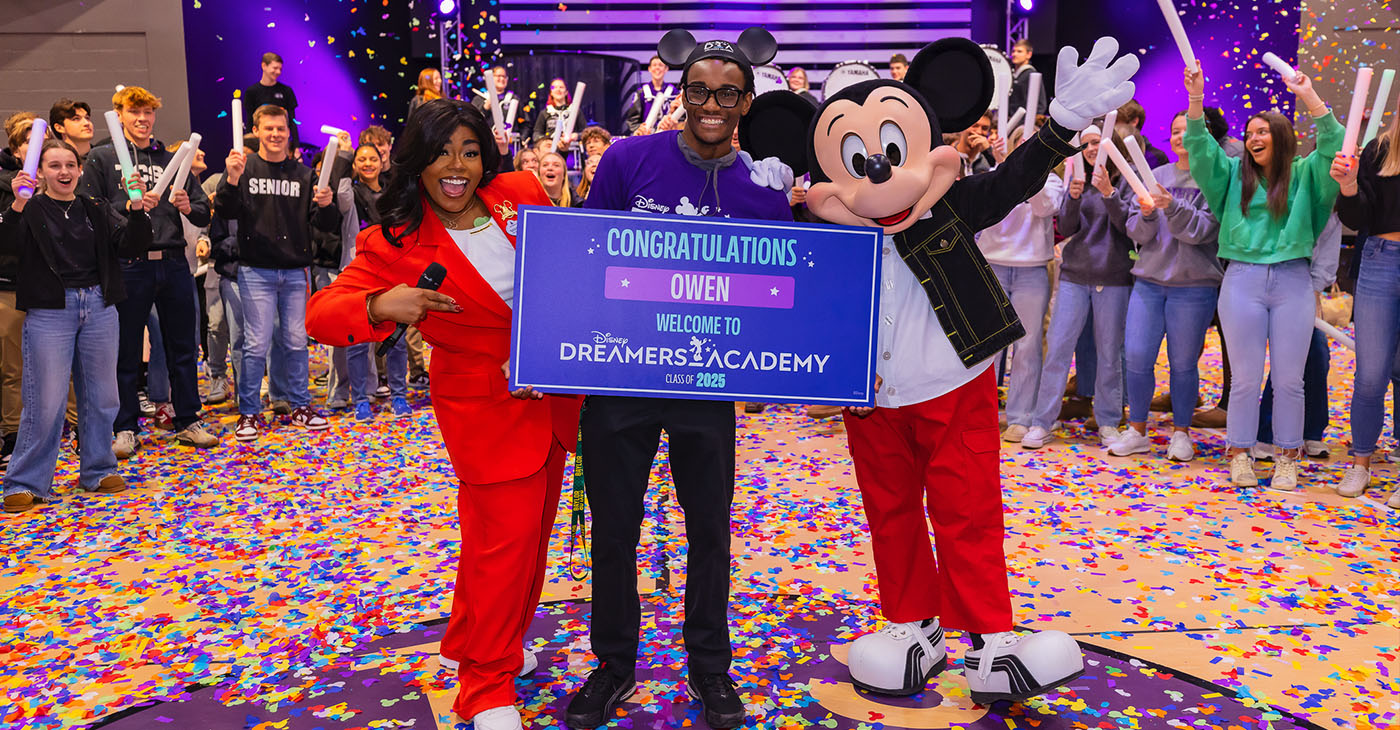

Selected students from around the country to be part of once-in-a-lifetime mentoring program at Walt Disney World Resort in March; Dreamers to interact with celebrities, business leaders, educators and more during four-day all-expenses-paid event

Walt Disney World Ambassador Shannon Smith-Conrad and Mickey Mouse surprise Houston-area student Jayden Kelly
LAKE BUENA VISTA, Fla. – Jan. 16, 2025 – There are 100 high school students from across the country heading to Walt Disney World Resort in Florida in March to take the next step in chasing their biggest dreams, such as developing cutting-edge technology, addressing food insecurity and even designing the next great Disney attractions. These ambitious teens make up the new 2025 class of Disney Dreamers Academy, a popular mentoring program at Walt Disney World Resort designed to inspire and empower students from diverse communities by encouraging them to explore limitless possibilities and turn their dreams into reality.
After surprising students in Houston and Atlanta with their selection earlier this week, Walt Disney World released the names of the remaining students today. At the multi-day program at Walt Disney World, March 26-30, 2025, Disney Dreamers will connect with business leaders, Disney executives, celebrities, and educators through workshops and seminars created to inspire and accelerate their career aspirations. They’ll explore diverse career fields; develop essential skills such as communication, leadership, and networking; and, of course, enjoy the magic and wonder of Walt Disney World, which continues to elevate the guest experience through ongoing investments in new attractions, entertainment and more.
“We are thrilled to spark new possibilities and provide these future leaders with the tools they need to chase their dreams,” said Shannon Smith-Conrad, a Walt Disney World Ambassador. “After 18 years of hosting Disney Dreamers Academy, we continue to be inspired by these teens and their incredible accomplishments.”
Each year, the Disney Dreamers are selected from thousands of applicants who answer essay questions about their personal stories and dreams for the future. The selected students, plus a parent or guardian, enjoy an all-expenses-paid trip to Walt Disney World. Since 2008, Disney Dreamers Academy, which is an important part of Walt Disney World’s commitment to supporting diverse communities, has inspired more than 1,700 students from across the country by fueling their dreams and showing them a world of possibilities. Graduates of the program have become storytellers, artists, engineers, innovators, journalists, and more, and many have transitioned into mentors to the Disney Dreamers who follow them.
The full list of selected students is available at www.DisneyDreamersAcademy.com.
For more information, visit DisneyDreamersAcademy.com. Regular updates about Disney Dreamers Academy are available on social media at Facebook.com/DisneyDreamersAcademy and Instagram.com/disneydreamersacademy.
The 100 students selected for the 2025 Disney Dreamers Academy (listed by state):
| Name | City | State |
| Olivia E. | Fort Mitchell | AL |
| Camden P. | Birmingham | AL |
| Cameryn S. | Little Rock | AR |
| Colin S. | Little Rock | AR |
| Colton C. | Gilbert | AZ |
| Iraj S. | Chandler | AZ |
| Lawrence V. | Fresno | CA |
| Brennan C. | Pasadena | CA |
| Connor C. | Northridge | CA |
| Euri K. | Tustin | CA |
| Lauren K. | La Crescenta | CA |
| Alissa L. | El Monte | CA |
| Joanne L. | La Crescenta | CA |
| Laura R. | Irvine | CA |
| Corey U. | Gardena | CA |
| McAustin U. | Long Beach | CA |
| Emery C. | Modesto | CA |
| Caleb D. | Stockton | CA |
| Sanja J. | Chula Vista | CA |
| Malia M. | Santa Clara | CA |
| Sarah S. | Cupertino | CA |
| Zhiyan Z. | Woodbridge | CT |
| Arizona S. | St Johns | FL |
| Haley E. | Hialeah | FL |
| Destiny J. | Plantation | FL |
| Torrick P. | Fort Lauderdale | FL |
| Tristan W. | Coconut Creek | FL |
| Kylie F. | Kissimmee | FL |
| Kaylee P. | Kissimmee | FL |
| Somaya R. | Orlando | FL |
| Kaitlyn S. | Mt. Dora | FL |
| Diongela T. | Orlando | FL |
| Jasmine T. | Apopka | FL |
| Ava H. | Panama City Beach | FL |
| Aarushi A. | Cumming | GA |
| Alonnah C. | Fayetteville | GA |
| Callie C. | Demorest | GA |
| Owen O. | Newnan | GA |
| Kylan R. | Stone Mountain | GA |
| Chasity R. | Locust Grove | GA |
| Tiyanna S. | Riverdale | GA |
| Rihana T. | Stockbridge | GA |
| Sierra W. | Snellville | GA |
| Ciara Essence W. | Acworth | GA |
| Caspia R. | Star | ID |
| Steven J. | Chicago | IL |
| Aarav K. | Naperville | IL |
| Kevin M. | Montgomery | IL |
| Ian S. | Marengo | IL |
| Ross R. | Cave City | KY |
| Asia D. | Jefferson | LA |
| Sambodhan B. | Malden | MA |
| Madeleine J. | Newburyport | MA |
| Christian R. | Leicester | MA |
| Claribel D. | Lexington Park | MD |
| Kayla G. | Upper Marlboro | MD |
| Joshua O. | Gambrills | MD |
| Elissa K. | Liberty | MO |
| Isabelle M. | Saint Louis | MO |
| DeJuan S. | Saint Louis | MO |
| Imani W. | St. Ann | MO |
| Sonia G. | Charlotte | NC |
| Kendall B. | Raleigh | NC |
| Vianna F. | Chapel Hill | NC |
| Savannah T. | Fayetteville | NC |
| Charlie A. | Phillipsburg | NJ |
| Myanelle B. | Somerset | NJ |
| Abigail K. | Leonia | NJ |
| Aubrey L. | West orange | NJ |
| Jessica N. | Paterson | NJ |
| Anna P. | Fort Lee | NJ |
| Finn S. | Collingswood | NJ |
| Olivia D. | Albuquerque | NM |
| Alexis L. | Albuquerque | NM |
| Derek C. | Syosset | NY |
| Nettie R. | East Hampton | NY |
| Jamila S. | New York | NY |
| Michai T. | Jamaica | NY |
| Jad A. | Westlake | OH |
| Madeline L. | Bexley | OH |
| Teodora V. | Churchville | PA |
| Sebastian T. | Sewickley | PA |
| Mason B. | Fort Mill | SC |
| Halle H. | Brentwood | TN |
| Sydney G. | Arlington | TX |
| Kennedy H. | Frisco | TX |
| Ava P. | Crandall | TX |
| Angel W. | Murphy | TX |
| Andres V. | El Paso | TX |
| Joseias E. | Houston | TX |
| Brice E. | Houston | TX |
| Trinity J. | Spring | TX |
| Jayden K. | Richmond | TX |
| Alexandra O. | Missouri City | TX |
| Zane S. | Manvel | TX |
| Michael C. | Virginia Beach | VA |
| Fritz W. | Suffolk | VA |
| Srishti B. | Sammamish | WA |
| Kelsi L. | Issaquah | WA |
| Ekampreet S. | Kent | WA |
About Disney Dreamers Academy:
Established by Walt Disney World in 2008, Disney Dreamers Academy was created to inspire high school students from varying backgrounds and communities across the nation to dream big and pursue their goals. The program provides impactful content, expert guidance, mentors, and sponsors. Each year, 100 high school students are selected to attend a four-day immersive and transformational experience at Walt Disney World Resort in Florida.








Art
The Afrikan Restoration Project Marks 60 Years of Kwanzaa With New Book and Expanded Focus
THE AFRIKAN RESTORATION PROJECT FOR IMMEDIATE RELEASE | November 24, 2026 Media contact: Shujaa Baker | [email protected] | (949) 257-7133 | Media Kit – https://bit.ly/3X2tSlz The Afrikan Restoration Project Marks 60 Yea


The Afrikan Restoration Project Marks 60 Years of Kwanzaa With New Book and Expanded Focus
Events in San Diego, Detroit, and online will honor the holiday’s origins and prepare for the next sixty years of the Nguzo Saba.
The Afrikan Restoration Project (TARP) announces its 2026 Kwanzaa anniversary season, Dec. 26–Jan. 1, marking sixty years of the African American and Pan-African holiday first observed in Los Angeles in 1966. Under the theme “Celebrating the First Sixty Years of Kwanzaa… and the Next!” the programs share an expanded understanding of the Kwanzaa creation story and thoughtfully promote year-round practice of the Nguzo Saba (Seven Principles).
Central to the celebration is the worldwide debut of the new book titled “Kwanzaa – FOR KIDS (and everybody else!),” written by Shujaa Baker, illustrated by Thad Lavalais, and based on the firsthand accounts of Kinamo and Karama Damu about the first Kwanzaa. The book traces how ten-year-old Kinamo’s questions about African holidays in 1965 inspired the creation of Kwanzaa while recounting the children’s experiences leading up to the first celebrations in 1966. Learn more at kwanzaaforkids.org.
60th Anniversary Events
Dec. 26 | San Diego | 1–4:30 p.m. PT — WorldBeat Cultural Center, Balboa Park. The children’s Kwanzaa Camp celebration and book debut features Karama Damu, a participant in the first Children’s Kwanzaa, along with a Kwanzaa Essentials lesson and lessons from the new book, art, music, drumming, and dance. Instructional content by Imagiread.
Dec. 26 | San Diego | 6–9 p.m. PT — WorldBeat Cultural Center. Umoja (Unity) Night program celebrating the First Sixty Years of Kwanzaa… and the Next! recognizes the first sixty years of Kwanzaa and the work ahead to teach the Nguzo Saba more broadly
Dec. 27 | Detroit | 2–5 p.m. ET — Charles H. Wright Museum of African American History. The Kujichagulia (Self-Determination) program explores Kwanzaa’s past, present, and future, and the role of self-determination in Elevating Blackness.
Dec. 29 | Online | 5–7 p.m. PT — Kwanzaa Then and Now: Celebrating the First Sixty Years and Preparing for the Next. TARP introduces its new book and announces the return of its study group on Jan. 10, 2027 – examining Ujamaa (Cooperative Economics) in the age of AI and robotics.
TARP is merging our work to promote African culture, S.T.E.M., manufacturing, and principled daily practice into a new online program called The Elevating Blackness Online Academy. Launching on December 5th, this site offers educational resources that build character, including curricula for Kwanzaa – FOR KIDS, the STEM ’n ’Nem children’s book series, and partner content.
Visit https://elevatingblackness.com for more info. (For beta test access – TESTER / Innovationary2026!).
TARP also invites public discussion of three position statements on Kwanzaa’s origins, the responsibilities of the next sixty years, and the daily practice of the Seven Principles found here.
Event details and registration: https://kwanzaa.org/events.html and https://tarpie.org/events. Contact Shujaa Baker for interviews, the media kit, and high-resolution images. See tarpie.org for full details.
About The Afrikan Restoration Project
TARP is an African-centered educational and cultural development initiative advancing cultural knowledge, practical capabilities, and principled community development through publications, programming, and collaborative education.
Black Press
COMMENTARY: Historic Elections Bring Joy to an Embattled Nation
BLACKPRESSUSA NEWSWIRE — Despite federal rollbacks in diversity and inclusion, fair housing, voting rights and more, when 2027 arrives, the nation’s elected leaders in states and in Washington will more closely resemble the country’s diversity in race, gender, and ethnicity. Beyond this year’s lengthy list of historic wins, when new officials assume their duties in January, America will have:

Despite economic challenges, civil rights leaders see hope
The glowing aftermath of November’s historic midterm elections not only usher in an annual season of hope and faith but also provide an encouraging sign that our democracy will now address the needs of millions of people who have been either pushed out or locked out of economic opportunity.
Despite federal rollbacks in diversity and inclusion, fair housing, voting rights and more, when 2027 arrives, the nation’s elected leaders in states and in Washington will more closely resemble the country’s diversity in race, gender, and ethnicity. Beyond this year’s lengthy list of historic wins, when new officials assume their duties in January, America will have:
- A Black Speaker of the House of Representatives
- 5 Black governors serving in Florida, Georgia, Maryland, Nevada and Wisconsin
- 7 Black state attorneys general protecting consumers in Georgia, Illinois, Maryland, Massachusetts, Minnesota, New York and Washington state
- 7 Black U.S. Senators representing Delaware, Georgia, Illinois, Maryland, Mississippi, New Jersey and South Carolina
- 66 or more members in the Congressional Black Caucus, depending upon final election certifications.
A chorus of civil rights advocates herald both the victories and opportunities for the nation.
“Voters didn’t just decide in this election,” stated Maya Wiley, president and CEO of the Leadership Conference on Civil and Human Rights. “They demanded! They demanded a very different future from the one offered from the current administration and its allies… Across race, gender, sexuality, identity, nation of origin, age, religion, disability, income, and geography, the majority of this country showed what they hold most sacred — their rights and freedoms that are tied to their opportunities and well-being…We cannot just tinker with a past that made progress but proved too fragile and resulted in dreams deferred.”
While Janai Nelson, Legal Defense Fund (LDF) President and Director-Counsel, applauded voters’ efforts in the November midterm elections, she also quickly noted that the quest for freedom and economic inclusion continues.
“The work of rebuilding our democracy begins now and we must be bold and visionary,” said Nelson. “LDF will continue its work with Black communities to hold elected officials accountable to address the very real issues facing our communities: ending the thuggery that has been unleashed by the president’s reckless deportation forces, ensuring strong and effective educational opportunities for all students, making health care and housing affordable, and creating fair economic opportunities that give everyone a chance to thrive — not just those at the top. Our vote was not the final word.”
The depth and breadth of the nation’s financial challenges is underscored in an updated report entitled, State of Personal Finance in America Q3 2026, a quarterly research study conducted by Ramsey Solutions that tracks personal finance behaviors and attitudes of everyday Americans.
According to the update, an estimated 94 million U.S. adults say they’re struggling or in crisis financially. The study also found that more than half of Americans – 53 percent – are living paycheck to paycheck.
“When more than half of Americans are cutting back on Christmas gifts, it shows just how much families are feeling the pressure,” said Rachel Cruze, personal finance expert and co-host of “The Ramsey Show” and “Smart Money Happy Hour.” “Christmas should be a time of joy, not a
financial burden that follows you into the new year.”
For some federal lawmakers, resurrecting the Consumer Financial Protection Bureau’s (CFPB) to its rightful regulatory role is a priority. In published comments appearing in a recent article by The Guardian, Representative Bill Foster of Illinois and Senators Raphael Warnock of Georgia and Catherine Cortez Masto of Nevada plan to aggressively scrutinize what has happened at the CFPB in recent years.
“Next Congress, my colleagues on the Financial Services Committee and I will investigate the unconstitutional dismantling of the CFPB,” Foster said, adding that he and other committee members will pursue “subpoenas, investigations, hearings, and, ultimately, legislative action to restore consumer protections in this country and hold accountable those who seek to profit off the most vulnerable Americans.”
Massachusetts Senator Elizabeth Warren, a former Harvard professor credited as being CFPB’s ‘brainchild’ is also speaking up for the embattled agency.
“Accountability is coming,” said Warren. “If you’re a Wall Street executive, Big Tech CEOs, giant corporations that have been cheating people, you should be worried. And government officials who have put their own interests ahead of the public interest, should be worried too.”
Hopes for future consumer-friendly reforms also include relief for the 42.6 million student loan borrowers who collectively struggle with $1.7 trillion of debt.
“Borrowers expect the newly elected Congress to address the student debt crisis and work to make student loan payments more affordable,” said Natalia Abrams, Student Debt Crisis Center President. “The 120th Congress has an opportunity and a responsibility to fulfill their promises of affordability. Student loan borrowers deserve a seat at the table and real solutions that address the financial burden they carry every day.”
Now, before new terms of office begin, is a season for Black America to celebrate our hope, joy, and faith in the future.
As Derrick Johnson, the NAACP President and CEO noted, “Once again, Black voters have proven that we are not bystanders in this country, we are its builders.”
Charlene Crowell is a senior fellow with the Center for Responsible Lending. She can be reached at [email protected]
Black History
Black Women’s Roundtable Unveils Its First 100 Days Federal Policy Agenda Priorities & Congratulates Congressman Hakeem Jeffries on Historic House Speaker Nomination
BLACKPRESSUSA NEWSWIRE — Developed under Campbell’s leadership, the BWR’s Policy Priorities draw from the Black Women’s Roundtable 2027 Federal Policy Agenda. They translate Black women voters’ concerns into specific legislative demands and a clear standard for holding newly elected members and returning lawmakers accountable.

“Black Women Didn’t Just Mobilize to Change Who Holds Office. We Organized to Change What Government Delivers”
Grounded in the 2026 Power of the Sister Vote Poll, BWR Outlines Seven Congressional Priorities Addressing Black Women Voters’ Concerns About Economic Security, Health Care, Voting Rights and Opportunities
Following the House Democratic Caucus’s nomination of Hakeem Jeffries for speaker, bringing him one step closer to becoming the first Black American to lead the U.S. The House of Representatives, the Black Women’s Roundtable today released its sevenpriorities for the first 100 days of the 120th Congress. The full House will elect its speaker when the new Congress convenes in January 2027. The BWR is the women and girls’ empowerment arm of the National Coalition on Black Civic Participation (NCBCP).
“For Black women who organized, mobilized their communities and helped elect the incoming Congress, the prospect of the nation’s first Black speaker carries profound historical significance, and an opportunity to turn representation into results,” states Melanie L. Campbell, NCBCP president and CEO and National Convener of the Black Women’s Roundtable.
Developed under Campbell’s leadership, the BWR’s Policy Priorities draw from the Black Women’s Roundtable 2027 Federal Policy Agenda. They translate Black women voters’ concerns into specific legislative demands and a clear standard for holding newly elected members and returning lawmakers accountable.
Working alongside state affiliates and coalition partners, NCBCP and the Black Women’s Roundtable led a multigenerational GOTV & Democracy Defense Campaign to engage and mobilize thousands of Black voters and protect access to the ballot across The South and in key states including: AL, FL, GA, MI, MS, NC, OH, PA, and SC (see www.UnityCampaign.org).
Black women helped mobilize voters and shape the outcome of the 2026 Midterm Elections. Now, they are sending a clear message to elected officials on a national, state and local level: Deliver on the issues that matter to our families and communities or answer to the voters who put you there.
The BWR Policy Priorities are informed by the The 2026 BWR Power of the Sister Vote Poll, a national survey of 1,000 registered Black women voters conducted during the 2026 midterm cycle. The findings underscore the urgency: 47% identified protecting the social safety net as a top federal priority, 43% cited rising prices, and 31% prioritized lowering health care and prescription drug costs.
Building on its nationwide voter mobilization and democracy protection efforts, NCBCP and BWR are now turning that organizing power toward holding elected officials accountable.
“Today’s vote brings Hakeem Jeffries one step closer to becoming the first Black speaker of the House – a historic milestone built on generations of struggle for representation and the organizing that Black women carried into this election,” said Melanie L. Campbell, NCBCP president and CEO and national convener of the Black Women’s Roundtable. “We recognize the significance of this moment, and we intend to build on it. Black women didn’t just mobilize to change who holds office. We organized to change what the government delivers.”
THE SEVEN PRIORITIES: WHAT BLACK WOMEN EXPECT FROM CONGRESS
NCBCP and BWR are calling on the 120th Congress to:
- Protect the Social Safety Net: Reverse Medicaid and SNAP cuts and protect Social Security and Medicare.
- Lower the Cost of Living: Expand the Child Tax Credit, increase affordable housing opportunities and address policies driving up family costs.
- Make Health Care Affordable and Save Black Mothers and Babies: Restore ACA tax credits, lower prescription drug costs, expand postpartum Medicaid coverage and protect maternity care.
- Create Jobs, Raise Wages & Expand Business Opportunities: Invest in job creation and apprenticeships, establish a $25 federal minimum wage, end the subminimum wage for tipped workers, advance paid family leave and expand access to entrepreneurship, small business development capital and federal contracting and procurement opportunities.
- Protect Voting Rights and Defend Democracy: Pass the John R. Lewis Voting Rights Advancement Act and the Freedom to Vote Act, protect ballot access and reject legislation that threatens voting rights.
- Reduce Gun Violence and Keep Communities Safe: Advance common-sense gun safety legislation, police accountability and protections for survivors of domestic violence.
- Combat Racism and Protect Equal Opportunity: Protect Black women and girls, defend civil rights and lawful diversity, equity and inclusion initiatives, and advance equal opportunity.
The broader federal policy agenda also calls for repealing the One Big Beautiful Bill Act, reversing cuts to federal programs and services, protecting federal workers and advancing economic, environmental and racial justice.
On immigration, Congress should provide no additional funding for U.S. Immigration and Customs
Enforcement (ICE). It should instead redirect the $75 billion the Department of Homeland Security received for ICE through 2029 toward addressing the affordability crisis and require the Department of Homeland Security to enforce civil rights protections.
The message to Congress is unmistakable: Black women did not mobilize simply to change who holds office. They mobilized to change what the government delivers.
Read the full Black Women’s Roundtable 2027 Federal Policy Agenda:HERE
About NCBCP: The National Coalition on Black Civic Participation (NCBCP) is a nonpartisan, nonprofit organization that, for 50 years, has worked to increase civic engagement and political participation in Black communities. Through its national network of organizations and grassroots partners, NCBCP strengthens civic leadership, promotes voter participation and advances policies that support equity and opportunity.
About the Black Women’s Roundtable: The Black Women’s Roundtable (BWR) is the women and girls’ empowerment arm of NCBCP. BWR brings together Black women leaders and organizations to advance civic engagement, economic security, leadership development and public policy priorities impacting Black women, girls and their families.
Black Press
Holiday Hosting Guide: Wines for Fried Turkey, Ham, Seafood and More
BLACKPRESSUSA NEWSWIRE — Adventurous types serving turducken this holiday might consider an earthy Oregon pinot noir. This meat trifecta deserves the soft tannins that will bring out the richness of the duck. Ham can be both salty and sweet. A dry rosé will pair with savory ham, and a zinfandel offers the fruit forwardness needed with a honey baked ham.

It’s that time of year to express gratitude for continual blessings and to stuff our faces with the legendary fried turkey. It might take more work to deep-fry a whole turkey than to roast it in a conventional oven. However, the sacrifice is worth it for the moist, succulent meat and that irresistible crisp crackling skin.
Wines That Pair well with fried turkey
* Beaujolais- light, very dry red wine from France
*Carricante–spicy dry white wine from Italy
*Champagne-versatile sparkling wine from France
*Chardonnay-unoaked version
*Cinsault-light dry red wine from France
*Gewurztraminer-dry spicy white wine from Germany
*Grenache Blanc–dry white wine from Spain
* Grüner Veltliner–savory dry white wine from Austria
* Lambrusco- sweet, bubbling red wine from Italy
*Pinot noir-light elegant dry red wine
* Rosé Prosecco- versatile, sparkling rosé, easy-drinking Italian wine
*Late Harvest Riesling-sweet white wine from Washington State
When a Fried Turkey isn’t on the menu
A classic turkey dinner with all the trimmings is a Thanksgiving Day feast.
Adventurous types serving turducken this holiday might consider an earthy Oregon pinot noir. This meat trifecta deserves the soft tannins that will bring out the richness of the duck. Ham can be both salty and sweet. A dry rosé pairs well with savory ham, and a zinfandel offers the fruit-forwardness needed for honey-baked ham.
Seafood dishes prepared with light sauces taste incredible with Sauvignon Blanc from New Zealand. Prime rib is an elegant showstopper; an aged Cabernet Sauvignon is a great choice when serving rich red meat. Look at the meal as a complete composition and try not to pair each dish with a separate wine. Experiment with wines you’ve never tried and choose quality products.
Budget-Friendly Options
Let’s keep it real, family: grocery prices are through the roof for all of us.
A couple of pounds of ground turkey, egg yolks, breadcrumbs, and poultry seasonings make excellent meatballs. A whole chicken is much less than a whole turkey and looks amazing on a platter. Simple, inexpensive desserts can be gelatin with fresh fruit, sugar cookies, and a mug of hot chocolate.
Are you invited to a neighbor’s home for Thanksgiving Day dinner? Take them up on it and bring a great bottle of wine or ask the hostess what she needs to complete the meal.
Enjoy the holidays and be happy with what you have; stay focused on good food, delicious wine, and those people you value most.
Black Press
OP-ED: America’s Healthcare System Isn’t Sustainable. What Would a Better Alternative Look Like?
BLACKPRESSUSA NEWSWIRE — Rather than waiting for Washington to impose changes from the top down, it’d be far better for patients, providers, insurers, employers, drug companies, and pharmacy benefit managers to work together now — to reimagine, and ultimately redesign, the system with a shared vision.

Virtually no one in America is satisfied with the healthcare status quo. Not doctors. Not hospital executives. Not drug or insurance company leaders. And most certainly not patients.
This nearly universal anger is setting the stage for seismic reforms. Policymakers in both parties are planning ambitious healthcare overhauls.
Rather than waiting for Washington to impose changes from the top down, it’d be far better for patients, providers, insurers, employers, drug companies, and pharmacy benefit managers to work together now — to reimagine, and ultimately redesign, the system with a shared vision.
America boasts the most talented doctors and best hospitals in the world. Our researchers develop the lion’s share of new medicines. And far more of those treatments are available here than in other peer nations, at least in theory.
Yet despite all these advantages, our current healthcare system fails to deliver the outcomes that matter most to families — because it was simply never designed to do so. We often cannot agree on what healthcare should ultimately accomplish, which outcomes matter most, or what tradeoffs we are willing to tolerate.
In the absence of this shared understanding, companies default to prioritizing their own short-term finances — even if that’s not in the long-term interests of patients, families, or society.
For instance, consider the dilemma facing health insurers. Americans frequently bounce from insurer to insurer as they change jobs, move states, retire and enroll in Medicare, or simply select new plans that better fit their needs.
So even when an expensive treatment would clearly improve a patient’s health and prevent future complications, the insurer or employer that shoulders the upfront cost likely will not reap the eventual savings.
Consider the dilemma posed by gene therapies, which target the underlying genetic malfunctions and mutations that cause certain diseases.
In many cases, a one-time dose of these therapies can completely cure a patient’s disease for life — and prevent millions of dollars in spending on hospitalizations and other care down the road. Multiple gene therapies are cost-effective, even with price tags exceeding $1 million.
In all likelihood, insurers that cover these therapies will see only a fraction of the return before patients switch plans. They therefore have a strong incentive to limit access, even when everyone agrees these treatments offer good value over a lifetime.
This behavior makes perfect sense from the perspective of an individual insurer or employer. But it makes no sense for society as a whole.
We need a genuinely market-based system in which providers, drug companies, and insurers can transparently compete for customers on both price and quality.
And that competition cannot happen unless we first adopt new valuation metrics to better understand the full costs and benefits of different treatments and care models — and then redesign payment and insurance rules so that organizations are rewarded, rather than penalized, for investing in patients’ long-term health.
The question is whether stakeholders can set aside their differences, agree on a shared definition of success, and implement reforms that improve patients’ long-term physical, mental, and financial health.
If they cannot, Washington will eventually impose changes from above.
Marc Boutin, J.D., a three-time cancer survivor and caregiver, is president and CEO of IVI and previously served as CEO of the National Health Council, where he led policy initiatives that helped shape national health care reform. This column originally appeared at DCJournal.com
Black Press
OP-ED: If Food Is Medicine, Teach Doctors How to Prescribe It
BLACKPRESSUSA NEWSWIRE — Since diet is first-line therapy for many of the most common chronic diseases afflicting Americans, physicians should be as comfortable evaluating nutrition evidence as they are interpreting the science behind the medications they prescribe. That starts with understanding how nutrition research differs from many other areas of medicine.

The Department of Health and Human Services recently announced an initiative to improve nutrition education across every stage of physician education and training. As part of the effort, dozens of medical schools have pledged to include 40 hours of nutrition training — or a competency-based equivalent — in their graduation requirements.
Those pledges target a longstanding gap. Medical schools currently devote less than 1% of lecture hours to nutrition, and until recently, roughly three-quarters of schools didn’t require a dedicated nutrition course.
As a cardiologist, I welcome this initiative.
But adding hours alone won’t be enough. More nutrition education won’t meaningfully improve our nation’s chronic disease crisis unless medical schools also rethink what they teach. For decades, medical and dietetic societies — even the government — have promoted similar dietary guidance, yet metabolic disease continues to rise.
Rather than repeat the same nutrition mantra, schools should focus on two priorities: teaching physicians how to evaluate nutrition evidence and translate it into individualized patient care.
Since diet is first-line therapy for many of the most common chronic diseases afflicting Americans, physicians should be as comfortable evaluating nutrition evidence as they are interpreting the science behind the medications they prescribe. That starts with understanding how nutrition research differs from many other areas of medicine.
A conventional drug trial can often isolate a single intervention and compare it with a placebo under tightly controlled conditions. Nutrition rarely fits that model.
Nutrition science therefore relies on observational studies, controlled feeding trials, mechanistic research, and clinical interventions.
Medical schools must teach future physicians how to weigh these different forms of evidence and understand what each study design can — and cannot — tell them.
Evaluating the evidence is only half the job — physicians also need to know how to apply it to the patient in front of them.
For decades, major medical groups have recommended a one-size-fits-all approach to healthy eating: reduce saturated fat, increase whole grains, eat less, and move more. But that conventional advice has failed to stem the rise of metabolic disease.
Today, approximately 90% of Americans show at least one sign of suboptimal metabolic health, while obesity and type 2 diabetes have steadily increased. It’s increasingly clear that a dietary strategy that works for a metabolically healthy patient may not be the best starting point for someone whose body is struggling to regulate glucose and insulin.
Future physicians need a toolkit that recognizes a range of evidence-based dietary approaches. For instance, research routinely shows that low-carbohydrate and ketogenic diets can improve glycemic control, weight, and other metabolic markers for many patients. Mediterranean-style or plant-based dietary patterns that emphasize whole, nutrient-dense foods can also offer benefits.
Medical schools must therefore teach future physicians how to match the right strategy to the right patient.
With this initiative, HHS has created an opportunity to rethink nutrition education for the next generation of physicians. Now it’s up to policymakers and accrediting bodies to ensure that the new requirements define competencies, not merely hours.
Get that right, and those 40 hours can produce better doctors — and healthier Americans.
Bret Scher, MD, is a board-certified cardiologist and lipidologist, and the founding medical director of the Coalition for Metabolic Health.



The Afrikan Restoration Project Marks 60 Years of Kwanzaa With New Book and Expanded Focus

How EDUCATION Evolved Her Business Since 2020 #shorts

Jamal’s Take: Cowboys Send a Message With Dominating Win Over Tennessee Titans

Twin Cities Radio: Why I Finally Joined The Current #shorts

I Made Six Figures—But Lost Money Building My Business #shorts

How Hip-Hop’s Evolution Made Us Fall in Love Again #shorts

Conscious Hip Hop: Why Great MCs Still Go Unheard #shorts

Check These Driving Impressions Before Buying #shorts

Car Buying Tips: 4 Steps to Avoid Costly Dealer Friction #shorts

Super Cruise or Rear Screens? Choose What Matters #shorts

HISTORY MADE: Keisha Lance Bottoms Becomes First Black Woman Elected Governor in American History

Retirement Triggers Doctor to Pen Book for Young Audience

Capturing Black Life’s Beauty

Multi-Faith Leaders Representing 10 Million People Launch National Anti-Authoritarian Initiative

Christianity’s Racial History

Hundreds of Black Christian Leaders Arriving in Israel for Martin Luther King-Inspired Mission

Message from the Associate Editor: Blindness, Hurts, Cops

Michael Shiner: The Enslaved Man Who Wrote His Way into American History

Keisha Lance Bottoms to Govern State Where Her Great-Great-Grandfather Was Enslaved

Don’t Pass the Torch. Expand the Circle.
How EDUCATION Evolved Her Business Since 2020 #shorts
Jamal’s Take: Cowboys Send a Message With Dominating Win Over Tennessee Titans
Twin Cities Radio: Why I Finally Joined The Current #shorts
I Made Six Figures—But Lost Money Building My Business #shorts
How Hip-Hop’s Evolution Made Us Fall in Love Again #shorts
Conscious Hip Hop: Why Great MCs Still Go Unheard #shorts
Check These Driving Impressions Before Buying #shorts
Car Buying Tips: 4 Steps to Avoid Costly Dealer Friction #shorts
Super Cruise or Rear Screens? Choose What Matters #shorts

This BOUNDARIES Bag Is Connecting Women Beyond the Purchase #shorts
-

 Black Press1 week ago
COMMENTARY: Thank You, Trump, for Making America Great Again!
-

 Black Press1 week ago
Black Men Encouraged to Start Prostate Cancer Screening at 45
-

 Black History1 week ago
Mississippi Congressman Bennie Thompson Congratulates Scott Colom on Historic Victory
-

 Black Press1 week ago
Oakland City Council Extends AI Data Center Moratorium for 10 Months.
-

 Black Press1 week ago
Computational Thinking and Young Children: It’s Not What You Might Think!
-

 Black History5 days ago
Black Barbershops Have Long Given Neighborhood Politics a Place to Unfold.
