
Black Press
PRESS ROOM: Denny’s Invests $3.3 Million in Holistic Approach to Feeding People: Body, Mind and Soul with Launch of Nationwide Community Alliance
NNPA NEWSWIRE — The official launch of Denny’s Community Alliance took place at a press conference at the St. Thomas University Benjamin L. Crump College of Law. Denny’s CEO and President Kelli Valade signed the Community Alliance agreement and presented a $500,000 scholarship gift from Denny’s to the College of Law in support of its commitment to social justice, with further programs and activities unfolding nationwide with the Denny’s Community partner organizations.

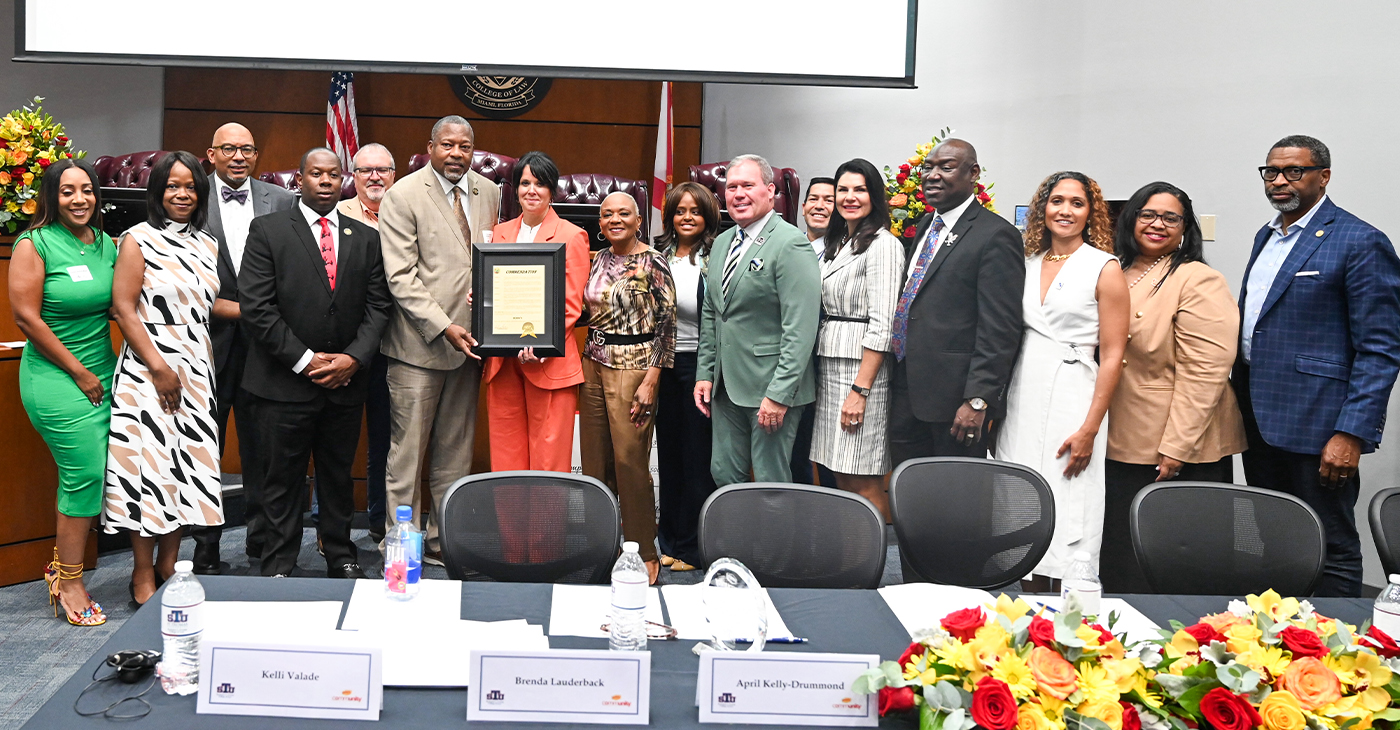
Kickoff Includes Signing of Alliance with 14 Partners including NAACP, HACR and the St. Thomas University Benjamin L. Crump College of Law, and Scholarship Presentation
SPARTANBURG, S.C., June 2024 – Denny’s (NASDAQ: DENN), America’s diner, announced today that it is elevating its decades-long commitment to communities nationwide by forming an alliance with 14 influential civic and educational organizations. The alliance is central to the brand’s Community initiative.
Denny’s groundwork for the Community initiative began over three decades ago when the company partnered with the NAACP, HACR, and 24 diverse civil rights organizations and nonprofit groups to drive positive change in the communities it serves. These efforts include over $2 billion in investments in diverse-owned businesses and donations exceeding $2.5 million in scholarships. Denny’s unwavering commitment to nurturing its workforce and addressing societal concerns takes a monumental leap forward with the launch of Community.
To amplify its dedication to feeding people: body, mind, and soul, Denny’s launched Community, a collaborative initiative dedicated to social change and forging strong alliances with trailblazing advocates, globally recognized civil rights leaders, and influential community and civic organizations representing historically marginalized communities. Denny’s will center its efforts around five key pillars: human and civil rights, business diversity, education, community involvement, and the cultivation of an inclusive leadership pipeline, in collaboration with its national and community partners.
The Denny’s Community initiative is a five-year partnership with organizations including: the St. Thomas University Benjamin L. Crump College of Law, Hispanic Association of Colleges and Universities, Hispanic Association on Corporate Responsibility (HACR), League of Latin American Citizens, NAACP, National Urban League, National Action Network, United States Hispanic Leadership Institute, and more.
Under the Community banner, Denny’s will allocate a total of $3.3 million for a multi-year commitment to its partners and support organizations to deploy local initiatives in cities and towns across the nation. These efforts include serving hot meals to underserved neighborhoods and groups via the Denny’s Mobile Relief Diner (MRD), which operates as a fully functional kitchen on wheels and travels across the nation, enhancing charitable giving programs, natural disasters, and emergency relief efforts.
Another key pillar in the Community initiative is promoting business diversity. Denny’s is partnering with the National Minority Supplier Development Council, US Pan Asian Chamber of Commerce, National LGBT Chamber of Commerce, Women’s Business Enterprise National Council, National Veteran Business Development Council, United States Hispanic Chamber of Commerce, and Disability:IN.

As part of Denny’s launch of its nationwide Community Alliance, a scholarship gift of $500,000 was given to the St. Thomas University Benjamin L. Crump College of Law. Crump accepted the donation from Denny’s in support of the College of Law’s commitment to social justice.
Pictured (l-r): Dean Tarlika Nunez-Navarro, Benjamin L. Crump College of Law; Randy Brown, Denny’s Senior Manager, Business Diversity; Brenda J. Lauderback, Chair, Board of Directors, Denny’s Inc.; Michael Whitacre, Denny’s Director of Franchise Operations; Benjamin L. Crump; Gail Sharps Myers, Denny’s Executive Vice President, Chief Legal and Administrative Officer; Kelli Valade, Denny’s CEO and President; Fasika Melaku-Peterson, Denny’s Senior Vice President, Chief Learning and Development Officer; President David A. Armstrong, St. Thomas University; Nader Talebzadeh, Denny’s Director of International Operations; April Kelly-Drummond, Denny’s Vice President, Chief Inclusion and Community Engagement Officer
The official launch of Denny’s Community Alliance took place at a press conference at the St. Thomas University Benjamin L. Crump College of Law. Denny’s CEO and President Kelli Valade signed the Community Alliance agreement and presented a $500,000 scholarship gift from Denny’s to the College of Law in support of its commitment to social justice, with further programs and activities unfolding nationwide with the Denny’s Community partner organizations.
Leaders of the coalition who attended the announcement include Benjamin L. Crump, St. Thomas University Benjamin L. Crump College of Law; Derrick Johnson, president of the NAACP; and Sylvia Pérez Cash, executive vice president and chief operating officer of the Hispanic Association of Corporate Responsibility (HACR).
“With the establishment of Denny’s Community initiative, we are continuing our work to connect with our guests and others in our communities,” said Valade. “Our partners are the embodiment of service and how to prioritize equity. We are honored to create this alliance that will impact and address challenges facing our society while breaking barriers to create a more diverse, equitable, and inclusive world for all.”
“We are grateful for corporations like Denny’s that recognize the vital importance of unity,” said Benjamin L. Crump. “We are honored to collaborate with leaders in this new alliance and are grateful to Denny’s for the scholarship support, which will help educate the social justice leaders of tomorrow, keeping the mission of equity and justice alive for decades to come.”
“The NAACP has been proud to partner with Denny’s for the last three decades, working collectively towards a more diverse corporate America,” said Derrick Johnson, President & CEO, NAACP. “The Community initiative is a crucial investment in those who have invested in the growth and success of the Denny’s brand. We are excited to continue this journey together, executing the vision of a more equitable and just society for all.”
“HACR is honored to enter a new phase of our decades-long partnership with Denny’s as part of Denny’s Community Alliance,” said HACR President and CEO, Cid Wilson. “Their multi-year investment is invaluable as we intensify our efforts to advance Hispanic inclusion. We recognize that real change requires sustained effort and are grateful to collaborate with a company, and peer advocacy organizations, that share our long-term commitment and unwavering focus. Our thanks to the leadership at Denny’s, for their steadfast commitment to Hispanic inclusion and overall DEI, including Kelli Valade, Board Chair Brenda Lauderback, board member and former CEO John Miller, and April Kelly-Drummond.”
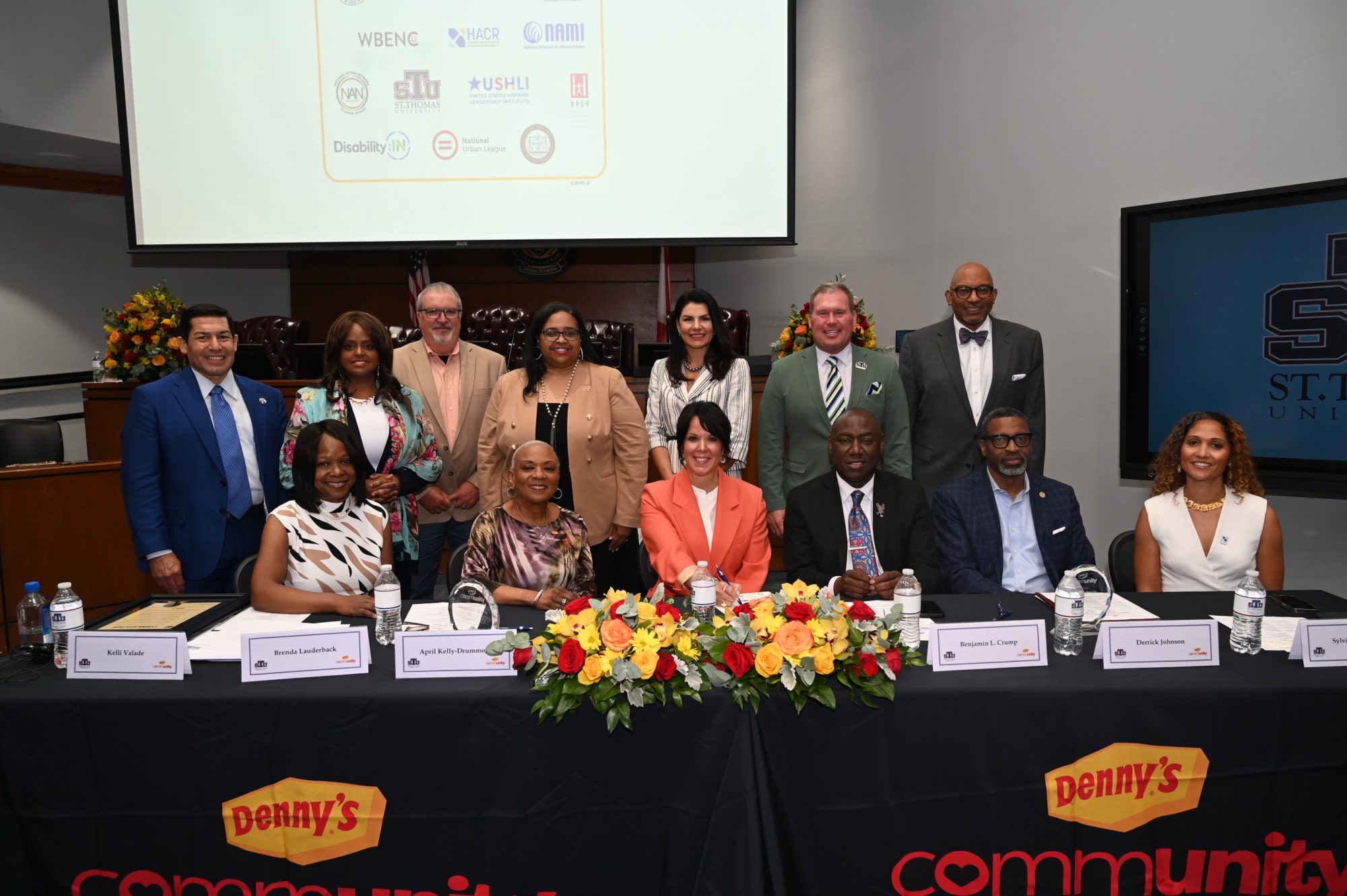
Denny’s recently announced the launch of it’s Community Alliance with a gift to the St. Thomas University Benjamin L. Crump College of Law. Representatives from Denny’s, NAACP, HACR, and the St. Thomas University Benjamin L. Crump College of Law were on hand for event.
Seated (l-r): Gail Sharps Myers, Denny’s Executive Vice President, Chief Legal and Administrative Officer; Brenda J. Lauderback, Chair, Board of Directors, Denny’s Inc.; Kelli Valade, Denny’s CEO and President; Benjamin L. Crump; Derrick Johnson, President and CEO, NAACP; Sylvia Pérez Cash, Executive Vice President, Chief Operations Officer, HACR.
Second Row (l-r): Nader Talebzadeh, Denny’s Director of International Operations; Fasika Melaku-Peterson, Denny’s Senior Vice President, Chief Learning and Development Officer; Michael Whitacre, Denny’s Director of Franchise Operations; April Kelly-Drummond, Denny’s Vice President, Chief Inclusion and Community Engagement Officer; Dean Tarika Nunez-Navarro, St. Thomas University, Benjamin L. Crump College of Law; President David A. Armstrong, St. Thomas University; Randy Brown, Denny’s Senior Manager, Business Diversity.
Denny’s April Kelly-Drummond, vice president and Chief Inclusion and Community Engagement Officer: “Bottom line: we are committed to serving communities everywhere – and all are welcome. We are proud to embark on this ambitious Community journey with our esteemed colleagues and partners to address social injustice in the restaurant industry and beyond, as well as create equitable access and opportunities for all particularly in the areas of education and economic empowerment.”
“For nearly 65 years, St. Thomas University (STU) has educated a diversity of national, local, and international students, helping them become ethical leaders for our global community,” said STU President David A. Armstrong, J.D. “Today, the university recognizes Denny’s efforts to promote human and civil rights, education, and community involvement. We thank Denny’s for their generous contribution to fund scholarships at the Benjamin L. Crump College of Law and its Center for Social Justice, which are training the world’s future servant leaders.”
St. Thomas University Benjamin L. Crump College of Law is one of America’s fastest growing and most diverse law schools, with a 71% enrollment increase since 2018 and over 300 incoming students expected in fall 2024. Black and Hispanic students make up roughly three-quarters of STU’s nearly 6,500 overall enrollment and that of the law school, which recently earned the second-highest bar passage rate in Florida.
For more information on Denny’s Community campaign and DE&I efforts, please visit www.dennys.com.
About Denny’s Corporation
Denny’s is a Spartanburg, S.C.-based family dining restaurant brand that has been welcoming guests to our booths for more than 70 years. Our guiding principle is simple: We love to feed people. Denny’s provides craveable meals at a meaningful value across breakfast, lunch, dinner, and late night. Whether it’s at our brick-and-mortar locations, via Denny’s on Demand (the first delivery platform in the family dining segment), or at The Meltdown, Banda Burrito, and The Burger Den, our three virtual restaurant concepts, Denny’s is ready to delight guests whenever and however they want to order. Our longstanding commitment to supporting our local communities in need is brought to life with our Mobile Relief Diner (that delivers hot meals to our neighbors during times of disaster), Denny’s Hungry for Education™ scholarship program, and our annual fundraiser with No Kid Hungry.
Denny’s is one of the largest franchised full-service restaurant brands in the world, based on the number of restaurants. As of March 27, 2024, the Company consisted of 1,553 restaurants, 1,489 of which were franchised and licensed restaurants and 64 of which were company-operated. This includes 168 restaurants in Canada, Costa Rica, Curacao, El Salvador, Guam, Guatemala, Honduras, Indonesia, Mexico, New Zealand, the Philippines, Puerto Rico, the United Arab Emirates, and the United Kingdom.
To learn more about Denny’s, please visit our brand website at www.dennys.com or the brand’s social channels via Facebook, Twitter, Instagram, TikTok, LinkedIn or YouTube.







Black Press
Birmingham on Pace for Fewest Homicides in 75 Years
BAKERSFIELD NEWS OBSERVER — Birmingham, Alabama, is currently on track to record its lowest annual homicide total in approximately 75 years. According to the Birmingham Police Department’s third-quarter briefing, the city recorded 34 homicides through October 1, representing a significant decrease from the 61 reported at the same time last year and the 129 reported by October 2024.

Birmingham, Alabama, is on pace to close 2026 with its fewest homicides in roughly 75 years — a turnaround for a majority-Black city that for decades made national headlines for its murder rate.
Birmingham police counted 34 homicides through Oct. 1, down from 61 at the same point in 2025 and 129 at the same point in 2024, Police Chief Michael Pickett said at the department’s third-quarter briefing. The city’s lowest annual total on record is 44, set in 1951. Just two years ago, Birmingham recorded 152 homicides, its deadliest year.
“I did not think that we would have this much of a reduction but of course that’s always the goal,” Pickett said. He put the drop at 74% compared with 2024 and said the department has cleared 91% of this year’s cases.
“Birmingham is on track for our fewest homicides in 75 years,” Mayor Randall Woodfin wrote on Facebook this month, crediting the officers of the Birmingham Police Department, Pickett, and the city’s community violence intervention workers.
The city’s bet runs on two tracks. On the policing side, Pickett has pointed to the department’s crime reduction plan, enforcement targeting illegal firearms, and cooperation with federal agencies. On the community side, Birmingham has put about $5.4 million in American Rescue Plan money into violence intervention programs: a hospital-based partnership with UAB Hospital, the Jefferson County Department of Health, the Offender Alumni Association, and Violence Intervention and Prevention Partners that places specialists at the bedsides of people wounded by gunfire; a street outreach team run with the Urban League of Alabama; a Group Violence Reduction Strategy with the National Institute for Criminal Justice Reform; and One Hood. With the one-time federal dollars expiring, the city council extended the hospital-linked program through June 2027 with $1.15 million and put $3 million for community violence intervention — a $1.5 million increase — into the city’s fiscal 2027 budget. Whether every program is fully covered once the federal money runs out remains unclear.
The honest caveats: murders are falling across the country, too — crime analyst Jeff Asher projects the lowest U.S. murder rate ever recorded in 2026, after the FBI reported the national homicide rate hit a 75-year low in 2025 — and nobody can prove which piece of Birmingham’s approach drove the drop. One category is moving the wrong way: domestic violence offenses are up 18.3% this year, the chief said. “This is not something the police department can handle alone,” Pickett said of the domestic violence increase.
Two accounting notes readers deserve: the mayor’s latest post says homicides are down 46% from last year, while the police department’s own Oct. 1 numbers work out to about 44% — and a May fact-check by ABC 33/40 found an earlier Woodfin figure slightly overstated. Separately, Bhamwiki counts 38 homicides as of Oct. 1 because it includes police-involved and justified cases; the police count is 34. And the pace math matters: 34 homicides through Oct. 1 projects to roughly 45 for the full year — just above the 1951 record of 44. So “fewest since 1951” is within reach; a new all-time low likely isn’t.
What’s working to make your neighborhood safer? Tell us.
Drafted by News Observed Editorial AI, human reviewed and published.
Based on reporting by Bakersfield News Observer.
Black Press
Ancestral Responsibility: Young Native Voters Fight Political Invisibility
NORTH DALLAS GAZETTE — Native American communities are mobilizing ahead of the November election to challenge long-standing systemic barriers and political invisibility. Recent data from the First Nations Development Institute refutes media narratives regarding Native voting patterns, showing that a majority of self-identified Native voters supported Kamala Harris in the 2024 election.
A mobilization is unfolding across tribal nations ahead of the November election. Driven by real data and a rising wave of young organizers, Native American voters are challenging systemic barriers to political power.
For generations, Native Americans have been treated as an invisible constituency in public life. Michael Roberts, president and CEO of the First Nations Development Institute, said that misrepresentations about native voters have clouded media narratives over recent years. Following the 2024 presidential election, relying on flawed national exit poll data, media placed some blame on Native Americans for the political shift.
“So while the media was trying to find a brown boogeyman on why Mr. Trump was in office … we had real data to show just the opposite,” noted Roberts.
A First Nations sample of 500 to 1,000 self-identified native voters revealed that 57 percent voted for Kamala Harris.
Roberts said the data showed attitudes reflective of the general public. Native voters are deeply concerned with inflation, the economy, affordability, and housing access. Yet they are also uniquely driven by tribal sovereignty, native languages, and cultural traditions. These cultural issues often drive them to the polls more than everyday pocketbook concerns.
Politically, Native Americans are not a monolith. With 475 tribes spread across 38 states and territories, traditional party lines are difficult to find. Roberts noted that analysts cannot view native voters through a simple black-and-white, Republican-or-Democrat lens.
Despite their potential to swing critical regions like Michigan and Alaska, native communities are largely ignored by major campaigns. First Nations data indicates that 50 percent or more of native voters have never been contacted by election campaigns. And nonprofit groups representing these communities remain severely underfunded.
Systemic barriers compound the neglect. Melissa Rogers, a professor of politics and policy at Claremont Graduate University, said upwards of 50 percent of native populations live within 20 miles of tribal homelands, debunking the myth of a sharp urban-rural Indian divide. Yet sadly, voting costs and distance barriers remain high on tribal lands.
Many reservations are so rural that residents must travel to distant county seats to collect mail or to register and vote. In Nevada, Duck Valley Reservation residents historically faced a 100-mile one-way drive to the Elko County seat just to cast a ballot or register in person.
Rogers noted that academic research shows tribal voting surges when registration and polling places are established directly on tribal lands.
Alternative options like mail-in voting face severe trust issues due to recent political attacks. Additionally, strict voter identification laws disproportionately disenfranchise native voters who often lack traditional physical addresses or state driver’s licenses.
In North Dakota, where the native vote is vital to a current Senate race, the state abruptly disallowed non-traditional addresses and post office boxes. Rogers warned that restrictive ballot deadlines, such as Arizona’s requirement that ballots arrive by election night, threaten to disenfranchise voters on the Navajo Nation due to slow rural mail delivery.
A historical skepticism remains, tied to past trauma. Rogers said federal government workers knocking on doors historically meant taking children, land, and resources from native households. The distrust extends to the census, which has long undercounted reservation populations.
A new crisis unfolds as federal proposals threaten to eliminate the American Indian and Alaska Native racial designations from official counts. Policy and funding decisions rely on these figures. Rogers warned that excluding native counts would devastate federal tribes.
In response, Native Organizers Alliance Executive Director Judith LeBlanc, a citizen of the Caddo Tribe of Oklahoma, said a national survey of 16,000 native people showed a fierce commitment to cultural continuity and essential human services.
When Congress pushed to try to make Big Cyprus into a wilderness area, which would have destroyed 11 traditional villages, burial grounds and medicine collection areas, her organization stood up for the rights of natives.
They also stood up for the rights of nature, and with the help of environmental groups, were able to document and mitigate the damage done by Alligator Alcatraz.
The organization’s surveys are fueling a new urgency among young voters. In Maine, Sage Phillips, co-coordinator of the Wabanaki Policy Youth Initiative, is leading youth to register voters, educate elders, and lobby the state house.
Wabanaki youth are pressuring candidates in gubernatorial, congressional, and local races to amend the 1980 Maine Indian Land Claims Settlement Act, which currently blocks local tribes from accessing beneficial federal laws.
Activists say the movement is about fulfilling an ancestral responsibility to protect sovereignty, lands, and future generations. But, the final hurdle rests on the integrity of the polling places themselves.
Over the last decade, targeted attacks on the voting system have made access significantly harder, Rogers said.
For information regarding local polling place availability, hours of operation, and rules ensuring a secure voting environment, citizens should check with official county election authorities and state election boards.
Ensuring that future elections remain open, equitable, and free of intimidation is critical for all citizens—especially American Indian voters.
The post Ancestral Responsibility: Young Native Voters Fight Political Invisibility appeared first on North Dallas Gazette.
Based on reporting by North Dallas Gazette.
Black Press
Black Household Wealth Plummeted 25% in Three Years, New Data Shows
MICHIGAN CHRONICLE — A new analysis of Federal Reserve data reveals that median wealth for Black households dropped 25% between 2022 and 2025, falling from $49,100 to $36,800. This decline occurred while White, Hispanic, and Asian households experienced increases in their median net worth, further widening the national racial wealth gap.

Median wealth among Black households fell 25% between 2022 and 2025, widening the racial wealth gap even as White, Hispanic, and Asian households saw their median net worth increase, according to a new analysis of Federal Reserve data.
Center for Economic and Policy Research (CEPR) director of race and economic justice, Algernon Austin, shared in an analysis published Tuesday (October 13) that median wealth among Black households fell from $49,100 in 2022 to $36,800 in 2025, a 25% decline.
In comparison, median wealth reached $332,100 for White households, $79,600 for Hispanic households, and $677,600 for Asian households in 2025, according to CEPR.
While Black households lost wealth, these groups saw their median wealth increase between 2022 and 2025. In 2025, Black households’ median wealth was $179,100 below the national median, up from a $162,000 gap in 2022.
Austin’s analysis suggests declining home, vehicle, and retirement account values contributed to the drop. The share of Black households with nonfinancial assets also declined from 81% to 78.4%.
The findings come as broader household wealth gains slowed and financial strain increased.Reuters reported earlier this month that the Federal Reserve’s latest Survey of Consumer Finances found the share of families spending at least 40% of their income on debt payments rose from 6.5% in 2022 to 8.6% in 2025.
The latest findings add to longstanding concerns about the racial wealth gap. A 2017 report by Prosperity Now and the Institute for Policy Studies projected that median Black household wealth could reach zero by 2053 if existing trends continued, raising questions about the long-term financial security of Black families.
That figure was a projection based on trends at the time, not a confirmed outcome.
The Black Information Network is your source for Black News! Get the latest news 24/7 on The Black Information Network. Listen now on the iHeartRadio app or click HEREto tune in live.
Based on reporting by Michigan Chronicle.
Art
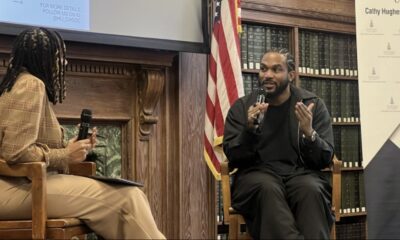
Kickstarter CEO Everette Taylor Shares Tips on Creating and Growing a Business
HOWARD UNIVERSITY NEWS SERVICE — Everette Taylor, the CEO of the global crowdfunding platform Kickstarter, recently visited Howard University to serve as the inaugural guest for the Cathy Hughes School of Communications’ new speaker series. Addressing students at the Founders Library, Taylor emphasized that the future of business belongs to those who are bold enough to take risks.
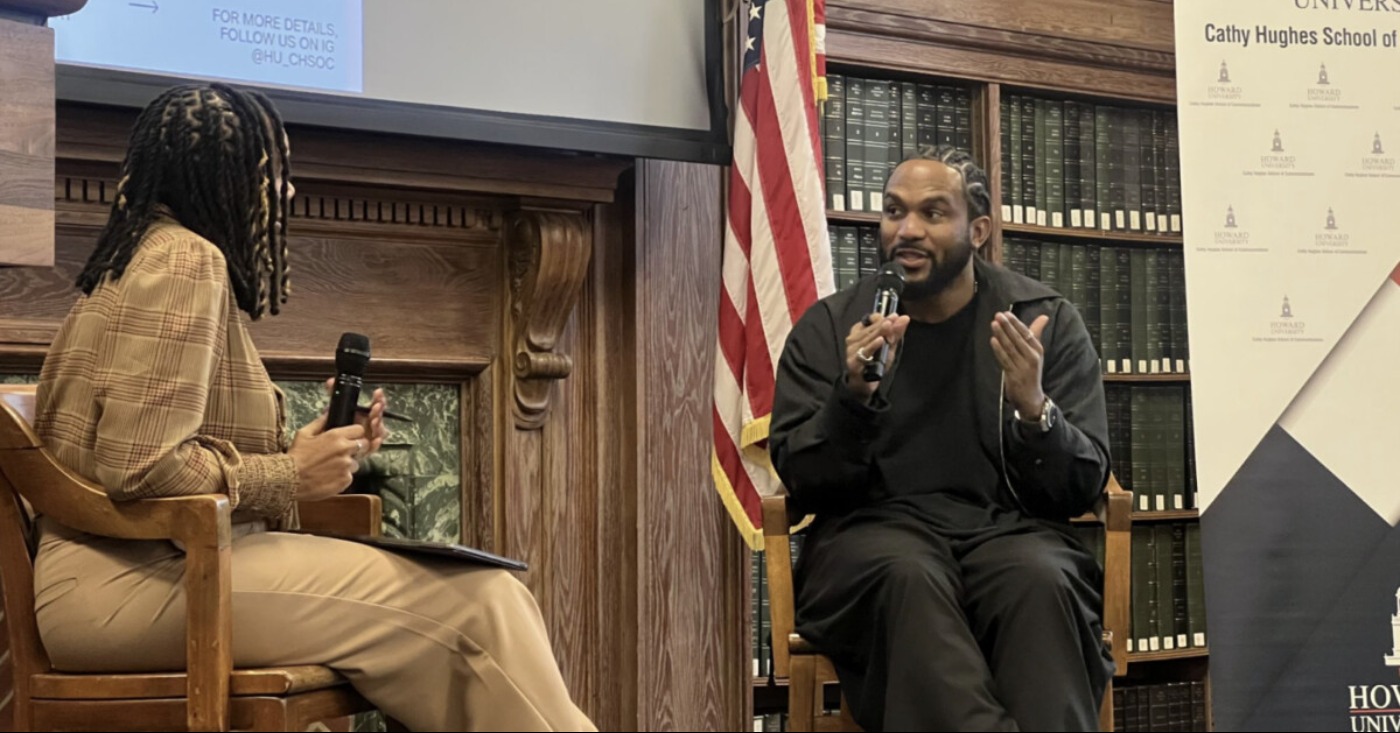
WASHINGTON (HUNS) — “The future belongs to creators who are bold,” Everette Taylor, CEO of crowdfunding platform Kickstarter, told students at Howard University during a recent visit.
As Taylor discussed his journey, he tested the boldness of students by inviting them to share their ideas during an impromptu pitch session at the Cathy Hughes School of Communications’ new speaker series in the Browsing Room of Founders Library. The inaugural speaker then shocked one group of students by pledging to invest in their thesis film, paying forward the opportunities that have lifted him as he struggled to pursue his dreams.
Taylor grew up in a low-income neighborhood in Richmond, Virginia, where he frequently encountered gang violence and drug dealing amid periods of homelessness.
Not feeling as if he conformed to conventional ideas of success, he eventually found inspiration in Jay-Z who balanced being an artist and an entrepreneur. Similarly, Taylor carved his own route, launching and growing various businesses.
He gained enough recognition to land on the 2018 Forbes’ 30 Under 30 list in marketing and advertising. In 2022, Forbes also named him as one of the top 50 most entrepreneurial CMOs when he was chief marketing officer of Artsy, an online art gallery and marketplace. That same year he took over Kickstarter, and the company reported a year-over-year revenue increase of 50% in the first quarter of 2026.
Taylor encouraged the audience through his story, but he also gave practical advice to help students who share his zeal to create and grow their business.
He explained that his mentor, Artsy CEO Mike Steib, helped him make the transition from being a CMO to becoming CEO at Kickstarter.
“These opportunities I don’t take for granted,” Taylor said, adding that Steib was “the first leader I had to take me under his wing.”
When he began his position at Kickstarter, Taylor said, “I had zero imposter syndrome, because I felt like I was ready for it, and it was because this person invested in me over the past few years.”
“A lot of my journey was me just hustling and being bold enough to ask for what I want, but I also need people to give me an opportunity.”
This idea of giving people opportunity impacts his business philosophy, as Taylor estimates that the number of African American employees grew exponentially since he’s been in leadership.
“Kickstarter was I think less than 2% Black, and at our peak I had gotten it to 20-something percent Black,” Taylor said.
Even then, Taylor also saw a need for representing other perspectives. “We still serve people globally, so we need people from different countries and cultures,” he said. “If you’re building a global company, it’s important to build a diverse base of people.”
“I always want to impact more lives, and that always leads to more results.”
Everette Taylor, CEO of Kickstarter
With the success Taylor had after becoming CEO of Kickstarter, he also found a need to prioritize his health.
“This is the first year that I’ve started the year with zero business goals,” he said. “For the first time, my goals have been centered around my health.”
He cites the illness of a friend who appeared to be healthy. Seeing his friend, who is also a successful entrepreneur, endure illness pushed him to prioritize his health.
“Business, I can do that in my sleep, but for me right now I’m so much more focused on setting goals for myself, and I know that’s going to impact the work that I do by feeling healthier and being a better version of myself.”
Samantha Housen, a sophomore public relations major and interior design minor from Harlem, attended the event to gain knowledge to grow her non-profit and for-profit businesses.
“I’m here because I want to explore more of the details of entrepreneurship from an actual professional,” Housen said, and to “see how his mindset could help me in my entrepreneurship.”
“My biggest takeaway is that I’m bold, and it’s OK to be bold,” she said. “I very much have the authority to do whatever I seek to do.”
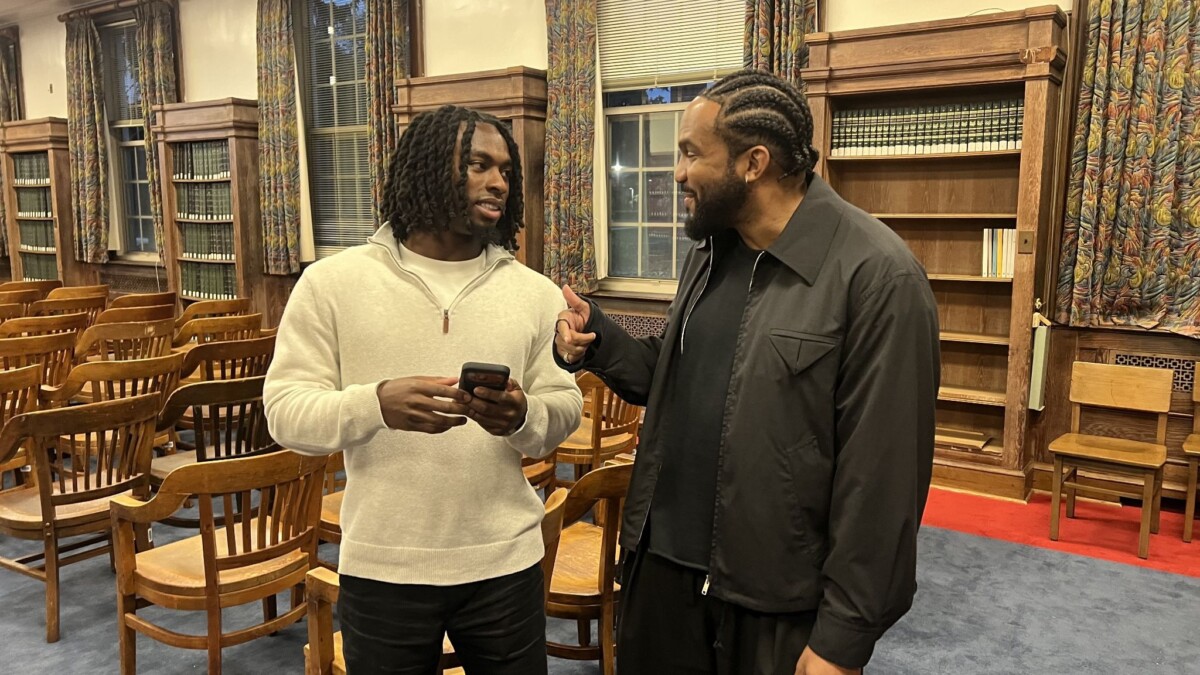
Kimberly Moffitt, Ph.D., dean of the Cathy Hughes School of Communications and host of the event, said she was excited about the speaker series.
“It’s because of students,” Moffitt said. “They felt like they weren’t hearing enough from people who are already post-graduation and successful. They wanted to hear those voices. So, this is an opportunity for me to bring folks to campus so they could reach out, talk and interact with folks that they aspire to be like or will be inspired by.”
Moffitt was excited for students to see someone who looked like them and carried themselves authentically in a position of high acclaim.
“He is showing you a different path, and letting you know that it’s OK to be who you are and show up in that space and not have to apologize,” Moffitt said of Taylor.
Moffitt also wants to encourage students to make the most of the speaker series. She gives details on upcoming speakers and the importance of hearing these people tell their stories.
“Those of you who want to be in TV and film, those jobs are different now,” she said. “You have to hustle in a different way.”
“I need our students to think about entrepreneurship in all that they do,” Moffitt added. “I want students to leave with that so that they have it in their back pocket should they need to draw on it.”
After the event. Taylor explained why boldness is essential to his success at Kickstarter.
“It’s for the grind and the ambition — not settling for status quo and mediocrity, and really going for it,” he said. “I always want to impact more lives, and that always leads to more results.”
Solomon Goins is a reporter for HUNewsService.com.
Based on reporting by Howard University News Service.
Black History
OP-ED: The Black Church Writes AI’s Next Chapter
BLACKPRESSUSA NEWSWIRE — I implore my fellow faith leaders to use these tools. Start now and use them with wisdom. We count on each and every one of you to make sure our communities help write the next chapter of this story. This rapid change is not as unfamiliar as it may sound. My first understanding of AI came from using a calculator for the first time in grade school. We did not call it AI, but it was a tool that helped me work through mathematical equations hours more efficiently.
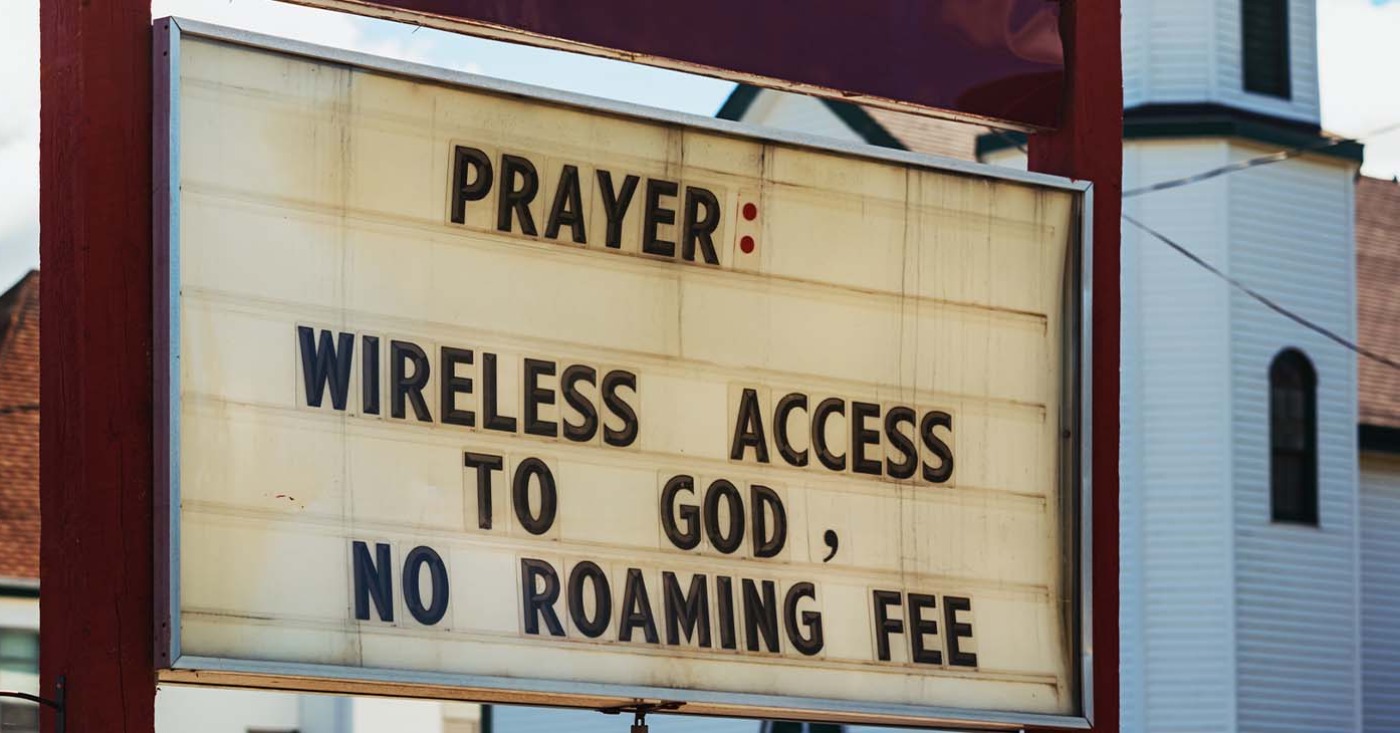
For generations, the Black church has stood strong in our communities through every historical change this country has experienced. During the civil rights movement and in recent times, faith leaders have helped uplift Black sanctuaries to register voters, keep food pantries open for people in need, and sit with families in hospital rooms in their most desperate moments. When our people faced new trials, they could always look to our faith leaders and the church to lean in to help us be included in these transformative changes.
Artificial intelligence is the latest revolutionary change to impact our society, and much like other transformations before us, underserved communities often get left behind.
I was recently featured in a report entitled “Faith, Community & AI” and it found that people send ChatGPT more than 70 million messages a week about religion. Nearly 22 million involve studying sacred texts, and 16 million ask about religious practices and holy days. Our members make up part of those numbers. They bring questions of faith to these tools every day.
Pastors have noticed, and according to a September 2025 Lifeway Research survey of 1,003 Protestant pastors, 42 percent said they use or experiment with AI in ministry. I count myself among them.
I write my sermons by hand, through prayer and study. When I finish a draft, I ask ChatGPT this question: “Where might this sermon become unclear or difficult to follow for someone early in their walk of faith?” It shows me gaps in my preparation, like where I incorrectly assumed everyone would know the context of who the Pharisees were. Then, change comes from my own pen, not the robot. The tool helps me reach the person in the back pew while the message still comes from me.
If I could have my wish, our whole community would take a similar posture. We must use these tools, understand them, and most importantly be present to help shape them if we want to be included in the coming change.
I implore my fellow faith leaders to use these tools. Start now and use them with wisdom. We count on each and every one of you to make sure our communities help write the next chapter of this story. This rapid change is not as unfamiliar as it may sound. My first understanding of AI came from using a calculator for the first time in grade school. We did not call it AI, but it was a tool that helped me work through mathematical equations hours more efficiently.
It starts with training; there is no involvement without understanding. Free AI trainings have begun in our churches and community centers across the nation. Every faith leader should sign up and, when possible, encourage members of your congregations to join you. By learning how to use AI, we can better understand what it can do, make up our own minds about its impact, and have a say in how it shapes our communities.”
Next, we must be at the tables where the builders of these tools make decisions. Presence is the first step toward understanding, and that gap is only bridged through a coordinated effort. How can any tool serve a community well if that community is not part of the conversation? Our traditions, needs, and concerns must be accounted for, and Black faith leaders are already making that happen. OpenAI’s recent Faith report states plainly that AI should never become an arbiter of religious truth. I fully intend to hold the company to its word, and the most effective way I can do that is from inside.
I will close with this––we must diligently protect what only the church can give. A believer in Seoul, Korea quoted in the report warned, “if you pour every struggle into a private chat, your pastor and your friends may never learn you need help.” A chatbot will not sit with a grieving family or pray with you at two in the morning. As we adopt this technology, it is up to us to ensure it keeps people connected to each other and to their church.
Rev. Dr. Adolphus Lacey is senior pastor of Bethany Baptist Church in Brooklyn, New York.
Black History
Federal Agents Search Ilhan Omar’s Home Just 22 Days Before Election
WASHINGTON INFORMER — Federal agents searched the D.C.-area home of Rep. Ilhan Omar (D-Minn.) on Monday, 22 days before Election Day. This extraordinary step involved executing a criminal search warrant against a sitting member of Congress.
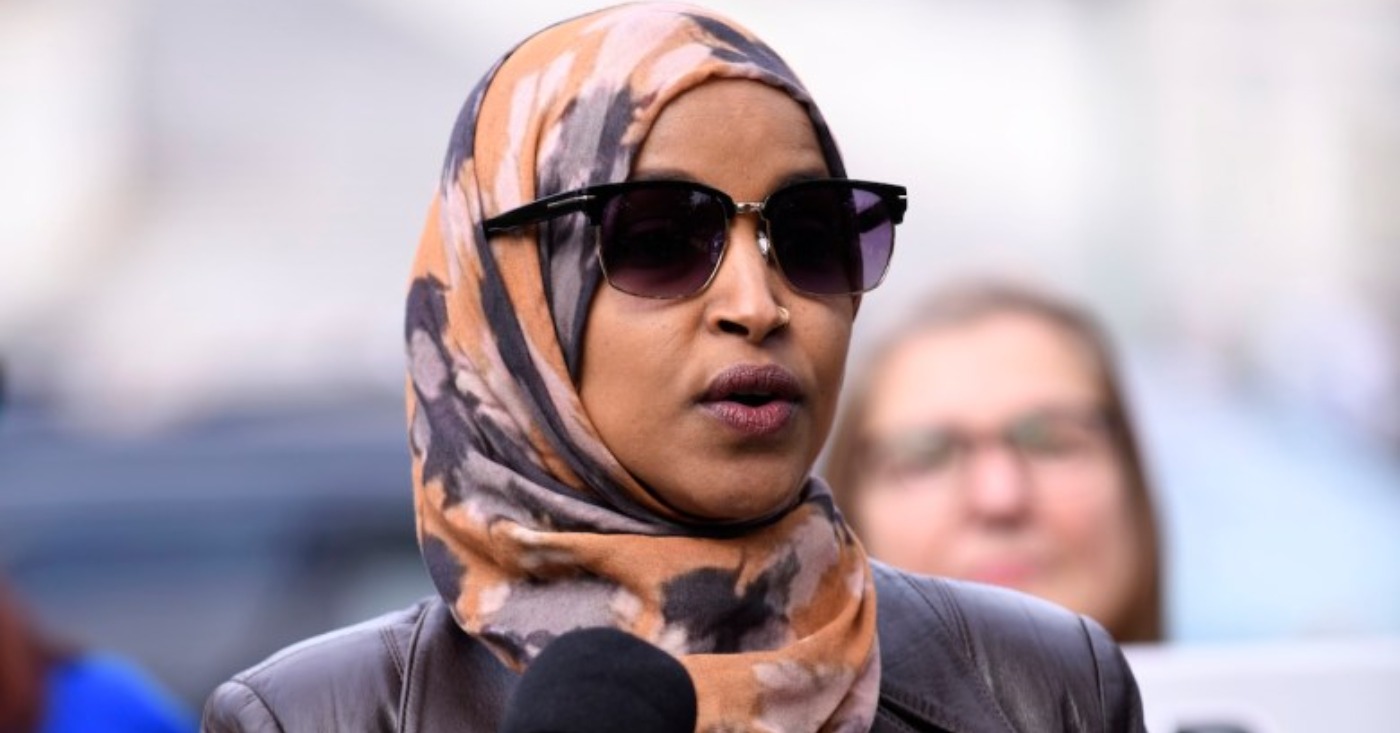
Federal agents searched the D.C.-area home of Rep. Ilhan Omar (D-Minn.) on Monday, taking the extraordinary step of executing a criminal search warrant against a sitting member of Congress just 22 days before Election Day, as the Trump administration investigates allegations involving her family’s immigration records.
The search immediately drew accusations of political intimidation from Omar’s supporters, who pointed to President Donald Trump’s repeated attacks on the Minnesota congresswoman and questioned the timing of an investigation targeting one of his most outspoken critics.
“Representative Omar is a dedicated public servant and a true ally for working families, and Donald Trump has done nothing but use racist tropes and stereotypes to attack her,” said Joel Payne, MoveOn’s chief communications officer. “Now, he’s abusing his power to physically intimidate and harass her.”
A Justice Department spokeswoman acknowledged that Homeland Security Investigations agents, part of Immigration and Customs Enforcement, searched a District residence as part of an ongoing federal criminal investigation.
The spokeswoman declined to provide additional information or publicly identify the person under investigation.
According to published reports, the warrant identified possible violations involving false statements, immigration document fraud and conspiracy. Federal investigators have also examined questions concerning Omar’s finances, campaign funds and interactions with foreign citizens.
No criminal charges against the congresswoman were identified, but Monday’s search occurred less than four weeks before voters decided whether to return Omar to Congress.
The investigation follows months of public accusations from senior Trump administration officials, including Vice President JD Vance, who previously claimed that Omar committed immigration fraud.
In an interview with conservative commentator Benny Johnson, Vance asserted, without publicly presenting evidence, that the administration believed Omar had broken immigration laws. He also said he and White House deputy chief of staff Stephen Miller had discussed how to pursue the allegations.
“What are the legal remedies now that we know that she’s committed immigration fraud?” Vance asked during the interview. “How do you go after her? How do you investigate her?”
Omar has repeatedly rejected the accusations, including claims that she married her brother to facilitate immigration fraud. Her office dismissed Vance’s allegations in March as fabricated and defamatory.
Questions about the investigation intensified in August when Immigration and Customs Enforcement refused to release records sought under the Freedom of Information Act concerning allegations surrounding Omar’s 2009 marriage to Ahmed Nur Said Elmi.
The agency cited an exemption allowing law enforcement authorities to withhold records when disclosure could interfere with enforcement proceedings. The refusal did not establish that Omar committed fraud or, at the time, confirmed that she was personally under investigation.
Omar, who came to the United States as a refugee from Somalia, was elected to Congress in 2018 and became one of the first two Muslim women to serve in the House. She represents Minnesota’s 5th Congressional District, which includes Minneapolis, and has frequently challenged Trump over immigration enforcement, civil rights, and his administration’s treatment of immigrant communities.
Her confrontations with the administration have made her a recurring target of the president’s political attacks. The criminal investigation also follows a frightening incident earlier this year in which Omar was physically attacked during a public appearance.
On Jan. 27, a man attacked Omar during a town hall meeting at the National Urban League’s Twin Cities headquarters in Minneapolis. The incident prompted condemnation from the National Coalition on Black Civic Participation and its Black Women’s Roundtable, which demanded accountability and warned against political violence.
“We are shocked and extremely disturbed by the attack on Rep. Ilhan Omar yesterday while she attempted to address the critical issues and chaos swirling around in Minneapolis,” Melanie L. Campbell, president and CEO of the coalition and national convener of the Black Women’s Roundtable, said in a Jan. 28 statement.
Campbell praised Omar for continuing to speak out despite threats against her.
“We believe that NO public official should be threatened or physically attacked, especially when they are serving in the best interests of their constituents,” Campbell said. “Political violence and intimidation have no place in our democracy.”
MoveOn, the progressive advocacy organization, accused Trump of using federal law enforcement to intimidate a political opponent and urged voters to respond at the ballot box.
“On Nov. 3rd, we get our chance to fight back and hold him and his corrupt administration accountable,” Payne said.
Based on reporting by Washington Informer.


NFL Round-Up: Caleb Williams strikes back, Panthers, Browns and Titans secure victories

Birmingham on Pace for Fewest Homicides in 75 Years

Ancestral Responsibility: Young Native Voters Fight Political Invisibility

Black Household Wealth Plummeted 25% in Three Years, New Data Shows

Kickstarter CEO Everette Taylor Shares Tips on Creating and Growing a Business

HBCU Football Roundup: Homecoming Wins for Howard, Tennessee State and Jackson State

Luxury SUV: Heated Seats & Captain’s Chairs Review #shorts

Black-Owned Banks: Compliance to Community Business #shorts

FDIC Study: African American Banks Disappearing Rapidly #shorts

Car Buying Tip: Check Windshield Glare & Interior Space! #shorts

The Youngest American Killed in the Vietnam War

Passing for White, Fighting for Black America: The Courage of Walter White

OP-ED: Haiti TPS: Have We Lost Sense of Humanity?
NFL: Week Two Recap | Jalen Hurts did not fold; Caleb Williams exits game with injury

Remembering Chauncey Bailey as Student Journalists Face Threats to Truth-Telling

Peter Magubane: a Camera Against Apartheid

Mayor Lee Announces $1 Million Kaiser Permanente Grant for Pilot Program to Address Homelessness, Clean Up Public Spaces throughout Oakland

OP-ED: How Head Start Also Helps Parents

Poll: Becerra Widens His Lead Over Hilton; Californians Split on Wealth Tax

Community Action Group ‘Friends of Zakiya’ Ask Sheriff for Time
Luxury SUV: Heated Seats & Captain’s Chairs Review #shorts
Black-Owned Banks: Compliance to Community Business #shorts
FDIC Study: African American Banks Disappearing Rapidly #shorts
Car Buying Tip: Check Windshield Glare & Interior Space! #shorts

St. Louis Celebrates Excellence at The St. Louis American’s 39th Annual Salute to Education Gala

‘No King: Vote Early’ protest for democracy in St. Louis

Optimize Your Seating: Essential Household Setup Guide #shorts

Brake Pedal Test Drive: Smooth Stops for Your Truck! #shorts

Life Lessons Learned Through Adversity: My Journey #shorts

From Claflin Alum to ColorBlind Artist
-

 Black Press6 days ago
All Skinfolk Ain’t Kinfolk
-
 Black Press5 days ago
Oakland Awarded More than $14 Million in State Funding
-

 Black Press5 days ago
Jendayi Arrest Raises Community Concerns Regarding Sheriff’s Chain of Command
-

 African American News and Issues4 days ago
Black History: Gladys West Mathematics Helped Make GPS Possible
-

 Black Press5 days ago
Allen Temple Baptist Church Hosts Free Prostate Cancer Screenings on Oct. 17
-
 Black Press5 days ago
Democrats, Community Groups Back Measure EE to Change How Oakland Is Governed
