
Politics
One of the Angola Three Recalls Life in Solitary Confinement


This April 22, 2009, file photo, shows a view of the front entrance of the Louisiana State Penitentiary in Angola, La. Albert Woodfox, the last of three high-profile Louisiana prisoners known as the “Angola Three,” could walk free within days after a federal judge ordered state officials to release him immediately. Woodfox has been in solitary confinement for 43 years. He was accused, along with three other prisoners, in the stabbing death of Brent Miller, a 23-year-old guard at the Louisiana State Penitentiary at Angola. (AP file photo/Judi Bottoni, File)
STACEY PLAISANCE, Associated Press
REBECCA SANTANA, Associated Press
NEW ORLEANS (AP) — Robert King says he watched nearly three decades of his life fade away in solitary confinement inside Louisiana’s Angola prison, sometimes glimpsing the world through a small window and longing for the few hours a week he might feel the sun on his face.
“We were caged up,” said King, who was released in 2001 after a court reversed his conviction in the death of a fellow inmate in 1973. “I don’t think a person can go through that and come up unscathed.”
King is one of three men known as the “Angola Three,” who supporters say spent decades in solitary confinement at the Louisiana State Penitentiary, often referred to simply as Angola, the town in which it’s located.
Another man, Herman Wallace, was released in October 2013 when a judge granted him a new trial and died days later.
Now, King is closely watching the fate of the last of the three, Albert Woodfox, after a judge this week ordered his immediate release and barred the state from trying him a third time in the killing of a prison guard in 1972.
The attorney general is fighting that ruling and won an emergency stay keeping him in jail while the two sides argue the matter before an appeals court.
In court filings Wednesday, Woodfox’s lawyers argued that he does not pose a flight risk if released, needs medical attention and would submit to electronic surveillance if released.
The lawyers also argued that prosecutors’ claims that Woodfox was dangerous were “starkly untrue.”
State officials have said repeatedly that the evidence shows he is a killer. They say Woodfox has been in a form of protective custody called closed cell restriction, but not solitary confinement. They say he’s allowed to watch television through the bars of his cell, talk to other inmates in his tier, read books, talk to visiting chaplains and leave his cell every day for an hour.
“The perception of ‘solitary confinement’ is a far cry from the reality,” said Aaron Sadler, a spokesman for the Attorney General’s office.
For now, Woodfox is being held in a jail where he’s awaited his new trial since February. His supporters estimate he’s spent a total of more than four decades in isolation, with some breaks in the 1990s and in 2008.
It’s a situation King knows well. He spoke to The Associated Press by telephone from Austin, Texas, where he now lives.
King said he was shackled at the hands and feet anytime he left his cell. He said he could see and converse with a handful of other inmates in the immediate vicinity, but they all had to be careful not to talk too loud, or too much, or they would be written up.
The conditions changed over time. At first there was no window or time outside, but eventually he was allowed outside for short periods a few times a week and given a cell with a window.
“If it was raining, too hot, too cold, they wouldn’t let us go outside, and they wouldn’t give us makeup time,” he said.
Many experts say such conditions, whatever the name, can have detrimental effects on inmates. Some have reported anxiety, paranoia, depression and hallucinations, said Dr. Sharon Shalev, a research associate from the Centre for Criminology at the University of Oxford who runs the website www.solitaryconfinement.org.
Shalev said she’s had prisoners tell her they harmed themselves just to reaffirm they were still alive.
There are no precise figures on the number of inmates held in isolation, the Vera Institute of Justice said in a May report. However, the report said estimates range from 25,000 — which includes only those held in so-called supermax facilities — to 80,000, which includes those held in some type of segregated housing across all state and federal prisons.
The report also said inmates in isolation are more likely to kill or hurt themselves than those held in the general population.
What has made the case of the Angola Three and Woodfox in particular such a lightning rod for international attention has been the length of time they were in isolation. Tory Pegram of the International Coalition to Free the Angola 3 said Woodfox was first put in solitary in April 1972, the same day the guard he was eventually accused of killing died.
Louisiana corrections officials have said he was in closed cell restriction for many years but declined to elaborate because litigation is pending.
Meanwhile, King is eagerly awaiting his friend’s release. He started driving from his home in Austin on Tuesday to meet Woodfox when he was released but turned around when that release was delayed. But he plans to be there if and when Woodfox walks out of the jail.
In the years since his release, King has written a book and often gives talks on his experiences. When asked how he didn’t go crazy, he replied, laughing, “I didn’t say I wasn’t crazy.”
“It was bitter,” he said. “But there are some things that you can make out of lemons. I just tried every day to make lemonade.”
___
Follow Santana on Twitter: @ruskygal. Follow Plaisance: @splaisance
Copyright 2015 The Associated Press. All rights reserved. This material may not be published, broadcast, rewritten or redistributed.












Black History
Remembering Moses Newson and the Power of the Black Press During the Civil Rights Movement
ATLANTA DAILY WORLD — Moses J. Newson, a pioneering journalist who spent decades documenting the American Civil Rights Movement for the Black press, died on November 17 at his home in Baltimore at the age of 99. His daughter confirmed that he passed away from natural causes.
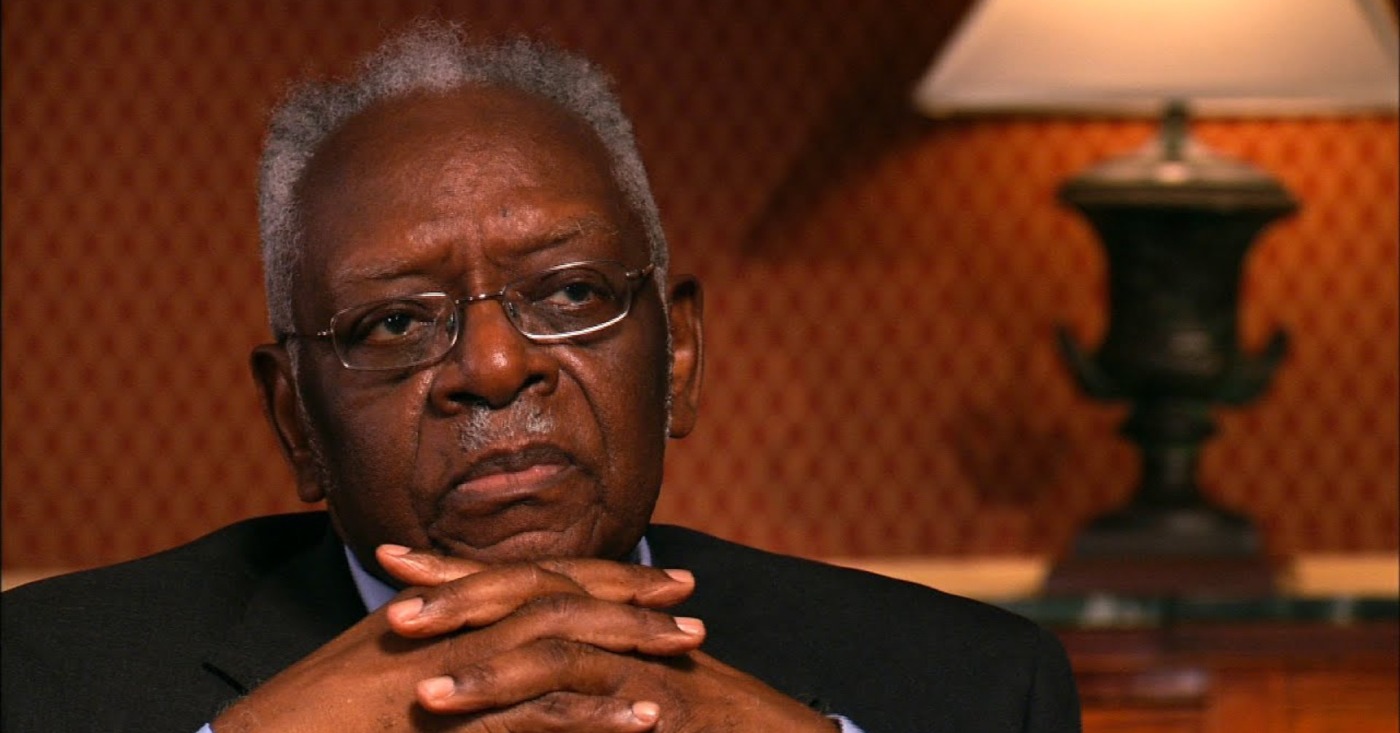
Moses J. Newson, a pioneering Black journalist whose reporting documented some of the most defining moments of the Civil Rights Movement, died November 17 at his Baltimore home. He was 99.
His daughter, Shawn Newson, confirmed to Journal-isms that he died of natural causes.
Throughout his career, Newson documented the struggle for racial equality from the front lines, bearing witness to events that challenged segregation and transformed American society. His work reflected the critical role of the Black press during an era when racial injustice frequently received inadequate coverage from mainstream news organizations.
Born February 5, 1927, in Fruitland Park, Florida, Newson pursued journalism after serving in the United States Navy. He studied at Storer College and Lincoln University in Missouri before beginning his newspaper career at the Tri-State Defender in Memphis in 1952.
His early assignments included coverage of school desegregation and the murder of Emmett Till in 1955, a case that helped galvanize the national Civil Rights Movement.
Newson joined the Baltimore Afro-American in 1957, covering the integration of Central High School in Little Rock, Arkansas, during his first assignment with the newspaper.
Four years later, he placed himself in considerable danger while covering the Freedom Rides, organized to challenge segregation in interstate transportation.
Newson survived the infamous attack on a Freedom Riders bus in Anniston, Alabama, in 1961. Despite the personal danger he encountered, he continued documenting the movement, providing readers with firsthand accounts of the resistance to racial integration.
His reporting also included the integration of the University of Mississippi in 1962 and the 1963 March on Washington. In 1968, he interviewed the Rev. Dr. Martin Luther King Jr. during preparations for the Poor People’s Campaign, shortly before King’s assassination.
Newson spent 21 years with the Baltimore Afro-American, rising from reporter to city editor and ultimately executive editor. He spent the final decade of his newspaper career overseeing editorial operations before transitioning into federal public affairs in 1978.
In 2014, the National Association of Black Journalists inducted Newson into its Hall of Fame, recognizing his contributions to journalism and his extraordinary record of civil rights coverage.
His experiences were also documented through the Civil Rights History Project, a collaboration between the Library of Congress and the Smithsonian Institution’s National Museum of African American History and Culture.
Newson’s family plans to honor his life with a private ceremony in February, when he would have celebrated his 100th birthday.
His death marks the loss of a journalist who witnessed history at extraordinary personal risk. His reporting remains part of the permanent record of America’s struggle for racial equality and a reminder of the indispensable role Black newspapers played in bringing that struggle to the nation’s attention.
The post Remembering Moses Newson and the Power of the Black Press During the Civil Rights Movement appeared first on Atlanta Daily World.
Based on reporting by Atlanta Daily World.
Black Press
Oakland Chamber of Commerce Faces $42,000 Ethics Fine for Campaign Violation
The Oakland Public Ethics Commission has approved a $42,000 fine against the Oakland Metropolitan Chamber of Commerce and its leaders for campaign finance violations. Investigators found that the chamber’s political action committee acted as a conduit to hide the identities of wealthy donors who funded attack ads against former Councilmember Desley Brooks during the 2018 election. The settlement concludes an investigation into pass-through contributions that deprived voters of legally required information. Several other political entities and former city officials are also linked to the case. Read more.

The political arm of the Oakland Metropolitan Chamber of Commerce and its leaders Barbara Leslie and Zack Wasserman were fined a total of $42,000 by the Public Ethics Commission for improper campaign spending and accusations of hiding campaign financial details for its efforts to oust City Councilmember Desley Brooks in 2018, as reported in The Oaklandside.
The commission approved the settlement, voting for it 5-2 at its meeting Tuesday evening.
The Chamber, utilizing its political action committee (PAC), “OakPAC,” acted as a conduit for money from more than a dozen large companies and wealthy individuals into an independent expenditure committee, “Oaklanders for Responsible Leadership,” which ran attack ads against Brooks during the 2018 election, according to the Public Ethics Commission.
According to Oaklandside,16 contributors donated nearly $90,000 to the campaign against then Brooks, and their names were kept hidden until months after the election when the Chamber submitted additional filings with regulators.
During her years in office, Brooks had been opposed by local groups because she led the creation of the city’s Department of Race and Equity and because of her consistent advocacy for ending the city’s longtime lack of attention to the needs and concerns of African American residents.
As a result, Brooks was often demonized, and former Mayor Libby Schaaf initiated several attempts to remove her from office.
The ethics commission, which has been investigating the case since 2022, is recommending a settlement requiring the Chamber’s PAC, the Chamber’s CEO Barbara Leslie, and the group’s board chair emeritus, Zack Wasserman, to pay a penalty of $42,000.
The accused have agreed to a “no contest” resolution, meaning they accept the penalty but do not admit wrongdoing.
The commission’s investigation was tied to a broader case involving Schaaf, who was accused of secretly leading three political committees in two different election years to attack political opponents and support a ballot measure.
The commission resolved most of the Schaaf investigation in October 2024 when the former mayor agreed to pay $21,000.
Two political committees, Committee for an Affordable East Bay and Oaklanders for Responsible Leadership, faced fines of $325,000 in penalties. But since those committees are no longer active, those penalties would be difficult to enforce, according to the commission.
In the proposed settlement of the Chamber of Commerce case, the ethics commission investigators said that the OakPAC’s use of pass-through contributions are “serious violations” of Oakland’s Campaign Reform Act.
“While the individual respondents have stated that they did not believe that the actions they took violated the law, the people involved in this arrangement were all sophisticated individuals who should have been familiar with campaign finance law,” investigators wrote. “[They] engaged in activity which deprived voters of donor information required by law.”
The investigators wrote that an internal accounting and tracking document of contributions planned for the anti-Brooks committee indicates “an intentional pattern of conduct to conceal the names of individuals whose contributions ended up going to [the committee], regardless of whether there was knowledge that these activities were illegal.”
Local observers have raised concerns that the ethics commission’s powers of enforcement are severely limited and do little to ensure fair political practices in local campaigns.
Oaklandside, Oakland Post file stories, and other online accounts are the sources of this report.
Black Press
A Record 216 Firearms Collected at East Oakland Gun Buy-Back Event
The Oakland Police Department and community partners recently hosted the “Guns to Gardens” buyback event, collecting a record 216 firearms. This total marks the largest collection in more than a decade, surpassing the previous high of 130 guns set in 2022. Participants received a total of $18,000 in gift cards for surrendering weapons ranging from compact pistols to military-style assault rifles and ghost gun kits. Officials confirmed that every weapon collected will eventually be repurposed to serve a new community function. Read more.

Over the weekend, the Oakland Police Department (OPD) and community partners hosted “Guns to Gardens,” a gun buyback event with strong community participation. OPD collected a record 216 firearms, exceeding the previous high of more than 130 in 2022 and marking the largest collection in more than a decade.
“Thanks to the generosity of our faith-based coalition, the Kaiser Foundation, and local partners, we distributed $18,000 in gift cards to community members who turned in their firearms,” said Oakland Mayor Barbara Lee.
The buyback follows the graduation of the 197th academy of Oakland Police Department (OPD) cadets on Nov. 6. The nine cadets are already making their mark connecting with residents, honoring the department’s history, and supporting department events.
In their first month, the Cadets helped clean the Remember Them monument at Henry J. Kaiser Memorial Park. They learned about Oakland Police Officer John Grubensky, who died in the line of duty while guiding community members to safety during the Oakland Hills Fire and is honored on the monument.
The Cadets handed out candy at OPD’s annual Trunk or Treat celebration and helped with the 197th Police Academy graduation ceremony.
Most recently, the Cadets participated in an inspection and pinning ceremony, marking another milestone in their development and service to our community.
OPD thanks Kaiser Permanente and PG&E for their donations, which led to the reinstatement of the Cadet Program. This program offers young people ages 15½ to 20½ opportunities to engage with their community, gain experience, and explore careers in public safety.
But it was the veteran officers that handled the buyback at St. Benedict’s Catholic Church at 2245 82nd Ave.in East Oakland.
The weapons collected on Nov. 14 ranged from compact pistols to assault weapons. One participant also surrendered equipment used to create homemade firearms, commonly known as “ghost guns.”
“I was shocked to see the number of assault weapons, military-style firearms, and ghost guns turned in,” said Oakland Police Chief James Beere. “Every firearm removed from our streets is one less that could be used in a shooting or other act of violence. By choosing to turn in unwanted guns, we help protect our neighborhoods and ultimately save lives.”
OPD and Lee thanked the community partners, volunteers, and participants for their continued support in this effort.
“Every single gun collected will be transformed into garden tools and given back to the community at future events,” said Lee. “A huge thank you to everyone who participated, our dedicated partners, and OPD for making Oakland safer.”
Paul Chambers is the strategic communications manager for the Oakland Police Department.
Black Press
A Record 216 Firearms Collected at East Oakland Gun Buy-Back Event
The Oakland Police Department and community partners recently hosted the “Guns to Gardens” buyback event, collecting a record 216 firearms. This total marks the largest collection in more than a decade, surpassing the previous high of 130 guns set in 2022. Participants received a total of $18,000 in gift cards for surrendering weapons ranging from compact pistols to military-style assault rifles and ghost gun kits. Officials confirmed that every weapon collected will eventually be repurposed to serve a new community function. Read more.

Over the weekend, the Oakland Police Department (OPD) and community partners hosted “Guns to Gardens,” a gun buyback event with strong community participation. OPD collected a record 216 firearms, exceeding the previous high of more than 130 in 2022 and marking the largest collection in more than a decade.
“Thanks to the generosity of our faith-based coalition, the Kaiser Foundation, and local partners, we distributed $18,000 in gift cards to community members who turned in their firearms,” said Oakland Mayor Barbara Lee.
The buyback follows the graduation of the 197th academy of Oakland Police Department (OPD) cadets on Nov. 6. The nine cadets are already making their mark connecting with residents, honoring the department’s history, and supporting department events.
In their first month, the Cadets helped clean the Remember Them monument at Henry J. Kaiser Memorial Park. They learned about Oakland Police Officer John Grubensky, who died in the line of duty while guiding community members to safety during the Oakland Hills Fire and is honored on the monument.
The Cadets handed out candy at OPD’s annual Trunk or Treat celebration and helped with the 197th Police Academy graduation ceremony.
Most recently, the Cadets participated in an inspection and pinning ceremony, marking another milestone in their development and service to our community.
OPD thanks Kaiser Permanente and PG&E for their donations, which led to the reinstatement of the Cadet Program. This program offers young people ages 15½ to 20½ opportunities to engage with their community, gain experience, and explore careers in public safety.
But it was the veteran officers that handled the buyback at St. Benedict’s Catholic Church at 2245 82nd Ave.in East Oakland.
The weapons collected on Nov. 14 ranged from compact pistols to assault weapons. One participant also surrendered equipment used to create homemade firearms, commonly known as “ghost guns.”
“I was shocked to see the number of assault weapons, military-style firearms, and ghost guns turned in,” said Oakland Police Chief James Beere. “Every firearm removed from our streets is one less that could be used in a shooting or other act of violence. By choosing to turn in unwanted guns, we help protect our neighborhoods and ultimately save lives.”
OPD and Lee thanked the community partners, volunteers, and participants for their continued support in this effort.
“Every single gun collected will be transformed into garden tools and given back to the community at future events,” said Lee. “A huge thank you to everyone who participated, our dedicated partners, and OPD for making Oakland safer.”
Paul Chambers is the strategic communications manager for the Oakland Police Department.
Black Press
UC Doctors, Nurses and Community Rally to Demand ICE Out of UC Hospitals
A coalition of University of California resident physicians and nurses rallied outside the Board of Regents meeting in San Francisco this week to demand the removal of immigration enforcement from UC hospitals. Supported by organizations including the California Nurses Association and SEIU, the protesters called for systemwide protocols to protect patient privacy and worker safety. Organizers argue that the presence of federal agents undermines medical trust and compromises care for vulnerable populations. The coalition is now urging university leadership to implement specific transparency measures and updated guidelines to read more.
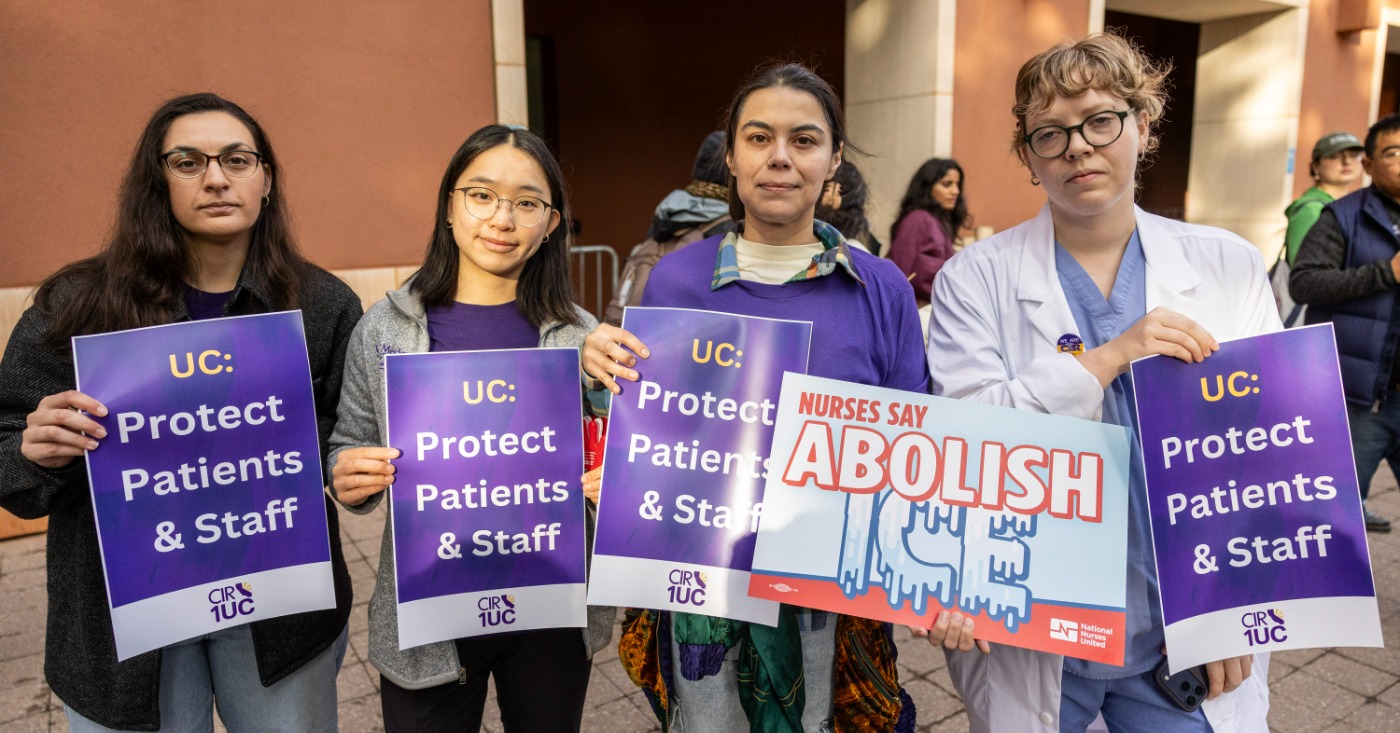
Alongside community members, a coalition of resident physicians and nurses from across the University of California rallied this week outside the Board of Regents meeting in San Francisco demanding that UC get ICE out of its hospitals and establish clear, systemwide protections for patients and healthcare workers.
Hundreds of emails have been sent to the Board of Regents and UC President James Milliken reiterating the need for a comprehensive policy and protocol. The email action is cosponsored by the Committee of Interns/Service Employees International Union (CIR/SEIU), the California Immigrant Policy Center, California Nurses Association, and United Auto Workers 4811, according to a press release issued by protest organizers.
These actions on Tuesday, Nov. 17, were part of a growing campaign to ensure UC hospitals remain places of healing, dignity, and confidential medical care for everyone, regardless of immigration or custody status, the press release said.
Currently, a lack of clear, consistent protocols and staff training for situations involving patients in immigration enforcement custody at UC Health facilities creates confusion, safety risks, and the potential for violations of patients’ rights. Healthcare workers need clear guidance to protect patient privacy, uphold legal rights, and provide appropriate medical care.
“As doctors, the well-being of the people we serve is our utmost priority. The presence of immigration enforcement in our hospitals undermines our ability to provide care and impedes patients from receiving proper, dignified treatment. UC must take action now to protect patients and staff,” said Dr. SatKartar Khalsa, CIR-SEIU regional vice president.
The presence of immigration enforcement officers in healthcare settings can interfere with medical examinations and treatment, compromise patient confidentiality, and undermine trust between patients and providers. Patients in immigration custody may face barriers to contacting family, accessing support services, and participating in decisions about their care. Healthcare workers also report fears of unsafe working conditions, racial profiling, and retaliation for advocating for their patients.
“Nurses demand that our hospitals must be places of healing and safety and completely off limits to any sort of ICE or federal immigration agent presence,” said Jamile Cabacungan, a medical-surgical-telemetry RN at UCSF Stanyan Hospital. “From the start of this cruel and unnecessary deportation program, nurses have been educating ourselves and our patients to know and exercise our rights, and we even sponsored state legislation to keep ICE out of our hospitals. Our employer UC must step up and proactively do everything possible to support us and our ability to provide safe care to our patients and communities.”
The coalition calls on UC leadership to:
- Protect patient privacy and dignity by limiting ICE access to patient care areas and safeguarding confidential patient communications.
- Uphold patients’ rights and continuity of care, including access to certified medical interpreters, family notification, surrogate decisionmakers, social services, legal support, and safe disposition planning.
- Protect healthcare workers from racial profiling and retaliation for advocating for immigrant patients.
- Establish clear protocols and staff training for responding to immigration enforcement activity in hospitals.
- Ensure transparency and accountability, including information about federal immigration agents’ visits to UC hospitals over the past year.
- Meet with union representatives to address healthcare workers’ concerns and develop effective protections.
The coalition is urging – at a minimum – for UC to adopt the updated California Attorney General guidelines, with stronger protections modeled on comprehensive immigrant rights policies. These protections must include practical protocols, staff training, clear lines of responsibility, and accountability for implementation.
Black History
‘We’re Committed to Delivering the Change that the American People Deserve’
House Speaker-designate Hakeem Jeffries recently outlined a legislative vision for the 120th Congress, emphasizing a commitment to affordability and government accountability. As the first Black congressman set to take up the Speaker’s gavel, Jeffries appeared alongside historic leadership selections Katherine Clark and Pete Aguilar to address the economic struggles facing American families. The Democratic nominee pledged to combat rising costs for groceries, housing, and healthcare while promising to address systemic corruption. Jeffries further detailed his strategy for representing diverse communities across the nation. Read more.
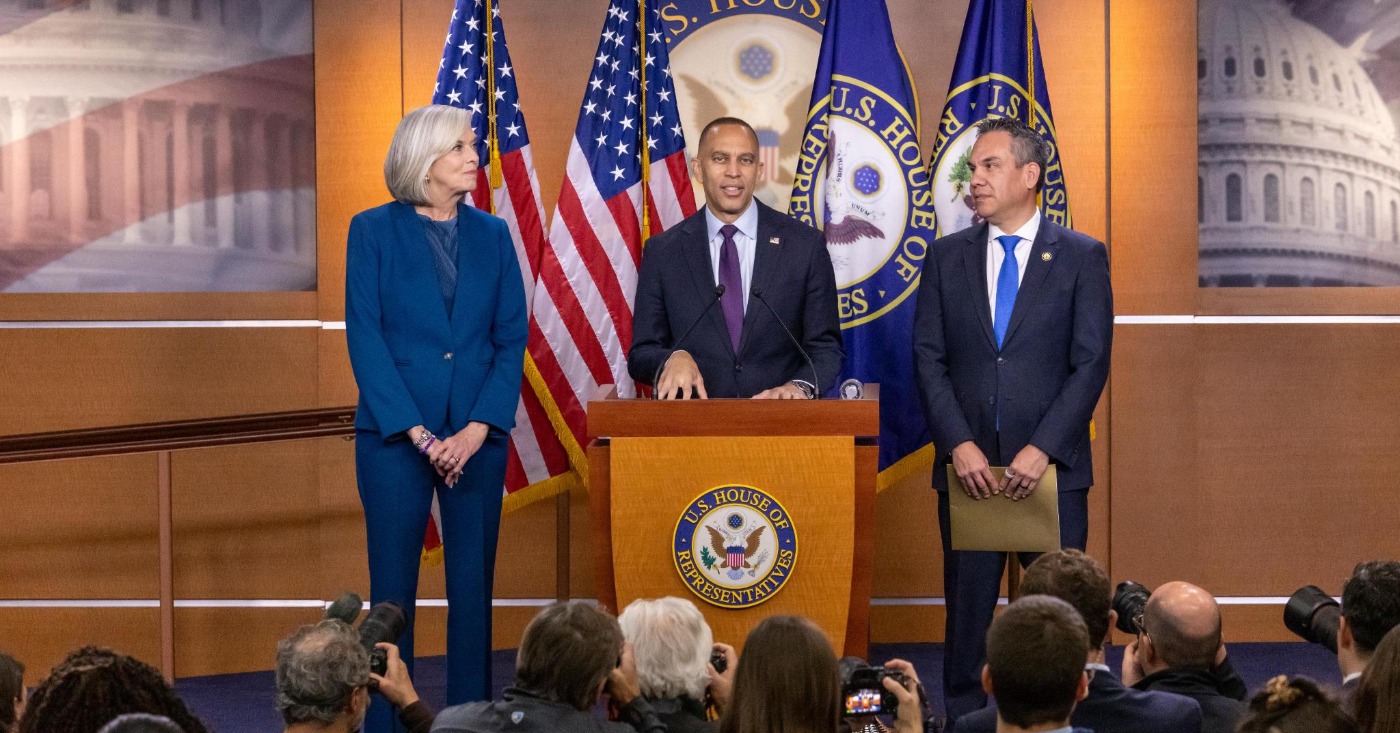
Hakeem Jeffriesto become the first Black congressman to take up the Speaker’s gavel
House Speaker-designate Hakeem Jeffries held a press conference where he emphasized that House Democrats are committed to delivering on their vision of affordability and accountability for the American people in the 120th Congress.
His remarks are shared below.
“It’s a high honor and a distinct privilege to stand before the American people today as the Democratic nominee to be the next Speaker of the United States House of Representatives. It’s a particular honor to stand with two amazing leaders, patriots, colleagues and friends. Katherine Clark, the Democratic Leader, the Majority Leader in the 120th Congress, a historic elevation, and Pete Aguilar, the next Majority Whip of the 120th Congress, also a historic elevation.
“We collectively know as House Democrats that life is way too expensive here in the United States of America. There are far too many people in this country who are working hard, they’re playing by the rules, but they can’t thrive and they can barely survive. That’s not acceptable here in this great country, the wealthiest country in the history of the world. We know the American people are struggling. We know millions of people are drowning in this failed Republican economy, and House Democrats are committed to turning things around.
“Our message to the American people who are struggling in this failed economy is a simple one. We hear you. We see you. We feel you. And House Democrats are committed to making life better for you. We’re going to fight for an affordable America. We’re going to fight to lower the high cost of groceries and gas and housing.
We’re going to fight to make healthcare affordable for every single American. And we’re going to fight to make sure that, in the face of the unprecedented corruption, chaos and cruelty visited upon the American people, that House Democrats will hold the crooks accountable, not for partisan reasons, but for patriotic ones, because the American people deserve better.
The 120th Congress is going to be the most diverse in America’s history. And we know that what brings people together are the challenges that Americans of every walk of life are experiencing. Our commitment is that we’re going to fight hard to make life better for everyone.
We’re going to fight for small-town America. We’re going to fight for urban America. We’re going to fight for rural America. We’re going to fight for the heartland of America. We’re going to fight for Black and brown communities all across America.
The people of this country are demanding bold, dramatic and transformational change. The status quo is unacceptable. And we’re committed to delivering, in a meaningful way, the type of change that the American people deserve so that everyone in this country can live an affordable life, a comfortable life and a good life.
U.S. Rep. Hakeem Jeffries’ media relations office is the source of this report.

2027 Cadillac VISTIQ Is This $96,271 SUV Quiet Enough?

The Hidden Costs of Buying: Protect Your Budget and Peace of Mind #shorts

2027 Chevy Tahoe High Country: Is $96,575 Worth It? #shorts
Actress Heather Alicia Simms on Broadway and Caribbean Theater

Playfessionals: Building Real Community for Twin Cities Professionals | MSR On the Radar

Minnesota Hip-Hop’s First First Avenue Shows in 1983 #shorts

Free Shipping at $85—Plus Big Plans for Wholesale and Expansion #shorts

Where Would You Charge Your EV: At Home or in Public? #shorts

Curtis Blow’s 1982 Rap Contest: The Win That Changed Everything #shorts

Stop Selling Jeans to Everyone—Find an Underserved Niche #shorts

HISTORY MADE: Keisha Lance Bottoms Becomes First Black Woman Elected Governor in American History

Retirement Triggers Doctor to Pen Book for Young Audience

Multi-Faith Leaders Representing 10 Million People Launch National Anti-Authoritarian Initiative

Christianity’s Racial History

Hundreds of Black Christian Leaders Arriving in Israel for Martin Luther King-Inspired Mission

Michael Shiner: The Enslaved Man Who Wrote His Way into American History

Keisha Lance Bottoms to Govern State Where Her Great-Great-Grandfather Was Enslaved

Don’t Pass the Torch. Expand the Circle.

Dallas Mavericks Unite Players, Legends and the Oak Cliff Community at 2026 Community Tip-Off

DOJ Fights to Keep Rep. Ilhan Omar’s Search Warrant Sealed: Report
The Hidden Costs of Buying: Protect Your Budget and Peace of Mind #shorts
2027 Chevy Tahoe High Country: Is $96,575 Worth It? #shorts
Playfessionals: Building Real Community for Twin Cities Professionals | MSR On the Radar
Minnesota Hip-Hop’s First First Avenue Shows in 1983 #shorts
Free Shipping at $85—Plus Big Plans for Wholesale and Expansion #shorts
Where Would You Charge Your EV: At Home or in Public? #shorts
Curtis Blow’s 1982 Rap Contest: The Win That Changed Everything #shorts
Stop Selling Jeans to Everyone—Find an Underserved Niche #shorts

AI Music Is Changing How We Discover Artists #shorts

Before You Rent Retail Space, Know Your Break-Even Sales #shorts
-

 Black Press1 week ago
Black Men Encouraged to Start Prostate Cancer Screening at 45
-

 Black History6 days ago
Black Barbershops Have Long Given Neighborhood Politics a Place to Unfold.
-

 Black History1 week ago
Debunking the Myth That Europeans Alone Plotted Africa
-

 Black Press1 week ago
Computational Thinking and Young Children: It’s Not What You Might Think!
-

 Black Press1 week ago
Alonzo Mourning’s Affordable Senior Housing
-

 Black History1 week ago
Wichita’s Only Black-Owned Bookstore Seeks $90,000 to Secure Its Future
