
Featured
LIVE! — ASK ALMA! TUES. 9.29.26 7PM EST
Got life questions? Join Alma live Tues, 9/29 at 7 PM EST for real talk, wisdom, and laughs. Don’t miss out!


Need a little advice, a good laugh, or just a fresh perspective? Join us for a brand-new episode of Ask Alma streaming live on Tuesday, September 29!
This week, Alma tackles real viewer questions with her signature blend of wisdom, warmth, and humor. From relationships and family dynamics to everyday life challenges, no topic is off limits when Alma is in the chair.
Whether you’re looking for guidance or simply enjoy hearing how others navigate life’s twists and turns, this is a conversation you won’t want to miss.
📅 September 29, 2026
📺 Watch live on YouTube
💬 Bring your questions and join the conversation!
Ask Alma: Real questions. Real talk. Real solutions… with a smile.
#AskAlma #LifeAdvice #Relationships #LiveStream #BlackPressUSA
🎙️ New to streaming or looking to level up? Check out StreamYard and get $10 discount! 😍 https://streamyard.com/pal/d/6551970446311424








Featured
Cardinal Ritter is headed back to the state championship!
Cardinal Ritter is heading back to the state championship after a dominant 62-30 victory over Eureka. The Lions now set their sights on the Class 5 title.


Cardinal Ritter is headed back to the state championship!
The Lions punched their ticket to the Show Me Bowl with a dominant 62 to 30 victory over Eureka. Sophomore quarterback Rhylan Moore threw for more than 300 yards and three touchdowns, while senior running back Amir Tillman rushed for 181 yards and three touchdowns.
Cardinal Ritter will face undefeated Helias as the Lions look to capture their first Class 5 state championship since 2023.
#STLAmerican #CardinalRitter #STLFootball #ShowMeBowl #StateChampionship
Black History
COMMENTARY: My Truth — We Can Realize the Dream Together
GARLAND JOURNAL — The 2027 Healthy Living Expo is scheduled for Monday, January 18, 2027, following the City of Dallas’ Dr. Martin Luther King, Jr. Parade.


Get ready. The 2027 Healthy Living Expo is a good way to start the new year. Complete with the Red Cross Blood Drive, workshops, health screenings, the Chitterling Cook-off and more, it’s a family affair!
The Realizing The Dream Healthy Living Expo is scheduled in observance of Dr. Martin Luther King Jr. Day and to follow the ‘City of Dallas’ Dr. Martin Luther King, Jr. Parade on Monday, January 18, 2027. The Expo is 9:00 am to 4:00 pm at the South Dallas Cultural Center.
Building on the well-attended 2026 Expo, the excitement is mounting for another day of community engagement and service. This year’s Expo, in partnership with the City of Dallas, Cr8ive Outlet, and the University of North Texas at Dallas College of Law, will continue to honor Dr. King’s vision of equality, opportunity, and improved quality of life.
The UNT Dallas College of Law is the first college or university in North Texas and the only law school in the nation to join the King family in its global campaign to use volunteer and civic engagement to bridge divides and strengthen communities.
The goal of Realize the Dream is to encourage public (and private) service and generate 100 million volunteer hours by MLK’s 100th birthday in 2029.
The Realizing the Dream Healthy Living Expo includes helping individuals and families access the knowledge, resources, and opportunities needed to lead healthier, more productive, and financially secure lives.
We realize that these are some challenging times and hopefully the 96-HOUR SPECIAL will be an incentive for those looking to join in for a wonderful day of Love as we educate, inform, inspire, challenge and entertain. The 96 hours, from November 27–30, 2026, are especially designed to help small businesses and encourage support of a worthy program. Outdoor booths for small businesses, nonprofits, and political vendors are $100 (After November 30 regular price $150).
Call 214 941 0110 so you can get in on the special.
This event is for the entire family, and the entire community. It’s an opportunity, after enjoying the parade, to continue the celebration as we remember someone who left this world in a better place.
Now, it’s up to us to do all we can. In this article:My Truth
Based on reporting by Garland Journal.
Art
‘i Hope It Makes People Want to Be 100 Percent Themselves’
ST. LOUIS AMERICAN — The Contemporary Art Museum St. Louis is currently hosting a major survey exhibition titled “Nobody’s Gonna Love You the Way I Do,” featuring the work of performance artist Ayana Evans. Organized by Chief Curator Dean Daderko, the exhibition spans over two decades of Evans’ career, highlighting her journey from a painter and fashion designer to a distinctive figure in the performance art world.

‘Ayana Evans: Nobody’s Gonna Love You the Way I Do’ offers agency at CAM
Long before a museum exhibition was devoted to her work, Ayana Evans was making art anywhere she pleased.
On escalators. In galleries. On city streets.
Sometimes she showed up in a zebra-print catsuit and bright red lipstick. Sometimes people stared. Sometimes they questioned whether what she was doing was art at all.
She did it anyway.
“I’m not sorry. I’m not trying to blend in,” Evans said. “I’m not covering up.”
That spirit drives Ayana Evans: Nobody’s Gonna Love You the Way I Do, now on view at the Contemporary Art Museum St. Louis through early February.
Organized by Dean Daderko Ferring Foundation Chief Curator, with support from Exhibitions Assistant Grace Early, the exhibition brings together more than two decades of Evans’ performance-based work. It also introduces local audiences to an artist whose practice centers freedom, self-acceptance and taking up space unapologetically.
For Daderko, the decision to devote a major exhibition to Evans came after witnessing one of her performances.
“I was so moved by it,” Daderko said. “I thought somebody needs to give this woman a big survey exhibition. It may as well be me.”
The exhibition traces Evans’ evolution from painter and designer to one of the country’s most distinctive performance artists.
Ironically, she never intended to become one.

Evans began as a painter. The Chicago native struggled to gain traction in New York’s art world. So she stepped away from fine arts entirely for several years and launched a fashion accessories business.
“I quit art for like seven years,” Evans said.
Eventually, she found herself returning to galleries and exhibition openings, but she noticed something about the spaces she was entering.
Coming from fashion, Evans favored sequins, short skirts and bold colors. The art world’s unofficial uniform of head-to-toe black clothing with harshly cut bangs felt vastly different.
“I didn’t look like an art girl,” Evans said.
She remembered being treated as though she didn’t belong.
“I literally was asked, ‘Who invited you?’”
Rather than shrinking herself, she leaned further into visibility.

A borrowed catsuit eventually became part of her artistic identity.
At first, Evans simply recorded videos with friends and posted them online. She wasn’t pursuing institutional recognition or trying to launch a career in performance art.
“The ambition was to do it,” Evans said. “Not the accolades.”
Over time, audiences found the work.
What they encountered was an artist willing to place herself at the center of conversations around visibility, body image and the ways Black women navigate public space.
One gallery video featured Evans perched on a dramatic red escalator in Venice. Another performance transformed ordinary public spaces into stages.
The work is playful. It can also be confrontational.
For Evans, those moments are less about provocation than permission.
“I always say I hope it makes people want to be 100 percent themselves,” she said. “It’s not about wearing neon like me. If I can wear a neon bodysuit, then you can wear whatever you want, too.”
That message emerged from Evans’ own journey.
She admits that she once struggled with body image and spent years trying to draw attention away from herself.
“This project almost became the worst-case scenario,” Evans said. “People talked about me and about my body. People took pictures. And then I realized I could wear whatever I wanted and not really care.”
Instead of opening old wounds, the work helped heal them.
“It freed me,” she said.
The resulting performances often feel less like spectacles than invitations.
Evans describes them as love letters.
“I love me. I want you to love you,” she said. “I want people to come see my work and feel like there’s some energy being exchanged, where I accept myself and I accept you.”
That generosity is part of what drew Daderko to her work so many years ago.
“Oftentimes people don’t feel like museums are for them,” Daderko said. “Ayana makes people feel seen.”
The exhibition reflects that philosophy from the moment visitors walk through the door.
Interactive elements encourage participation. Visitors can step onto a red carpet, pose with signs and props inspired by Evans’ projects and become part of the experience rather than simply observing it.
For Daderko, creating that sense of access was essential.
“The goal is to show what this experience is like and to do it in a way that invites people into the conversation,” he said.
That perspective also shapes how Evans hopes audiences experience performance art.
Too often, she believes the form is treated as something exclusive or inaccessible, even though many communities engage with performance traditions every day.
“I want people to know that performance art is for them,” Evans said. “It’s not this thing over there.”
Expanding the definition of performance art is only part of the goal.
“I want them to feel happy,” Evans said. “I want it to be a celebration.”
For Daderko, the exhibition offers audiences a chance to discover what he’s long admired about Evans’ work.
“They maybe haven’t met their favorite performance artist yet,” Daderko said. “But they’re about to.”
Ayana Evans: Nobody’s Gonna Love You the Way I Do continues through February 7, 2027, at the Contemporary Art Museum St. Louis (CAM), 3750 Washington Boulevard, St. Louis, MO 63108. For more information, camstl.org.
The post ‘I hope it makes people want to be 100 percent themselves’ appeared first on St. Louis American.
Based on reporting by St. Louis American.
Black History
COMMENTARY: What’s the Best Meal Served During Thanksgiving?
HOUSTON DEFENDER — As Thanksgiving approaches, Black families across the country prepare for the annual return of familiar culinary debates that transcend the dinner table. These discussions are rarely about the food alone; instead, they reflect deep-seated traditions, family hierarchies, and historical lineages passed down through generations.
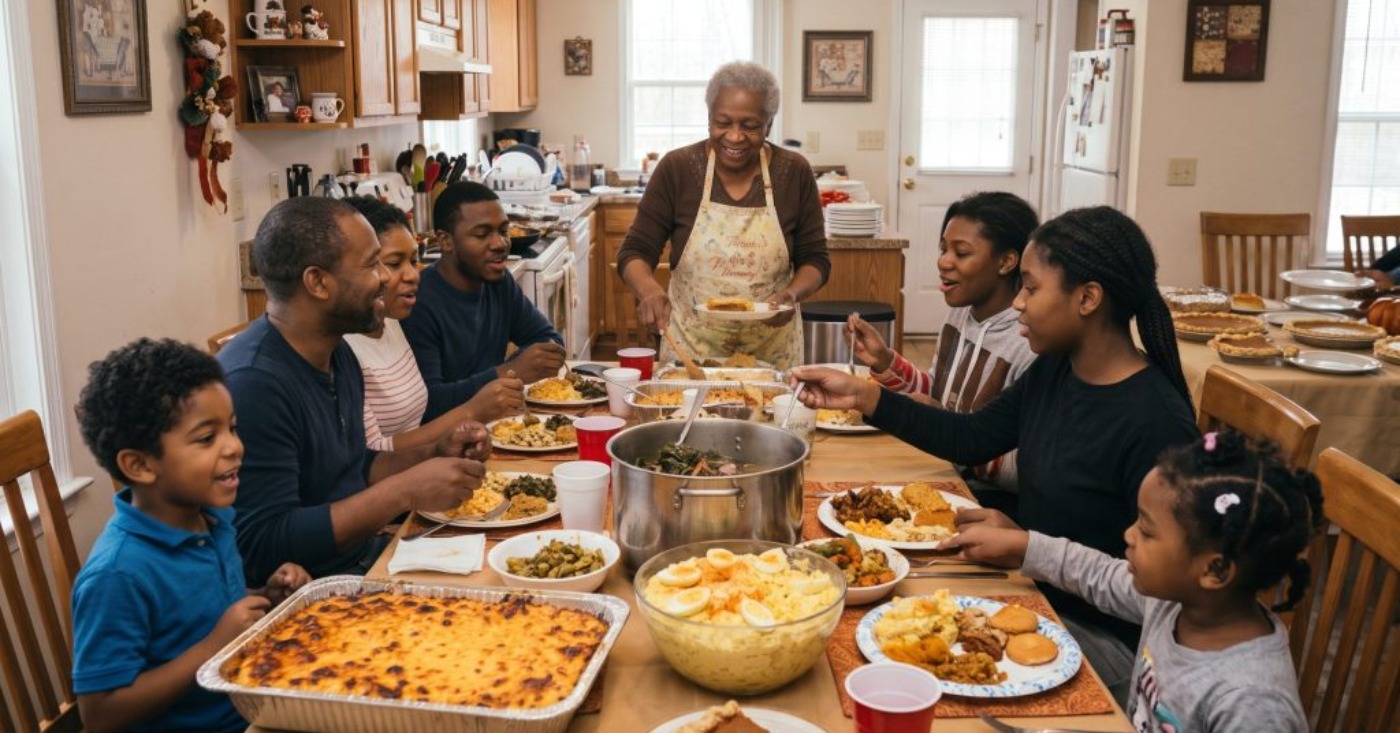
Before anyone fixes a plate this Thanksgiving, somebody is going to ask who made the macaroni and cheese. In many homes, that question is a very serious one.
Thanksgiving is around the corner, and with it come the same arguments Black families have had forever. Dressing or stuffing. Sweet potato pie or pumpkin. Hot sauce or vinegar on the greens. Who gets to season the food, who gets to taste it, and who gets told to go sit down.
The fights are rarely about the food itself. Behind each dish is a recipe, a relative, and a rule passed down from a grandmother, an aunt, or a church kitchen.
Here are 10 Thanksgiving plate debates that recur every year, ranked from most heated to least heated.
Baked macaroni and cheese rules

The rules are short. It is baked, never stovetop, and it never comes out of a box. The cheese gets shredded by hand, the top gets brown, and the corner pieces go first.
The bigger rule is who makes it. Most families have one approved cook, and a pan from an unknown kitchen gets inspected before anyone takes a scoop. The dish also carries real history. Monticello, Thomas Jefferson’s Virginia plantation, credits James Hemings, the enslaved chef Jefferson took to France for culinary training in the 1780s, with helping popularize macaroni and cheese in America.
Dressing vs. stuffing

In much of the South, it is called dressing. It starts with cornbread, bakes in its own pan, and never goes inside the bird. In the North, the dish is more often called stuffing and usually starts with white bread. Technically, the difference is where it cooks. Stuffing goes inside the turkey. Dressing does not.
Sweet potato pie vs. pumpkin pie

Sweet potato pie has long been tied to Black Southern cooking. Food historians trace it to enslaved Africans in the American South, who cooked sweet potatoes in place of the West African yams they knew from home. Pumpkin pie, meanwhile, became the standard Thanksgiving dessert in much of the rest of the country. Some families let it in, as long as it sits at the far end of the dessert table.
Who is allowed in the kitchen?

Some family kitchens have a chain of command. The elder in charge decides who seasons, who stirs, and who tastes. Everyone else gets a job far from the stove, like setting the table, running to the store for ice, or watching the kids.
Getting put out of the kitchen is a rite of passage. So is the day an aunt finally hands over a spoon and asks for a second opinion on the greens. That moment means you have earned her trust.
Baked, fried or smoked turkey

Oven-baked turkey is still the classic. Deep-fried turkey grew out of Louisiana’s Cajun cooking and became a Southern holiday standard by the 1990s.
Texas has its own smoked-turkey tradition. Greenberg Smoked Turkeys in Tyler has smoked birds over hickory for generations and ships them across the country every holiday season.
In Houston, the fight often comes down to fried vs. smoked. The fryer crowd wants crisp skin and a fast cook. The smoker crowd wants low heat, wood smoke, and patience.
The greens

Collard greens need smoked meat, and families split on which kind. Some cooks swear by smoked turkey wings or necks. Others will not make a pot without ham hocks.
Then the table fight starts. Some people want a splash of pepper vinegar. Others reach for hot sauce. Some want both. The pot likker, the broth left at the bottom of the pot, is its own prize, usually claimed with a piece of cornbread.
Potato salad

Potato salad is a cookout staple, which is why some families say it has no business on a Thanksgiving plate. Others say the holiday spread is not finished without it.
If it makes the table, the next questions come fast: who made it, mustard or no mustard, sweet relish or dill, and whether anybody added raisins. That last one usually ends the conversation.
Which side are you on? Tell us in the comments.
Based on reporting by Houston Defender.
Black Press
Queen Latifah Turns Affordable Housing Mission into New Doc
CHICAGO DEFENDER — Queen Latifah is expanding her extensive legacy in music, film, and philanthropy through a new documentary titled “You Can Go Home Again.” The film, produced by Flavor Unit Entertainment and P&G Studios, chronicles the entertainer’s return to her hometown of Newark, New Jersey, to develop an affordable housing complex.
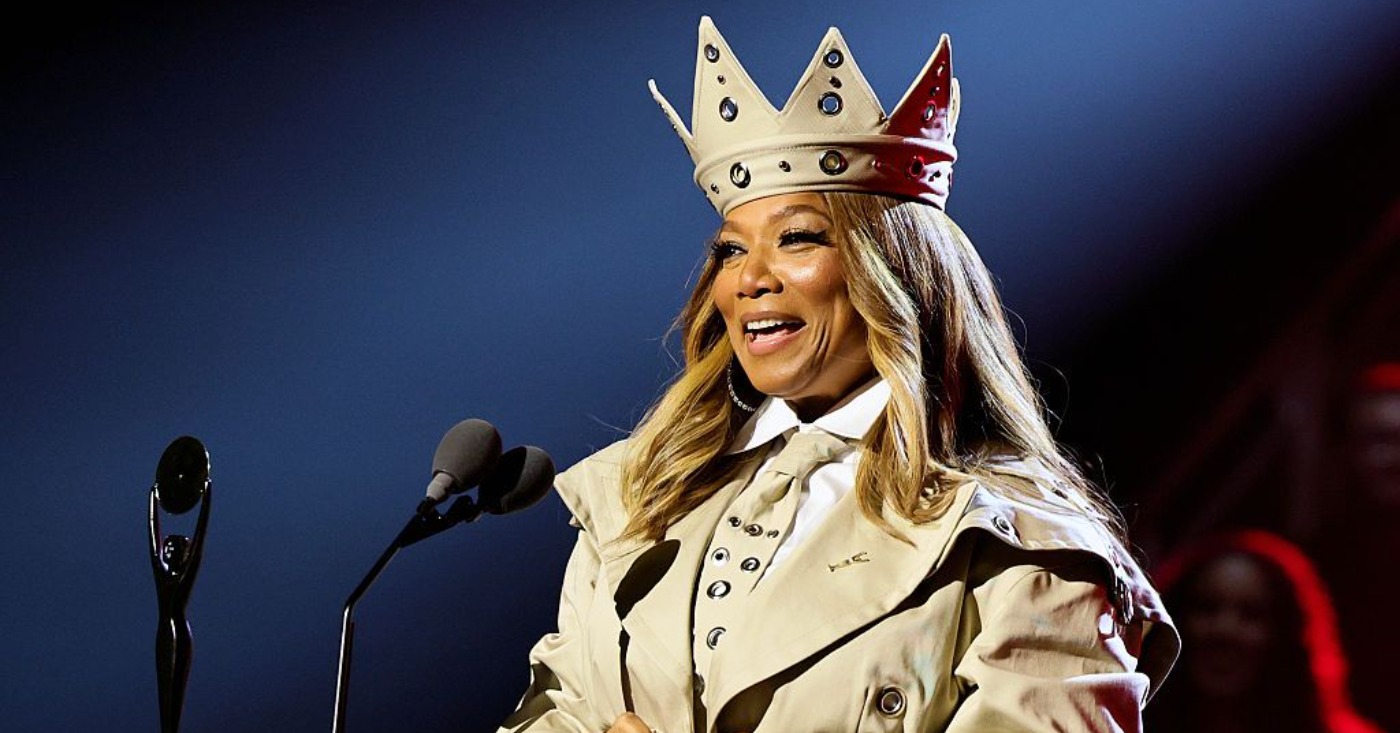
Hip-hop culture will always owe a gratitude to Dana Elaine Owens, otherwise known to the world by her regal moniker, Queen Latifah. Not only a pioneer to the art craft of rap, she’s also managed to stretch her legacy over a span of four decades and counting due to a dynamic showcase of talent when it comes to music production, film, television, theater, entrepreneurship and philanthropy.
The latter skill even brought Latifah back to her hometown of Newark, New Jersey in 2022, where she was able to build an affordable housing unit while simultaneously honoring her late mother, who sadly passed away in 2018.
Four years later, the journey is being prepped for all to witness in the upcoming BET documentary, You Can Go Home Again.
RELATED:Ladies Of Hip-Hop: Queen Latifah
The project is a combined effort from Latifah’s Flavor Unit Entertainment and co-producer P&G Studios, with filmmaker Muta’Ali stepping into the director’s chair. It will focus on the development of RISE Living, a mixed-use property comprised of 76 units. The building’s name is a direct tribute to the dearly-missed Rita Owens, with RISE aptly and affectionately standing for “Rita Is Still Everywhere.” It holds extra emphasis given the fact that Rita herself was denied being a homeowner during Latifah’s childhood due to the infamous process of urban renewal, described more frankly in the trailer as “Negro removal.”
The trailer takes us deeper into to the story of Newark as well, as the “U.N.I.T.Y.” emcee spells out memories both amazing and difficult of her time growing up in the city.
“There’s life and death right in the city of Newark,” she says boldly while staring straight in the camera, going on to later add on her upbringing, “My mother always told me, ‘You got to take care of home — you always have to give back.’ You know, we’re blessed, so we should be a blessing.” The vision of her mother is one she sees every time she thinks of Newark, and with the housing development literally rising from the ashes of demolition it’s clear this a project birthed out of genuine love.
“When I think about building, I think about building for people like my mother,” Latifah says while showing the inside of one unit in the trailer. She ended her thought by stating, “We deserve to move into a nice home that we love, that feels like home, that’s well-appointed, that we can then take and make our own.” The Queen has spoken!
Expect You Can Go Home Again to premiere on BET and Paramount+ this Friday (November 27) at 10 PM ET/9 PM CT. Peep the full trailer below:
The post Queen Latifah Turns Affordable Housing Mission Into New Doc appeared first on Chicago Defender.
Based on reporting by Chicago Defender.
Black History
Three Black Physicians Lead Women’s Health Care
ST. LOUIS AMERICAN — Three Black women now lead the obstetrics and gynecology departments at major medical institutions across St. Louis, bringing extensive expertise in clinical care, public health, and research to their roles. Dr.

Three Black women chair obstetrics and gynecology departments at major St. Louis medical institutions, bringing experience in patient care, public health, research and medical education to their roles.
Dr. Monique V. Swain chairs the Department of Obstetrics, Gynecology and Women’s Health at Saint Louis University School of Medicine and SSM Health SLUCare Physician Group. Dr. Dineo Khabele chairs the Department of Obstetrics & Gynecology at Washington University School of Medicine. Dr. Jade James-Halbert chairs the Department of Obstetrics and Gynecology at SSM Health DePaul Hospital in Bridgeton.
Their leadership is particularly significant in Missouri, where Black women were 2.5 times more likely than White women to die from pregnancy-related causes from 2019 to 2023, according to the Missouri Department of Health and Senior Services. The state’s Pregnancy-Associated Mortality Review Board determined that 79% of pregnancy-related deaths were preventable.
A 2023 St. Louis County Department of Public Health report found that Black women experienced pregnancy-associated deaths at 2.4 times the rate of White women in the county from 2017 to 2021.
Dr. Kanika A. Cunningham, director of the St. Louis County Department of Public Health, said having Black women in OB/Gyn leadership positions can help influence hospital policies and reduce discriminatory treatment.
“Thinking about the disparities that we see among our Black moms and babies in St. Louis County and even in the city — having a Black OB/Gyn chair means they’re going to advocate and make sure when women go into labor and delivery units they receive fair access to treatment,” Cunningham said.
Swain, who became chair in September, said she was drawn to SSM Health and SLU because of their “genuine commitment to closing health inequities and understanding the social factors that affect care.”
A specialist in breast health and cancer genetics, Swain previously directed Henry Ford Hospital’s obstetrics and gynecology residency program in Michigan. At SLU, she oversees clinical, research and educational programs and nearly 50 faculty members across six subspecialties.
Swain described her position as “more than a title but rather a responsibility to ensure cultural humility, enforce equitable and quality care of all patients, and support the professional development of those that come behind me.”
Her priorities include improving care for aging women through collaboration with specialists treating cardiovascular disease, cancer, osteoporosis and menopause.
“I became a physician to help people and make sure every patient has access to equitable, high-quality care,” Swain said. “I look forward to working with our multidisciplinary teams and communities to improve maternal outcomes, strengthen breast cancer screening, and build a women’s health program that supports patients throughout their lives.”
Khabele is a physician-scientist whose ovarian cancer research explores chemotherapy resistance and how new treatments might overcome it.
She made history in 2020 as the first Black department chair at Washington University School of Medicine.
Khabele previously told The St. Louis American about efforts to diversify the medical workforce, improve training on health disparities and help patients overcome barriers to treatment, including transportation problems.
“I am deeply committed to driving institutional change, conducting research that improves care, training the next generation, and advancing OBGYN and women’s health care in St. Louis and across the region,” she said.
In a 2023 interview with Curiosus, a publication of Barnes-Jewish Hospital and Washington University School of Medicine, she discussed training OB/Gyn specialists to provide “compassionate, culturally sensitive and leading-edge care.”
“That mission aligns with my personal motivation,” Khabele said. “I want to make a difference. The job I have makes it possible for me to help instigate change. I think we have a unique opportunity in St. Louis to lead the nation in developing new ways to address disparities in health care.”
James-Halbert brings more than two decades of experience in women’s health and community medicine to DePaul.
A St. Louis native, James-Halbert attended two historically Black institutions — Fisk University and Meharry Medical College. Her early influences included her childhood pediatrician, Dr. Helen Nash, a pioneer among Black physicians in St. Louis.
James-Halbert spent several years caring for women at Betty Jean Kerr People’s Health Centers and Myrtle Hilliard Davis Comprehensive Health Centers.
She joined SSM Health in 2011 as an OB/Gyn hospitalist, caring for pregnant women and supervising residents and medical students. She chaired DePaul’s obstetrics and gynecology department from 2013 to 2015 and returned to the position in January 2023.
James-Halbert earned a master’s degree in public health from Saint Louis University and later served as director of research and medical services for the St. Louis County health department.
A past president of the Mound City Medical Forum, an organization of Black physicians, James-Halbert has advocated for patients through her involvement with the St. Louis Regional Health Commission.
In an interview published through the commission’s partnership with Humans of St. Louis, she discussed why she pursued public health.
“As much as I love taking care of patients, you do it one patient at a time,” James-Halbert said. “I bumped my head enough to realize we need systems change. The system is what helps more people.”
Sylvester Brown Jr. is the Deaconess Foundation Community Advocacy Fellow.
The post Three Black physicians lead women’s health care appeared first on St. Louis American.
Based on reporting by St. Louis American.


Cardinal Ritter is headed back to the state championship!

COMMENTARY: My Truth — We Can Realize the Dream Together

‘i Hope It Makes People Want to Be 100 Percent Themselves’

COMMENTARY: What’s the Best Meal Served During Thanksgiving?

Queen Latifah Turns Affordable Housing Mission into New Doc

Three Black Physicians Lead Women’s Health Care

COMMENTARY: Who Can Afford to Be Generous Anymore?

A Brief History of the San Francisco Bay View National Black Newspaper

Bennett College Pockets $12 Million for Aaron Douglass Harriet Tubman Painting Sale at Sotheby’s

IN MEMORIAM: Andrea Stewart-Cousins, New York’s First Woman Senate Leader, Dies at 76

HISTORY MADE: Keisha Lance Bottoms Becomes First Black Woman Elected Governor in American History

Multi-Faith Leaders Representing 10 Million People Launch National Anti-Authoritarian Initiative

Christianity’s Racial History

Hundreds of Black Christian Leaders Arriving in Israel for Martin Luther King-Inspired Mission

Keisha Lance Bottoms to Govern State Where Her Great-Great-Grandfather Was Enslaved

Michael Shiner: The Enslaved Man Who Wrote His Way into American History

Don’t Pass the Torch. Expand the Circle.

Superb Woman: Destiny B. Sadler

DOJ Fights to Keep Rep. Ilhan Omar’s Search Warrant Sealed: Report

OP-ED: Closing the Next Digital Divide — Communities of Color Must Have a Voice in the AI Future
Cardinal Ritter is headed back to the state championship!

How We’ve Kept Our Events Fresh Since 2009 #shorts

How Mentorship Made Sustainable Real Estate Development Possible #shorts

The Missing Link That Brought Playprofessionals Together #shorts

Preparation: The Key to Sustaining Success #shorts

Why Strong Connections Matter in the Black Business Ecosystem #shorts

Life After Football: How I Rediscovered the Joy of Learning #shorts

Chevy Tahoe: What’s Worth Keeping—and What Isn’t? #shorts

Car Buying Takes 14 Hours—What’s Your Time Worth? #shorts

Cadillac VISTIQ Road Noise: Test This Before You Buy #shorts
-

 Black History1 week ago
Black Barbershops Have Long Given Neighborhood Politics a Place to Unfold.
-

 Featured1 week ago
How Sick Must America Get Before Saying Enough to RFK
-

 Black History6 days ago
Hoodoo Heritage Month Celebrates Origins of African American Folk Medicine
-

 Black History6 days ago
PRESS ROOM: Donalds Transition Website Now Open to All Floridians Who Want to Serve
-

 Featured6 days ago
Scott Colom’s Nike Challenge Goes National, Freshman Democrats Get a Surprise 📱
-

 Featured1 week ago
How to Rob a Bank
