
Politics
It’s Not Just Right-to-Work: Bills Targeting Unions Multiply


In this Nov. 13, 2014 file photo, AFL-CIO President Richard Trumka speaks in Washington. Republicans lawmakers in statehouses nationwide are working to weaken organized labor, sometimes with efforts that directly shrink union membership. Walker’s signing of right-to-work legislation in Wisconsin on Monday puts his defiance of organized labor even more at the center of his nascent presidential campaign. And the inability of unions to exact a price for the first round of legislation targeting them in 2011 is encouraging even more proposals to limit their power. (AP Photo/Manuel Balce Ceneta, File)
JONATHAN MATTISE, Associated Press
NICHOLAS RICCARDI, Associated Press
CHARLESTON, W.Va. (AP) — It’s not just Gov. Scott Walker.
Republican lawmakers in statehouses nationwide are working to weaken organized labor, sometimes with efforts that directly shrink union membership. Walker’s signing of right-to-work legislation in Wisconsin on Monday puts his defiance of organized labor even more at the center of his nascent presidential campaign. And the inability of unions to exact a price for the first round of legislation targeting them in 2011 is encouraging even more proposals to limit their power.
The Republican wave in the November elections left many unions nationwide looking exceptionally vulnerable. In West Virginia, a union PAC spent $1.4 million trying to keep the statehouse in Democratic hands but couldn’t reverse the cultural trends turning the state red. Exit polls found that even union members were almost evenly split between the Republican and the Democrat in the major statewide race for U.S. Senate.
Now Republicans, in control of the state legislature for the first time since 1931, are taking advantage of their opportunity, pushing measures to expand non-union charter schools and scale back requirements that public projects pay higher, union-scale wages.
In Wisconsin, Walker beat back attempts to recall him after he signed a law limiting collective bargaining by public sector workers in 2011. His signature on the right-to-work law now makes Wisconsin the 25th state to ban contracts that force all workers to pay union dues. Both he and Michigan Gov. Rick Snyder, who signed a right-to-work law in 2012 and was also opposed by unions, won re-election in November.
“Their examples were inspiring,” said Victor Joecks of the Nevada Policy Research Institute, a conservative think tank whose ideas for limiting labor power have been embraced by Republicans who have taken over that state’s legislature for the first time since 1929. The message, he said, was, “Hey, this is possible, and it’s better for the state, and the taxpayers appreciate it.”
With many legislative sessions just beginning, nearly 800 union-related bills have been proposed in statehouses, according to the National Conference of State Legislatures.
President Barack Obama expressed his concern about the latest Wisconsin move and the general assault on unions.
“It’s inexcusable that, over the past several years, just when middle-class families and workers need that kind of security the most, there’s been a sustained, coordinated assault on unions, led by powerful interests and their allies in government,” Obama said in a statement Monday. “I’m deeply disappointed that a new anti-worker law in Wisconsin will weaken, rather than strengthen workers in the new economy.”
A right-to-work bill passed the lower house of the Missouri Legislature, though it’s likely to be vetoed by the state’s Democratic governor. Indiana is also moving to eliminate requiring union-level wages on public projects. Nevada is considering a wide range of proposals, including legislation that would let local governments dissolve collective bargaining agreements in times of economic hardship. Illinois’ new Republican governor, Bruce Rauner, signed an order prohibiting government unions from automatically collecting dues from members.
Even local governments are getting in on the action — several Kentucky counties are implementing right-to-work measures even though the state, with its House still controlled by Democrats, does not have such a law.
The proposals’ sponsors say they want to save taxpayers money and create jobs. There is also a political consequence.
Labor provides Democrats with crucial cash and volunteers in campaigns, but its political value to the party extends even farther. Belonging to a union increases the odds of a voter supporting Democrats, and labor increases the participation of lower-income voters who tend to back Democrats, said Roland Zullo of the University of Michigan’s Institute of Labor and Industrial Relations. “If you have more unions, you have higher rates of voting, especially in places that are poor,” he said.
Much of the impact of new laws has come in the vote-rich rust belt, where Republicans hope states with whiter and older populations, such as Wisconsin and Michigan, will eventually side with them in presidential elections to counter the loss of states in the South and West with younger and more diverse populations. In Wisconsin, public-sector union membership shriveled after Walker’s 2010 law and the proportion of workers in unions shrank from 14 percent to 11 percent. Hundreds of union members protested against the right-to-work legislation in the state capitol recently but admitted most were demoralized.
“People have lost faith,” said Eric Gates, a union member from the town of Menasha, 35 miles southwest of Green Bay.
Michigan experienced the sharpest loss of union members in the nation in the last two years, when its right-to-work law went into effect, according to federal data. But union officials also trace the loss to another 2012 measure, which received less attention: a law declaring that 42,000 in-home health care workers were no longer eligible to be represented by a union. Unions were unable to overturn the measure at the ballot box.
“They’re decreasing our ability to back supporters of our issues, whether they’re Democrats or Republicans,” said Marge Robinson, president of SEIU Health Care Michigan, which lost four-fifths of its membership as a result but still tries to communicate with many of the aides. “Even though we try to keep them as much engaged as possible, they’re all on their own, they’re not in an organization that works together.”
In Ohio, where unions reversed an effort to eliminate collective bargaining by government workers, GOP Gov. John Kasich still cruised to re-election last year.
Union membership has been steadily declining since the 1980s, when it measured at 20 percent of all workers. In 2014, only 11.1 percent nationally belonged to a union. James Sherk, a labor economist at the conservative Heritage Foundation, said the shrinkage in membership in Michigan may be due to trends other rather than the recent legislation. He noted that Democrats have joined Republicans on some measures that unions oppose, like pension reform and tougher standards for teachers.
If there’s a bright side for labor, it’s that things could be even worse. Given how many states Republicans control, Sherk said, there could be many more challenges to labor than have emerged.
___
Associated Press reporter Dana Ferguson in Madison, Wis., contributed to this report.
Copyright 2015 The Associated Press. All rights reserved. This material may not be published, broadcast, rewritten or redistributed.







Black History
PRESS ROOM: Mississippi Congressman Bennie Thompson to Speak at Oakland Post/El Mundo and Post News Group 64th Anniversary Celebration
POST NEWS GROUP — The anniversary fundraising luncheon, to be held at Scott’s Restaurant in Jack London Square, will also celebrate the 200th anniversary of the founding of the Freedom’s Journal, the first Black newspaper, published March 16, 1827, in New York.

Mississippi Congressman Bennie G. Thompson will be the keynote speaker at the 64th Anniversary Celebration of the Oakland Post/El Mundo and the Post News Group on Feb. 12, 2027.
The anniversary fundraising luncheon, to be held at Scott’s Restaurant in Jack London Square, will also celebrate the 200th anniversary of the founding of the Freedom’s Journal, the first Black newspaper, published March 16, 1827, in New York.
More details on the anniversary celebration will be announced soon.
(The Oakland Post was founded in 1963 by Thomas L. Berkley and his wife, Velda. Paul and Gay Plair Cobb purchased the Post newspapers in 2004.)
The Cobbs’ connection to Thompson goes back decades. After a brief home libation ceremony with “Roots” writer Alex Haley and civil rights activist Beni Ivey in 1973, the Cobbs moved to the South to continue their work in the civil rights, voter education, and political development movements.
As national field director of the Southern Elections Fund (SEF), Paul Cobb helped raise funds, register voters, and politically organize with the late Julian Bond and John Lewis when Bennie Thompson ran for mayor of Bolton, Mississippi, in 1973.
After two terms as mayor, Thompson served on the Hinds County Board of Supervisors in the 1980s before being elected to represent Mississippi’s 2nd congressional district in 1993. A Democrat, he has served as chair of the Committee on Homeland Security from 2007 to 2011 and from 2019 to 2023.
Thompson was appointed chair of the Jan. 6th Congressional Committee by Nancy Pelosi in 2021 and will likely be appointed chair of the Homeland Security Committee, which oversees issues concerning immigration and ICE agents.
In an interview on NPR, Thompson praised Scott Colom’s recent Senate victory, pointing out that Colom is the first Black U.S. senator elected from Mississippi since Reconstruction.
For more information, visit: https://postnewsgroup64th.eventbrite.com
Black Press
Harlem Neighbors Feed Neighbors, Senator Cleare’s Thanksgiving Giveaway Brings Hope to the Table
HARLEM COMMUNITY NEWSPAPERS — State Senator Cordell Cleare partnered with local businesses and community activists to host her annual Turkey and Produce Giveaway on Friday, Nov. 22. Held at the Adam Clayton Powell Jr.
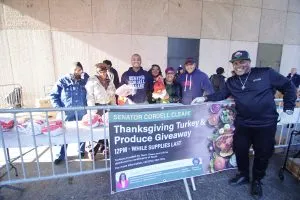
The spirit of Thanksgiving came alive in Harlem on Friday, November 20, as State Senator Cordell Cleare and community partners brought neighbors together for her annual Turkey and Produce Giveaway at the Adam Clayton Powell Jr. State Office Building Plaza.
Beginning at noon, residents visited the plaza at 163 West 125th Street to receive free food on a first-come, first-served basis. The holiday distribution included hundreds of donated turkeys and boxed meals, along with hot turkey dinners, fresh produce and traditional fixings to help families prepare for Thanksgiving.
For households working to stretch their budgets, the giveaway offered practical support during a season when grocery bills and other necessities can place added pressure on family finances.
“Times are particularly harsh economically, there is a lot of anxiety and uncertainty, and if we can help in any way, this is what we do,” Cleare said.
The senator credited local businesses, community organizations and activists with answering her office’s call for donations and assistance. Their contributions helped provide constituents of the 30th District with food for their holiday tables.
“Typically once again, we have Harlem neighbors helping fellow Harlemites,” Cleare said, highlighting the community cooperation behind the annual effort.
Beyond distributing turkeys, the event offered several forms of food assistance, including prepared meals for residents seeking an immediate dinner and produce and fixings for those planning to cook at home.
Cleare expressed gratitude for the partners who contributed, describing the gathering as an opportunity to ease financial strain while helping residents enjoy the upcoming holiday.
With neighbors leaving the plaza carrying bags of food, the giveaway reflected Harlem’s enduring tradition of mutual support. Through donated meals, shared resources and community commitment, Cleare and her partners helped bring Thanksgiving comfort to local households, demonstrating how collective generosity can make a meaningful difference for families.
Based on reporting by Harlem Community Newspapers.
Black History
Remembering Moses Newson and the Power of the Black Press During the Civil Rights Movement
ATLANTA DAILY WORLD — Moses J. Newson, a pioneering journalist who spent decades documenting the American Civil Rights Movement for the Black press, died on November 17 at his home in Baltimore at the age of 99. His daughter confirmed that he passed away from natural causes.
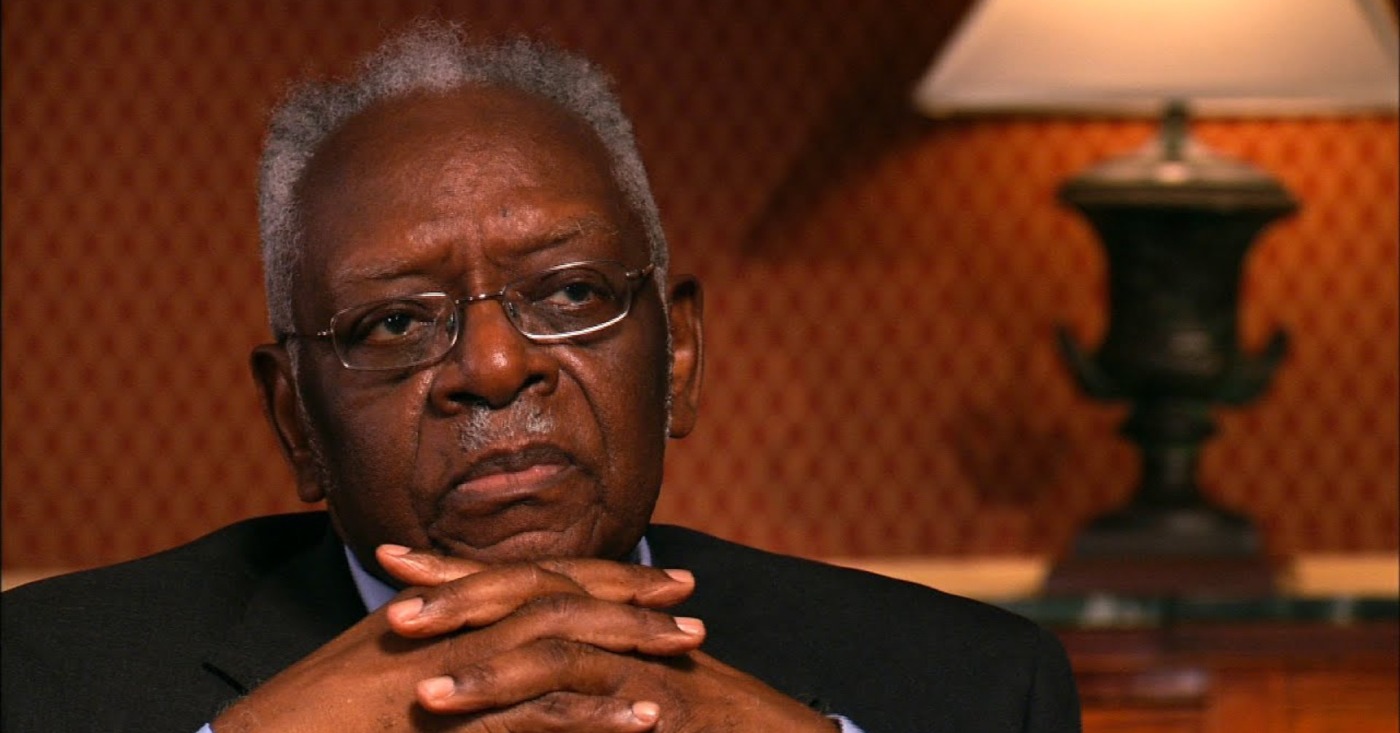
Moses J. Newson, a pioneering Black journalist whose reporting documented some of the most defining moments of the Civil Rights Movement, died November 17 at his Baltimore home. He was 99.
His daughter, Shawn Newson, confirmed to Journal-isms that he died of natural causes.
Throughout his career, Newson documented the struggle for racial equality from the front lines, bearing witness to events that challenged segregation and transformed American society. His work reflected the critical role of the Black press during an era when racial injustice frequently received inadequate coverage from mainstream news organizations.
Born February 5, 1927, in Fruitland Park, Florida, Newson pursued journalism after serving in the United States Navy. He studied at Storer College and Lincoln University in Missouri before beginning his newspaper career at the Tri-State Defender in Memphis in 1952.
His early assignments included coverage of school desegregation and the murder of Emmett Till in 1955, a case that helped galvanize the national Civil Rights Movement.
Newson joined the Baltimore Afro-American in 1957, covering the integration of Central High School in Little Rock, Arkansas, during his first assignment with the newspaper.
Four years later, he placed himself in considerable danger while covering the Freedom Rides, organized to challenge segregation in interstate transportation.
Newson survived the infamous attack on a Freedom Riders bus in Anniston, Alabama, in 1961. Despite the personal danger he encountered, he continued documenting the movement, providing readers with firsthand accounts of the resistance to racial integration.
His reporting also included the integration of the University of Mississippi in 1962 and the 1963 March on Washington. In 1968, he interviewed the Rev. Dr. Martin Luther King Jr. during preparations for the Poor People’s Campaign, shortly before King’s assassination.
Newson spent 21 years with the Baltimore Afro-American, rising from reporter to city editor and ultimately executive editor. He spent the final decade of his newspaper career overseeing editorial operations before transitioning into federal public affairs in 1978.
In 2014, the National Association of Black Journalists inducted Newson into its Hall of Fame, recognizing his contributions to journalism and his extraordinary record of civil rights coverage.
His experiences were also documented through the Civil Rights History Project, a collaboration between the Library of Congress and the Smithsonian Institution’s National Museum of African American History and Culture.
Newson’s family plans to honor his life with a private ceremony in February, when he would have celebrated his 100th birthday.
His death marks the loss of a journalist who witnessed history at extraordinary personal risk. His reporting remains part of the permanent record of America’s struggle for racial equality and a reminder of the indispensable role Black newspapers played in bringing that struggle to the nation’s attention.
The post Remembering Moses Newson and the Power of the Black Press During the Civil Rights Movement appeared first on Atlanta Daily World.
Based on reporting by Atlanta Daily World.
Black Press
Oakland Chamber of Commerce Faces $42,000 Ethics Fine for Campaign Violation
The Oakland Public Ethics Commission has approved a $42,000 fine against the Oakland Metropolitan Chamber of Commerce and its leaders for campaign finance violations. Investigators found that the chamber’s political action committee acted as a conduit to hide the identities of wealthy donors who funded attack ads against former Councilmember Desley Brooks during the 2018 election. The settlement concludes an investigation into pass-through contributions that deprived voters of legally required information. Several other political entities and former city officials are also linked to the case. Read more.

The political arm of the Oakland Metropolitan Chamber of Commerce and its leaders Barbara Leslie and Zack Wasserman were fined a total of $42,000 by the Public Ethics Commission for improper campaign spending and accusations of hiding campaign financial details for its efforts to oust City Councilmember Desley Brooks in 2018, as reported in The Oaklandside.
The commission approved the settlement, voting for it 5-2 at its meeting Tuesday evening.
The Chamber, utilizing its political action committee (PAC), “OakPAC,” acted as a conduit for money from more than a dozen large companies and wealthy individuals into an independent expenditure committee, “Oaklanders for Responsible Leadership,” which ran attack ads against Brooks during the 2018 election, according to the Public Ethics Commission.
According to Oaklandside,16 contributors donated nearly $90,000 to the campaign against then Brooks, and their names were kept hidden until months after the election when the Chamber submitted additional filings with regulators.
During her years in office, Brooks had been opposed by local groups because she led the creation of the city’s Department of Race and Equity and because of her consistent advocacy for ending the city’s longtime lack of attention to the needs and concerns of African American residents.
As a result, Brooks was often demonized, and former Mayor Libby Schaaf initiated several attempts to remove her from office.
The ethics commission, which has been investigating the case since 2022, is recommending a settlement requiring the Chamber’s PAC, the Chamber’s CEO Barbara Leslie, and the group’s board chair emeritus, Zack Wasserman, to pay a penalty of $42,000.
The accused have agreed to a “no contest” resolution, meaning they accept the penalty but do not admit wrongdoing.
The commission’s investigation was tied to a broader case involving Schaaf, who was accused of secretly leading three political committees in two different election years to attack political opponents and support a ballot measure.
The commission resolved most of the Schaaf investigation in October 2024 when the former mayor agreed to pay $21,000.
Two political committees, Committee for an Affordable East Bay and Oaklanders for Responsible Leadership, faced fines of $325,000 in penalties. But since those committees are no longer active, those penalties would be difficult to enforce, according to the commission.
In the proposed settlement of the Chamber of Commerce case, the ethics commission investigators said that the OakPAC’s use of pass-through contributions are “serious violations” of Oakland’s Campaign Reform Act.
“While the individual respondents have stated that they did not believe that the actions they took violated the law, the people involved in this arrangement were all sophisticated individuals who should have been familiar with campaign finance law,” investigators wrote. “[They] engaged in activity which deprived voters of donor information required by law.”
The investigators wrote that an internal accounting and tracking document of contributions planned for the anti-Brooks committee indicates “an intentional pattern of conduct to conceal the names of individuals whose contributions ended up going to [the committee], regardless of whether there was knowledge that these activities were illegal.”
Local observers have raised concerns that the ethics commission’s powers of enforcement are severely limited and do little to ensure fair political practices in local campaigns.
Oaklandside, Oakland Post file stories, and other online accounts are the sources of this report.
Black Press
A Record 216 Firearms Collected at East Oakland Gun Buy-Back Event
The Oakland Police Department and community partners recently hosted the “Guns to Gardens” buyback event, collecting a record 216 firearms. This total marks the largest collection in more than a decade, surpassing the previous high of 130 guns set in 2022. Participants received a total of $18,000 in gift cards for surrendering weapons ranging from compact pistols to military-style assault rifles and ghost gun kits. Officials confirmed that every weapon collected will eventually be repurposed to serve a new community function. Read more.

Over the weekend, the Oakland Police Department (OPD) and community partners hosted “Guns to Gardens,” a gun buyback event with strong community participation. OPD collected a record 216 firearms, exceeding the previous high of more than 130 in 2022 and marking the largest collection in more than a decade.
“Thanks to the generosity of our faith-based coalition, the Kaiser Foundation, and local partners, we distributed $18,000 in gift cards to community members who turned in their firearms,” said Oakland Mayor Barbara Lee.
The buyback follows the graduation of the 197th academy of Oakland Police Department (OPD) cadets on Nov. 6. The nine cadets are already making their mark connecting with residents, honoring the department’s history, and supporting department events.
In their first month, the Cadets helped clean the Remember Them monument at Henry J. Kaiser Memorial Park. They learned about Oakland Police Officer John Grubensky, who died in the line of duty while guiding community members to safety during the Oakland Hills Fire and is honored on the monument.
The Cadets handed out candy at OPD’s annual Trunk or Treat celebration and helped with the 197th Police Academy graduation ceremony.
Most recently, the Cadets participated in an inspection and pinning ceremony, marking another milestone in their development and service to our community.
OPD thanks Kaiser Permanente and PG&E for their donations, which led to the reinstatement of the Cadet Program. This program offers young people ages 15½ to 20½ opportunities to engage with their community, gain experience, and explore careers in public safety.
But it was the veteran officers that handled the buyback at St. Benedict’s Catholic Church at 2245 82nd Ave.in East Oakland.
The weapons collected on Nov. 14 ranged from compact pistols to assault weapons. One participant also surrendered equipment used to create homemade firearms, commonly known as “ghost guns.”
“I was shocked to see the number of assault weapons, military-style firearms, and ghost guns turned in,” said Oakland Police Chief James Beere. “Every firearm removed from our streets is one less that could be used in a shooting or other act of violence. By choosing to turn in unwanted guns, we help protect our neighborhoods and ultimately save lives.”
OPD and Lee thanked the community partners, volunteers, and participants for their continued support in this effort.
“Every single gun collected will be transformed into garden tools and given back to the community at future events,” said Lee. “A huge thank you to everyone who participated, our dedicated partners, and OPD for making Oakland safer.”
Paul Chambers is the strategic communications manager for the Oakland Police Department.
Black Press
A Record 216 Firearms Collected at East Oakland Gun Buy-Back Event
The Oakland Police Department and community partners recently hosted the “Guns to Gardens” buyback event, collecting a record 216 firearms. This total marks the largest collection in more than a decade, surpassing the previous high of 130 guns set in 2022. Participants received a total of $18,000 in gift cards for surrendering weapons ranging from compact pistols to military-style assault rifles and ghost gun kits. Officials confirmed that every weapon collected will eventually be repurposed to serve a new community function. Read more.

Over the weekend, the Oakland Police Department (OPD) and community partners hosted “Guns to Gardens,” a gun buyback event with strong community participation. OPD collected a record 216 firearms, exceeding the previous high of more than 130 in 2022 and marking the largest collection in more than a decade.
“Thanks to the generosity of our faith-based coalition, the Kaiser Foundation, and local partners, we distributed $18,000 in gift cards to community members who turned in their firearms,” said Oakland Mayor Barbara Lee.
The buyback follows the graduation of the 197th academy of Oakland Police Department (OPD) cadets on Nov. 6. The nine cadets are already making their mark connecting with residents, honoring the department’s history, and supporting department events.
In their first month, the Cadets helped clean the Remember Them monument at Henry J. Kaiser Memorial Park. They learned about Oakland Police Officer John Grubensky, who died in the line of duty while guiding community members to safety during the Oakland Hills Fire and is honored on the monument.
The Cadets handed out candy at OPD’s annual Trunk or Treat celebration and helped with the 197th Police Academy graduation ceremony.
Most recently, the Cadets participated in an inspection and pinning ceremony, marking another milestone in their development and service to our community.
OPD thanks Kaiser Permanente and PG&E for their donations, which led to the reinstatement of the Cadet Program. This program offers young people ages 15½ to 20½ opportunities to engage with their community, gain experience, and explore careers in public safety.
But it was the veteran officers that handled the buyback at St. Benedict’s Catholic Church at 2245 82nd Ave.in East Oakland.
The weapons collected on Nov. 14 ranged from compact pistols to assault weapons. One participant also surrendered equipment used to create homemade firearms, commonly known as “ghost guns.”
“I was shocked to see the number of assault weapons, military-style firearms, and ghost guns turned in,” said Oakland Police Chief James Beere. “Every firearm removed from our streets is one less that could be used in a shooting or other act of violence. By choosing to turn in unwanted guns, we help protect our neighborhoods and ultimately save lives.”
OPD and Lee thanked the community partners, volunteers, and participants for their continued support in this effort.
“Every single gun collected will be transformed into garden tools and given back to the community at future events,” said Lee. “A huge thank you to everyone who participated, our dedicated partners, and OPD for making Oakland safer.”
Paul Chambers is the strategic communications manager for the Oakland Police Department.



Cadillac VISTIQ Road Noise: Test This Before You Buy #shorts

Family and Friends Honor Billy Rabun with Birthday Balloon Release After Deadly Midtown Shooting

Football Blocking Drill: The Moment He Proved Himself #shorts

Build a Business That Lasts: Stay True, Adapt, Grow #shorts

Community Transformation Takes a Lifetime of Commitment #shorts

New to the Twin Cities? Find Your Community with PlayProfessionals #shorts

4 Buyer Pain Points That Make Every Deal Harder #shorts

$96,575 Tahoe: Which Extras Are Worth Paying For? #shorts

How Mentorship Turned Into Unexpected Job Offers #shorts

Networking Events That Turn Strangers Into Friends #shorts

HISTORY MADE: Keisha Lance Bottoms Becomes First Black Woman Elected Governor in American History

Multi-Faith Leaders Representing 10 Million People Launch National Anti-Authoritarian Initiative

Christianity’s Racial History

Hundreds of Black Christian Leaders Arriving in Israel for Martin Luther King-Inspired Mission

Michael Shiner: The Enslaved Man Who Wrote His Way into American History

Keisha Lance Bottoms to Govern State Where Her Great-Great-Grandfather Was Enslaved

Don’t Pass the Torch. Expand the Circle.

DOJ Fights to Keep Rep. Ilhan Omar’s Search Warrant Sealed: Report

OP-ED: Closing the Next Digital Divide — Communities of Color Must Have a Voice in the AI Future

COMMENTARY: Thank You, Trump, for Making America Great Again!
Cadillac VISTIQ Road Noise: Test This Before You Buy #shorts
Family and Friends Honor Billy Rabun with Birthday Balloon Release After Deadly Midtown Shooting
Football Blocking Drill: The Moment He Proved Himself #shorts
Build a Business That Lasts: Stay True, Adapt, Grow #shorts
Community Transformation Takes a Lifetime of Commitment #shorts
New to the Twin Cities? Find Your Community with PlayProfessionals #shorts
4 Buyer Pain Points That Make Every Deal Harder #shorts
$96,575 Tahoe: Which Extras Are Worth Paying For? #shorts
How Mentorship Turned Into Unexpected Job Offers #shorts
Networking Events That Turn Strangers Into Friends #shorts
-

 Black History1 week ago
Black Barbershops Have Long Given Neighborhood Politics a Place to Unfold.
-
 Black History1 week ago
OP-ED: Black voters made history. They laid the groundwork for a Third Reconstruction.
-
 Featured1 week ago
How Sick Must America Get Before Saying Enough to RFK
-

 Black History5 days ago
Hoodoo Heritage Month Celebrates Origins of African American Folk Medicine
-

 Black History5 days ago
PRESS ROOM: Donalds Transition Website Now Open to All Floridians Who Want to Serve
-

 Featured5 days ago
Scott Colom’s Nike Challenge Goes National, Freshman Democrats Get a Surprise 📱
