
National
In Ferguson, the Struggle Continues

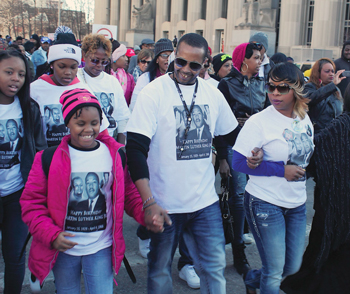
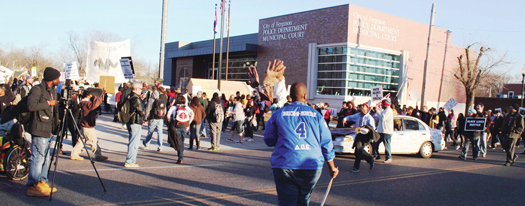 Demonstrators converge on Ferguson Police Dept. headquarters. |
by J.A. Salaam
Special to the NNPA from The Final Call
FERGUSON, Mo. (FinalCall.com) – Nearly seven months since the death of 18-year-old Michael Brown Jr., the small St. Louis suburb of Ferguson still wrestles with many unanswered questions. Is the movement over? Was the protesting across the country all in vain? What’s on the horizon for the little town of approximately 22,000 residents, 67 percent of whom are Black? And do Black lives really matter?
 |
What is apparent is emotions and tensions still run high. Recently, over 250 protesters filled a meeting at the aldermanic chamber at St. Louis City Hall to voice concerns on a proposed independent police review board called the Civilian Oversight Board for the city.
The Jan. 28 meeting came to an abrupt close when Jeff Roorda, business manager and spokesperson for the St. Louis City Police union yelled at moderator, Alderman Terry Kennedy for failing to “restore order” when protesters interrupted.
“Can we get some order in here?,” Mr. Roorda yelled at the alderman to which Mr. Kennedy responded, “First off you don’t tell me about my function.”
Mr. Roorda then rushed towards Mr. Kennedy when he encountered Cachet Currie, a Black woman, in the aisle leaving the meeting. Mr. Roorda grabbed and pushed the woman down to get her out the way resulting in a scratch on her forehead. Ms. Currie is reportedly filing charges. Mr. Roorda was observed wearing an “I am Darren Wilson” wrist band to the meeting.
The proposed board would have the authority to investigate allegations of police misconduct, research and assess police policies, operations and procedures.
It would inspect complaints against members of the police department involving excessive use of force, abuse of authority, sexual harassment and assault, discourtesy, racial profiling, or use of offensive language, including, but not limited to, slurs relating to race, ethnicity, religion, gender, sexual orientation, gender identity, immigrant status and disability.
St. Louis tourism is taking a blow as protesters, college students, clergy and legal activists are disrupting events in the St. Louis region. On Jan. 31 about 30 anti-racism activists walked through the St. Louis RV Vacation & Travel Show with “Face Racism” and “Are you comfortable” drawn on their faces. Some of the protesters held signs that read “White Only” and “No Coloreds.”
Pushing and pressing forward
Reports are surfacing that the federal investigation of former Ferguson police officer Darren Wilson will not result in charges he violated Michael Brown Jr.’s civil rights when he shot and killed the teen.
The Justice Department report has not been completed, and Attorney General Eric Holder will make the final decision whether to press federal civil rights charges against Mr. Wilson. But activists won’t quit pressing for change, despite the outcome in Ferguson and other cities. Community groups and individuals are still organizing and demanding accountability from political and law enforcement leadership. Many meetings and forums took place during the weekend of the Dr. Martin Luther King Jr. Holiday.
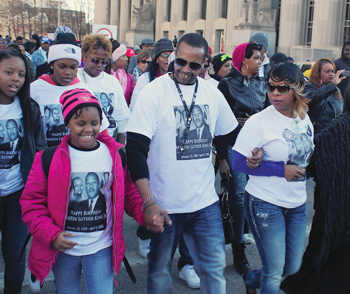
Lesley McSpadden, mother of slain teen Michael Brown, Jr. and her family participate in King holiday march. Photos: D.L. Phillips
|
“The movement is not over, we are not going to settle with the way things have always been. We still have more to do and we didn’t do a good job. Because nothing has changed, we haven’t gotten any of these police officers arrested for misusing their authority; we haven’t gotten any policies changed, the system of preying on poor people are still in effect, police officers are still allowed to do what the hell they want in the community and nothing is done anything yet,” said Dauud Amun Royal, co-chair of the St. Louis-based Center of Hope and Peace.
“So for people to be slapping each other on the back and giving awards as if something meaningful has been done is an insult to the brother who got killed. That’s why we can go on T.V. and jump up and down like we’ve done since the 60s. And it means nothing because we don’t follow through,” continued Mr. Royal who was attending an event honoring Dr. Martin Luther King Jr. There is much more work to do and “we are not finished,” he said.
Participants from across the country gathered for open dialogue with law enforcement representatives, politicians and protestors from various cities. Ferguson 1000 Jobs co-founders St. Louis businessman Dave Spence and economist and investment advisor Dr. Lance McCarthy, Ferguson Police Chief Thomas Jackson, Ferguson Mayor James Knowles III and Paul Muhammad founder of the St. Louis Peace Keepers participated.The Charles Hamilton Houston Institute for Racial Justice hosted an event at Harvard Law School Jan. 17 to discuss racial profiling of Blacks and injustices in the legal system and formulate solutions.
The event was filled with moments of anger and tension toward Ferguson officials.
“I cannot quit or resign as chief in the middle of this, because I must have a chance to fix what’s wrong, that’s my responsibility and no one else can do it but me,” said Chief Jackson to The Final Call when asked about comments during the forum calling for him to resign.
The movement is far from over and diversity training is one of the keys to moving forward but it will be a challenge, Mr. Muhammad told The Final Call. “But if the police departments are willing to allow those of us who are out in the community with the people, we can become the bridge between the police and the community. This would at least start the healing process and build a level of trust between the two,” he added. Police must first engage and get involved in the community and build relationships with the people to serve and protect, said Mr. Muhammad. He also recommended police become more actively engaged in schools, community centers and get to know people on a more human level to develop trust.
On Jan. 18 Missouri Representative William Lacy Clay Jr. and members of the Congressional Black Caucus were at the Wellspring United Methodist Church in Ferguson to speak with the community.
“We need to be outraged when local law enforcement and the justice system repeatedly allow young, unarmed Black men to encounter police and then wind up dead with no consequences,” said Rep. Clay.
Dr. Leah Gunning Francis, an associate dean at the Eden Theological Seminary in St. Louis, insisted that society needed to regard the lives of Black men to be as important as those of White men.
We have to restore the humanity of young Black men, she said.
“We are going nowhere. We have several actions in place to take us from the selfishness thought process and bring it back to the village mindset. We are focusing on awareness, the community, education and the government. We have plans to raise the level of thinking first of the people then we can help sustain the community,” said Jeremy Rhone of the community group Mighty 13 of Ferguson.
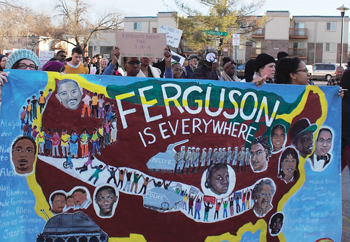
Marchers continue anti-police misconduct marches in Ferguson, Mo.
|
Before the non-indictment of Mr. Wilson many groups had hopes of justice to counteract issues that run deep in the city but the unrest increased locally and nationally, said Mr. Spence. His group, Ferguson 1000 Jobs unveiled a comprehensive plan to address the issues.
“We have been convening meetings with leaders for the last four months and understand there is apathy. People are tired of hearing lip service, hence we developed our views that were delivered as such from a wide variety of leaders in the community,” said Mr. Spence.
Faith-based, corporate, community and youth leaders gave their opinions on what it would take to help get Ferguson back on track. The discussions have resulted in what’s been dubbed “Wish List for Ferguson.” It includes housing development, youth education and scholarships.
Mr. Spence believes the “Wish List” will prompt more dialogue among all St. Louis region stakeholders, leading to action.
Ferguson 1000 Jobs also aims to bring together some of the area’s largest employers to give St. Louis county residents job training, business development, and employment opportunities.
“We are moving towards the poor people’s campaign. You are not going to see us just running out in the street to get tear gassed for freedom. We have to make everyday life a protest. We’ve had demands for six months and not one of our demands were met. None of them!” said youth activist Tory Russell of Hands Up United. He criticized President Barack Obama for not coming to Ferguson like former President Bush went to New Orleans after Hurricane Katrina.
“Here’s the same man that wanted us to vote but he couldn’t come see the people when they were hurting the most. Then the worst was that we thought there was enough to get a civil rights charge. Not just local but nationally, there was cases that were clearly violations but that didn’t matter. That hurts when you have Black officials in high positions of politics but they can’t do nothing for their people,” said Mr. Russell.
“We are begging an uncivil system for civil rights and an inhuman system for human rights and that’s not going to happen. They cannot grant you what you want. They are trying to act like this movement never existed like a 199 cities didn’t rise up.’
“In the 2016 election we will make the question does Black Lives Matter as part of the ballot and they will have to answer that question,” vowed Mr. Russell.



Black Press
Do You Want to Transform a Standard Venue into a Luxury Experience?
BLACKPRESSUSA NEWSWIRE — Creating a luxury event involves far more than simply providing high-quality food and a formal dress code. To truly transform a standard venue into an unforgettable experience, event planners must ensure that every detail, from the atmosphere to the entertainment, is meticulously curated to match a specific theme.

A luxury experience involves elevated food, atmosphere, and entertainment for attendees. The venue matters just as much. Focus on comfortable seating, premium lighting, and other elements to provide guests with a beautiful event that they will not forget.
Have you ever stepped into an event space that took your breath away? A well-curated luxury event space with matching party backdrop setups can transport you to another time or place, providing a needed break from the stresses of everyday life. Event planners understand that the venue needs to contribute to the luxury experience as much as any other factor.
What Is a Luxury Experience?
A luxury experience simply means that the event provides attendees with a beautiful setting and premium food. Additionally, every part of the event should be curated to match its theme and purpose.
How Can Venue Transformation Turn a Regular Space Into a Luxury Experience?
How can you upgrade your venue from a regular party to a luxury experience? Here are some steps to take that will elevate the quality of your venue and setting.
Divide the Room Into Zones
If possible, divide the room into several zones, so attendees can mix and mingle. For instance, an event with a cocktail hour and a sit-down dinner can have a cocktail area with standing tables and a dining area with traditional sit-down setups. A silent auction functions better when the auction area is separated from where guests tend to congregate and socialize.
Consider Beverly Hills event equipment rentals to make each zone unique. Provide features that attract guests so they make their way around the space, rather than staying in one area.
Find a Sophisticated Color Palette
Garish, tacky colors can instantly downgrade your event. Guests will notice before anything else, and the glaring shades may be unpleasant to look at.
Some events have a predesignated color scheme based on their purpose or the hosting organization. In these cases, try to incorporate neutral shades wherever possible to soften the space and avoid clashing with the existing color palette.
If you can choose the colors, consider the theme of the event. A fundraiser for breast cancer awareness, for example, may call for shades of pink. A casino night will work better with a darker theme.
Use Comfortable Seating
Guests should find respite when sitting, not immediately feel uncomfortable. Invest in chair rentals that have cushions and are wide enough to accommodate your guests. Create spaces designed for comfort with couches and plushy chairs.
Set Up Premium Lighting
Cheap lighting can put an unpleasant glare on the entire space. Use soft, warm lights that emit luxury, rather than whiter lights. With warmer undertones, even brighter lights will not hurt the eyes as much.
Add table lamps and lower lighting for a cozier glow. Allow guests to adjust the lighting to their preferences as well.
Ensure the Acoustics Are Balanced
Sound is essential for creating a premium experience. Live music is a wonderful option, but the acoustics need to be balanced to prevent your guests from feeling overwhelmed. Perform sound checks with live musicians before the event begins so you can assess the sound quality all over the event venue, not just in front of the stage.
If you choose prerecorded music or a DJ, speaker placement is crucial. Avoid putting speakers too close to seating areas or places where guests congregate. Rather, place the speakers in areas that allow them to fill the room instead of directly next to people’s ears.
Highlight Nature
An outdoor event should emphasize nature to elevate the event space. Consider incorporating and highlighting the natural beauty of the venue. Indoor events can be instantly upgraded by bringing plant life, such as trees and flowers, into the room to cultivate an inviting oasis.
Frequently Asked Questions
Is a Luxury Event Worth the Higher Price Tag?
Often, yes, especially when fundraising is involved. Luxury events that are curated to a higher net-worth audience may translate to more money raised overall.
VIP guests expect a premium experience. When guests pay hundreds of dollars per plate or thousands per table, it is important to deliver every element of luxury to show them that they did not waste their money.
For weddings or other events that do not include raising money, a luxury event may still be the best option to suit your needs. If you have always dreamed of an exquisite wedding with finer touches, then adding luxury will be worth it to have the day that you deserve.
What Is the Dress Code for a Luxury Event?
It depends on the style of the event, as well as the time of day, setting, and many other elements. Luxury events that take place in the evening typically lean toward black- or white-tie, but a mid-morning brunch may feature more casual wear.
If you are hosting a luxury event, it is best practice to outline the dress code on the invitation. There will not be any guesswork involved for guests, and you do not have to worry about attendees showing up with the wrong attire.
Consider including advice, even if it doesn’t strictly relate to the dress code. Heels, for example, may not work well in events that take place on a golf course or another grassy area.
How Far in Advance Do You Have to Start Planning a Luxury Event?
Ultimately, it is up to you when you need to start planning the event. When contacting vendors such as caterers and entertainment, see how far out you can book and lock in those elements as soon as possible.
The earlier you plan, the less stressed you will be. As your event approaches, you can focus on finishing touches rather than nailing down huge problems.
Consider Luxury Party Aesthetics
A luxury experience is about more than just a fancy plate of food and a black-tie or white-tie dress code. Curating the event space to match the event’s mood will help bring the entire concept together.
Would you like to learn more about event hosting? Explore our site for ideas and inspiration to suit your next event.
Content provided through ContentManagerIO.
Black History
Don’t Pass the Torch. Expand the Circle.
Alpha Kappa Alpha Sorority, Inc. is redefining mentorship by empowering undergraduate women to take active roles in high-level organizational governance. Instead of asking young leaders to wait their turn, the sorority is integrating students like Noah M.P. Harris into international boards and planning committees alongside seasoned veterans like Dr. Tonja L. Ringgold. This intergenerational model aims to combat professional burnout and systemic barriers by offering meaningful responsibility and guidance today, rather than in the distant future, to learn how this approach is transforming leadership. read more.
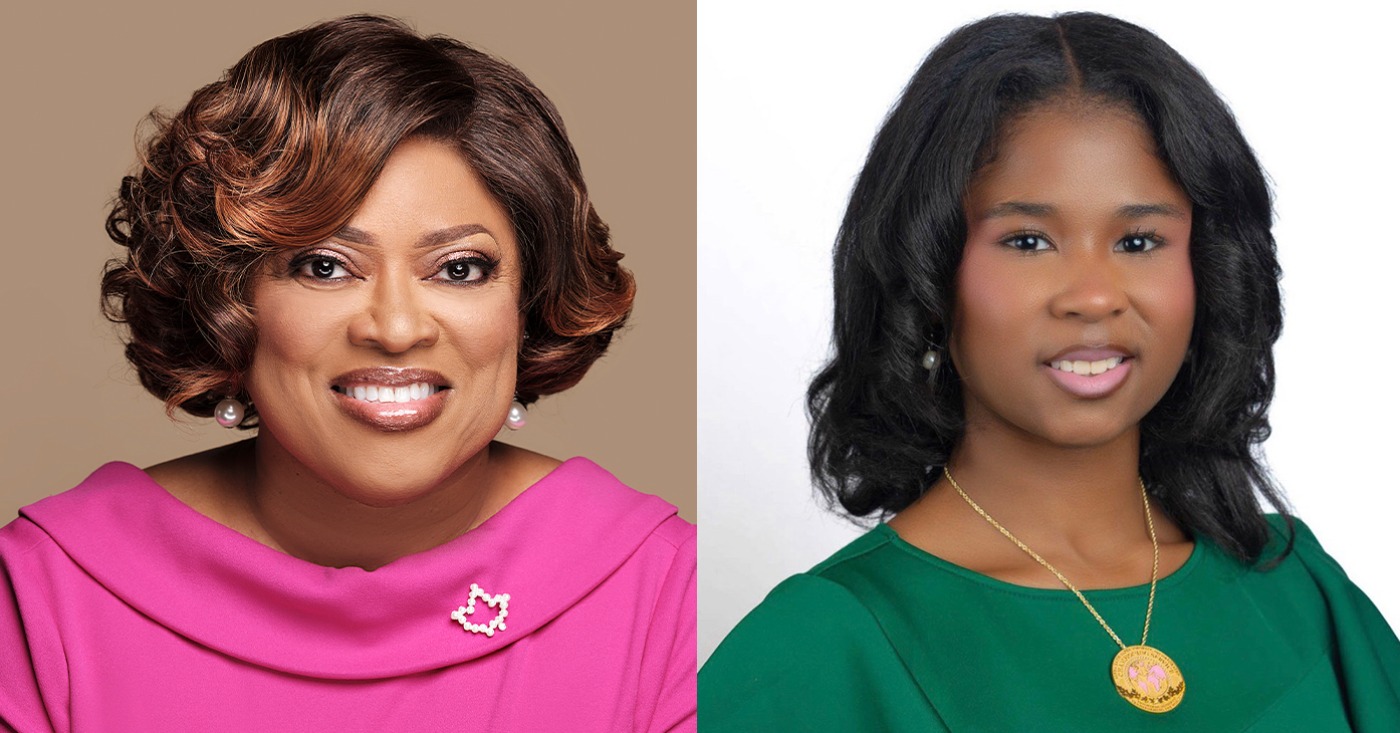
On Nov. 14, hundreds of undergraduate women gathering at Morgan State University in Baltimore for Alpha Kappa Alpha Sorority’s Undergraduate Leadership Institute will do more than listen to presentations. They will run the program. Graduate advisers will take seats in the back of the room.
This is intentional. Too many institutions invite young people to observe leadership without trusting them to exercise it. We believe the future of leadership depends not on one generation stepping aside for another, but on generations sharing responsibility now.
We have seen the difference from two vantage points.
For Dr. Ringgold, Morgan State is where that journey began. Initiated into Alpha Kappa Alpha’s Alpha Delta Chapter in 1982, she recently reunited with two sorority sisters who guided her as an undergraduate, including a former chapter president whose example still informs her leadership today. Forty-four years later, she returns as director of the sorority’s North Atlantic Region, keenly aware of what it means when someone invests in a young woman’s potential. The homecoming carries added significance: Alpha Delta, chartered in 1926, is celebrating its centennial; and the chapter that shaped her is still helping shape new leaders.
For Ms. Harris, leadership is not a distant destination. She is a Bowie State University senior and president of its Eta Chapter who, this summer, was elected Alpha Kappa Alpha’s International Second Vice President. As an undergraduate member of the sorority’s international governing board, she carries student perspectives into decisions affecting the organization. A 2025 Leadership Fellows experience encouraged her to seek that larger platform. To her, leadership is measured by the people she can serve, not simply the position she holds.
Our experiences challenge a familiar assumption: Young people must wait their turn. Founded in 1908 by Black college women, Alpha Kappa Alpha now counts more than 390,000 initiated members across more than 1,122 chapters. That reach brings a responsibility to open doors, not merely preserve tradition.
Deloitte’s 2026 global survey found that 76% of Gen Z respondents were interested in pursuing senior leadership roles eventually, although only 6% of surveyed Gen Z and millennials named leadership their primary career goal. Many cited burnout, excessive responsibility and work-life balance as concerns. Young people are not necessarily avoiding leadership. They are questioning the conditions under which it is exercised.
At a time when companies are pulling back on women’s advancement, Black women face persistent barriers. McKinsey and LeanIn.Org’s 2025 report found that among companies studied, only 60 Black women were promoted to manager for every 100 men. Telling young women to wait their turn cannot fix an unequal pathway to leadership.
Experience matters. Seasoned leaders carry institutional memory, hard-won judgment and relationships that take years to build. But experience cannot develop in a waiting room. Young leaders need meaningful assignments, honest guidance and room to make mistakes. Experienced leaders must also be prepared to reconsider familiar ways of doing things.
We see that exchange in our own relationship. Ms. Harris draws on Dr. Ringgold’s decades of sorority service and higher education experience. Dr. Ringgold listens when Ms. Harris speaks, recognizing that younger perspectives can challenge assumptions and reveal better approaches. Neither of us has all the answers. Both of us have something to contribute.
Our upcoming Undergraduate Leadership Institute will put that principle into practice. Undergraduate members will lead, with graduate members offering guidance and expertise. We’re taking the same approach in planning our 96th North Atlantic Regional Conference, scheduled for March 2027, where undergraduate counterparts will work alongside graduate vice chairs in operations, programming, social activities and logistics. They’ll help plan an event serving the entire region, not just their undergraduate peers.
That is the distinction between inclusion and influence. A seat at the table means little if the people invited cannot help determine what happens there.
Businesses, colleges, nonprofits and civic organizations can do the same. Pair mentorship with meaningful assignments. Involve emerging leaders in decisions before those decisions are final. Give them resources and room to grow. When they challenge a familiar practice, ask whether it still serves its purpose.
We should not ask experienced leaders to disappear or young leaders to wait. The goal isn’t to pass the torch and walk away. It’s to expand the circle of people empowered to lead and build stronger institutions together.
Dr. Tonja L. Ringgold is the North Atlantic Regional Director of Alpha Kappa Alpha Sorority, Incorporated. Noah M.P. Harris, a senior at Bowie State University, is the sorority’s International Second Vice President and president of its Eta Chapter.
Black Press
Kids on Campus: Success in Learning Together
The Association of Community College Trustees and the National Head Start Association have released the second annual report for Kids on Campus, an initiative placing Head Start classrooms directly on college campuses. With nearly 20 percent of U.S. undergraduates raising children, the program addresses childcare barriers that often prevent degree completion. The project aims to establish 50 partnerships by 2030 to support two-generation economic mobility. The new report highlights the initiative’s expansion across 19 states and identifies key growth opportunities to help student parents succeed. Read more.

The Association of Community College Trustees (ACCT) and the National Head Start Association (NHSA) released the Year Two Annual Report of the Kids on Campus initiative, which advances the success of parenting students and supports the school readiness of young children from low-income backgrounds by expanding Head Start classrooms onto community college campuses. The five-year initiative aims to establish at least 50 such partnerships by 2030.
Nearly one in five undergraduates in the United States — approximately 3.14 million students — are parenting while pursuing their college education. For many, access to high-quality, affordable, and convenient child care remains one of the biggest barriers to completing their degree.
The initiative’s core philosophy is rooted in two of the most effective strategies for reducing poverty: providing high-quality early childhood education and increasing adult economic mobility through education, training, and workforce pathways. Together, these approaches support two generations simultaneously, strengthening children’s development while helping parents pursue long-term economic success.
“When we support parents, we uplift students,” says Francisco Solis, president of San Antonio College (TX), which has a long-standing partnership with Head Start. “When families thrive, our community thrives. This is the power of a two-generation approach.”
The annual report outlines the rationale behind ACCT and NHSA’s work, progress to date, next steps, and opportunities for community colleges and Head Start programs to engage with Kids on Campus.
As of March 2026, at the end of year two of the initiative:
- 110 community colleges and 130 Head Start programs have taken initial steps to connect and engage with Kids on Campus.
- Partners have identified 43 potential matches between community colleges and Head Start programs interested in exploring partnerships across 19 states.
Five new Kids on Campus partnerships have launched in California, Illinois, Massachusetts, Maryland, and Texas, with two additional partnerships in advanced stages of development in Texas.
“Before I found the Head Start on my college campus, it was extremely difficult,” says Cristina Medina, a student parent at Palo Alto College, one of the newest Kids on Campus launched sites. “I was on the edge of mentally and emotionally giving up because being a full-time mom while going to school and work was hard with no support.”
The initiative continues to grow nationwide through expanded partnerships, technical assistance, and collaborative efforts to strengthen on-campus child care and early childhood education opportunities for student parents and families.
The report profiles active partnerships and explores the benefits and barriers they face, financial considerations, model sustainability, advice from the field, and what is next for Kids on Campus.
To access the full report, go to kidsoncampus.org/annual-report.
ACCT and NHSA invite community colleges, Head Start programs, and philanthropic supporters interested in transforming outcomes for children and families to contact [email protected].
Kids on Campus is supported by ECMC Foundation, Imaginable Futures, Lumina Foundation, the Annie E. Casey Foundation, Trellis Foundation, Crimsonbridge Foundation, and Seldin Haring-Smith Foundation.
Association of Community College Trustees (ACCT) is a non-profit educational organization of governing boards, representing more than 6,500 elected and appointed trustees who govern over 1,000 community, technical, and junior colleges in the United States and beyond. ACCT fosters the principles and practices of exemplary governance while promoting high-quality and affordable higher education, cutting-edge workforce and development training, student success, and the opportunity for all individuals to achieve economic self-sufficiency and security. Visit www.acct.org for more information.
The National Head Start Association (NHSA) believes that every child, regardless of circumstances at birth, has the ability to succeed in school and in life. The opportunities offered by Head Start lead to healthier and empowered children and families and stronger, more vibrant communities. NHSA is the voice for more than 750,000 children, 250,000 staff, and more than 1,600 Head Start grant recipients in the United States. Visit nhsa.org or follow @NatlHeadStart to learn more.
Black History
Nixon Unbought, Unbossed and Undeterred Following U.S. Senate Defeat – Free Press of Jacksonville
Angie Nixon, who garnered over 3 million votes in her bid for the U.S. Senate, expressed disappointment after losing to Ashley Moody with a narrow margin of 50-48. Despite the defeat, she remains dedicated to holding elected officials accountable on healthcare and community issues and plans to challenge Moody again in 2028. Nixon highlighted the essential role of Black women in her campaign, noting their significant support and efforts to mobilize voters. Despite a lower voter turnout in Duval County compared to previous elections, grassroots efforts by local activists, particularly Black women, were notable. Nixon aims to inspire future generations of leaders and voters, emphasizing the importance of civic engagement.
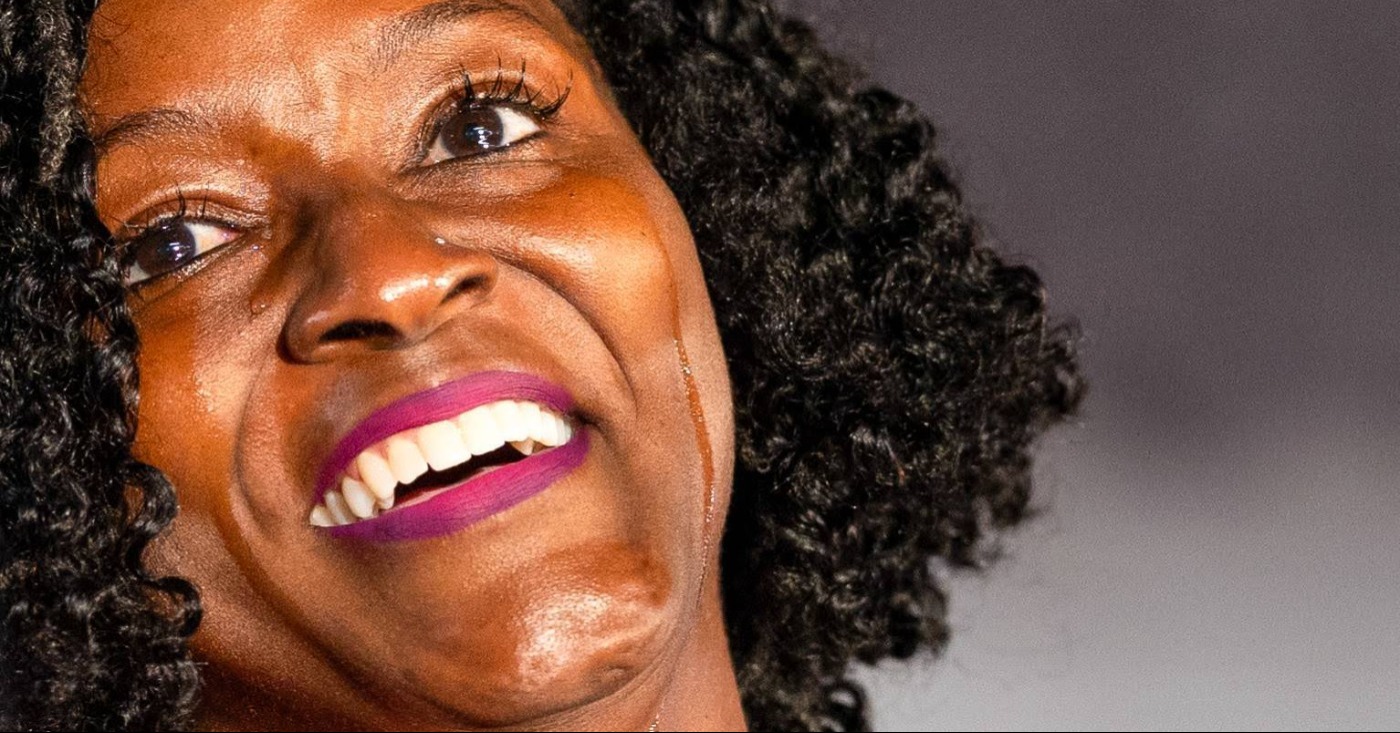
A Black woman from the heart of Moncrief earned the support of more than 3 million Floridians this election season.
Angie Nixon did not become the first Jacksonville resident to serve in the U.S. Senate since 1936.
At least not yet.
The 42-year-old organizer, small business owner, politician and mother says she will challenge Senator-elect Ashley Moody in 2028.
“I’m disappointed in the outcome, but I’m ready to get back to work – everyone is – because we’re going to make sure that Ashley Moody is held accountable for making sure that people have access to quality healthcare, a roof over their head, food on the table, and trying to lower these costs,” Nixon said on Tuesday night. “So, I’m OK. I’m not happy with the outcome, but I’m ready to get to work.”
That fact that Nixon came so close can only be attributed to the scores of Black women who supported her campaign.
Some were on staff, others volunteered, tens of thousands more voted for the former state representative who has used her bullhorn to bulldoze through staid situations in Tallahassee.
A Black woman has never won statewide office in Florida. Nixon’s 50-48 loss to Moody means it still hasn’t happened.
Not many politicians would walk onto a stage after losing a statewide race playing Bonecrusher’s “Never Scared”.
Nixon faced racist attacks from an advisor to President Donald Trump. Nazi rhetoric was used on Fox News to describe Nixon’s supporters. Yet, they traversed the state – from Marathon to Marianna; from Sarasota to South Florida – connecting with voters.
The forlorn, yet hopeful faces of so many Black women in the audience said more than their words could muster. Some were pastors, others were elected officials. One, Sandra Thompson, attended the March on Washington for Jobs and Freedom in 1963.
Thompson spent Election Day providing information to voters outside the Legends Center in Sherwood.
“It’s a very important election,” Thompson said. “We are electing our new leaders: the governor, a senator, and the House of Representatives. We need to get it right.”
If Thompson’s presence at Nixon’s campaign party was any indicator, people did not get it right.
Despite the chance to send a Jacksonville native to the U.S. Senate, hundreds of thousands of Duval County voters did not cast a ballot this year.
Preliminary data from the Duval County Supervisor of Elections shows only 55 percent of eligible voters participated this year.
Felicia Demps was not going to miss this election season. She brought five of her grandchildren with her inside the polling booth.
“They came home, and their teacher said, ‘We need to vote.’ I said, ‘Well, let’s go!”
Demps says she is a reliable Democrat who supported lowering property taxes, supported the 1-mil tax extension for Duval County Public Schools, and cares about community.
“Everyone needs to get together. Everyone wants the streets fixed until it’s time to vote,” Demps said. “The most important thing is: we want these things; but we won’t get out and vote.”
This year’s turnout is better than 2022, when Gov. Ron DeSantis won re-election for fun. But it’s lower than the 63 percent of Duval voters who turned out – many of whom hoped Andrew Gillum would become Florida’s first Black governor.
Black women were at the heart of the local effort to inform and motivate voters.
Cortina Floyd spent three hours waving signs along Moncrief Road ahead of the Northwest Classic football game between Raines and Ribault. Floyd and her Sigma Gamma Rho Sorority, Inc. sisters were among the nearly 50 people who sported Black Greek-letter organizations and informed voters last week.
“As a Black educator, I feel it’s important for me to do my civic duty,” Floyd said.
Exit polling indicates Black women in Jacksonville, in Florida and beyond, did their civic duty.
Afterward, girls of all ages danced on stage after the Associated Press called Florida’s Senate race in Moody’s favor. As they danced, they were unencumbered by the burdens and expectations that are placed on the bodies, minds, and souls of Black girls.
The organizer who lives on the Northside, in a household with multiple union members, says it was not her dream to run for the U.S. Senate. But the woman who openly invoked Shirley Chisholm and Fannie Lou Hamer on the campaign trail committed to doing what she could to help the next generation of girls.
“It’s not necessarily a dream personally. I just want to help people,” Nixon said on Tuesday night. “I wanted to make sure that we’re improving their lives. But the young people that came up to me tonight, they’re excited. They’re ready to continue to do the work and ready to, actually, build a better vision for their future. I’m all hands on deck with them, helping them grow as leaders and helping register more voters so that we can actually win.”
Advertising
PRESS ROOM: AutoNetwork.com Launches a Free Auto Section for Newspapers, Credit Unions, Banks, Churches, Schools and Nonprofits
BLACKPRESSUSA NEWSWIRE — Right now, someone who reads your paper, banks with you, sits in your pews, or attends your school is signing a car deal. Too often, they leave with a high-cost loan, old trade-in debt rolled into a new one, add-ons they never asked for, or a repair bill they didn’t understand. Most of those losses happen because no one gave them the facts first.

One line of code puts free, sourced car-buying and car-repair lessons in front of the people you serve. No cost. No contract. No staff needed.
AutoNetwork.com, which has served car buyers since 1986, today launched the Auto Section: a free, ready-made car-money education section that any organization can add to its website by pasting one line of code. Its message is simple: Know Before You Go To A Dealer.
The people you serve are paying for what no one told them
Right now, someone who reads your paper, banks with you, sits in your pews, or attends your school is signing a car deal. Too often, they leave with a high-cost loan, old trade-in debt rolled into a new one, add-ons they never asked for, or a repair bill they didn’t understand. Most of those losses happen because no one gave them the facts first.
Every organization on this list exists to look out for its people. The facts are now free and take minutes to add. Not sharing them means letting the next family learn the hard way, at the dealer’s desk or the repair counter.
One Auto Section, five ways to serve
- Newspapers: a reader-service section you don’t have to staff, write or pay for. You keep 100% of the ad space around it and 100% of any sponsor line you sell, such as “Auto Section sponsored by…” on your own page.
- Credit unions and banks: member education that reaches people before they sit down in the dealer’s finance office, where the loan terms get decided.
- Churches: a stewardship and money ministry for families. A car is one of the biggest purchases most households make.
- HBCUs and schools: first-car, first-loan and first-repair lessons for students and their families.
- Nonprofits: a ready-made addition to financial-empowerment programs, with no added cost or staff.
- What your people learn
- Financing: leasing vs. buying, who should lease, mileage limits, wear charges and GAP coverage.
- Trade-in debt: how owing more than a car is worth happens, and how to get out.
- Depreciation: how fast a car can lose value, with a free calculator.
- Add-ons and fees: what to get in writing before signing.
- Warranties: what the factory covers, and when extended coverage may not pay off.
- Credit: rights and steps for buyers with low or no credit, plus a first-time buyer guide.
- Service costs: how to choose a repair shop, ask for a written estimate, know your rights and spot a padded bill, plus factory maintenance schedules and estimated ownership costs so routine service is never a surprise.
- Plus: Ask AI Roosevelt for answers to car questions, and new-model walkaround videos.
Every guide links to its sources. The Auto Section teaches what to ask and what is normal; it never quotes local shop prices or sells repairs.
Built to be safe, simple, and yours
- Easy: copy one line from the free setup page, paste it where you want the section, and you’re done. New guides and videos appear by themselves.
- Safe: it runs in a sealed frame that cannot read or change your site, your logins or your ad accounts. It collects no reader names or emails.
- Clean: only AutoNetwork.com education appears inside the section. No outside ads. Guides and videos open inside it, so readers stay on your page.
- No strings: no cost and no contract. Delete the line, and it’s gone.
A word from the founder
“For forty years I’ve watched good people pay too much for cars and repairs simply because nobody told them what to ask,” said Roosevelt Gist, founder of AutoNetwork.com. “The organizations people already trust are the best messengers. We built the Auto Section so they can share the facts without spending a dime or hiring anyone.”
The next car deal or repair bill in your community is happening now. Add the free Auto Section today and make sure your people walk in knowing the facts:
https://autonetwork.com/autosection?src=press-release
If you can paste a link into your website, you can install it. Questions? Email [email protected].
About AutoNetwork.com
AutoNetwork.com has served car buyers since 1986 with free, sourced consumer education, vehicle reviews, and the free AutoNetwork.com app. The Auto Section is general education, not legal or financial advice. Learn more at autonetwork.com.
Black History
MHU Commemorates ASCORE and Anniversary of Desegregation
THE URBAN NEWS — UNC Asheville and Mars Hill University are collaborating to host a series of commemorative events marking the 65th anniversary of their desegregation. The programming honors Etta Mae Whitner Patterson and Oralene Anderson Graves Simmons, two former members of the Asheville Student Committee on Racial Equality (ASCORE) who became the first Black students at their respective institutions in 1961.
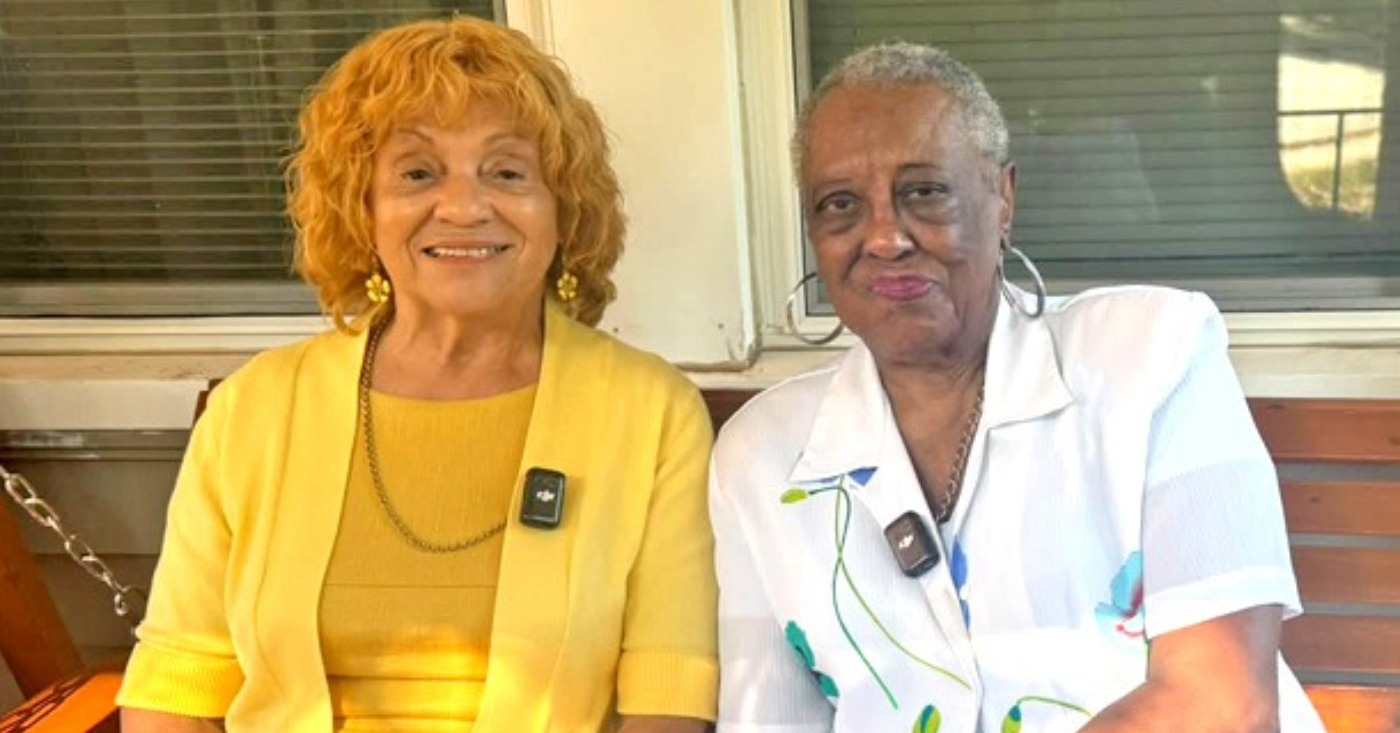
A week of events at UNC Asheville, Mars Hill University, and downtown Asheville.
In 1961, two young women broke the color barrier to become the first African American students at two Western North Carolina colleges: Etta Mae Whitner Patterson at UNC Asheville and Oralene Anderson Graves Simmons at Mars Hill University (then Mars Hill College).
Both women were students at Asheville’s Stephens-Lee High School, where they were members of the Asheville Student Committee on Racial Equality (ASCORE). Through nonviolent protest, ASCORE led efforts to desegregate many Asheville stores and businesses.
Patterson and Simmons, who later founded the Martin Luther King Jr. Association of Asheville and Buncombe County, have since received honorary doctorates from their alma maters in recognition of their achievements and lifelong service to their communities.
To commemorate ASCORE, honor the leadership of Etta Patterson and Oralene Simmons, and mark the 65th anniversary of the desegregation of UNC Asheville and Mars Hill University, UNC Asheville’s Department of History and Mars Hill University’s Liston B. Ramsey Center for Appalachian Studies invite the public to attend “Stories of ASCORE: Lessons in Courage, Desegregation, and Community Activism.”
The program will feature two panel discussions with Drs. Patterson and Simmons, along with other former members of ASCORE. Panelists will discuss how their experiences integrating Asheville’s businesses and institutions prepared them for their college careers, professional lives, and continued community activism.
The first panel discussion will take place at 6 p.m. on Tuesday, November 10, 2026, in the Blue Ridge Room of Highsmith Union at UNC Asheville. The event will feature a presentation by Dr. Patterson and a panel discussion with Dr. Simmons, Marvin Chambers, Jesse Ray, and Al Whitesides. The panel will be moderated by Deborah Miles, retired director of the former UNC Asheville Center for Diversity Education.
This event is sponsored by UNC Asheville’s Department of History and Africana Studies Program, with generous support from King and Pam Prather. A free visitor parking permit is required for the UNC Asheville event. Please visit the university’s parking website for instructions on obtaining a permit for the evening’s program.
The second panel discussion will take place at 5 p.m. on Thursday, November 12, 2026, in the Tony and Terry Floyd Conference Center in the Mars Hill University Campus Center. The event will feature Dr. Simmons, Annette Coleman, and Elizabeth Colton. The panel will be moderated by Jonathan McCoy, professor of history at Mars Hill University.
This event is sponsored by the Liston B. Ramsey Center for Appalachian Studies, with generous support from the university’s Provost’s Office.
In addition, at 12 noon on Wednesday, November 11, 2026, in Pack Square in downtown Asheville, Mayor Esther Manheimer and the Buncombe County Commission Chair will proclaim ASCORE Day and present honors to Etta Patterson and Oralene Simmons. Holly Jones of the North Carolina Governor’s Office will also participate in the ceremony.
For more information, contact Leila Weinstein at Mars Hill University ([email protected]) or Ellen Holmes Pearson at UNC Asheville ([email protected]).
Based on reporting by The Urban News.

Ballots, Black Press & Veterans: Voices That Matter!

Ayanna Pressley Calls for Action 📱

Ayanna Pressley Calls for Action

Rear Seat Legroom Test: Will Adults Fit Comfortably? #shorts

L I V E | Scott Colom Speaks for the First Time as Mississippi’s Senator-Elect | Tougaloo College
L I V E | Scott Colom Speaks for the First Time as Mississippi’s Senator-Elect | Tougaloo College

How a Local Plant Partnership Brightened Our Creative Space #shorts

Sports Coverage Through a Fan’s Eyes: Bringing Community to the Game #shorts

Memphis 1980 We Spread the Peanut Butter Too Thin

I Bought 700 Homes When Nobody Wanted Them John Hope Bryant

Practitioners of African Traditional Spirituality Offer Ancestral Reverence Ritual Oct. 31

Tamiko Armstead | 2026 Lifetime Achiever in Education

Oakland Awarded More than $14 Million in State Funding

HISTORY MADE: Keisha Lance Bottoms Becomes First Black Woman Elected Governor in American History

OP-ED: The Black Church Writes AI’s Next Chapter

Inside 820 S. Michigan: New Book Captures the Lost World of Ebony and Jet

OP-ED: If the ‘Cornell 7’ Were Black Men at an HBCU — America Wouldn’t Be This Sympathetic

Jendayi Arrest Raises Community Concerns Regarding Sheriff’s Chain of Command

Kickstarter CEO Everette Taylor Shares Tips on Creating and Growing a Business

While Black Families Pay More for Power, Some Attorneys General Fight to Save High-Cost Coal
Ayanna Pressley Calls for Action 📱
Ayanna Pressley Calls for Action
Rear Seat Legroom Test: Will Adults Fit Comfortably? #shorts
L I V E | Scott Colom Speaks for the First Time as Mississippi’s Senator-Elect | Tougaloo College
How a Local Plant Partnership Brightened Our Creative Space #shorts
Sports Coverage Through a Fan’s Eyes: Bringing Community to the Game #shorts
Memphis 1980 We Spread the Peanut Butter Too Thin
I Bought 700 Homes When Nobody Wanted Them John Hope Bryant

Build a Million Dollar Business with AI John Hope Bryant

Willie D on Houston legacy, turning 60
-
 Black History1 week ago
HISTORY MADE: Keisha Lance Bottoms Becomes First Black Woman Elected Governor in American History
-

 Featured1 week ago
Multi-Faith Leaders Representing 10 Million People Launch National Anti-Authoritarian Initiative
-
 Black History1 week ago
Christianity’s Racial History
-
 Black History1 week ago
Michael Shiner: The Enslaved Man Who Wrote His Way into American History
-
 Black History1 week ago
Five Hospitals Said No! Who Will Help Annette Henry Recover?
-

 Black History1 week ago
Hundreds of Black Christian Leaders Arriving in Israel for Martin Luther King-Inspired Mission
