
Charlene Crowell
Debt and Rising Home Costs Continue to Defer Homeownership
NNPA NEWSWIRE — Whatever happened to the American Dream of owning a home and giving your children a better life than you experienced as a child? Is this ‘dream’ being deferred or denied?


By Charlene Crowell, NNPA Newswire Contributor
Do you ever get the feeling that when it comes to news about the nation’s economy you’re in a different world?
I certainly do. And what’s more, I think much of America – especially Black America — feels the same.
A decade has passed since the housing collapse. In that time, bank profits are back and continue to rise. Despite occasional trading fluctuations, the stock market remains profitable for most investors. Then there’s the low rate of unemployment that is often cited as if economic strides have included nearly everyone.
But unemployment data does not reflect the vast number of people who today are working and earning less, otherwise known as the underemployed.
People who toil at jobs that pay less than in previous years often have a work ethic that is bigger than their paycheck. Even for those who take a second job, the extra and modest earnings seldom free them from hoping they have enough money to make it through each month.
I also think about the families who sacrificed retirement or building savings to give their children a college education. Both new college graduates, their parents and sometimes grandparents are startled at the amount of debt they share and how long it will take to fully repay it.
Whatever happened to the American Dream of owning a home and giving your children a better life than you experienced as a child? Is this ‘dream’ being deferred or denied?
The stark reality is that between the rising cost of college and the equally rising costs of homeownership, much of the country that works for a living is in a financial catch-22.
This contention is borne out by an updated consumer survey that annually measures profiles of both home buyers and sellers. Each year, the National Association of Realtors (NAR) surveys consumers who purchased a primary home in the past year. For 2018, NAR used a 129-question survey of consumers who purchased a home between July 2017 and June 2018.
Summarizing results, NAR concluded that current housing trends are affected by “mounting student debt balances,” along with rising interest rates, higher home prices and larger down payments.
“With the lower end of the housing market – smaller, moderately priced homes – seeing the worst of the inventory shortage, first-time home buyers who want to enter the market are having difficulty finding a home they can afford,” said NAR Chief Economist Lawrence Yun. “Homes were selling in a median of three weeks and multiple offers were a common occurrence, further pushing up home prices.”
Despite the financial hurdles noted by the NAR survey, there was a single glimmer of encouraging news. For the second year in a row, single female buyers are successfully pursuing their own American Dream. While married couples comprise 63 percent of home buyers, single females represent 18 percent, purchasing homes at a median price of $189,000.
But for the rest of the home buying market, NAR found that the past year meant a median home purchase price of $250,000 required a median household income of $91,600 for a successful mortgage application. Additionally, the nation’s median home down payment now is 13 percent, or $32,500 for that $250,000 priced home.
How long does it take for families to amass $32,000 for a home down payment? Longer than most families would want to wait, I’m certain. According to new research by the Urban Institute, median wealth for Black parents is $14,400 compared to white parents at $215,000, and $35,000 for Hispanic parents.
“As the NAR report shows, the share of first-time homebuyers continues to lag far behind historical norms,” commented Mark Lindblad, a Senior Researcher with the Center for Responsible Lending (CRL). “Efforts should be directed toward pairing low-down payments with affordable and responsible mortgage products so that low-income households and borrowers of color have equal access to the opportunities that come from owning a home of one’s own.”
Lisa Rice, President and CEO of the National Fair Housing Alliance shared a similar view to that of Lindblad.
“The NAR’s survey underscores the persistent difficulty under-served communities face when trying to purchase housing,” said Rice. “With a median purchase price of $250,000 and down payment of $32,500, homeownership remains out of reach for far too many and this exacerbates stress on rental housing prices.”
The most recent figures from the Census Bureau report that nation’s 64.4 percent homeownership rate in the third quarter of 2018 was not statistically different from that of 2017 when it tallied 63.9 percent. Geographically, homeownership in the Northeast, Midwest and South remained the most stagnant.
In stark contrast, the financial outlook for the 64 percent of Americans who already own a home brought a hefty median equity gain of $55,000 when they sold their residence over the past year. Additionally, after selling their homes, 44 percent traded up to a large home.
In other words, if you can find a way to become a homeowner, the costs incurred will likely be outweighed by the economic gains.
But making that important financial transition from renter to homeowner will become harder as mortgage interest rates climb from the historic lows of recent years. Additionally, should home inventories remain low, the likelihood of ‘supply and demand’ economics will keep driving prices higher as well.
“Now more than ever,” added Rice, “we need radical policies that will spur the development of affordable housing in all communities.”
Charlene Crowell is the Center for Responsible Lending’s Communications Deputy Director. She can be reached at [email protected].













Black Press
Black Student Loan Default Rate Five Times Higher than Whites
NNPA NEWSWIRE — Citing new research from Protect Borrowers, formerly the Student Borrower Protection Center, the coalition advised Education Secretary Linda McMahon in a January 7 letter that a new student loan default occurred every nine seconds in 2025. That escalating rate is unprecedented, and is nearly three times worse than in 2019the year prior to the COVID-19 pandemic.

By Charlene Crowell
On behalf of the nearly 9 million people who are now in default on their student loans, a coalition of advocates from consumer, civil rights, and education organizations is appealing to the federal Education Department to halt its plans to begin garnishing borrowers’ wages this month. Default status connotes borrowers are 270 days or more behind on their payments.
Citing new research from Protect Borrowers, formerly the Student Borrower Protection Center, the coalition advised Education Secretary Linda McMahon in a January 7 letter that a new student loan default occurred every nine seconds in 2025. That escalating rate is unprecedented and is nearly three times worse than in 2019, the year prior to the COVID-19 pandemic.
Further, according to the advocates, the Trump administration’s student loan policies are disproportionately harming Black and older borrowers. Signing the joint letter of appeal were: Protect Borrowers, American Federation of Teachers, the Debt Collective, NAACP, National Education Association, the Student Debt Crisis Center, and Young Invincibles.
“Research shows that involuntary collections only exacerbate the economic challenges faced by defaulted borrowers, who are disproportionately seniors and Black borrowers,” wrote the coalition. “In fact, of the borrowers already in default, roughly a third of them are older borrowers. Black graduates are additionally five times more likely to default than their white peers.”
Additionally, and according to Protect Borrowers, nearly two-thirds of the borrowers who defaulted during the Trump Administration—more than 2.6 million people—live in states that President Trump won in the 2024 election. Among the states most severely affected were Florida, Georgia, Ohio, and Texas, each of which saw 100,000 or more borrowers default last year.
“The decision to resume wage garnishment against millions of borrowers amidst a growing affordability crisis crushing working families is calloused and unnecessary,” continued the coalition. “The decision also comes at a time when struggling borrowers have been forced to wait amidst a nearly 1 million application backlog to enroll in an Income-Driven Repayment (IDR) plan, and as mass layoffs at the Department have made it even harder for borrowers to get help with their student loans or if they are experiencing issues with their student loan servicer.”
For Derrick Johnson, President and CEO of the NAACP, the nation’s oldest civil rights organization, the Trump administration’s policies are about financial rights.
“By garnishing wages for defaulted student loan borrowers, the Trump Administration will only deepen financial hardship for working families and disproportionately harm Black borrowers,” said Johnson. “Millions are already struggling with rising costs and economic uncertainty, and stripping wages will only push families further into financial crisis.”
Randi Weingarten, President of the American Federation of Teachers, agreed with Johnson: “This is not about borrowers’ responsibility; it’s outright hostility to the young people trying to get ahead. The Trump Administration is choosing to squeeze teachers, nurses, and others while prices are increasing and families are struggling to stay afloat, ripping away wages and tax refunds when people need them most.”
A fact sheet developed by the Center for Responsible Lending tracks key 2025 policy decisions that summarize the Education Department’s actions taken against student loan borrowers. These include:
- In March 2025, the Department cut nearly half its workforce, with the Federal Student Aid office and Office for Civil Rights among the hardest hit. With Federal Student Aid’s servicing and community outreach infrastructures dismantled, systemic servicing errors are less likely to be caught or corrected, leaving borrowers with fewer avenues for help just as major loan policy changes are being rolled out.
- In May 2025, the Department reinstated the Treasury Offset Program, allowing the government to seize tax refunds from borrowers in default.
- On August 1, 2025, the Department of Education restarted interest accrual for borrowers with Department of Education loans in the SAVE forbearance. Since 2023, SAVE’s unpaid interest shielded borrowers from balance growth. With that protection gone, borrowers’ balances will now grow during this forbearance and may keep rising if monthly payments do not fully cover accrued interest. This shift makes repayment harder and adds long-term uncertainty for more than 7 million borrowers.
Beginning July 1, 2026, parents who take out new Parent PLUS loans will no longer be eligible for any income-driven repayment plan. That means no access to income-contingent repayment (ICR) or repayment assistance plan (RAP) leaving the standard repayment plan as their only choice. Borrowers with existing Parent PLUS loans can preserve access to ICR if they consolidate their loans before the July 1, 2026, deadline.
“As safeguards are rolled back and oversight weakens, borrowers face growing balances and greater financial strain, making it urgent to press for stronger policies that preserve the promise of higher education as a pathway to opportunity,” concluded CRL.
Charlene Crowell is a senior fellow with the Center for Responsible Lending. She can be reached at [email protected]”
Black Press
Student Loan Debt Drops $10 Billion Due to Biden Administration Forgiveness
NNPA NEWSWIRE — The Center for American Progress estimates the interest waiver provisions would deliver relief to roughly 6 million Black borrowers, or 23 percent of the estimated number of borrowers receiving relief, as well as 4 million Hispanic or Latino borrowers (16 percent) and 13.5 million white borrowers (53 percent).

New Education Department Rules hold hope for 30 million more borrowers
By Charlene Crowell, The Center for Responsible Lending
As consumers struggle to cope with mounting debt, a new economic report from the Federal Reserve Bank of New York includes an unprecedented glimmer of hope. Although debt for mortgages, credit cards, auto loans and more increased by billions of dollars in the second quarter of 2024, student loan debt decreased by $10 billion.
According to the New York Fed, borrowers ages 40-49 and ages 18-29 benefitted the most from the reduction in student loan debt.
In a separate and recent independent finding, 57 percent of Black Americans hold more than $25,000 in student loan debt compared to 47 percent of Americans overall, according to The Motley Fool’s analysis of student debt by geography, age and race. Black women have an average of $41,466 in undergraduate student loan debt one year after graduation, more than any other group and $10,000 more than men.
This same analysis found that Washington, DC residents carried the highest average federal student loan debt balance, with $54,146 outstanding per borrower. Americans holding high levels of student debt lived in many of the nation’s most populous states – including California, Texas, and Florida.
The Fed’s recent finding may be connected to actions taken by the Biden administration to rein in unsustainable debt held by people who sought higher education as a way to secure a better quality of life. This decline is even more noteworthy in light of a series of legal roadblocks to loan forgiveness. In response to these legal challenges, the Education Department on August 1 began emailing all borrowers of an approaching August 30 deadline to contact their loan servicer to decline future financial relief. Borrowers preferring to be considered for future relief proposed by pending departmental regulations should not respond.
If approved as drafted, the new rules would benefit over 30 million borrowers, including those who have already been approved for debt cancellation over the past three years.
“These latest steps will mark the next milestone in our efforts to help millions of borrowers who’ve been buried under a mountain of student loan interest, or who took on debt to pay for college programs that left them worse off financially, those who have been paying their loans for twenty or more years, and many others,” said U.S. Secretary of Education Miguel Cardona.
The draft rules would benefit borrowers with either partial or full forgiveness in the following categories:
- Borrowers who owe more now than they did at the start of repayment. This category is expected to largely benefit nearly 23 million borrowers, the majority of whom are Pell Grant recipients.
- Borrowers who have been in repayment for decades. Borrowers of both undergraduate and graduate loans who began repayment on or before July 1, 2000 would qualify for relief in this category.
- Borrowers who are otherwise eligible for loan forgiveness but have not yet applied. If a borrower hasn’t successfully enrolled in an income-driven repayment (IDR) plan but would be eligible for immediate forgiveness, they would be eligible for relief. Borrowers who would be eligible for closed school discharge or other types of forgiveness opportunities but haven’t successfully applied would also be eligible for this relief.
- Borrowers who enrolled in low-financial value programs. If a borrower attended an institution that failed to provide sufficient financial value, or that failed one of the Department’s accountability standards for institutions, those borrowers would also be eligible for debt relief.
Most importantly, if the rules become approved as drafted, no related application or actions would be required from eligible borrowers — so long as they did not opt out of the relief by the August 30 deadline.
“The regulations would deliver on unfulfilled promises made by the federal government to student loan borrowers over decades and offer remedies for a dysfunctional system that has often created a financial burden, rather than economic mobility, for student borrowers pursuing a better future,” stated the Center for American Progress in an August 7 web article. “Meanwhile, the Biden-Harris administration also introduced income limits and caps on relief to ensure the borrowers who can afford to pay the full amount of their debts do so.”
“The Center for American Progress estimates the interest waiver provisions would deliver relief to roughly 6 million Black borrowers, or 23 percent of the estimated number of borrowers receiving relief, as well as 4 million Hispanic or Latino borrowers (16 percent) and 13.5 million white borrowers (53 percent).”
These pending regulations would further expand the $168.5 billion in financial relief that the Biden Administration has already provided to borrowers:
- $69.2 billion for 946,000 borrowers through fixes to Public Service Loan Forgiveness (PSLF).
- $51 billion for more than 1 million borrowers through administrative adjustments to IDR payment counts. These adjustments have brought borrowers closer to forgiveness and addressed longstanding concerns with the misuse of forbearance by loan servicers.
- $28.7 billion for more than 1.6 million borrowers who were cheated by their schools, saw their institutions precipitously close, or are covered by related court settlements.
- $14.1 billion for more than 548,000 borrowers with a total and permanent disability.
- $5.5 billion for 414,000 borrowers through the SAVE Plan.
More information for borrowers about this debt relief is available at StudentAid.gov/debt-relief.
Charlene Crowell is a senior fellow with the Center for Responsible Lending. She can be reached at [email protected].
Black Press
DOJ and State Attorneys General File Joint Consumer Lawsuit
NNPA NEWSWIRE — “Healthy competition in the rental housing market requires two key ingredients,” added Deputy Attorney General Lisa Monaco. “The market must be dictated by open and honest competition among landlords. And, renters must be able to negotiate prices with landlords — without the specter of collusion…. But RealPage has shut away those ingredients, changed the locks, and thrown away the keys. That’s collusion — and that’s against the law.”
By Charlene Crowell
In August, the Department of Justice and eight state Attorneys Generals filed a lawsuit charging RealPage Inc., a commercial revenue management software firm providing apartment managers with illegal price fixing software data that violates antitrust law and artificially increases costs for millions of renters across the nation.
After a nearly two-year investigation, the agencies found an estimated 80 percent of renters are forced to pay falsely inflated rates while also denying honest landlords an opportunity to compete for these same customers.
The lawsuit claims RealPage’s practices are federal interstate commerce violations provided by the long-standing Sherman Act enacted in 1890.
“When the Sherman Act was passed, an anticompetitive scheme might have looked like robber barons shaking hands at a secret meeting,” stated. “Today, it looks like landlords using mathematical algorithms to align their rents. But antitrust law does not become obsolete simply because competitors find new ways to unlawfully act in concert. And Americans should not have to pay more in rent simply because a company has found a new way to scheme with landlords to break the law.”
Joining the civil lawsuit are the Attorneys General of California, Colorado, Connecticut, Minnesota, North Carolina, Oregon, Tennessee, and Washington.
Falsely-inflated rental costs worsen the already disproportionate financial strain felt by people of color. Tight living spaces that come at sky-high costs especially harm disproportionate numbers of Black and Latino renters. As Harvard’s Joint Center for Housing Studies 2024 State of the Nation’s Housing noted:
“More than half of Black (57 percent), Hispanic (54 percent), and multiracial (50 percent) renter households were cost burdened at last measure in 2022… While racial income inequality explains some of the difference, burden rates remain disproportionately high for lower-income renters of color, at 85 and 87 percent for Black and Hispanic renters, respectively, as compared to 80 percent of their white counterparts.”
The complaint alleges that RealPage contracts with competing landlords who agree to share with the firm nonpublic, competitively sensitive information about their apartment rental rates and other lease terms. This data is then used with RealPage’s algorithmic pricing software to generate recommendations, including apartment rental pricing and other terms, for participating landlords. The use of rivals’ data trove of competitively sensitive information violates interstate commerce law aimed at preventing monopolies.
The complaint further alleges that in a free market, these landlords otherwise would be competing independently to attract renters based on pricing, discounts, concessions, lease terms, and other dimensions of apartment leasing.
“Healthy competition in the rental housing market requires two key ingredients,” added Deputy Attorney General Lisa Monaco. “The market must be dictated by open and honest competition among landlords. And, renters must be able to negotiate prices with landlords — without the specter of collusion…. But RealPage has shut away those ingredients, changed the locks, and thrown away the keys. That’s collusion — and that’s against the law.”
North Carolina Attorney General Josh Stein, whose office filed the joint lawsuit on August 23 in the Middle District of North Carolina, also weighed in on the lawsuit’s importance.
“Few things are as important as our homes – but too many North Carolinians struggle to afford their apartment,” said Attorney General Josh Stein. “Rents are already too high. I will not tolerate any company scheming to block healthy competition among landlords. It raises rent, and it’s illegal.”
For one North Carolina local official, the lawsuit is an opportunity to right a grievous wrong.
“Between 2010 and 2020 the median rent in Wake County jumped up 40 percent,” said Shinica Thomas, Wake County Board of Commissioners Chair. “That costs families an extra $4,200 a year. For a household that’s struggling to make ends meet, that can be the difference between stability and eviction.”
A growing metro market, Wake County is home to the state’s capitol, Raleigh. But according to multiple independent housing research reports, high rental rate increases have occurred throughout the nation, in communities of varying sizes and locales.
For example, monthly rents in Knoxville, TN reached $1,818 in February 2024, a 59.1 percent increase from 2019, according to this spring, SmartAsset.com.
More recently, Apartments.com found posted national rental rate averages by state and city. Nationally, the average national monthly cost of a one-bedroom apartment with 699 square feet is $1,563.
On a statewide basis, average rental costs in California, the District of Columbia, Massachusetts, New Jersey and New York all surpass $2,000 for dwellings with as low as 631 square feet to no more than 727 square feet. Conversely, Oklahoma is one of the states with the lowest average rent of $880 for a 687 square foot unit.
Comparing costs and square footage by city, Apartments.com additionally found New York City had the highest monthly rental cost of $3,865, and the smallest square footage at 598 square feet. The only other city, Boston ($3,450), was the only other city with more than had over $3,000 in average rental costs. All of the following cities average rental costs exceeding $2,000 for less than 700 square feet in Los Angeles, Miami, Oakland, San Diego and Seattle.
“Access to affordable housing options is becoming increasingly difficult,” said Monica Burks, Policy Counsel at the Center for Responsible Lending. “Anti-competitive practices that inflate already high housing costs disadvantage individuals and families working hard to secure this basic need.”
Charlene Crowell is a senior fellow with the Center for Responsible Lending. She can be reached at [email protected].
BlackPressUSA
Understanding the Nation’s Ticking Fiscal Time Clock
NNPA NEWSWIRE — NNPA NEWSWIRE — “The vast majority of Americans want to avoid a shutdown. The faction who does not want any compromise may represent a small proportion of the public, but they hold outsized influence in the U.S. Capitol,” said Patrick Murray, director of the independent Monmouth University Polling Institute.
Federal Funding to Expire by Mid-November
By Charlene Crowell, NNPA Newswire Contributor
For the second time this year, Congress’ inability to reach consensus on essential fiscal legislation has devolved into largely partisan bickering and literal, last-minute temporary financial band-aids. On September 30, the last day of the 2022-2023 federal fiscal year, a continuing resolution (CR) provided a 45-day reprieve, just in time to meet a midnight deadline that would have resulted in a federal government shutdown.
In signing the stop-gap appropriations measure, President Joe Biden acknowledged its benefit and also reminded the nation of how unnecessary it really was.
“This bill ensures that active-duty troops will continue to get paid, travelers will be spared airport delays, millions of women and children will continue to have access to vital nutrition assistance, and so much more,” said President Biden. “But I want to be clear: we should never have been in this position in the first place. Just a few months ago, Speaker McCarthy and I reached a budget agreement to avoid precisely this type of manufactured crisis.”
Readers may recall that in late spring and facing a first-ever national debt default, another piece of compromise legislation led to the Fiscal Accountability Act.
That eleventh hour maneuver provided a two-year window for the Treasury Department to borrow – as needed – funds to pay the nation’s more than $31 trillion of debt. In return, according to the Congressional Budget Office (CBO), cutbacks on discretionary spending would result in a drop in projected budget deficits of about $4.8 trillion over the next decade, and a savings of $0.5 trillion in interest. But this fiscal compromise requires Congress to return to that deferred problem in January 2025.
Neither of these developments have been well-received by the public. Only days before the September 30 fiscal rescue, a consumer poll taken September 19-24 by Monmouth University echoed President Biden’s concerns:
- 74 percent of respondents disapproved of the job Congress is doing;
- 68 percent believed the government is on the wrong track; and
- 64 percent supported compromise to enact a new budget.
“The vast majority of Americans want to avoid a shutdown. The faction who does not want any compromise may represent a small proportion of the public, but they hold outsized influence in the U.S. Capitol,” said Patrick Murray, director of the independent Monmouth University Polling Institute.
By mid-November, the nation will again face a shutdown at a time when families typically and excitedly finalize preparations for annual Thanksgiving gatherings. If a full federal spending plan for the new 2023-2024 fiscal year that began October 1 is not approved, many will also await learning whether the federal government will be able to function during a season dedicated to blessings.
As with most budget cut decisions, potentially-affected personnel are understandably anxious. Currently, there are 4.5 million people who are either military or civilian federal employees, according to the CBO.
Similarly, agencies that administer programs that respond to vital needs are in a similar dilemma.
For example, the stark rise in requests for disaster relief from flooding, hurricanes, and wildfires caused the Federal Emergency Management Agency (FEMA) to recently appeal to Congress for an additional $16 billion to serve communities in distress. On September 19, Deanne Criswell, FEMA Administrator testified before a House subcommittee, alerted lawmakers to the agency’s shrinking ability to keep pace with surging requests.
“On average, we are seeing a disaster declaration every three days,” testified Criswell. “We strive to be vigilant stewards of taxpayer dollars, and we are careful in our projections of how much funding will be required for the Disaster Relief Fund. However, there are times when the number and intensity of disasters outpaces appropriated funds, and we find ourselves in such a moment today.”
Funding for these and other needs now have been added to the traditional conservative calls to cut entitlement programs like the Supplemental Nutrition Assistance Program (SNAP) more commonly known as food stamps. As of this spring, 41.9 million people who comprise 22.2 million households were enrolled in SNAP, according to Pew Research.
According to the Department of Education, an estimated 26 million students would be affected by a proposed $4 billion cut in funding schools serving low-income children. In higher education, Pell Grants that provide a critical source of financial aid for low-to-moderate income college students would be cut by 22 percent, and the maximum award would be lowered to $1,000 – at a time when the cost to attend college continues to soar.
Time will tell whether this Congress will face and respond to America’s real needs. But tens of millions of Americans potentially could be impacted by a federal government closure while the nation is on a ticking fiscal time clock.
BlackPressUSA
Biden Student Debt Forgiveness Plan Begins, Not Ends
NNPA NEWSWIRE — The good news is that of the 43 million people affected by the executive action, 20 million borrowers will have all of their debt cancelled. Many of these borrowers incurred student loans but dropped out of school, left with thousands in debt and lower earnings due to the lack of a degree.
States Must Increase Funding, Hold More Bad Actors Accountable
By Charlene Crowell
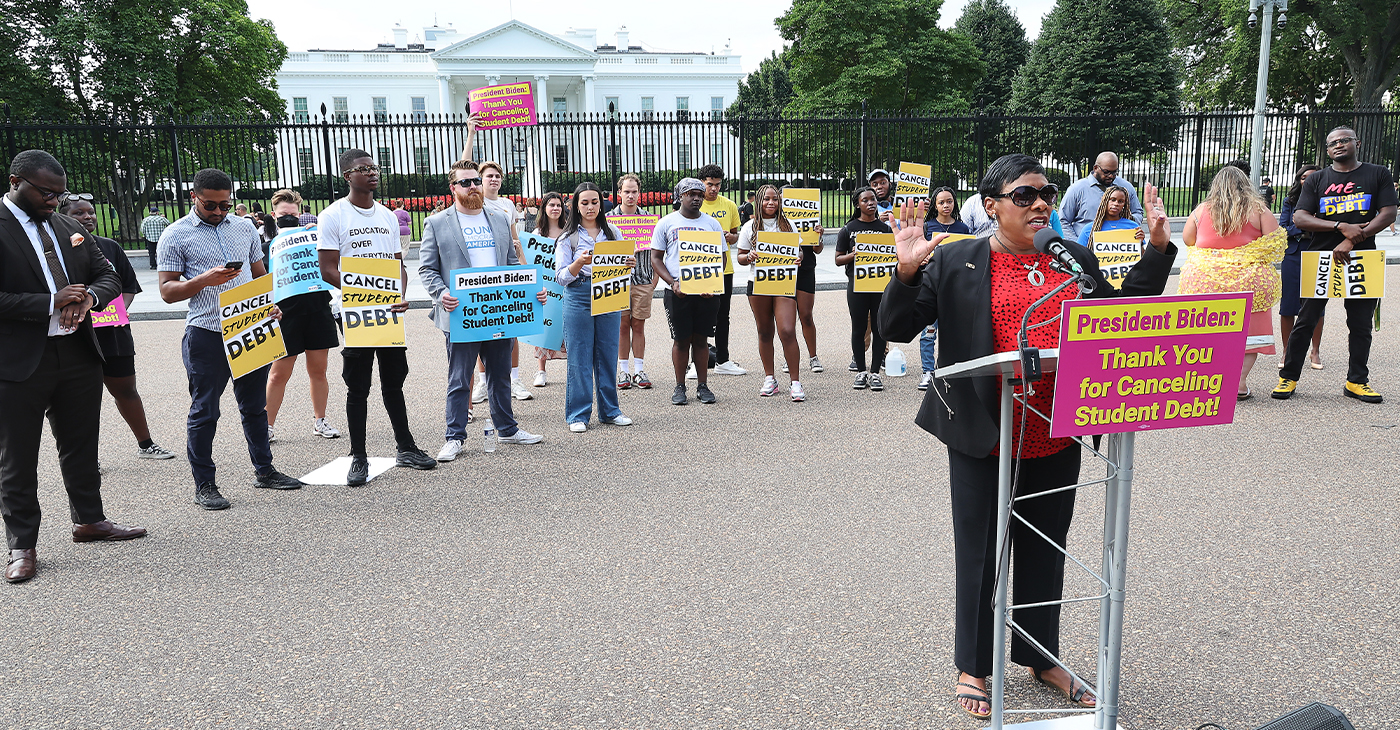
President Joe Biden’s recent student debt cancellation announcement elicited a diverse range of reactions– some congratulatory, others critical, and still others that seem unsure what to make of the unprecedented multi-billion-dollar effort.
Predictably, long-time education and civil rights advocates spoke to the need for additional reforms, while others wondered about cancellation’s impact on an already troubled economy. Families struggling with the rising cost of living and deepening student debt –have only a few months to make household budget adjustments before loan payments resume in January.
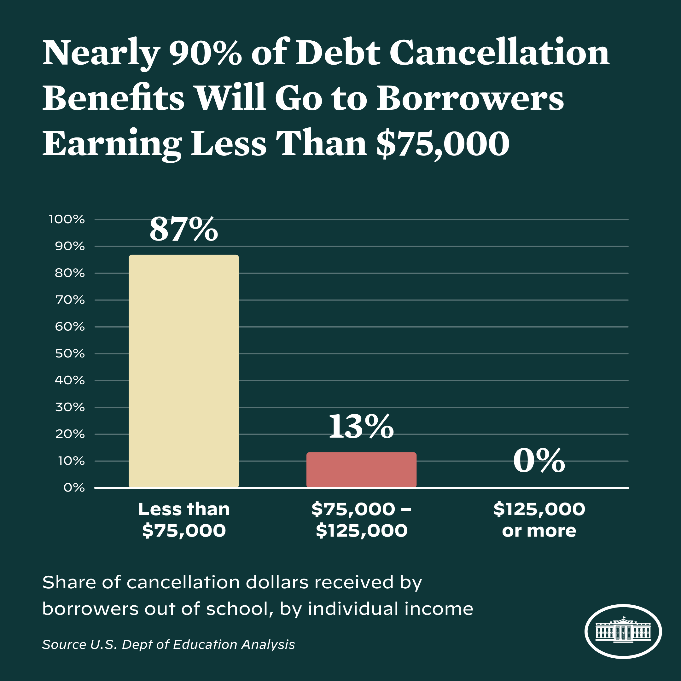
The good news is that of the 43 million people affected by the executive action, 20 million borrowers will have all of their debt cancelled. Many of these borrowers incurred student loans but dropped out of school, left with thousands in debt and lower earnings due to the lack of a degree.
Another 27 million people from working class backgrounds who received Pell grants are assured of up to $20,000 in debt relief.
But these actions do not resolve the structural mismatch between the still-rising costs of college, limited family financial means to contribute to that cost, and the availability of financial aid other than interest-bearing loans.
“We’ve all heard of those schools luring students with a promise of big paychecks when they graduate only to watch these students be ripped off and left with mountains of debt,” stated President Biden on August 24. “Well, last week, the Department of Education fired a college accreditor that allowed colleges like ITT and Corinthian to defraud borrowers…Our goal is to shine a light on the worst actors so students can avoid these debt traps.”
It seems like a perfect time for the Department of Education to clean house of all the bad higher education actors — especially costly for-profit institutions that promise a lot but deliver little, and accreditors that fail to do their jobs.
On August 30, following President Biden’s announcement, the Department of Education took action against another defunct for-profit: Westwood College. This trade school lured unsuspecting students into costly debt from January 1, 2002 through November 17, 2015 when it stopped enrolling new borrowers in advance of its 2016 closure. The Department found widespread misrepresentations about the value of its credentials for attendees’ and graduates’ employment prospects.
“Westwood College’s exploitation of students and abuse of federal financial aid place it in the same circle of infamy occupied by Corinthian Colleges and ITT Technical Institute,” said Under Secretary James Kvaal. “Westwood operated on a culture of false promises, lies, and manipulation in order to profit off student debt that burdened borrowers long after Westwood closed.”
Now, 79,000 Westwood borrowers will benefit from $1.5 billion in debt cancellation, thanks to the Department.
Changes to Public Service Loan Forgiveness (PSLF) Program rules will allow borrowers that would not otherwise qualify, to receive credit for past periods of repayment. Interested borrowers and their families can get more information on the program’s information page, but they must act by October 31. Details on the time-limited offer are available at:https://studentaid.gov/announcements-events/pslf-limited-waiver.
But individual states must do their part as well. Across the nation, state revenues are flush with surpluses.
“I don’t think there’s been a time in history where states are better equipped to ride out a potential recession,” said Timothy Vermeer, senior state tax policy analyst at the Tax Foundation, a Washington, D.C.-based think tank. “A majority, if not all, of the rainy-day funds are in a really healthy position.”
Additionally, and according to the 2021 edition of the annual State Higher Education Finance (SHEF) report, short-changing higher education funding at the state level will likely lead to worse, not better results. The report tracks enrollment trends, funding levels and distributions of state institutions.
“Generous federal stimulus funding protected state revenues and directly supported higher education, reducing states’ need to cut funding during the pandemic and short economic recession,” states the report’s news release. “However, sharp declines in student enrollment and net tuition and fee revenue signal continued upheaval for public higher education revenues.”
Federal stimulus funding during the pandemic boosted state education appropriations, but only 8.9 percent of state aid to public institutions in 2021 went toward providing student financial aid, according to SHEF. And without federal stimulus funds, state education appropriations would have declined by one percent in 2021 if full-time enrollment had held constant, according to the report.
“States vary in their relative allocations to higher education,” states the report. “Public institutions in some states remain primarily publicly funded, but a growing proportion have become primarily reliant on student tuition and fee revenue over the last two decades.”
The report notes that while federal stimulus and relief funds are helpful, they cannot be a replacement for long-term state investments, because stimulus funds are time-limited and often restricted in their use.
If we want to end the student debt trap, now is the time for citizens to challenge states to use their tax revenue to do more for their own constituents.
Charlene Crowell is a senior fellow with the Center for Responsible Lending. She can be reached at [email protected].
Advice
COMMENTARY: Record Inflation Shrinks Housing Affordability, Worsens Racial Wealth Gaps
NNPA NEWSWIRE — Homeownership, historically a reliable building block to family wealth, is more of a challenge today for first-time homebuyers. As of 2022’s first quarter, the median price of an existing single- family home grew to $368,200, according to the National Association of Realtors (NAR), 15.7 percent higher than a year ago.


Many Consumers Pay More for Rent Than Others Do for Mortgages
By Charlene Crowell, NNPA Newswire Contributor
This summer, temperatures are not the only thing rising above normal.
The U.S. Bureau of Labor Statistics reported that the nation’s consumer price index (CPI) at the end of May was the largest since December 1981, more than 40 years ago. This key economic measure tracks the change in prices paid by consumers for goods and services for about 93 percent of the total U.S. population.
The most recent report released on June 10, showed double-digit CPI increases for fuel, food, utilities, and both new and used vehicles.
Even before this data release, many consumers already adjusted their lives to compensate as best they could for $5 per gallon gas prices, keeping family cars longer, and taking fewer family outings to free up funds for still-rising food prices.
But how much longer can housing remain affordable when prices for both homes and rents are rising even higher?
Homeownership, historically a reliable building block to family wealth, is more of a challenge today for first-time homebuyers. As of 2022’s first quarter, the median price of an existing single family home grew to $368,200, according to the National Association of Realtors (NAR), 15.7 percent higher than a year ago.
Families able to afford a 20 percent down payment on this median-priced home can look forward to a monthly mortgage of approximately $1,383, which is $319 more – 30 percent higher – than a year ago, according to NAR.
For Black America, however, a history replete with systemic discrimination in education, employment, lending, and housing imposes additional harsh realities that have yet to be effectively addressed.
From 2013 to 2019, after adjusting for inflation, the median household income of Black households increased by just $800, compared with about $3,000 for white households and $3,700 for Latinx households, according to research by the National Equity Atlas that analyzed the nation’s 100 largest metro areas. Additionally, during these same years, the number of neighborhoods affordable to Black households dropped by 14 percent.
“Shrinking neighborhood affordability and the dearth of affordable neighborhoods that provide the necessary conditions for health, well-being, and economic success in many large metros are reinforcing longstanding patterns of racial segregation and creating new ones,” concludes this report.
Other new research from Freddie Mac sought to identify the causes of soaring home prices and where affordable homes might still be found.
What drove home price growth, and can it continue?
Freddie Mac’s new report found four factors driving escalating home costs:
- Record low mortgage rates in 2020 and 2021 generated a race to beat future rate increases;
- Home inventories were limited due to underbuilding on one hand, and below average distressed sales on the other;
- The number of first-time homebuyers grew due in part to favorable age demographics; and
- Many consumers left high-cost cities for cheaper ones that already had a housing shortage. Where affordable homes can be found, brings to mind an old adage in real estate, ‘location, location, location’.
“As of February 2022, migration out of the largest 25 cities remains three times higher than the rate pre-pandemic,” states the Freddie Mac report. “The most significant increase in migration has been to midsized metro areas with populations between 500,000 to 1 million, followed by smaller midsized metros and smaller metro areas.”
The irony is that today, many consumers are paying more for fair market rent (FMR) than many monthly mortgages that lead to home equity and wealth.
The down payment – rather than the monthly mortgage note – is the primary barrier to homeownership for many renters. With a rising cost of living, few – if any – dollars remain at the end of a month for many families. And even if a family has managed to save a few hundred dollars or more, home down payments on the private market are tens of thousands of dollars.
Some home lenders may offer adjustable-rate mortgages (ARMs) as an alternative to cash-strapped buyers. But the key word in these loans is ‘adjustable’. When loan interest resets occur, borrowers should plan for higher interest rates. It would also be prudent to remember that the foreclosure crisis of the early 2000s was fueled by high-cost mortgage loans that left millions of Black and Latino homeowners either without a home or remaining in one with a loan balance larger than its market value.
If this nation really wants to address its affordable housing crisis, then it is time to give Black America a level playing field with access to affordable and sustainable mortgages. It is equally important to diversify new construction housing.
Currently, the vast majority of new construction housing — whether for rent or for purchase – are for higher-income consumers, leaving moderate and low-income families with severely shrinking housing options.
Every family of every income needs a home. Effective housing reforms would offer both access and affordability – not either-or.
Charlene Crowell is a senior fellow with the Center for Responsible Lending. She can be reached at [email protected].

San Diego’s State Workers Demand Better Pay in Major Strike

Unscripted Sports Talk: Featuring Local Media Stars! #shorts

Par 365: Making Indoor Golf More Accessible in Minnesota #shorts

Honoring Clem Haskins: A Basketball Legend’s Legacy at UMN #shorts
NFN live presents Beyond IWDM 50 Podcast
The Hidden Cost of Insurance Loyalty

Retrospectro Talks Viral Videos, Lean Squad, Music & More | Interview

CBCF’s ALC 55 Recap | September 2026

The Washington Informer Celebrates 62 Years | Recap

Heated Seats & Sliding Window: Ultimate Truck Comfort #shorts

OP-ED: Haiti TPS: Have We Lost Sense of Humanity?

Remembering Chauncey Bailey as Student Journalists Face Threats to Truth-Telling

All Skinfolk Ain’t Kinfolk

Poll: Becerra Widens His Lead Over Hilton; Californians Split on Wealth Tax

Rulings Leave Questions Lingering in Nolan Wells Case

Latinas Deserve Equal Pay. Unions Help Make It Happen.

Zakiya Jendayi Arrested, Locked Out of Home by Sheriff’s Deputies

Why Black Artists Struggle to Sell Tours

COMMENTARY: The Audacity of Joyce Beatty

A $2.1 Trillion Wellness Industry Never Built a Daily Practice for Black Children. So This Atlanta Family Did.
San Diego’s State Workers Demand Better Pay in Major Strike
Unscripted Sports Talk: Featuring Local Media Stars! #shorts
Par 365: Making Indoor Golf More Accessible in Minnesota #shorts
Honoring Clem Haskins: A Basketball Legend’s Legacy at UMN #shorts
Retrospectro Talks Viral Videos, Lean Squad, Music & More | Interview
CBCF’s ALC 55 Recap | September 2026
The Washington Informer Celebrates 62 Years | Recap
Heated Seats & Sliding Window: Ultimate Truck Comfort #shorts

Test Subaru’s 11.6-Inch Screen in REAL Daylight #shorts

EV Range Anxiety? Your Daily Commute Needs Just One Overnight Charge #shorts
-

 Black History1 week ago
OP-ED: The Black Church Writes AI’s Next Chapter
-

 Featured6 days ago
Tamiko Armstead | 2026 Lifetime Achiever in Education
-

 Black History1 week ago
Practitioners of African Traditional Spirituality Offer Ancestral Reverence Ritual Oct. 31
-
 Art1 week ago
Kickstarter CEO Everette Taylor Shares Tips on Creating and Growing a Business
-

 Black History1 week ago
Columbus’s Oldest Businesses Still Open: 10 That Have Lasted 75+ Years
-

 Black History1 week ago
COMMENTARY: BIG MAMA SAID: Don’t Throw Away the Gift Just Because It Came Wrapped Wrong
