Connect with us

Howard University News Service

Coverage that Matters to Your Community

Published

on

By the Fall 2023 NewsVision Cohort  

From the war in the Middle East and concerns over Artificial Intelligence in the classroom, to tips for fighting seasonal depression, the Fall 2023 NewsVision Capstone covers your community. The “Triumphant Ten” reported from the White House, March On Washington and Congressional Black Caucus, to the campus of Howard University. The six credit capstone course is the last stop for the collegiate journalists before graduation. They produced all original content and uniquely assumed all roles of production in front of and behind the camera. Led by Associate Professor Jennifer Thomas, the seniors filmed the newscast at Studio A in the Cathy Hughes School of Communications.

HOWARD UNIVERSITY FALL 2023 NEWSVISION CAPSTONE: “THE TRIUMPHANT TEN” PRODUCER: Briana Alvarado DIRECTOR: Calvin Jordan Barrett TECHNICAL DIRECTOR: Cortneii Samuel ANCHORS: Gregory Lloydon Coleman, Zoe Warner FLOOR DIRECTOR: Alyssa Mark AUDIO: Ginger Mattison TELEPROMPTER: Starr Garner STUDIO CAMERAS: Aya Furin-Campbell, Kiara Patterson EXECUTIVE PRODUCER/ PROFESSOR: Jennifer C. Thomas

02 Nov 2015 3.19 pm

Nicole Luke’s car design. Photo…

05 Nov 2021 2.19 pm

According to the CDC, Black women have a…

06 Mar 2016 10.11 pm

Ta-Nehisi Coates, a New York Times best-sellling…

Continue Reading
Advertisement
Comments

HBCU

Howard University Statement on the Recent Shooting Incident 

This incident was not affiliated with Howard University, and no Howard University students, faculty, or staff were involved.

Published

on

By

Howard University Statement on the Recent Shooting Incident 

WASHINGTON, DC—On Friday, October 24, 2025, at approximately 8:22pm, officers from the Metropolitan Police Department (MPD) and the Howard University Department of Public Safety (HUPD) responded promptly to reports of gunfire near the 2500 block of Georgia Avenue and Howard Place, NW.

This incident was not affiliated with Howard University, and no Howard University students, faculty, or staff were involved. Preliminary reports indicate that a confrontation between two individuals led to the shooting. Four individuals sustained non-life threatening gunshot wounds. MPD and HUPD officers pursued and apprehended two suspects, who are now in MPD custody. Three firearms were also recovered at the scene.

The safety and well-being of the Howard University community is our highest priority. HUPD has implemented enhanced security measures throughout the weekend, including an increased presence of University security personnel and local law enforcement agencies on and around campus to ensure a safe and welcoming environment for all.

The University appreciates the swift and coordinated response of MPD and HUPD officers, whose actions helped to protect the safety of our community.

Contact: [email protected]

Office of University Communications 

Continue Reading

Black History

‘This is a Bond for Life:’ From Sisterhood to the Presidential Race

HOWARD UNIVERSITY NEWS SERVICE — The women who were initiated into Alpha Kappa Alpha Sorority, Inc. at Howard University in the spring of 1986, they know Kamala Harris as “line sister.” More than 30 of Harris’ sorority sisters celebrated this historical moment. They traveled across the country to meet here in Chicago for the Democratic National Convention. And Monique Poydras, an organizer of the event, shares why her sorority sisters are here to support Harris.

Published

on

A young Kamala Harris on the campus of Howard University. Photo courtesy of Valerie Pippen-Coutee.

By Trinity Webster-Bass | Howard University News Service

CHICAGO — Kamala Harris has had many roles and titles over the course of her political career. Attorney General, Senator, Vice President and now Democratic presidential nominee.

But for the women who were initiated into Alpha Kappa Alpha Sorority, Inc. at Howard University in the spring of 1986, they know Kamala Harris as “line sister.”

“Greetings most gracious ladies of the upper, uppermost house of Alpha Chapter, Alpha Kappa Alpha Sorority Incorporated, Howard University, Washington, DC 20059,” they all chanted in unison.

Today, I sat down with a few fellow members of the Alpha Chapter of Alpha Kappa Alpha Sorority. More than 30 of Harris’ sorority sisters celebrated this historical moment. They traveled across the country to meet here in Chicago for the Democratic National Convention. And Monique Poydras, an organizer of the event, shares why her sorority sisters are here to support Harris.

College classmates and sorority sisters of Democratic Presidential nominee Kamala Harris gathered at the Democratic National Convention.

College classmates and sorority sisters of Democratic Presidential nominee Kamala Harris gathered at the Democratic National Convention.

“So, we have gathered here today because we are so excited about our line sister, Kamala Harris, Vice President Harris,” Poydras said. “We’re here to celebrate her and also to support her in her nomination for president of the United States, and we’re looking at an individual who’s not only qualified, she’s qualified, overqualified for the role. And we couldn’t be more proud and humbled about our beginnings at Howard University.”

Valerie Pippen-Coutee has known Harris for over 40 years, and before they were sorority sisters, they were best friends.

“We got closer and closer together almost every day, and what we ended up doing was the summer of ‘85 we decided to go to summer school,” she recalled. “So, we worked during the day and went to summer school at night, and that really was difficult, but we were together every night.”

Pippen-Coutee continues to tell the story of how she convinced Harris to become a member of Alpha Kappa Alpha, the first Black sorority founded at Howard University.

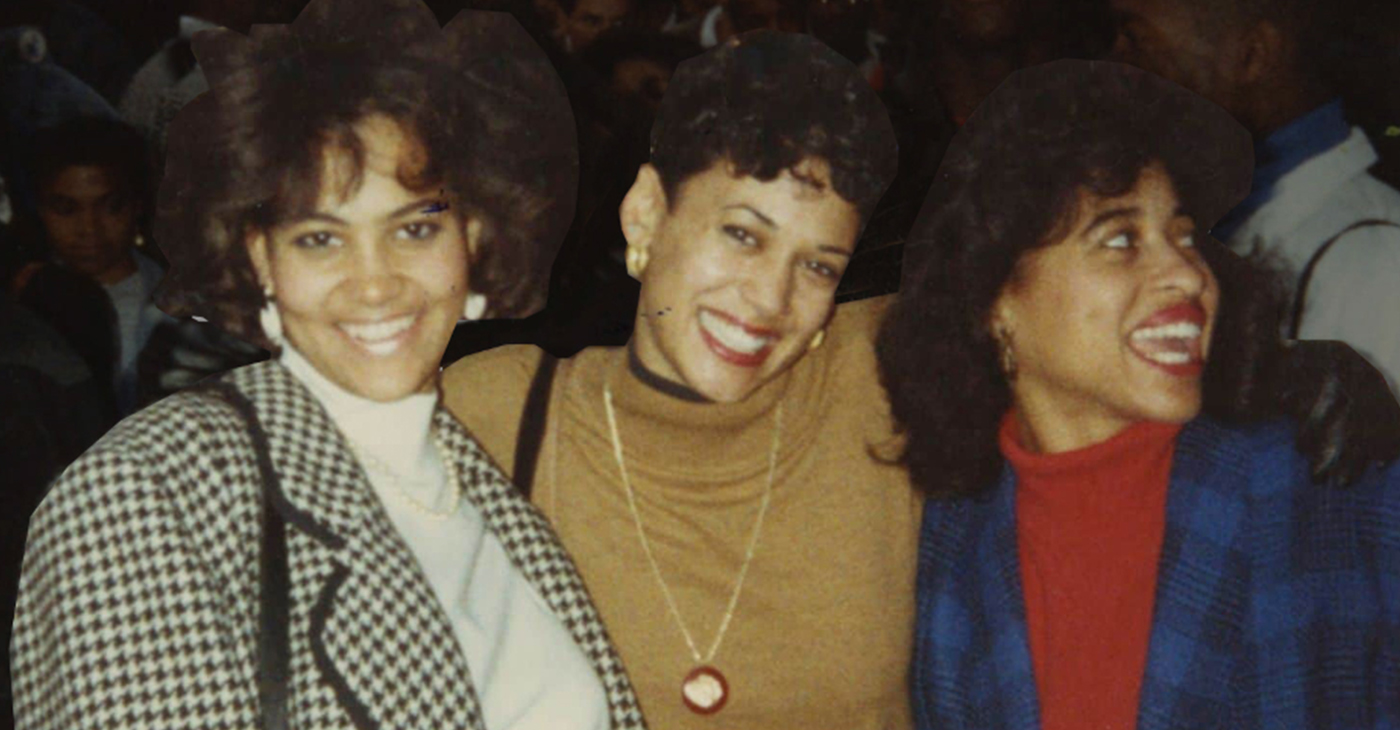
Harris (upper left) on the campus of Howard University with her Alpha Chapter AKA members (1986).

Harris (upper left) on the campus of Howard University with her Alpha Chapter AKA members (1986).

“I remember I had pledged already, and I remember saying to her, ‘Hey, you should go out for the sorority. You should really do it.’ She was like, ‘I don’t know. I don’t know what I want to do.’ I was like, ‘Look, you really need to do it.’ And she said, ‘I’m gonna do it.’ And so she did, and the rest is history.”

For many of Harris’ fellow members, getting people to the polls and Harris into the Oval Office are personal matters. From California to Washington, D.C., her sorority sisters have been there every step of the way.

Pippen-Coutee, like many of her sorority sisters, had plenty of stories to tell. They spoke of fond memories as they moved through life together.

“She might not remember this, but there was one time I visited her in Oakland, and we went shopping, and I was working, and I believe she had just become working in the District Attorney’s office. She kept saying, Pippen. She calls me Pippen. ‘Pippen, I need a blue suit. I need a blue suit.’ I bought her that blue suit.’”

And as a line sister Inez Brown explained that they have been with Harris throughout her wearing many different suits.

Vice President Kamala Harris with line sister Inez Brown Courtesy: Inez Brown.

Vice President Kamala Harris with line sister Inez Brown Courtesy: Inez Brown.

“We have celebrated her along the way,” Brown said. “When she was serving in Los Angeles, when she became the Attorney General, some of us were present at her swearing-in ceremony and celebration when she became a U.S. Senator we also celebrated with her in that moment. We were in the room when she took her oath and when she was running for president.”

“We galvanized and we did what we could do to influence and encourage people to register to vote and to support financially, because we know money speaks, and that is an important part of every election.”

What her fellow sorority sisters love most about Harris is her character, and for Pippen-Coutee, her laugh.

“I just want people to know how much of a genuine person Kamala is, how loving and caring and funny, like we both love to laugh,” she said. “And that’s one thing we always had in common was laughter. And I just remember how she and I would just look at each other, just start cracking up.”

Brown, who also helped to organize the event, wants people to know that at the end of the day Harris is a person too.

“And I think a unique lens for us is her line sisters, as we get to paint the human side of Kamala,” Brown said. “People have only sort of known her in her public service, so they often wonder, ‘Is she really this? Is she really that?’”

“We are here to say she is authentic and she is genuine and she has never shifted that. No matter what role she has served in. We love her for that, and I think she absolutely loves us for being there for her as line sisters and not people who are just enamored with her space in life.”

Despite campaigning and running the country, Brown explains that in her time of need, Harris still found a moment to always have her back.

“I had brain surgery, and I talk about it because it is something real, and I realize it empowers me to support someone else who might be taking that journey,” she said. “I had just had surgery. Kamala called the hospital, and she was in the thick of her candidacy, but she made the time to reach out to me.”

Poydras knows that what bonds them is their shared experiences as Black women. It’s their sisterhood that connects them all.

“The founding of our illustrious sorority came at a time when we didn’t have anywhere,” Poydras explained. “We only had each other. So, we had to create our own organization so that we could be a part of something special. This is not, ‘Oh, you just, you know, you’re part of an organization in college,’ and then it ends. This is a bond for life, a commitment for life, and that’s what our sisterhood stands for.”

And in case you’re wondering, Vice President Harris did indeed work at the McDonald’s on Georgia Avenue across from campus.

“Yes, it is true. She had to make money,” Brown said. “We all needed a job,” Brown and Poydras exclaimed at the same time.

Continue Reading

Black Press

Amid Calls for Reform, Supreme Court Reviews Key Cases Like Gerrymandering

Published

on

By Ebenezer Nkunda
Howard University News Service

As the highest judicial authority in the United States, the Supreme Court is facing increasing calls for reform over concerns about ethical issues, partisanship and lifetime appointments. The chief justice and eight associate justices have the power to mold the trajectory of the nation in their hands, deciding on numerous cases that hold significant impact  such as reproductive rights, affirmative action and now voting rights. 

During its current term, the Supreme Court is reviewing the matter of Alexander v. South Carolina State Conference of the NAACP, where lower courts had deemed a recently adopted congressional map unconstitutional due to suspected racial gerrymandering. The court is expected to announce its decision on what counts as an unconstitutional gerrymandering;-’ in enough time to prepare for the 2024 elections in November – at the latest during the summer.

The case came from the aftermath of the 2020 census, where it was discovered that the redrawn congressional map had moved tens of thousands of residents from one district to another, disproportionately impacting Black residents by creating an underpopulated 1st District and an overpopulated 6th District.

The South Carolina State Conference of the NAACP responded with a lawsuit, claiming unconstitutional gerrymandering. A panel of three U.S. District judges ruled in its favor, concluding that race had been the primary factor behind the design of the first district, thereby violating constitutional amendments. The U.S. Supreme Court heard arguments on Oct. 11, when South Carolina’s Republican-controlled General Assembly challenged this decision, asserting that its actions were politically motivated, not driven by racial considerations.

Attorney John M. Gore, representing the South Carolina General Assembly, argued that the lower court had erred in characterizing the Republican lawmakers’ actions as unconstitutional racial gerrymandering. He pointed to the blurred line between race and politics in their decision. Gore invoked the precedent set by Rucho v. Common Cause, which permits partisan gerrymandering unless expressly prohibited by a state’s constitution, which is not the case in South Carolina.

On the opposing side, Legal Defense Fund (LDF) senior counsel Leah Aden argued on behalf of the NAACP. She countered Gore’s claims, emphasizing that the district court’s ruling had correctly identified race as the primary driving force behind the gerrymandering. 

Aden cited the wealth of evidence and testimonies presented during an extensive trial, which indicated that the legislature had manipulated the boundaries to gain partisan advantage, including the “bleaching” of predominantly Black Charleston County. The senior counsel argued that the move was strategically aimed at preventing the district from becoming more Democratic, as most black people in Charleston are, and led to a significant decrease in the 1st District’s  Black population.

During the proceedings, some of the left-leaning justices, Sonia Sotomayor and Elena Kagan, expressed uncertainty about the South Carolina counsel’s request for the Court’s intervention in response to alleged errors made by the lower court, deeming the argument weak. Justice Ketanji Jackson Brown suggested that finding clear error in the lower court’s ruling for South Carolina might be plausible if there were no findings and substantial evidence regarding the state’s actions of sanctioning a map with racial considerations.

Justice Samuel Alito was assertive in his questioning of the Legal Defense Fund attorney, directing more than half of the questions at her. He also focused on the constitutionality of the map, citing his knowledge and familiarity with the mapmaker responsible for drawing the new South Carolina congressional map.

On the other hand, Justice Clarence Thomas gave the appearance of being disengaged. Thomas, who has a history of not speaking at all during arguments, leaned far back in his chair, almost as if he was taking an afternoon nap on a living room recliner. This raises questions about the appropriateness of such actions, or inactions, particularly when parties are allotted only 30 minutes to make their case. 

Many people aspire to argue in front of the justices and dream of such an opportunity. Before the commencement of oral arguments, a group of attorneys is introduced and granted admission to the Bar of the Supreme Court of the United States. During this process, one attorney had a touching and joyful moment as he introduced his wife, marking a heartfelt occasion in the most esteemed court in the land.

However, the scene outside the Supreme Court building is quite different, evoking mixed emotions.

Standing outside the Supreme Court building is Robin Galbraith, a mother of two, who is in her 95th day of protesting. She stands in front of the Supreme Court daily, hoping to raise awareness about the necessity for reform and advocating for stricter limitations on the justices. 

Robin Galbraith stands outside the Supreme Court on her 95th day of protests. (Photo by Ebenezer Nkunda/HUNewsService.com)

Earlier this year, ProPublica published a report disclosing Crow’s gifts to Thomas. These gifts included trips on super yachts, frequent flights on private jets and extended vacations at private resorts. Notably, inside one of Crow’s residences hangs a mural featuring close friends, depicting the billionaire and Crow.

The Ethics in Government Act mandates that high-level federal officials must publicly disclose their financial history to make sure those upholding the constitution are doing it with integrity. Thomas has since maintained that he has adhered to the act’s requirements. He has issued a statement defending hospitality from his friend, asserting that it is not obligatory to disclose such matters under the law. According to a Propublica report, Justice Thomas complained about his salary to a Republican lawmaker and expressed that the salary given to Supreme Court justices may lead to resignations if there isn’t a raise soon. In the following years, that is when Thomas received gifts from Crow and expenses paid for by other friends and high-earning acquaintances. 

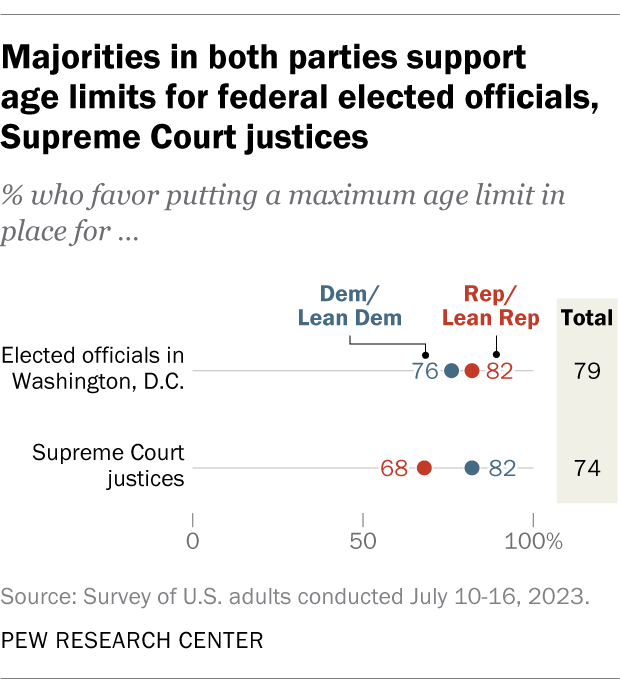
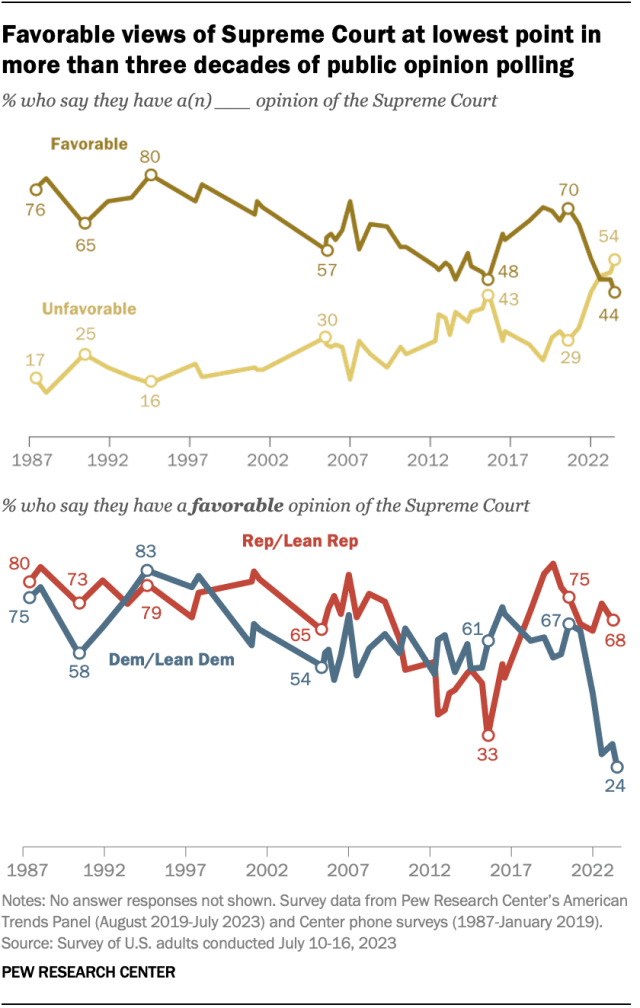
The limitations of the Supreme Court are constantly questioned. As high-level officials with lifetime appointments, only one justice has been impeached since 1805. According to a Pew Research Center Study, 74% of Americans favor having maximum age limits for members of the Supreme Court.

“Lifetime appointments are crazy,” says Aaniyah Hicks, a law student studying at the University of California-Berkeley, who doesn’t have the dream of serving on the Supreme Court, nor arguing in front of them.

This first-year law student says the public should have a say in the selection of individuals who wield significant power, especially those who interpret the Constitution. Questioning the legitimacy of the current system suggests that it’s crucial to investigate the personal relationships of influential public figures, such as Supreme Court justices, given the substantial power and public responsibility they hold.

“The system itself is corrupt, so I can’t sit here and say that nothing is happening,” the student said. “However, I also believe that people have lives outside of their careers. Justice Thomas is on such a high pedestal and wields immense power, so we should be privy to all the relationships that justices have.”

Nadine Cyler, 58, stood outside the Supreme Court to express her support for the Black community in South Carolina, believing that the laws in question are aimed at diminishing Black voting power in the country, ultimately perpetuating the power dynamic in favor of the majority.

Nadine Cyler stood outside the Supreme Court building donning a sign that reads “2nd class citizen.” (Photo by Ebenezer Nkunda/HUNewsService.com)

With a sign reading “2nd class citizen” on one side and “SCOTUS is illegitimate” on the other, Cyler stood outside the building to express her doubts and concerns. She questioned the legitimacy of the South Carolina General Assembly and those overseeing the case.

“It’s convenient for white men who wield all the power and enact various covert policies and laws to maintain their hold on power to dismiss other groups by asking, ‘Why is it always about race?’ when it is always about race,” Cyler said. “Every time people secure a policy or law that grants them a right, you find a way to create another law or policy to strip away that right to keep power in the hands of white men.”

Following oral arguments, the Legal Defense Fund held a press conference joined by plaintiffs from the Alexander v. South Carolina Conference of the NAACP case, reaffirming their belief that the voting rights of Black South Carolina residents are being impeded based on race.

Adriel I. Cepeda Derieux, deputy director of the ACLU’s Voting Rights Project, stated that this is a “textbook” case and that the Supreme Court will rule in their favor.

As the Legal Defense Fund continues to champion the rights of marginalized communities and the importance of fair representation, the Supreme Court’s ultimate decision in the Alexander v. NAACP case remains eagerly anticipated in the coming year.

Ebenezer Nkunda is a reporter for HUNewsService.com.

27 Sep 2016 5.43 pm

Philosopher George Santayana once said,…

18 Apr 2022 8.20 am

The confirmation of Judge Ketanji Brown…

23 Mar 2022 7.32 pm

By Bria Scott, NewsVision reporter When…

Continue Reading

BlackPressUSA

President Biden’s Full Howard University Commencement Address

NNPA NEWSWIRE — “You’re the scientists, the doctors, the advocates who will bring — do big things like ending cancer as we know it and even curing some cancers, which we’re on our way of doing. You’re the diplomats and global citizens making democracy work for people around the world. Lawyers defending our rights. Artists shaping our culture. Fearless journalists. This is real, though. You’re – this is what you’re doing. Fearless journalists and intellectuals pursuing the truth and challenging convention.

Published

on

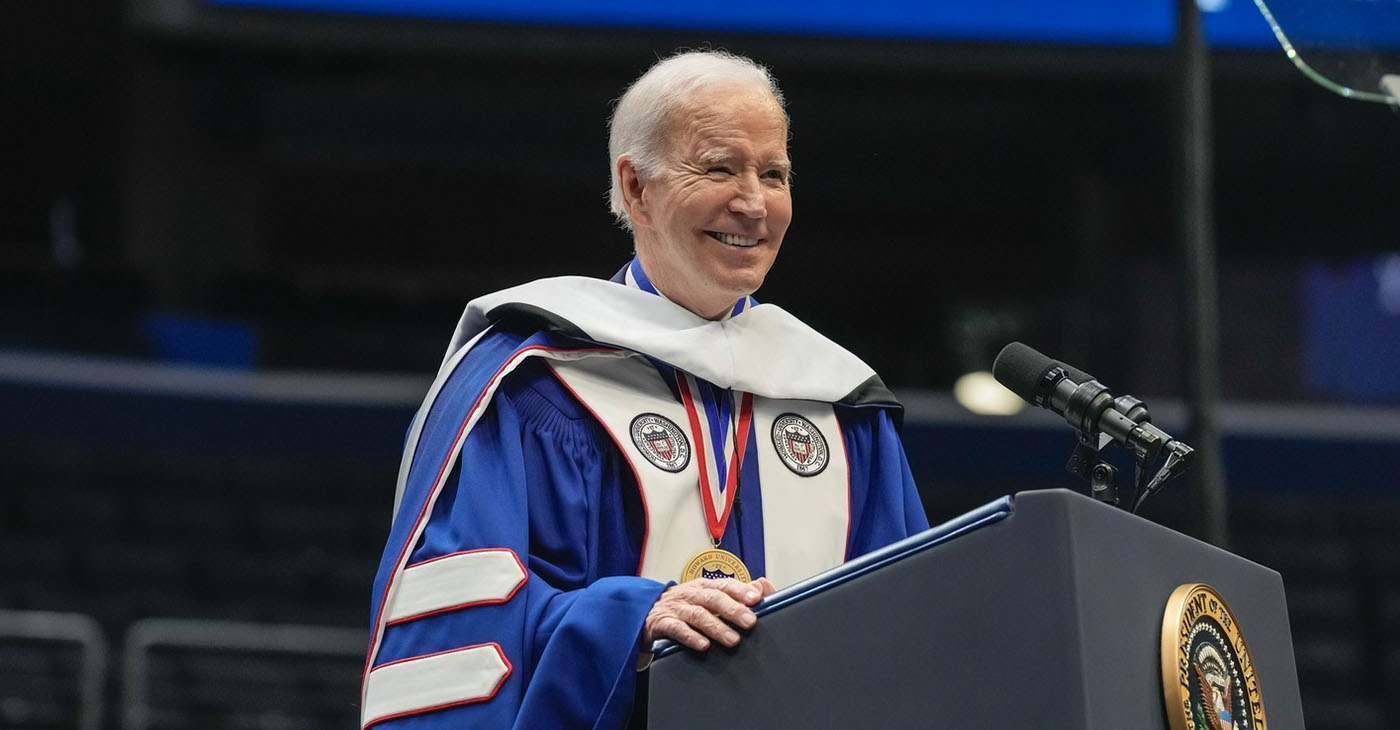
“President Joe Biden delivers the commencement address for the 2023 Howard University graduating class.

NNPA Newswire

You are here with your heart and through the heartache, through blood, sweat, and tears of everything that’s came before, for everything yet to come. You are here at a new moment of hope and possibilities.

But, graduates, before we begin, as mentioned many times, tomorrow is Mother’s Day. Stand for your mothers and grandmothers. Stand and thank them.

Where I come from, moms rule.

To my friend – and he is my friend – Congressman Jim Clyburn, the thing that I admire most about you, Jim, is your absolute integrity in everything you do – in everything you do. This is a man of honor.

I attended South Carolina State University’s commencement as Jim received his degree, he earned 60 years ago but never got a chance to receive it in person.

Jim, it’s an honor to join you here today and receive an honorary degree from this great university.

And it’s truly special – special to join fellow honorees. Prime Minister Rowley, I didn’t know you were so talented. I just thought you were foreign policies – you know, Latin American guy. I – you know, I – we got to talk.

All kidding aside, thank you for being a strong partner in the Caribbean and for addressing climate change and supporting democracies across the Western Hemisphere.
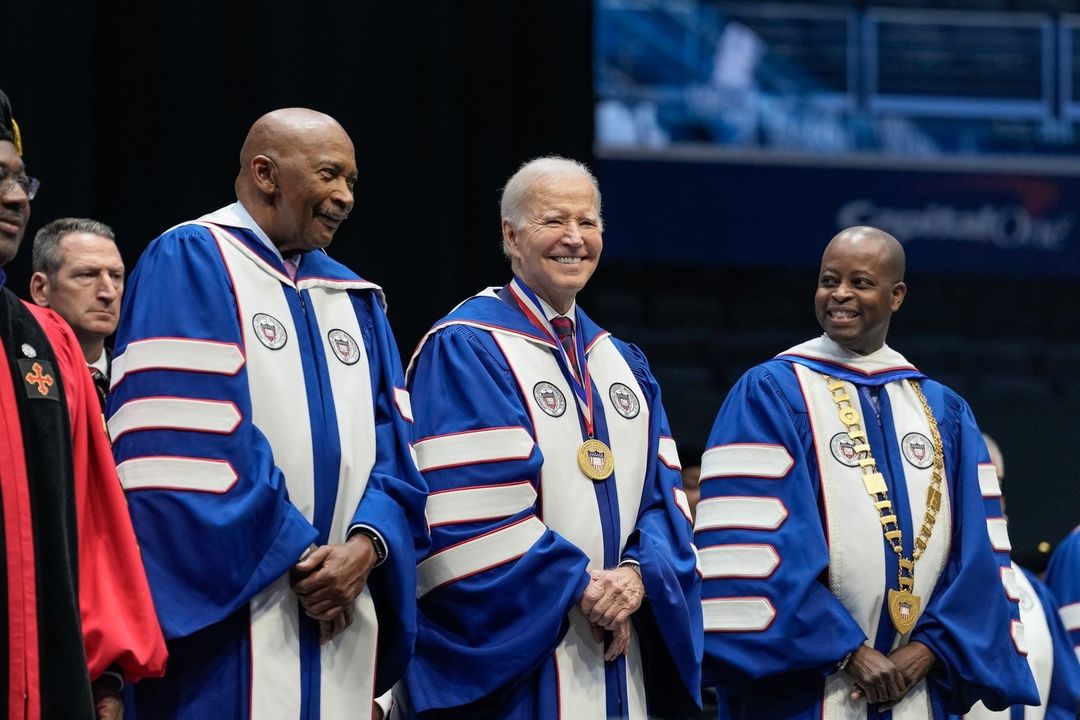
I’m also honored that – there’s a person here today, Dr. Tony Allen. He is President of my home state [H]BCU, Delaware State University, where I got politically started.

I was fortunate to have Tony as a Senate staffer for a long time. Then he got his PhD, had a distinguished career in business, and became president of an HBCU.

Now Tony chairs my White House Board of Advisors on HBCUs, which is designed to support and advance HBCU excellence with a lot more money.

I’m also proud to say that we’re the first White House to formally convene where the real power is: The Divine Nine. Oh, you all – you all think I’m kidding? Not a joke.

The Divine Nine not only has a seat at the table, we definitely hear you at the table. And there, first time ever, at the White House permanently.

So, folks, in 2023, I’m truly honored to be here at Howard.

Chartered 156 years ago by an act of Congress just after Emancipation and the Civil War. Founded – founded on a hilltop in Washington, D.C. The Mecca. The Mecca.

Always promoting, excellence, leadership, and truth and service. It really has. And a proving ground for future leaders of science, medicine, education, business, faith, arts, entertainment, and public service.

Trailblazing intellectuals, lawyers, doctors. The first Black – I might say – Vice President of the United States of America. You can say that again.

Kamala sends her love. And she sent a clear message that today I have the privilege, as she points out, of speaking at the real H-U.

Now you realize that’s going to cost me at home.

This – there’s enormous pride in this university founded in the verses of the Howard anthem. And I quote, “Reared against the eastern sky, proudly there on hilltop high… There she stands for truth and right, sending forth her rays of light.” It matters. It matters. It matters.

We’re living through one of the most consequential moments in our history with fundamental questions at stake for our nation.

Who are we? What do we stand for? What do we believe? Who will we be? You’re going to help answer those questions.

Let me take you back to January of 2009. I stood in Wilmington, Delaware, on the train station of Amtrak, carrying my folder waiting to be picked up by a guy named Barack Obama.

The first Black man elected President of the United States.

I was there to join him as Vice President on the way to the historic inauguration in Washington. A moment of extraordinary hope, but also, as I stood there – and this is the God’s truth – I couldn’t help think about another day I stood there.

I wasn’t much more than your age. I’d just got out of law school.

I was a public – I had gone to work for a big firm, but my state – because when Dr. King was assassinated, parts of it were – my city – parts were burned to the ground. We had a very conservative governor.

He stationed the National Guard on every corner with drawn bayonets for 10 months. I quit and became a public defender.

And I used to have to introduce my clients – no, that’s not so noble – I had to interview my clients down at the Wilmington train station when they were arrested.

On the east side – that’s where they’d be taken in the aftermath of the riots that burned Wilmington following his assassination.

In 2009, while waiting for Barack, I was both living history at the same time I was reliving it. A vivid demonstration: When it comes to race in America, hope doesn’t travel alone.

It’s shadowed by fear, by violence, and by hate.

But after the election and the re-election of the first Black American President, I had hoped that the fear of violence and hate was significantly losing ground.

After being – no longer being Vice President, I became a professor at the University of Pennsylvania for four years.

But in 2017, in Charlottesville, Virginia, crazed neo-Nazis with angry faces came out of the fields with – literally with torches, carrying Nazi banners from the woods and the fields chanting the same antisemitic bile heard across Europe in the ‘30s.

Something that I never thought I would ever see in America.

Accompanied by Klansmen and white supremacists, emerging from dark rooms and remote fields and the anonymity of the Internet, confronting decent Americans of all backgrounds standing in their way, into the bright light of day.

And a young woman objecting to their presence was killed.

And what did you hear? That famous quote. When asked about what happened, that famous quote. “There are very fine people on both sides.”

That’s when I knew – and I’m not joking – that’s when I knew I had to stay engaged and get back into public life. No, I – I don’t say it for that reason. I say it for the journey.

I don’t have to tell you that fearless progress towards justice often meets ferocious pushback from the oldest and most sinister of forces. That’s because hate never goes away.

I thought, when I graduated, we could defeat hate. But it never goes away. It only hides under the rocks. And when it’s given oxygen, it comes out from under that rock.

And that’s why we know this truth as well: Silence is complicity.

It cannot remain silent. We are living through this battle for the soul of the nation. And it is still a battle for the soul of the nation.

What is the soul of a nation? Well, I believe the soul is the breath, the life, the essence of who we are. The soul makes us, “us.”

The soul of America is what makes us unique among all nations. We’re the only country founded on an idea – not geography, not religion, not ethnicity, but an idea.

The sacred proposition rooted in Scripture and enshrined in the Declaration of Independence that we’re all created equal in the image of God and deserve to be treated equally throughout our lives.

While we’ve never fully lived up to that promise, we never before fully walked away from it.

We know that American history has not always been a fairytale.

From the start, it’s been a constant push and pull for more than 240 years between the best of us, the American ideal that we’re all create equal – and the worst of us, the harsh reality that racism has long torn us apart.

It’s a battle that’s never really over.

But on the best days, enough of us have the guts and the hearts to st- – to stand up for the best in us.

To choose love over hate, unity over disunion, progress over retreat. To stand up against the poison of white supremacy, as I did in my Inaugural Address – to single it out as the most dangerous terrorist threat to our homeland is white supremacy.

And I’m not saying this because I’m at a Black HBCU. I say it wherever I go.

To stand up for truth over lies – lies told for power and profit.

To confront the ongoing assault to subvert our elections and suppress our right to vote. That assault came just as you cast your first ballots in ‘20 and ‘22.

Record turnouts. You delivered historic progress.

I made it clear that America – Americans of all backgrounds have an obligation to call out political violence that has been unleashed and emboldened.

As was mentioned already, bomb threats to this very university and HBCUs across the country.

To put democracy on the ballot.

To reject political extremism and reject political violence.

Protect fundamental rights and freedoms for women to choose and for transgender children to be free.

For affordable healthcare and housing.

For the right to raise your family and retire with dignity.

To stand with leaders of your generation who give voice to the people, demanding action on gun violence only to be expelled from state legislative bodies.

To stand against books being banned and Black history being erased.

I’m serious. Think about it.

To stand up for the best in us.

And today, I come here to Howard to continue the work to redeem the soul of this nation, because it’s here where I see the future.

And I’m not – that’s not hyperbole.

We can finally resolve those ongoing questions about who we are as a nation. That puts strength of our diversity at the center of American life.

A future that celebrates and learns from history.

A future for all Americans. A future I see you leading. And I’m not, again, exaggerating. You are going to be leading it.

Again, let’s be clear: There are those who don’t see you and don’t want this future.

There are those who demonize and pit people against one another. And there are those who do anything and everything, no matter how desperate or immoral, to hold onto power. And that’s never going to be an easy battle.

But I know this: The oldest, most sinister forces may believe they’ll determine America’s future, but they are wrong.

We will determine America’s future. You will determine America’s future. And that’s not hyperbole.

No graduating class gets to choose the world into which they graduate. Every class enters the history of a nation up to the point it has been written by others.

But few classes, once in every several generations, enter at a point in our history where it actually has a chance to change the trajectory of the country.

You face that inflection point today, and I know you will meet the moment. I – just think about the many ways you already have.

With your voices and votes, I was able to fill my commitment to put the first Black woman on the Supreme Court of the United States of America.

And, by the way, she’s brighter than the rest.

She is one bright woman.

Because of you, more Black women have been appointed to the federal appellate courts under – than under every other President in American history combined.

And, by the way, I mean it. I mean it. Because of you. Because of you.

You turned out. You spoke up. You knew. You showed up, and the votes counted. And you made people say, “Whoa, wait a minute.

What price will I pay if I don’t do the following?”

You feel the promise and the peril of climate change. Because of you, we’re making the biggest investment ever in the history of the world in climate change.

Don’t ever think your voice doesn’t matter.

I’m keeping my promise that no one should be in jail merely because of using or possessing marijuana. Their records should be expunged – just expunged.

My student debt relief plan would help – tens of millions of people, especially those on Pell Grants.

Seventy percent of Black college students receive Pell Grants. Many of you, the savings would be significant and even wiping out student debt completely for some.

But – this new Republican Party is dead set against it, suing my administration to stop you from getting student debt relief.

The same opposition who received relief loans, I might add, to keep their businesses afloat during the pandemic – members of the Congress – worth thousands, even millions of dollars – most of which didn’t have to be paid back. Yet, they say it’s okay for them but not for you. I find it outrageous.

To reduce your debt service payments when you graduate, we’re also ensuring that no one – no one with an undergraduate loan today or in the future will have to pay more than 5 percent of their discretionary income to repay their loans, down from 10. And in 20 years, it’s gone.

Republican officials are fighting that as well. But I will always keep fighting for you. And many others will – and many in the Republican Party as well will fight for you.

But we also know there is more to do. Because of your power, we took the most significant law on gun violence – we passed it – the most significant law in 30 years.

But we will not give up. I got the Assault Weapons Ban passed 30 years ago, and we’re going to pass it again.

We must pass it.

And there’s more to do on police reform and public safety.

During the State of the Union, I asked the rest of the country to imagine having to talk to their children and their families like your families had to talk to you.

It’s about your security. It’s about your dignity.

It’s demeaning and degrading and deadly when you just have to stand there and say, “When you’re stopped, turn the interior light on, put both hands on the wheel, don’t reach for your license.” What in the hell is going on in America?

No, think about it.

I ask all the parents of non-minority children to ask what they would say, what they would do.

I know you’re frustrated that there are so many elected officials who refuse to pass a law that will do something.

Kamala and I stood next to the family of George Floyd and civil rights leaders and law enforcement officials to sign the executive order I came up with requiring the key elements of the George Floyd bill be applied to federal law enforcement: banning chokeholds, restricting no-knock warrants, establishing a database for police misconduct, advancing effective and accountable community policing that builds public trust.

And we’ll keep fighting to pass the reforms nationwide.

Equal justice is a covenant we have with each other. It must not just be an ideal; it has to be a reality.

You’re leading the way on this and so much more.

That’s why Kamala and I are so committed to investing in you and HBCUs. HBCUs help produce 40 percent of Black engineers; 50 percent of Black lawyers; 70 percent of Black doctors and dentists; 80 percent of Black judges.

Look, we see HBCU excellence in every day, with staff at every level of the White House and the administration, because I decided when I was elected, I promised I was going to have my administration would look like America.

But we all know that HBCUs don’t have the same endowments and funding as other major colleges and universities.

For example, denying the opportunity to build and fund research labs that will lead to new technologies and good-paying jobs.

That’s why I asked, and we’ve invested $6 billion and counting in HBCUs, including to create new research and development labs that prepare students for jobs of the future in high-income fields, from cybersecurity, engineering, biochemistry, healthcare.

Standing here, I think the last time I came to Howard with President Frederick and others was in my final year as Vice President to host the Cancer Moonshot on campus, because you are leading the way.

You’re the scientists, the doctors, the advocates who will bring — do big things like ending cancer as we know it and even curing some cancers, which we’re on our way of doing.

You’re the diplomats and global citizens making democracy work for people around the world. Lawyers defending our rights. Artists shaping our culture.

Fearless journalists. This is real, though. You’re – this is what you’re doing. Fearless journalists and intellectuals pursuing the truth and challenging convention.

You’re the leaders of tomorrow, but it’s coming on you really quickly.

Because of you, I see a future we can finally move away from the narrowed and cramped view that the promise of America is a zero-sum game: “If you succeed, I fail.” “If you get ahead, I fall behind.”

And maybe worst of all, “If I can’t hold you down, I can’t lift myself up.”

Instead of what it should be, “If you do well, we all do well.”

That’s what I see in you. That’s what I see in America. And more Americans are – a future of possibilities for all Americans.

Look, no matter – that future – what it holds, my sincere hope is that each of you find a sweet spot between happiness, success, and ambition.

That – a good life. A life of purpose.

Because here’s the thing: You don’t know where or what fate will bring you or when. You just have to keep going.

You have to just keep the faith. You have to just get up.

And you can find the balance between ambition and happiness and success – that good life of purpose, of family, and, as you know here at Howard, of excellence, leadership, and truth and service.

There is no quit in you. There is no quit in America.

So, let me close with this. In our lives and in the life of the nation, we know that fear can shadow hope. But it’s also true that hope can defeat fear.

In January of 2021, I stood at the U.S. Capitol to be inaugurated as President of the United States. Just days before, on that very spot, a violent insurrection took place.

A dagger at the throat of democracy. For the first time in our history, an attempt to stop the peaceful transfer of power in this country.

And they failed. Our democracy held. Again, hope prevailed.

And this time, I was standing with a Black woman about to take a two-mile procession down Pennsylvania Avenue as President and Vice President of the United States of America.

And who was marching alongside her? The Howard University Marching Band in lockstep and solidarity. You were.

I give you my word as a Biden: Class of 2023, you’re the reason I’m so optimistic about the future.

And I give you my word, I really mean it. You’re part of the most gifted, tolerant, talented, best-educated generation in American history.

That’s a fact.

And it’s your generation, more than anyone else’s, who will answer the questions for America: Who are we? What do we stand for? What do you believe? What do we believe? What do we want to be?

I’m not saying you have to share this burden all on your own.

The task at hand ahead is the work of all of us.

But what I am saying is: You represent the best of us. And that’s the God’s truth. You represent the best of us.

Your generation will not be ignored, will not be shunned, will not be silenced.

So, on the hilltop high, keep standing for truth and right, and send your rays of light.

Congratulations to you all. We need you.

God bless you. And may God protect our troops.

Continue Reading

Black History

Brothers Lean on “Granny,” Aunt, One Another After Covid-19 Loss

HOWARD UNIVERSITY NEWS SERVICE — According to a new modeling study published in Pediatrics, a child loses a parent or guardian in one of every four COVID-19 deaths, a devastating consequence that is affecting the lives of an estimated 140,000 children. 

Published

on

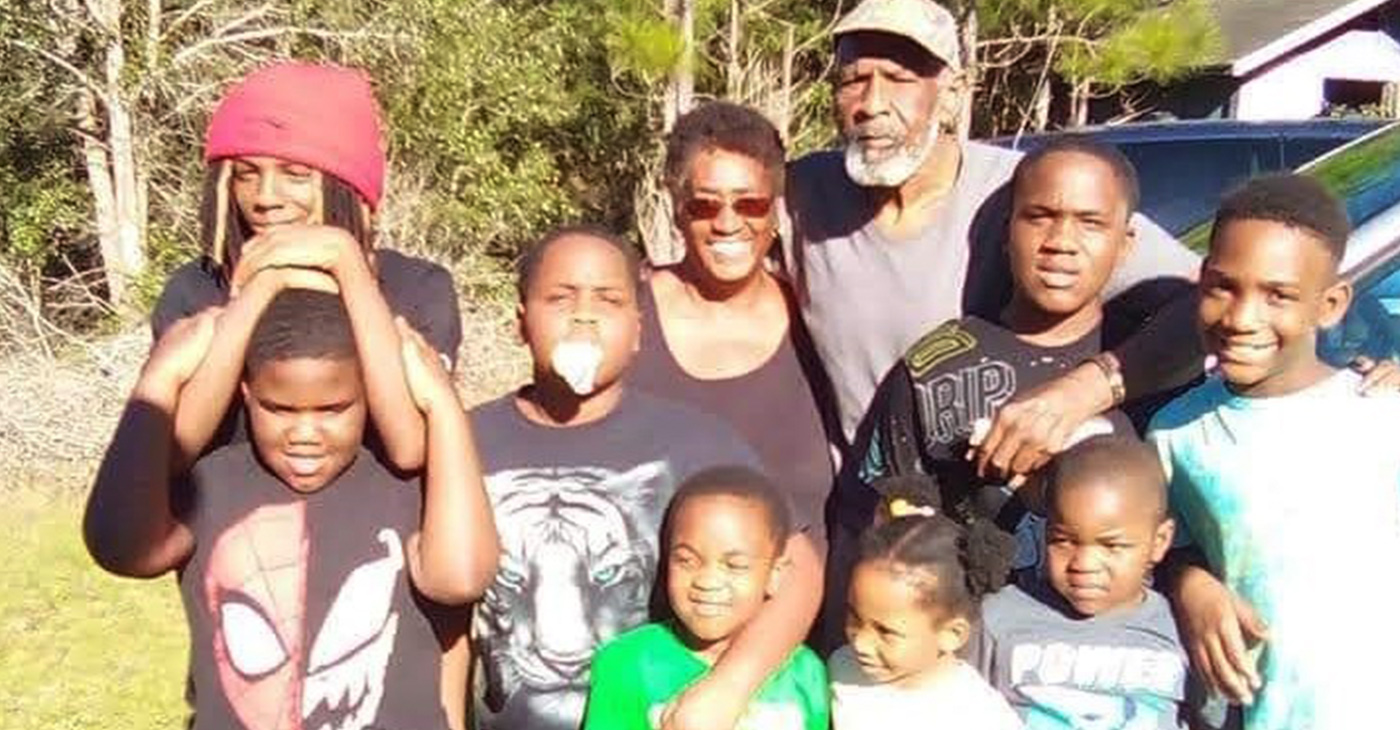
Courtney Hamilton’s six sons and other family, (top from left rear) Camarian, in red hat, Kendall, Kristian, grandparents Betty Hamilton and Curtis Hamilton, Kingston, and their cousin Alex Hamilton, (bottom from left), Kobe, their cousin Kamarah Hamilton, and Kassius, had just finished their annual visit to the grave of their mother where they release six red balloons in her honor. Hamilton was killed in an automobiel accident in 2018. Photo courtesy of the Hamilton family.

PAINDEMIC PAIN: Mending Unseen Wounds

Black and Brown families have been disproportionately affected by the coronavirus pandemic. So have their children. According to the National Institutes of Health, tens of thousands of children have lost at least one parent or caregiver to COVID-19. Half of them are Black or Brown. This is one in a three-part series looking at how their lives have changed.

By Ahnayah Hughes, Howard University News Service

At first glance, they are just five rambunctious brothers doing what boys their ages do.

They like bouncing on their trampoline, riding their scooters, tossing around a football and playing video games. One is particularly fond of reading.

They are an especially tight-knit bunch.

There is Kingston, 10, the oldest, who their grandmother, Betty Hamilton, nicknamed “The Enforcer.” He makes sure the youngest get their baths and say their nightly prayers, she said.

“He’s like a little parent,” said Hamilton, 65, who retired on disability nine years ago after working 18 years at Pulaski State Prison, the women’s prison in Hawkinsville, Georgia.

Kristian, 9, has his own description for his brother.

“Sometimes he can be a bit bossy,” he said.

Kristian is the avid reader. He enjoys adventure books, drawing cartoons and is quickly moving to the next level on the Minecraft series.

“If the rest of them are outside, he’s somewhere inside with his nose in a book,” Hamilton said.

Kendall, 8, has autism and needs things to be just so, their grandmother said.

“He is very independent and wants to take his time figuring out things for himself,” she said. “He needs to do it on his own, in his own way, and he always gets it.”

Kobe, 5, is extremely smart, and he’ll let you know it, said his aunt, Carla Hamilton, 42, a registered nurse in Snellville, Georgia, 32 miles southeast of Atlanta by car. Their mother was her younger sister and only sibling.

“I had to tell him to stop calling people dumb!” she said.

And then there is the baby, Kassius, 4.

“I call him Cassius Clay,” his grandmother said, alluding the birth name of boxing icon Muhammad Ali. “He’s rough and tough. He’s always ready to fight and get his way.”

All five boys live with her in a three-bedroom house in Eastman, Georgia, with their grandmother and grandfather, Curtis Hamilton. Curtis Hamilton who holds the distinction of being the first Black National Guardsman in Eastman.

They have been reunited with brother and mother’s oldest child, Camarian, 14, who has been living there for the past three years.

Each is unique yet bound together by a common emotional scar. They share a pain and a deep fear left by COVID-19.

The signs are subtle, their grandmother said. For example, if one of them gets a cold or has the sniffles, they are quick to tell her, so she can immediately take preventive measure, or they will ask her for medicine, she said.

“They panic a little when anyone gets sick,” Hamilton said. “When their uncle got COVID, they were distraught. They thought COVID was a death sentence for everyone.”

To them, it is.

It’s the reason Kingston asked his grandmother one day, “Did my dad get his shot? If he did, would he still be living?”

It was Aug. 8, 2021, when their father, Ken Williams, a manager for a fast food restaurant in Warner Robbins, Georgia, was diagnosed with COVID-19.

Their mother, Courtney Hamilton, had died three years earlier in an automobile accident in Perry, Georgia. She was 27.

“It was a huge shock for all of us,” Carla said of her death. “You always think you have to be strong for the kids, but really, they were so strong for us.”

The couple had never married. Their relationship, family members said, was off-and-on.

After their mother’s death, their grandmother and their Aunt Carla moved in temporarily to help take care of them.

They stayed together five months until the father moved out with the boys and continued to move, five times in three years, the family said. Sometimes the boys stayed with relatives, sometimes with his girlfriend.

Still, their father set the rules and the tone, the family said. He was their primary caregiver, but more than anything, he was their father, a man who was consistently in their lives.

The kids were living with Williams’ girlfriend when he was diagnosed. The children were quickly quarantined away from their father and kept out of school, though they didn’t know exactly why at the time, their grandmother said.

Williams entered the hospital Aug. 20 in Warner-Robbins. Three days later, he was dead. He was 37.

“They were devastated,” their grandmother said. “For the past three years, he was the sole provider for them.”

The next time the five saw their father was at his wake before his cremation. He was in a casket alongside another casket that held his 57-year-old father, Kenneth Williams, who had died a day earlier of unrelated causes.

With Williams’ death, his sons joined tens of thousands of children in the U.S. who have experienced the loss of one or both parents to the COVID-19. According to a new modeling study published in Pediatrics, a child loses a parent or guardian in one of every four COVID-19 deaths, a devastating consequence that is affecting the lives of an estimated 140,000 children.

After their father’s death, their grandmother and their aunt scurried to gather all the documents related to children – school, medical and birth records — and the boys moved into Carla Hamilton’s four-bedroom house with her five children in Snellville.

Kingston, 10, right, and his aunt, Carla Hamilton, have become even closer following the death of his mother, Hamilton’s younger sister and only sibling, in a car accident in 2018, and the death of his father from COVID-19 in August. Hamilton took in Kingston and his brother following their father’s death before they moved to live with their grandmother in Eastman, Georgia. Photo courtesy of the Hamilton family.

Kingston, 10, right, and his aunt, Carla Hamilton, have become even closer following the death of his mother, Hamilton’s younger sister and only sibling, in a car accident in 2018, and the death of his father from COVID-19 in August. Hamilton took in Kingston and his brother following their father’s death before they moved to live with their grandmother in Eastman, Georgia. Photo courtesy of the Hamilton family.

The property owner, however, said their presence was a violation of Hamilton’s lease. The children were forced to move again, this time with their grandmother, who had been keeping Camarian Hamilton, since his mother’s death.

These days, the four oldest boys are enrolled in South Dodge Elementary School, and Kassius is in pre-kindergarten, his grandmother said. Camarian, attends Dodge County High School.

Having responsibility for the care and feeding of five boys thrust upon them at the age most people retire would be considered a burden by many, but not the boys’ grandmother.

“I’m loving every minute of it,” Hamilton said. “Having all of them in the house really gives me a good purpose for living. I never realized how much I stayed in the house and did nothing but watch TV. But with them here, there’s something to do constantly.”

The boys seem to like it too, according to “The Enforcer.”

“I think it’s good [living with Granny],” Kingston said. “I like living down here. I like my new school. I like that most of my family lives here, and we get to see Cam and our cousins.

“I do my chores. I help my grandma and Pop Pop. I help with Kassius and Kobe. I just like being helpful.”

Their aunt said she has seen a change in the five.

“There’s a feeling of relief,” she said. “They’re settled. They’re calm. They’re finally stable, and they know they’re not going anywhere.”

Outwardly, the boys seem fine, Betty Hamilton said. She has noticed, however, they don’t talk much about their parents unless it’s among each other.

Their grandmother said, the boys put her on notice they want vaccinations as soon as possible.

“They want the shots,” she said. “They let me know that. They don’t have them yet, but as soon as I can find out where they can get them, I’ll get them.”

She has enrolled them in counseling.

“Everybody grieves differently,” she said. “This is the first week. The counselor will meet them on a one-on-one basis. I wanted them to be able to talk and not be scared something is going to happen to me.

“I want them to be kids and not have to worry about things like that.”

Every year on their mother’s birthday, the boys release six purple balloons—her favorite color—at her gravesite in Chauncey, Georgia, 15 miles from their home., their grandmother said. This year, a month after Williams’ passing the boys asked if they could get six red balloons in his honor and release them all together.

While chatting among themselves, Kingston said, “Well, my mom got a big old birthday present today!”

He was asked if he was talking about the balloons.

“No,” he said. “I’m talking about my dad. They’re together in heaven.”

Even on the days when the boys ask tough questions, like every time they hear anything on the news about COVID-19, or have the occasional nightmare, they appear to be at peace, their family said.

“All six of them are together again, and I think that’s how my daughter and Ken would have liked it,” their grandmother said. “I think they’re happy, because they know this is where they’ll be from now on.”

Continue Reading

Black History

What Happened to Millions of NBA All-Star Stephen Curry’s Money?

NNPA NEWSWIRE — Can a seed planted and cultivated at a historically Black university over time grow into a full-blown, competitive NCAA Division 1 program in an athletic endeavor that many don’t even consider a sport, even after Tiger Woods? So far, the answer seems to be yes.

Published

on

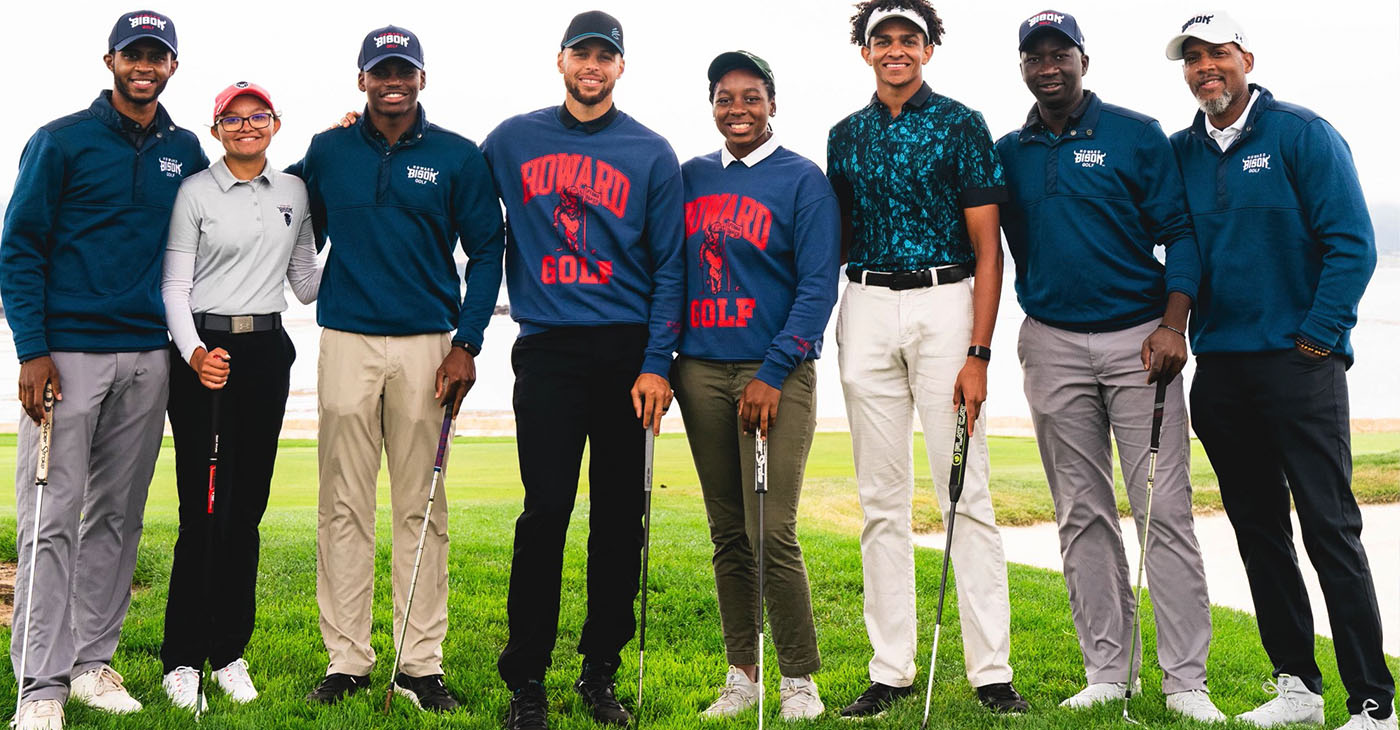
NBA all-star Stephen Curry, fourth from left, is surrounded by members of the program he created during the university’s fundraiser at the famous Pebble Beach Golf Course. From the left, Otis Ferguson, the former Howard student who asked Curry to fund a program, golfers Morgan Taylor, Everett Whiten, Curry, Kendel Abrams, Richard Jones Jr., Edrine Okong and team Coach Sam Puryear

You Might Be Surprised

By Gregory Smith, Howard University News Service

WASHINGTON – They are a diverse bunch.

Some are just eligible to vote. Many are not old enough to legally drink, while others are full-grown adults working on graduate degrees

Their hometowns and backgrounds are a microcosm of America and beyond — East Lansing, Michigan; Chesapeake, Virginia; York, Pennsylvania; Ellicott City, Maryland; Pearland, Texas; West Palm Beach, Florida; Memphis.

Four are from Chicago with a metro population of eight million people and one is from Suwanee, Georgia with just 16,000 souls.

Another calls home tiny Lugazi, Uganda, whose sports claim to fame is that in In 2012 its Little League baseball team qualified for the Little League World Series in Williamsport, Pennsylvania.

They have been drawn together to Howard University by three things; first, their love of golf, seven-time NBA All-Star Stephen Curry’s money and finally, to answer a question the sports world has been asking since 2019 when it was announced that Curry had donated $6 million over six years to Howard to create a golf program at a university that hadn’t competed in the sport in nearly 50 years.

Can a seed planted and cultivated at a historically Black university over time grow into a full-blown, competitive NCAA Division 1 program in an athletic endeavor that many don’t even consider a sport, even after Tiger Woods?

So far, the answer seems to be yes.

The team has equipment, uniforms, camaraderie, commitment, and talent and two golf teams, eight women on one and seven men on the other. So far, they already have posted wins and highly respectable first-year record in a sport season burdened by the coronavirus pandemic.

Additionally, the university raised an additional $3 million in July to support the program during its Bison at the Beach Golf Classic at Pebble Beach, California, golf course, the nation’s number one public golf course.

Curry made the commitment after then Howard student Otis Ferguson IV approached about the idea of a Howard golf program while Curry was screening a film he had made at Howard.

To begin the program, the university’s first step was to find an experienced leader who could build a program.

They hired Sam Puryear.

At Michigan State, Puryear became the first African-American head coach in a power five conference. He produced one national championship, one Big Ten championship, two coach of the year awards.

Prior to Michigan State, Puryear was an assistant coach at Stanford University, an intense program that attracted world-wide attention during Tiger Woods’ tenure.

Puryear said he expects to bring the winning pedigree to Howard

“My standards are the exact same,” Puryear said. “We want to find the best student athletes with the resources that we have available. Dealing with a champion like Curry could help us build something and go after the best players.”

Puryear is no stranger to HBCU golf. He graduated in 1992 from Tennessee State University where he was captain of the golf team. The team was led by Catana Starks, the first woman to coach a men’s golf program at the highest collegiate level.

“We want to build something that no one has seen,” Puryear said. “HBCU golf is getting stronger and better. I don’t feel pressured (by Curry or Howard) to win. All of the pressure that I have, I put on myself.”

Howard’s men’s and women’s golf team could have the same success as previous teams he has coached, Puryear said, which is why he reached out for Everett Whiten Jr.

Everett Whiten Jr., a junior majoring in marketing, received a call from Puryear just two days after he found out Hampton University discontinued their golf program due to budget cuts caused my COVID-19.

“We had only been home for a few days because of the pandemic when my coach called and said that the program had been cut,” said Whiten of Chesapeake, Virginia.

Whiten played multiple sports until 12 years old. His dad played golf and wanted him to play as well, but basketball had his heart. Whitten gave golf a chance in middle school and hasn’t looked back.

Since joining the university’s golf team, Whiten has finished in the top 10 at the Georgetown Invitational, top 15 at the Howard Invitational and won the Towson Invitational.

He credits much of his success to Puryear.

“Coach Sam is special,” he said. “At Hampton, I had a coach that went through the motion. Coach talks to us like we are one of his kids. We are really building a good culture for the next generation and I’m glad to be a part of it.”

Whiten got a chance to play golf with Stephen Curry during a fundraising event for the program.

“He’s a normal guy,” he said. “He came up to me and made a simple conversion like he was a Howard student himself. It’s exciting to see that he is invested into the program and not just financially.”

Puryear said he didn’t have much time to recruit after initially taking over the program, so during the recruiting process he targeted student athletes who were in the transfer portal.

Raquel Simpson, a sophomore majoring in political science from Chicago, said that she was committed to Hampton University, but had to look elsewhere once the golf program was cut due to the pandemic.

“Coach reached out to my parents, because he heard about what happened at Hampton,” Simpson said.

Simpson did not qualify to play in any tournaments this fall.

“I didn’t play as well as I hoped,” she said.” The regiment that coach has us on and the workouts with our trainer has me feeling prepared for the spring season.”

To get Simpson on track, she works out three days a week with the athletic trainer.

“On Tuesdays we work on lower body, Wednesdays is upper body, and Thursday is full body,” she said. “Other days we are expected to go to Woodmont Country Club, Argyle Country Club, or Woodmore Country Club to practice actual golf.”

Kendall Jackson, who says she has been playing golf since she was 6, sought to be part of Howard’s tea as soon as she heard about Howard as soon as she heard about NBA all-star Stephen Curry’s $6 million donation to start a golf program.

Kendall Jackson, who says she has been playing golf since she was 6, sought to be part of Howard’s tea as soon as she heard about Howard as soon as she heard about NBA all-star Stephen Curry’s $6 million donation to start a golf program.

Puryear said Curry’s financial support for the program attracted him to the head coaching job. Puryear said he has since found Curry is personally really invested into the program.

“The biggest thing is the support that Curry shows,” he said. “We have talked many times. He is a big supporter of the kids and actually wants them to play well.”

Justin Green, a first-year business management major, said golf is the main reason he came to Howard. The university wasn’t on his radar until he saw the donation from Curry, he said.

“My dad’s friend went to school with coach Puryear and that’s how we connected,” Green said. “I eventually came on a visit and continued to send my tournament result to him.”

Green has qualified and played in four of the five tournaments this season. He attributes his early success to hard work, the coach and his teammates.

“I use the donations from Curry as an opportunity,” he said. “We are really blessed because the coach has a lot of experience. He knows how to shape great golfers.”

In two seasons Puryear has had three athletes win an event.

Kendall Jackson, a first-year finance major from Pearland, Texas, said that she reached out to Puryear after learning about the donation from Curry.

Jackson said she has been playing golf since she was 6 years old and has always wanted to play at the collegiate level. In middle school, Jackson started going to the golf course every day and began playing in tournaments.

“I have always wanted to play golf at a HBCU,” she said.

Being the only child, Jackson was hesitant about attending Howard, because she wanted to stay closer to home.

After talking to Puryear and meeting some of her teammates, she was sold, she said. Jackson said that there is a small ounce of pressure with all the eyes on the program.

“I feel pressured slightly, but it’s more of a responsibility to be good,” she said. “The chemistry between us is good. We live together, have team bonding outside of golf, and support one another.”

Continue Reading

SIGN UP TO RECEIVE NEWS UPDATES IN YOUR INBOX

Subscribe

* indicates required

Like BlackPressUSA on Facebook

Advertisement

Advertise on BlackPressUSA

advertise with blackpressusa.com

Latest News