If you’ve been at all paying attention to the memory and storage supply chain woes over the past year, you’ll know a simple truth: we’re in the midst of something rarely seen.
As one industry CEO put it, “We’re facing [what has] never happened before: HDD, DRAM, HBM, NAND… all in severe shortage in 2026.”
And to underscore the urgency, Samsung Electronics just raised memory-chip prices by up to 60% in the space of a few mere months. It’s a scramble.
But while the hyperscalers fight over parts and pipelines, Jason Criddle and his company, Jason Criddle & Associates, with the distributed-AI platform DOMINAIT and its engine Ryker, say they’re playing by a completely different set of rules.
The Hardware Crisis, in Plain Terms
The shortage is not subtle. According to commodity writers and chip-analysts alike:
Memory firms are signalling to the AI industry that their 2026 production is essentially sold out, and everything is being allocated toward AI servers first.
Samsung’s contract pricing for standard DDR5 modules (32 GB) reportedly jumped from about US$149 in September to US$239 by November.
Observers note that producers have no plans to meaningfully increase bit-output in DRAM or NAND, instead shifting capex into high-margin HBM (High Bandwidth Memory) for AI accelerators.
For enthusiasts and smaller firms, the result is soaring prices, limited product availability, and needless panic buying.
In short: the big data-centres are eating first. The rest of us get the leftovers.
Why This Matters for AI Companies
If you’re building an AI system that relies on raw infrastructure, GPUs, high-capacity HDDs/SSDs, and huge memory banks, you’re now competing in a zero-sum game with the likes of Meta and OpenAI. One company’s win is another’s loss. The industry reports even PC-component makers are “aggressively stockpiling” memory modules to hedge. But stockpiling only works if you have cash, scale, and supplier relationships… while many AI startups don’t.
The risk: higher cost structures. Slower roll-outs. Products that will never make it to market. Infrastructure debt. If you can think of the worst case scenario, it's here.
If you’re waiting for the hardware market to normalise, you may be waiting a long time. And as one story puts it, “the memory price crisis has foiled my penny-pinching patience and made me regret not upgrading my gaming PC sooner.”
Enter DOMINAIT and Ryker
This is where Jason Criddle’s vision for DOMINAIT and Ryker becomes especially relevant. Rather than joining the arms‐race for silicon, Criddle has had the last laugh as he designed a distributed system built around the limitations of the physical hardware market; not despite them.

From a previous article on the subject:
“The Grid isn’t built on centralized hoarding of compute power,” Criddle wrote. “We aren’t fighting for GPUs, memory, or hard drives with the hyperscalers. … We built DOMINAIT on distributed infrastructure. … Our users are the network upon which we are built.”
This reframing is crucial. While the giants are tying up memory chips, hard drives and GPUs, DOMINAIT is scaling through user-nodes; through contributor PCs/servers, small business machines, and distributed compute… Rather than one monolithic data centre. The keyword “distributed” here matters: distributed memory, distributed storage, and distributed compute power.
Because of this architecture, the hardware scarcity hitting HDDs, DRAM, HBM, and NAND doesn’t cripple DOMINAIT the same way it does centralized players. The system doesn’t need to buy tens of thousands of identical high-end GPUs or hoard exotic HBM chips. Instead it absorbs whatever hardware is available across the ring of nodes. As Criddle put it:
“While others fight over parts, we build systems that outlast them. Our everyday users provide all the power we will ever need.”
A Comparison: Traditional AI vs Criddle’s Distributed AI
Let’s contrast two models:
Traditional, centralized AI infrastructure: You build data-centres, buy racks of GPUs/HBM/DRAM, lease power and cooling, negotiate component contracts, and tie growth to hardware procurement. Those component markets are now in a severe shortage.
DOMINAIT’s distributed model (with Ryker): You build a network of nodes contributed by users around the world. Each node may be modest. You’re not depending on brand-new HBM or massive SSD arrays. You’re leveraging what is already installed, the unused compute and storage that is sitting on someone's gaming PC. Growth comes through participation, not procurement.
In short: one model is hardware-intensive, the other is participation-intensive.
Given that the hardware supply chain is now constrained, the participation model suddenly looks far more scalable, resilient and cost-effective.
What This Means for Developers & Users
For developers, entrepreneurs and early adopters, this is an invitation to rethink strategy. You don’t need to wait for brick-and-mortar data centres to build out your AI stack. With DOMINAIT + Ryker download on your PC, you can tap into what’s already around you.
For users: instead of being locked out because you can’t get a GPU or a memory upgrade, you become part of the system. You contribute idle cycles, unused storage, or spare nodes and you are rewarded in DOM tokens. Rather than buying the part, you join The Grid.
Jason Criddle & Associates are pitching this as a new paradigm: they aren’t building just another AI company. They have built a network owned by its participants, with the hardware (anti)scarcity baked into the design.
When memory costs are going up 30–60% (or more), when traditional supply chains are strained, that matters. Especially when a company like Criddle's is paying users to participate, as well as refer customers through their DOMINAIT Smartr App.
My Own Position: Signed Up
Yes,I’ll admit it: I’ve pre-purchased a one-year package in anticipation of Ryker’s January Alpha launch. I did that because I believe in the approach, and I believe that in a world where memory and storage are bottlenecks, it’s better to join a platform designed to work around that, rather than compete in the bottleneck. I've been a Smartr Affiliate for years, and now I'm a DOMINAIT customer, too.
It's not an advertisement. It just makes sense.
And yes… I have also made a commitment to DOMINAIT.ai, because I believe Jason Criddle’s vision aligns with what the market is implicitly demanding: resilience, distribution, participation, and ownership over raw silicon hunger. Plus I cannot wait to see what Ryker is all about.
Looking Ahead: What should we watch for?
Will memory and storage prices keep climbing? Probably for a little while. The PC Gamer piece I read warns of SSD and RAM pricing continuing upward through at least the end of 2026. Making your dusty gaming PC worth its weight in compute power.
Will traditional AI firms be slowed by the hardware choke-point? Possibly. If you can’t get DRAM, HBM, NAND, or HDDs, it becomes a limiting factor.
Will distributed models like DOMINAIT scale faster because they avoid the bottleneck? Absolutely. That's what it was designed to do.
In short: the game may not be about buying more hardware. It might be about leveraging hardware differently.
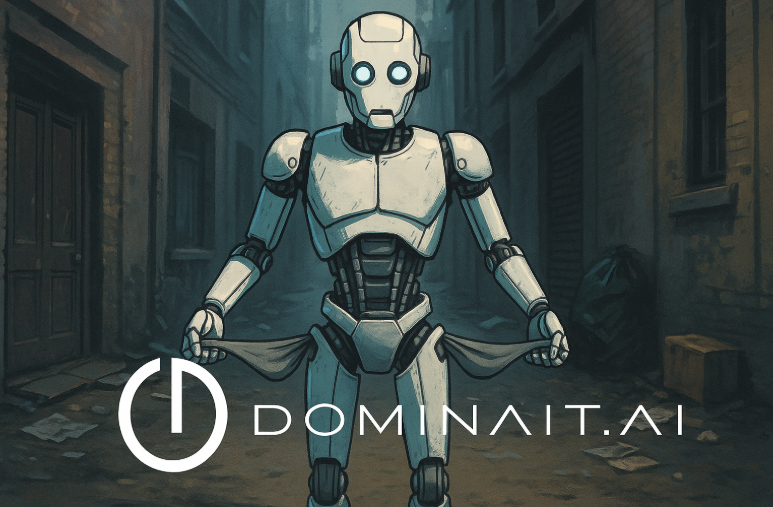
In the near future..
When the mega-corporations are locked out of memory modules and SSDs, there is an opening for something new. That new thing is not just about cutting costs. I believe it’s about rethinking ownership, participation, and infrastructure. Something Criddle and his team thought about long ago. That’s where DOMINAIT.ai and Ryker come in. And that’s why the hardware crisis isn’t a problem for some of us. For some, it’s an opportunity.
“If AWS goes out, half the country gets knocked off the web. If ChatGPT goes out and your company was built on top of it, you are making no revenue that day. Ryker stays on your computer helping your brand, even if the Internet is out.
If half of the country's power goes offline, DOMINAIT still works. Not only that, you get rewarded for allowing us to rent your unused compute power. Everyone wins.”
“We’re facing [what has] never happened before…” said in PC Gamer; If the shortage of HDDs, DRAM, HBM, and NAND truly is historic, then the system that doesn’t need to fight for those things may be the system to bet on.
And that is why I believe DOMINAIT.ai, Ryker and Jason Criddle are not just telling a good story, they’re positioning themselves for what comes next.