
Religion
In Islam, a Long Tradition Against Depicting the Prophet


Flowers and pens and placards lie after being placed to show solidarity with those killed in an attack at the Paris offices of weekly newspaper Charlie Hebdo, in Trafalgar Square, London, Thursday, Jan. 8, 2015. Masked gunmen stormed the Paris offices of a weekly newspaper that caricatured the Prophet Muhammad, methodically killing 12 people Jan. 7, including the editor, before escaping in a car. (AP Photo/Kirsty Wigglesworth)
HAMZA HENDAWI, Associated Press
CAIRO (AP) — It’s not mentioned in Islam’s holy book, the Quran, but the religion’s ban on depicting the Prophet Muhammad — even favorably — has run firm through the centuries.
Religious traditions built over the years have prohibited such depictions out of respect for Muhammad and to discourage idolatry, according to Muslim scholars and clerics. The ban is further rooted in a wider prohibition against images or statues of human beings.
There have been exceptions. A rich tradition of depicting Muhammad emerged in miniatures and illustrations for manuscripts from around 1200 to 1700. The art is mainly from Turkey and Iran, where pictorial traditions were stronger than in the Arab world. The paintings often show traditional stories from Muhammad’s life, such as his journey to heaven, though in some the prophet’s face is obscured by a veil or a plume of flame.
Shiites also differ from Sunnis by depicting Muhammad’s son-in-law Ali, revered by Shiites who see him as the prophet’s rightful successor. His image — and those of his sons Hassan and Hussein — are plentiful among Shiites, adorning posters, banners, jewelry and even keychains. For Sunnis, the ban on depictions extends beyond the prophet to his close companions and wives.
“The Prophet Muhammad enjoys sublime and supreme status among Muslims and it is impossible to let a normal person depict or act the role of the prophet,” said Iraqi Shiite cleric Fadhil al-Saadi. “There is no confirmed information about the shape or the features of the Prophet … So nobody should come up with a painting or an image of him. That would represent an insult to the status of the prophet.”
With no explicit text against depictions — or against images of humans in general — the prohibition comes from deduction by Muslim scholars and interpreters over the centuries from the collections of Hadeeth, or sayings and actions of Muhammad.
The prohibition against depicting humans and other living beings, which emerged from scholars as early as the 9th century, came from reported sayings of Muhammad, in some of which he refused to enter a room with such depictions or challenged their creators to breathe life into them. The presumption was that such art would suggest man can emulate God’s powers of creation — and there were worries that statues in particular could encourage idolatry.
Islamic tradition is full of written descriptions of Muhammad and his qualities — describing him as the ideal human being. But clerics have generally agreed that trying to depict that ideal is forbidden. That puts satirical — and obscene — depictions like those in the French magazing Charlie Hebdo far beyond the pale.
While no one knows Muhammad’s true appearance, followers of the relatively modern, ultraconservative Salafi movement in Islam seek to emulate him as closely as possible — including in what they believe to be his physical features and dress. Hardcore Salafis wear a beard without a moustache, let their hair grow long, line their eyes with kohl or wear robes stopping around mid-shin, contending that was the prophet’s manner.
The ban also extends to his wives, daughters, sons-in-law, the first caliphs who succeeded him and his closest companions. In fact, Egypt’s al-Azhar mosque, the Sunni world’s foremost seat of religious learning, has complained when “Mohammed, Messenger of God,” an epic 1970s Hollywood production, depicted the prophet’s camel.
There is a thriving production of religious TV series in the Arab world depicting the times of the prophet. But Muhammad and his companions are never themselves shown. At times, a white light stands in for Muhammad in the films or in movie posters — and when they are meant to be addressing Muhammad, the actors usually speak into the camera.
Copyright 2015 The Associated Press. All rights reserved. This material may not be published, broadcast, rewritten or redistributed.


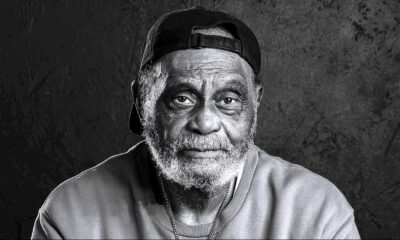

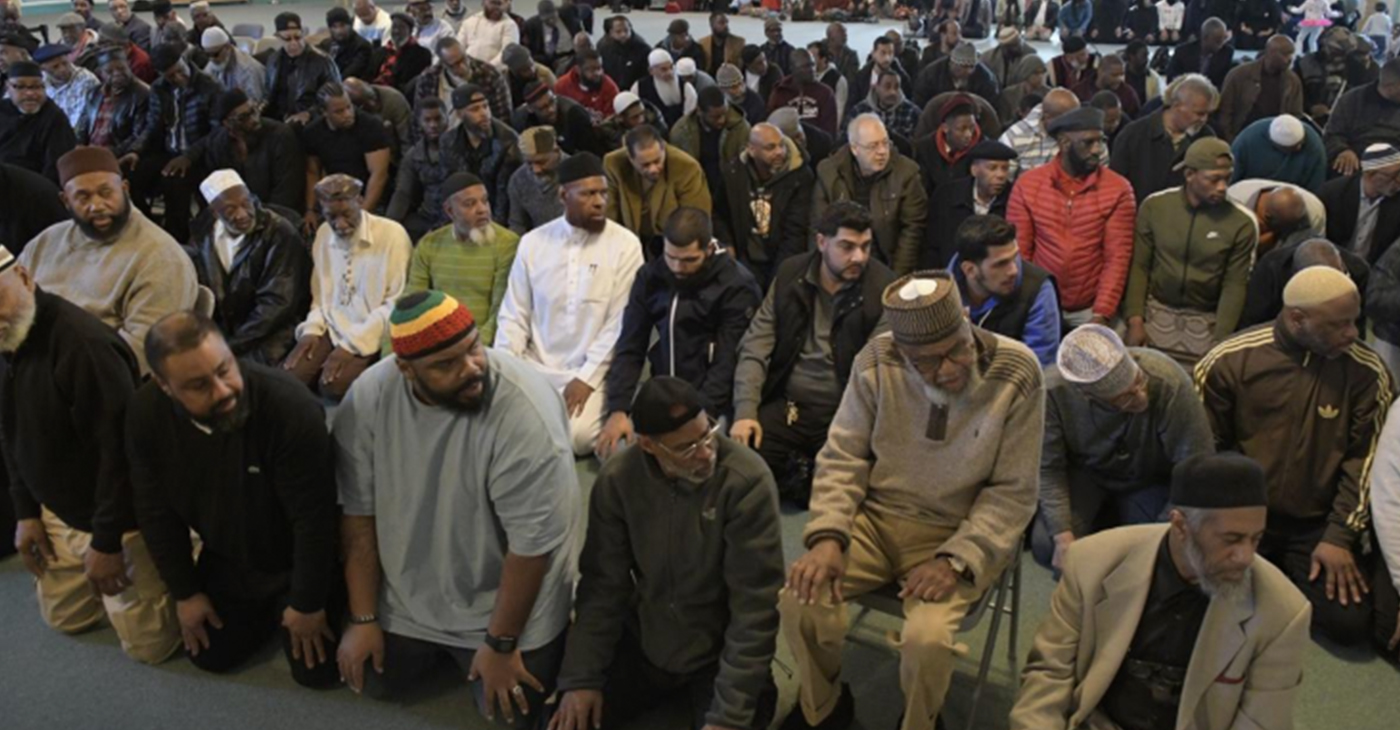
![Library of Congress description: "H. Rap Brown, SNCC [i.e., Student Nonviolent Coordinating Committee], news conference]" (Wikimedia Commons / Photo by Marion S. Trikosko)](https://blackpressusa.com/wp-content/uploads/2025/11/1124-H-Brown-400x240.jpg)
![Library of Congress description: "H. Rap Brown, SNCC [i.e., Student Nonviolent Coordinating Committee], news conference]" (Wikimedia Commons / Photo by Marion S. Trikosko)](https://blackpressusa.com/wp-content/uploads/2025/11/1124-H-Brown-80x80.jpg)



Black Press
COMMENTARY: But God!
THE POSITIVE COMMUNITY — Reverend J. Loren Russell discusses the concept of unmerited grace, drawing from Ephesians 2:1-10 CEV. The passage highlights that humanity was once separated from God due to sin, following worldly ways and selfish desires, which made them deserving of punishment.
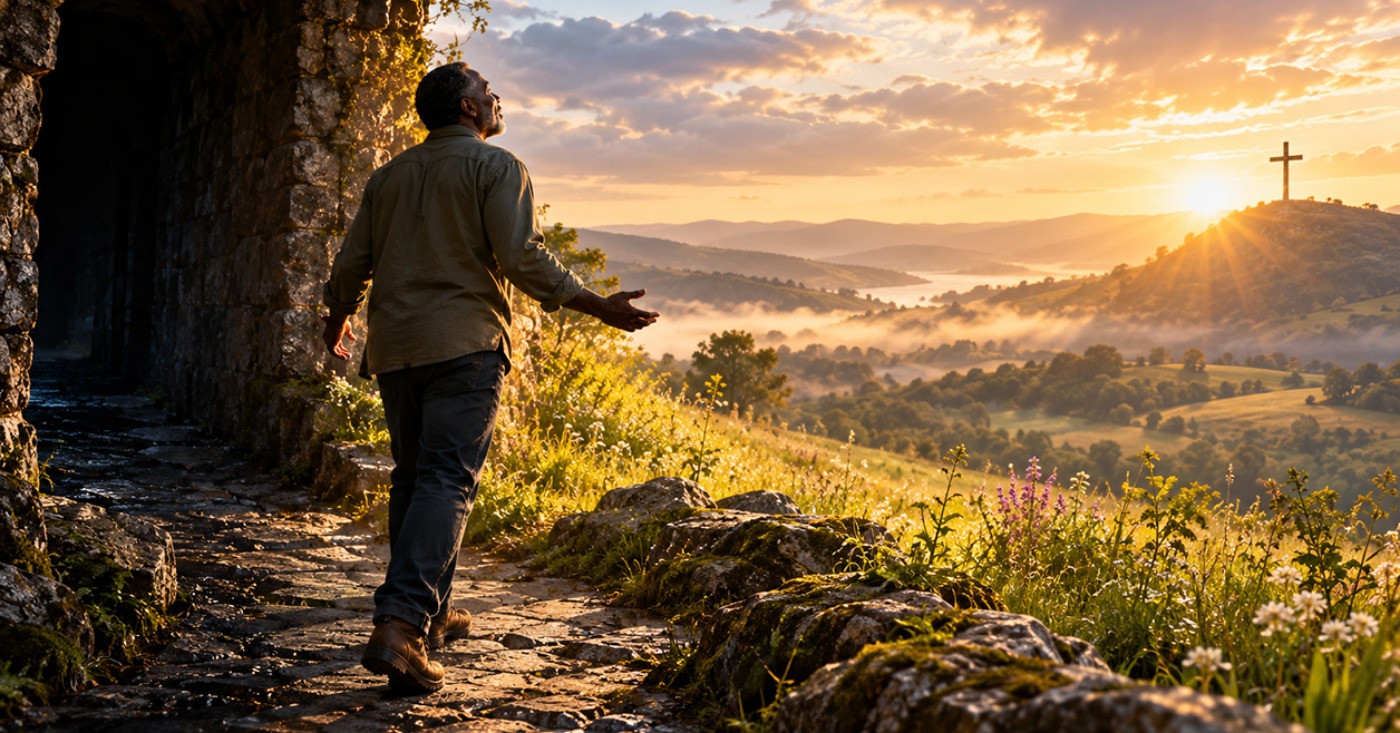
Ephesians 2:1–10 CEV
“In the past you were dead because you sinned and fought against God. You followed the ways of this world and obeyed the devil. He rules the world, and his spirit has power over everyone who doesn’t obey God. Once we were also ruled by the selfish desires of our bodies and minds. We had made God angry, and we were going to be punished like everyone else. But God was merciful! We were dead because of our sins, but God loved us so much he made us alive with Christ, and God’s gift of undeserved grace is what saves you. God raised us from death to life with Christ Jesus, and he has given us a place beside Christ in heaven. God did this so in the future world he could show how truly good and kind he is to us because of what Christ Jesus has done. You were saved by faith in God, who treats us much better than we deserve. This is God’s gift to you, and not anything you have done on your own. It isn’t something you have earned, so there is nothing you can brag about. God planned for us to do good things and to live as he has always wanted us to live. This is why he sent Christ to make us what we are.”
If it were not for the love of God, none of us would be worth anything. In fact, we would be walking dead, looking for a grave to lay down in.
These are not my words. Paul tells the Ephesian church that we were all dead because of our sins. But God brought us to life through His undeserved grace. In other words, we did not then, and we do not now, deserve His grace. The reason we were then, and are now, eligible to be made alive is not because we deserve it, but because the Lord is truly good and kind to us because of what Christ Jesus has done.
Notice the conjunction, or antithesis, “but.” It serves as a directional signal. It changes the direction of the conversation and points us toward unmerited favor. We were dead—but God! We were sinners—but God! We were undeserving—but God! We were headed in the wrong direction—but God!
Although we do not deserve God’s grace, He extends it to us anyway. The Apostle John told us, “For God so loved the world that He gave His only begotten Son, that whoever believes in Him should not perish…” And here we go again—“but” has everlasting life.
That “but” symbolizes God’s grace, God’s favor, and God’s love for undeserving people who, by no merit of their own, are pardoned in this life and given a place in the Lord’s Kingdom yet to come.
When we see or say “But God,” it should force us to recognize both our unworthiness and the Lord’s sovereignty over all things—including us. The truth is that we cannot take credit for what only God could do. We didn’t save ourselves and we didn’t earn His grace. We didn’t deserve His mercy. But God!
I don’t know about you, but I thank God every day for the opportunity to look at my own life and say:
“BUT GOD!”
If God has ever stepped into your situation and changed the direction of your story, you ought to be able to say it with me:
BUT GOD!
Be Blessed!
Rev. J. Loren Russell is an associate minister at Goodwill Baptist Church and is the clergy officiant of the Evangelical Church of God, all in the Bronx, President/CEO of The JLR Company for Church Financial & Strategic Consulting (718-328-8096), and hosts “Matters of Faith – The Radio Show” on Monday nights from 8:00 – 10:00 PM on Facebook Live. Be sure to Friend “Matters of Faith” on YouTube and email us at [email protected]. Order your copy of Matters of Faith: The eBook at www.smashwords.com/books/view/993177.
Based on reporting by The Positive Community.
Black History
Baptist Minister Says Black Church Champions for Civil Rights to Reign but Hesitates to Let Black Women Lead
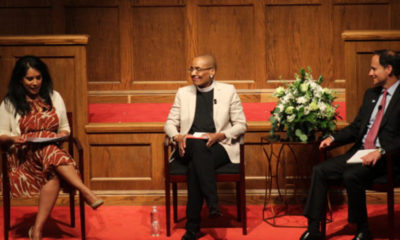
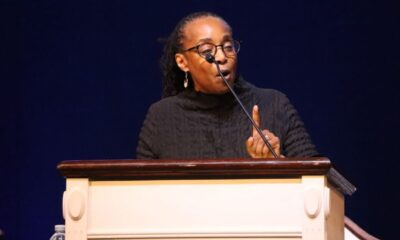
HOWARD UNIVERSITY NEWS SERVICE — During a recent service at Howard University’s Andrew Rankin Memorial Chapel, Rev. Judy Fentress-Williams called on the Black church to be more steadfast in elevating Black women to the pulpit. The renowned biblical scholar noted that while she experienced less pushback in her specific context, many women delay answering a call to ministry due to a lack of acceptance for women in leadership roles.
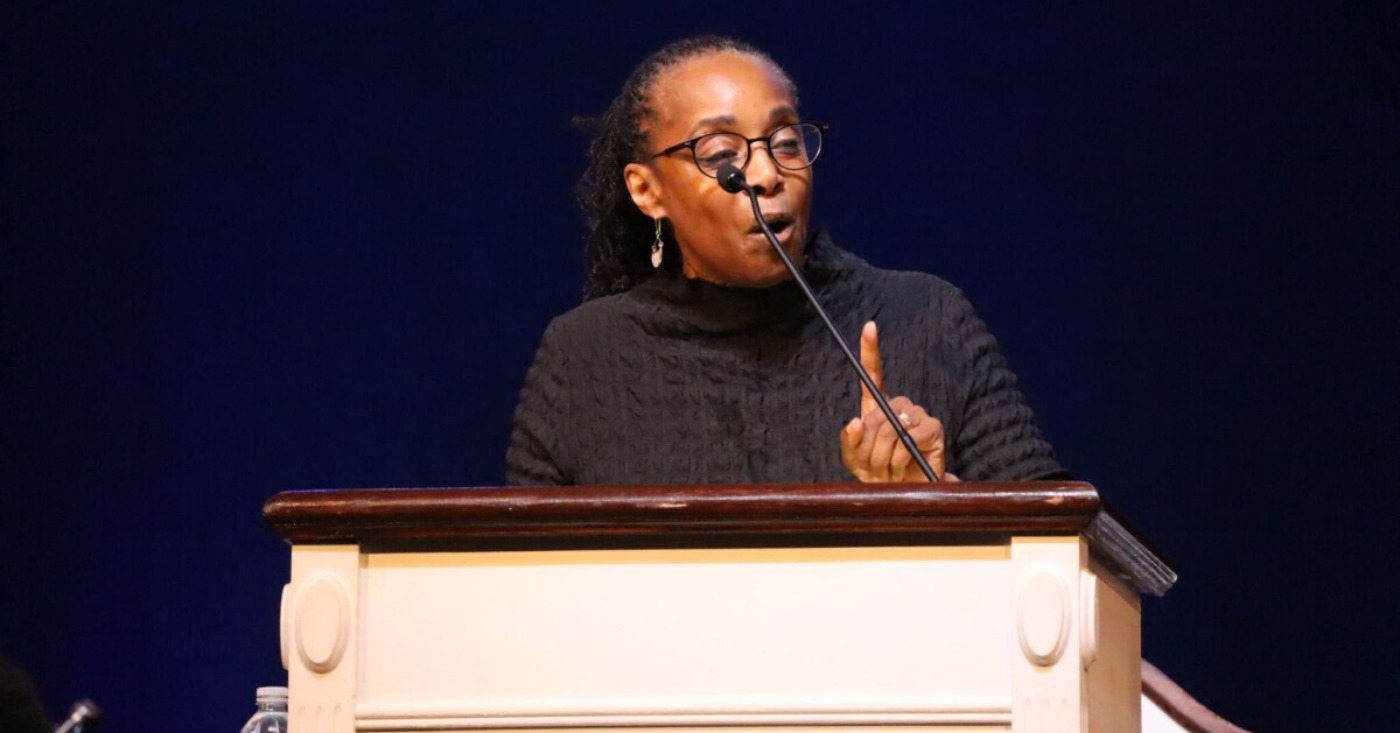
WASHINGTON (HUNS) – On the second Sunday service of the semester at the Andrew Rankin Memorial Chapel at Howard University, Rev. Judy Fentress-Williams, called on the Black church to be more steadfast in its efforts to elevate Black women to the pulpit.
On August 30, the renowned biblical scholar and senior teaching assistant of the Alfred Street Baptist Church in Alexandria, Virginia, spoke on the Biblical parable of the mustard seed with her sermon titled “Think Small”. Her sermon urged young people not to abandon their purpose in pursuit of accolades, but instead to pursue freedom and belonging without having to prove themselves. This sentiment is difficult for Black women who want to become senior leaders.
“Because of the unique context that was Alfred Street Baptist Church, I didn’t get pushback because I was a woman,” Rev. Fentress-Williams said. “What I will say is that I think I was slow to answer my call to ministry, and that’s typical for many women. Many women hear a call to ministry and say, no, that’s called a teacher.”
Despite teaching for 20 years, her journey into ministry illustrates the lack of acceptance for women to fully pursue their calling.
According to the Pew Research Center, 73% of Black adults identify as Christians (65% being Protestant, 4% being Catholics, and the other 4% associated with the Church of Jesus Christ of Latter-day Saints and Jehovah’s Witnesses). However, Black women who make up 64% of congregations within the Protestant faith only account for 1% of senior leadership.
The disparity highlights how the Black church remains patriarchal in its authority. Rev. Kelly U. Farrow, founder of the Circle of Sacred Fire, a non-profit initiative that connects the 1% and dismantles those patriarchal beliefs.
Since 2018, the organization has curated teachings in sermon design and sisterhood for Black women. The organization has 58 circles nationwide, including collegiate chapters.
“[It] is critical because representation matters. We need to see every diversity, every gift, every voice, every shade, every age group in leadership at this time. Without representation, we are only singing and sharing half the song.” Rev. Farrow said.
Representation remains critical for younger generations already experiencing the pushback. Andrea Pool, president of Howard’s Community Gospel Choir, says being a young woman holding the highest position in the organization has made others question her ability to lead.
“I think coming to D.C. definitely just exposed me to a lot because with me being raised by people who were in the church, with my mom being a minister,” Pool said. “I didn’t realize there was another world out there that didn’t appreciate having females in leadership.”
The choir forges an acceptance of many Christian beliefs amongst members to stand on biblical principles. However, Pool is adamant about leaning on women leaders, like her mother, to remind her that identity and relationships alone are not what will make her a great leader.
“I think women in leadership can take younger generations, honestly, everywhere. I think in [the] church it is important to understand that men aren’t the only people who can lead. They aren’t the only people who can bring people to Christ.” Pool said.
Based on reporting by Howard University News Service.
Black History
IN MEMORIAM: The Rev. Leon “Sonny” Clark, Longtime Orange County Pastor and Community Leader, Dies at 72
Rev. Leon William “Sonny” Clark, the longtime pastor of New Spirit Baptist Church in Santa Ana and a prominent faith and community leader in Orange County, passed away on September 9 at the age of 72. Born in Bennettsville, South Carolina, Clark was a U.S. Navy veteran who dedicated his life to service. He served various Southern California churches before leading New Spirit Baptist Church for over 22 years, extending his work into counseling, mentoring, and civic engagement, and supporting the African American community. To learn more about his life and contributions, read more.
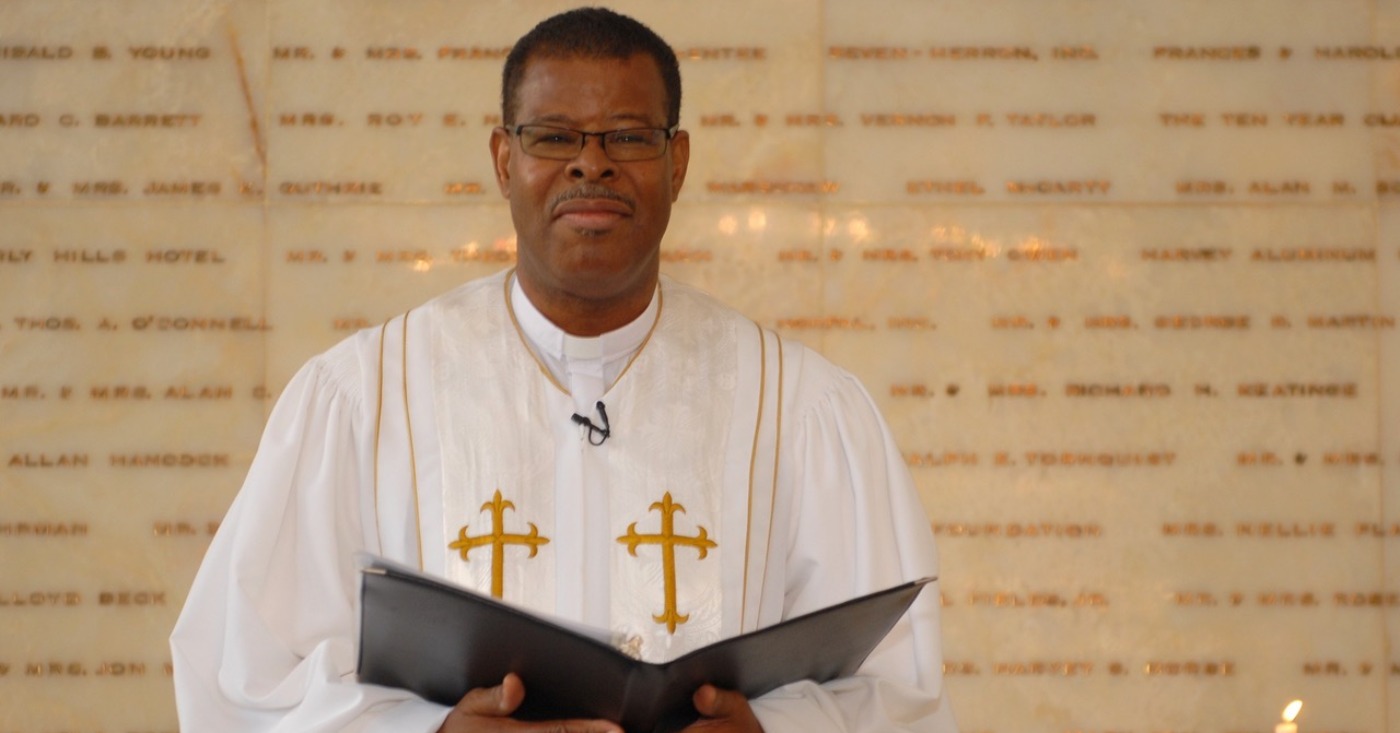
Rev. Leon William “Sonny” Clark, longtime pastor of New Spirit Baptist Church in Santa Ana and a respected faith and community leader in Orange County, died Sept. 9. He was 72.
Born Oct. 2, 1953, in Bennettsville, South Carolina, Clark was a U.S. Navy veteran who later built a life of service centered on family, faith, ministry, and community.
Clark began his formal ministry at Metropolitan Baptist Church in Altadena in 1978. After acknowledging his call to ministry in 1980, he preached his first sermon and went on to serve churches throughout Southern California, including Second Baptist Church in Riverside, Mount Vernon Baptist Church in Rubidoux, Antioch Missionary Baptist Church in Pomona, and Friendship Baptist Church in Yorba Linda.
In November 2003, Clark was called to lead New Spirit Baptist Church in Santa Ana, where he served as pastor for more than 22 years. His work extended beyond the pulpit through counseling, mentoring, civic engagement, and efforts to strengthen Orange County’s African American community.
Clark served on the Orange County Heritage Council and supported efforts to preserve and celebrate African American history and culture. He helped organize the Orange County Black History Parade and Unity Festival, served on the Interfaith Committee and the Orange County Transit Authority, and served as president of the Orange County Ministers Conference.
In 2024, the City of Santa Ana recognized Clark for his contributions to the community. He also received the Orange County Southern Baptist Association Hall of Faith Award and was previously honored as Pastor of the Year by the Orange County Heritage Council.
Clark is survived by his wife, Andrea Joyles Clark; six children, Shawn Williams, Le Ondra Clark Harvey, Kyla Coward, Joshua Clark, Marissa Clark and Ashley Clark; grandchildren and great-grandchildren; siblings; extended family; and the New Spirit Baptist Church congregation.
A wake will be held Thursday, Oct. 1, from 4 to 8 p.m. at New Spirit Baptist Church, 701 S. Sullivan St. in Santa Ana, with a remembrance service from 5 to 6:30 p.m.
A Celebration of Life will be held Friday, Oct. 2, at Friendship Baptist Church, 17145 Bastanchury Road in Yorba Linda. Viewing begins at noon, followed by the service at 1 p.m.
Burial will take place Monday, Oct. 5, at 10:15 a.m. at Riverside National Cemetery.
Clark often shared a guiding principle that shaped his ministry: “Start where you are. Use what you have. Do what you can.”
Black History
In Wake of Death on Doorstep, Williams Chapel Baptist Church Calls for Better Care, Funding for Unhoused
An unhoused individual was found deceased on the steps of Williams Chapel Baptist Church in East Oakland at approximately 6:30 a.m. Monday. The church, located at 1410 10th Ave., extended condolences to the individual’s family, noting the tragedy reflects a broader crisis. Williams Chapel Baptist Church provides shelter and referral services, working with West Side Missionary Baptist Church. They call for increased funding and collaboration to expand services for unhoused individuals. Read more to learn about the church’s efforts and the call for solutions.
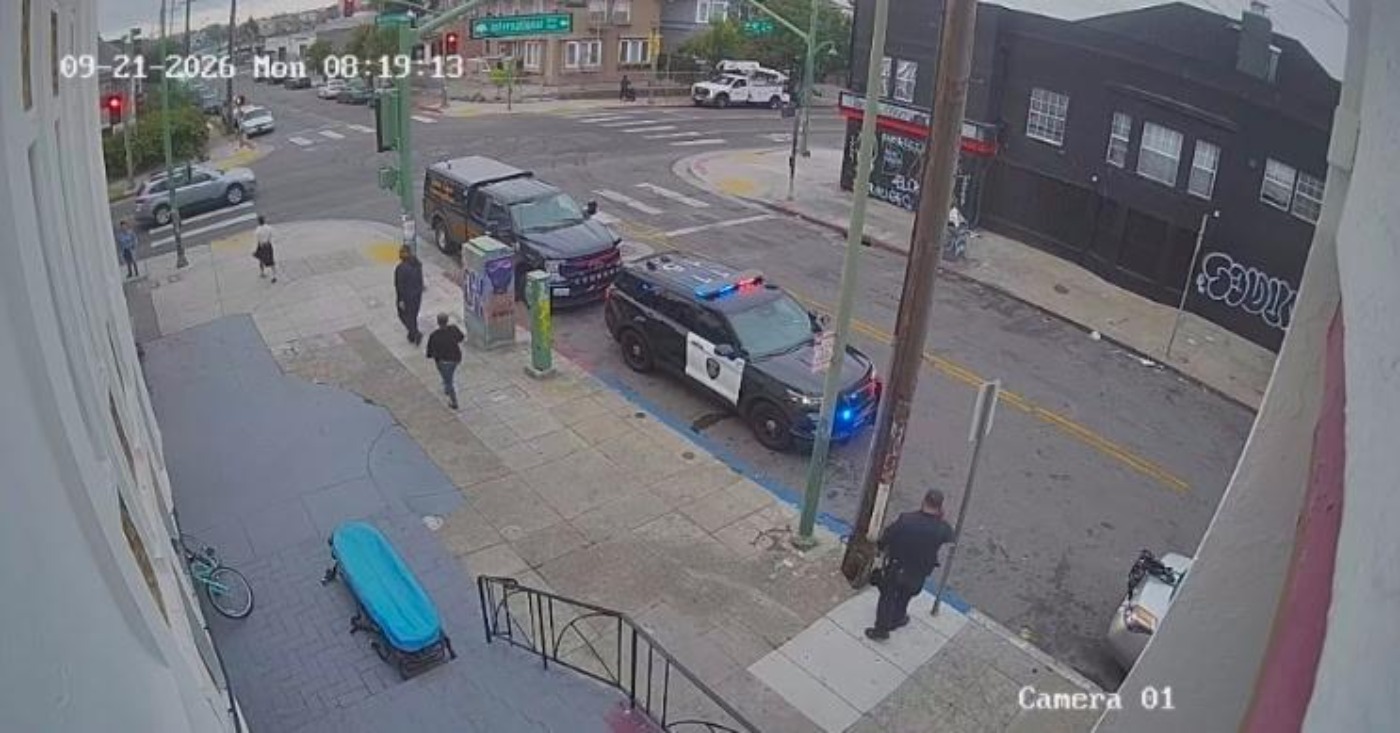
Church extends condolences to individual’s family and loved ones
At approximately 6:30 a.m. Monday, an unhoused individual was found deceased on the steps of Williams Chapel Baptist Church, located at 1410 10th Ave. on the corner of 10th and International in East Oakland.
The individual appears to have come to the church seeking safety and may have needed medical support. We extend our deepest condolences and prayers to the individual’s family and loved ones.
This tragedy reflects a broader crisis affecting unhoused individuals and families throughout the Bay Area. Too many people are living without reliable shelter or timely access to medical care, mental health support, and other essential services. Limited funding and insufficient resources continue to leave vulnerable people without the help they need.
Williams Chapel Baptist Church, a member of the Interfaith Council of Alameda County, works alongside West Side Missionary Baptist Church to provide safe-haven overnight parking, tiny-home emergency shelter, and wraparound referral services to the unhoused.
With funding, both East and West Oakland sites can increase to full capacity and extend to other congregations, creating more safe places for people living on the streets to seek shelter, support, and connection to services.
We invite government agencies, nonprofit organizations, interfaith communities, businesses, and neighbors to join us in this work. By working together with compassion and purpose, we can develop meaningful solutions and help more people experiencing homelessness receive care, stability, and dignity.
Black History
Nuna Phillips-McKee Celebrates 100 Years: ‘A Century of Faith, Family and God’s Amazing Grace!’
OAKLAND POST — Nuna’s life has been one of Christian service. A longtime member of Wings of Love Maranatha Ministries, now Incredible Church, she serves as director of Community Services and is actively involved in the church’s Food Ministries.

Nuna Phillips-McKee will reach an extraordinary milestone on Sept. 24 —her 100th
birthday, marking a century filled with faith, family, service, laughter and the amazing grace of God.
Born Sept. 14, 1926, in Oakland, Nuna has witnessed a world of change during her lifetime, yet the values that have guided her remain constant: a deep faith in God, devotion to family, a strong work ethic and a heart for serving others.
She enjoyed a distinguished career as a civil servant for more than 40 years, demonstrating the dedication, dependability and strength that have characterized so much of her life.
Nuna’s life has been one of Christian service. A longtime member of Wings of Love Maranatha Ministries, now Incredible Church, she serves as director of Community Services and is actively involved in the church’s Food Ministries.
Through the years, she has continued to help meet the needs of others—not merely with food, but with kindness, compassion and a genuine desire to serve. Her ministry reflects a simple principle by which she lives: when God blesses you, you bless others.
Nuna is the proud mother of one son, whose memory she carries in her heart, and the beloved grandmother of three grandchildren, as well as six great-grandchildren and one great-great-grandchild.
At 100, she has the rare blessing of seeing several generations of her family carrying forward a legacy that began long ago.
She remains the loving, intelligent, witty, and, when the occasion calls for it, delightfully sassy Nuna that her family and friends know so well. Her contagious laugh, quick wit and youthful spirit have endeared her to generations of relatives, church members and friends.
Nuna was born into the large and loving Phillips family of seven sisters and one brother, with bonds that formed in childhood and have remained precious throughout the decades. Their shared love, faith, and family traditions have continued to be a source of joy, strength and countless treasured memories.
As family and friends gather for this special occasion, they will celebrate far more than a number. They will celebrate 100 years of prayers prayed and answered; 100 years of lessons learned and wisdom shared; 100 years of family, faith, laughter and love; 100 years of serving God and serving others.
Most of all, they will celebrate a life that stands as a testimony to God’s faithfulness through every season.
Nuna’s century-long journey can be summed up in the words chosen to commemorate this remarkable occasion: “100 years of God’s amazing grace.”
Black History
PRESS ROOM: Faith & Works Launches ‘Road to Black November’ to Strengthen Black Voter Participation in Jefferson County
BLACKPRESSUSA NEWSWIRE — Road to Black November will bring together residents, volunteers, community leaders, civic and social justice organizations, local influencers and content creators around one shared goal: increasing Black voter participation in Jefferson County ahead of the November 3 General Election.

September 12 kickoff will unite residents, volunteers, community leaders, organizations, and local influencers for a 52-day nonpartisan Get Out the Vote initiative
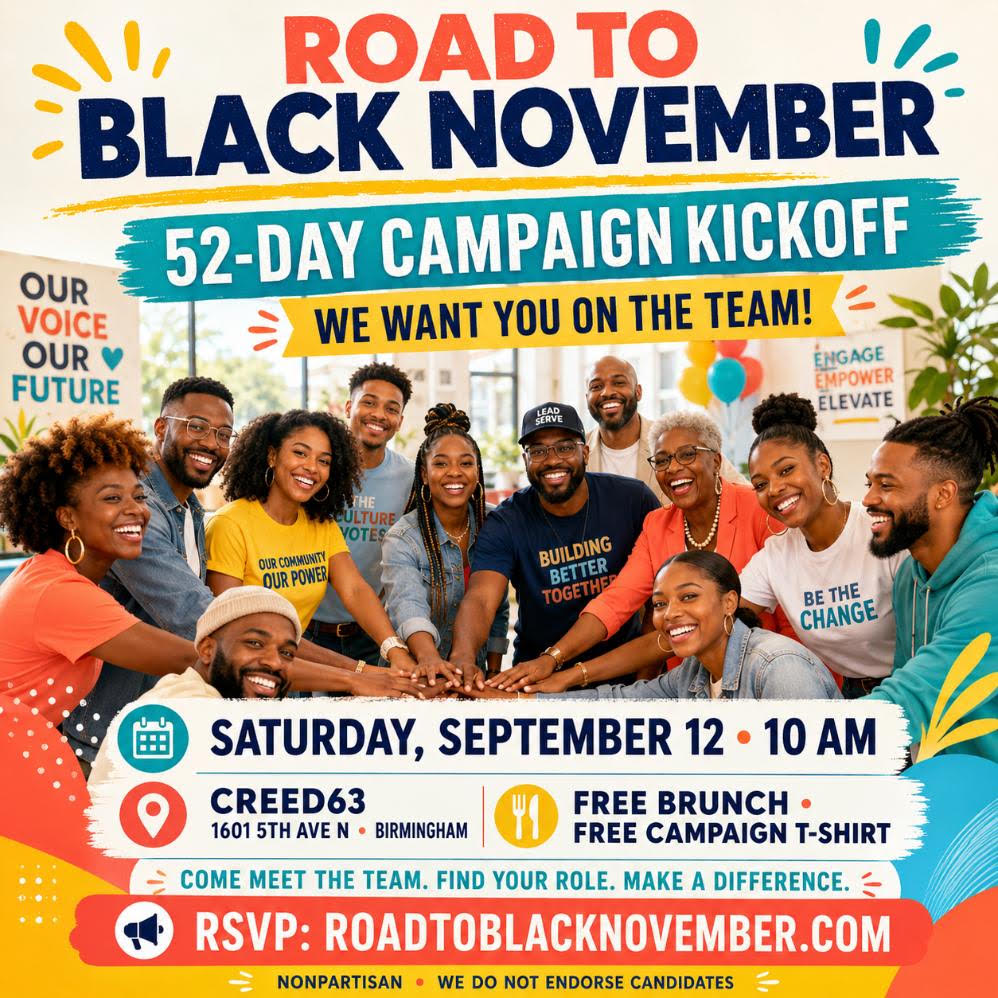
BIRMINGHAM, Ala. — Faith & Works Collective presents ReVote Community Voter Project will launch Road to Black November, a 52-day nonpartisan voter-participation initiative, with a community kickoff on Saturday, September 12, from 10:00 a.m. until 2:00 p.m. at Creed63, located at 1601 Fifth Avenue North in downtown Birmingham.
Road to Black November will bring together residents, volunteers, community leaders, civic and social justice organizations, local influencers, and content creators around one shared goal: increasing Black voter participation in Jefferson County ahead of the November 3 General Election.
Faith & Works’ data identified more than 9,000 Black residents who are inactive or have been dropped from the voter files in the Jefferson County communities. The initiative is working to reach thousands of additional residents who may need to register or update their information. Road to Black November will help residents check their voter status, register to vote, and prepare to participate in democracy.
Road to Black November is not about telling people who to vote for or encouraging support for any candidate or political party. It is about increasing Black voter turnout by helping residents make sure they are registered, active on the voter file, informed, and prepared to vote.
“More than 9,000 Black residents in the communities we are working to reach have been identified as inactive or dropped from the voter file. That means thousands of our neighbors may believe they are ready to vote when they are not,” said Cara McClure, founder and executive director of Faith & Works Statewide Collective. “Democracy requires all of us to participate—and all of us to put in the work. You may not want to canvass or phone bank, but you can still make a difference. We will train you in relational organizing and give you the language and tools to reach your family, friends, church members, and neighbors. Everyone has a role in helping our community get ready for Black November.”
The free kickoff will include food, fellowship, voter-engagement tools, and volunteer training. Participants can choose how they want to contribute through canvassing, phone banking, voter-registration outreach, voter- status checks, relational organizing, community events, or online engagement. The kickoff will also begin a Week of Action from September 12–20, during which participants will work together to reach Jefferson County residents and invite others to become involved in the voter-participation initiative.
Participants may RSVP through September 11 at www.RoadToBlackNovember.com. Beginning September 12, the same website will become the Your Voter Journey hub, providing voter information, resources, and opportunities to participate through Election Day.
Road to Black November is strictly nonpartisan. Faith & Works will not tell residents who to vote for and will not support or oppose any candidate, political party, or political committee through this initiative.
About Faith & Works
Faith & Works Statewide Civic Engagement Collective is a Black-led, community-centered organization working to expand civic participation, develop community leadership, and strengthen residents’ ability to influence decisions affecting their families and communities.
Media Contacts
Cara McClure Founder and Executive Director Faith & Works Collective, 205-427-8312 – [email protected]
Brandon McCray, Road to Black November Organizing Manager, 205-215-1330 – [email protected]


Jaguars Do Better: Top of Ladder or Resting at the Bottom

Master P Encourages Norwood Elementary Students to Dream Big, Work Hard

New York Prosecutors Reopen Alleged Cornell University Gang Rape Case

Latanya Orr Expands Vision After Goldman Sachs Program

Students from Stonecrest Help Families Grow Food

Annika Ashton First Black Woman and Jamaican Broward County Attorney

Cuts and Conversations Turns Barber Chairs into Space for Lifesaving Dialogue

NFL: Bryce Young is Proving “Patience is a Virtue”

EV Home Charging: Don’t Buy Until You Ask This! #shorts

National Civil Rights Museum Freedom Award Honors the Relentless Fight for Equality

Latest Massacre in Haiti Reveals Cruelty U.S. Deportations

Black Americans Have Doubts About the U.S. Food System

When Praises Go Up: SUGC Nominated for Prestigious Stellar Award.

Booked and Unbound: The Legacy of Black Women’s Literary Circles

The Youngest American Killed in the Vietnam War

U.S. Sole Nation to Oppose U.N. Resolution Correcting Africa’s Size on World Maps

COMMENTARY: Big Mama Said ‘Don’t Let Grief Break the Bank’

Outnumbered: Elbert Cox’s Equation for Greatness

Passing for White, Fighting for Black America: The Courage of Walter White

U.S. Open Influencers Spark Backlash over Ring Lights, Filming as Gauff and Osaka Speak Out
EV Home Charging: Don’t Buy Until You Ask This! #shorts

The Conversation with Al McFarlane

The Conversation with Al McFarlane 📱

Introduction, 2027 VW Atlas SEL Premium R Line Worth $58,135?

Welcome, 2027 VW Atlas SEL Premium R Line Worth $58,135?

Smart Car Buying: Ask These Questions Before You Buy! #shorts

2027 VW Atlas SEL Premium R Line Worth $58,135?

Unlock Auto Loans: Black-Owned Banks & Credit Unions #shorts

Find Black-Owned Banks & Auto Loan Pre-Approval Easily #shorts

Car Warranty Explained: Powertrain, Basic & Roadside! #shorts
-
 Black Press5 days ago
OP-ED: Haiti TPS: Have We Lost Sense of Humanity?
-
 Black History1 week ago
Remembering Chauncey Bailey as Student Journalists Face Threats to Truth-Telling
-
 Black Press1 week ago
Poll: Becerra Widens His Lead Over Hilton; Californians Split on Wealth Tax
-
 Black History1 week ago
COMMENTARY: The Audacity of Joyce Beatty
-

 Black History1 week ago
Rulings Leave Questions Lingering in Nolan Wells Case
-
 Black History1 week ago
Baptist Minister Says Black Church Champions for Civil Rights to Reign but Hesitates to Let Black Women Lead
