
Politics
Black Voters in the South Face New Threats

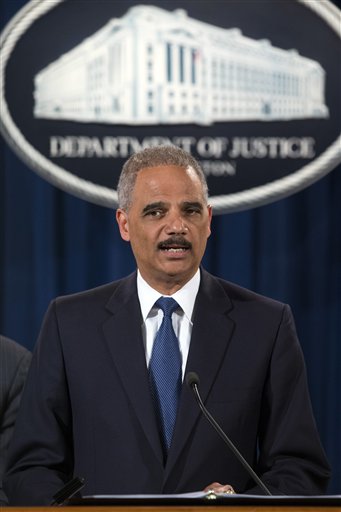
Attorney General Eric Holder speaks during a news conference at the Justice Department, on Monday, May 19, 2014, in Washington. (AP Photo/ Evan Vucci)
By Freddie Allen
NNPA Washington Correspondent
WASHINGTON (NNPA) –Despite major advances to access to the ballot box nearly 50 years after the passage of Voting Rights Act of 1965 (VRA), Blacks, living primarily in the South and Southwest, continued to face challenges at the ballot box, according to National Commission on Voting Rights (NCVR) report.
“Though protection under the Voting Rights Act has produced significant gains, African Americans are continually subjected to new threats to their full enfranchisement,” stated the report. “The ongoing protection of the Voting Rights Act is vital to the inclusion of this community.”
Last summer, the United States Supreme Court invalidated the Section 4 coverage formula in the Voting Rights Act that required jurisdictions with a demonstrated history of voter discrimination to “pre-clear” any changes in voting laws with the Justice Department of a federal court. The ruling effectively neutered Section 5 of the VRA.
“Four states formerly covered by Section 5 of the VRA – Texas, Louisiana, South Carolina and Georgia – rank as the worst offenders,” according to the report. The study found that, when it comes to voting discrimination, Texas was the worst state in the country, “including multiple state-level violations.”
Last August, Attorney General Eric Holder filed a lawsuit against Texas over a restrictive voter ID law that went into effect after the Shelby decision, and also sought to support groups who took the Lone Star State to court over redistricting policies.
Following the Shelby v. Holder ruling, civil rights lawyers have increasingly used Section 2 of the VRA to defend voters’ rights across the nation, but the report acknowledged the limitations of Section 2 lawsuits.
“While Section 2 provides important and considerable safeguards against discrimination, it does not provide the same level of protection that Section 5 afforded minority voters,” stated the report. “Section 2 litigation is often complex and can be slow, time-consuming, and expensive,” especially for poor, minority voters with access to limited resources.
Under Section 5, covered jurisdictions had to prove that new laws didn’t create added hardships for poor and minority voters. Section 2 reverses that burden of proof, placing it squarely on the shoulders of the voters and civil rights lawyers.
Since the Shelby v. Holder decision, new, controversial voting laws have been passed, forcing civil rights and Justice Department lawyers to expend resources battling over whether those laws hurt thousands of voters.
The report covered a number of forms of voter discrimination, including minority vote dilution, voter challenges and intimidation, felony disenfranchisement, voter purges and restrictive photo ID requirements.
“The findings show that contrary to the court’s assertion voting discrimination is still rampant and that states and localities previously covered by Section 4 and Section 5, the [Voting Rights Act] provisions struck down by the court, continue to implement voting laws and procedures that disproportionately affect African Americans, Latinos, Asian Americans and Native Americans voters,” said Arnwine.
From 1995-2013, redistricting changes made up 58 of 113 Section 5 preclearance denials, the report said.
“Redistricting plans that dilute minority voting strength typically submerge minority voters in overpopulated districts, divide minority population concentrations to prevent them from comprising the majority of a fairly-drawn district (“fragmentation” or “cracking”), or unnecessarily over concentrate them in a minimal number of districts (“packing”),” stated the report.
Robert Kengle, co-director of the Voting Rights Project at the Lawyers’ Committee for Civil Rights Under Law, said that redistricting is the reallocation of political power and there is always a temptation to make minority voters the pawns in that process.
“Whether you’re talking about disputes between political parties or disputes between incumbents or one faction or another it’s tempting to dilute minority voter strength to achieve your political goals,” said Kengle.
Kengle added: “Sometimes it’s just as simple as saying, ‘We don’t want minority voters electing candidates,’ and the district lines are drawn to prevent that.”
Jurisdictions that pass plans are usually more discreet today than they were in the 1960s or 1970s, but when you look at the results, sometimes the results are very similar, observed Kengle.
Leon Russell, the vice chairman of the NAACP Board of Directors called redistricting ‘a partisan tool.’
“For legislatures that are dominated by one particular party, it’s that party that usually draws those lines to protect its political power,” said Russell. “If you can control who votes and where they vote, you can control the power.”
Following the Shelby decision, the Justice Department made severe cuts to its federal observer program.
“The federal observer program provided an important deterrence against voter discrimination with 10,702 observers deployed from 1995-2012,” the report said.
Kengle said that federal election observers serve multiple purposes and one of the most important purposes doesn’t result in litigation. Election officials often request federal election observers from the Justice Department to calm tense situations when there have been concerns about claims of voter intimidation or other misconduct at the polls.
Election observers monitor the polls “not so much with an eye toward bringing a lawsuit, but rather allowing people to vote without concerns for intimidation,” said Kengle, adding that, in recent years, observers have documented compliance with the language minority provisions of the Voting Rights Act.
Federal observers also keep an eye on the voting process on the ground and take notes in a way that attorneys or other election observers are not able to do, said Kengle, who worked in the Voting Section at the Justice Department for about 20 years and supervised election coverage.
Losing that monitoring power will be a huge loss for minority voters, said Kengle.
“Blacks are conscious of the history that produced the Voting Rights Act of 1965 and all the sacrifices that people made so that act could become law,” said Arnwine.
Arnwine disagreed with the majority decision in the Supreme Court Shelby County case that concluded that the rise in Black voter turnout and the number of minority elected officials signaled that the Section 4 pre-clearance formula in the VRA was outdated and that voter disenfranchisement was largely a problem of the past.
Arnwine sees if differently, noting that ncreased Black voter turnout doesn’t mean that it’s easier to vote, “it means that people are more determined to vote.”
###









Black Press
New Protections for Ticket Buyers: Gov. Newsom Signs Assemblymember Isaac Bryan’s Bill
OAKLAND POST — Assembly Bill 1349 expands state regulation of original ticket sellers, resellers and online resale marketplaces. The law targets deceptive sales practices, ticket-buying software and speculative listings — tickets advertised for sale by sellers who do not possess them or have authorization to sell them.
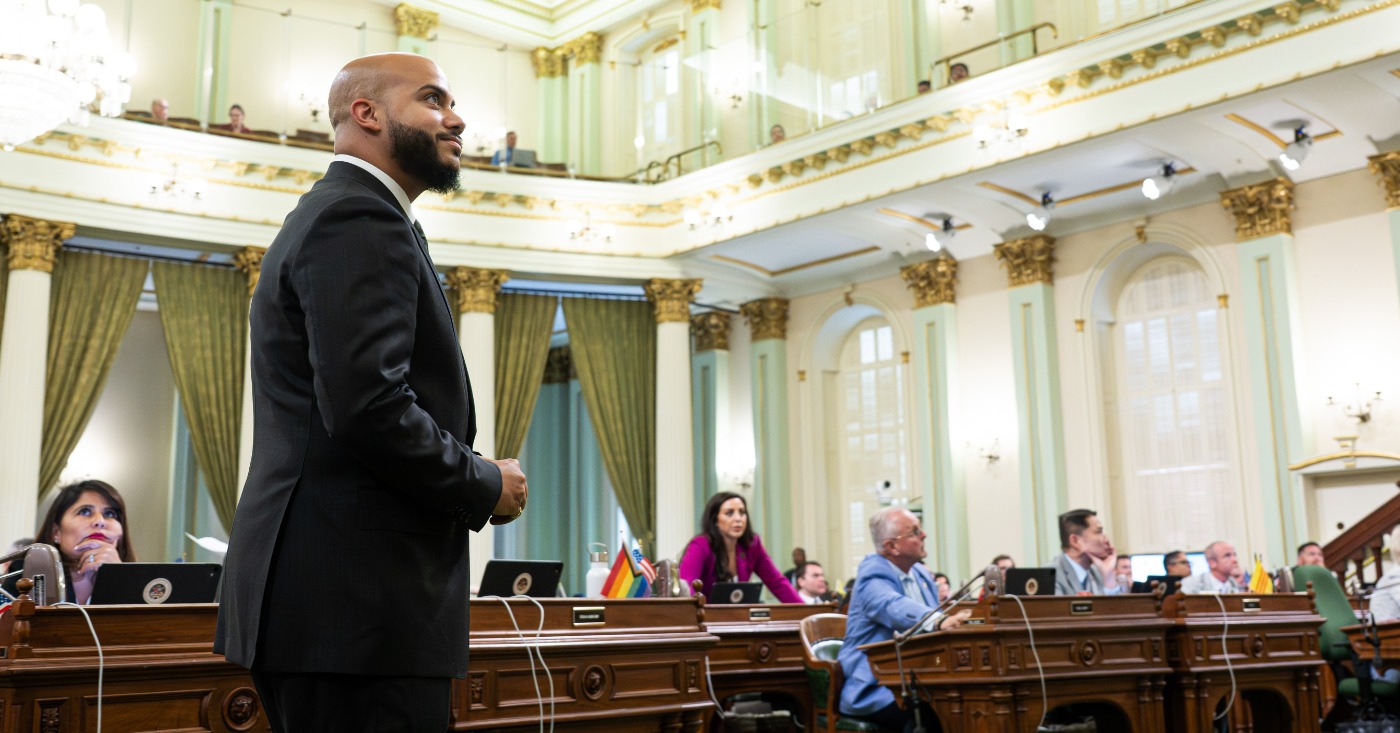
Gov. Gavin Newsom signed legislation on Sept. 27 authored by Assemblymember Isaac Bryan (D-Ladera Heights) that strengthens consumer protections for Californians purchasing tickets to concerts, sporting events and other live entertainment.
Assembly Bill 1349 expands state regulation of original ticket sellers, resellers and online resale marketplaces. The law targets deceptive sales practices, ticket-buying software and speculative listings — tickets advertised for sale by sellers who do not possess them or have authorization to sell them.
“Buying a ticket shouldn’t come with hidden risks or unfair practices,” Newsom wrote on social media after signing the measure.
Under AB 1349, ticket sellers are prohibited from listing tickets before they have been officially released unless they have authorization or a legally enforceable right to receive them. Online marketplaces must also take reasonable steps to prevent speculative ticket sales on their platforms.
The law prohibits sellers from using bots, multiple accounts, email addresses or internet protocol addresses to circumvent ticket limits, presale restrictions, electronic queues and other controls. It also bans websites and advertisements designed to mislead buyers into believing they are purchasing tickets from an authorized seller, venue or event organizer.
Sellers who violate certain provisions and fail to provide a promised ticket may be held liable for twice the ticket’s contracted price. Buyers may also recover nonrefundable expenses incurred while attempting to attend an event, along with reasonable attorney’s fees and court costs.
Pastor Tecoy Porter Sr., president of the National Action Network’s Sacramento chapter, said the law establishes needed accountability.
“Buying a ticket to a concert or show shouldn’t mean entering a marketplace where the rules are stacked against you. This year, we worked with a coalition of consumers, civil rights advocates, community groups, and businesses to make AB 1349 stronger. Consumers deserve enforceable rules that protect them. We thank Assemblymember Bryan for his leadership, and we will keep working to make ticketing fair for every Californian.”
Jose L. Barrera, national vice president for the Far West Region of the League of United Latin American Citizens, also praised the measure.
“Californian families deserve certain protections when they buy tickets. Assemblymember Bryan listened to communities across California and delivered a bill that puts fans first. We thank him and Governor Newsom for making it law.”
Black Press
OP-ED: Haiti TPS: Have We Lost Sense of Humanity?
BLACKPRESSUSA NEWSWIRE — The treatment of more than 300,000 Haitians living and working in the United States under Temporary Protected Status (TPS) presents such a moment. The Senate should pass S.4814, legislation that would extend TPS for Haitians for three years. The Senate’s Republican members hold a critical key to whether Congress will act before the midterm elections.

There are moments when a nation must decide, not simply what it has the legal power to do, but what its sense of humanity requires it to do.
The treatment of more than 300,000 Haitians living and working in the United States under Temporary Protected Status (TPS) presents such a moment. The Senate should pass S.4814, legislation that would extend TPS for Haitians for three years. The Senate’s Republican members hold a critical key to whether Congress will act before the midterm elections.
There are several reasons that the Haitian TPS question is a genuine crisis. First and foremost, Haiti is dangerously unsafe, and the justification for TPS could hardly be clearer.
Haiti continues to experience extraordinary violence and instability. United Nations and human-rights organizations report killings, kidnappings, sexual violence, displacement and widespread abuses by armed gangs. Millions of Haitians face acute humanitarian needs.[1]
Most tellingly, the U.S. Department of State warns Americans: “Do Not Travel” to Haiti, citing kidnapping, crime, terrorism, civil unrest and limited health care.[2]
That warning raises an unavoidable question: If Haiti is too dangerous for Americans to travel there, how can it be considered safe to compel more than 300,000 Haitians to return?
Congress created TPS precisely for circumstances in which armed conflict or extraordinary conditions make safe return impossible or inappropriate.[3] The documented conditions in Haiti meet that humanitarian standard many times over.
Let’s also clear up another misimpression. The Supreme Court in its June 25, 2026 decision in Mullen v. Doe did not order TPS to end and it did not order Haitians to be deported.
Rather, the Court ruled that the Department of Homeland Security (DHS) had the primary responsibility to decide when to grant TPS and that its decisions were not, in most instances, judicially reviewable.[4]
The decision therefore permitted the Administration’s termination of Haitian TPS to proceed, but the humanitarian question of whether it should proceed remains with the political branches. In other words, Congress retains its legislative authority to act. S.4814 is Congress exercising that authority.
For Haitians living under the threat of deportation, this is not an abstract legal dispute. The human cost is becoming painfully real.
Consider Pierre Damas Bel, a 20-year-old Haitian college student with a promising future, who lived in Springfield, Ohio. After losing his immigration protection, he was placed on an ICE ankle monitor. His family has described the profound psychological distress he experienced.
Bel subsequently died after stopping his car and walking into traffic on a crowded Ohio highway. His family believes it was suicide Authorities are investigating, and it would be irresponsible to claim that immigration policy alone caused his death. But his tragic story illustrates the human consequences of creating fear and uncertainty for people who have lived, studied and worked lawfully in this country and have no immediate expectation of returning home safely.[5]
There also is another compelling reason for Congress to act: Haitian TPS holders are caring for Americans.
Approximately 21,000 Haitian TPS holders work as caregivers and nursing assistants, serving an estimated 77,000 patients nationwide.[6] They care for seniors in nursing homes, assist people with disabilities and provide home care that allows vulnerable Americans to remain in their communities.
When experienced Haitian caregivers lose their legal ability to work, families must scramble to find replacements, nursing facilities face staffing shortages, and vulnerable people can lose caregivers they have trusted for years.
At a time when America already faces a serious shortage of direct-care workers, deporting thousands of experienced Haitian caregivers is not merely inhumane, it’s self-defeating and contrary to our nation’s own healthcare needs.[7]
The mass deportation of Haitians also presents a troubling humanitarian double standard that Congress should confront.
The Trump Administration has made a special effort to admit White South African Afrikaners as refugees, citing racial persecution and violence — a dubious claim at best. At the same time, it is stripping protection from Haitians whose country is experiencing catastrophic violence, death and insecurity.
The State Department currently rates South Africa for travel recommendations at Level 2—“Exercise Increased Caution.” Haiti is at Level 4—“Do Not Travel.”[8]
Every person facing genuine persecution deserves humanitarian consideration and protection, but humanitarian standards should be applied consistently. If America can recognize humanitarian danger facing White South Africans, surely it can recognize the documented and extraordinary danger confronting Black Haitians.
The disparity deserves congressional scrutiny—not because one group should receive less protection, but because humanitarian protection should not depend upon race or political convenience.
Finally, the Haitian TPS question should not be reduced to a partisan argument.
Republican Ohio Governor Mike DeWine has criticized the Administration’s approach to Haitian immigrants and warned of the consequences of ending TPS. Democratic Maryland Governor Wes Moore has likewise expressed opposition to returning Haitians to dangerous conditions.[9]
These governors understand that immigrants are not merely immigration cases. They are workers, taxpayers, caregivers, parents, students, neighbors and members of their communities.
The House of Representatives has already taken action and passed a bill to restore Haitian TPS.
The Senate’s Haitian TPS bill (S.4814) offers a measured response: three additional years of protection while Haiti confronts its extraordinary crisis. It is not amnesty! It does not grant citizenship or permanent residence. It does not repeal America’s immigration laws. It does, however, provide important and humane temporary protection while conditions make return to Haiti unsafe.
Our history tells us what happens when government treats human beings with hostility and indifference, and regards humanitarian appeals as inconveniences to be overcome.
America can and must do better.
The Senate now has an opportunity to demonstrate that America’s humanitarian principles apply consistently—to Black immigrants as well as everyone else. Republican senators hold a critical key to bipartisan action. Before the midterm elections, they should join Democrats in responding to this humanitarian imperative.
Our nation’s sense of humanity demands it.
Wade Henderson, Esq. is a civil and human rights attorney in Washington, DC. He serves as a Senior Advisor to the Haitian Bridge Alliance.
Endnotes
- United Nations Integrated Office in Haiti (BINUH), Human Rights Reports; Human Rights Watch, World Report 2026: Haiti.
- U.S. Department of State, Haiti Travel Advisory, Level 4—“Do Not Travel.”
- 8 U.S.C. §1254a(b)(1).
- Mullin v. Doe / Trump v. Miot, U.S. Supreme Court, June 25, 2026.
- Washington Post, “College student steps into traffic, is killed after losing immigration status,” Sept. 1, 2026; ABC News, Sept. 1, 2026. Authorities continue to investigate Bel’s death.
- Reuters, “US families, healthcare providers under strain after Trump crackdown on Haitian immigrants,” Aug. 19, 2026.
- Id.; see also reporting by LeadingAge concerning the impact of ending Haitian TPS on senior and disability care.
- U.S. Department of State, Haiti Travel Advisory; South Africa Travel Advisory.
- Reporting on statements by Ohio Gov. Mike DeWine and Maryland Gov. Wes Moore concerning Haitian TPS.
Black History
COMMENTARY: Battling Black Voter Distrust
HOUSTON DEFENDER — Black voters have long been a reliable base for the Democratic Party, but political strategists and voters indicate that years of inconsistent engagement and unfulfilled expectations have created a trust gap.

Black voters have been among the Democratic Party’s most dependable supporters for generations. But loyalty and trust are not the same thing.
With less than a month to go before the midterm elections, Black voters and political strategists say years of inconsistent engagement and unmet expectations have left some voters questioning whether the party has earned their continued support. The challenge now is bigger than winning votes. It’s convincing distrustful voters that staying politically engaged is worth it.

Communications strategist Ashley Etienne argues that Democrats have spent years taking one of their most reliable voting blocs for granted, creating a widening trust gap that threatens the party’s long-term prospects in Texas and nationally.
“Trust is the currency of persuasion,” she said. “We’re seeing distrust at an all-time high, especially with Black voters … distrust of the media, institutions, the Democratic Party, self-agreement. Campaigns don’t lose because they fail to talk to voters. They lose because they fail to listen.”
Etienne, who served as a senior adviser to Presidents Barack Obama and Joe Biden and communications director for Vice President Kamala Harris, said repairing that relationship requires something considerably more difficult than another campaign advertisement. It requires listening.
Black support remains strong, but not absolute
Recent polling suggests Democrats continue to hold a substantial advantage among Black voters heading into November, but that support isn’t universal.
A July 2026 Pew Research Center survey found 68% of Black registered voters said they would support the Democratic candidate for U.S. House in their district, compared with 8% who favored the Republican. Another 25% said they were either unsure or would support another candidate.

That uncertainty follows some erosion in Democratic support among Black voters in the 2024 presidential election. A Pew analysis of validated voters found 83% of Black voters supported Kamala Harris in 2024, compared with 92% who supported Joe Biden in 2020.
Pew found that shift was driven less by individual voters switching from one party to another than by differences in who turned out to vote.
The findings don’t suggest Black voters have abandoned Democrats. They do raise questions about whether longstanding party loyalty is enough to guarantee participation.
“We’ve been making that same argument decade after decade,” Etienne said. “Those are becoming less persuasive arguments.”
Why is trust disappearing?
The distrust isn’t necessarily about one candidate or one election. For some Black voters, frustration comes from feeling heavily courted during election season without seeing enough progress afterward on the issues affecting their daily lives.
Housing costs remain a concern. So do education, economic opportunity, neighborhood investment, and the cost of everyday necessities.
That creates a difficult dynamic for campaigns: Asking voters to participate in a political system that some believe has not delivered enough for them.
It also raises a separate question. What happens when frustration with political parties becomes disengagement from the political process altogether?
What happens when voters stay home?
The answer can become particularly consequential in local elections, where races can be decided by hundreds of votes rather than thousands.
Harris County Democratic Party Chair Traci Gibson has pointed to several 2024 judicial races decided by narrow margins. District judge candidate Elaine Palmer lost by 304 votes, while Jeralynn Manor lost by 647 votes.
Gibson also warned about voters who begin Harris County’s lengthy ballot but don’t finish it.
“If you go into these polls and you vote for the first five people and then you leave, that’s how we get Elaine Palmer losing by about 300 votes,” Gibson said.
The larger issue extends beyond any candidate or political party. Judges are elected. School boards make decisions affecting students and families. City and county officials determine how public dollars are spent. State lawmakers decide which bills become state law.
Those decisions are made regardless of how many eligible voters participate.
“We have to have strategies, we have to have plans, we have to have a mechanism in place for people to feel they are heard.”
Karla West
For voters distrustful of political parties or government institutions, political participation also doesn’t have to mean unquestioning loyalty to either party.
Voters can research candidates individually, compare their positions, attend or watch candidate forums and examine an incumbent’s record against previous campaign promises. They can also learn what the often-overlooked offices farther down the ballot actually control.
In that sense, distrust can become a reason for greater scrutiny rather than disengagement.
Candidates have work to do, too
Responsibility for rebuilding participation doesn’t fall solely on voters.
At a recent Third Ward town hall hosted by state Rep. Jolanda “Jo” Jones, Harris County Precinct 7 Constable James “Smokie” Phillips and Houston Black American Democrats, voters and political strategists called for more sustained campaign engagement.
“Investment drives outcomes. If you don’t invest in it, it doesn’t work,” Etienne said.
She argued that campaigns spend heavily on polling, consultants and advertising while directing too little money toward Black-led political infrastructure and organizations with established relationships in Black communities.
Shamier Bouie, chair of Houston Black American Democrats, said organizing cannot begin a few months before Election Day.
“It’s all about year-round organizing, and increased investment in Black voter outreach … more funding for Black-led organizations that have relationships, infrastructure, and experience in effectively engaging Black communities,” Bouie said.
The question of investment also surfaced in July when Democratic U.S. Senate candidate James Talarico pledged $25 million toward Black voter outreach. Some voters wanted specifics about where and how that money would be spent.
“We still need our kids, we still need our schools equitably funded,” said Augie Cahee, vice president of marketing web delivery at JPMorgan Chase & Co. “So, we want to know what you’re going to do with the money. Don’t stand up and tell me $25 million and you don’t have a plan.”
The exchange illustrated the larger trust problem: Voters aren’t simply asking candidates to talk to them. They want to know what happens after the conversation.
From distrust to accountability
Karla West, a precinct chair for downtown’s Precinct 16, said responsibility ultimately belongs on both sides.
“We fell asleep at the wheel,” West said of voter turnout.
But she also challenged political leaders.
“The Democratic Party did not say what they would do for you,” West said. “We haven’t heard a plan for years. I’m sick of it. We have to have strategies, we have to have plans, we have to have a mechanism in place for people to feel they are heard.”
Defender Reporter Tannistha Sinha contributed to this report.
Based on reporting by Houston Defender.
Auto
Consumers and States Awarded $694 Million After Predatory Auto Lender Settles Lawsuit
WASHINGTON INFORMER — A class-action settlement involving predatory auto lender Credit Acceptance Corporation (CAC) has resulted in $694 million in relief for an estimated 55,000 consumers. Attorneys general from 40 states and the District of Columbia announced the settlement with one of the nation’s largest subprime auto lenders on September 18.

An estimated 55,000 consumers will benefit from a $694 million class-action settlement against a predatory auto lender reached by attorneys general in 40 states and the District of Columbia.
The settlement announced on Sept. 18 with Credit Acceptance Corporation (CAC), one of the nation’s largest subprime auto lenders, will provide the following financial relief for affected consumers:
- $630 million in debt relief for consumers — $388 million to consumers whose cars have been repossessed; the remaining $246 million for those whose vehicles have not been repossessed and will now keep their autos.
- $60 million in restitution to thousands of additional consumers who were misled and lost their cars within months of taking out their loans.
- $15.5 million in reimbursement to each state office that comprised the multistate working group, and the National Association of Attorneys General.
“CAC preyed on consumers in New York and across the nation with false promises of affordable loans, only to exploit them with outrageous interest rates that ruined their credit and cost them their cars,” said New York Attorney General Letitia James, who led the multi-state effort. “While their customers struggled to make payments, CAC made millions. By continuing our case to hold CAC accountable, we secured hundreds of millions of dollars in debt relief and restitution for all those who were taken advantage of by their schemes.”
The lawsuit, originally filed in 2023, alleged that CAC projected, down to the penny, how much money it could extract from borrowers through loan payments, late fees, repossession and auction, debt collection, and wage garnishment, without considering a consumer’s ability to repay their loan, according to James. CAC then offered to split the projected collections with its affiliated dealers.
Low-income borrowers with either low credit scores or little credit history were routinely pushed into purchasing vehicles that were worth far less than their loans. CAC states on its own website: “Approval decisions are typically available in 30 seconds or less, and nearly 80 percent of deals are approved for funding within 24 hours.”
Further, CAC misstated key terms on loan agreements, including the principal and interest amounts, and did not disclose thousands of dollars in credit charges. Although the average loan carried an annual interest rate of more than 38%, other rates reached over 100%. These predatory debt trap loans soon defaulted within 12 or 18 months.
“Credit Acceptance Corporation set car buyers up to fail by making loans it knew they would never be able to afford, and by allowing dealers to inflate the cost of financing agreements with hidden add-ons. As a result, the company profited, even while customers lost their cars and continued to struggle with debt,” said District of Columbia Attorney General Brian L. Schwalb.
Other state officials had similar reactions to the settlement.
“Credit Acceptance Corporation closed its eyes to deceptive origination practices and made predatory, high-cost auto loans that were likely to result in repossession and leave consumers trapped in a cycle of debt,” said California Attorney General Rob Bonta.
Consumers eligible for restitution will be notified by a claims administrator. Consumers with questions about the settlement can call CAC’s customer service number at 800-634-1506.
The settlement also provides additional terms that will free affected consumers from many of the other financial harms inflicted, while other stipulations carry long-term, consumer-friendly reforms.
In the short term, CAC must contact and clearly inform consumers of any products they purchased and offer them a process to cancel those products while keeping their vehicles. It must also notify all affected consumers that their car loan accounts have been closed, no further payments are owed, any lien held has been released, and the certificate of title has been sent. Credit bureaus will also be notified of these actions.
For the next five years, CAC is required to submit written reports that demonstrate how it is complying with all aspects of the consent order. Any failure or shortcomings related to the order will prompt a mandatory remediation plan with details that identify how compliance will be achieved.
Other long-term settlement stipulations that CAC must observe:
- Providing consumers with pre-loan disclosures about the risks of default and the value of the vehicle.
- Limiting a price cap for vehicle prices to no more than 109% of retail book value for certain consumers.
- Implementing procedures that prevent dealers from raising car prices due to creditworthiness or above advertised prices.
Comments in a report released earlier this year by the Center for Responsible Lending showed how consumers with subprime credit scores, most of whom are Black, were left reeling from the effects of predatory car loans.
As Nicole, one participating consumer, noted, “You pay that and nothing, nothing ever changes.”
As CAC faces court-ordered reforms and restitution, Nicole and similar consumers can finally receive well-earned financial fairness.
Charlene Crowell is a senior fellow with the Center for Responsible Lending. She can be reached at[email protected].
Based on reporting by Washington Informer.
Black Press
TILGHMAN: Why Parents of Children with IEPs Should Know Their School Bus Driver
WASHINGTON INFORMER — Parents of children with Individualized Education Programs (IEPs) often face unique considerations regarding their child’s school transportation. Ensuring consistency and understanding their child’s needs on the bus can be a significant concern.

As the father of a young daughter with autism, I have learned that getting your child to school is not always as simple as putting them on the bus and waiting for them to come home.
When your child has an Individualized Education Program, you pay attention to things other parents may never have to think about.
Who is working with my child today? Does this person understand her needs? What happens if her routine suddenly changes? If something goes wrong and she cannot fully explain it to me, who will be able to tell me what happened?
Those questions do not stop at the schoolhouse door. They follow our children onto the school bus.
That is why one of the simplest pieces of advice I can give another parent of a child with an IEP is this: Get to know your child’s bus driver and attendant.
Learn their names. Introduce yourself. Say good morning. Ask how your child is doing on the ride.
Those few minutes can matter more than we realize.
For some children with disabilities, consistency is incredibly important. The same bus, the same driver, the same seat and the same routine can provide a sense of comfort before the school day even begins.
Then one morning, something changes.
The bus is late. There is a substitute driver. The route changes. The bus does not arrive when expected.
For many families, that is an inconvenience. For some of our children, it can change the entire morning.
As parents, we also know that our children may not always come home and tell us exactly what happened during the ride. That makes the adults who interact with them even more important.
A bus driver may notice that your child suddenly does not want to get on the bus. An attendant may notice that your child seems upset at the same point along the route every day.
They may notice a change in behavior, a problem with another student, or simply that something seems different.
That information can be valuable to a parent.
But relationships work both ways.
Parents can also help transportation staff understand our children. You do not have to share every detail of your child’s disability or educational record. But appropriate information about communication, behavior, safety or transitions can help the adults responsible for transporting your child better understand how to support them.
And when a transportation problem occurs, you are no longer starting the conversation with a complete stranger.
That does not mean parents should be responsible for fixing school transportation. We shouldn’t.
School systems remain responsible for providing required transportation services, including services identified in a student’s IEP. When buses are repeatedly late, accommodations are not being followed or transportation problems interfere with a child’s education, parents should document those concerns and raise them with the appropriate school and transportation officials.
Building a relationship with a driver should complement accountability, not replace it.
That distinction is important.
As a father navigating special education, I have learned that advocacy is not only about what happens during an IEP meeting.
Advocacy happens in the hallway. It happens at pickup. It happens through an email to a teacher. And sometimes it happens at the bus stop at 7 o’clock in the morning.
Our children’s educational experience begins before they enter the classroom and continues after they leave it.
Think about the person behind the wheel.
For some children, their bus driver is the first school employee they see every morning and the last one they see every afternoon.
That person is part of your child’s school experience.
So tomorrow morning, if you haven’t already, introduce yourself.
Learn the driver’s name.
Let them learn your child’s name — and, when appropriate, a little about what helps your child succeed.
It won’t prevent every late bus, substitute driver or transportation problem.
But if there is one thing I continue to learn as both a father and an advocate, it is that relationships matter.
And for children with IEPs, one more adult who knows, understands, and cares about your child can make a difference.
Based on reporting by Washington Informer.
Black Press
St. Louis Officials Form Pro Bono Task Force to Fight Fraud Against Tornado Survivors
ST. LOUIS AMERICAN — St. Louis Mayor Cara Spencer has announced the formation of a pro bono task force aimed at combating contractor fraud against victims of last year’s May tornado. This initiative expands the city’s legal aid efforts for residents in the tornado zone, which saw an EF3 tornado damage and destroy thousands of homes in the city’s north and west.

A volunteer-led task force of St. Louis-based lawyers will go after contractors who take advantage of victims of last year’s May tornado.
Mayor Cara Spencer announced the creation of the task force on Thursday as an expansion of the city’s effort to provide legal aid to victims in the tornado zone. The EF3 tornado damaged and destroyed thousands of homes in the north and west parts of the city.
The task force will be composed of area lawyers and Legal Services of Eastern Missouri, a legal aid group that often works with the city on housing and other legal issues.
Together, the litigators will provide free legal expertise and representation to eligible homeowners who believe they were defrauded by a contractor, including by receiving shoddy or partial work.
Spencer said she hopes the task force sends a “clear and unambiguous message” to fraudsters looking to victimize homeowners impacted by the tornado.
“I’ve just heard over and over again some truly heartbreaking stories of folks that have been taken advantage of by contractors, some of which are local,” Spencer said.
In May, a High Ridge contractor was charged with defrauding victims of the tornado by Missouri Attorney General Catherine Hanaway’s office.
Homeowners seeking legal aid will go through a two-stage screening process to evaluate their claims. Then, if selected, an attorney will be matched with the homeowners. The intake form can be found here.
Celeste Vossmeyer, an attorney who has worked with Spencer’s administration on several other projects, helped assemble the task force. She said the city’s north and west sides need extra eyes while recovery efforts continue.
“We’re hoping that this is also going to be a deterrent as other money flows into the tornado disaster area and to other scammers that may try to take advantage of these individual homeowners,” she said.
Spencer said the city will also partner with the attorney general’s consumer protection office. The office will forward complaints from homeowners in the tornado zone to the task force.
Spencer said that without the help of the volunteers, Legal Services of Eastern Missouri and the attorney general, the city could not offer this type of help.
Shawn Caruso, a senior attorney at Legal Services of Eastern Missouri, called on other lawyers in the area to consider joining the pro bono team.
“Every lawyer who volunteers expands our ability and our capacity to provide more free legal aid to our residents,” Caruso said.
Published with permission as part of a content partnership between The St. Louis American and St. Louis Public Radio. Click here to view original story.
The post St. Louis officials form pro bono task force to fight fraud against tornado survivors appeared first on St. Louis American.
Based on reporting by St. Louis American.


Introduction, 2027 VW Atlas SEL Premium R Line Worth $58,135?

Welcome, 2027 VW Atlas SEL Premium R Line Worth $58,135?

Smart Car Buying: Ask These Questions Before You Buy! #shorts

2027 VW Atlas SEL Premium R Line Worth $58,135?

A $2.1 Trillion Wellness Industry Never Built a Daily Practice for Black Children. So This Atlanta Family Did.

Unlock Auto Loans: Black-Owned Banks & Credit Unions #shorts

Find Black-Owned Banks & Auto Loan Pre-Approval Easily #shorts

Car Warranty Explained: Powertrain, Basic & Roadside! #shorts

NFN present Tonight: Inaugural Beyond IWDM50 Podcast – Northeast Sectional Focus

Defender Athlete of the Week – Elicia Hunt

Latest Massacre in Haiti Reveals Cruelty U.S. Deportations

Black Americans Have Doubts About the U.S. Food System

When Praises Go Up: SUGC Nominated for Prestigious Stellar Award.

Booked and Unbound: The Legacy of Black Women’s Literary Circles

The Youngest American Killed in the Vietnam War

U.S. Sole Nation to Oppose U.N. Resolution Correcting Africa’s Size on World Maps

COMMENTARY: Big Mama Said ‘Don’t Let Grief Break the Bank’

Outnumbered: Elbert Cox’s Equation for Greatness

U.S. Open Influencers Spark Backlash over Ring Lights, Filming as Gauff and Osaka Speak Out

Prostate Cancer is Twice as Likely to Kill Black Men. Talking to Your Doctor Could Help Save Your Life
Introduction, 2027 VW Atlas SEL Premium R Line Worth $58,135?
Welcome, 2027 VW Atlas SEL Premium R Line Worth $58,135?
Smart Car Buying: Ask These Questions Before You Buy! #shorts
2027 VW Atlas SEL Premium R Line Worth $58,135?
Unlock Auto Loans: Black-Owned Banks & Credit Unions #shorts
Find Black-Owned Banks & Auto Loan Pre-Approval Easily #shorts
Car Warranty Explained: Powertrain, Basic & Roadside! #shorts
NFN present Tonight: Inaugural Beyond IWDM50 Podcast – Northeast Sectional Focus
Defender Athlete of the Week – Elicia Hunt

Houston confronts the toll of gun violence on youth
-

 Black Press5 days ago
OP-ED: Haiti TPS: Have We Lost Sense of Humanity?
-
 Black History1 week ago
Remembering Chauncey Bailey as Student Journalists Face Threats to Truth-Telling
-

 Black Press1 week ago
Poll: Becerra Widens His Lead Over Hilton; Californians Split on Wealth Tax
-

 Black History1 week ago
COMMENTARY: The Audacity of Joyce Beatty
-

 Black History1 week ago
Rulings Leave Questions Lingering in Nolan Wells Case
-

 Black History1 week ago
Baptist Minister Says Black Church Champions for Civil Rights to Reign but Hesitates to Let Black Women Lead
