
Business
OP-ED: Minnesota’s KleinBank Violated Fair Housing Act, Failed Minority Communities
The Home Mortgage Disclosure Act is the nation’s most comprehensive mortgage lending report for its inclusion of data on lending by race and ethnicity.


PRINTHEADLINE
OP-ED: Redlining Settlement Fails to Provide Strong Penalties
Other Actions Signal More Backward Turns on Fair Housing
WEBHEADLINE
OP-ED: Minnesota’s KleinBank Violated Fair Housing Act, Failed Minority Communities
By Charlene Crowell (Deputy Communications Director, Center for Responsible Lending)
For as long as many people of color can remember, succeeding generations have called for justice. Despite these age-old pleas, justice is not only elusive, but frustrating since the enactment of a series of civil rights laws. Despite federal guarantees of equal treatment, much of Black America experiences something short of what was promised.
A recent settlement of a federal redlining lawsuit is yet another sign that justice is still being denied. Even worse, those entrusted in key federal agencies are willing to accept much less than what is fair or just.
On January 13, 2017 and as one of the last cases brought under the Obama Administration, the Department of Justice (DOJ) sued KleinBank, a lender in the Twin Cities’ metropolitan area with violations of both the Fair Housing Act (FHA) and the Equal Credit Opportunity Act (ECOA). The complaint said, in part, that from at least 2010 to 2015, “KleinBank’s discriminatory practices as described herein have been intentional and willful, and implemented with reckless disregard for the rights of individuals on the basis of their race and/or national origin.”
The January 2017 lawsuit followed a near two-year DOJ investigation that uncovered illegal redlining in neighborhoods of color. Within the metro area, lending in 78 of 97 majority-minority census tracts were excluded by the bank. Further, as KleinBank expanded to add at least seven full-service branches since 2007, not one is in a community of color.
Beyond a failure to serve all consumers, mortgage applications and approvals among consumers of color were equally disturbing. Other metro lenders surpassed KleinBank by as large a ratio as five-to-one in serving consumers of color. For example, among the 5,837 single-family residential loan applications filed with KleinBank, only 1.06 percent – 62 – came from consumers of color. Of the bank’s approved 4,392 residential mortgages, only 51 were secured in neighborhoods of color.
With these and other findings, DOJ’s complaint requested both monetary damages to those consumers who fell victim to these illegalities, and a civil penalty to vindicate the public interest.
Yet on May 8 of this year when a settlement was reached with the current DOJ, there was no civil penalty or judicial oversight – two key elements in earlier settlements with similar charges. Among other requirements, a limited, three-year agreement authorized a $300,000 loan subsidy fund to increase credit access in predominantly minority neighborhoods, as well as another $300,000 for credit repair initiatives, education, outreach and advertising that would include minority media. The settlement required the bank to redraw its Community Reinvestment Act assessment area. KleinBank also agreed to open a single branch in a neighborhood of color within the next year.
According to the settlement, “The United States agrees to jointly stipulate with KleinBank to the dismissal of the Civil Action. The parties agree and acknowledge that this consideration is adequate and sufficient.”
Pardon me, but I respectfully disagree—and so do others who believe in fair lending. A lack of civil penalty coupled with a brief term of compliance does not bode well for fair or just lending.
“The absence of a civil penalty is noteworthy and inconsistent with past redlining cases,” noted Melissa Stegman, a Senior Policy Counsel with the Center for Responsible Lending (CRL). “Furthermore, unlike prior cases, the parties entered into a settlement agreement – not a consent order. A consent order is a more powerful vehicle in that it is subject to the judge’s approval. Also, with a court order, the court maintains supervision of the agreement. Arguably, it’s a stronger way to hold the bank accountable for meeting the terms of the settlement.”
According to the original DOJ complaint the Federal Deposit Insurance Corporation (FDIC) never conducted a redlining examination of the bank, nor did it comment on or approve the bank’s CRA assessment area.
It is also noteworthy that earlier this month HUD announced it planned to seek public comment to revisit whether its 2013 rule known as ‘disparate impact’ was consistent with the 2015 U.S. Supreme Court ruling. Until this rule was adopted in the previous administration, many entities argued in fair housing lawsuits that lenders never intended to discriminate in housing. Disparate impact theory focuses on the effects of practices that foster housing discrimination and was upheld by the U.S. Supreme Court in 2015. HUD’s interest in public comment in 2018 sets the stage for weakening or reversing the rule and is yet another rollback of Obama-era initiatives.
Unfortunately, these kinds of fair lending concerns are experienced across the nation. In 2017, 28,843 housing-related complaints were reported, according to the National Fair Housing Alliance’s 2018 Fair Housing Trends Report. Of these complaints, more than 70 percent were handled by private, nonprofit fair housing organizations.
But the federal Department of Housing and Urban Development (HUD) is charged with ensuring effective enforcement of the Fair Housing Act. Even so, HUD processed less than five percent of last year’s complaints – about 1,311. Further, DOJ brought only 41 cases from the 6,896 complaints forwarded by Fair Housing Assistance Program agencies.
The Home Mortgage Disclosure Act is the nation’s most comprehensive mortgage lending report for its inclusion of data on lending by race and ethnicity. It too will be under review by the Consumer Financial Protection Bureau and appears to be in jeopardy. Currently, this annual report informs the housing industry as well as consumers as to remaining disparities and challenges. Without its detailed data, fair housing measures would be watered down.
When government offices charged and entrusted to enforce laws fail to fulfill their full duties, laws enacted to end discrimination become meaningless. If HUD turns away from fair housing enforcement, as recent actions taken by the agency indicate, or DOJ settles for far less than the law allows or what has even occurred as precedent, none of us should stay silent in the face of these failures.
“It has been 50 years and the Fair Housing Act still has not been fully implemented,” noted Lisa Rice, President and CEO of the National Fair Housing Alliance. “We cannot build a thriving society as long as our nation is plagued by discrimination, segregation, and severe economic inequality.”
Charlene Crowell is the Communications Deputy Director with the Center for Responsible Lending. She can be reached at [email protected].











Black Press
Should You Have to Pay to Hear the Gospel?
ST. LOUIS AMERICAN — Pastor Philip Anthony Mitchell of Atlanta’s 2819 CHURCH and Tim Timberlake of Celebration Church in Jacksonville, Florida, are at the center of a social media debate. The controversy stems from ticket prices for their “Street Preachers” podcast tour, with general admission tickets reportedly costing around $60 and VIP options up to $200.

For generations, the Black church has passed the offering plate to keep the lights on, pay the preacher, help the poor and carry the Gospel beyond its walls. But what happens when the preacher leaves the sanctuary, takes a popular Christian podcast on tour — and charges admission?
That question has placed Pastor Philip Anthony Mitchell, founder and lead pastor of Atlanta’s fast-growing 2819 CHURCH, at the center of a heated social media debate.
Mitchell and Tim Timberlake, senior pastor of Celebration Church in Jacksonville, Florida, host “Street Preachers,” which its official website describes as a “raw, unfiltered podcast” committed to spreading the Gospel.
‘A brood of vipers’
The controversy began after ticket prices for the podcast’s 2026 tour circulated online. General admission tickets reportedly cost about $60 before fees, with premium options, including a VIP meet-and-greet package, priced at $200. Critics questioned whether ministers should charge people to hear the Gospel.
Others defended the pastors, arguing that Christian events require venues, transportation, security, equipment and staff.
Mitchell answered critics from the pulpit last month, calling them “a brood of vipers.” He said the podcast is a separate, personal project and that neither his church nor Timberlake’s is bankrolling it.
“Now we have decided to go on a tour to take the gospel to cities, and because that’s not funded by 2819, and it’s not funded by Celebration Church, Tim and I gotta do that with our own pockets,” Mitchell said. “It’s why there is tickets. We have to pay for venues and security and productions and staff from our own pockets.”
Mitchell called some critics “ignorant” and said they did not know that a child was healed through faith during one of the events.
“And you want to complain about a 60 ticket?” he said. “So hate on!”
Worship service vs. media event
Mitchell maintains that “Street Preachers” is an independently produced podcast tour, not a worship service, and that ticket revenue helps cover production costs.
Yet the presence of pastors, Scripture and Gospel language makes the distinction less clear to some believers.
The official tour website lists all eight 2026 stops as sold out. Promotional material announcing additional dates promised, “Better ticket options. Same Gospel. Same move of God.”
Corporate prayer gathering
The language gets to the heart of the dispute. Some Christians argue that no one should be kept outside because they cannot afford a ticket. Others say the Gospel remains free even when people pay for the venue and experience surrounding its presentation.
The paid podcast tour, however, is not Mitchell’s only large-scale gathering. On Oct. 10, 2819 CHURCH will host “ACCESS — That Powerful Hour of Prayer” at AT&T Stadium in Arlington, Texas. Admission is free.
2819 CHURCH has said 80,000 free tickets were claimed before registration reopened.
The contrast raises another question: What makes one Gospel-centered event a ministry supported by donors and another a production supported by customers?
Unfiltered preaching, youth appeal
Mitchell’s congregation, composed largely of young Black adults, grew from fewer than 200 weekly worshippers in 2023 to about 6,000, according to the church. Some worshippers arrive before sunrise to secure a place inside.
His appeal rests partly in an intense, vulnerable and raw preaching style.
“I’m preaching without watering that down, without filtering out things that we think might be too controversial,” Mitchell told The Associated Press.
That visibility has also brought scrutiny of his theology, associations, travel, security and the businesses surrounding his ministry.
But the controversy reaches beyond Mitchell and Timberlake. Christian music concerts charge admission. Seminaries charge tuition. Religious publishers sell Bibles, books and devotionals. Churches pay musicians, media teams and guest preachers. Money becomes particularly uncomfortable, however, when an event is presented simultaneously as ministry and entertainment.
Ministry vs. entertainment
Supporters should not assume every dollar collected becomes personal profit. Critics, however, question whether lower-cost seats, sponsored tickets or free admission for people who cannot pay should be part of a Gospel-centered event.
The Black church always has required resources for ministry. It also has carried a sacred responsibility to make room for people with little or nothing to give.
The sold-out “Street Preachers” tour shows people are willing to pay to attend. The free ACCESS gathering offers a different model. The challenge is preserving that open door as Christian ministry increasingly adopts the machinery — and economics — of popular entertainment.
The post Should you have to pay to hear the Gospel? appeared first on St. Louis American.
Based on reporting by St. Louis American.
Black Press
OP-ED: Proposition 44 Would Put a Price on Trust
The danger in Proposition 44 is not only its 90 percent figure. It is that the meaning of “qualifying” spending will be worked out later. A clinic preparing a budget today may not know whether a navigator, health educator, transportation program, outreach worker, technology upgrade, or other patient-support service will be counted the way it expects. Yet the financial consequence of getting it wrong could be immediate.

Black Press
OP-ED: Proposition 40: It’s Time to Play Chess, Not Checkers
Proposition 40 would impose a one-time 5 percent tax on the wealth of Californians with more than $1 billion in assets. Most of that money would go toward health care, with the remainder supporting food assistance and education-related programs.

Black Press
Master P Encourages Norwood Elementary Students to Dream Big, Work Hard
BIRMINGHAM TIMES — Music mogul Percy Miller, known as Master P, visited Norwood Elementary School on Friday alongside his mascot sidekick, Captain Ace. Teachers and students, dressed in school colors, welcomed Miller, who shared lessons on education, consistency, networking, and the importance of not letting circumstances define one’s future.

Music mogul Percy Miller, better known as Master P, visited Norwood Elementary School on Friday with his mascot sidekick, Captain Ace. (Birmingham City Schools) ”
The sounds of students singing filled Norwood Elementary School Friday morning as teachers dressed in camouflage and students wearing their school colors of green welcomed a special guest whose career has been built on music, entrepreneurship and perseverance.
Before taking the stage at the Birmingham-Jefferson Convention Complex (BJCC) Friday night, music mogul and entrepreneur Percy “Master P” Miller spent the morning with Birmingham students, sharing lessons about education, consistency, networking and the importance of refusing to let circumstances determine their futures.
Miller was joined by Captain Ace, the blue-dog mascot and educational character associated with his school visits and assemblies. Together, they turned the celebrity appearance into a lesson centered on positive choices, learning, and believing in one’s potential.
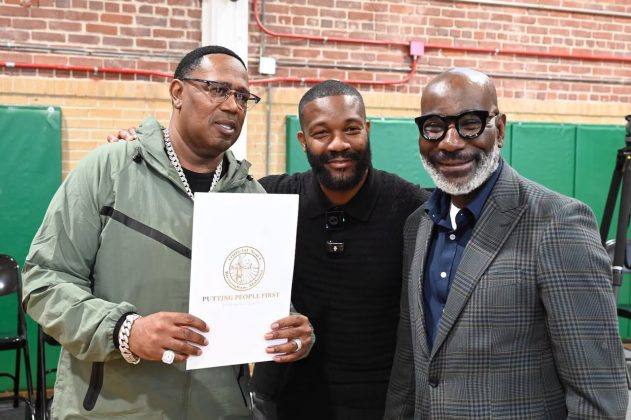
The visit also brought together Birmingham city and school leaders, including Mayor Randall L. Woodfin, Birmingham City Schools Superintendent Dr. Mark Sullivan and members of the school system’s staff and leadership.
At the conclusion of the assembly, Woodfin and Sullivan presented Miller with a proclamation honoring his visit to Norwood Elementary.
For Miller, however, the morning was less about recognition and more about the children sitting in front of him.
“I love the kids,” Miller told the students. “Even though I got a show, I’m like, no, I got to come and touch the kids because that’s the future.”
Miller said his focus is on what he described as “saving the next generation” and educating young people so they can recognize their potential.
“I want these kids to know that they can fly over all this negative,” he said.
That message became personal when Miller reflected on his own childhood.
He told students he grew up living with his grandparents, who had 12 children. His family lived in a three-bedroom housing project, but Miller said he refused to allow his circumstances to define what was possible for him.
“I didn’t let my condition stop me, and I don’t want you guys to let your condition stop you,” he told the students.
Miller repeatedly returned to the idea that dreams require action.
“There’s no limit to your dreams,” he said, emphasizing that success requires work and that students cannot “cheat the game of life.”
He then asked the students how many of them wanted to be successful. The room responded.
Miller used a familiar example to explain one of his central lessons: McDonald’s.
After asking students what the restaurant sells, he shifted the conversation from hamburgers to consistency.
“McDonald’s is selling consistency,” Miller said.
He explained that a Big Mac is expected to taste the same wherever it is purchased, using that familiarity as an analogy for persistence.
“Keep doing something, not giving up,” he told the students. “Keep chasing your dreams, doing something every day to get that, even when it don’t look like it’s gonna happen.”

“Somebody’s gonna make it big.”
Miller also challenged the students to think about the relationships they are building now. He asked whether they understood what networking means before explaining that the people sitting beside them today could become important figures in their lives tomorrow.
Miller shared a story about a girl he knew when he was in school — someone he said other people did not like or treated negatively. Years later, she became a bank president. When Miller needed a loan, he said, she remembered how kind he had been to her when they were younger.
“You never know who’s gonna be what in here,” Miller said.
He encouraged students to introduce themselves to others, learn their names and treat people well.
“That’s networking,” he said.
For Miller, the lesson went beyond professional connections. He encouraged students to recognize the possibility within one another.
“Who’s gonna be a doctor? Who’s gonna be a lawyer? Who gonna be a teacher?” he asked. “Who gonna be the president of the bank? Who gonna be the mayor? Who gonna be the superintendent?”
Miller said students cannot know where their classmates will end up, which makes how they treat one another today important.
“Somebody’s gonna make it big,” he said. “And it could be all you guys.”

Moments of Celebration
The visit was also filled with moments of celebration. Before Miller addressed the students, Norwood teachers and scholars welcomed him with a robust singalong to “The Affirmation Song,” creating an energetic introduction to the morning’s message.
The appearance of Captain Ace added another layer to the program. The character is part of Miller’s educational work with children, with school assemblies and musical programs addressing topics including anti-bullying, stranger danger and mental health awareness.
Miller said he has spent years making time for young people because he sees them as the future.
The message aligned with the presence of Birmingham’s education and civic leadership throughout the morning. Woodfin and Birmingham City Schools leadership have increasingly emphasized connecting children with educational, enrichment and career opportunities across the city. Earlier this year, the city announced its Children and Youth Commission’s Cradle-to-Career Roadmap, a strategy designed to connect the systems and resources influencing children from early education through adulthood.
For Norwood students, however, the morning offered a more immediate lesson: the opportunity to see someone who built a career from a childhood that did not necessarily predict the future he ultimately created.
As Miller prepared to leave, he encouraged students to keep working, keep learning and keep believing in themselves.
“I kept going,” he told them, reflecting on the people who once told him he would not succeed. “That’s what I want you guys to do. Keep going, no matter what your conditions is. No matter what your environment is.”
Based on reporting by Birmingham Times.
Black Press
Latanya Orr Expands Vision After Goldman Sachs Program
CHICAGO CRUSADER — Chicago entrepreneur LaTanya Orr has completed the Goldman Sachs One Million Black Women: Black in Business program, an experience she states has refined her business growth strategies and deepened her commitment to supporting women entrepreneurs. Orr founded The FoundHERS Suite, a collaborative space for women business owners.

Chicago entrepreneur LaTanya Orr has graduated from the Goldman Sachs One Million Black Women: Black in Business program, a milestone she says has helped sharpen her approach to business growth while expanding her work supporting women entrepreneurs.
Orr, an author and business strategist, is the founder of The FoundHERS Suite, a collaborative workspace and entrepreneurial community designed to help women business owners develop their companies through education, connections and shared opportunities.
She participated in the Spring 2026 cohort of Goldman Sachs’ Black in Business program, which provides business education and resources to Black women sole proprietors. Orr said the experience strengthened her understanding of enterprise growth, financial stewardship and long-term business strategy.
“The program didn’t hand me a blueprint—it challenged me to rethink the one I already had,” Orr said. “It strengthened my thinking around enterprise, stewardship, and long-term impact while reaffirming the work I’ve been called to do.”
Her participation in the program came during a period of transition for The FoundHERS Suite. Earlier this year, an unexpected incident involving the building where the Suite operated forced the business to temporarily close its physical location.
Rather than abandon the concept, Orr said the interruption provided an opportunity to reassess how the organization could continue serving women entrepreneurs while she considered the future of the physical workspace.
Part of that evolution is BridgeWRX, Orr’s strategic advisory and thought leadership platform. The venture is designed to help women entrepreneurs move beyond developing brands and focus on building sustainable businesses through strategy, leadership development and intentional growth.
Orr emphasizes that BridgeWRX is not intended to replace The FoundHERS Suite. Instead, she sees it as an extension of the broader mission, providing additional ways for entrepreneurs to receive information, build relationships and strengthen their businesses while she explores the Suite’s next chapter.
Since completing the Goldman Sachs program, Orr has expanded that work through strategic advisory services, educational programs, publishing and community-centered initiatives.
Among those efforts is ShiftShop, a workshop series focused on practical business development. Another initiative, Gather & Shift, brings entrepreneurs together for networking, collaboration and shared learning.
Orr is also developing an editorial component to her work. Through The Bridge, her Substack publication, and HERspectives, a LinkedIn thought leadership series, she writes about entrepreneurship, leadership, business growth and the challenges established founders encounter as they attempt to move from operating individual businesses toward building larger enterprises.
Her developing BridgeWRX Leadership Library is expected to include books, tools and other resources drawn from more than two decades of Orr’s experience as an entrepreneur.
“I’ve come to realize that the assignment was always bigger than the building,” Orr said. “BridgeWRX allows me to extend the mission of The FoundHERS Suite in new ways while continuing to prepare for its next chapter. My passion has always been helping women discover what’s possible, build with intention, and create something that lasts.”
The Goldman Sachs One Million Black Women initiative was launched as part of the financial institution’s broader effort to invest in Black women and address economic disparities. Black in Business focuses specifically on Black women sole proprietors, providing participants with business education, access to resources and opportunities to develop strategies for growth.
For Orr, completing the program comes as she works to bring several parts of her entrepreneurial experience under a broader strategy.
Through BridgeWRX, she plans to continue offering advisory services, educational experiences, publishing and community programming. At the same time, Orr said she remains committed to The FoundHERS Suite and its original goal of creating opportunities for women entrepreneurs to connect and grow.
The result, she said, is an expanded vision centered not simply on operating a business, but on helping entrepreneurs create enterprises capable of producing long-term impact.
Based on reporting by Chicago Crusader.
Black Press
Students from Stonecrest Help Families Grow Food
THE CHAMPION NEWSPAPER — Two Georgia college students from Stonecrest are utilizing agriculture, technology, and community education to help families across Georgia grow their own food, even without traditional farming spaces. Mason Wright, a Morris Brown College student and founder of Plant It Georgia Vertical Institute, and Kosey Henley, a University of Georgia student, developed a mobile agricultural laboratory.
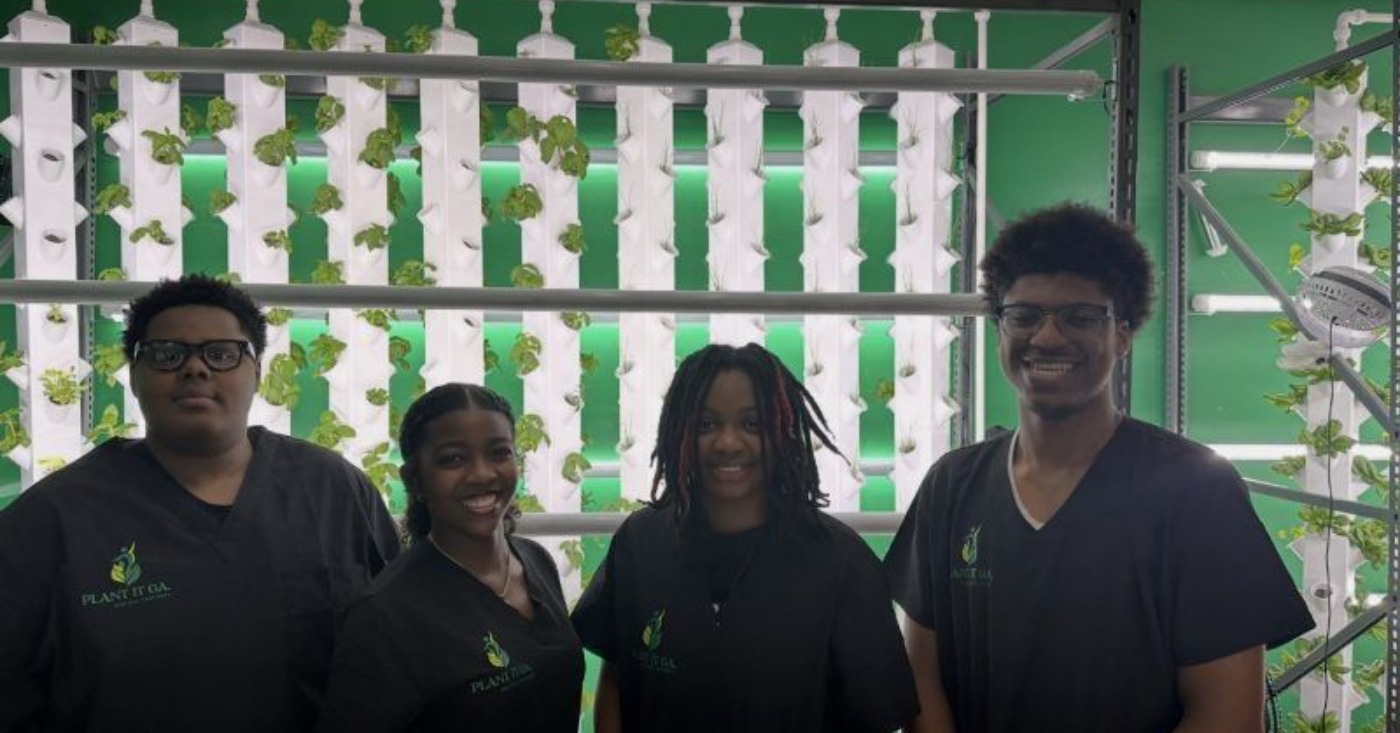
Two Georgia college students from Stonecrest are combining agriculture, technology, and community education to help families throughout Georgia grow their own food — even those without access to traditional growing spaces and equipment.
The two students recently completed the first prototype of Plant It Georgia’s mobile agricultural laboratory, which they said is an enclosed trailer equipped to introduce young people and families to growing food without relying on traditional farmland.
Mason Wright—a youth entrepreneur and a student at Morris Brown College—is the founder of Plant It Georgia Vertical Institute. The institute is an “educational initiative created to train young people in vertical farming, hydroponics, and other modern agricultural technologies,” according to Wright. Kosey Henley, a student at the University of Georgia, worked alongside Wright on the mobile lab.

The students said the idea came in response to an obstacle challenging many communities: transportation. Instead of requiring students to travel to the Plant It Georgia Vertical Institute, the program can take its lessons and growing systems directly into neighborhoods, schools, recreation centers, and other community spaces to teach students and their families about growing food in urban communities.
Inside the prototype, visitors will find hydroponic growing channels, lighting, and other equipment that show them how plants can grow in controlled environments. The laboratory aims to support hands-on lessons covering seed germination, water circulation, plant nutrition, lighting, harvesting, and the technology used to manage indoor crops, according to Wright.
The project comes as Georgia and the nation face an aging agricultural workforce.
According to the U.S. Department of Agriculture’s 2022 Census of Agriculture, Georgia had 63,492 agricultural producers, but only 4,770 were younger than 35. Nationally, the USDA counted 296,480 producers younger than 35, approximately 9 percent of all U.S. producers.
At the Plant It Georgia Vertical Institute, students are taught that farming does not always require acres of open land or heavy machinery. Vertical farming allows crops to grow upward in stacked systems while hydroponics uses nutrient-rich water instead of soil to feed the plants. These tactics make food production possible in classrooms, buildings, trailers, and densely populated urban communities, according to Wright.
Plant It Georgia’s growing systems can cultivate lettuce, tomatoes, collard greens, peppers, and a variety of culinary herbs, according to the news release. Students are taught the entire growing process — from placing seeds into starter materials and monitoring water and nutrients to caring for mature plants and harvesting fresh produce.
The program also introduces participants to careers connected to agricultural technology, plant science, environmental sustainability, food systems, and entrepreneurship.
Wright’s role as a Morris Brown College student and founder represents the connection between HBCU leadership, entrepreneurship, and community service, according to a news release. Wright also made headlines for opening Mason’s Super Dogs in Stonecrest in 2020 — which he now also operates on the Atlanta Beltline’s Eastside Trail. Henley brings another important academic connection through the University of Georgia, one of the state’s leading institutions in agriculture and agricultural research, according to the news release.
For event locations and more information, follow Plant It Georgia on Instagram (@plantitGA).
13 total views
Based on reporting by The Champion Newspaper.


Why A Black Bank Started From A House #shorts

Defender ONE-on-ONE: U.S. Rep. Christian Menefee

How To Manage Conflict at Work

How To Overcome Financial Setbacks and Win

How To Overcome Financial Setbacks and Win

Sports Talk: Texans vs Cowboys

Car Warranty Explained: Battery, Maintenance & Roadside #shorts

Social Media Success through Songs

2026 Voting Guide: Every Candidate and Proposition Explained!

From The Desk of The Editor 10/07/26

Latest Massacre in Haiti Reveals Cruelty U.S. Deportations

The Youngest American Killed in the Vietnam War

Booked and Unbound: The Legacy of Black Women’s Literary Circles

Passing for White, Fighting for Black America: The Courage of Walter White

OPINION: Nolan Wells’ Death One of Several Signifying Racial Terror Lives on in U.S. South

OP-ED: Haiti TPS: Have We Lost Sense of Humanity?

OP-ED: If AI Is the New Language of Power, Then NAN Wants Black Communities Fluent

OP-ED: How Does Your State Rank for Pre-K?

Henry O. Flipper: A Trailblazer at West Point and Beyond

NFL: NFC Preview | The Rams will NOT make the Super Bowl
Why A Black Bank Started From A House #shorts
Defender ONE-on-ONE: U.S. Rep. Christian Menefee
How To Manage Conflict at Work
How To Overcome Financial Setbacks and Win
How To Overcome Financial Setbacks and Win
Sports Talk: Texans vs Cowboys
Car Warranty Explained: Battery, Maintenance & Roadside #shorts
Social Media Success through Songs
2026 Voting Guide: Every Candidate and Proposition Explained!
From The Desk of The Editor 10/07/26
-
 Black Press1 week ago
OP-ED: Haiti TPS: Have We Lost Sense of Humanity?
-

 Black History1 week ago
Why Black Artists Struggle to Sell Tours
-

 Auto1 week ago
Consumers and States Awarded $694 Million After Predatory Auto Lender Settles Lawsuit
-
 Black Press1 week ago
COMMENTARY: Property Is Power! What Is a Gift of Equity and What Could It Mean for Black America?
-

 Art1 week ago
From Ma Rainey to AI: New Technology Amplifies an Old Fight over Artist Control
-

 Black Press1 week ago
TILGHMAN: Why Parents of Children with IEPs Should Know Their School Bus Driver
