Connect with us

Minnesota Spokesman-Recorder

2018 midterm results: Historic gains made in Minnesota

MINNESOTA SPOKESMAN-RECORDER — It may not have been the blue wave that some had predicted, but Democrats made significant gains nationally and across the state of Minnesota.

Published

on

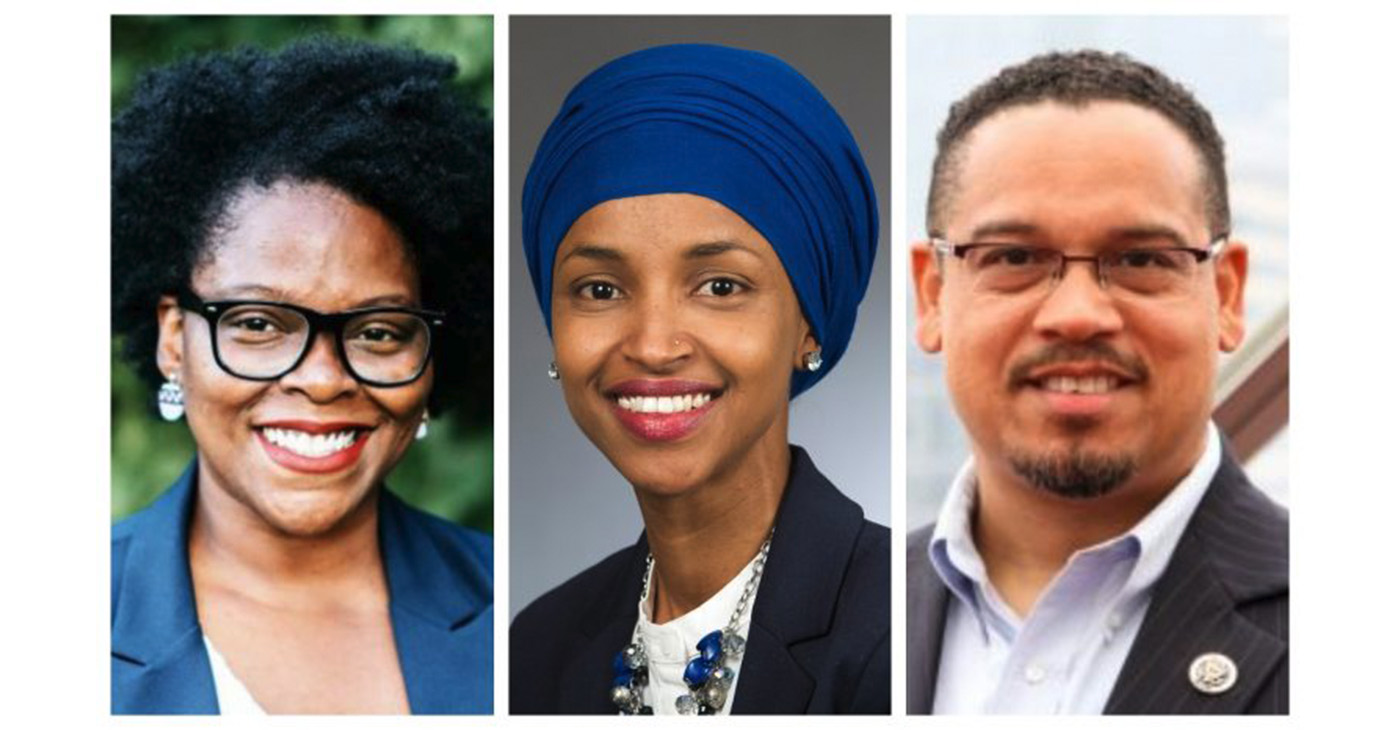
(l-r) Angela Conley, Ilhan Omar and Keith Ellison were victorious in their historic bids.

By MSR News Online

It may not have been the blue wave that some had predicted, but Democrats made significant gains nationally and across the state of Minnesota. The Democrats regained the U.S. House, with Nancy Pelosi poised to return as Madam Speaker and, in Minnesota, Democrats also reclaimed the House — the first time in four years.

Democrats swept all the statewide offices, with candidates Keith Ellison, Ilhan Omar and Angela Conley, making history with their wins.

After a bruising and contentious race for attorney general, Ellison triumphed to become the state’s first African American attorney general and first African American to hold a statewide office.

Ilhan Omar, who was vying for Ellison’s seat in the Fifth District, fulfilled her quest and is now the first Somali American elected to the U.S. House. “Here in Minnesota, we don’t only welcome immigrants, we send them to Washington,” proclaimed Omar at her victory party.

Angela Conley unseated longtime incumbent Peter McLaughlin to represent Hennepin County’s Fourth District. Conley and Irene Fernando, who defeated in former Minneapolis City Council Member Blong Yang in the Second District, are now the first people of color elected in the county board’s history.

There also appears to be a new sheriff in town in Hennepin County with Dave “Hutch” Hutchinson claiming victory over incumbent Rich Stanek in a tight race. Hutchinson would be the first openly gay sheriff in the Midwest if the numbers hold in his favor.

Some other notable wins across the state include Democrat Angie Craig, who unseated incumbent Jason Lewis in U.S. Second District after losing to him two years ago, and Dean Philips, who prevailed over Erick Paulsen in U.S. Third District after a hard-fought race.

Find more statewide election results below.

Governor

Winner: Tim Walz – Democrat 53.9%
Jeff Jonson – Republican 42.4%
Chris Wright – GRP 2.7%
Josh Welter – Libertarian 1.0%

Attorney General

Winner: Keith Ellison – Democrat 49.1%
Doug Wardlow – Republican 45.2%
Noah Johnson – GRP 5.7%

U.S. Senate

Winner: Amy Klobuchar – Democrat 60.3%
Jim Newberger – Republican 36.2%
Dennis Schuller – Independent 2.6%
Paula Overby – Green 0.9%

Secretary of State

Winner: Steve Simon – Democrat  52.3%
John Howe – Republican  43.6%
William Denney Independent 4.1%

State Auditor

Winner: Julie Blaha – Democrat 49.4%
Pam Myhra – Republican 43.2%
Michael Ford – Independence 5.3%
Chris Dock – Libertarian 2.1%

U.S. Senate Special Election

Winner: Tina Smith (Incumbent)  53.0%
Karin Housley – Republican 42.4%
Sarah Wellington – Independent 3.7%
Jerry Trooien – Green 0.9%

Go to https://electionresults.sos.state.mn.us for complete elections results.

This article originally appeared in the Minnesota Spokesman-Recorder.

Continue Reading
Advertisement
Comments

#BuyBlack

Agape Movement Recommended as Development Partner for the People’s Way Project in South Minneapolis

MINNESOTA SPOKESMAN RECORDER — “This moment is bigger than any one individual or organization,” said Bridgette Stewart of Agape Movement. “The People’s Way project represents an opportunity to build something lasting for the community, centered on healing, unity, economic opportunity, and honoring the significance and legacy connected to this space.”

Published

on

Agape Movement has been recommended as the development partner for the People’s Way project in South Minneapolis, following years of community advocacy and organizing centered on healing, economic empowerment and ensuring the future of the space remains rooted in the voices of South Minneapolis residents. Credit: Chris Juhn / MSR

A Milestone for South Minneapolis

By MSR News Online | Minnesota Spokesman Recorder

Agape Movement has been recommended as the development partner for the People’s Way project in South Minneapolis, marking a significant milestone in a years-long community effort to shape the future of one of the city’s most historically significant spaces.

Rooted in Community Voice

The recommendation follows years of advocacy, organizing, relationship-building, and community conversations centered on ensuring the future of the space remains rooted in the voices and needs of the people who call South Minneapolis home. The People’s Way project is built around a vision of healing, economic empowerment, culture, and long-term community investment.

“This moment is bigger than any one individual or organization,” said Bridgette Stewart of Agape Movement. “The People’s Way project represents an opportunity to build something lasting for the community, centered on healing, unity, economic opportunity, and honoring the significance and legacy connected to this space.”

Gratitude and Collaboration

Agape Movement expressed gratitude to the City of Minneapolis, residents, faith leaders, local businesses, organizers, and supporters who have remained engaged throughout the process. The organization also acknowledged the other finalists who participated in the proposal process, including P3, Urban League, Rise and Remember, and others who have remained committed to the future of the space.

As the project moves forward, Agape Movement may collaborate with outside consultants or professionals for fundraising guidance, technical support, financial strategy, and project advising at various phases of development.

What Comes Next

“Our commitment is to transparency, collaboration, and keeping the community at the center of every step of this process,” Stewart said. “We know this project carries deep meaning for many people, and we welcome continued engagement as we move forward together.”

Additional project updates and community engagement opportunities will be shared as the process continues.

Continue Reading

Black History

The Reader Who Became a Revolutionary: Kwame Nkrumah

MINNESOTA SPOKESMAN RECORDER — Before he freed a nation, Kwame Nkrumah was a young reader who discovered that ideas could be as powerful as armies and that liberation had to be spoken in a language people recognized as their own.

Published

on

Credit: Planting People Growing Justice
Credit: Planting People Growing Justice


By Alex Mason | Minnesota Spokesman Recorder

Kwame Nkrumah: How a Young Reader from the Gold Coast Became the Father of African Independence

A profile of Dr. Kwame Nkrumah traces his journey from a colonial classroom in the Gold Coast to Lincoln University, to leading Ghana to become the first sub-Saharan African nation to win independence, and to shaping Pan-Africanism as a movement that still resonates today.

Before he became the face of a nation’s independence, Kwame Nkrumah was a young reader who discovered that ideas could be as powerful as armies.

Born in 1909 in the Gold Coast, a British colony that would later become Ghana, Dr. Kwame Nkrumah grew up in a world that offered little room for concepts like freedom and self-determination. His early education came through missionary schools, but his imagination outgrew the walls of colonial classrooms. He wanted his life to amount to more than survival. He wanted dignity, self-rule, and a future that was not contingent upon European approval.

He found that future in books.

Nkrumah read voraciously from philosophy, politics, history, to economics. He read Marcus Garvey, W.E.B. Du Bois, Lenin, Gandhi. Through those pages he encountered bold and dangerous ideas: that African people must own their own destiny, that a small but well-coordinated group of people holds the power to overthrow systems far larger than themselves. Literacy was not merely personal growth. It was his connection to something larger than himself.

When he left for the United States in 1935, he worked menial jobs while studying at Lincoln University and later the University of Pennsylvania. He lived frugally, studied obsessively and debated endlessly. He organized African students, wrote articles and attended political meetings, learning along the way about the nature of power and its strengths and its vulnerabilities.

Nkrumah saw words as a weapon, as a vehicle for change. By the time he returned to the Gold Coast in 1947, he was not just a scholar. He was a communicator. He knew how to speak in classrooms and in marketplaces. He knew how to speak dangerously. He could move professors and farmers with the same fire, because he understood that liberation had to be spoken in a language people recognized as their own.

His political rise was swift because his message was unambiguous: self-government. Now. Not someday. Not when Britain felt comfortable. Now.

He founded the Convention People’s Party, organized strikes and boycotts, and mobilized everyday citizens who had never been told their voices mattered. When colonial authorities jailed him, his popularity only grew. In 1951, he was elected Prime Minister from a prison cell. Six years later, the Gold Coast became Ghana, the first sub-Saharan African nation to win independence from colonial rule.

Nkrumah became its first Prime Minister, then President. But his vision extended far beyond Ghana’s borders. He was a towering advocate of the Pan-Africanist movement and believed that political independence without economic sovereignty was hollow. He warned that neocolonialism was simply colonialism dressed in friendlier language. Many of those warnings proved painfully accurate.

In 1966, while he was abroad, a military coup removed him from power. He never returned to Ghana as its leader, spending his final years in exile writing, teaching and thinking about Africa’s future.

He died in 1972, but his ideas did not die with him. Today, Nkrumah’s legacy lives in every African nation that governs itself, in every Pan-African movement that insists Black history does not begin with slavery, and in every young reader who learns that leadership can come from anywhere.

Dr. Kwame Nkrumah did not just help free a nation. He helped redefine what Black leadership could look like when it refuses to shrink itself for the comfort of the West.

Ready to learn more about Kwame Nkrumah? Read Planting People Growing Justice’s book “Kwame Nkrumah: Warrior King” by Nancy Loewen.

Alex Mason is a Minneapolis-based writer and editor. He has written for nonprofits for nearly a decade.


Excerpt:

Photo Captions:

A vivid illustration or depiction of a young Kwame Nkrumah reading intently, symbolizing his early intellectual curiosity and the foundational role of literature in shaping his revolutionary ideas and future leadership.

A compelling visual representation of Kwame Nkrumah, either a portrait or a historical image, conveying his stature and influence as a pivotal leader in the African independence movement and a champion of Pan-Africanism.

Website Tags and SEO Keywords:

Twitter (X) Tags and Handles:
@NNPA_BlackPress @MNSpokesman @kofi_1982


Continue Reading

#BuyBlack

Ashley Bolden Built Lynnmonade on Mindset and Mission

MINNESOTA SPOKESMAN RECORDER — Discover how Ashley Bolden transformed a backyard lemonade stand into Lynnmonade, a Twin Cities wellness brand focusing on holistic nutrition and mental health.

Published

on

Founder, Ashley Bolden, built Lynnmonade from a backyard lemonade stand into a Twin Cities wellness beverage brand rooted in holistic nutrition, mental health and positive affirmations, earning 2026 New Business of the Year recognition from the West Broadway Coalition along the way. Credit: Courtesy

Black Business Spotlight: Lynnmonade Founder Ashley Bolden Turned a Child’s Question into a Wellness Movement

By Jasmine McBride | Minnesota Spokesman Recorder

It started with a simple question from a child: Mom, how can I make some money?

Ashley Bolden gave her son a choice, mow lawns or sell lemonade. He chose lemonade. What followed was a journey that would transform a backyard hustle into Lynnmonade, a beverage brand rooted in holistic wellness, mental health and the kind of quiet determination that defines Black entrepreneurship in the Twin Cities.

Bolden has called Minnesota home for 21 years. In the spring of 2020, just as the world was shutting down, she began selling lemonade with her son. When COVID hit and her son stepped back, Bolden kept going. She started thinking differently about what she was making and why.

“There has to be a more-healthy option,” she recalled thinking. That instinct led her to expand the menu beyond lemonade, incorporating herbal teas and fresh juices designed to detox and refresh the body. “A lot of our illnesses come from what we consume,” she said. “These teas and fresh juices can help the body be at its best performance.”

But Lynnmonade was never just about the drink.

Every Lynnmonade product carries an affirmation, a mantra or a reflection question, intentional prompts designed to pull people out of the autopilot of daily life and into something more intentional. Questions like “If you knew you would succeed, what would you attempt to do?” or prompts like “I am capable of…” are printed alongside the beverages, turning every sip into a moment of pause.

“I really wanted to create something where people can have a chance to unplug from the day-to-day and actually think about what they are trying to strive for in life,” Bolden said.

The mission is personal. As someone who has navigated her own mental health struggles, Bolden said she has seen firsthand what happens when people are invited to slow down and reflect.

“I see a spark in people’s eyes when you take them out of that mode of what they got to do next,” she said. “Positive things happen. Mindset is everything.”

Building the business has not been without its challenges. Without early mentorship or guidance, Bolden described the process of formalizing Lynnmonade as “touch and go,” working through administrative missteps and learning as she went. She credits the West Broadway Coalition with helping her find her footing.

After meeting coalition representative Donna Sanders at a community event, Bolden was invited to the office, where she met staff members Colleen Klungseth and Kristel Porter. They listened to her pitch, offered feedback and connected her with resources that matched where she was in her business journey. The coalition has since helped her review grant applications and linked her to people who could support her growth, and also awarded Bolden as 2026 New Business of the Year.

“I think it would have been a lot easier if I would have had that support from the beginning,” she said. “Connecting me with people who can help me at the stage that I am at has been really beneficial.”

Today, Lynnmonade operates primarily through catering, with individual tea boxes also available. Bolden has shown up at community events including Open Streets, building her brand one conversation and one cup at a time. Her ambitions for the future are clear: she wants to take Lynnmonade on the road, bring greater awareness to non-alcoholic beverages in corporate and business settings, and eventually land on store shelves.

And her son? After watching his mother build something real, he’s ready to come back.

“He wants to be involved now,” Bolden said with a laugh. “After witnessing the proof, he’s like, ‘Well, how can I help?’”

For orders and more information, visit lynnmonade.com or follow the brand on social media at @lynnmonadejuice on all platforms. Pop-up events are in the works for summer 2026, check the page for updates.

Jasmine McBride welcomes reader responses at [email protected].

Continue Reading

Black Press

OP-ED: Small Businesses Need Minnesota to Act on Pass-Through Tax Policy

MINNESOTA SPOKESMAN RECORDER — A Twin Cities immigrant entrepreneur who built several businesses including grocery stores in underserved neighborhoods is calling on Minnesota lawmakers to extend the Pass-Through Entity tax option before it expires, warning that its loss would hit small businesses already recovering from Operation Metro Surge with higher federal tax bills.

Published

on

Daniel Hernandez stands proudly in front of his Colonial Market in Minneapolis. Credit: Alexzia Shobe.

A Twin Cities Small Business Owner Is Urging Minnesota to Extend a Tax Policy That Could Save Thousands of Businesses

By Daniel Hernandez | Minnesota Spokesman Recorder

I came to the United States as a teenager with a clear goal: to build something meaningful through hard work. I put in long days in construction, restaurants, and landscaping; doing whatever it took to learn, save, and eventually start my own business.

Over time, I built and ran several successful ventures, including an event photography company, a magazine, a tax and accounting firm, and now grocery stores serving neighborhoods across the Twin Cities where other retailers chose not to invest. I’ve created jobs, supported families, and committed to communities that deserve stability and opportunity.

That’s why I’m speaking out now.

Small business owners in Minneapolis and the communities we serve are recovering from serious disruptions, including the impacts of Operation Metro Surge. That event hit immigrant communities especially hard. In my own case, I lost nearly half of my 60 employees and saw revenue drop by about 85%. While I worked to provide competitive wages, health benefits, and paid time off, the real hardship fell on the people who lost their jobs and income.

Even as we rebuild, small businesses are facing another challenge. The Minnesota Legislature is considering letting an important tax policy expire: the Pass-Through Entity tax option.

Here’s what that means in plain terms.

Many small businesses, including mine, are pass-through businesses. That means the business itself doesn’t pay income tax. Instead, the owners report the income on their personal tax returns. But under current federal rules, there’s a limit on how much state tax we can deduct. That often leads to higher federal tax bills.

The Pass-Through Entity option fixes that. It allows the business to pay the state tax directly, which means the business can fully deduct those taxes on its federal return and lower the total amount of income taxed federally. The result is straightforward: small business owners pay less in federal taxes, without reducing what the state collects.

This policy is not new or controversial. Thirty-six states already offer it. It doesn’t cost Minnesota anything, it’s revenue neutral. And it benefits more than 66,000 businesses across the state.

In a state where the cost of doing business is already high, it’s hard to understand why we wouldn’t offer the same basic tax treatment as states like California and Illinois.

Small businesses have carried a heavy load in recent years, through a pandemic, rising costs and public safety disruptions. We’ve adapted, reinvested and stayed committed to our communities. What we need now are practical policies that support that work, not make it harder.

If the Minnesota House does not act soon, many businesses will face significantly higher federal tax bills. That’s money that could otherwise be used to hire workers, raise wages or reinvest in local neighborhoods.

I urge Gov. Tim Walz and members of the House Tax Committee to pass House File 3127 and extend the Pass-Through Entity election.

Small businesses are the backbone of our communities. We’ve proven our resilience. Now we need our state leaders to show the same commitment to us.

Daniel Hernandez is the owner of Colonial Market located at 2100 E. Lake St.


Excerpt:

Photo Captions:


Website Tags and SEO Keywords:

Twitter (X) Tags and Handles:

Continue Reading

Black Press

Minneapolis Police Chief’s Public Statements on Domestic Violence Cases Under Scrutiny After City Auditor Report

MINNESOTA SPOKESMAN RECORDER — Minneapolis City Auditor finds MPD failed Allison Lussier, recommending an apology for misstatements. A second review opens into the Davis Moturi case, highlighting systemic issues and calls for reform.

Published

on

Left to Right: Minneapolis Police Chief Brian O’Hara met with Allison Lussier’s Aunt Jana Willamas after the City Auditor revealed several missteps in their investigations. Credit: Clint Combs / MSR

City Auditor Finds MPD Failed Allison Lussier and Recommends Formal Apology as Second Review Opens Into Davis Moturi Case

By Clint Combs | Minnesota Spokesman Recorder

A Minneapolis city auditor after-action review found MPD made serious missteps in the Allison Lussier domestic violence case, including never requesting the medical examiner’s report, and recommended a formal written apology to her family for Chief O’Hara’s public misstatements, as a second review opens into the Davis Moturi shooting.

Before Minneapolis Police Chief Brian O’Hara knew the full weight of what the city auditor would eventually find, he was talking too fast.

In February 2025, O’Hara told the Star Tribune that investigators could not establish that Allison Lussier had been murdered. “We cannot prove that this is a murder,” O’Hara said. “The fact that he had a history of domestic abuse does not create probable cause.”

The City Auditor’s After-Action Review revealed that the MPD never actually requested the medical examiner’s report until the auditors themselves asked for it while reviewing the case.

O’Hara went further. “Someone dead and decomposed with needles everywhere is not a sign that a crime occurred,” O’Hara said, adding that Lussier had sustained no other known injuries, like a fractured skull.

The Hennepin County Medical Examiner found that Lussier’s primary cause of death was a subdural hematoma, a collection of blood between the skull and the brain.

A crowd of domestic violence advocates and MPD staff attend the Minneapolis Audit Committee meeting to hear the long-delayed report.

A crowd of domestic violence advocates and MPD staff attend the Minneapolis Audit Committee meeting to hear the long-delayed report.

Chief O’Hara’s words, spoken publicly and on record, are at the center of an auditor report that found MPD made several missteps in investigating domestic violence cases. The report recommended that MPD be formally required to issue a written apology to the Lussier family for public misstatements related to the medical examiner’s findings. By the time City Auditor Robert Timmerman gave his report to the Minneapolis committee and City Council members, O’Hara’s tone had finally shifted. “Jen again, I apologize. I’m sorry. We are committed to moving forward together,” O’Hara told Jana Williams, Lussier’s aunt. “I’m thankful again to Jana, to other community members that she invited that were present with us, advocates for their willingness to have conversation with us and to move forward and try and improve things for the future.”

Williams was not mollified.

The audit arrives as MPD faces intense scrutiny over a second high-profile failure. Davis Moturi, a Black Minneapolis man, reported 19 incidents of vandalism, property damage, harassment and threats in the year he had lived next door to his white neighbor, John Herbert Sawchak, many of them laced with racial slurs. Despite those repeated calls for help, Moturi was shot in the neck while pruning a tree in his own yard. The Moturi case prompted a second after-action review by the City Council.

The audits reveal that four officers auditors had hoped to interview were never reached. Three were on extended leaves of absence. One had left the department entirely. City Auditor Timmerman confirmed that when his office reached out to that departing officer, they received a single response: “I’m not going to participate.”

Council Member Aisha Chughtai noted that, to her understanding, the officer who separated from the department did so about one month after O’Hara issued a directive requiring officers to cooperate with auditors. Timmerman said he did not remember the exact date but confirmed his office had attempted contact and been refused.

The audit was further hampered by a jurisdictional wall. Timmerman’s office lacks authority to access Hennepin County Medical Examiner records, meaning auditors could not independently verify the contents of the medical examiner’s report on Lussier’s death.

“Public comments by MPD regarding violence against Native women are heavily scrutinized and should be held to a high standard,” Timmerman said. “We recommend that MPD be required to issue a letter or other statement to the family of Miss Lussier apologizing for public misstatements related to the medical examiner’s findings and report.”

Williams addressed the findings after the presentation. She named Sgt. Michael Heyer as the officer she believed had retired before speaking to auditors, and said Lussier’s lead homicide detective was the one who refused to participate. Timmerman would not confirm the identity or role of the officer who had separated from the department.

“You failed. Allison Lussier’s case you failed. Arionna Buckanaga case, you failed. You failed so many cases prior to this,” Williams said. “Hopefully we start hearing exactly what the gravity of today meant.”

Jana Williams speaks to reporters after City Auditor Robert Timmerman revealed systemic missteps in MPD investigations into the deaths of Allison Lussier and Davis Moturi.

Jana Williams speaks to reporters after City Auditor Robert Timmerman revealed systemic missteps in MPD investigations into the deaths of Allison Lussier and Davis Moturi.

The audit reported that officers and lieutenants inside MPD expressed low morale over public disagreements between Chief O’Hara and Hennepin County Attorney Mary Moriarty. Timmerman said that Moriarty made proactive efforts to communicate with top brass at MPD. Williams said that investigations into her niece were caught in what she described as a “cat-and-mouse game” between O’Hara and Moriarty. “Allison Lussier didn’t deserve this. Nobody deserved this today,” Williams said.

When Chughtai asked the chief’s office whether regular meetings between the chief and the county attorney were taking place, she was told no.

MPD and the HCAO stressed that their branches still maintain working relationships across many departments.

To prevent future audits from hitting the same walls, Timmerman said his office is pursuing subpoena authority from the state legislature, seeking powers parallel to those held by the state auditor and the legislative auditor. Council Member Soren Stevenson flagged that the next police contract negotiation should also address barriers from a collective bargaining agreement that currently prevents civilian investigators from holding supervisory roles.

Vanya Hogen, an attorney with Hogen Adams, detailed the internal pushback that stalled the reports.

“We did face a few limitations, such as early resistance from several MPD officers who requested the involvement of the Police Officers Federation of Minneapolis,” Hogen said. She noted this “disrupted the anticipated timeline” of the entire review process.

Williams was surprised that the auditor did not secure an interview from the medical examiner.

“You think that the city would have had some more recourse to push them to give an interview or at least a statement,” Williams said. “At least a statement, especially when you’ve got the chief of police blaming the medical examiner for calling off the crime scene.”

O’Hara said the Lussier homicide investigation remains open.

Continue Reading

Black History

IN MEMORIAM: Rest in Power — Minnesota Loses a True Warrior in Yusef Mgeni

MINNESOTA SPOKESMAN RECORDER — Yusef Mgeni, a brilliant historian, community organizer, former St. Paul educator and fierce advocate for Black people, died on April 7, 2026, leaving behind a legacy that will echo through generations of Black Minnesota history and community building.

Published

on

Yusef Mgeni Credit: Courtesy

By MSR News Online

Minnesota and the world lost a powerful voice and a true warrior on April 7, 2026. Yusef Mgeni is gone, but his legacy will echo for generations.

Yusef was a brilliant historian, a community organizer, a former St. Paul educator, and a fierce advocate for Black people. He carried with him an extraordinary archive of speeches, books, articles, and photographs documenting the work of countless Black scholars and leaders. His knowledge was not just deep. It was generational. Talk to him about any subject concerning Black history, and he would give you a dissertation.

His roots in this community ran deeper than most people knew. Yusef was the grandnephew of Fredrick McGhee, the pioneering 20th-century civil rights activist and attorney who made his mark in St. Paul at the turn of the century. That lineage was not lost on Yusef. He carried it forward with pride and purpose, spending decades making sure the stories of Black Minnesotans were told, preserved, and passed on.

As a journalist, Yusef called NAACP leaders and community figures to identify the issues that mattered most to Black people and wrote about them in local newspapers. He was a contributor to the Minnesota Spokesman-Recorder, a platform he understood and respected deeply. As a former St. Paul NAACP vice president, he remained active and engaged well into his retirement, answering emails and voicemails for residents who were at their wits’ end, helping them navigate evictions, legal challenges, and systemic barriers.

“Generally, they contact us when they are at their wits’ end,” he once said. “They are going to get evicted; their car is getting repossessed. We assist in navigating the system.”

His work was always about access. Under his leadership and alongside other NAACP leaders, the St. Paul chapter helped establish a landmark covenant between the police and the St. Paul community in 2001, a model that contributed to dramatically lower excessive-force costs than in Minneapolis in the decade that followed.

Yusef was also a passionate champion of ethnic studies in Minnesota’s schools, understanding that education rooted in Black and Brown history was not a supplement to American history but central to it.

“Ethnic studies is also American history,” he said. “The fact that the legislature and the MDE have both endorsed ethnic studies requirements in schools is a real plus for giving people the opportunity to explore and learn more about American history, and more importantly, to see themselves reflected in that learning.”

In the 1970s and ’80s, Yusef worked alongside Mrs. Clarissa Walker at the Sabathani Community Center, where they poured their energy into uplifting and empowering the community. Their work helped shape the cultural and political landscape of South Minneapolis during a critical era. They were part of a generation that built institutions, nurtured young people, and fought for justice with unwavering commitment.

Yusef also played a key role in the early development of KMOJ Radio, helping to establish a platform that amplified Black voices long before it was common or convenient. His activism extended through education, the St. Paul NAACP, the Million Man March, and the Urban Coalition, always rooted in a deep and abiding love for his people.

He was also an interviewee in the Rondo neighborhood oral history project preserved by the Minnesota Historical Society, ensuring that the voices and stories of that community would never be lost.

Not long ago, a colleague was blessed to sit with Yusef at his home, where he reflected on his life and his legacy. He talked about his work in education, his activism, and his years of service to the community. But what stood out just as much was how he spoke about his family and his people, with warmth, with pride, and with purpose.

Today, we honor him not only for what he accomplished but for the spirit with which he did it.

A scholar. A builder. A warrior. A keeper of our stories.

Thank you, Yusef, for everything you gave and everything you sacrificed on behalf of Black people. Your legacy stands tall, and our community is better because of you.

Rest in Power, Yusef Mgeni.

Continue Reading

SIGN UP TO RECEIVE NEWS UPDATES IN YOUR INBOX

Subscribe

* indicates required

Like BlackPressUSA on Facebook

Advertisement

Advertise on BlackPressUSA

advertise with blackpressusa.com

Latest News